




Abstract
Previous research has highlighted the important role of choice in listeners’ responses to music, but relatively little is known about the subjective criteria on which listeners base their choices. Hence, the goal of this study was to make a first attempt to investigate the relative importance of various criteria in listeners’ choice and aesthetic judgment of music, and how the weighting of these criteria varies as a function of preferences for specific music genres, music education, and personality traits. These issues were explored by means of a 13-item questionnaire, which was administered to 72 Swedish participants (18–43 years old), who studied either psychology or music at a conservatory level. The results suggested that a range of criteria are important in both music choice and aesthetic judgment. As expected, there were many differences between psychology students and music students regarding their relative weighting of different criteria. In particular, psychology students tended to rate “extrinsic” choice criteria (e.g., “suits specific activities”) as opposed to “intrinsic” criteria (e.g., “interesting structure”) higher than did music students. Still, both groups rated the expression and arousal of emotions as the most important criteria for their music choice and aesthetic judgment. The results are discussed with regard to their implications for music education and future research on music preference and aesthetics.
Music is ubiquitous in today’s society (Hargreaves & North, 1997) and touches people in all sorts of ways (Juslin & Sloboda, 2010). Thus, it is a primary goal of music psychology to understand listeners’ responses to music. It is increasingly recognized, however, that there are different kinds of responses to music (Scherer & Zentner, 2001). For instance, most researchers in the affective sciences regard preference as a long-term affective evaluation of an object with a low intensity (e.g., liking of a particular genre of music). Emotion refers to a fairly brief but intense reaction to an event that involves various sub-components (subjective feeling, physiological arousal, emotional expression, action tendency, and regulation), which are more or less synchronized. Aesthetic response is a more complex process, which appears to involve a combination of perceptual, cognitive, and emotional factors related to judgments of the aesthetic value of an artwork (Juslin, 2013; see also Leder, Belke, Oeberst, & Augustin, 2004). Although these are distinct processes, they are related in ways that make it useful to explore them together.
Music choice
Regardless of the specific type of response, it has been indicated in several studies that the response tends to be stronger (i.e., more intense) when the music has been chosen by the listener (Blood & Zatorre, 2001; Liljeström, Juslin, & Västfjäll, 2013; Mitchell, MacDonald, & Knussen, 2008). Several explanations have been advanced in previous research to explain the positive role of music choice. First, self-chosen music is likely to be more familiar to the listener than other-chosen music. Familiarity in itself may enhance a listener’s liking (North & Hargreaves, 1995), and allows a greater number of underlying mechanisms for arousal of emotions to be activated, including memory-based mechanisms like evaluative conditioning and episodic memory (Juslin, 2011). Second, self-chosen music may offer a greater sense of control over the situation, which is conducive to experiencing positive emotions (Fox, 2008). But most importantly, listeners tend to choose to listen to types of music they prefer, which may contribute to both more intense and more positive emotional reactions (Liljeström et al., 2013).
In a sense, music choice may be regarded as the active realization of music preference. Thus, for example, Price (1986) has defined preference as “an act of choosing, esteeming, or giving advantage to one thing over another” (p. 154), and Lamont and Greasley (2009) have defined preference “broadly as referring to the music, whether style or piece, that people like and choose to listen to at any given moment and over time” (p. 160). As implied by the latter definition, preference may be both short-term and more long-term. The present study focuses on the long-term aspect of music preference.
Several studies have reported relationships between music preferences and demographic variables such as age, gender, social class, and personality traits (for reviews, see Rentfrow & McDonald, 2010; Lamont & Greasley, 2009; Russell, 1997). However, although a few studies have mapped the factors in the music, the listener, and the situation that might influence music preferences (Hargreaves, North, & Tarrant, 2006; LeBlanc, 1982), there are few studies of the subjective bases for listeners’ music choice (Lamont & Greasley, 2006; Schäfer & Sedlmeier, 2010). Choosing between options necessarily entails an evaluation of each option with regard to some criteria, and this raises the question of which criteria are used.
Why do listeners choose to listen to specific types of music, rather than to others? What subjective criteria are most important for their choice? Are the criteria different depending on the listener’s genre preferences? It is crucial to understand how listeners themselves conceive of their music choice (Lamont & Greasley, 2006), because intentions can strongly influence listeners’ responses (Sloboda, Ivaldi, & O’Neill, 2001).
In the present survey study, listeners were required to rate the relative importance of a large set of subjective criteria for music choice based on results from previous studies of the goals, functions, and motives for music listening (Juslin & Laukka, 2004; Juslin, Liljeström, Laukka, Västfjäll, & Lundqvist, 2011; Juslin, Liljeström, Västfjäll, Barradas, & Silva, 2008; North, Hargreaves, & O’Neill, 2000; Roe, 1985; Schäfer & Sedlmeier, 2010; Sloboda et al., 2001). Among the many intentions behind music listening, people listen to music to relax, evoke memories, admire skills, express their identity, and analyze structure. Of particular interest is the role of emotions. Music is often valued for its abilities to express and evoke emotions (Budd, 1985). Thus, one can assume that listeners will tend to choose music that is expressive and that evokes emotions. We acknowledge that music choice is highly context-dependent (Hargreaves et al., 2006). Nonetheless, we believe that certain criteria may be more important than others across different contexts and types of listening. Consequently, the present study focused on overall ratings of choice criteria.
Based on recurrent ideas in seminal literature on music aesthetics (e.g., Hanslick, 1854/1986; Kant, 1790/2000; Meyer, 1956), one may conceptualize listeners’ criteria for music choice in terms of a distinction between intrinsic and extrinsic criteria. This distinction reflects a historical conflict between those who have proposed that the value of music resides in the music itself (e.g., “absolute music”, “art for art’s sake”, “formalism”) and those who have proposed that the value of music is due to its effects and its benefits for society (e.g., “expressionism”, “everyday uses of music”). It might, of course, be suggested that the value of music reflects both of these aspects. Still, it follows that some criteria for music choice can be regarded as more intrinsic since they focus on the music as such, for example, that the music is original or features an interesting structure. Other choice criteria can be regarded as more extrinsic since they involve “ulterior motives”. They focus on the desired effects of the music or the functions it may serve for the listener, for example, that the music can evoke valuable memories or help the listener to relax.
Aesthetic judgment
One criterion for music choice that might be particularly important for musicians and music students is that the music should have an aesthetic value. Responses to music involve aesthetic judgments, which go beyond mere preference or emotion, but may affect what music we enjoy to hear. Some authors have argued that one of the goals of music education should be to cultivate attitudes that predispose students toward aesthetic appreciation and/or sensitivity (e.g., Kingsley, 1946; Reimer, 1968). The nature of aesthetic judgments has been explored within the field of aesthetics, “the branch of philosophy devoted to conceptual and theoretical inquiry into art and aesthetic experience” (Levinson, 2003, p. 3). Several hundred years of philosophical work has so far failed to yield a consensus that might guide empirical research. Part of the problem is defining art, with some scholars suggesting that the concept of art is inherently open, and so resistant to definition (Weitz, 1956). Despite such problems, common conceptions of aesthetic experience emphasize its focus on an object’s aesthetic properties. Thus, according to Levinson (2003), it is widely agreed that aesthetic properties are “perceptual properties … relevant to the aesthetic value of the object that possesses them” (p. 6). But what, exactly, are the subjective criteria for value that underlie listeners’ aesthetic judgments of music? There is a paucity of research on this subject, but a review of European concepts of European art put forward from ancient Greece to modern times suggests that the following criteria have been particularly influential in aesthetics (Juslin, 2013):
art as possessing formal properties such as beauty (Kant, 1790/2000), complexity (Berlyne, 1971), wittiness (Levinson, 2003), or the sublime (Lyotard, 1994)
art as expression (e.g., “clarifying an emotion”; Collingwood, 1938)
art as originality (e.g., “modernism”; Greenberg, 1971; Kraus, 1986)
art as good taste (e.g., “the absence of extremes”; Fechner, 1876)
art as artistic skill (e.g., “fashioning objects that are admired”; Sparshott, 1982)
art as reception (e.g., “feelings in the audience”; Tolstoy, 1898/1960)
art as conveying a message (e.g., “implicitly advancing some proposition”; Levinson, 2001)
art as defined by institutions (e.g., “art is what art schools, museums, and artists define as arts”; Dickie, 1974)
art as representation of nature (e.g., “mimesis”; Plato, 1923)
art as intention (e.g., “art is something produced with the intention of giving the capacity to satisfy aesthetic interest”; Beardsley, 1982)
This study does not aim to provide an objective definition of art, but rather to elucidate how ordinary music listeners and music students, as opposed to art theorists, approach this issue. Do they consider music “art”? If so, what are the most important criteria by which they consider a piece of music “art”? What is the role of emotion in their judgments? These issues are partly related to the distinction between “high” and “low” culture (DiMaggio, 1987). What distinguishes music as one of “the fine arts” from music as mere entertainment or commercial commodity? In this study, listeners were asked whether they think music is art and, if so, on what grounds. They were further required to rate a set of criteria for aesthetic value, based on different conceptions of art (listed above) to examine which conception best applies to music listeners in modern western society.
Individual differences
It is quite well established that there are individual differences in music preference and aesthetic response (Abeles & Chung, 1996). Listeners differ substantially with regard to what music they consider worth listening to, and this needs to be taken into account when studying music choice and aesthetic judgment. Given differences in preference, it seems plausible that there are also differences concerning the criteria for music choice and aesthetic judgment. In particular, one can expect musicians, who dedicate their lives to composing, performing, and listening to music, to have a somewhat different weighting of criteria than do non-musicians. For example, musicians might be more inclined to appreciate music in terms of its intrinsic features (discussed previously), whereas non-musicians might be more inclined to appreciate its extrinsic features. Therefore we may ask: To what extent does the education of listeners affect the criteria of their choice and aesthetic judgments? Are musicians more inclined than non-musicians to regard music primarily in terms of intrinsic features? In this survey study we compared psychology and music students at a conservatory level concerning their ratings of criteria for choice and aesthetic value of music.
Another potentially important variable is personality. It has been found that differences in temperament may predict differences in preferential listening behavior even at 8 months of age (Trehub, Nakata, & Bergeson, 2002), and many studies have obtained links between adult music preference and personality traits (Rentfrow & McDonald, 2010). Thus, we examined if listeners’ ratings were systematically related to personality characteristics, in terms of the Big Five model that decomposes personality into the traits Extraversion, Agreeableness, Openness to experience, Neuroticism, and Conscientiousness (Costa & McCrae, 1992).
In summary, the aim of this study was to investigate the relative importance of various criteria in listeners’ choice and aesthetic judgment of music, as well as how the weighting of these criteria varies as a function of preferences for specific music genres, musical education, and personality traits. These issues were investigated by means of a questionnaire, featuring a combination of fixed and open-ended response items that was administered to 72 participants (36 psychology students and 36 music students) in Sweden. The goal was to find preliminary trends that can guide future research and lay the groundwork for theories of music preference and aesthetic judgment, as well as applications in music education.
Method
Participants
Seventy-two individuals, 30 females (42%) and 42 males (58%), 18 – 43 years old (M = 25.0, SD = 5.62), took part in the study and were given either movie tickets or course credits for their anonymous and voluntary participation. All participants were Swedish, 78% played (at least) one musical instrument and 63% had received some musical training. Fifty percent of the participants were psychology students at Uppsala university, the remaining 50% were students at the Royal College of Music in Stockholm (for recruitment details, see Procedure). The music students were pursuing a bachelor’s degree in music performance (classical 47%, jazz 53%). Fifty-five percent of the psychology students played an instrument as a hobby and 28% had received some limited form of music education or training previously (e.g., a choir). Self-reported music interest for the sample as a whole, on a scale from 0 to 7, varied (Min = 3, Max = 7, SD = 1.12), but was mostly high (M = 6.15). Mean number of hours per week spent listening to music was 18.96 hours (SD = 11.75, Min = 5, Max = 50). Music preferences were widely distributed, but the five most commonly preferred genres, overall, were classical (M = 5.06), rock (4.82), pop (4.59), jazz (4.43), and film music (4.13). 1
Material
A specially-designed questionnaire featuring 13 items (i.e., forced-choice, quantitative ratings, and open-ended responses) was developed by the authors to explore listeners’ criteria for choice and aesthetic judgment of music. The questionnaire is presented in the Appendix. 2 As may be seen, the first set of questions (Q1–8) focused on a selection of demographic and individual variables (i.e., age, gender, education, musical training, music preferences). Long-term preferences (or taste) for genres of music (Q8) were measured using a list of 21 genres partly based on the Short Test of Music Preference (see Rentfrow & Gosling, 2003), although the list was modified for Swedish conditions by dropping the genre “bluegrass”, which is rare in Sweden, and adding the genre “dance band” (Swedish “dansband”), which is common.
The second section (Q10) asked participants to rate the importance of a large number of criteria for their music choice. The items were largely based on previous studies on uses and motives of music listening (see Juslin & Laukka, 2004; Juslin et al., 2011; Juslin et al., 2008; North et al., 2000; Roe, 1985; Schäfer & Sedlmeier, 2010), several of which used more open-ended questions to examine why people listen to music. What the present participants did not know was that the 18 criteria were conceptually divided into intrinsic factors and extrinsic factors (see Introduction). Thus, the nine items that measured different intrinsic criteria had in common that they focused on the music itself, what the music “is” or “has”. These items included that the music is well-composed, expressive, beautiful, skillfully performed, or original; that it really “swings”; or has an important message, an interesting structure, or aesthetic value. In contrast, the nine items that measured various extrinsic criteria had in common that they focused more on the external effects of the music and the ulterior functions it could serve for the listener. These effects and functions included that the music can help the listener to evoke emotions, relax, evoke valuable memories, express an identity, obtain company, or reflect on life; or that it suits particular activities, or is conducive to dancing. In developing the items, we tried to strike a balance between covering substantially different criteria and being able to capture the latent conceptual distinction between intrinsic and extrinsic criteria. 3 To obtain more stable estimates of the rated importance of intrinsic and extrinsic criteria than were provided by the individual criteria items, we aggregated the participants’ ratings for each criteria type to obtain two mean values for each participant (i.e., one for intrinsic and one for extrinsic), which could be used to compare music students and psychology students. The coding of each item is shown in the Appendix, but was not featured in the actual questionnaire.
The third section focused on aesthetic judgments. One item (Q11) asked the listeners if they regarded music as art. An open-ended question followed up this item by asking the listeners to explain their answer. Those who responded that music is art were asked to rate the relative importance of various criteria for regarding a piece of music as art (Q12). The list of criteria was intended to be reasonably representative of European conceptions of art put forward from ancient Greece to modern times (Juslin, 2013, see Introduction).
At the end of the questionnaire, we included a personality test. Faced with the challenge of measuring personality traits by means of survey, where the time required to fill out the test is of great importance, we used a short personality inventory (Q13 in the Appendix), the Ten Item Personality Inventory (TIPI) developed by Gosling, Rentfrow, and Swann (2003). This is a brief version of the Big Five Inventory (Costa & McCrae, 1992), which measures Extraversion, Agreeableness, Conscientiousness, Emotional stability (also referred to as “Neuroticism”), and Openness to experience. Tests of TIPI reached adequate levels, in terms of convergence with widely used Big Five indices in self, observer, and peer reports, test-retest reliability, patterns of predicted external correlates, and convergence between self- and observer-ratings (Gosling et al., 2003). Table 1 presents descriptive statistics for the results obtained in the present study along with normative data from Gosling et al. (2003). The present data are fairly similar to the norms, but consistent with a previous study in Sweden which featured a representative sample of participants (i.e., Juslin et al., 2011) in that the mean score for Extraversion is slightly higher than the norm.
Data for the Ten-Item Personality Inventory (TIPI).
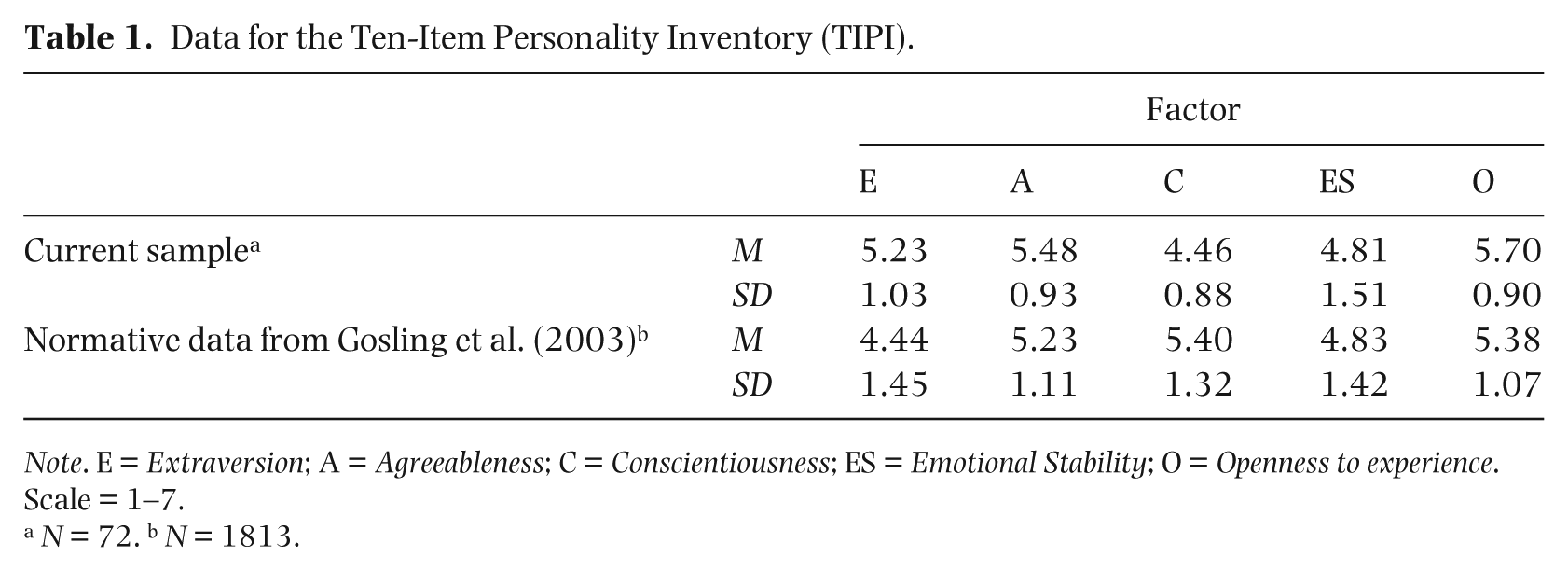
Note. E = Extraversion; A = Agreeableness; C = Conscientiousness; ES = Emotional Stability; O = Openness to experience. Scale = 1–7.
N = 72. b N = 1813.
Procedure
The participants were recruited by contacting their teachers at Uppsala University and Royal College of Music. Participants were required to fill out the questionnaire individually, under silent conditions. A cover letter outlined the aims of the investigation, and ensured the participant that all data were confidential and would only be used for scientific purposes. The cover letter emphasized the scientific importance of the study, and that it was sponsored by a university (rather than by a company). The participants were informed that they had the right to withdraw their response afterwards, should they for some reason regret their participation. None of those contacted declined to take part in the study, and none of them withdrew his or her response afterwards. It took approximately 15 minutes to fill out the questionnaire.
Results
Music choice
To evaluate the participants’ ratings of criteria for music choice (Q10), we conducted a mixed-design Analysis of Variance (ANOVA), with Choice criteria as within-subjects factor and Education as between-subjects factor. The analysis revealed no significant main effect of Education (F1,67 = 0.42, p = .52, partial eta-squared = .006), but there was a highly significant effect of Choice criteria (F17,1139 = 18.53, p < .001, partial eta-squared = .217), indicating that at least some criteria were rated differently by listeners.
Figure 1(a) presents mean values and standard errors for the listeners’ ratings of various choice criteria. Careful inspection of Figure 1(a) shows that the two most highly rated criteria were “moves me emotionally” and “is expressive”. Post hoc tests using Tukey’s HSD indicated that these criteria were rated significantly higher than all other criteria (p < .05). The criterion “is beautiful” was rated significantly higher than “evokes memories”, “has important message”, “expresses my identity”, “makes me reflect on life”, “is original or innovative”, “has interesting structure”, “makes me want to dance”, and “is familiar to me”; and “is skilfully performed” was rated significantly higher than the same criteria, except “evokes memories” and “has important message”. “Keeps me company” was further rated significantly higher than “makes me want to dance” and “is familiar to me”; and “has aesthetic value”, “really swings”, and “helps me to relax” were all rated significantly higher than “is familiar to me” (p < .05).
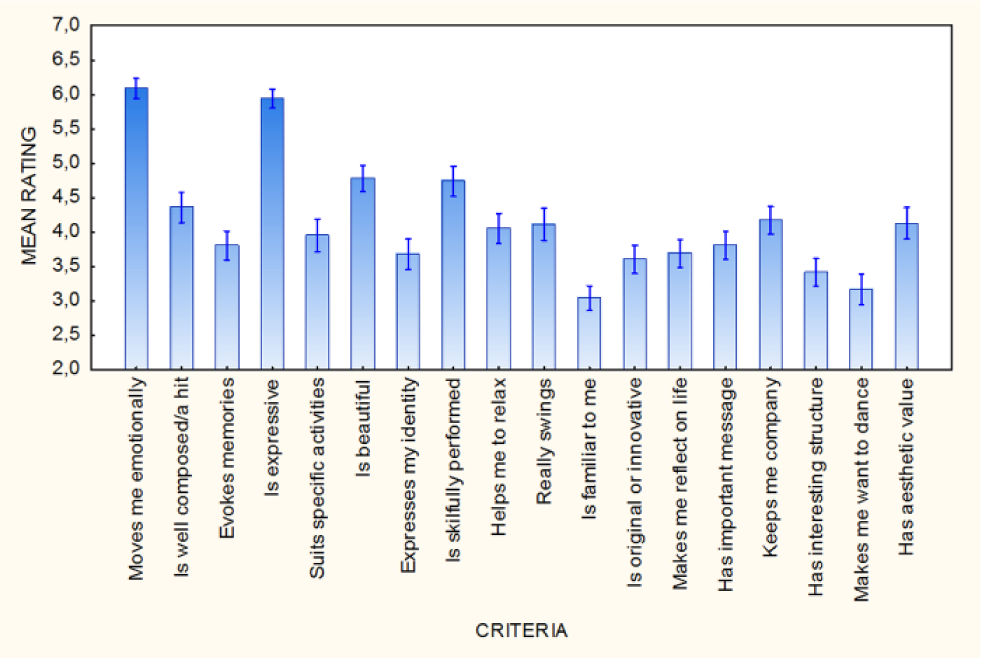
Mean values and standard errors for listeners’ ratings of the importance of different criteria for music choice (overall trend).
However, the main effect of Choice criteria was qualified by a significant interaction between Choice criteria and Education (F17,1139 = 2.94, p < .001, partial eta-squared = .042). Figure 1(b) shows means and standard errors of participants’ ratings of choice criteria, as a function of education. Both groups rated “moves me emotionally” and “is expressive” as the most important criteria, though there were a number of differences between the groups with regard to the other criteria: for instance, psychology students rated “suits specific activities”, “makes me reflect on life”, “has an important message”, and “makes me want to dance” higher than did music students. Conversely, music students rated “moves me emotionally”, “swings”, and “has an aesthetic value” higher than did psychology students. However, most differences were minor, as indicated by the small effect size of the interaction (see above).

Mean values and standard errors for listeners’ ratings of the importance of different criteria for music choice as a function of education.
We also examined whether listeners’ ratings of the relative importance of music-choice criteria would be predictive of their preference for particular music genres, by conducting one (simultaneous) 4 multiple regression analysis on the listeners’ ratings for each of the following commonly preferred genres: classical, jazz, pop, and film music (see Method). The limitation to these genres was due to the need to obtain sufficient variability in the ratings, particularly to obtain enough instances of both high and low ratings of each musical genre. The dependent variable was the preference-rating by each listener (continuously coded), and the independent variables were the ratings of the music-choice criteria (continuously coded). Due to the small number of listeners, we pre-selected a set of predictors to obtain a ratio of roughly 10 cases to every predictor, which is usually regarded as an acceptable ratio (5 to 1 is the minimum ratio; see Cooksey, 1996, p. 123; and Hair, Anderson, Tatham, & Black, 1998, p. 166). Hence, only choice criteria that showed a statistically reliable relationship to at least one of the four music genres were included as predictors. So-called multicollinearity was not considered a problem, since none of the intercorrelations between the predictors exceeded r = .40.
Table 2 shows a summary of the results. As can be seen, the multiple regression analyses produced significant multiple correlations for all genres, indicating that genre preferences can be predicted to some extent at least, based on ratings of music-choice criteria. Each genre was also associated with a unique set of predictors: for instance, preference for classical music was positively associated with tendencies to choose music that “is skillfully performed” and “moves me emotionally”, whereas preference for jazz music was positively associated with tendencies to choose music that “has interesting structure” and “really swings”, and negatively associated with tendencies to choose music that “makes me reflect on life” and “makes me want to dance”.
Summary of multiple regression analyses: Prediction of music genre preferences from ratings of music-choice criteria.
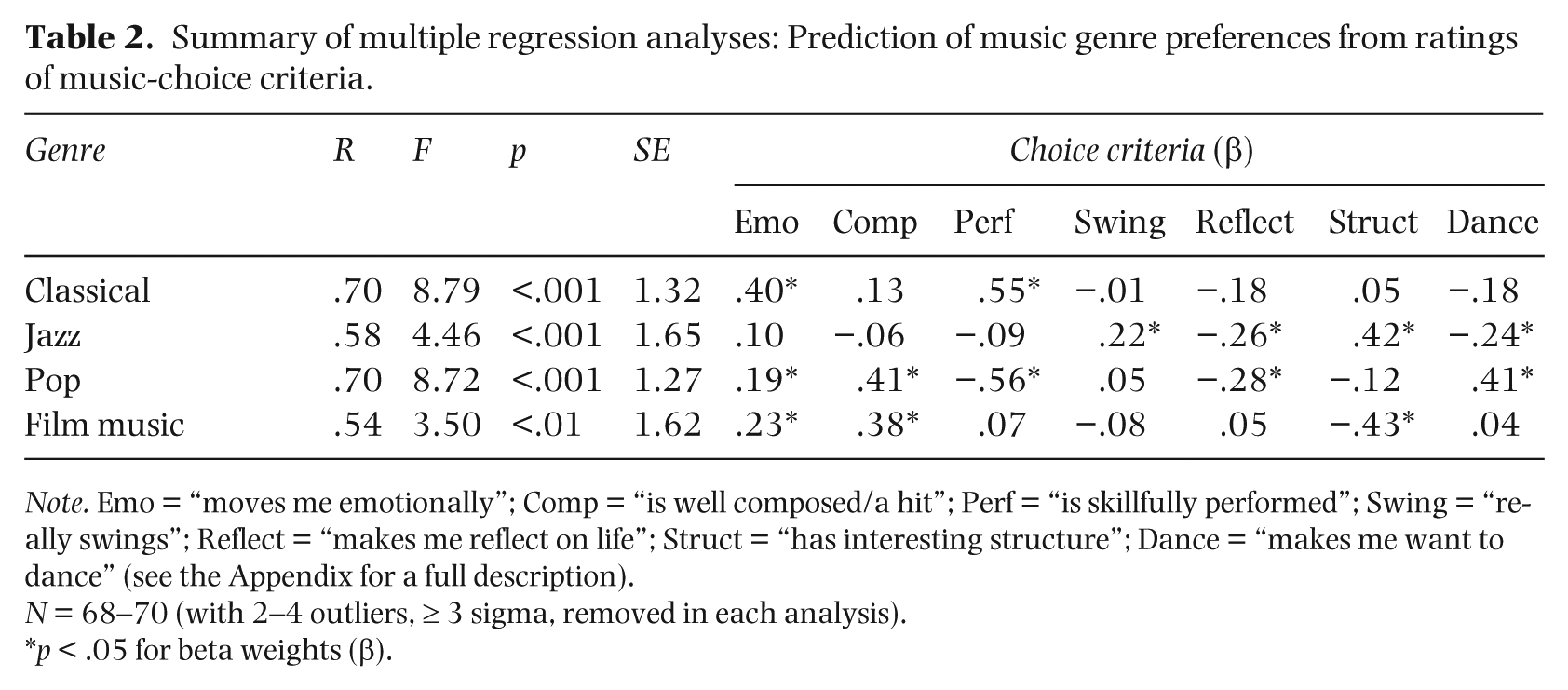
Note. Emo = “moves me emotionally”; Comp = “is well composed/a hit”; Perf = “is skillfully performed”; Swing = “really swings”; Reflect = “makes me reflect on life”; Struct = “has interesting structure”; Dance = “makes me want to dance” (see the Appendix for a full description).
N = 68–70 (with 2–4 outliers, ≥ 3 sigma, removed in each analysis).
p < .05 for beta weights (β).
To examine whether psychology students and music students provided different ratings with regard to intrinsic vs. extrinsic criteria (see Method), we aggregated the participants’ ratings of each criteria type in order to obtain two mean values per participant: One value for intrinsic and one for extrinsic. Then we conducted a two-way mixed-design ANOVA with Criteria type as within-subjects factor, and Education as between-subjects factor. The results from the analysis showed no significant main effect of Education (F1,70 = 0.91, p = .34, partial eta-squared = .013), but there was a significant main effect of Criteria type (F1,70 = 13.950, p < .001, partial eta-squared = .166): intrinsic criteria yielded higher mean ratings (M = 4.33, SE = 0.10) than extrinsic criteria (M = 3.91, SE = .10). This effect was qualified by a significant interaction between Criteria type and Education (F 1,70 = 5.81, p < .05, partial eta-squared = .077). Figure 2 shows the interaction. Note that although the groups rated intrinsic criteria in a roughly similar manner, psychology students rated extrinsic criteria higher than did music students. A post hoc test using Fischer’s LSD confirmed that the difference was significant (p < .05).
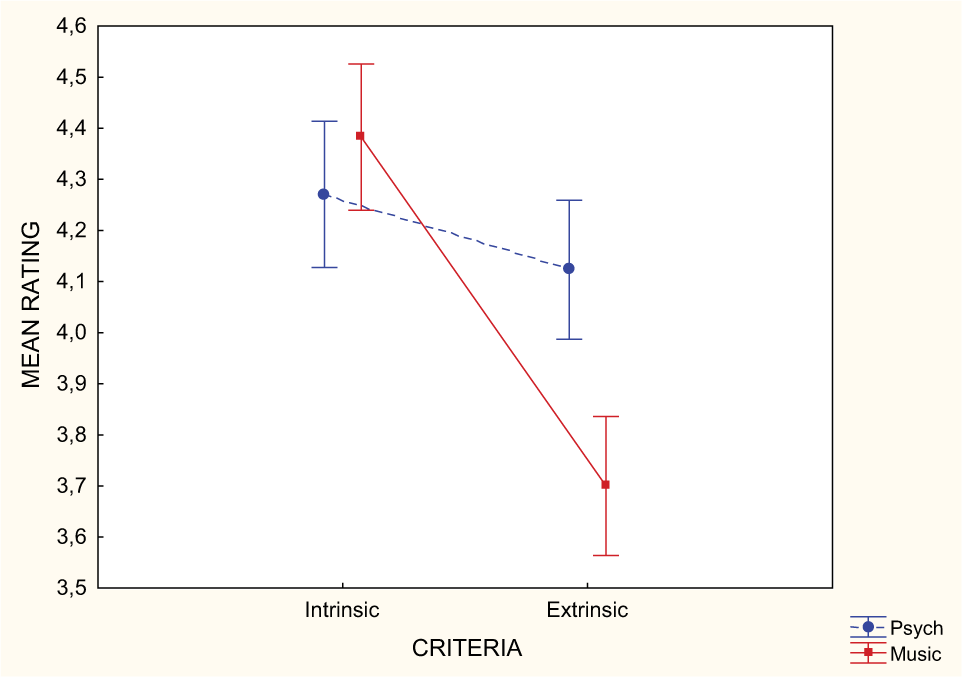
Mean values and standard errors for listeners’ ratings of intrinsic vs. extrinsic choice criteria as a function of education.
Aesthetic judgment
In response to the item “do you consider music ‘art’?” (Q11), 35% responded “Always”, 46% responded “Often”, 18% responded “Sometimes”, and 1% responded “Never”. A test using Cochran’s Q showed a highly significant overall effect (Q = 32.67, df = 3, p < .001), 5 thereby confirming that the response frequencies were significantly different. Looking at these results as a function of education revealed only very minor differences in the participants’ responses: “Never” (Psychology, 0% / Music, 3%), “Sometimes” (17% / 19%), “Often” (50% / 42%), and “Always” (33% / 36%). In other words, the tendency to consider music “art” was not related to music education. The qualitative data from the open-ended follow-up question (Q11 b) which required the participants to expand on their answers to the previous item (Q11a) were sorted into categories of responses with distinct themes. Table 3 presents a summary of the content categories, their frequency of occurrence and some examples of response. 6 It can be seen that the most common themes were “expression”, “creativity”, and “only certain music is art”. Yet, a rather broad range of themes occurred, many of which overlap with the 13 aesthetic criteria rated subsequently (see below). Because most participants regarded at least some music to be art, the open-ended answers usually specified conditions under which music is art. To sum up the responses, participants regarded music as art to the extent that it, like other art forms, is a creative form of expression which requires skill and some intention, is part of our culture, and manages to arouse emotions in receivers, but is not carried out for commercial purposes.
Summary of theme categories from qualitative analysis of responses to item 11(b).
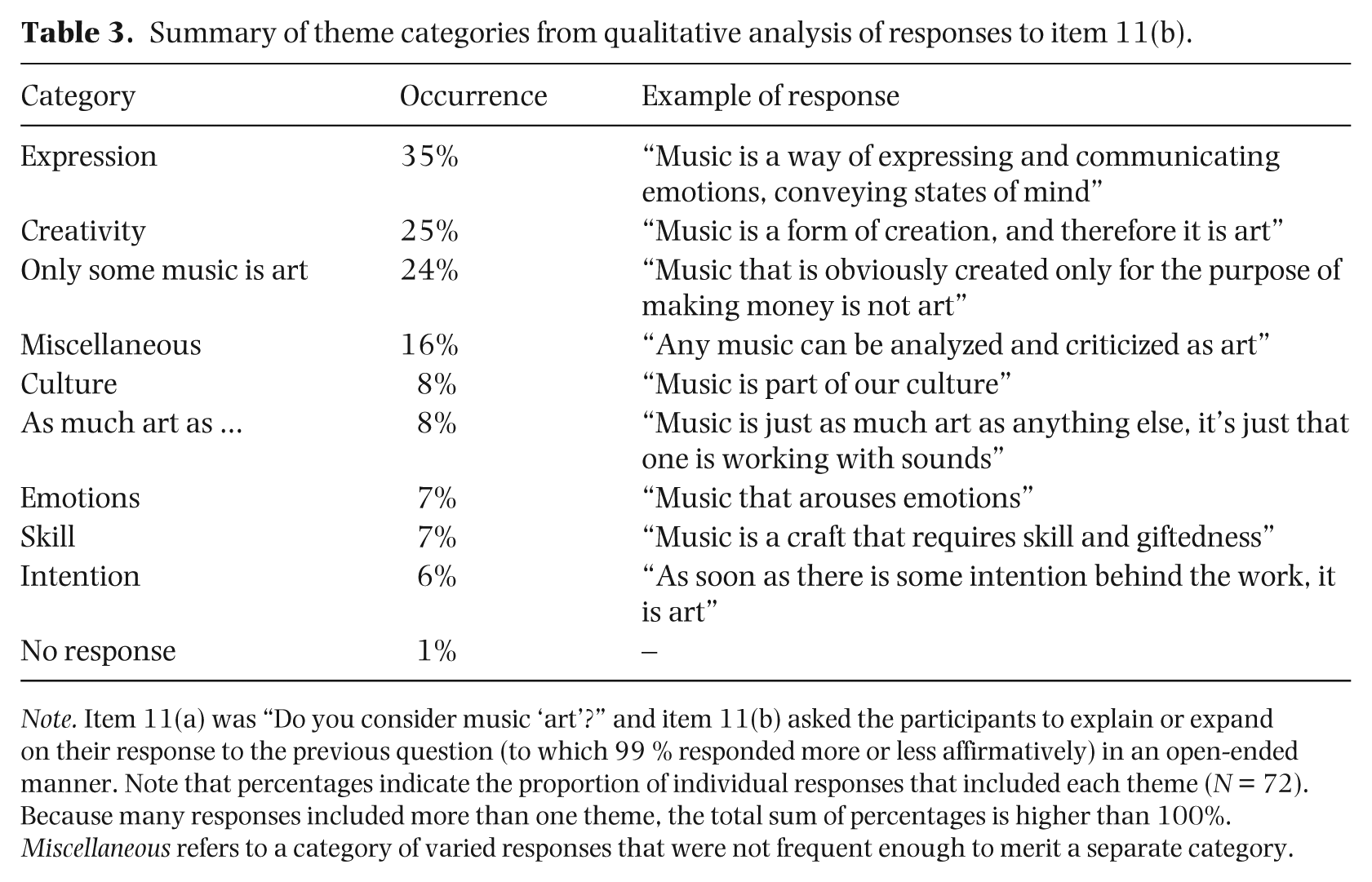
Note. Item 11(a) was “Do you consider music ‘art’?” and item 11(b) asked the participants to explain or expand on their response to the previous question (to which 99 % responded more or less affirmatively) in an open-ended manner. Note that percentages indicate the proportion of individual responses that included each theme (N = 72). Because many responses included more than one theme, the total sum of percentages is higher than 100%. Miscellaneous refers to a category of varied responses that were not frequent enough to merit a separate category.
Those participants (90%) who did not respond “never” to question 11(a) were asked to continue to item 12, which required the participants to rate the relative importance of various aesthetic criteria. To check whether the criteria were rated differently by the participants, we conducted a mixed design ANOVA, with Criteria as within-subjects factor and Education as between-subjects factor. The results of this analysis indicated no significant differences with regard to Education, neither a main effect (F1,64 = 0.13, p = .72, partial eta-squared = .002), nor an interaction (F12,768 = 1.27, p = .23, partial eta-squared = .019). Thus, we collapsed the two groups and calculated a one-way ANOVA. The results revealed a strongly significant effect of Criteria (F12,780 = 31.31, p < .001, partial eta-squared = .325). Figure 3 shows means and standard errors for participants’ ratings of criteria for the aesthetic value of music. As can be seen, the five highest-rated items in order of falling importance were Expression, Emotional arousal, Originality, Artistic skill, and Artistic message. Post hoc tests between the different criteria using Tukey HSD revealed that Expression was significantly different from all other criteria except Emotional arousal, which, in turn, was significantly different from all criteria except Originality, Artistic skill, and Artistic message. All of these criteria were significantly different from the lowest-rated criteria (Sublimity, Complexity, Use as art, Representation; p < .05).

Mean values and standard errors for listeners’ ratings of criteria for aesthetic value of music.
Personality traits
To examine individual differences in ratings of criteria related to listeners’ personality, we computed the Pearson correlations (r) between individual test scores on TIPI and ratings of the 18 choice criteria and the 13 aesthetic criteria, respectively. The results indicated that none of the resulting correlations accounted for more than 10% of the variance in the ratings. Mean variance accounted for (across traits and criteria) was Mr2 = .013 (choice criteria) and Mr2 = .015 (aesthetic criteria), respectively. In other words, TIPI scores typically accounted for less than 2% of the variance in the ratings. As could be expected with such small effects, none of the correlations were statistically significant after correcting for multiple tests using the Holm-Bonferroni procedure.
Discussion
Summary of findings
The purpose of this study was to explore the relative importance of subjective criteria in listeners’ music choice and aesthetic judgment, as well as how the weighting of these criteria varies as a function of preferences for specific genres, music education, and personality traits. From the results emerges a complex picture of the bases for listeners’ choices and judgments. Starting with the music-choice criteria, the results suggest that there is no single criterion that may account for music choice. In fact, a whole range of criteria play a role. However, certain criteria did appear more important than others, overall: for instance, that the music moves the listener emotionally; and also that the music is expressive, beautiful, and skillfully performed. In contrast, familiarity was not rated highly by the listeners despite being a frequently studied variable in responses to music. Though familiarity with a piece of music may indeed increase liking (Peretz, Gaudreau, & Bonnel, 1998), it may not be an important variable when listeners select music in everyday life; the mere fact that the piece of music is familiar is not sufficient motivation to choose to listen to it. That is, there is plenty of music that is familiar to us, that we nevertheless dislike.
It is further worth noting that the participants’ ratings of subjective criteria were related to their rated preferences for specific music genres. Specifically, multiple regression analyses showed that participants’ preference ratings for the music genres classical, jazz, pop, and film music could be predicted to some extent, based on how they had weighted various criteria for music choice (e.g., “skilfully performed” → classical; “interesting structure” → jazz; “makes me want to dance” → pop; “well composed” → film music).
There were no significant correlations between Big Five personality traits and ratings of choice criteria. However, psychology and music students differed significantly with respect to their relative weighting of extrinsic as opposed to intrinsic criteria. Specifically, musicians were less inclined than psychology students to regard extrinsic criteria as important for their choice of music. This is consistent with the tendency amongst musicians to consider music in absolute terms, and not as a background to other activities (DeNora, 2000). Still, the fact that extrinsic criteria did receive high ratings by one of the groups highlights the need to look beyond the music, and to consider the listener and the context also in order to understand music preferences (Hargreaves et al., 2006). Future research should explore whether and how the weighting of various choice criteria is modulated by situational demands and type of music listening (e.g., active vs. passive).
One criterion for music choice that was important for music students was that the music should have an aesthetic value. Aesthetic judgments may be particularly important for “peak” experiences with music. This brings us to the primary question of whether music is art. The present results indicate that most listeners considered at least some music to be art, and that the tendency to do so was not really depending on education; psychology students and music students were equally inclined to consider music art (but music students rated aesthetic value as more important in their choice of music). However, there appeared to be no single criterion that defined music as art. Instead, a number of criteria were regarded as important, including expression, emotion arousal, originality, artistic skill, and artistic message. From these results, it may be tentatively concluded that aesthetic judgments of music listeners generally embrace an art definition in terms of multiple attributes or clusters, rather than a single attribute that is a necessary and sufficient condition (for a discussion, see Stecker, 2003). It further seems that old conceptions of art that require that aesthetic objects are beautiful or sublime have lost their currency in the eyes (or ears) of the contemporary music listener (i.e., “ugly” music might also have a high aesthetic value.) This is consistent with modernist conceptions of art, which have abandoned the primary role of beauty in art more generally (Lorand, 2007). (Yet, as observed previously, perceived beauty may still be important for music choice.) Note that there were no significant differences between psychologists and musicians in the ratings of aesthetic criteria despite the fact that there were differences concerning choice criteria. This is, perhaps, further illustration of the (partial) separation between preference and aesthetic judgment (Juslin, 2013). Correlational analyses showed no significant relationships between Big Five traits and ratings of aesthetic criteria, indicating that these traits are not a primary influence on listeners’ definitions of aesthetic value. However, further research is needed to confirm this conclusion.
What, then, is the role of emotion in music choice and aesthetic judgment? The present results suggest that emotion is significantly related to both. Despite some differences among psychology students and music students in their weightings of criteria, both groups regarded the expression and arousal of emotions as the most important criteria influencing both music choice and aesthetic judgment. (Clearly, music can express more than just emotions, but that “expression” was interpreted as expression of emotions by the participants was clear from the responses to item 11b; Table 3.) In particular, that the music arouses emotions was the single most important criterion out of 18 possible factors for the listeners’ music choice. Hence, the results confirm the crucial role of emotions in any account of music preference and aesthetic judgment (for further discussion, see Juslin, 2013).
Limitations of the study
The present findings have suggested preliminary trends that may guide further research in the area. However, there are several limitations of this study that need to be acknowledged. One obvious limitation is that the participant sample was fairly small and consisted merely of psychology and music students. This sample can be described as a sample of convenience; no attempt was made to obtain a strictly random and representative sample. The focus was rather on how two groups (psychologists and musicians) may differ. For that same reason, however, we should be careful not to overgeneralize the observed trends. For instance, differences with regard to sample may explain why Schäfer and Sedlmeier (2010), who featured students from a technological university, obtained somewhat different results with more focus on “cognitive factors” (e.g., self-reflection).
Another well-known problem concerns the imperfect categorization of musical genres. Genres can be described in many different ways, and at different levels. These categories can change over time, and new genres constantly appear. Yet, it has been argued that quantitative ratings, such as those used here, still offer the best way to measure long-term preference (also referred to as taste). In addition, because the present participants can be regarded as engaged listeners (see the ratings of music interest in Method section), they may be more committed to particular music genres than are less engaged listeners (Lamont & Greasley, 2009). Even so, the genre problem should be kept in mind when interpreting the present results.
One further limitation relates to the use of self-report, and problems associated with this measure. Participants only report what they can or are willing to report. Their answers may be affected by factors such as social desirability and demand characteristics (Visser, Krosnick, & Lavrakas, 2000). These problems relate to a more general issue: How can we best measure choice and aesthetic judgment? It must be noted that a survey approach is only one out of several possible ways of measuring preferences and judgments (for an overview, see Abeles & Chung, 1996). Surveys are arguably effective, because many questions about a topic can be answered by a relatively large sample of participants (as compared to, say, interviews), which renders possible several different types of analysis. In addition, the use of standardized questions makes measurement more precise, and ensures that similar data can be collected from different groups so that they can be compared. However, standardization renders questionnaires inflexible, since the study design has to remain unchanged throughout the data collection. Surveys also arguably tend to address issues in a slightly more superficial manner, than, say, in-depth interviews. It needs to be acknowledged that explicit rating of the relative importance of criteria in general is not really the same as proven causal effects of these criteria on actual judgments (though it seems plausible that the two are related, especially for engaged listeners, who are able to articulate the reasons for their choices). In any case, because of the different and partly non-overlapping advantages and disadvantages of different approaches, it may be heuristic to triangulate across different methods; for instance, survey studies can be complemented by qualitative interviews (Lamont & Greasley, 2006), experience sampling (Juslin et al., 2008), as well as experimental studies (Peretz et al., 1998). 7
Finally, and perhaps most importantly, it should be noted that the subjective criteria of individual listeners constitute only one of many factors that together determine music choice and aesthetic judgments in real life. A wide range of factors in the music, the listener, and the situation (Hargreaves et al., 2006) influence listeners’ reactions and should be part of a more complex model of music preference (LeBlanc, 1982). Especially, the context of the listening is likely to influence short-term fluctuations in preference. Nevertheless, listeners’ subjective criteria are crucial in this process and have been little studied previously (MacDonald, 2000).
Implications for music education
The present results may also have some important implications for the domain of music education. As observed by Droe (2006), music education involves interaction with the music preferences of students on a daily basis. In fact, it is frequently argued that one of the aims of music education should be to expand knowledge of music styles and music preference. Thus, “knowledge of music preference and the factors that influence it seem indispensable to music educators in discovering appropriate rewards for their students: Music that brings enjoyment to the student” (Droe, 2006, p. 30). It is plausible that students’ preference for music played in class may influence many aspects of their experience, including the enjoyment of performance and the desire to practice (Renwick & McPherson, 2002). It may thus be argued that the student’s music preference has to be taken into serious consideration when designing lessons, choosing music, and delivering instruction (Droe, 2006).
In that respect, one of the key findings of this survey is that the expression and arousal of emotions are important criteria for both music preference and aesthetic judgment of music. Discussing the role of expression in music education, Elliott (2005) has argued that “teachers ought to make a central place for engaging students in listening for, reflecting on, interpreting, performing, and creating musical works that are expressive of emotions” (p. 102). As regards the arousal of emotion, Maehr, Pintrich, and Linnenbrink (2002) suggest that there has been a tendency to “downplay the role of affect and emotions as central to motivational processes” (p. 367) in models of motivation, even though they are crucial in music learning (Hallam, 2010).
Even at the highest levels of conservatoire education, it is increasingly recognized that audiences come to concerts wanting, or even expecting, to be “moved” by the music. Indeed, a survey study by Thompson (2006), which investigated listeners’ responses during a concert of classical music, found that their enjoyment of the musical event was better predicted by their emotional engagement than by the perceived quality of the performance. The importance of expression and emotion should arguably be reflected in the training of musicians also. Yet as noted by Hallam (2010), most curricula in formal music education do not focus on education of the emotions, including emotions in music. Though musicians consider communication of emotions as a key element of musical ability (Hallam & Prince, 2003) and performing music (Lindström, Juslin, Bresin, & Williamon, 2003), students appear to perceive that technique is often emphasized at the expense of expression. This view is supported by video observation of instrumental teaching lessons (Karlsson & Juslin, 2008). However, recent empirical studies have made it feasible to develop more theoretically informed teaching strategies aimed at expressive skills (see Juslin, Friberg, Schoonderwaldt, & Karlsson, 2004; Juslin, Karlsson, Lindström, Friberg, & Schoonderwaldt, 2006), and this could bring the training of musicians closer to parity with the aesthetic priorities of most music listeners. In conclusion, this study offers evidence that expression and arousal of emotion play a major role in choice and aesthetic judgment of music, highlighting the need to offer opportunities for expressing and experiencing emotions in music education.
Footnotes
Appendix Questionnaire (translated from Swedish)
Acknowledgements
We are grateful to Simon Liljeström for his help in recruiting the participants for the psychology group, and to the participants for sharing their views with us. We also thank the anonymous reviewers for comments on a preliminary version of this article.
Funding
This study was supported by the Swedish Research Council through a grant to Patrik Juslin (dnr 421-2010-2129).