



Abstract
Many content analyses have investigated the content of popular music, but as yet no one has looked for references to prosocial behavior in the lyrics. There are no quantitative content analyses of prosocial content in popular music, although we know that many musicians are concerned with social engagement, the environment, equal rights, and many other prosocial behaviors. To investigate which topics are the most prevalent in popular music lyrics and how frequently these refer to prosocial behavior, a content analysis was performed on 588 songs appearing in the German yearly charts from 1954 to 2014. The major interest of songwriters seems to be love, which was found in 57% of the songs; this was the most common topic found. References to prosocial behavior were found in 3.74% of the songs. Prosocial behavior usually appeared in songs dealing with social or political topics.
Introduction
Daily, millions of people listen to popular music via radio, streaming providers, television, and recordings played in supermarkets, and the full list of sources is much longer. For this reason, many researchers have investigated the content of music. In terms of broad topics, love is the most commonly found (e.g., Edwards, 1994). As for more specific themes, drugs, sexuality, and tragedy are often found in the lyrics of popular songs. Political, social, and religious content has sometimes been identified, and, of course, antisocial statements have also been found. To this point, however, no analysis has investigated a very important subject: prosocial behavior (a non-occupationally motivated behavior that benefits other people or society as a whole is considered prosocial; see Padilla-Walker & Carlo, 2015). This research gap might seem surprising because many musicians (including the Black Eyed Peas, whose song title is included in the title of this paper) appear to wish to present and encourage prosocial behavior (e.g., helping, donating, or saving the environment) through their lyrics. Notable examples are Bob Geldof and the artists participating in Band Aid (in 1984, 1989, 2004, and 2014), as well as Michael Jackson and the charity project USA for Africa (1985). Researchers have studied the prosocial content of various media, including Disney movies (Padilla-Walker et al., 2013) and prime-time television (Baxter & Kaplan, 1983; Harvey, Sprafkin, & Rubinstein, 1979), but, as Coyne and Smith (2015) have pointed out, no research has yet been conducted on the prosocial content of lyrics in popular music. As the body of research on the positive effects of popular music—especially music with prosocial lyrics—slowly grows (see below), it seems fruitful to analyze the lyrics for prosocial content.
This study aimed to show which major topics are found in popular music from the 1950s to the present, focusing especially on how many songs contain content referring to prosocial behavior. The article begins with an investigation of previous content analyses of popular music lyrics and a summary of existing research on prosocial content in music as well as in other media. Next, the aims and research questions are clarified, before introducing the methods, procedures, and results of a comprehensive content analysis of popular songs over a 60-year time frame. The article concludes with a discussion of, and reflection on, the results, methods, and limitations.
Content of popular music
Although the insights drawn from content analyses of popular music lyrics and the uses of these insights are much discussed and criticized (Denisoff, 1975; Frith, 1986), many quantitative empirical findings have demonstrated the time periods during which certain topics were more or less salient in songs featured on the charts, on all-time favorite lists, and in radio airplay. These results are important, because popular music is known to reflect social, economic, and even political realities, as well as providing insights on the tastes, preferences, and trends of music listeners—especially adolescents (Frith, 1998; North, Hargreaves, & O’Neill, 2000). When it comes to prosocial content this is especially relevant for children’s and adolescents’ development of prosocial behavior, which can be affected by media and music exposure (Coyne & Smith, 2015). No study has yet investigated prosocial content in popular music, however.
Most content analyses investigating popular music lyrics have sought to provide a historical overview of prevalent topics in the lyrics. One example of this is the first known content analysis of popular music on the radio (Peatman, 1942), which had already found that most of the lyrics of this music were about love. Indeed, the major topic of popular songs seems to be love (e.g., Carey, 1969; Edwards, 1994). This includes themes that could be described as parts of the patterns of courtship illustrated by Horton (1957). In some studies, all topics other than love were subsumed under the category “others” (Dukes, Bisel, Borega, Lobato, & Owens, 2003). In contrast, Cole (1971) specified that, in addition to 71% of the songs focusing on love, 12% had lyrics referring to religion, and 10% referred to social protest—a sparse result for the 1960s. Madanikia and Bartholomew (2014) found a decrease of the dominance of the topic of love in song lyrics from 1971 to 2011. This finding might be explained by these researchers’ distinction between lust and love, which were often combined in other content analyses. The addition of the distinct topic of lust can explain the decrease in the topic of love.
As mentioned above, many content analyses have investigated overall topics in popular song lyrics. Some studies have, however, examined specific content. For example, specialized works have dealt with ethnopsychological processes (Stedman & Alpher, 1987) and the portrayal of people with disabilities (Hochbaum, 2010). Previous content analyses of popular music with a larger scope have focused on references to antisocial behavior, such as drug use (e.g., Brookshire, Davis, Stephens, & Bryant, 2003; Christenson, Roberts, & Bjork, 2012; Cougar Hall, West, & Neeley, 2013; Diamond, Bermudez, & Schensul, 2006), and on sexualization (e.g., Cougar Hall, West, & Hill, 2012), violence (e.g., Primack, Gold, Schwarz, & Dalton, 2008b), and negatively valenced self-focus (Léveillé Gauvin, 2017). A more recent content analysis used most of these themes as 19 distinct categories (Christenson, de Haan-Rietdijk, Roberts, & ter Bogt, 2018).
A study by DeWall, Pond, Campbell, and Twenge (2011) had an aim related to that of the present study. These scholars showed that the use of words related to other-focus (e.g., we, us), social interaction (e.g., mate, talk), and positive emotions (e.g., nice, sweet) decreased from 1980 to 2007, whereas the number of words related to self-focus (e.g., I, myself) and antisocial behavior (e.g., hate, kill) increased. Because only single words were examined, it would have been difficult to identify prosocial behavior, but perhaps the authors could have considered keywords for prosocial behavior, like “help” or “donate,” to explain the study’s results. Two additional content analyses dealt with a topic that may be connected to prosocial behavior: Pettijohn and Sacco (2009a, 2009b) examined the lyrics of the top songs from the US Billboard charts from 1955 to 2003. They found that, in relatively socially and economically threatening times, the lyrics of popular songs were more meaningful and comforting and that they referred to more intergroup themes. These categories were assessed by the coders of the study and were not connected to prosocial behavior. It is debatable whether these results could be explained by the frequency of references to prosocial behavior, which were not coded.
Again, no content analysis has yet investigated the presence of prosocial behavior in popular music lyrics. Although some existing studies may have found applicable content, they may have generally subsumed this content under other topics.
Prosocial behavior and music
The scientific literature about music and prosocial behavior includes few studies. Most of these studies have focused on the effect of prosocial lyrics on the listener. Some evidence indicates that music with prosocial content increases prosocial behavior. These findings come mostly from a series of experimental studies conducted by Greitemeyer (2009a, 2009b, 2013) and the field studies of Jacob, Guéguen, and Boulbry (2010) and Ruth (2017a). Other studies have shown that this kind of music can decrease antisocial behavior (Böhm, Ruth, & Schramm, 2016; Greitemeyer, 2011; Greitemeyer & Schwab, 2014). In a longitudinal study, Coyne and Padilla-Walker (2015) showed that the long-term effect of prosocial content is rather small compared with the effects of aggressive and sexual lyrics. One study, conducted by Niven (2015), found a contrary result, indicating that music in general can decrease aggression but that there are no specific effects of music with prosocial lyrics. This result is isolated, because it was found in a very special field setting: customers listening to a loop while on hold for a call center. Additionally, the results of the study are not comparable to those in laboratory settings, because no manipulation check was used and it is unclear whether participants listened to whole songs or just brief excerpts.
Most of these studies used the General Learning Model proposed by Buckley and Anderson (2006) as a theoretical basis. The theory describes underlying mechanisms, making plausible the process from reception to the eventual behavior. When it comes to the selection of songs, the mentioned studies relied on pilot studies or preselected lists of songs that were regarded as potentially prosocial. Because of increasing interest in the effects of music with prosocial content and the lack of content analyses that focus on prosocial behavior, an analysis of the prosocial content of popular music seems necessary.
The multidimensional model of prosocial behavior as described by Padilla-Walker et al. (2013) can help understand what types of prosocial behavior are to be found in popular music lyrics. Typically, content analyses have only looked for prosocial actions, whereas the multidimensional model argues that there are different types of verbal and physical prosocial behaviors that differ in terms of their motivation. Some of these behaviors are complex and not easily accessed by children and are therefore less likely to be imitated or even learned. This is why content analyses should at least take into account the different types of behavior when estimating the impact of prosocial content on (young) recipients. In their content analysis, Padilla-Walker et al. (2013) examined the frequency and nature of prosocial behavior as displayed in Disney movies. Overall, 61 movies were analyzed, and data on every prosocial behavior were collected, including the type of prosocial behavior (physical or verbal), motivations for the behavior, the context in which the behavior appears, and variables about the characters involved in the prosocial behavior. The study found that approximately one prosocial behavior is portrayed per minute.
Aims and research questions
To close the research gap that was shown above, and following the study by Padilla-Walker et al. (2013), the major aim of the present study was to show what content has dominated in popular music over a long-term progression and how much prosocial behavior can be found in the lyrics of popular music. Therefore, two major research questions were formulated, followed by a subsequent hypothesis and an explorative research question. Most existing content analyses that looked for various topics to identify prevalent themes in popular music were conducted from the 1960s to the 1980s. These studies revealed love as the major topic attracting listeners and reflecting an important theme, especially for adolescents (Dukes et al., 2003). To test whether this remains true today or whether another topic has become more prevalent, the first research question (RQ1) was derived. The second research question (RQ2) focuses on references to prosocial behavior.
RQ1: What are the major topics of popular music lyrics? RQ2: What is the frequency of references to prosocial behavior in popular music lyrics?
In addition, it would be interesting to determine what type of prosocial behavior, according to the multidimensional model, is to be found in these lyrics. Certain assumptions can be made regarding when and in which contexts prosocial behavior will appear more frequently. For example, it is possible that the most references to prosocial behavior might be found in the 1960s, in the context of politically and socially driven songs. This idea is supported by Padilla-Walker and Carlo’s (2015) assertion that prosocial behavior is essential for establishing social relationships and a civilized society. Therefore, the hypothesis (H1) suggests the following:
H1: References to prosocial behavior appear more often in social or political songs than in others.
The third research question (RQ3) aimed to provide more information about the context of prosocial behavior. Because there is no empirical evidence on how often prosocial content can be found in various genres or in songs performed by various artists, or whether the songs are relatively successful, this question remains explorative.
RQ3: Which other factors (such as genre, chart position, or the gender or race of the artist) are associated with references to prosocial behavior?
Methods
A content analysis was conducted to answer the research questions and test the hypothesis. This study is based on popular music charts from Germany. Since 1954, chart lists have been available for Germany, which is one of the major music markets in the world. The German charts feature mainly international songs from the USA and the UK, but also include songs from Germany. This means the charts included very successful international songs that could be understood and analyzed by the coders of the present study. These songs were therefore considered an appropriate sample for answering the research questions and testing the hypothesis.
Data
To obtain data for a chronological overview, the best-of-the-year chart lists from 1954 to 2014 were collected once for each five-year period. Chart lists can be considered to reflect the most successful songs that presumably reached the most people. This enabled me to draw conclusions from a database that is relevant for many people. Most of the best-of lists were top-50 charts. Because no one company compiled the charts in all of the periods, the charts that were officially licensed by the music industry were used for the different years. From 1959 to 1977, the German specialist journal Musikmarkt collected the total sales of records and compiled—first monthly and then weekly—charts that were based on these numbers. The length of the journal and its charts varied at the beginning of its history: some charts published by Musikmarkt featured only the top 20 (1959), a top-28 list (1964), and a top-40 hit list (1969).
The charts from 1954 were provided by the German magazine Automatenmarkt. This monthly specialist journal was about the usage of “automaten” (jukeboxes) and featured the first German charts based on sales of singles used in jukeboxes. Although no airplay or consumer sales are taken into account by the magazine, those charts were considered to be official and were displayed by record dealers.
The official German charts from 1976 to 2012 were compiled by the market research company MediaControl, and the lists for 2013 and later were gathered by another market research company, GfK Entertainment. Both companies took into account the overall sales of every music production unit, such as CD, records, and downloads. The data collected for their charts were adjusted to current conditions over the years and are comparable to the US Billboard singles sale charts. 1 This resulted in a total of 588 songs representing the most successful songs from 1954, 1959, 1964, 1969, 1974, 1979, 1984, 1989, 1994, 1999, 2004, 2009, and 2014 in Germany (see Table S1–S13 in the Supplemental Material).
The data were coded using a predefined coding system. 2 The coding units of the current analysis were the verses, choruses, and interludes of the songs. In total, 3113 units and an average of 5.29 units per song were coded. If the chorus of a song was repeated (for example, at the end of the song) each repetition was counted separately to incorporate the importance of a chorus in the analysis. A total of 17 songs were instrumentals and therefore were not coded. English was used in 69.2% of the lyrics, followed by German, which was used in 25.7% of the lyrics; 1.6% featured mixed languages, with the remaining 3.5% being in French, Spanish, Italian, Turkish, Portuguese, and Romanian. 3
Variables
The first set of variables used for the analysis were the easily accessible formal characteristics regarding the structure and information about the song, namely chart position, genre, duration, language, and the sex and race of the main vocalist(s). For the coding units, the included variables were the part of the song (chorus, verse, or interlude) and the number of words. The genre was rated by the coders following predefined definitions from the Handbuch der populären Musik [Handbook of popular music] by Wicke, Ziegenrücker and Ziegenrücker (2007). Fourteen genres were used based on the short test of music preference (STOMP) designed by Rentfrow and Gosling (2003). Duration was determined using playlists from Spotify. When the race of the vocalist was unknown, the coders were asked to use a Google image search to determine the information. Predefined rules ensured that all coders knew how to divide the songs into the different units. Verses, choruses (or refrains), and interludes (or middle-eights) were defined following Wicke and colleagues (2007). A verse was regarded as one unit for as long as the melody did not change into a different one. All pre- and post-chorus parts were subsumed into the chorus. If another part with major changes in harmony and melody appeared, it was regarded as an interlude. The coders were instructed to count the number of words in each unit. Interjections such as “ey” or “yeah” were not counted.
One of the main variables of interest was topic. The coders were asked to identify the major topic of each coding unit. Every unit was assigned only one topic. If there were multiple topics, the one that appeared first was coded. The topics were derived from various content analyses (in particular Cole, 1971; Hyden & McCandless, 1983; Meier, 2000; Mohan & Malone, 1994; Rice, 1980). This resulted in a total of eight major topics: 1. society and politics; 2. violence; 3. drugs; 4. love; 5. nonsense; 6. music and parties; 7. places and journeys; and 8. other. All of the categories were extensively described in the coding rules, incorporating many important subtopics such as the different stages of courtship defined by Horton (1957). Different types of legal and illegal drugs as defined by Cougar Hall et al. (2013) were in one category, and any social and political subtopics, such as economics, religion, or war, fell under the category of society and politics.
References to prosocial behavior were the other main variable of interest. Whenever a prosocial behavior was mentioned in one of the units (regardless of the topic), the coders were asked to code that unit as containing a reference to prosocial behavior and to specify this behavior following the method used by Padilla-Walker et al. (2013). First, the coders had to decide whether an actual action or a verbal behavior was found. Following Padilla-Walker et al. (2013), prosocial behavior can be divided into physical and verbal prosocial behavior. Examples of physical behavior include descriptions of a scene where someone helps another person, donates money, or engages in a comparable behavior (e.g., “You don’t have to worry ’cause you have no money, people on the river are happy to give” from Proud Mary). Verbal behaviors might include compliments, encouragements, or advice on behaving prosocially, as well as ironic statements referring to prosocial behavior (e.g., “If you want to make the world a better place, take a look at yourself and make that change” from Man in the Mirror). For romantic behavior like comforting, coders were advised to decide whether this behavior was only romantic or if helping or supporting was intended. Although this is important for Padilla-Walker et al. (2013), the present study did not assess the costs and motivations of prosocial behavior, because, unlike movies, lyrics usually do not offer enough information to draw conclusions about the motivations for and costs of the actions. In the present study, the coders were asked to rate the personal relatedness of the prosocial behavior from the perspective of the average German person: could that behavior happen close to me in my personal surroundings, and does the behavior affect me personally? A situation described in the lyrics where someone aims to save the rainforests in Africa would therefore be rated low on relatedness, whereas a situation where a person rescues someone else from a burning building in a German city would be rated as very related.
Procedure
The lyrics were divided and coded by four coders working independently. To preserve reliability, a pretest was conducted with all of the coders. Using a sample of 20 prosocial songs (taken from Greitemeyer, 2009a; Ruth 2017a) and 11 regular songs (selected randomly from best-of-the-year charts) that were not selected for the main study, a test using the coding system was undertaken by the four coders. The inter-coder reliability was calculated using Holsti’s (1969) method. For most of the variables, including topic (.86), genre (.92), part of the song (.98), presence of prosocial behavior (.80), and type of prosocial behavior (.77), the alpha values were reasonable. Only personal relatedness could be considered to be at a critical level (.67); to retain a multidimensional measurement of this hardly tangible construct, however, the variable was included in the analysis.
The first step in the coding procedure was to select a song from the relevant charts and check the availability of the lyrics online. For 20 songs with lyrics written in languages other than German or English, translations provided by lyrics websites were used. If the lyrics were found, their validity was checked by listening to the song while reading the lyrics. If mistakes or missing parts were detected, the coders newly transcribed the relevant parts. In the second step, the song was divided into the song parts or coding units. Third, the coders were asked to code the song and song units on all of the variables. In the fourth step, the coders were asked to check again for the presence of prosocial behavior. If a prosocial behavior was detected in a coding unit, its type was coded, and the relatedness of the behavior was rated. Finally, the song was checked one last time, and, if every category had been coded, the next song was chosen from the charts (see the coding scheme in Appendix 1).
Strategy of analysis
The main analyses employed chi-squared tests on all of the coding units. The different coding units were essential for testing the hypothesis and answering the research questions. To test how many songs in total feature at least one reference to prosocial content, the whole songs were used as data, whereas the coding units were used as the sample to test the quantity of prosocial references through the years. Additionally, Pearson’s chi-squared correlation tests were used to yield associations between some of the variables. Because 11 independent tests were calculated, the significance level was adjusted to p < .0045 according to the Bonferroni correction.
Results
Content of popular music
To answer the first research question, the topic categories were compared first in an overall analysis and then separately by year. As stated above, the results strengthen the statement that love is the most frequent topic (56.8%) in popular music lyrics, and the distribution of topics differs from a normal distribution (χ 2 (7) = 5986.057, p < .001, Cramer’s V = .53, n = 3094). The results of the descriptive analysis are displayed in Figure 1.

Distribution of topics in popular music lyrics.
The distribution of topics by year can be seen in Figure 2. Again, there are irregularities that differ from a normal distribution, as indicated by a chi-squared test (χ 2 (84) = 647.401, p < .001, Cramer’s V = .17, n = 3094).

Distribution of topics in popular music lyrics over time.
Songs that refer to society and politics were found in every five-year period, with a small peak in 1979. At 9.4%, this is the third most frequent topic, excluding “other,” at 13.5%, because that category includes all other topics that were infrequently mentioned. The category of violence was absent from 1954 through 1969. This topic was first coded in 1974, with a peak in 1984. It was then absent again from 2004 through 2014. The topics of drugs was particularly present in 1954 and rather rare in the following years. The topic of love was always present, ranging from 40.6% of all units in 1954 to 73.5% of all units in 1964. Nonsense lyrics were found in every year except for 2009 and 2014 and ranged from 0.6% to 4.4%. The topic of music and parties was present in nearly every year, except for 1964, when not a single unit was coded under this topic. During the other years, this topic ranged from 6% of all units in 1959 to 21.2% in 2009. With a total of 12.1%, this was the second-most frequent topic in the analyzed lyrics. The last topic, places and journeys, was not present in the years 1984, 1999, and 2014. In the other years, its frequency ranged from 1.1% (1994) to 14.5% (1959).
References to prosocial behavior in popular music
To determine the extent to which references to prosocial behavior were present in the lyrics of popular music (RQ2), full songs, rather than only the coding units, were used to illustrate how many songs with references to prosocial behavior were released each year. The results can be seen in Figure 3. Overall, 22 (3.74% of the total) songs featuring prosocial behavior were found. A chi-squared test indicated that no individual year featured significantly more songs with prosocial references, compared with the other years (χ 2 (12) = 19.2111, ns., Cramer’s V = .18, n = 588).

Distribution of songs with or without references to prosocial behavior from 1954 to 2014.
When the song units were used, the distribution varied more, and there were differences between the years regarding the coding units. This means that there are songs featuring more than just one part with references to prosocial behavior. The results can be seen in Table 1, and the difference between years is significant (χ 2 (12) = 44.153, p < .001, Cramer’s V = .12, n = 3094).
Distribution of prosocial and non-prosocial lyrics in song parts from 1954 to 2014.

Note: “No” indicates lyrics without references to prosocial behavior; “Pro” indicates lyrics with references to prosocial behavior.
From the 47 units with prosocial references, only 17 were categorized as physical behavior. Although there were more verbal statements, the difference seems to be insignificant (χ 2 (1) = 3.596, ns., Cramer’s V = .28, n = 47). The results indicate that lyrics featuring prosocial behavior vary in terms of personal relatedness. Predominantly, lyrics with references to prosocial behavior seem to be personally related more often than not (M = 2.72, SD = 0.9; range for this variable: 1 = low personal relatedness to 4 = high personal relatedness).
The hypothesis (H1) indicated that prosocial behavior appears most frequently within social and political contexts. To test this hypothesis, the content with references to prosocial behavior was compared across the identified topics. The results showed a significant difference between the frequency of references to prosocial behavior for the topic society and politics, compared with the other topics (χ 2 (7) = 199.052, p < .001, Cramer’s V = .25, n = 3094). The descriptive results can be seen in Table 2.
Distribution of song parts with or without prosocial lyrics by topic.
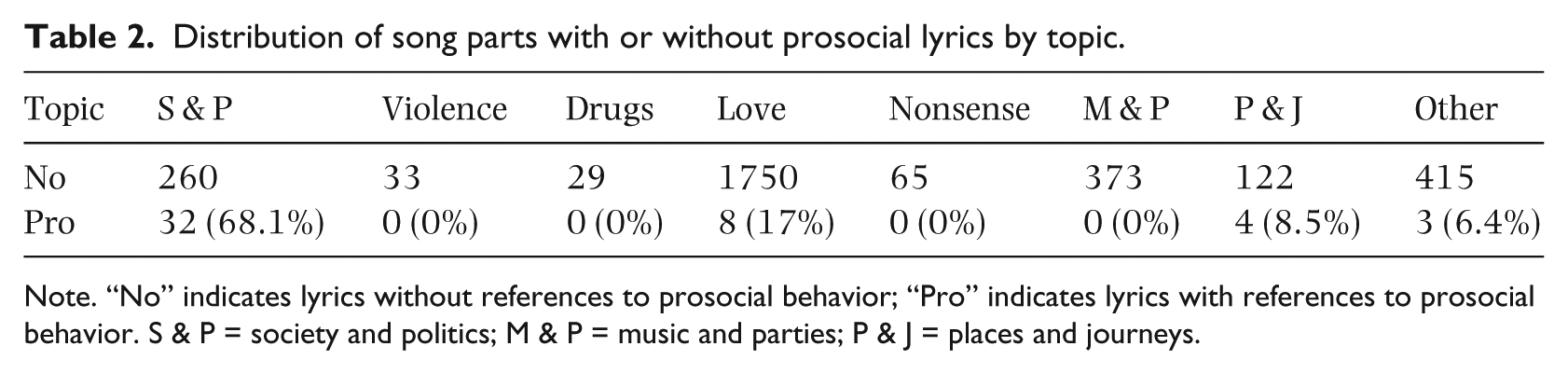
Note. “No” indicates lyrics without references to prosocial behavior; “Pro” indicates lyrics with references to prosocial behavior. S & P = society and politics; M & P = music and parties; P & J = places and journeys.
To answer the third and final research question, the correlations between prosocial behavior and other coded parameters were examined. The results indicate that, first, songs with references to prosocial behavior have a high chart position significantly more often than they have a lower one (χ 2 (49) = 105.610, p < .001, Cramer’s V = .18, n = 3113). The best position in the best-of-the-year charts reached by a song with prosocial references is number two, and lowest is number 46, with a mean position of 16.15 (SD = 12.91). Most of the units with references to prosocial behavior found were performed by male singers (31), 4 by women, and 12 by groups of mixed gender (χ 2 (5) = 18.708, ns., Cramer’s V = .08, n = 3113). This difference is not statistically significant, although the descriptive results and the effect size indicate that, in relative terms, mixed-gender groups performed the most prosocial lyrics. The descriptive results showed that 2357 of the 3113 coding units were performed by white singers, whereas only 237 of the units were performed by racially mixed groups. White artists performed most of the songs with references to prosocial behavior (22), followed by mixed groups (20) and African Americans (5); the difference found was statistically significant (χ 2 (4) = 83.198, p < .001, Cramer’s V = .16, n = 3113). This finding means that, in relative terms, mixed groups feature the most prosocial lyrics. There was no significant difference in terms of the song parts, indicating that prosocial content appears in all song parts in a relatively balanced way (χ 2 (2) = 3.048, ns., Cramer’s V = .03, n = 3096). Looking at the distribution of references to prosocial behavior by genre, country music and soundtracks featured relatively more units that were coded as prosocial. Rock and pop music also featured references to prosocial behavior. Overall, however, the differences between the genres were not significant (χ 2 (13) = 20.655, ns., Cramer’s V = .08, n = 3113). These results can be seen in Figure 4.

Distribution of references to prosocial behavior by genre.
Discussion and conclusions
This study has positioned the content of popular music lyrics in a historical overview and shown how prosocial behavior is present in those lyrics, following the model introduced by Padilla-Walker et al. (2013). To empirically test several assumptions regarding the topics and references to prosocial behavior of popular music, a content analysis of the most successful songs of the year from 1954 to 2014 was conducted.
As the previous content analyses indicated, the most frequent topic found in popular music lyrics is love. This is supported by the results of the current study, although the frequency (56.8%) was not as large as that reported in other studies. For example, Cole (1971) found love in 71% of the examined lyrics, Edwards (1994) found that 72% of the analyzed songs were about love, and Christenson et al. (2018) found love in 67.3% of the analyzed lyrics. This difference might be because of the present study’s sample or because of the more detailed categorization that was used in this analysis. The dominance of love songs is apparent, reflecting the most important topic for the artists and their fans. Especially for the major target group of popular music, adolescents, love is one of the most important topics in everyday life (Dukes et al., 2003). For love and all of the other topics, however, no obvious increase or decrease can be seen in the results over time. This finding is particularly important for topics like violence and drugs. From an ethical perspective, even the smallest increase in the appearance of those topics should be regarded as critical, but the present study’s results suggest that there has been no change in the frequency with which violence and drugs are mentioned in songs over the years.
Taken together, the results related to the second research question show that prosocial behavior seems to be mentioned only rarely in popular music. This result is counterintuitive, because one could easily list many examples of prosocial lyrics. No chronological increase or peak could be found over the years, however, and only 3.74% of all of the examined songs featured references to prosocial behavior. This is not much, compared with the numbers of references to degrading sex (36.9% of 279 songs; Primack et al. 2008b) and illegal substance use (33.3% of 279 songs; Primack, Dalton, Carroll, Agarwal, & Fine, 2008a) found in the lyrics of popular songs. It is possible that this study’s sample missed the times when prosocial behavior was particularly prevalent, but this does not seem to be the case, as songs from at least one year were included for all decades. It seems more likely that artists who engage socially do not necessarily put this into the lyrics of their songs, and, although their prosocial songs are famous, most of their other songs are about more popular topics. Another explanation might be that references to prosocial behavior are found more often in less popular songs. Songs from subgenres and niches might be more prosocial. The results also show, however, that songs with prosocial lyrics can be very successful.
Turning to the interpretation of the results, songs with prosocial lyrics often appear in the context of social and political topics, as stated in the hypothesis. This fits the assumptions, because topics about society and politics are rare, as are references to prosocial behavior. Although prosocial behavior and love fit together well (and actually appeared together in the results), socially and politically outspoken songs and artists seem to be more likely to address difficult topics in their lyrics, which call for prosocial actions.
Looking at the correlations between prosocial content and various characteristics of the songs, prosocial songs seem to achieve a high chart position, which might be related to their rarity and peculiarity. Men sang most of the prosocial songs, because men sang more songs overall and had more variety in their topics than did female singers; this does not mean that men feature more references to prosocial behavior in general. In fact, mixed-gender groups (2.2%) performed relatively more prosocial lyrics than did male (1.6%) or female singers (0.6%). Another interesting finding is that ethnically mixed groups were especially likely to perform songs featuring prosocial behavior. Both results seem reasonable, as we are reminded of collaborations like USA for Africa and Where is the Love by the Black Eyed Peas (neither of which were included in the sample). These mixed groups stand for anti-racism as well as equality and might address social topics like these in a prosocial way. There were no significant differences found for song part or genre. This means that prosocial behavior appears in choruses, verses, and interludes, as well as in most of the genres; no genre or song part stands out. Of course, this might be because only a few prosocial lyrics were found, but it can also be interpreted in a positive way: prosocial behavior seems to be a topic that can appear in every part and style of music.
Although the findings support the hypothesis and offer answers to the research questions, some limitations of the study should be mentioned. First, the five-year timeline means that the results serve only as an indicator of chronological progressions. The results should not be generalized, as some trends and the progression for a certain period cannot be captured using these data. Nevertheless, this method does provide a general understanding of an overall increase or decrease in the appearance of a topic. Second, the categorical variable for topic was successful, as it was able to capture over 86% of the topics present in the lyrics. The analysis of some themes from the “other” category (e.g., work, death, biographies, and astronomy), however, could be fruitful. The themes in this category were rare and therefore problematic to use as stand-alone categories, but future content analyses should potentially consider these themes in more detail. Future research could therefore take into account the categories provided by the lyrics evaluation scale used by Neguţ and Sârbescu (2014). Third, the findings of correlations with references to prosocial behavior should not be generalized because so few prosocial lyrics were found. Still, the descriptive results give us clues about the nature of popular songs with references to prosocial behavior. Future studies might want to focus on analyzing different types of songs with prosocial lyrics (for example, those that are more or less successful) to derive more insight into the nature of the songs. Fourth, although the multidimensional model of prosocial behavior is a promising model depicting all of the important factors, for a medium such as pop song lyrics, it is difficult to apply this model because the lyrics usually do not feature enough information. When John Lennon and his Plastic Ono Band (1969) sing, “All we are saying is give peace a chance,” it is difficult to tell from the lyrics alone what the motivation or costs are for giving peace a chance. Finally, it is not possible to determine from a content analysis whether the songs have an impact on listeners, as has been shown in studies by Greitemeyer (2009a, 2009b, 2011, 2013) and Ruth (2017a, 2017b), and as is predicted by the General Learning Model (Buckley & Anderson, 2006). Likewise, it is impossible to say what intentions the songwriters had or whether lyrics that were not perceived as prosocial were in fact intended as prosocial by the authors. Several studies have explored the effects of music with prosocial lyrics, but no analyses of songwriters’ perspectives have been conducted; future studies should investigate this topic.
Overall, the study of popular music lyrics shows to what extent people are exposed to certain topics—especially prosocial behavior. Although this study revealed that there are fewer references to prosocial behavior in popular music than one might think, the investigation of songs with references to prosocial behavior and the effects of these songs is still a promising research field. One might question why more artists do not use their popularity and influence to reach listeners with prosocial content, but it is possible that the rarity of these songs makes the few that exist more special and effective. If there are only a few songs with prosocial content, they might stand out more and receive more corresponding media coverage, leading to more knowledge about the songs’ prosocial content. This eventually leads to more prosocial behavioral intentions (Ruth, 2017b). If too many songs contained prosocial content, people might feel overwhelmed and would then be more likely to reject the content. To affect people with prosocial messages via music, the few songs in the charts that refer to prosocial behavior may be enough. One might have thought, however, that more popular musicians would feature that important content and one could still ask, “where is the prosocial behavior?”
Supplemental Material
Supplementary_Figure – Supplemental material for “Where is the love?” Topics and prosocial behavior in German popular music lyrics from 1954 to 2014
Supplemental material, Supplementary_Figure for “Where is the love?” Topics and prosocial behavior in German popular music lyrics from 1954 to 2014 by Nicolas Ruth in Musicae Scientiae
Supplemental Material
Supplemental material for “Where is the love?” Topics and prosocial behavior in German popular music lyrics from 1954 to 2014
Supplemental material, Supplementary_Material for “Where is the love?” Topics and prosocial behavior in German popular music lyrics from 1954 to 2014 by Nicolas Ruth in Musicae Scientiae
Footnotes
Appendix 1
Acknowledgements
I would like to thank my students Jana Heins, Lucie Juraschek, Jana Rebellato, Yannick Schmiech, and Ulrike Stegemann for their help with compilation, transcriptions, and coding. Without their efforts working on the lyrics this paper would not have been possible. In addition, I especially thank my supervisor Prof. Dr. Holger Schramm for the support during the work on this paper and my whole PhD project.
Funding
This research received no specific grant from any funding agency in the public, commercial, or not-for-profit sectors.
Supplementary material
Tables with the index “S” are available as Supplemental Online Material, which can be found attached to the online version of this article at http://msx.sagepub.com. Click on the hyperlink “Supplemental material” to view the additional files. The song lyrics are available online at  .
.
Notes
References
Supplementary Material
Please find the following supplemental material available below.
For Open Access articles published under a Creative Commons License, all supplemental material carries the same license as the article it is associated with.
For non-Open Access articles published, all supplemental material carries a non-exclusive license, and permission requests for re-use of supplemental material or any part of supplemental material shall be sent directly to the copyright owner as specified in the copyright notice associated with the article.

