



Abstract
Although there has been an increase in research considering the positive effects of music with prosocial lyrics on people’s behavior, little is known about the process by which this happens or about the factors that influence the effect of listening to songs with prosocial content. This study focused on the interaction between attention level and familiarity, two factors that, to some degree, determine the effect of this kind of music. Based on the general learning model, the reciprocal feedback model of music perception, and the elaboration likelihood model, an online experiment (n = 220) was conducted to test how people listening attentively to familiar or unfamiliar music with prosocial lyrics are affected, in comparison with those listening inattentively. The results yielded a significant interaction effect between attention and familiarity on prosocial behavior, indicating that only familiar songs with prosocial lyrics affect inattentive listeners, whereas attentive listeners are affected similarly by familiar and unfamiliar songs. Effects on emotions and an indirect effect of familiarity on prosocial behavior via activated pre-knowledge and positive emotions were also found. The results are discussed regarding their role in understanding the music reception process and their meaning for listeners’ prosocial behavior.
“If you wanna make the world a better place, take a look at yourself and then make a change,” is the catchphrase of Michael Jackson’s song, “Man in the Mirror” (1987). Popular songs with prosocial lyrics such as this positively affect people who listen to them, but does the feeling of being touched or moved by a song with prosocial lyrics make people change their actions to be more prosocial?
Most existing studies on the effects of popular music have focused on aggressive song lyrics and music with violent content (e.g., Anderson, Carnagey, & Eubanks, 2003; Gutscher, Schramm, & Wirth, 2011; Knobloch-Westerwick, Musto, & Shaw, 2008; Pieschl & Fegers, 2015). Media reports about music and violence usually feature genres such as heavy metal or rap. Accordingly, many studies have focused on those styles and the effects proposed in the media (e.g., Gowensmith & Bloom, 1997; LaMarre, Knobloch-Westerwick, & Hoplamazian, 2012; Lawrence, & Joyner, 1991; Mast & McAndrew, 2011). In contrast, only a few studies have investigated potential effects of music with prosocial content. This seems peculiar because there are many famous musicians who convey prosocial messages in their song lyrics. Charity songs like “We are the World” or “Do They Know It’s Christmas?” come to mind. One might also recall other songs by Michael Jackson or other artists and bands, including U2, Rise Against, and The Black Eyed Peas. Some existing studies, for example, those by Greitemeyer (2009a, 2011), have investigated the positive effects of popular music with references to prosocial behavior. However, only a few studies have proposed a reception process or investigated the underlying mechanisms (e.g., Greitemeyer, 2009b; Ruth, 2017b). Effects found in field studies (Jacob, Guéguen, & Boulbry, 2010; Ruth 2017a) indicate that listeners are affected by songs with prosocial lyrics even when they do not listen to the music attentively. For this reason, Ruth (2017b) asserted that the listener’s pre-knowledge about the music plays an important role in the reception process: The more familiar a song is, the more likely it is to trigger memories, scripts, or emotions that the listener associates with the song. The present study focuses on precisely these factors, namely, attention and familiarity, and their role in the reception process.
Theoretical background
The general learning model (GLM; Buckley & Anderson, 2006) is a broad learning theory proposed by Greitemeyer (2009a) and used by many other studies to investigate the underlying processes of the effects of prosocial media. The GLM shows how an individual’s behavior can be affected by social learning scenarios via media reception in a general sense. The theoretical model states that any media stimulus, such as playing video games, watching movies, or listening to music, can have short-term and long-term effects. Whereas the long-term effects can be explained through several learning encounters in various states and environments over a certain time, the short-time effects are predominantly influenced by personal and situational factors that alter a person’s internal state through their cognition, affect, and arousal (see Figure 1).
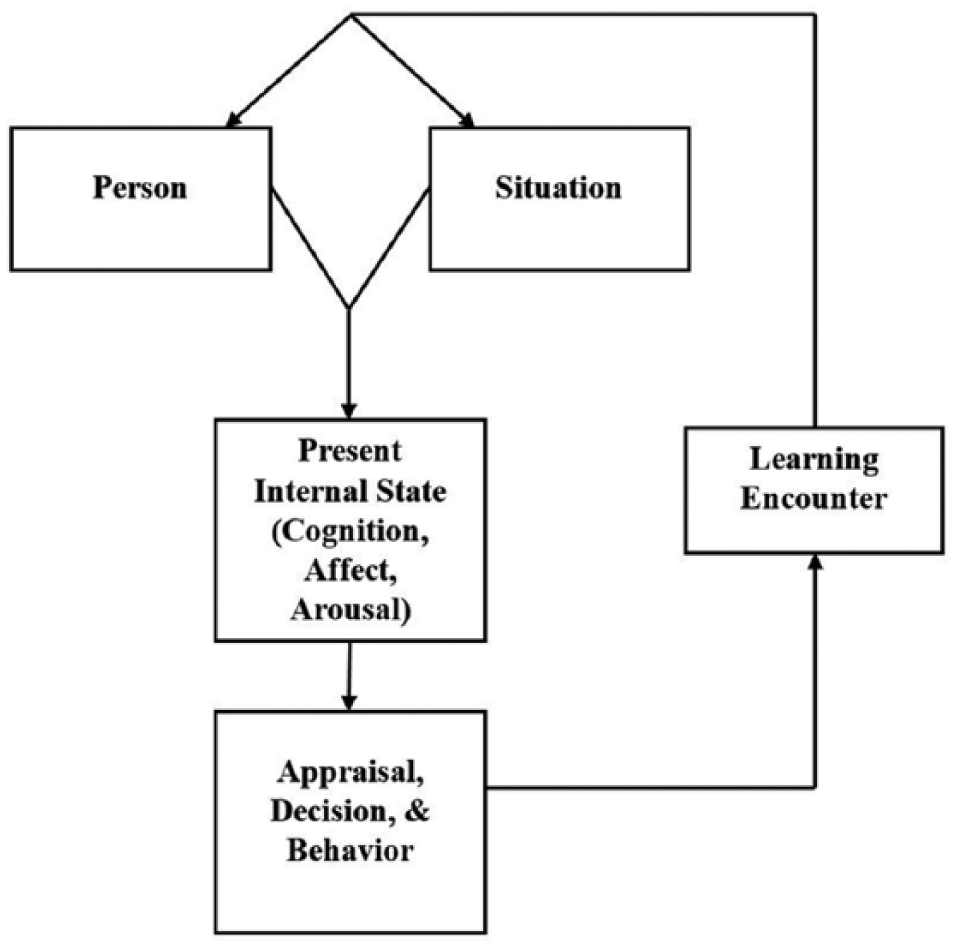
Basic schematic of the general learning model, adapted from Buckley and Anderson (2006).
Accordingly, the process proposed by the GLM starts with situational and personal input variables. Situational variables include the presence of other persons, the setting of the current situation, and the person’s level of attention in the situation. Personal variables comprise established predispositions or individual traits such as attitudes, fears, and knowledge.
The input of a media or music reception situation interacts with personal and situational input variables and finally affects the cognitive route by triggering attributions, thoughts and learned scripts (Huesmann, 1986), the affective route (e.g., situative mood or emotions), or arousal. The influence of the input on these three routes (cognition, affect, and arousal) and their interaction eventually determine the internal state. Through the internal state, a person is more likely to appraise situations and inputs in a certain way. This appraising process paves the way for a person’s decisions and actions in a certain encounter. If the behavior leads to either unrewarding or satisfying results, a learning encounter is initiated that may eventually influence the personal variables.
To illustrate the process, one could think of a highly emotional (personal variable) person sitting on a crowded bus (situational variable) and listening to a song with prosocial lyrics (input) on his or her headphones. The song lyrics activate prosocial thoughts and positive feelings, which lead to a prosocial internal state. Suddenly, the person sees an elderly person looking for an unoccupied seat. The person with the prosocial internal state is more likely to give his or her seat to the elderly person.
The GLM seems to be a simplified model that cannot meet the requirements of the complexity of the music reception process. Ruth (2017b) has extended the GLM by including factors taken from the reciprocal feedback model of musical communication (Hargreaves, MacDonald, & Miell, 2005). Comparing the two models, one can find many similarities. For example, Hargreaves and his colleagues argue that the listener’s response to the music is determined by three essential factors: personal, situational, and musical variables. Following the reciprocal feedback model, personal and situational variables are comparable to those described in the GLM. However, musical variables provide information about the musical input that is not specified in the GLM. Examples are collative variables like the complexity of the musical structure or the listener’s familiarity with the content. In the reciprocal feedback model, the listener’s response consists of cognitive, affective, and physiological components, which is comparable to the GLM. The present study proposes and uses a new process model that combines the advantages of the two existing models (see Figure 2).
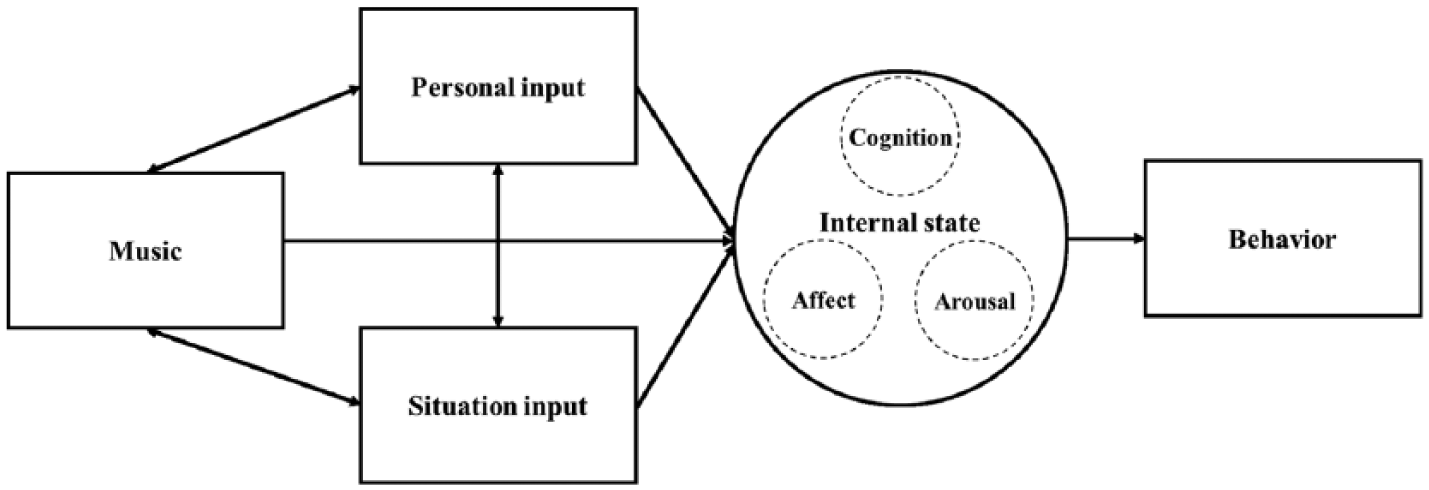
Proposed music process model following the general learning model and the reciprocal feedback model.
Attention
Taking into account the research aims, the present study will focus on one situational variable, namely, attention, and one music variable, namely, familiarity. How recipients process a message depends on how deeply they are elaborating the message. The more a person can focus on a message, the more likely he or she will be to process and evaluate the message, whereas incapable or unmotivated persons will rely on heuristics or pre-existing information and knowledge. This theoretical assumption is supported theoretically by the elaboration likelihood model (ELM; Petty & Cacioppo, 1986). This model was initially proposed for persuasion contexts and describes how persuasion can occur when an individual’s elaboration is high or low, but the process and effect are different in each situation. Recipients can be affected via two routes, namely, the central route and the peripheral route. Regarding attentive listening, this means that inattentive listeners (peripheral route) are more likely to rely on their pre-knowledge, memories, or scripts when processing the content of a song, whereas attentive listeners (central route) can evaluate the content in full.
Familiarity
Attentive listeners, who use the central route, can evaluate the arguments and their quality in the lyrics, whereas inattentive listeners, who use the peripheral route, can be affected by simpler cues, for example, the source of information or emotions. The reciprocal feedback model describes music input factors such as familiarity as important for the reception process, and this seems especially critical when the listeners use the peripheral route. When an inattentive listener notices a familiar song, he or she can rely on their pre-knowledge about the song, for example, knowing the artists and the content or their situational emotions (e.g., feeling good). Following the GLM and the reciprocal feedback model, pre-knowledge that is activated can be described as a cognitive variable that affects the internal state and eventually the behavior. Some studies investigated the effect of familiarity on music perception (e.g., North & Hargreaves, 1995); however, no research has yet investigated these effects in combination. That is why the aim of the current study is to examine the effect of attention and familiarity of songs with references to prosocial music on prosocial behavior.
Music with prosocial lyrics
Padilla-Walker and Carlo (2015) have pointed out that prosocial behavior is a multidimensional construct that is essential for establishing a civilized society and social relationships. They define prosocial behavior as a behavior that benefits others or society at large and is done intentionally and without involving payment or being part of a job. Helping people, donating money, or saving the environment can be considered prosocial behaviors. To date, there have been two field studies observing actual prosocial behavior in an everyday environment to examine the influence of the presence of music with prosocial lyrics. The first of these studies, conducted by Jacob et al. (2010), showed that people exposed to songs with prosocial content in a restaurant gave larger tips to their servers, which can be considered a prosocial behavior, than did people who listened to comparable music with neutral lyrics or people who did not listen to music. In the second study, conducted by Ruth (2017a), customers who were exposed to music with prosocial lyrics bought more fair trade coffee than did those listening to comparable neutral music. Both studies have high external validity and indicate the need to further investigate the processes underlying the reception process of this kind of music.
In a series of studies on music with prosocial content, Greitemeyer (2009a) conducted experiments in which participants were randomly assigned to two groups: the experimental group listened to a song with prosocial lyrics, and the control group listened to a song with neutral lyrics. In each of the experiments, Greitemeyer tried to assess the influence of the music on one of the internal-state variables described by the GLM. The results of his studies indicate that music with prosocial lyrics influences prosocial thoughts, empathy, and eventually prosocial behavior. The results also indicate that empathy mediates the effect of prosocial music on prosocial behavior (Greitemeyer, 2009b).
Other studies have focused on the internal state and other mediating variables. For example, Ruth (2017b) showed the impact of trait empathy and state empathy on the reception process and the influence of media coverage of prosocial music on the appraisal of the music. The findings of Clark and Giacomantonio (2013, 2015) support the importance of empathy in the process. They showed how empathy affects prosocial behavior through a person’s music preferences. Other cognitive factors, such as awareness or appraisal, have also been investigated. For example, Bodner and Golboa (2009) found an effect of crisis songs on the awareness of intergroup conflicts, and Ziv (2017) showed how the appraisal of a situation can be influenced by protest music.
Helping behavior is not the only final outcome variable that has been examined. Greitemeyer, Hollingdale, and Traut-Mattausch (2015) showed that listening to songs with lyrics about women’s equality increased listeners’ positive attitudes and behaviors toward women. The reception of prosocial songs also leads to a decrease in prejudices and discrimination (Greitemeyer & Schwab, 2014); less risky driving behavior (Greitemeyer, 2013); and a decrease in antisocial thoughts, feelings, and behavior (Greitemeyer, 2011a). Böhm, Ruth, and Schramm (2016) confirmed the findings of the last of these studies in an online study showing the beneficial impact of a prosocial song on aggressive thoughts. The only longitudinal study investigating the influence of musical content on prosocial behavior was conducted by Coyne and Padilla-Walker (2015). The results demonstrated that especially adolescents were more likely to be influenced in their behavior by aggressive or sexual content than by prosocial musical content.
In terms of short-term effects, there has been only one contrary result to date. Niven (2015) showed that music generally decreased aggression among customers in a call center wait loop, but no specific effects were found for music with prosocial lyrics. However, this study took place in a very special situation, and the findings should therefore not be generalized to the effectiveness or ineffectiveness of music of any kind.
Overall, existing research has focused on behavioral outcome variables, and only a few studies have investigated the underlying process by looking at the effects on cognition and affect. It seems reasonable to say that there is considerable evidence on the overall effect of music with prosocial content on prosocial behavior. Furthermore, the effect appears to be mediated by affective variables, especially state empathy. 1
Hypotheses
Following the conclusions by Ruth (2017b), some of the empirical results, including those of the field studies, can be explained by the pre-knowledge listeners have about music with which they are highly familiar. Field studies (Jacob et al., 2010; Ruth 2017a) have found effects of music with prosocial lyrics on prosocial behavior, even when listeners were not listening attentively. Following the ELM, one could argue that the pre-knowledge of an inattentive listener is more likely to be activated after listening to familiar music with prosocial content – thus increasing prosocial behaviors – than after listening to a song that is unfamiliar. This leads to the hypotheses 1a and 1b.
In contrast, attentive listeners are able to process the content of unfamiliar as well as familiar songs and should thus show comparable prosocial behavior regardless of their level of familiarity with the music. Following the GLM, the effect of prosocial music on prosocial behavior is mediated by the recipient’s internal state. Listening inattentively to familiar – but not unfamiliar – music with prosocial lyrics should initially trigger cognitive reactions such as the salience of prosocial thoughts. The thoughts of attentive listeners should be triggered in a comparable way regardless of familiarity, because they will receive the content regardless of whether the song is familiar or not. This leads to hypotheses 2a and 2b.
The second state that will be affected by listening to music with prosocial content is affect. Greitemeyer (2009b) showed that state empathy mediates the effect of songs with prosocial lyrics on prosocial behavior. For an inattentive listener, this effect should only be found when he or she listens to a familiar prosocial song, whereas the empathy of attentive listeners should be comparable regardless of familiarity. This leads to hypotheses 3a and 3b.
The valence of how music with prosocial lyrics affects people is unknown. According to the GLM, it seems reasonable that prosocial content would stimulate positive emotions and decrease negative emotions (Böhm et al., 2016; Greitemeyer, 2011a). Therefore, if only those listening attentively and those listening inattentively to familiar songs should be affected by the music, inattentive listeners exposed to unfamiliar songs should be affected the least. This leads to hypotheses 4a and 4b.
Hypotheses 1a/2a/3a/4a: Inattentive listeners demonstrate more prosocial behavior/have more prosocial thoughts/show more empathy/are more emotionally affected after listening to familiar music with prosocial lyrics than do inattentive listeners listening to unfamiliar music with prosocial lyrics.
Hypotheses 1b/2b/3b/4b: Attentive listeners do not differ in prosocial behavior/prosocial thoughts/empathy/emotional affect after listening to known or unknown music with prosocial lyrics.
The proposed music processing model suggests that the input factors interact with each other and eventually affect behavior, mediated by the internal state. If the song is familiar, it is likely that the personal input factor of pre-knowledge will be activated, which makes the content easier to access. This, in turn, should affect the internal state and eventually lead to a specific behavior. The final hypotheses consider which internal state variables are affected by music with prosocial content:
H5a/b/c: A familiar song, compared with an unfamiliar song, leads to more prosocial behavior mediated by pre-knowledge and prosocial thoughts/empathy/emotions.
Methods
An online-based 2 × 2 between-subjects experiment was conducted with a convenience sample of 220 German participants. The participants were assigned randomly to one of four experimental conditions. In two groups, the recipients were distracted by a mathematical task taken from an intelligence structure test (I-S-T 2000 R by Amthauer, Brocke, Liepmann, & Beauducel, 2001) so that they listened to the music in an inattentive way. Participants in the other conditions were asked to listen carefully to the songs so that they would listen attentively. One inattentive and one attentive group listened to two familiar songs with prosocial lyrics (one song in German and one in English), while the other groups listened to comparable unfamiliar songs. To provide songs with understandable lyrics and not only a single case stimulus, two songs – one in English and one in German – were used. After listening to these songs, the participants were asked to complete a standardized questionnaire that was compiled for the present study. To ensure a musical stimulus with high internal validity, a pilot study was also conducted.
Pilot study
The goal of the pilot study was to identify a German and an English song with prosocial lyrics that were well known, as well as two (German and English) songs that were unknown. The only difference between the songs should be the familiarity to the listeners; they should be comparable in terms of style and instrumentation. Before the pilot study, eight well-known and eight unknown English and German (rock, pop and hip hop) songs with prosocial lyrics were compiled.
A total of 51 undergraduate students (mean age = 20.86 years, SD = 2.09; 76.5% female) participated in the pilot study, which was conducted in a laboratory setting under controlled conditions. All of the participants indicated that German was their native language and that they understood English at least at an average level.
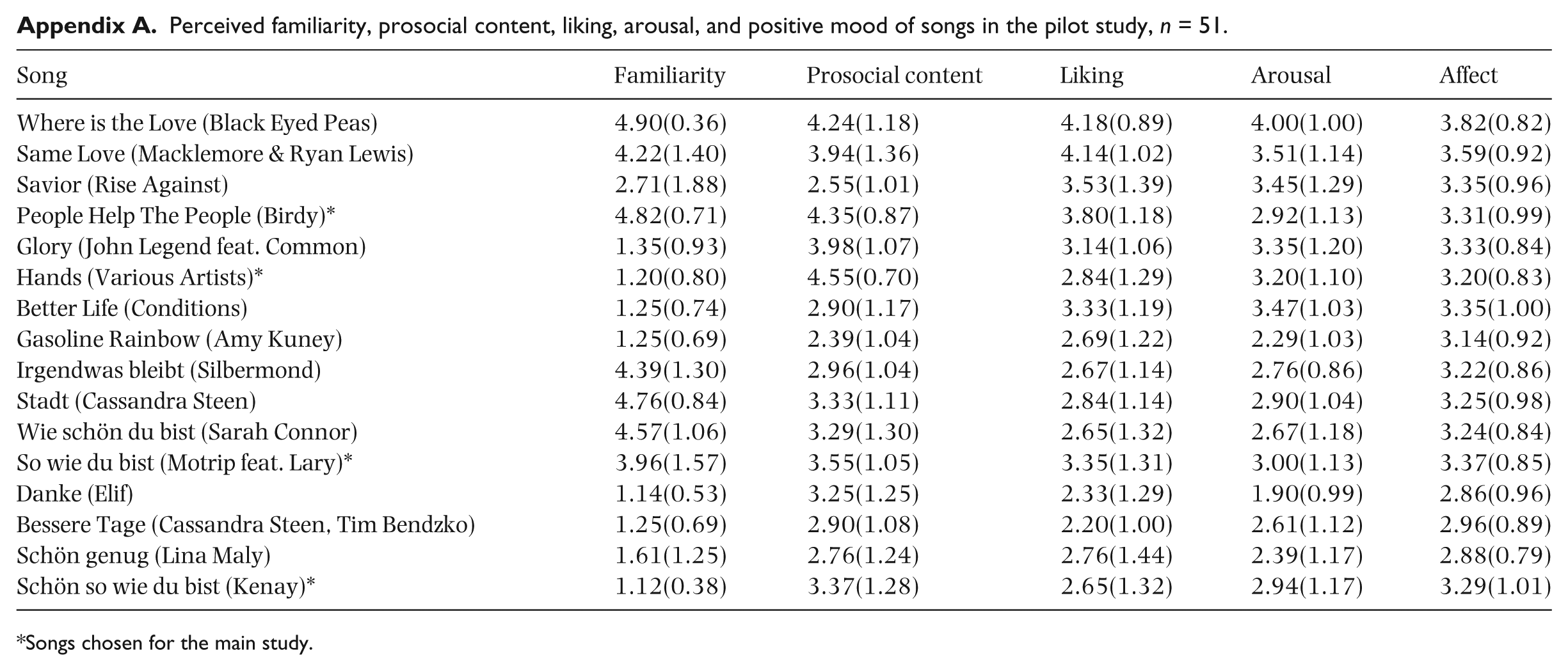
The songs rated the highest on perceived prosocial content with the largest differences in familiarity were chosen for the main study. The descriptive results for all of the songs are shown in Table 7 in the Appendix. The two selected English songs were the familiar “People Help the People” by Birdy (2011), which is about solidarity and helping each other, and the unfamiliar “Hands,” performed by 24 various artists (2016), including Jennifer Lopez and Britney Spears. “Hands” is a charity song for the victims of the mass shooting in a gay night club in Orlando in 2016. The two German selections were the familiar “So Wie Du Bist,” a rap song by MoTrip (2015) about people supporting other people who are struggling with their lives, and the unfamiliar “Schön so Wie Du Bist” by Kenay (2016), which is on the same topic as the song by MoTrip. Regarding affect and arousal, the songs were perceived in a comparable way; only liking varied, which is not surprising because the more familiar songs were slightly favored.
Participants
An online convenience sample was recruited via various online channels. The most efficient of these was the use of the online platform Survey Circle, which provides an exchange system for scholars seeking participants. Additionally, participants were recruited through postings on social media and personal correspondence. As an incentive, it was advertised that five participants would be selected at random to receive the sum of 20 Euros.
From the 289 participants who finished the survey, 69 were excluded based on the manipulation checks: knowing the unfamiliar songs, not knowing the familiar songs, or, among attentive listeners, being unable to state what the song lyrics were about. Additionally, participants were excluded based on the following exclusion criteria: spending too much or too little time on the survey or knowledge of the purpose of the study. This resulted in a final analytical sample of 220 persons.
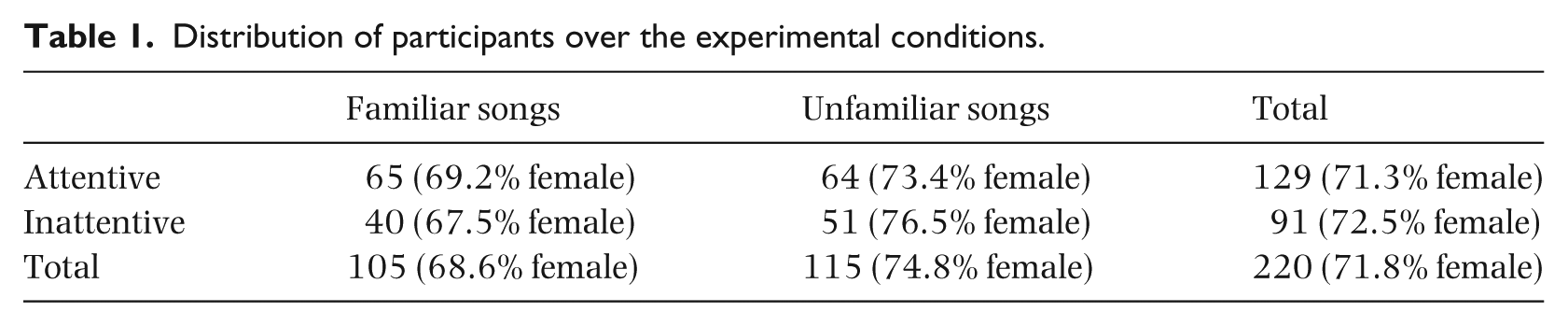
Participants were 71.8% female, with an average age of 25.8 years (SDage = 8.89). The distribution of participants over the experimental conditions can be seen in Table 1. Based on their responses using five-point Likert scales (5 = very much, 1 = not at all), the participants spoke and understood both German and English at a high level (MGerman = 4.94, SDGerman = 0.29; MEnglish = 3.57; SDEnglish = 0.64), were highly interested in music (M = 3.64, SD = 1.10), and had a below-average level of musical training (M = 2.69, SD = 1.33). Students from school made up 20.5% of the sample, 45.9% were students from universities, 30.9% were employed, and the rest were not working or studying. An unusually high percentage of the participants (43.2%) indicated that they held a higher education degree, which means the sample is not representative. Additionally, the sample was made up of a higher proportion of females than is found in the general population.
Distribution of participants over the experimental conditions.
Measurements
In the questionnaire, first, ephemeral variables such thoughts, emotions, and empathy were assessed. Questions concerning activated pre-knowledge, socio-demographics, and behavior were included at the end of the survey. Correlations between all dependent variables can be seen in Table 2.
Correlations between dependent variables.
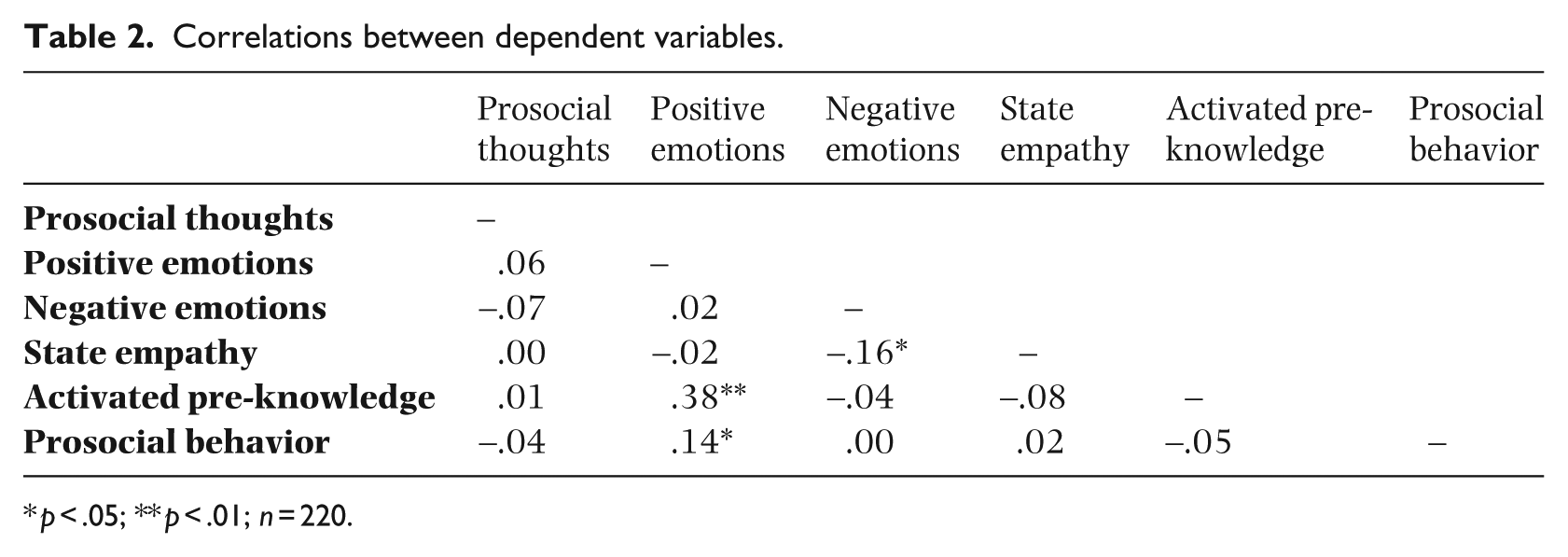
p < .05; ** p < .01; n = 220.
Prosocial thoughts
The German word completion task (WCT) by Mügge (2014) was used to measure the availability of prosocial thoughts. This is an implicit method previously used by Anderson et al. (2003) and Mügge (2014) to investigate the impact of songs with violent lyrics on participants’ aggressive thoughts. In the WCT used in the present study, participants were presented with 19 two- to nine-letter word fragments and asked to spontaneously form words from the stems. The chosen word stems could result in neutral or prosocial words (e.g., for HE_ _, a neutral word could be HEAD, and a prosocial word could be HELP). A score was calculated by coding all prosocial words as one and all other words as zero. A mean score was calculated from the relationship of prosocial words to other words, leading to an interpretable score ranging from 0 (no prosocial words) to 1 (only prosocial words).
Affect
To measure the accessibility of positive and negative emotions, the established Emotion Scales, an inventory for the self-rating of actual emotional feelings (EMO16) constructed by Schmidt-Atzert and Hüppe (1996), was used. To assess participants’ emotions after the song reception, they were asked to indicate on five-point Likert scales (1 = not at all, 5 = very much) how well each of 14 nouns described their emotions. Items used were, for example, “joy” and “fear.” Two subscales were compiled using seven items for negative emotions (α = .74) and seven for positive emotions (α = .77).
State empathy
To measure a situational feeling of empathy, parts of the FEPAA-E by Lukesch (2006) were used. This questionnaire consists of descriptions of scenarios with at least two persons involved in a conflict (e.g., “Tom has a brand new car that he lends to Marc for the weekend. Marc causes an accident with Tom’s car. How does Marc feel now?”). After the description of each scenario, participants were asked to choose one of three possible reactions for the first protagonist and the second protagonist. Following Lukesch’s guidelines, one of each set of three reactions could be considered an empathetic response (e.g., “Marc feels ashamed, because he caused the accident”). A total of six scenarios were used and adjusted to modern language in the current study. Sum scores were calculated ranging from 0 empathetic reactions, which indicates a low level of state empathy, to 12 empathetic reactions, which indicates a high level of state empathy.
Activated pre-knowledge
To assess the pre-knowledge activated by the songs, items were compiled that referred to the experiences that participants remembered in relation to the songs. Participants were asked to indicate, for example, whether they were reminded of media coverage about the song or if they remembered an event where the song appeared. These ratings were on five-point Likert scales (1 = not at all, 5 = very much). The items were designed following Hargreaves et al.’s (2005) suggestions on informational influence and using prior-knowledge items from marketing studies (Rao & Monroe, 1988). A mean index consisting of six items was calculated (α = .84).
Prosocial behavior
To measure an actual prosocial behavior, participants’ willingness to donate money to a charity project was assessed. On the last part of the questionnaire, participants could indicate whether they would like to sign up for the raffle of 5 times 20 Euros. Furthermore, they were informed that the study was associated with the charitable organization United Nations Children’s Fund (UNICEF) and that they could donate money to the organization. The last item asked the participants to decide what percentage of the 20 Euros they would be willing to donate to UNICEF. The more money they said they would give, the more prosocial their behavior was considered. After the raffle, a final total of 64 Euros was donated by the winners to UNICEF.
Results
A two-factor analysis of variance (ANOVA) was used to test hypotheses 1a and 1b. These hypotheses postulate that the listener’s attention level and familiarity with a song containing prosocial lyrics have an interaction effect on prosocial behavior. Indeed, the ANOVA revealed a significant interaction for attention and familiarity, F(1, 216) = 4.00, p < .05, η2 = .02, and a main effect for attention, F(1, 216) = 4.94, p < .05, η2 = .02, but no main effect for familiarity, F(1, 216) = 2.22, ns, η2 = .01. The results can be seen in Table 3. Figure 3 shows that, as hypothesized, those who listened inattentively to unfamiliar songs showed the least prosocial behavior, while attentive and inattentive listeners of familiar songs and attentive listeners of unfamiliar songs showed similar behavior. Thus, hypotheses 1a and 1b can be accepted.
Descriptive results on the interaction between familiar/unfamiliar songs with prosocial lyrics and attentive/inattentive listening on the listener’s prosocial behavior (donating 0 to 100 Euros).
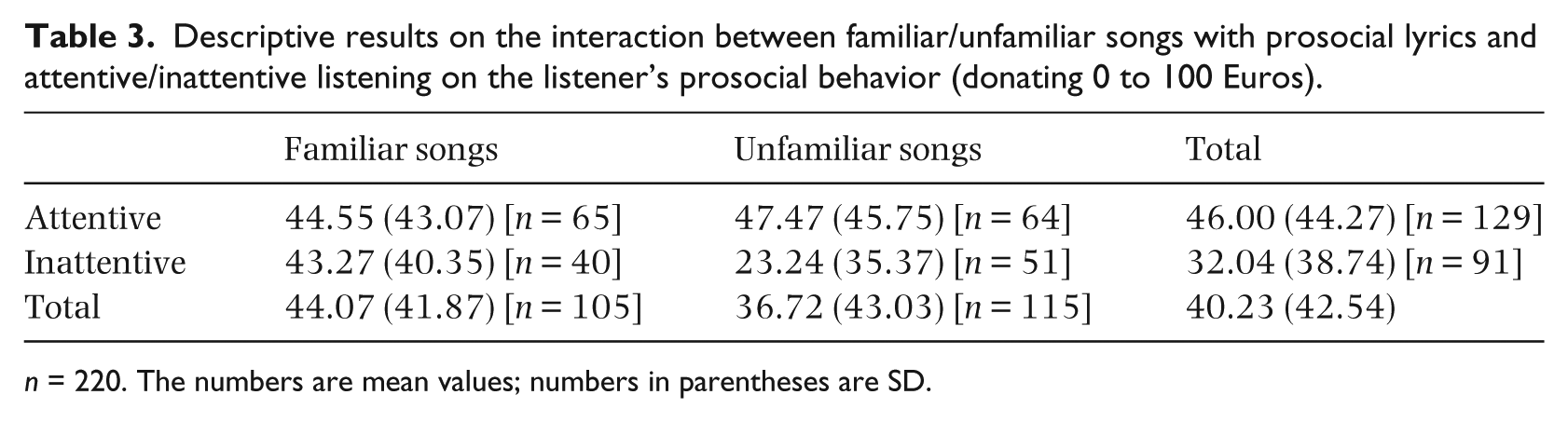
n = 220. The numbers are mean values; numbers in parentheses are SD.
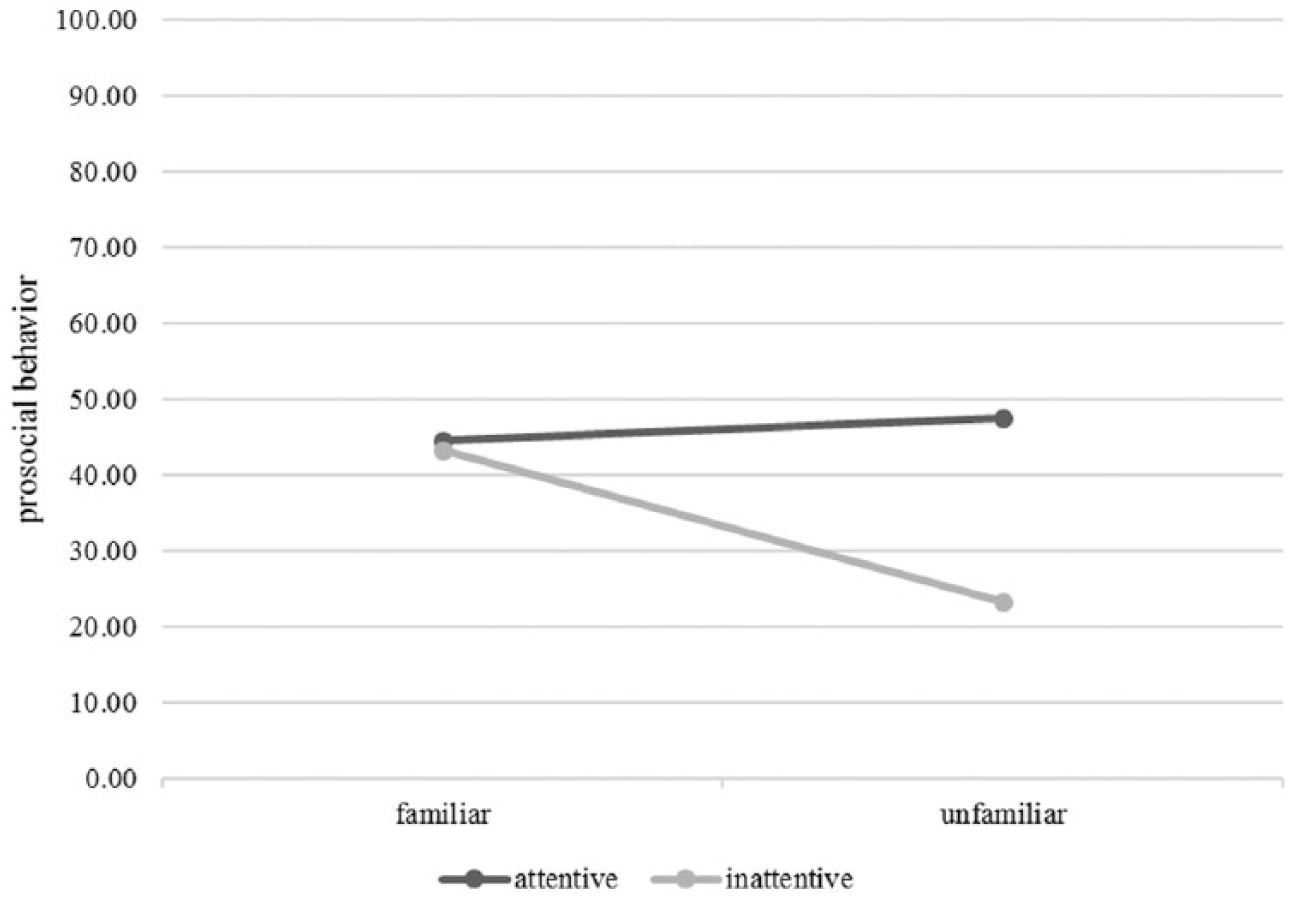
Interaction effect between familiar/unfamiliar songs with prosocial lyrics and attentive/inattentive listening on the listener’s prosocial behavior (donating 0% to 100% of 20 euros), n = 220.
Hypotheses 2a and 2b state that there is an interaction effect between attention and familiarity on prosocial thoughts. The ANOVA results showed no such interaction effect on prosocial thoughts as measured with the WCT, F(1, 216) = 0.08, ns, η2 < .01, no main effect for attention, F(1, 216) = 0.03, ns, η2 < .01, and no main effect for familiarity, F(1, 216) = 0.00, ns, η2 < .01. The descriptive results are listed in Table 4. Therefore, hypotheses 2a and 2b must be rejected.
Descriptive results on the interaction between familiar/unfamiliar songs with prosocial lyrics and attentive/inattentive listening on the listener’s prosocial thoughts.
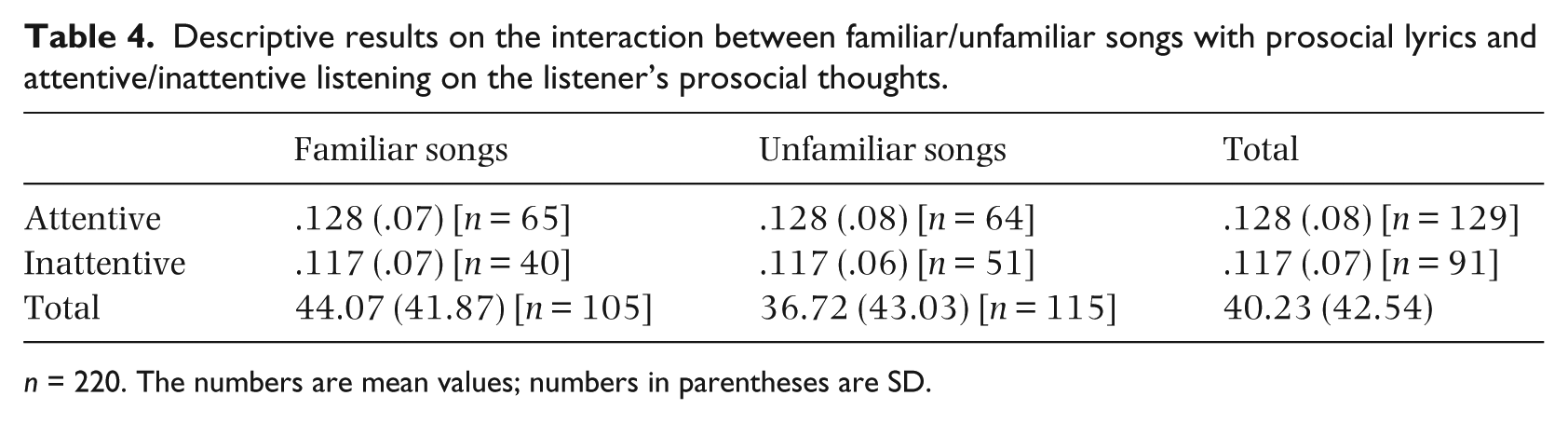
n = 220. The numbers are mean values; numbers in parentheses are SD.
Hypotheses 3a and 3b indicate that there is an interaction effect between attention and familiarity on state empathy. The ANOVA findings showed no interaction effect for state empathy as measured with the FEPAA-E, F(1, 216) = 0.14, ns, η2 < .01, no main effect for attention, F(1, 216) = 3.28, ns, η2 = .02, and no main effect for familiarity, F(1, 216) = 0.01, ns, η2 < .01). Although there is a tendency toward a main effect for attention on state empathy (see Table 5), hypotheses 3a and 3b cannot be accepted.
Descriptive results on the interaction between familiar/unfamiliar songs with prosocial lyrics and attentive/inattentive listening on the listener’s state empathy.
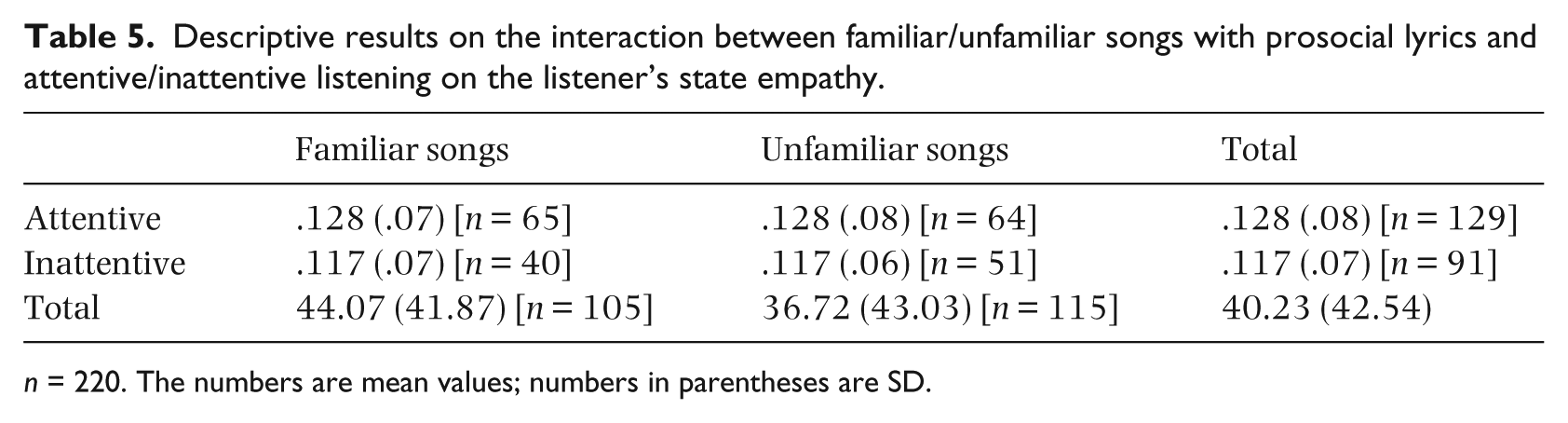
n = 220. The numbers are mean values; numbers in parentheses are SD.
Regarding the influence of attention and familiarity on affect, hypotheses 4a and 4b state that there is an interaction effect. To test the hypotheses, two ANOVAs for each subscale of the EMO16 were calculated. The first ANOVA showed no interaction effect for negative emotions, F(1, 216) = 0.00, ns, η2 < .01, and no main effect for familiarity, F(1, 216) = 2.05, ns, η2 = .01. However, there was a significant main effect for attention, F(1, 216) = 14.64, p < .01, η2 = .06. This means that attentive listeners showed significantly less negative emotions after listening to music with prosocial lyrics than did inattentive listeners (see Table 6). The second ANOVA showed no interaction effect for positive emotions, F(1, 216) = 0.96, ns, η2 < .01. However, there were significant main effects for both familiarity, F(1, 216) = 4.19, p < .05, η2 = .02, and attention, F(1, 216) = 18.34, p < .01, η2 = .08. The descriptive results, as shown in Table 7, demonstrate that attentive listeners have more positive emotions than do inattentive listeners and that familiar songs with prosocial lyrics evoke more positive emotions than do unfamiliar songs. Because of the significant main effects with no interaction effects, these hypotheses cannot be fully accepted.
Descriptive results on the interaction between familiar/unfamiliar songs with prosocial lyrics and attentive/inattentive listening on the listener’s negative emotions.
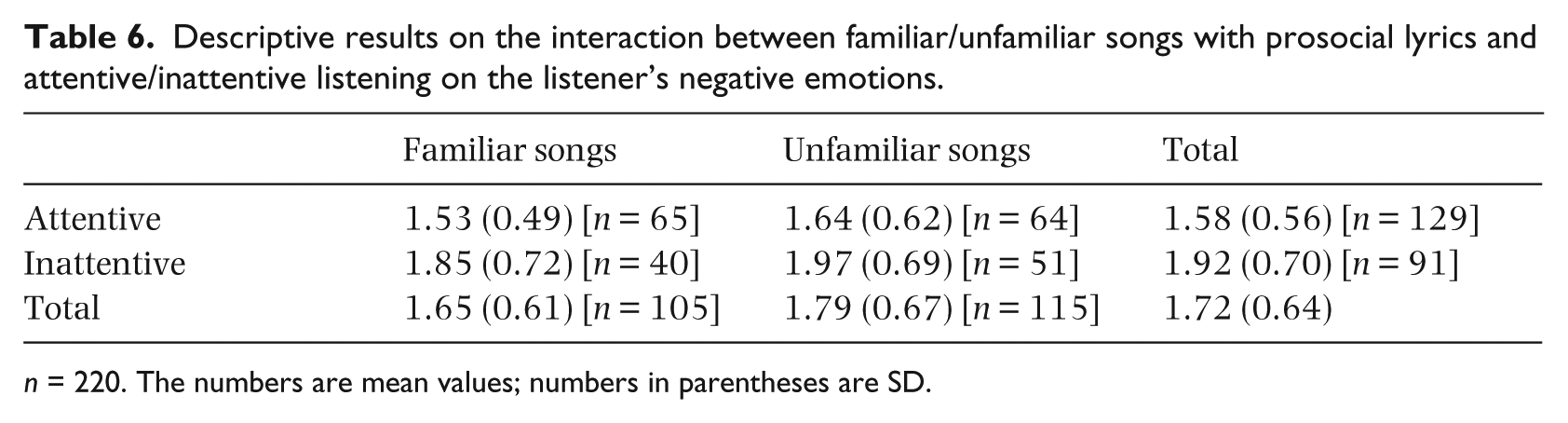
n = 220. The numbers are mean values; numbers in parentheses are SD.
Descriptive results on the interaction between familiar/unfamiliar songs with prosocial lyrics and attentive/inattentive listening on the listener’s positive emotions.
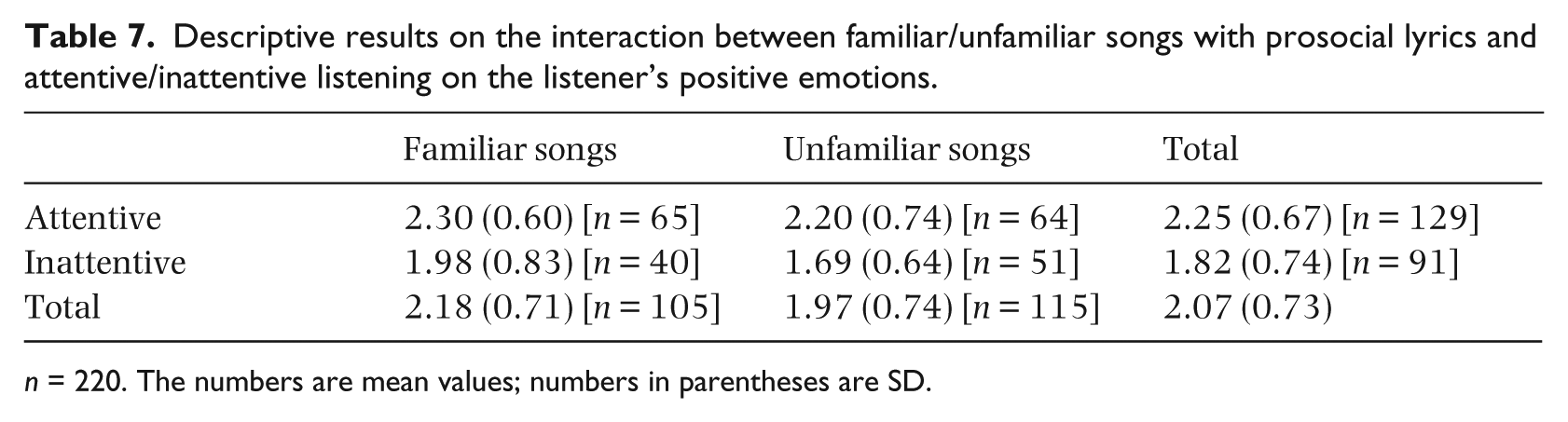
n = 220. The numbers are mean values; numbers in parentheses are SD.
Hypothesis 5 states that the familiarity of the music triggers the listener’s pre-knowledge, which, in turn, affects cognition and affect, eventually having an impact on prosocial behavior. To test this hypothesis, four mediation analyses using bootstrapping based on 10,000 samples were calculated to assess the indirect effect of the familiarity of the music on prosocial behavior mediated by activated pre-knowledge (M = 2.08, SD = 1.08) and the internal state – prosocial thoughts (b = 0.00, bias-corrected and accelerated bootstrapped confidence interval; BCa BCI [−0.04, 0.08]), state empathy (b = 0.13, BCa BCI [−0.03, 0.05]), positive emotions (b = 6.41, BCa BCI [2.37, 11.83]), and negative emotions (b = 0.14, BCa BCI [−0.48, 1.86]). The only significant mediation model found was through positive emotions, R2 = .44, p < .01. The results (Figure 4) indicate that a familiar song activates pre-knowledge, which affects the listener’s positive emotions and eventually leads to more prosocial behavior.
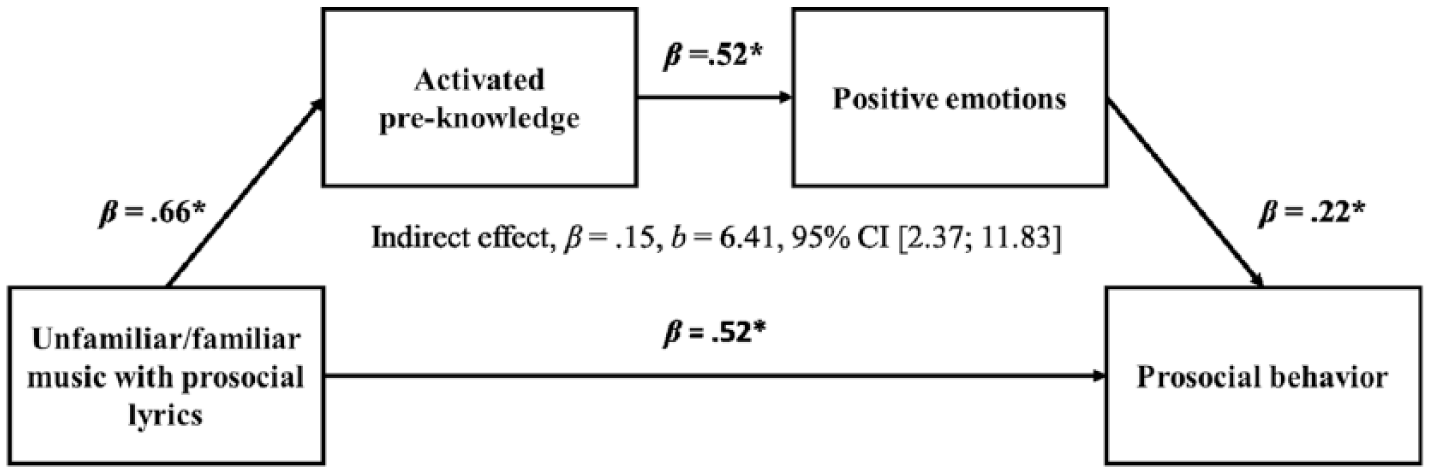
Model of familiar music as a predictor of prosocial behavior mediated by activated pre-knowledge and positive emotions, bias-corrected and accelerated bootstrapped confidence interval based on 10,000 samples, n = 220; * = p < .01.
Discussion
The results presented give us insights on how we process music with references to prosocial behavior. Two factors, namely, attention and familiarity, play an important role in music processing. When the effects of music and lyrics are investigated, musical factors like familiarity and situational factors like the attention of the listeners should be taken into account. The short-term effect proposed by the GLM can be approved by the current results: the interplay between music, person and situation lead to an altered internal state and eventually lead to prosocial behavior.
The observed interaction effect between the attention level and the familiarity of the music with prosocial lyrics on prosocial behavior fits hypotheses 1a and 1b. The descriptive results indicate that an unfamiliar song affects attentive listeners slightly more, compared with a familiar song. Following the assumptions drawn from the ELM, it is understandable that inattentive listeners tend to behave less prosocially. This can be explained by participants having insufficient ability to process the content because of the distraction of the math test, combined with a lack of pre-knowledge about the music that might be used for heuristic processing. Thus, the prosocial content could not affect the listener’s behavior.
No effect of the manipulated factors on prosocial thoughts was found, and no descriptive differences were found among the experimental groups. It might be that their prosocial thoughts were similar because no neutral or antisocial lyrics were used in comparison, as in the studies by Greitemeyer (2009b). Additionally, no significant interaction effect of the factors for state empathy was found. One could argue that this is because the lyrics were about the general problems of society instead of about a person’s specific problem with whom one could empathize. Still, a marginally significant (p = .07) main effect for attention was found. This effect does not fully prove the hypotheses to be correct, but it does provide evidence that attentive listening leads to higher state empathy.
Empirical evidence from previous studies did not clarify which aspects of affect besides empathy are triggered by music with prosocial lyrics. The results of the current study indicate that attentive listening to this kind of music leads to less negative emotions and more positive emotions. The music being familiar to the listener also leads to more positive emotions. The latter finding can be explained by the close connection between familiarity and liking (North & Hargreaves, 1995), which, in turn, might lead to positive emotions.
Finally, the mediation analysis conducted here is consistent with the music processing model’s proposition of activated pre-knowledge and positive emotions as mediators. When listeners are familiar with the song, their pre-knowledge is activated. This, in turn, triggers positive emotions that increase the possibility that listeners will act prosocially in a decision-making situation. Although other variables seem to be reasonable mediators, only positive emotions led to a significant indirect effect.
Limitations
Although the experimental design and the pretested and valid music stimuli were operationalized in a rigorous way, there are some limitations that should be mentioned. First, no control groups for comparable songs with neutral lyrics were included. Because the effect of prosocial lyrics in comparison with neutral lyrics is well documented (Jacob et al., 2010; Greitemeyer, 2009a; Ruth, 2017a) and the major dependent variable in the present study is prosocial behavior, it was more efficient to focus on the two major factors of familiarity and attention and only on prosocial lyrics. Second, the results might be biased by participants’ fondness for the songs. Liking and familiarity are two correlated factors when it comes to music (North & Hargreaves, 1995). Based on the pilot test, participants’ liking of the songs varied. However, future studies might want to focus on finding familiar and unfamiliar songs that do not vary in terms of liking or want to measure liking as a covariate. Third, the WCT as proposed by Mügge (2014) might not have measured the assessment of prosocial thoughts as well as this was done in other studies (e.g. Greitemeyer, 2009b), because no mean differences were found among the experimental groups. Other methods, such as the thought listing task introduced by Cacioppo, von Hippel, and Ernst (1997), could be applied in future studies. Fourth, it is possible that the FEPAA-E questionnaire did not assess state empathy as expected. This might be because the task was presented too late in the survey and the ephemeral effect had already vanished, or because six scenarios were insufficient for assessing empathy. It is also possible that the lack of significant findings might be due to participants answering very empathetically because of social expectations. Thus, future studies should consider using an empathy measurement such as the one introduced by Cialdini et al. (1997). Fifth, the measurement of prosocial behavior is a rather implicit measure because the participants had not yet received the money they could choose to donate. One could argue that, because of social desirability bias, participants indicated that they would spend more money than they actually would if they were already holding the money in their hands. However, the results show that the willingness to donate was rather low. In any case, at minimum, the measurement can be regarded as an indicator of a prosocial behavior that would potentially lead to an actual donation. Sixth, a mathematical task was favored over a verbal task (Gutscher et al., 2011). The adapted task from an intelligence test might have been very challenging, causing some participants to engage too much. Although the manipulation was successful, the task itself might have had an impact on the participants’ cognitions and emotions. Additionally, the mathematical task seems to have led to more drop-outs among the inattentive groups (see Table 1). Seventh, the convenience sample drawn for this study was highly educated and had a higher proportion of females than is seen in the general population. However, it was the online sampling method that made selecting a sample of this size – even after excluding so many participants – possible. Finally, as always with popular music, it is difficult to prove that the content and the music of the songs used was comparable. The pilot study showed that the songs used were comparable on most of the parameters, and they were preselected because of their content. Of course, the best way to assure comparable content would be to produce original songs for future studies. This is difficult to accomplish because of the high production standards in recent popular music.
Conclusions
The theorized music processing model proposed in this article could be validated by the results to a certain extent. Incorporating an experimental design, a valid stimulus, and the measurement of an actual prosocial behavior, the present study showed how important pre-knowledge and attention are for the processing of music with prosocial lyrics. From the previously described theoretical point of view, the effects of attention and familiarity and the mediation process seem reasonable – at least for one internal state variable, namely, positive emotions. In addition to the listening scenarios examined in this study, there are many other variables that should be taken into account in future studies. For example, there is a need for studies that thoroughly investigate how music and lyrics should be designed to impact listeners’ reactions and behavior. Therefore, more studies (like Pieschl & Fegers, 2015) altering musical parameters and lyrics for inclusion in experimental designs should be conducted.
Again, there are many other factors in the process model that should be further investigated to fully understand the effect of music with prosocial lyrics on listeners. However, it is safe to say that, if you want to make the world a better place, you need the listener’s attention or pre-knowledge of a familiar song.
Footnotes
Appendix
Perceived familiarity, prosocial content, liking, arousal, and positive mood of songs in the pilot study, n = 51.
| Song | Familiarity | Prosocial content | Liking | Arousal | Affect |
|---|---|---|---|---|---|
| Where is the Love (Black Eyed Peas) | 4.90(0.36) | 4.24(1.18) | 4.18(0.89) | 4.00(1.00) | 3.82(0.82) |
| Same Love (Macklemore & Ryan Lewis) | 4.22(1.40) | 3.94(1.36) | 4.14(1.02) | 3.51(1.14) | 3.59(0.92) |
| Savior (Rise Against) | 2.71(1.88) | 2.55(1.01) | 3.53(1.39) | 3.45(1.29) | 3.35(0.96) |
| People Help The People (Birdy)* | 4.82(0.71) | 4.35(0.87) | 3.80(1.18) | 2.92(1.13) | 3.31(0.99) |
| Glory (John Legend feat. Common) | 1.35(0.93) | 3.98(1.07) | 3.14(1.06) | 3.35(1.20) | 3.33(0.84) |
| Hands (Various Artists)* | 1.20(0.80) | 4.55(0.70) | 2.84(1.29) | 3.20(1.10) | 3.20(0.83) |
| Better Life (Conditions) | 1.25(0.74) | 2.90(1.17) | 3.33(1.19) | 3.47(1.03) | 3.35(1.00) |
| Gasoline Rainbow (Amy Kuney) | 1.25(0.69) | 2.39(1.04) | 2.69(1.22) | 2.29(1.03) | 3.14(0.92) |
| Irgendwas bleibt (Silbermond) | 4.39(1.30) | 2.96(1.04) | 2.67(1.14) | 2.76(0.86) | 3.22(0.86) |
| Stadt (Cassandra Steen) | 4.76(0.84) | 3.33(1.11) | 2.84(1.14) | 2.90(1.04) | 3.25(0.98) |
| Wie schön du bist (Sarah Connor) | 4.57(1.06) | 3.29(1.30) | 2.65(1.32) | 2.67(1.18) | 3.24(0.84) |
| So wie du bist (Motrip feat. Lary)* | 3.96(1.57) | 3.55(1.05) | 3.35(1.31) | 3.00(1.13) | 3.37(0.85) |
| Danke (Elif) | 1.14(0.53) | 3.25(1.25) | 2.33(1.29) | 1.90(0.99) | 2.86(0.96) |
| Bessere Tage (Cassandra Steen, Tim Bendzko) | 1.25(0.69) | 2.90(1.08) | 2.20(1.00) | 2.61(1.12) | 2.96(0.89) |
| Schön genug (Lina Maly) | 1.61(1.25) | 2.76(1.24) | 2.76(1.44) | 2.39(1.17) | 2.88(0.79) |
| Schön so wie du bist (Kenay)* | 1.12(0.38) | 3.37(1.28) | 2.65(1.32) | 2.94(1.17) | 3.29(1.01) |
Songs chosen for the main study.
Acknowledgements
I would like to thank my students Laura Häpp, Yannick Schmiech, and my colleague Nicole Liebers for their support with the study. Especially, many thanks to my supervisor Prof. Dr. Holger Schramm for the support during the work on this paper and my whole PhD project.
Funding
The author(s) received no financial support for the research, authorship, and/or publication of this article.