



Abstract
Adults’ (N = 220) reported motivations for listening to sad music after experiencing adverse negative circumstances were examined by exploring how their music selection strategies related to (a) their self-regulatory goals, and (b) reported effects of listening. The effects of music selection strategies, self-regulatory goals, and reported effects on the achievement of mood enhancement were also explored using a retrospective survey design. The findings indicate that music choice is linked to the individual’s identified self-regulatory goals for music listening and to expected effects. Additionally, the results show that if individuals had intended to achieve mood enhancement through music listening, this was often achieved by first experiencing cognitive reappraisal or distraction. The selection of music with perceived high aesthetic value was the only music selection strategy that directly predicted mood enhancement. Where respondents indicated that they chose music with the intention of triggering memories, this was negatively related to the self-regulatory goal of mood enhancement.
Keywords
Self-regulatory goals for music listening and their effects are of interest to scholars in psychology, musicology and sociology, and for practitioners in music therapy and music education (Edwards, 2011; Hallam, Cross, & Thaut, 2011). Music-listening effects have traditionally been examined through laboratory tests of responses to experimenter-selected music. However, recent research has started to focus on individuals’ reports of the effects of self-selected music, in order to further understand aspects of everyday music use (Rentfrow, 2012).
The current study investigated music listening in order to understand people’s self-regulatory goals, music selection strategies, and the effects of self-selected music that the listener identified as sounding sad; what we describe as Self-Identified Sad Music (SISM). We are interested in why people sometimes decide to listen to music that they identify as sad when they are already feeling sad after experiencing an adverse event. We believe that we can learn about people’s motivation for listening to sad music by asking people to reflect upon their experiences and describe their choices.
Motivations to listen to sad music when feeling sad
Several recent studies provide evidence that people listen to sad music when experiencing sadness or adverse negative affective states (Hunter, Schellenberg, & Griffith, 2011; Matsumoto, 2002; Saarikallio & Erkkilä, 2007; Schellenberg, Peretz, & Vieillard, 2008; Van den Tol, 2012, 2013). For instance, results of a focus group study that was conducted with 11 Finnish adolescents showed that participants who were sad or angry were inclined to listen to SISM in order to think through and work out problems, as a distraction from problems, for expressing emotions, and to attain closure (Saarikallio & Erkkilä, 2007). Similarly, Miranda and Claes (2009, p. 218) indicated that “music listening can be thought of as being used intentionally by adolescents for coping with daily stressors.” Moreover, experimental research shows that the desire to listen to sad music is strongest directly after a negative mood, whereas people are more likely to listen to uplifting music when some time has passed after negative mood induction (Chen, Zhou, & Bryant, 2007).
Music listening and self-regulation
A range of recent studies have investigated the extent to which self-regulatory goals can be attained through music-listening. For example, music-listening can be used to change, maintain, or reinforce affect, moods and emotions (i.e., Chen et al., 2007; Knobloch & Zillmann, 2002; Lonsdale & North, 2011), for relaxation (Thayer, Newman, & McClain, 1994), for reminiscence or to trigger nostalgia (i.e., Knobloch & Zillmann, 2002; Van Goethem & Sloboda, 2011), for stimulating cognitive effects (Sloboda, Lamont, & Greasley, 2009), for meaning enhancement (Maher, Van Tilburg, & Van den Tol, 2013), or as a platform for mental work or cognitive reappraisal (i.e., Lonsdale & North, 2011; Saarikallio, 2007, 2008; Saarikallio & Erkkilä, 2007).
Consistent with the above findings, listening to SISM when feeling sad has also been found to serve many self-regulatory functions. In a recent study, 65 adults were asked to write about a recent occasion in which they had decided to listen to SISM when they were feeling sad (Van den Tol & Edwards, 2011). Participants indicated that listening to SISM could have a variety of psychological effects: (Re-)experiencing affect, which means getting in touch with or intensifying affective states; Retrieving memories, which means retrieving episodic memories associated with the music; Cognitive, which refers to the use of music for cognitive reappraisal; Friend, where the music was described as serving as a symbolic friend; Social, reflecting feeling closer to or emotionally connected to (real) friends and family; Distraction, which refers to the use of music for distraction and keeping the mind of from unwanted feelings and thoughts; and Mood enhancement, which involves making one feel better or less sad. Most participants indicated that listening to sad music when feeling sad could sometimes be used as an effective way to cope with an adverse event.
Listening to sad music when feeling sad and music-listening strategies
Results of a number of recent studies suggest that people can use different strategies to select music, and that the selection of these strategies depends on the goals they are pursuing in a specific situation (Chen et al., 2007, DeNora, 1999; Lonsdale & North, 2011; Saarikallio & Erkkilä, 2007; Thoma, Ryf, Mohiyeddini, Ehlert, & Nater, 2012). The following music-selection strategies were found in a qualitative study about listening to SISM when feeling sad (Van den Tol & Edwards, 2011): Connection, meaning selecting a specific piece of music because the music portrays affect or has lyrics that the listener can identify with at that moment; Memory Triggers, referring to the selection of music because the music has associations with past events and persons; High Aesthetic Value, which involves selecting the music because one perceives the music to be “good” or “beautiful music;” and also Message Music, where music is chosen that conveys a message to which the listener wants to relate. Moreover, the music selection strategies and self-regulatory effects were linked to each other. Specifically, people often seemed to use a connection selection strategy when they wanted to (re-)experience affect, people often aimed for cognitive reappraisals when they used music which conveys a message, when people selected music with a high aesthetic value they often aimed for distraction or mood enhancement, and when people used a memory triggers selection strategy, they often did so in order to retrieve memories, to feel social and to (re-)experience affect. It was indicated, however, that quantitative follow up research with a larger sample is needed, in order to generalize these findings to a larger population (Creswell, Plano Clark, Guttmann, & Hanson, 2003).
Listening to sad music when feeling sad and mood enhancement
Some of the participants in the study by Van den Tol and Edwards (2011) indicated they experienced mood enhancement as a result of listening to SISM when feeling sad. Many different psychological processes have been suggested to play a role in positive affective experiences that can be experienced as a result of listening to sad music (Blood & Zatorre, 2001; Huron, 2011; Kallinen & Ravaja, 2006; Matsumoto, 2002; Saarikallio, 2008; Vuoskoski, Thompson, McIIlwain, & Eerola, 2012). Listening to self-identified pleasant music results in brain activity in regions associated with reward and displeasure inhibition (Blood & Zatorre, 2001; Menon & Levitin, 2005; Schubert, 1996). Moreover, findings by Vuoskoski et al. (2012) indicate that people who score high on the traits aesthetic appreciation and empathetic engagement enjoy sad music to a greater extent than people who score low on either one of these traits. Based on the above findings, it is likely that we will also find indications that mood enhancement can be achieved directly as a result of selecting sad music that is judged to have high aesthetic value. More specifically, it may be likely that people will consciously select music with high aesthetic value when they aim to achieve mood enhancement after having experienced an adverse event.
A variety of different studies indicate that engagement in cognitive re-appraisal and behavioural diversion (e.g. listening to music to distract the self from problems) or distraction are among the most effective behavioural strategies used to pursue mood enhancement (Hayes et al., 2010; Kross, Ayduk, & Mischel, 2005; Totterdell & Parkinson, 1999). In line with this, it has been found that the common use of music for diversion (a concept that relates to listening to music for distraction) and mental work (a concept that includes listening to music for cognitive reappraisal) related positively to perceiving oneself to be efficient in repairing one’s mood (Saarikallio, 2008). This was found in a cross-sectional survey that was conducted among a group of Finnish adolescents. It is hence likely that listening to SISM may also result in mood enhancement when music is used for cognitive re-appraisal or distraction, and that people use these effects of music when they aim to achieve mood enhancement.
Listening to SISM when feeling sad can be used in order to experience acceptance, support, or empathy from the music, which has been described as experiencing that the music is a friend (Van den Tol & Edwards, 2011). Findings from a study on the use of music conducted among adolescents (Saarikallio, 2008) indicated that the common use of music for solace (a concept that includes listening to music to experience friendship with the music) was positively correlated with mood-repair. However, exploration of earlier collected narrative data about SISM when feeling sad (Van den Tol & Edwards, 2011) did not reveal any examples in which participants experienced mood enhancement as a result of “the experienced friendship with the music.” We hence believe that the friendship element in sad music may potentially represent a different value than the solace element in music in general. In other words, the current research is hoped to shed more light on how the imagined friendship that is experienced during SISM can be categorized in terms of perceived coping value.
In previous research on SISM, it was found that the memories that are recalled during listening to SISM often involve missed loved ones, and foregone times (Van den Tol & Edwards, 2011). This description of memories seems to resemble some elements of nostalgia. Wildschut, Sedikides, Arndt and Routledge (2006) described nostalgia as a bittersweet emotion that is a happiness-related experience but also contains elements of negative emotionality. They also indicated that nostalgia often involves the self as a protagonist in interactions with close others. Interestingly, research has indicated that people often engage in nostalgia in order to repair negative moods (Wildschut et al., 2006). Moreover, Barrett et al. (2010) found that sad moods can motivate people to listen to music as a means to retrieve nostalgic memories and enhance positive moods. However, findings of previous qualitative research on SISM indicated that only some people felt better after having retrieved memories during SISM, whereas others participants reported to find it unpleasant to engage in memory retrieval during music-listening (Van den Tol & Edwards, 2011). Moreover, one participant indicated to have expected to feel better but to unexpectedly feel worse after having listening to the music of his choice. It is hoped that the current research provides more light on the phenomena of SISM memories retrieval and mood enhancement.
Aims
Three specific aims guided this research:
(1) As a first aim, we sought to identify several distinct groups of music selection strategies, self-regulatory goals and self-reported effects. More specifically, we wanted to find out how the items on the SISM questionnaire that we designed would statistically group together.
(2) As a second aim we sought to “understand music selection strategies.” More specifically, we were interested in people’s motivations for selecting music. This part of the research extended prior qualitative research by examining the strengths of the relationships between each specific music-selection strategy and specific self-regulatory goals and reported effects. 1
(3) As a third aim, we sought to “understand mood enhancement.” More specifically, we wanted to examine which music-selection strategies, which self-reported effects, and which self-regulatory goals predicted the experience and achievement of mood enhancement.
Hypotheses
An overview of more specific predictions in relation to each of the above-mentioned aims are provided as follows:
(1) It was predicted that categories of items would represent the goals, effects, and strategies that were observed in previous research on SISM when feeling sad.
(2a) Participants who use a connection selection strategy will be most likely to report feeling sadness and wanting to experience sadness as a self-regulatory goal.
(2b) Participants who use a memory triggers selection strategy will be most likely to report experiencing memories, feeling closer to others, and to feeling sadness, and to also have pursued these effects as a self-regulatory goal.
(2c) Participants who select music with a direction strategy will be most likely to report experiencing cognitive reappraisals and to also have pursued this as a self-regulatory goal.
(2d) Participants who select music with a high aesthetic value selection strategy will be most likely to report experiencing distraction, or mood enhancement and to also have pursued this as a self-regulatory goal.
(3a) It was predicted that participants would report having experienced mood enhancement when participants also reported having experienced cognitive or distracting effects of listening to SISM, and that people actively pursue cognitive or distracting music-listening experiences when they aim to experience mood enhancement. In other words, distraction and cognitions will mediate mood enhancement independent of which music selection strategy is used.
(3b) It was predicted that selecting the SISM (just) for its high aesthetic value would be the only music-selection strategy that could predict mood enhancement as a goal or as an effect (independently of other self-regulatory goals, or other recalled effects).
Methods
Participants
A total of 220 adults volunteered to participate in this study (135 females, 80 males, and 5 undisclosed). Participants’ ages ranged from 18 to 69 (M = 28.30 SD = 11.51). The study represented participants of 26 different nationalities; 74 participants were Caucasians from the USA, 38 were Irish, 24 were Dutch, 12 were British, 10 were African-Americans, 9 were Australian, 8 were Canadian, 6 were Greek, 3 were Malaysian, 3 were Belgian, 22 participants indicated having another nationality, and 11 participants did not report their nationality.
Measures
A questionnaire was developed for the purpose of investigating people’s recalled music listening motivations and effects of SISM during a recent event when feeling sad. This questionnaire started with requesting the participant to think back to an adverse emotional event they had experienced after which they had listened to music that portrayed sadness. Participants were then asked to rate several statements, each on 5-point interval scales ranging from 1 (I do not agree with this at all) to 5 (I very much agree with this). To decrease error a “not applicable” option was added to this interval scale. Participants firstly rated several statements relating to the music selection strategies they had used for selecting the music (“I chose to listen to the sad music because . . .” for example, “. . . the music contains lyrics that communicated hope.”). Next, they rated several statements relating to self-regulatory goals they wanted to achieve as a result of listening to the sad music (“The reasons I listened to the sad music was . . .” for example, “. . . to bring back memories.”). Participants then rated several statements relating to the recalled effects of listening (“Listening to this sad music did . . .” for example, “. . . bring back memories.”). Participants’ level of attention were checked by using two attention check items that explicitly instructed participants how to rate them. These items were placed in the middle and at the end of the questionnaire. After rating all statements, participants provided information about age, nationality and gender.
The self-report of experiences served a valuable purpose: we were interested in people’s everyday life experiences of listening to SISM when feeling sad after adverse circumstances. This may not always be usefully studied within a laboratory or controlled environment where emotional states have to be induced, and ethical issues may subsequently arise. Consistent with approaches such as those from within narrative research (Gabrielsson; 2011; Moen, 2006) we advocate the use of retrospective recall in human subject research as a means by which humans’ construction of their experiences can be usefully examined. To quote (Gabrielsson, 2011, p. 455), “They are perhaps never completely faithful to the original, but can nevertheless be said to be accurate in the sense that they represent the meaning that the experience had to the person concerned.” Rather than focusing on what might be flawed or inaccurate about the findings, we contend that as long as our findings are indicated to be based on recall rather than real time experiences, our method is congruent with many current approaches in research about human experience.
Procedure
Participants were recruited by email invitations for which we used the University email system and by invitations via the internet, including social science research networks. The invitation stated that University researchers were looking for participants to volunteer for a study exploring people’s motivations to listen to sad music when feeling sad. The invitation included a link to the website where a detailed information sheet, a consent form and the study were provided. Upon completing the study, participants were thanked for their participation and were provided with a comment box for any additional information that they wished to share.
A total of 10 participants who either failed to provide the correct answer to the attention checks, who missed more than five statements, or who had selected the “not applicable” option more than five times, were dropped from the sample. A missing value analysis was conducted on the dataset to be able to also use the responses of participants from which only some data was missing (Tabachnick & Fidell, 2007). The research procedure was approved by the Faculty of Arts, Humanities and Social Science Research Ethics Committee of the University of Limerick, Ireland.
Results
Aim 1: Structure of the data
Five principal component analyses were conducted to investigate the structure of the data in order to statistically explore Aim 1. Principal component analysis is a statistical approach used for investigating underlying structures of items and for grouping items together based on their magnitudes of covariance (e.g. Tabachnick & Fidell, 2007). In order to be able to use the extracted components for the investigation of some of the other research questions in which regression based techniques are used, it was important to extract components with relatively low multicolinearity (Ezekiel & Fox, 1959, pp. 283–284). Hence, we employed a varimax rotated solution, deleted items that loaded higher than 0.45 on more than one component, and conducted new analyses with the remaining items until several distinct multiple-item components occurred (Hair, Anderson, Tatham, & Black, 1998; Tabachnick & Fidell, 2007).
A categorization of five distinct direct goals and five distinct direct effects was indicated (see Table 1 and Table 2). The direct goals and effects were labelled Sadness, Memories & Social, Distraction, Cognition and Friend (reflecting the labels of Van den Tol & Edwards, 2011). Sadness referred to getting in touch with or intensifying affective states. For Memories and Social, the memory part of this label referred to retrieving episodic memories associated with the music, and the social part of this label reflected feeling closer to or emotionally connected to (real) friends and family. Cognitions referred to the use of music for cognitive reappraisal, Friendship referred to that the music can serve as a symbolic (imaginary) friend, and Distraction referred to the use of music for distraction and keeping the mind off unwanted feelings and thoughts.
Rotated component matrix on direct goals.
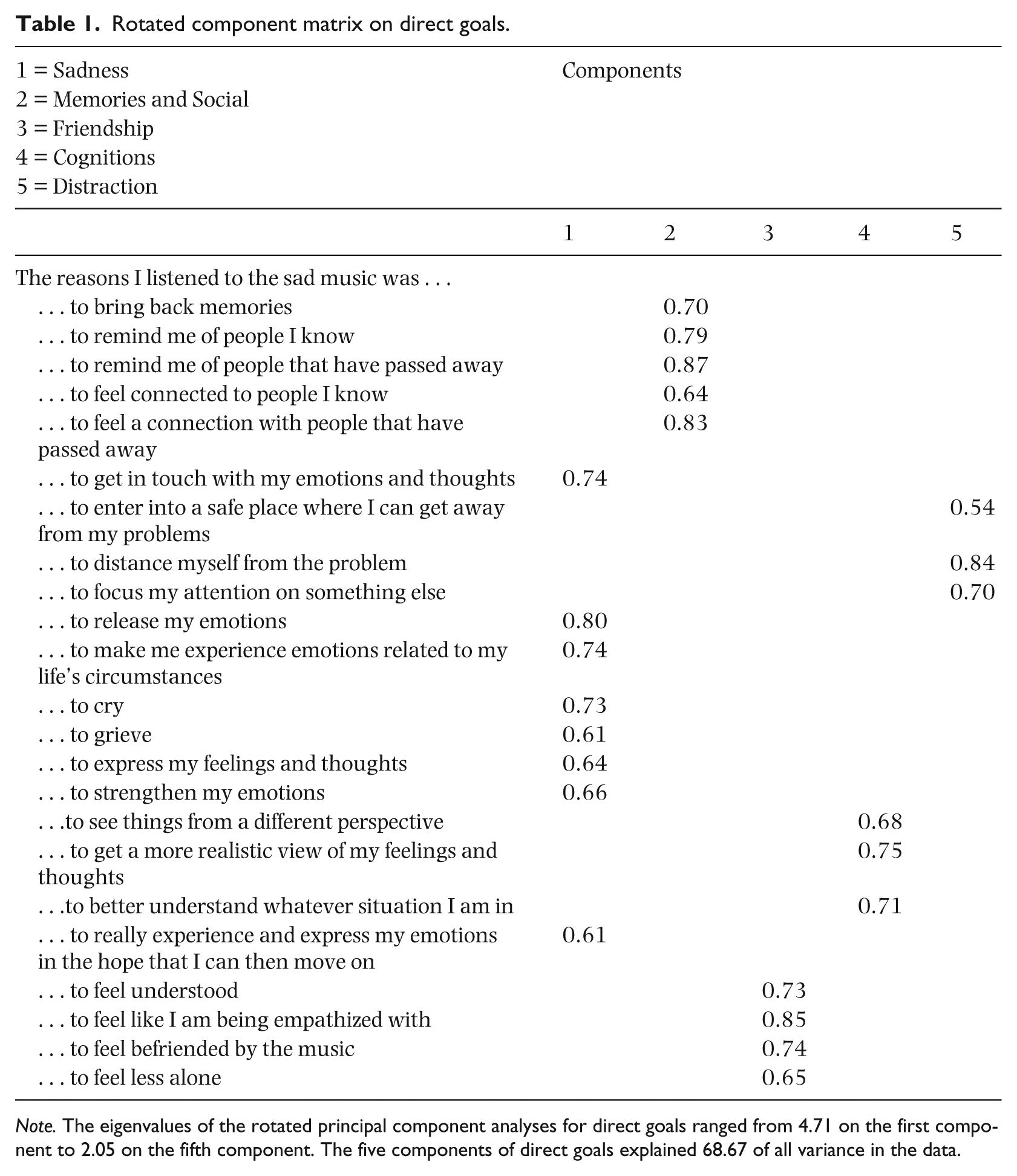
Note. The eigenvalues of the rotated principal component analyses for direct goals ranged from 4.71 on the first component to 2.05 on the fifth component. The five components of direct goals explained 68.67 of all variance in the data.
Rotated component matrix on direct effects.

Note. Eigenvalues of the rotated principal component analysis for direct effects ranged from 5.19 on the first component through 2.27 on the fifth component, and explained 66.90% of variance in total.
One component was found in both analyses on indirect goals and indirect effects. The items of this component (see Table 3 and Table 4) reflected the description of the category Mood Enhancement. The label Mood Enhancement referred to making one feel better or less sad.
Rotated component matrix on indirect goals.

Note. The eigenvalue on the only rotated component on the principal component analysis on indirect goals was 3.20 and explained 64.01 of all variance.
Rotated component matrix on indirect effects.
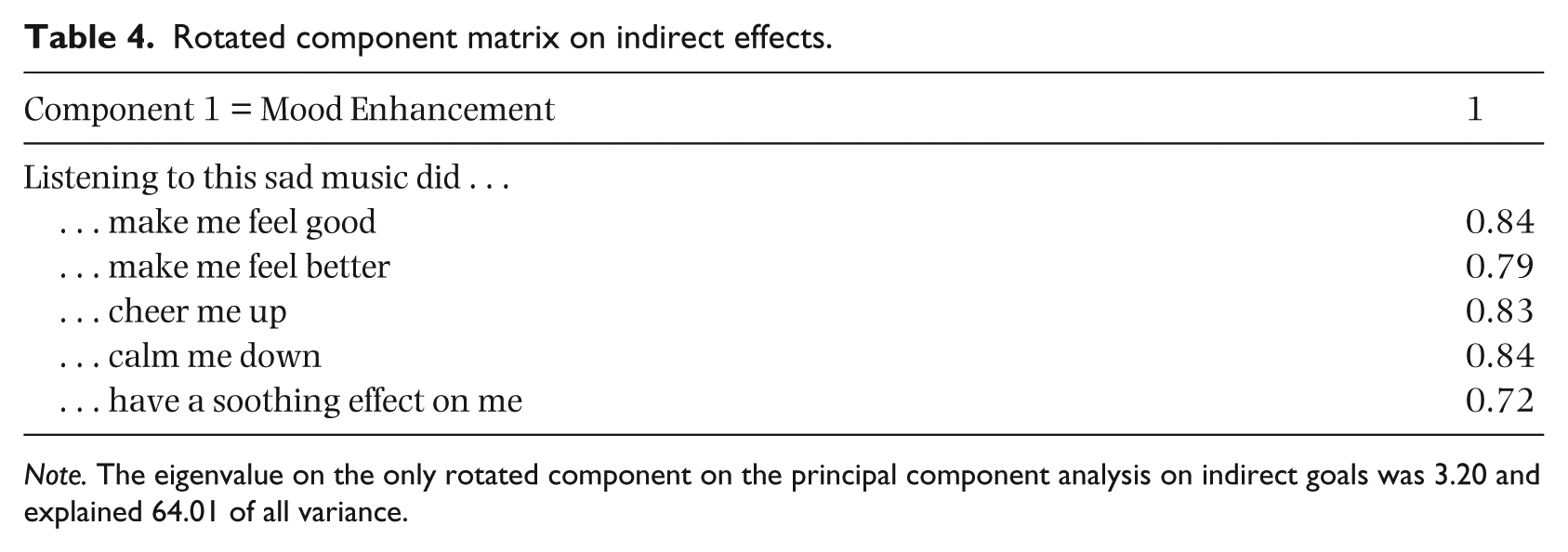
Note. The eigenvalue on the only rotated component on the principal component analysis on indirect goals was 3.20 and explained 64.01 of all variance.
Three groups of items which represented distinct music selection strategies were found (see Table 5). These were named Connection & Memory Triggers, High Aesthetic Value, and Direction (reflecting the labels of Van den Tol & Edwards, 2011, 2012). For Connection & Memory Triggers, connection referred to selecting music because the music portrays affect or has lyrics that the listener can identify with at that moment, and memory triggers referred to the selection of music because the music has associations with past events and people. High Aesthetic Value referred to selecting the music because one perceives the music to be “good” or “beautiful music,” and Direction referred to selecting music that conveys a message to which the listener wants to relate.
Rotated component matrix on music selection strategies.

Note. The rotated components eigenvalues for strategies ranged from 2.12 on the first component to 2.06 on the third component, the component outcome of all strategies components cumulatively explained 62.86 of all variance in the data, with the first component explaining 21.15% and the third 20.64%.
Aim 2: Understanding music selection strategies
Linear regression analyses were conducted to investigate how the music selection strategies predicted people aiming for specific self-regulatory goals or reported effects. 1 Throughout each of these analyses, one music selection strategy was entered as an independent variable and one reported effect or self-regulatory goal was entered as a dependent variable (see Table 6 and Table 7).
Result on the linear regression analyses on how music selection strategies predict self-regulatory goals.
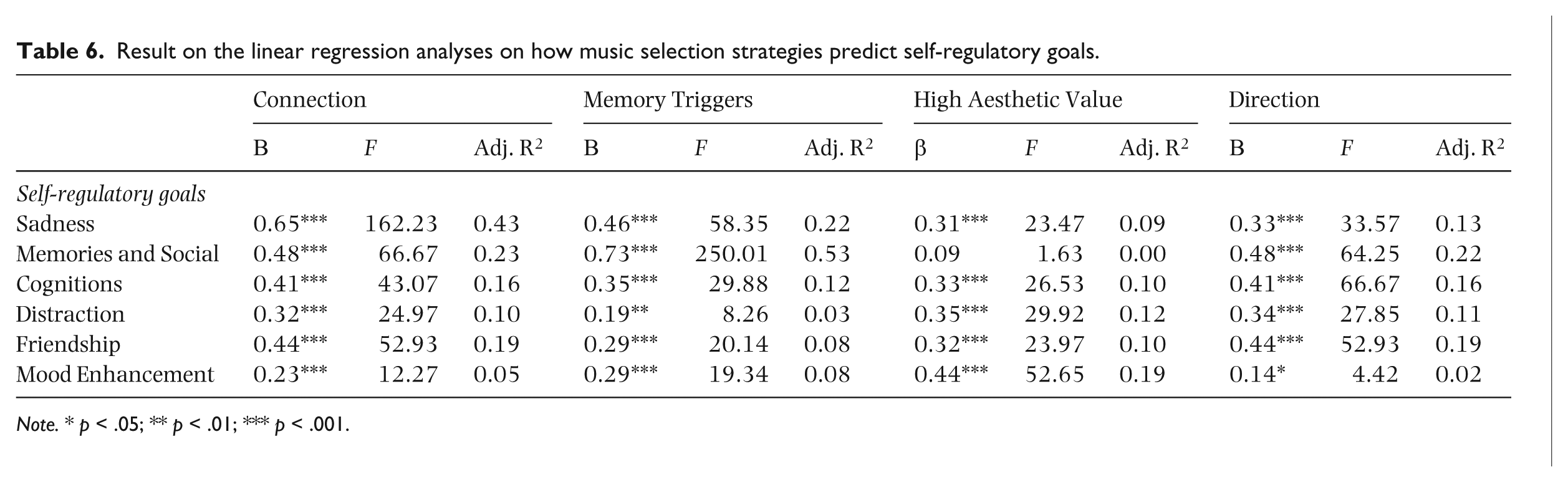
Note. * p < .05; ** p < .01; *** p < .001.
Result on the linear regression analyses on how music selection strategies predict reported effects of music listening.
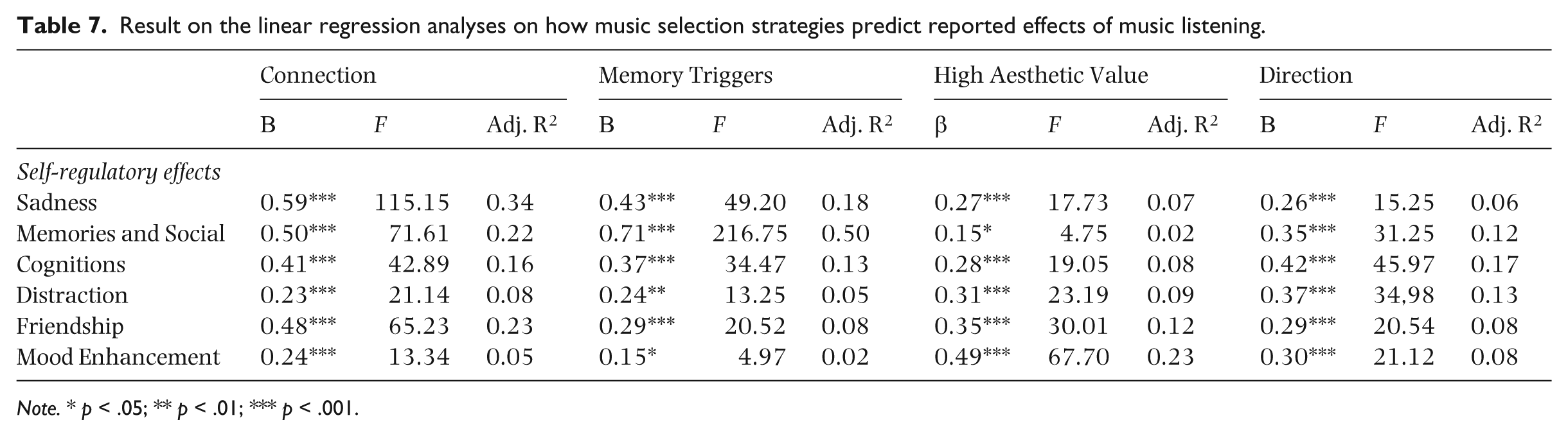
Note. * p < .05; ** p < .01; *** p < .001.
All but one music selection strategies significantly regressed upon each of the direct self-regulatory goals and self-regulatory effects. The only non-significant regression was observed between using a High aesthetic value music selection strategy and the self-regulatory goal Memories and Social.
In line with the hypothesis (2a), Connection regressed strongest upon Sadness, (2b) the music selection strategy Memory Triggers regressed strongest upon the goal and effect Memories and Social, but also yielded a strong regression with Sadness. In line with the hypothesis (2c), the strategy Direction regressed strongest upon the effect Cognition, this regression coefficient was smaller, however, for the goal Cognitions. Selecting music with a Direction selection strategy regressed strongest upon the goal of Memories and Social, and also upon the goal Friendship. In line with the hypothesis (2d) it was found that selecting music with a High Aesthetic Value selection strategy yielded the strongest regression upon Mood Enhancement but also produced a strong regression coefficient for Distraction (see Table 6 and Table 7).
Aim 3: Understanding mood enhancement
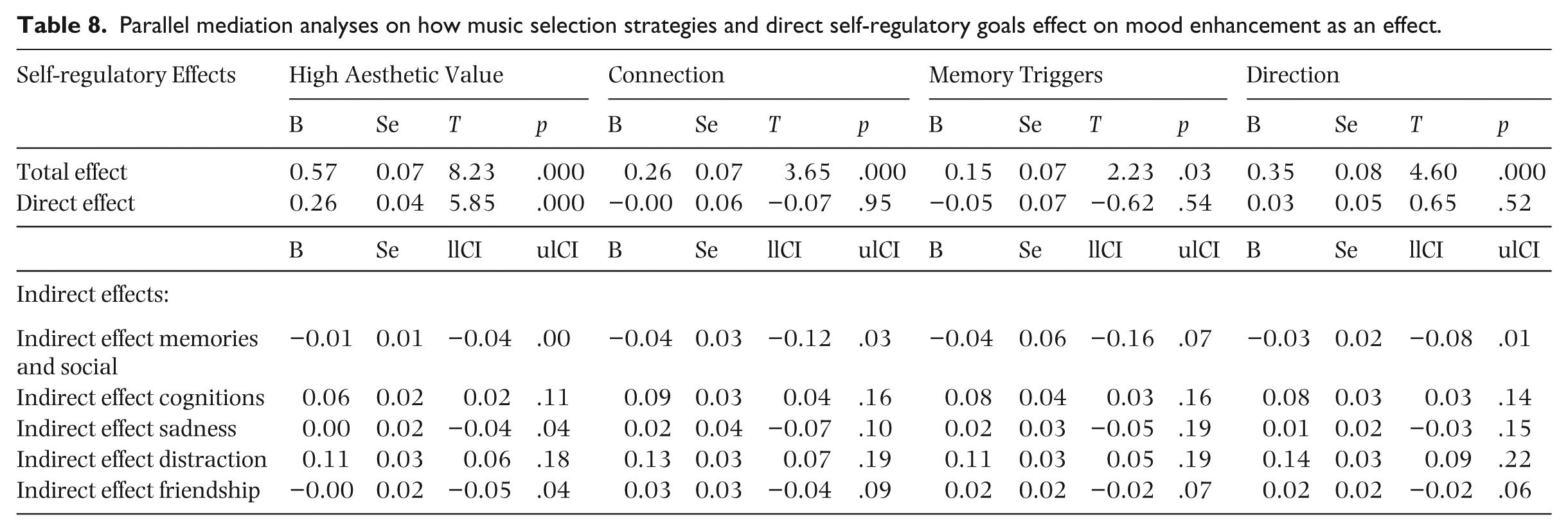
Multiple-mediation analysis is a statistical test that is commonly used to explore the effects of one independent and several parallel mediating variables on one dependent variable (Preacher & Hayes, 2004, 2008). Several parallel mediation analyses were conducted in order to investigate to what extent Mood Enhancement was a direct or an indirect goal or effect of music listening. We investigated this for each different music selection strategy. More specifically, we wanted to know to what extent each music selection strategy has a unique effect on experiencing mood enhancement, and to what extent direct effects/direct goals may have a unique role in mediating these effects on mood enhancement. Each of these analyses were conducted with one of the music selection strategies as an independent variable, with all the direct goals or all the direct effects as parallel mediating variables, and with either mood enhancement as a goal or mood enhancement as an effect as a dependent variable (Figure 1 depicts this model and Table 8 and Table 9 provide the results of the analyses).
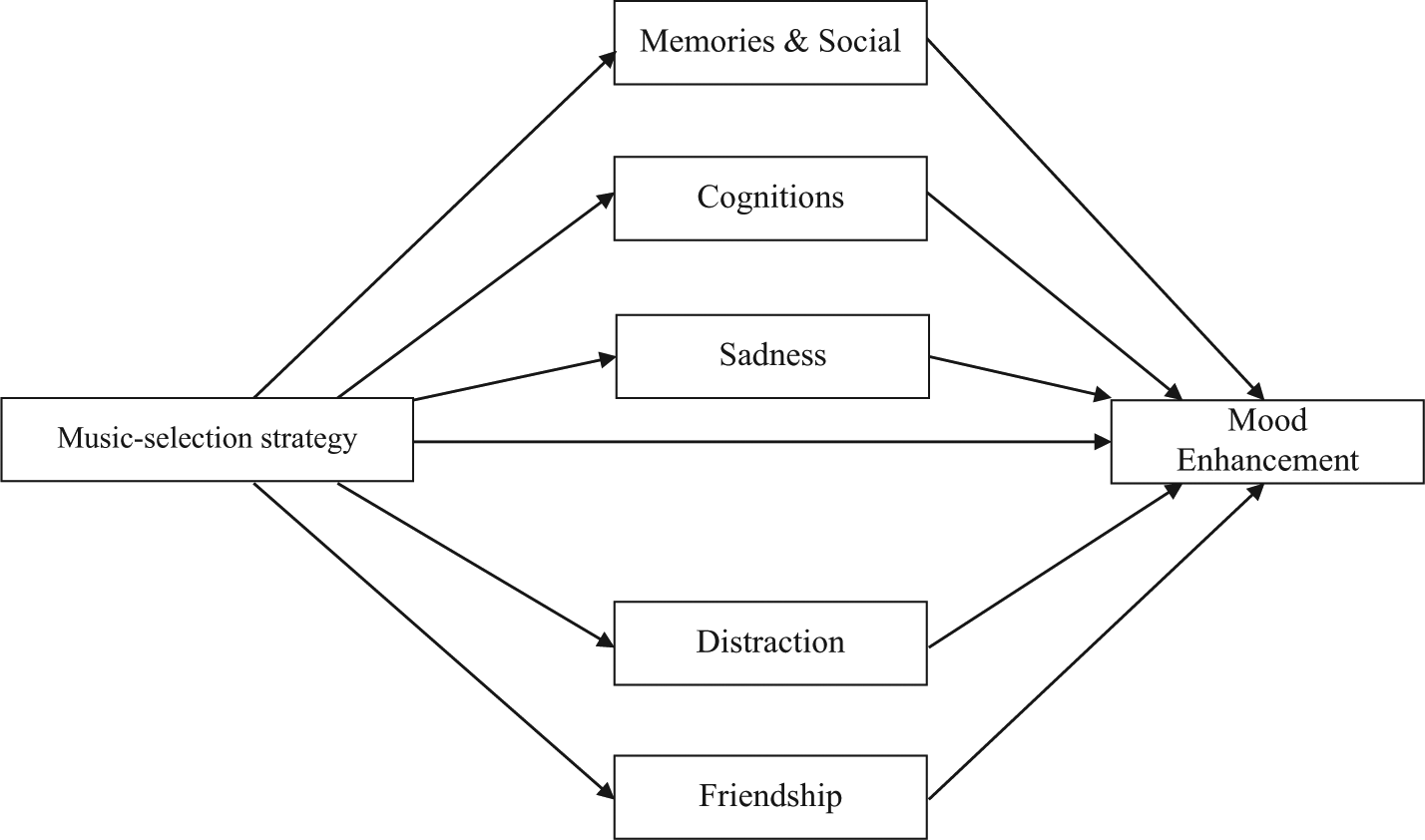
A graphical representation of the parallel mediation analyses that were conducted in order to investigate how listening to SISM (is expected to) result(s) in mood enhancement
Parallel mediation analyses on how music selection strategies and direct self-regulatory goals effect on mood enhancement as an effect.
Parallel mediation analyses on how music selection strategies and direct self-regulatory goals effect on mood enhancement as a goal.
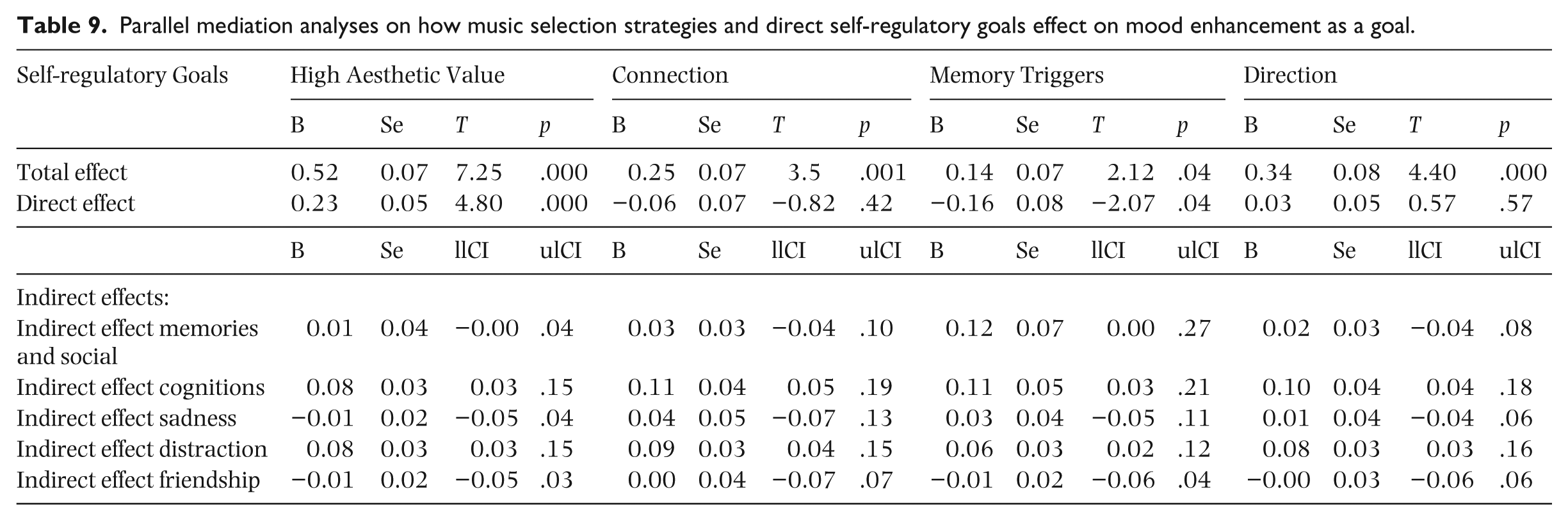
In line with the hypothesis (3a), it was observed that the components Cognitions and Distraction played a significant mediating role in the relationship between music selection strategies and Mood Enhancement, for the analysis of each strategy and both for goals and for effects.
In line with the hypothesis (3b), the relationships between Mood Enhancement and music with High Aesthetic Value remained significant after controlling for the effect of the mediating variables. This was the case for both the analyses conducted on self-regulatory goals and reported effects. Moreover, none of the other significant regression effects of music selection strategies upon mood enhancement remained significant after controlling for all other self-regulatory goals or for all other reported effects.
There were few other self-regulatory goals or reported effects that mediated mood enhancement. However, an additional mediating relationship was observed for the selection of music with the goal Memories and Social on having the goal of Mood Enhancement when the mediating roles of direct goals were examined for selection of music with a Memory Triggers selection strategy. Moreover, when mediating effects of goals were taken into account for the selection of music with a Memory Triggers selection strategy, the relationship between this music selection strategy and the goal of mood enhancement reversed. This finding was also not anticipated.
Discussion
The current research was guided by several aims and hypothesis. The paragraphs below will provide a structured overview on the findings for all of these aims and hypotheses.
Aim 1: Structure of the data
The prediction regarding the structure of the data was that a distinction of strategies, goals and effects would be observed relatively similarly to previous findings on listening to SISM when feeling sad (Van den Tol & Edwards, 2011). The current results largely confirmed this prediction. In the analysis on music selection strategies three components were observed, the components were named: Connection and Memory Triggers, High Aesthetic Value and Direction. Please note that the label for the earlier proposed category Message Music has been replaced by the label Direction. The items belonging to the earlier identified music selection strategies Connection and Memory Triggers (Van den Tol & Edwards, 2011) loaded high on one component. It is important to note, however, that even though these strategies show statistical overlap, findings (see Table 6) do suggest that distinct psychological processes guide these selection strategies. This statistical overlap may be explained by people’s simultaneous use of these two music selection strategies.
In the analyses on indirect self-regulatory goals and effects one component was observed. This was in line with the expectations. This component represented Mood Enhancement and was labelled accordingly.
In the principal components analyses that were conducted on the direct self-regulatory goals and effects, five components were observed. These components represented: Sadness, Memories and Social, Cognitions, Friendship and Distraction. Please note that these labels represent all earlier proposed self-regulatory function categories (Van den Tol & Edwards, 2011) but that some of the labels have been altered in order to make these more consistent with each other. Items that represented the earlier proposed distinct categories of Retrieving Memories and Social (Van den Tol & Edwards, 2011) represented only one component: Memories and Social. This is in line with observations that the memories that are retrieved through music listening are often of a social nature (Van Goethem & Sloboda, 2011).
Aim 2: Understanding music selection strategies
Almost all the music selection strategies yielded positive significant relationships to each of the goals and effects. These findings may either indicate that people pursue more than one goal when they select music (providing this overlap in regressions) or that each music selection strategy can be used to achieve more than one specific goal. In line with literature (Saarikallio & Erkkilä, 2007; Van Goethem & Sloboda, 2011) we believe that it is most likely that both these theories are correct. The specific relationships that did not yield significance were between selecting music with High Aesthetic Value and the goal and effect of Memories and Social, indicating that it is not likely that people use this music selection strategy in order to achieve this goal or experience this effect.
The following findings were observed with regards to the strongest regression coefficients for each music-selection strategy with each goal or effect: Selected music with a Connection selection strategy yielded the strongest results for aiming to use music for Sadness and reporting to have experienced Sadness as a result of listening to the music. This was in line with the hypothesis (2a) and may be explained as conscious self-regulatory use of music that portrays a certain emotion in order to experience emotional contagion (Juslin & Västfjäll, 2008; Knobloch & Zillmann, 2002). In line with the hypothesis (2b), the Memory Triggers selection strategy yielded a strong regression upon using music to experience Memories and Social and Sadness and to experience Memories and Social and Sadness as a reported effect of music-listening. In line with these findings, it has been noted that music with memory triggers can be used effectively to retrieve memories and to be in touch with emotions (Baumgartner, 1992; Juslin & Västfjäll, 2008). As predicted, (2c) people most often selected music with a High Aesthetic Value selection strategy when they aimed for Distraction. We argue that the more beautiful music is, the easier it is for the listener to concentrate on the music. Moreover, these findings are in line with findings that stimulus that is perceived to have High Aesthetic Value will generate sensory pleasure and inhibit displeasure (Hekkert, 2006; Menon & Levitin, 2005). The strategy Direction yielded a strong relation with experiencing cognitions as an effect of music listening, but not with having cognitions as a goal. Surprisingly, it was found that people were more inclined to select music with a Direction music-selection when they aimed to pursue the self-regulatory effects Memories and Social or Friendship. This was not entirely in line with the hypothesis (2d), and more research will be needed to further explore why this happened.
Aim 3: Understanding mood enhancement
Several studies reported that listening to sad music can induce positive moods (Garrido & Schubert, 2010, 2011a, 2011b; Kallinen & Ravaja, 2006; Schubert, 2007; Vuoskoski et al., 2012). Extending these findings, we proposed and found that people select music with a (3b) high aesthetic value and engage in (3a) distraction and (3a) cognitive reappraisal in order to achieve mood enhancement. In line with these findings, the use of a high aesthetic value selection strategy and the engagement in distraction or cognitive reappraisal were also found to be effective self-regulatory strategies for achieving mood enhancement as a result of listening to SISM when feeling sad.
These findings resonate with findings from other music listening literature but also add insights to existing theory and findings. For example, Chen et al. (2007) found that during negative moods, people most strongly prefer to listen to music with a negative valence, whereas people are more inclined to repair their mood by listening to more uplifting music shortly after a negative mood. They suggested that listening to sad music provides the opportunity to sort out one’s feelings, and that this may explain why some people listen to sad music during sadness. Results of the current research indeed indicate that those people who had recalled to listen to SISM to sort out their feeling and thoughts (i.e., Cognition) during listening to sad music also felt more positive. In line with the current findings that listening to music for cognitive engagement may contribute to mood enhancement, research on coping also found that “A why focus on emotions from a self-distanced perspective (distanced-why strategy) . . .” can enable “. . . ‘cool,’ reflective processing of emotions, in which individuals can focus on their experience without reactivating excessive ‘hot’ negative affect” (Kross et al., 2005, p. 709).
Mood enhancement was additionally reported more often by participants who sought to provide opportunities for distraction and had selected the music for its aesthetic value. It has to be pointed out, however, that even though listening to SISM for distraction may very likely provide some listeners with mood enhancement, continuous use of music for distraction from negative moods may be an indicator of avoidant coping (Miranda & Claes, 2009; Garrido & Schubert, 2011) or may even indicate problems with psychological adjustment (Hutchinson, Baldwin & Oh, 2006).
As part of the parallel mediation analyses, a reversed effect was observed between selecting music with a memory trigger selection strategy and having mood enhancement as a goal. This was found when the mediating roles of other goals were taken into account. Interestingly, people’s expectations were not verified in the effects that they reported. We believe that these findings indicate that it is unlikely that many people recalled selecting SISM with a memory trigger selection strategy in order to try to achieve mood enhancement when they did not also pursue any of the other goals (distraction or cognitions) by which mood enhancement can be achieved. Zillmann (2000) argued that people sometimes engage in behaviour that may not provide immediate rewards in terms of feeling, but is expected to have positive mood rewards in the long term. In terms of the current findings, this may mean that some people find it more important to spend time retrieving memories than to enhance their mood, and that these people have expectations that this behaviour is rewarding in the long term.
In line with the abovementioned findings, we also did not observe that Memories and Social mediated the achievement or experience of mood enhancement. Although we did not examine nostalgic experiences in particular, these findings are nonetheless intriguing as research on nostalgia and music-listening (Barrett et al., 2010) suggests an enhancing role of nostalgia. It is likely that differences in the designs of both studies have influenced the differences in results. For example, the current research focussed on SISM, and the research by Barrett et al. (2010), focussed on the effects of music-listening in general. This may mean that people may be more likely to select happy music in order to retrieve nostalgic memories for mood-repair, and select sad music when they aim to be in touch with sadness as a mean to work out their feelings (delayed gratification). This argument is in line with the findings that people who score high on the trait nostalgia proneness are more likely to select happy music than people who are scoring lower on this trait (Batcho, 2007). It is also possible, however, that the differences between previous and current results occurred because we did not specifically measure nostalgia in the current research. As Batcho noted: “one can remember without being nostalgic, but one cannot be nostalgic without remembering” (2007, p. 362).
Not many participants reported experiencing mood enhancement while simultaneously reporting to have felt sad, or had reported both of these experiences taking place simultaneously. In other words, it seems unlikely that mood enhancement occurs very often as a result of experiencing sadness, or that people try to first be in touch with or express affective experiences in the pursuit of mood enhancement.
Few participants reported to simultaneously have experienced mood enhancement while also having experienced friendship. Based on this self-report, it is unlikely that many people experience mood enhancement when they experience friendship with the music, or that people are aiming to achieve mood enhancement when they aim to experience friendship with the music. These findings are different to findings of a study on music listening in general (Saarikallio, 2008) where it was found that a concept closely related to friendship (i.e., solace) related positively to mood enhancement. These differences in findings may potentially be explained by our focus on SISM or sad affective state. Based on unpublished research, we suggest that friendship is pursued as a means to experience delayed gratification as well as acceptance (Van den Tol & Edwards, unpublished).
Contributions
The current research provides several new insights into people’s beliefs about the self-regulatory value of listening to SISM when feeling sad. Moreover, this research verified several previous findings on SISM when feeling sad by employing a large sample and adopting a converging method. The current research provided a self-regulatory perspective on the argument of how listening to sad music is believed to contribute to positive affective states (Blood & Zatorre, 2001; Huron, 2011; Kallinen & Ravaja, 2006; Matsumoto, 2002; Vuoskoski et al., 2012). It is hoped that this self-regulatory perspective provides a broader perspective on mood-repair in relation to self-motivated music listening in everyday life. Additionally, this is the first study that statistically explores the self-regulatory value of a range of earlier identified music-selection strategies used when deciding to listen to SISM when feeling sad, hence providing further insights into what motivates people to select a specific piece of sad music when feeling sad.
Limitations and future directions
In terms of generalizability of findings, it has to be noted that the current research was conducted using a retrospective survey design, meaning that findings represent people’s recollection of having listened to SISM when feeling sad rather than people’s experiences while engaging in this behaviour. Because this study focused on self-reported goals and effects, we have to be careful with generalizing these findings to actual outcomes of music-listening. Future research may seek to verify these findings with the use of Experience Sampling Methodology, which is a method of research in which participants are asked to make notes of their experience when they are engaging in it (Hektner, Schmidt, & Csikszentmihalyi, 2006). Two good examples of the use of this method for investigating music listening motivations in everyday life are studies conducted by Dillman et al. (2008) and also Västfjäll, Juslin and Hartig (2012).
Research has indicated that music listening has a positive effect on health, but especially on positive emotional experience during music listening (Västfjäll et al., 2012). In order to not cause any confusion about the interpretation of our results, we emphasise here that the aim of our study has not been to prove that listening to SISM is a good strategy to achieve mood enhancement, or that mood enhancement is the main reason for listening to sad music. Results of our continuous study have rather indicated opposite results. More specifically, listening to sad music when feeling sad will intensify feelings of sadness for most people (Van den Tol, 2011, 2012; Van den Tol & Edwards, 2011, 2012, 2013). Similarly, recent results by Garrido and Schubert (2013) have indicated that many people feel sad rather than happy after having listened to self-selected sad music. It has to be noted, however, that when people listen to music in order to be in touch with emotions, experiencing sad emotions is not always reported as a negative event by the individual (Schubert, 2007). Some people describe expressing and being in touch with sadness during music-listening as a cathartic experience (Van den Tol & Edwards, 2011).
Some people are able to enjoy sad music and experience positive emotions during sad music-listening to a greater extent than other people (Garrido & Schubert, 2013). Recent research indicates that people’s ability to move on from sad thoughts is especially impaired among ruminators, whereas ruminators’ use of sad music is more maladaptive than that of other people (Garrido & Schubert, 2013). These findings suggest the importance of more research that explores people’s motivations for listening to SISM while simultaneously exploring complimentary temporal factors. Indeed, Chen et al. (2007) indicated that temporal factors are important to acknowledge to understand people’s music-listening behaviour. Research that relates music-listening behaviour to psychological health is especially important as it will provide valuable information for music therapists and other professionals working in (mental) health care (Edwards, 2011).
Footnotes
Acknowledgements
We would like to thank Wijnand A. P. Van Tilburg for his helpful comments on an earlier version of this manuscript.
Funding
This research received no specific grant from any funding agency in the public, commercial, or not-for-profit sectors.