




Abstract
In collaborative musical composition, such as those used frequently in popular music styles, conflicts between band members are commonplace. This article seeks to examine how task-based and interpersonal conflicts between band members impact on the creation of collaborative compositions, utilising a case study of a band composing music for an album recording. This paper reports on research that tracks the process of the creation of songs for a fourth album recording by a three-piece ensemble who have worked together since 1999. The composition process is marked by numerous disputes and arguments among the band personnel and the interactions between the band members move fluidly between phases of instruction, cooperation, collaboration and conflict. The authors (also the band’s members) analyse video and audio recordings of rehearsals, making observations based in grounded theory in relation to verbal and nonverbal interactions and offering personal reflections on these interactions. Drawing on theoretical perspectives in relation to communication, conflict and group dynamics such as group flow and empathetic creativity, individual and group behaviour are examined with emphasis on the impact of such behaviour on the collaborative process.
Keywords
Collaborative music-making practices are common across many music genres. Bennett (2010) outlines a range of collaborative models in Anglo-American popular songwriting including the Nashville approach (acoustic guitar/piano, pen and paper and two writers), the Factory (the “staff songwriters” such as in Tin Pan Alley or The Brill Building) and the Jamming model (a band forming songs in a rehearsal room). The latter model is also common in improvising instrumental groups, where musical seeds or stimuli are explored and developed by a group of musicians either in live performance or in rehearsal or recording situations. In these situations there is the potential for conflict among collaborators. This paper seeks to examine how conflict during the collaborative process impacts on the creation of collaborative compositions, utilising a case study of a band composing music for an album recording.
Intragroup conflict
There is an abundance of literature in relation to the role of conflict in terms of organisational management and workforce productivity. Jehn (1995) examined the benefits and detriments of intragroup conflict within more than 100 work groups and management teams and looked at the relationships “between the type and level of conflict and the nature of the task, the interdependence of the group and the group norms about conflict” (Jehn, 1995, p, 257). Jehn (1995) utilised Hackman’s (1995) criteria for group effectiveness, where work group productivity is measured against performance standards and how the social processes used by the group maintained or enhanced group members’ willingness to work on subsequent team tasks. Conflict was considered in terms of “task conflict” and “relationship conflict”:
Relationship conflict exists when there are interpersonal incompatibilities among group members, which typically includes tension, animosity, and annoyance among members within a group. Task conflict exists when there are disagreements among group members about the content of the tasks being performed, including differences in viewpoints, ideas and opinions. (Jehn, 1995, p. 258)
Jehn (1995) found that task conflict was detrimental to groups performing routine tasks but beneficial to groups performing non-routine tasks (complex tasks with few set procedures, standard solutions and a high degree of uncertainty). Relationship conflict was detrimental regardless of the task type.
Moving from evaluating team effectiveness to team creativity, Chen (2006) focuses on the impact of task conflict and interpersonal conflict (an adaptation of the concept of relationship conflict) on the functioning of project teams in the high tech industry in Taiwan. The interplay between creativity, measured by Chen in terms of the team creating “novel and useful ideas on task related issues … and knowledge that has not existed before the team was formed” (Chen, 2006, p. 109), and conflict varies across the project life cycle and this is an important consideration when considering how conflict impacts on the collaborative musical composition process.
Musical intragroup conflict
One of the most well-documented intragroup conflicts involved the Beatles during the making of the White album. Sound engineer for some of the sessions, Geoff Emerick, recounts how McCartney would later refer to the album as the “Tension Album” (Emerick & Massey, 2006, p. 224). Emerick recalls how the band would work on one song repeatedly:
It could get incredibly boring and depressing hearing them play the same song for nine or ten hours at a stretch, especially if it was getting worse and worse as they got more drugged and went off into tangents. Interestingly, during those long jam sessions Ringo would most often be the one to take them in new directions – he’d get fed up doing the same beat all the time and he’d change it, which sometime sparked a musical change from one of the others. (Emerick & Massey, 2006, pp. 248–249)
One such musical change occurred in the song “Ob La Di Ob La Da” (Lennon & McCartney, 1968a, track 4) where Lennon, who had evidently become fed up with “Paul’s granny music shit” (Emerick & Massey, 2006, p. 246), had got angry and “began smashing the keys with all his might, pounding out the famous opening chords that became the song’s introduction, played at breakneck tempo” (Emerick & Massey, 2006, p. 246). Another example is when Lennon apparently abused Emerick as he attempted to manipulate the mixing desk to get the distorted guitar sound that appears on the single version of “Revolution” (Lennon & McCartney, 1968b, track 2; Emerick & Massey, 2006, p. 253). Emerick’s account provides insight into how specific conflict incidents, occurring at points well into the process, constructively affected the final recorded musical outcomes.
A more contemporary illustration is provided by Morrow (2011) in his account of how the interactions between band members from Boy & Bear and the producer Joe Chicarrelli during the making of the Moonfire album (Gavin, Hart, Hart, Hosking, & Symes, 2011) led to “a more creative, and marketable, result when considering the demo recordings that were taken into the session” (Morrow, 2011, para. 19). Morrow draws on the work of Sawyer (2007) framing this discussion in relation to how heterogeneity enhances aspects of group flow.
Group flow and empathetic creativity
Sawyer (2006, 2007, 2010) develops the concept of group flow, related to Csikszentmihalyi’s (1990) flow theory, through research into improvising theatre groups and improvising jazz groups:
Group flow is an emergent property of the group. Group flow can inspire musicians to play things that they would not have been able to play alone, or that they would not have thought of without the inspiration of the group. (Sawyer, 2006, p. 158)
According to Sawyer (2006), group flow is distinct from the individual psychological state of flow and requires consideration of the interactions between group members during performance.
Hart and Di Blasi (2015) examine the concept of group flow or “combined flow” in the experiences of musicians participating in musical jam sessions. They reach the following two key theoretical findings:
The idea that musicians experience a group jam as a progression through a sequence of separately definable stages.
The theory that the inter-subjective nature of a group jam leads to empathy development between group members (Hart & Di Blasi, 2015, p. 279).
Hart and Di Blasi (2015) found that in a group jam session there are some important conditions for “success” (from the viewpoint of the participants) including the need for each musician to find a niche within the musical texture and for the musicians to have matched skill levels to avoid boredom or anxiety. Whether a jam proceeds to an optimum level or not, the participants experience an increase in empathy at the conclusion, having shared the highs and lows together. Of key relevance to this research is how the group moves through clearly definable stages during the course of a group jam. The link between ensemble playing and empathy is reiterated in a study by Rabinowitch, Cross, and Burnard (2013), who found that long-term musical group interaction by children had a positive influence of the development of empathy.
Drawing on the work of education researcher Roslyn Arnold (2004), Seddon (2005) developed the concept of “empathetic creativity” to describe the mode of musical communication aspired to by participants during jazz improvisation. Empathetic creativity emerges from a state of empathetic attunement:
Empathy is achieved by understanding the thoughts and feelings of self and others through attunement, decentring and introspection. Attunement prepares individuals for exploration, risk-taking, concentration and rapport and requires the development of trust between individuals. (Seddon, 2005, p. 48)
Seddon makes a distinction between empathetic and sympathetic attunement:
At a sympathetic level of attunement there might be musical cohesion but clashes of musical styles, with interpretation of rhythms or accommodation of a weaker player preventing musicians from reaching the empathetic level. Empathetic attunement occurs when musicians are able to decentre and see things from other musical perspectives. (Seddon, 2005, pp. 48–49)
Seddon (2005) links the concept of levels of attunement to six modes of communication: verbal/nonverbal instruction; verbal/nonverbal cooperation; and verbal/nonverbal collaboration. The modes of communication are linked to the activity being undertaken with the instructional and cooperative modes representing lower order creative task levels. The latter collaborative modes can be identified when improvising musicians verbally “discuss and evaluate their performance of the music in order to develop the content and/or style of the piece” or nonverbally when musicians “take creative risks which can result in spontaneous musical utterances” (Seddon, 2005, p. 53).
It should be noted that while the discussion so far has focused on rehearsal and performance of jazz and popular music, there is relevant research into group dynamics in classical music ensembles (e.g., Ginsborg & King, 2007; Murnighan & Conlan, 1991). Seddon and Biasutti (2009) have applied notions of group flow and creative attunement comparing rehearsals of a string quartet with a jazz sextet. An important aspect of Seddon and Biasutti’s (2009) research and also that of Ginsborg, Chaffin, and Nicholson (2006) was the acknowledgement that the collaborators’ level of experience, both individually and together, was an important factor in the examination of group communication and creativity. However, there is a gap in the literature in relation to discussion of the role of conflict in collaborative composition, as opposed to performance and rehearsal, and it is this gap that our research intends to examine.
Compositional process
The compositional process employed by the participants in this research is the “jamming model” (Bennett, 2010) mentioned above, where band members jam together, developing ideas primarily through a play process. In this process the musicians begin with a seed of an idea (e.g., a repeating riff, chord sequence, melodic fragment or drum pattern) and proceed to play this idea while others attempt to find another complementary part within the musical texture. As new ideas emerge the original seed may evolve or be discarded as the jam progresses. The process can have varying degrees of focus and intention. For example, in the early stages of development a band may play quite freely and move fluidly through multiple ideas/musical textures. When ideas are deemed mutually worth pursuing, a refining process can occur where a particular musical texture is then worked over (a process that can involve lengthy time periods between the initial jam and subsequent refining process).
Method
The participants (and authors) are members of the group amphibian, a three-piece, mostly instrumental ensemble that formed in 1998. The group consists of Matt Hill (keyboards, samples), Barry Hill (bass, guitar and samples) and Rob Walsh (drum kit, samples). The group has produced three albums with Michael Worthington as sound engineer, the first two released nationally via the Groovescooter label and the first also released in Japan via IGM. The group has received three Australia Council for the Arts’ grants including two for the creation of new works and one for international touring to the UK. The group has performed live at major venues in Australia including Sydney Town Hall, The Basement and Harbourside Brasserie in Sydney and has been the support act for David Bridie, Ed Kuepper and Scanner among others. Prior to the formation of amphibian in 1998, the group members had extensive experience collaborating in ensembles since 1993 and siblings Matt and Barry Hill have played together since childhood.
After an initial intensive period of writing, performing and producing (1998–2002) the group members moved apart geographically and between 2002 and 2012 only intermittently worked together. Since July 2012, the members have been living in the same region and have been getting together to compose mostly once per week. Since 2012, Barry has switched from bass to guitar. The group is now focused on recording two further albums and has been developing new material through a process of joint composition. The sessions have taken place in a makeshift studio where equipment has been permanently set up in a packing shed on Rob’s farm where both Rob and Barry live. The sessions have been documented by both video and audio recordings. The focus of the audio recordings has been primarily to assist in the composition process, with group improvisations and jams recorded for subsequent listening by all members, with desirable material then edited, further reviewed and refined in rehearsal. The video footage provides the main source of data for this paper. Still images of the video footage and musical transcriptions are provided for key points in the discussion below to assist in presenting the context and partial evidence of the nonverbal interactions as they occurred.
The analysis of the video was undertaken with the intent of examining the interaction of the band members (both verbal and nonverbal communications) and the musical ideas developed during two 30-minute sections of one particular composition session. This portion of video was chosen (from approximately 60 hours of video footage covering 35 composition sessions over a 2-year period) by the authors after they all agreed that it presented a microcosm of the group’s typical interactions and music development. The analysis of the video followed the stages outlined in Seddon (2005), which is based in grounded theory (Lincoln & Guba, 1985) with an adaptation based on the constant comparative method (Glaser & Strauss, 1967; Lincoln & Guba, 1985). This method involves five stages: immersion, categorisation, phenomenological reduction, triangulation and interpretation (McLeod, 1994).
In the first stage (immersion), a transcript of the video data was made, including a record of verbal communications and descriptions of nonverbal communications in addition to transcriptions of musical fragments performed during the session excerpt. The second stage (categorisation) involved a systematic analysis of the transcribed data in order to assign categories to the intra-band interactions and the music fragments developed. Identified categories were then grouped under specific themes in the third stage (phenomenological reduction).
After the categorisation stage, the themes identified were an expanded version of Seddon’s (2005) six modes of communication; here expanded to eight. Under the two main categories of verbal and nonverbal communication there are four distinct modes identified: instruction, cooperation, collaboration and conflict. Following Jehn (1995) and Chen (2006) conflict was also further subdivided into task-related conflict and interpersonal conflict. Verbal communication (in any mode) could occur while the musicians were playing or when one or more of them were not playing. For example, if one band member wanted another band member to return to a particular musical part that they had been playing or to play something novel that they wanted to be heard on a particular instrument. Nonverbal communications (including consideration of the sonic/musical parts/utterances) were categorised with reference to Seddon (2005) in regard to the instruction, cooperation and collaboration modes. The category of conflict was evident, for example, when one or more of the participants verbally abused another band member, stopped playing, or was otherwise distracted by external technical issues (such as equipment malfunction, tuning problems, undesired effects settings) or experienced internal (nonverbalised) frustrations. Identifying the latter category was reliant on the participants own reflections on viewing the video footage.
The process of triangulation (Stage 4) was particularly important in relation to developing and understanding of nonverbal communications. This occurred at two levels; within the authors’ dual participant/research role, and between the lead author’s initial undertaking of the first three stages outlined above and the subsequent presentation of this analysis to the other authors for verification. As participants/researchers, the authors were uniquely placed to consider both the outward visible/audible communications and their invisible/inaudible thoughts at the time. This does of course lead to a potential for the authors to be too close to the data and at risk of making tacit assumptions that may not be visible to others or indeed reliable. Within the domain of artistic research (Borgdorff, 2012) or more broadly Schon’s reflective practitioner (Schon, 1983), the notion of practitioner/researcher is widely accepted. Haddon and Hutchison (2015) also provide a pertinent example whereby the method of joint reflective writing is employed to establish a critical distance for the authors in their joint roles as participant and researcher.
The final stage (interpretation) involved considering the findings in relation to a broader perspective. Here, the interactions between the band members are considered in relation to the literature on conflict in groups and the impact this has on group functioning; the understanding of the jamming model for collaborative composition; the contribution to understanding of the characteristics of group flow; empathetic attunement and empathetic creativity.
Findings
Modes of communication
The analysis of the data for this research revealed that the modes of communication identified above (instruction, cooperation, collaboration and conflict) occurred at any point in the composition session and were not necessarily sequential. For example, in contrast to the findings of Hart and Di Blasi (2015), a period of playing that was undertaken with the intention of developing new parts to add to or refine an existing musical texture did not move through the sequential, identifiable phases. Instead, the modes of communication moved back and forth, between instruction, cooperation, collaboration and conflict, at various points in the session. In the two examples discussed below (covering approximately 60 minutes of 120 minutes spent working on the development of the track “Junta” in one session), the conflict moments are critical points within each session, moving the composition process onwards toward a compositional solution that is ultimately satisfactory for all band members.
In the first part of the video the band members all play parts that had been developed in a session three weeks earlier. The basic elements that were in place at the start of the session are notated as shown in Figure 1.
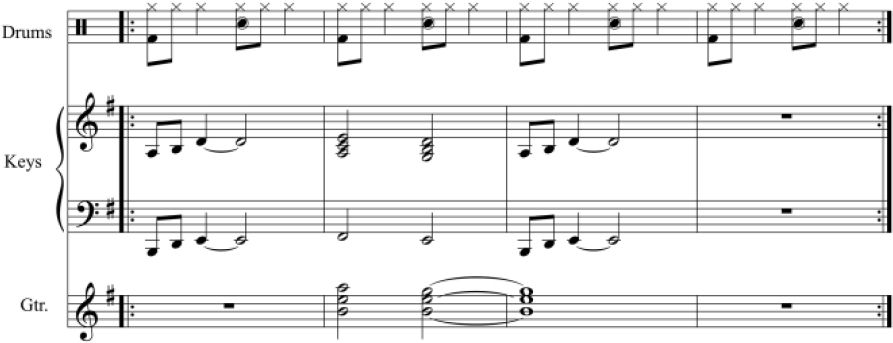
“Junta” basic parts after 1 August 2014 session.
For a period of 10 minutes these basic parts are repeated by the band in a manner that can be categorised largely as nonverbal cooperation; the elements are cohesive but do not extend to a more creative level (Seddon, 2005). While other ideas are experimented with to add to the above musical texture, they are not pursued for very long. After 10 minutes, while the band continues playing, the following verbal instructive interaction occurs (Figure 2):
I’ve got a proposal, you come here, keep your sound on, (to Barry) come here. (Matt changes his part)
Go back to your other bit Matt… we’re just doing a triangle part, you’re going ya da ya da ya da (sings rhythm), stick on that and country post rock it, so I’ll do this (plays hi hats, three eighth notes on beats 1 and 3) you’re doing (plays three eighth notes starting on upbeat. Then stops playing)
Yeah, play (Rob resumes playing)
Gotta get heavy and loud.
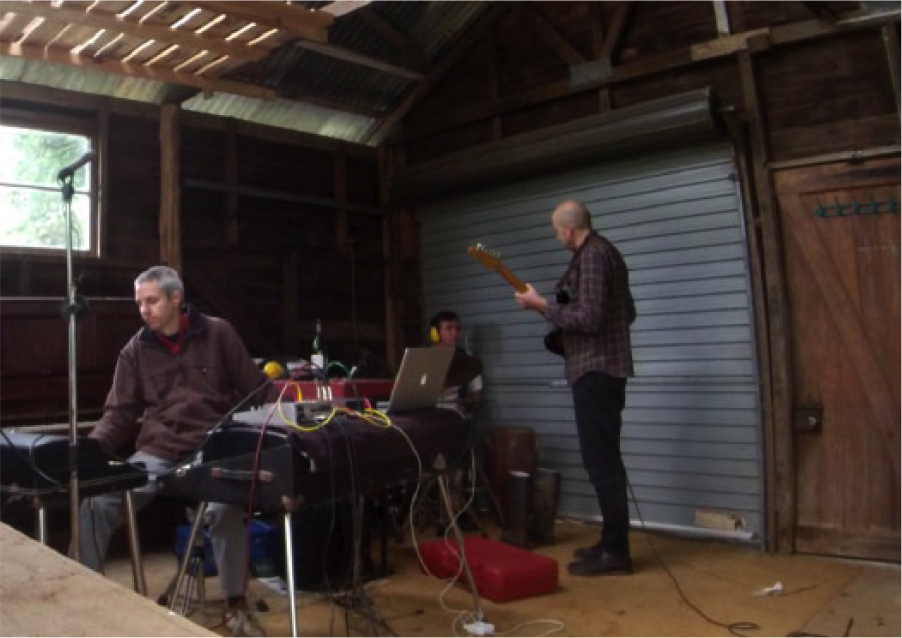
Session image accompanying “I’ve got a proposal” comment.
The band then continues in a cooperative manner for 2 minutes, following Rob’s instructions, however conflict occurs at this point when Barry moves his effects pedal (on the floor) and gets tangled in the power lead and stops playing (Figure 3).
I’ve lost the feeling
(stops playing as well) Obviously, what the fuck, useless prick, get the fucking feeling and stop thinking about crap.
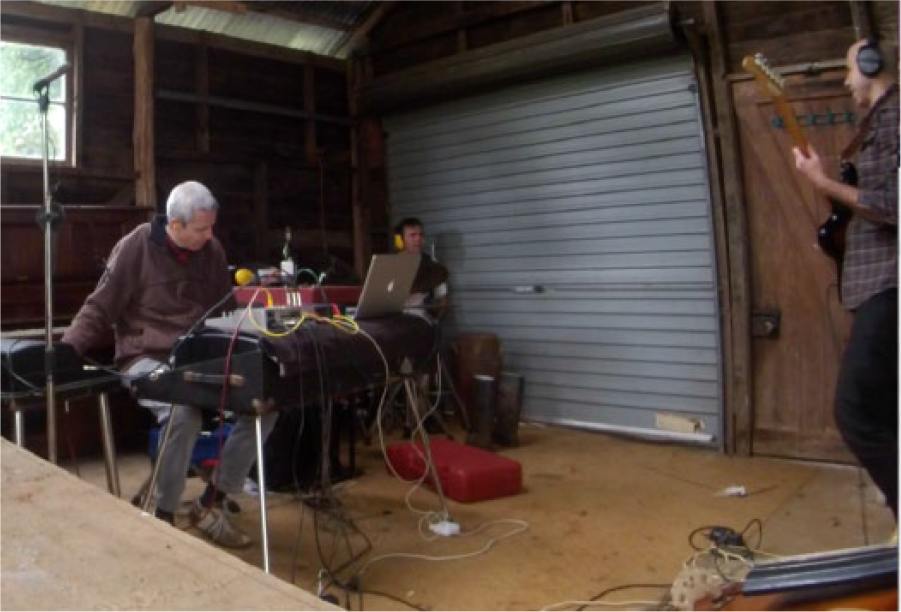
Session image accompanying “I’ve lost the feeling” comment.
The conflict here can be categorised both as task and interpersonal conflict. “The feeling” is an explicit musical objective previously deemed by the band members themselves as one of the key criteria for the development of the new material (task conflict), while “stop thinking about crap” is a comment on Barry’s life outside of the band (interpersonal conflict). This conflict phase is then followed by the band playing under Rob’s direction (asking the others to build in dynamics for a specific period), in a cooperative manner. From here the session moves into a phase of verbal cooperation with two of the band members discussing the overall concept for the piece:
Do you like that idea of just keeping it simple and building?
Yeah, but I don’t want it to go in exactly the same direction as the last two tunes
Why not?
Well we can go sort of the same direction but I don’t want it to sound …
I’ve got a new chord progression that goes … (plays chord progression from other tune)
You don’t want what?
I don’t want the same song as the other two.
How’s it the same song?
Well he started doing that and I started doing that (playing arpeggiated right hand on Wurlitzer electric piano)
It’s exactly the same song is it?
No it’s not, it’s good, it’s got potential, let’s just keep going.
Rob then turns this discussion to Barry and the phase of communication switches to part instruction, part conflict:
Yeah, well keep going, (looking at Barry) and turn it up, so I can fucking hear you, and stop thinking about (name of person) and play something with some feeling in it. (Matt laughs) Waffle head. You do what you want, doesn’t worry me, I’ve got a job at the end of the week.
The band then returns to playing and this personal jibe seems to have been a catalyst for an increased level of engagement with the task at hand because for the following 8 minutes the band plays with much greater energy and coherence. Numerous new musical ideas are developed and all band members exhibit signs of empathetic engagement (indicative of Seddon’s nonverbal cooperation category). This is evident in the smiles and eye contact between all members as shown in Figure 4.
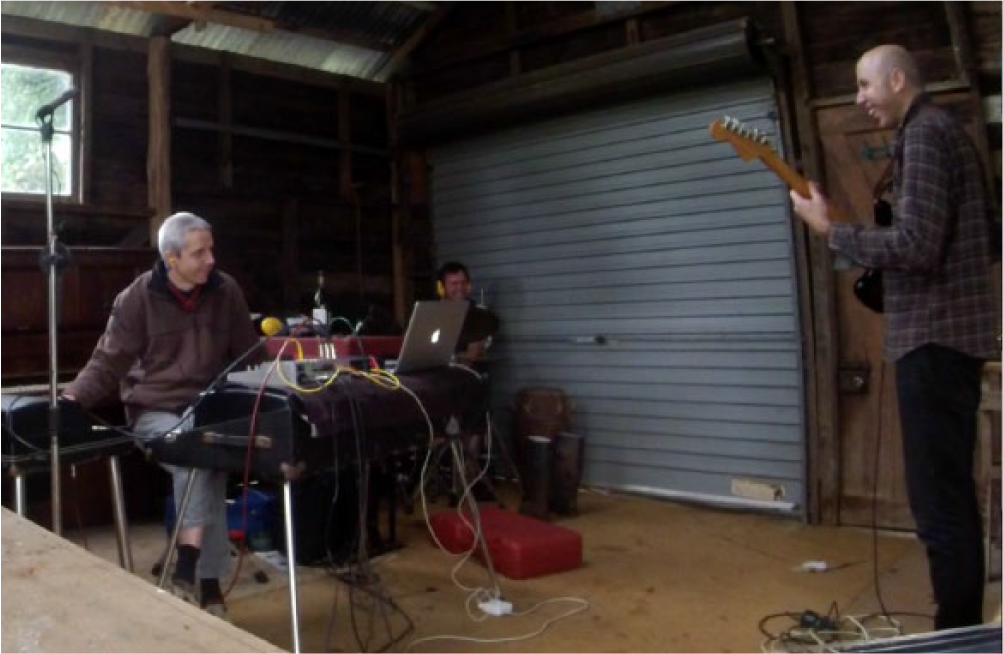
Session image highlighting empathetic engagement.
In the above example the band moves through the various phases throughout a 30-minute period: cooperation, instruction, cooperation, conflict, instruction, cooperation, instruction, conflict, collaboration. The second conflict moment plays a critical part in the sequence in moving the nonverbal interactions from the cooperative to collaborative mode, and in doing so lifts the musical output to a more creative level.
A second example of where conflict is a critical catalyst is outlined below. After 30 minutes of rehearsing the group has settled on two versions of one section of the track and these are notated in Figures 5 and 6. At this point the group is seeking to solidify a contrasting “B” section, using a compositional approach adopted numerous times by the group where the “A” section is played for a set length of time and then everyone goes straight into an improvised contrasting part. At best this process results in musical outcomes that the whole group is satisfied with and as such represents empathetic attunement (Seddon, 2005). This process is repeated numerous times in a brainstorming fashion with the results recorded and then reviewed. Rob begins this process with a provocation to Barry:
So you’re ready? This isn’t Jamey Aebersold (American music educator famous for publishing “play-along” backing tracks for jazz musicians). It’s not university, this has to be something that sounds good, and has a bit of attitude. It’s not just waffly, whatever those classes you do are. Ready?
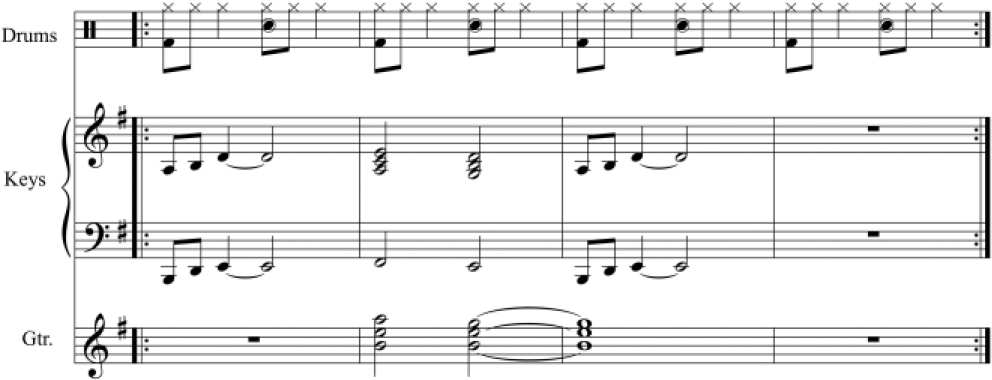
“Junta” basic parts for A section half time drum feel.
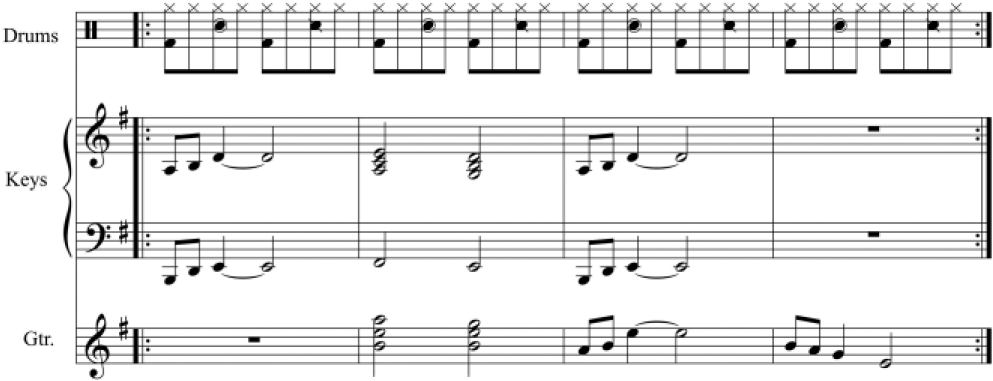
“Junta” basic parts for A section double time drum feel.
The group proceeds with this approach for 25 minutes with several iterations. Some of the new section attempts sounding cohesive to all members, but none deemed suitable (both at the time and on later listening) as a B section candidate. The cohesive sections can be categorised as periods of collaborative/empathetic engagement whereas the sections where other attempts occur (e.g., when one of the band members begins playing something and then stops when they feel the part is not working) can be categorised as cooperative/sympathetic engagement (i.e., band members are offering few novel and cohesive musical ideas, but still maintaining the form and rules of the compositional approach). At times the interaction moves into an instructive mode. For example, while still playing Rob suggests that Barry and Matt don’t play anything and just listen to the drums for eight bars to “see if you can hear anything”. Rob then proceeds to direct Barry to play the “triangle thing” (a rhythm exercise that band members have previously worked on). At another point Rob suggests to Barry that he try playing some bass lines (Matt had been playing keyboard basslines up to that point).
After 25 minutes of attempting contrasting B sections, individual frustrations begin to emerge and a conflict moment arises. This begins when Rob stops playing, gets up from the drum kit and the following conversation takes place (Figure 7).
Where do you hear this piece going? I know where I hear it going. I hear it going into the mystery sort of repetitive loop sort of zone, but it needs a wall of sound for that to happen.
After the first bit?
Yeah, the first bit’s great. I think the first bit’s beautiful. What I’m hearing is that sort of thing transitioning into a mystery wall of loopiness. You know how you were just doing that (points to keyboard)…
Yeah, yeah. (pointing to Barry) What’s he doing in that bit?
I don’t know. I don’t know what he’s hearing or where his brain is.
I’m not very inspired by it at the moment.
Fucking get inspired, this happens every week, where your brain’s like somewhere, so get inspired, that’s what you spend your whole life doing music for.
Like those parts in “Yamasan” (another track by the group), where you sort of become the defacto bass player, but not necessarily low frequencies.
But they’ve all been dumped.
They’ve all been dumped?
No they haven’t
All the bits I like get dumped
What bits do you like? You don’t even communicate. You just sit around here playing with your fucking pedals, can’t even hear you half the time, you’re like – I don’t know – in your own world.
I don’t know, they were all going to a different place from where we started.
We’re trying stuff out, but there’s nothing about being dumped. You’ve got your own dumping going on. If you think you’ve got something good play it so we can frigging hear it, rather then just defaulting fiddling with pedals and switching your chorus on and off. Play some fucking notes that mean something and play them.
Well I’ll take that on board
Rather than your default position “I don’t feel very inspired, it doesn’t move me”, well fucking play something that moves us and moves you. I think it’s beautiful that first section.
Yeah the first section’s good but…
Ok, I propose, get on the fucking thing without fluffing about, everyone, and just build it, even if it’s just a single note. Too many, trying to do different bass lines and this and that and the other.
I like the simple four chord bass thing, was a direction that I’d like to go, contrasting the repetitive groove.
Ok, well make it sound good then. I’m happy to just stay on one beat forever.
I don’t think you are
I am if you’re doing something.
No because your farm would suffer! (Barry laughs)
Don’t be scared, don’t be hung up that it’s going to sound like the other song, we’re onto a formula that works
I don’t care, I’m enjoying life, it’s good
Well don’t waste my fucking time
Well you’re the one who sat down on the couch.
Ok (getting up) well play something. Play something other than clown music. (Pointing to Barry) Get your sound, turn up. The thing is (pointing to Matt) when you play your left hand the whole time it dominates Barry. He tries to play lower notes or come up with something harmonic, he can’t because you’re just dominating with this garbage.
(Rob’s wife enters off screen, Rob goes to speak to her)
Did I come at a bad time?
You’ve come at a classic time.

Session image accompanying “Where do you hear this piece going?” comment.
The verbal conflict that is transcribed above moves fluidly between both task-based conflict and relationship conflict. An example of task-based conflict occurs when Rob says:
The thing is (pointing to Matt) when you play your left hand the whole time it dominates Barry. He tries to play lower notes or come up with something harmonic, he can’t because you’re just dominating with this garbage.
Earlier in the conversation the conflict alludes to longer term relationship issues when Rob says to Barry:
What bits do you like? You don’t even communicate. You just sit around here playing with your fucking pedals, can’t even hear you half the time, you’re like – I don’t know – in your own world.
This conflict acts as a catalyst for the development of a specific section of the track that had been the compositional problem for this particular session. After a short break, the band resume playing and in the following 30 minutes a new B section is settled on (see Figure 8) that incorporated some of the musical elements that had been played in the previous 60 minutes.

“Junta” basic parts for B section.
Conflict as strategy
In the above interaction the line between humour and abuse is a fine one, with nonverbal communication including wry smiles and laughter at various points indicative of a friendly camaraderie. One reading of Rob’s abusive language could be that it is a strategy to provoke a response or shake the others out of habitual musical responses and/or to get them to engage more wholeheartedly in the process of developing this particular section of music. However, there are times when this crosses over into pure frustration in places. Rob’s plea to Barry to “get inspired” becomes more frustrated when Barry suggests that all his parts have “been dumped”. In both these instances the standard “soft skill” (Birkett, 1993) instruction, that is, to criticise the behaviour and not the person, is abandoned by Rob when he suggests that Barry is “in his own world”. While the atmosphere in the rehearsal is tense at this moment, it is clear to all the group members that this is not an unusual incident. Barry demonstrates his awareness of this when he states at the end to Rob’s wife who has just entered the rehearsal space: “You’ve come at a classic time”. The following conversation (from the end of the session after the new B section has been agreed on and a demo version recorded) highlights the band’s awareness of how the conflict incidents have contributed to the generation of new musical ideas that solve a specific compositional problem:
I think that’s the structure and we just work on that build. Do you like it?
Yeah, good, I like it.
Compare it to the version you liked before, the old version (Matt plays a recording of the old version on computer).
Put it there for your bloody joy, for your frigging joy and happiness (shaking Barry’s hand). Good abuse today (Matt and Barry laugh). Good productive abuse.
Again it is evident here that Rob is viewing conflict as a strategy and that both Barry and Matt accept this. The camaraderie between the three band members is evident at the end of the rehearsal, highlighting the sense that the three experience the highs and lows of the rehearsal in a way that suggests empathetic attunement (Seddon, 2005).
Immersion, combined flow and group flow
Throughout this section of the composition session the group members appear to have varying degrees of immersion in the session. In relation to the characteristics of combined flow as identified in Hart and Di Blasi (2015) the group members appear to move in and out of these characteristics. For example, when the band was working on playing through the A section only, Rob establishes his parts early and then makes suggestions to the others as to what to play. One interpretation of his subsequent abusive outbursts is that the “challenge–skill balance” characteristic is no longer present and that he is becoming bored and wants to take control over the situation. Another characteristic of combined flow is “concentration on the task at hand”. The moment when Barry stops playing and says that he has “lost the feeling” not only indicates a loss in concentration but also a deeper concern that he is uncertain of the direction of the music (i.e., lacking a “clear goal” – a characteristic of individual flow but not identified by Hart and Di Blasi, 2015, in combined flow).
The musical outcome from the process outlined here is the basic drum, keyboard and guitar parts for a track that has two distinct sections. These sections, particularly the B section, from Matt’s point of view are very different from the sort of parts he would be inspired to play if working alone. In fact, one of the B section improvisations (notated in Figure 9) was of particular interest to Matt and this has been noted for future reference. This follows Sawyer’s (2006) notion that group flow is an emergent property of a group. While the transcription of the parts indicated above just outlines the basic elements in the 4-bar pattern, the final recorded version highlights the building intensity, with many variations to the parts as notated, which was achieved in the performance. The build in intensity in the B section was something that Rob suggested (an instruction to the other members), however the exact nature of how that build was to be achieved was left to the group to develop during the extended rehearsal process.

“Junta” – rejected B section keys part.
Conclusion
It is somewhat ironic that the track was given the title “Junta” prior to the particular composition session that is detailed here. The fact that the title had resonance with the group members perhaps acknowledges the way the group has come to view its own processes. In this particular rehearsal intra-band conflict took the form of verbal abuse (particularly from Rob), nonverbalised frustration with the performance of other group members and nonverbalised frustration from all group members with the lack of progress in creating a suitable contrasting B section. Throughout the composition session, the interaction between the band members moved between various modes (instruction, cooperation, collaboration, conflict) as the band sought to find a mutually agreeable solution to a specific compositional problem (i.e., composing a contrasting B section to fit with an existing A section). The moments of conflict during this interaction are key moments in the process where the band members have arrived at a point where at least one of the members is “uninspired” or otherwise frustrated with the progress. Each conflict moment is followed by a period of sustained engagement by all band members in the collaborative play/composition process that ultimately leads to the compositional solution. The shared history of the group members (outlined earlier) provides a contrasting, longer-term perspective from which to view the interactions in this rehearsal. As such, the “shared highs and lows” reinforce Seddon’s (2005) notion of empathetic attunement and empathetic creativity.
This research, while presenting only a microcosm of one group’s collaborative creative conflicts, does add to the body of literature on group flow (e.g., Hart & Di Blasi, 2015; Morrow, 2011; Seddon, 2005; Seddon & Biasutti, 2009) and empathetic creativity (Seddon, 2005). This research also addresses a gap in the literature in relation to understanding the impacts of conflict during collaborative composition practices. There are implications in relation to the understanding of informal music learning processes (Green, 2002), offering a case study of a jamming model (Bennett, 2010). Further research is necessary to compare the experiences of other groups working with this process. Following Chen (2006), it would be interesting to examine the impact of conflict at various stages in the album production cycle. This research has only examined the compositional phase and has not considered other phases of production such as recording, mixing, marketing and promotion. From the examples from the literature given here (e.g., The Beatles and Boy & Bear), and in the detailed account of one amphibian rehearsal, conflict clearly plays an important role in the collaborative composition process, acting as a catalyst for participants’ (band members’) focused engagement with the process resulting in musical outcomes that may have remained unearthed in the absence of such conflict.
Footnotes
Funding
The author(s) received no financial support for the research, authorship, and/or publication of this article.