



Abstract
The decision to grant conditional release from prison (aka the parole decision) has been largely neglected in the contemporary criminological literature, despite its critical implications. The current study, conducted in Pennsylvania, United States, tests for punitive themes in parole decision making by examining the impact of several measures reflective of punishment satisfaction on the decision to grant release to eligible parole candidates. The results indicate that the amount of time served in relation to the original punishment does not predict parole decisions but the nature of the original offense does. Moreover, inmates eligible for parole have to experience at least one parole denial to increase their chances of release, suggesting that parole decision makers use the parole process as a punitive means. The implications of the findings are discussed.
Introduction
A growing body of research emphasizes the significance of the prisoner reentry and reintegration process for persons recently released from prisons, for the communities to which they return, and for the justice system. Despite this recognition, the decision to grant conditional release from prison before the expiration of the sentence, aka the parole decision, has received little attention recently. This is surprising considering that the decision is one of the most critical liberty decisions. Aside from its public safety stakes and implications for correctional capacity, the parole decision has life-altering consequences for the freedom of those incarcerated individuals eligible for parole. Given its discretionary nature, the decision also has serious implications for the fair and equal administration of justice.
This study examines parole decisions in one large U.S. jurisdiction, the State of Pennsylvania. The research tests for punitive themes in parole decision making by examining whether measures reflective of punishment satisfaction have an impact on parole decisions above and beyond other factors ostensibly related to the purposes of parole (i.e., successful transitioning of offenders from the institutional setting to the community). Thus, the article addresses criticism raised about parole that parole decision makers implicitly may engage in resentencing when considering whether offenders should be conditionally released before the expiration of their sentences (see Hawkins, 1983; Marquez-Lewis et al., 2013; Roberts, 2009). Arguably, such an approach would exceed the main mandate given to parole decision makers, which is to assess offenders’ rehabilitation and readiness for release and what conditions would help them to successfully transition back in society.
The Parole Decision and Its Relation to Sentencing
Parole is rooted in sentencing models that acknowledge the potential for offender rehabilitation and manifest concern for offender welfare. Under such models (in the United States known as indeterminate because they allow judges to set minimum and maximum limits), parole is conceived as the main means for incentivizing offenders to change. An inmate becomes eligible for parole only after serving the minimum term imposed by the judge, or as is the case with most European jurisdictions, a certain proportion of the original sentence. The parole board’s main task is to determine, based on the inmates’ institutional conduct and other related factors, whether those individuals eligible for parole have shown signs of rehabilitation, are likely to achieve successful reintegration, and what supervisory conditions would help in achieving that goal. Framed under these terms, the parole decision is highly predictive, aiming to prevent future crime by eventual parolees. As Hawkins noted in an earlier work examining the nature of parole decision making, this “ostensible design and practice of parole” and its underlying utilitarian-based penology align with the “positivist conception of the criminal sanction as a means of treatment to reform the offender” (Hawkins, 1983, p. 102).
Recent policy trends, however, raise the question of whether other, punitive concerns also drive parole decisions. Several jurisdictions in the United States now emphasize the role of victim input at parole by calling for direct victim (or victim’s family) participation during the parole hearing (Caplan, 2011; Roberts, 2009). Such changes, driven by victim rights advocacy groups, have been promoted as addressing concerns for retributive justice and accountability to victims. Thus, policies calling for victim input at parole have their origins in similar policies calling for victim participation in sentencing, via “impact statements” (McLeod, 1989; Moriarty, 2005; Roberts, 2009). Scholars, however, are critical of this more recent focus of the victim rights movement. Roberts (2009), for example, points out that while listening to victim sentiments at sentencing is justified and responds to this decision’s aim to distribute normative justice, at parole victims “seldom possess information relevant to the parole decision” (Roberts, 2009, p. 347). He argues that taking victims’ input into account in making parole determinations contradicts principles of sound correctional policy, as such input, inherently based on personal feelings, would undermine the board’s main focus on risk assessment and offender reintegration. Caplan (2011), too, underscores that policies calling for victim input at parole rarely provide explicit direction to parole boards on “how to objectively consider” the information from victims in deciding whether to grant release (p. 291).
Although the question about the purpose of the parole decision is not new (see, for example, Hawkins, 1983)—and efforts to address it led to significant reforms (see below)—these current policy trends highlight its continued relevance and renewed urgency. Under Hawkins’ (1983) framework, the policies calling for victim input at parole would add to other related trends in U.S. penology, supporting the notion of a revival of the classical approach to punishment and its commitment to retribution (aka the “neo-classical ideology”). Dubbed by Roberts as reflecting “punitive victim rights” (Roberts, 2009, p. 347; also see Roach, 1999), arguably, these policies can contribute to creating an environment in which parole decision makers feel encouraged to assign blameworthiness and make judgments about commensurability between crime and punishment—or in Hawkins’ (1983) words, “assess evil” (p. 101).
If indeed parole practices are found to institutionalize the punitive considerations underlying these policies, arguably the utility of parole itself is called into question. Particularly poignant are issues about how parole relates to sentencing and its aims. The forum for consideration of punishment “deservedness,” especially assessment of commensurability between punishment severity and offense seriousness, is the sentencing stage. A reassessment at parole of whether the original sentence was “enough” would indicate that the parole decision makers—by questioning the original punishment imposed—doubt the punishing authority entrusted to judges. Such considerations would also contradict the original and purported goal of parole as preparing the offender for release and reentry. In Pennsylvania, the jurisdiction under study, the legislative act governing the board of parole, the Parole Act of 1941, which established the board and delineated its power and duties, emphasizes both that parole should ensure public protection and provide “opportunity for the offender to become a useful member of society and the diversion of appropriate offenders from prison” (Pennsylvania Parole Act of 1941). Thus, instead of reexamining satisfaction with all original punishment aims, the parole decision, bounded by the original sentence, should determine instead whether release after the offender has served the required minimum be authorized and, if so, under what conditions. In short, the use of parole for resentencing purposes would raise questions about the legitimate goals of parole and its role in the justice process.
Literature Review
Heightened scrutiny of parole practices in the United States in the 1970s led to reforms across the country. Initially, such efforts focused on structuring discretion in parole decision making (Carroll, Wiener, Coates, Galegher, & Alibrio, 1982; M. R. Gottfredson, 1979; D. Gottfredson & Ballard, 1966; D. Gottfredson et al., 1978; Von Hirsch & Hanrahan, 1979). Later on, continued criticism in an era of “tough-on-crime” approaches called for complete elimination of parole and the adoption of mandatory release systems in several U.S. states and the federal jurisdiction (Carson, 2014; Carson & Golinelli, 2013; Hughes, Wilson, & Beck, 2001). Under these models, the release happens automatically (“is mandated”) once the offender has served a certain proportion of the sentence. Not surprisingly, studies on parole have focused on the consequences of this shift, especially contrasting post-release outcomes (i.e., recidivism) under different release mechanisms (Ellis & Marshall, 2000; Hughes et al., 2001; Schlager & Robbins, 2008; Solomon, Kachnowski, & Bhati, 2005; Turpin-Petrosino, 1999). The states abolishing parole, such as Washington and Maine, were reported to have the lowest rates of post-release supervision (incidentally, among the states retaining parole, Pennsylvania had the highest supervision rates; Hughes et al., 2001). In terms of post-release outcomes, these studies generally reported better performance (i.e., lower recidivism rates and longer time to reoffending) under parole systems when contrasted with mandatory releases or maxing out (the releasing of inmates at the expiration of their sentences; Hughes et al., 2001; Schlager & Robbins, 2008), though some reported no significant differences (Solomon et al., 2005).
These changes in parole policies across the United States fit within larger shifts in penal policies affecting sentencing and correctional practices over the span of several decades (Simon, 1993, 2007). Thus, although subject to some debate, the increase in punitiveness and over-reliance on incapacitation-orientated approaches to punishment has been widely documented—and considered the leading cause of the mass incarceration crisis afflicting U.S. correctional systems and local communities (Alexander, 2010; Clear, 2007; Clear & Frost, 2013; Feeley & Simon, 1992; Garland, 2001; Petersilia, 2003; Useem & Piehl, 2008). Regarding parole, the adoption of mandatory releases and the growing recognition of the risk-management approach to correctional supervision reflect the incapacitation focus of the “new penology” (Feeley & Simon, 1992). However, the victim rights movement, discussed above, is arguably the main vehicle effecting legislative change driven by punitive, retribution-driven sentiments (Caplan, 2011; Roberts, 2009).
The emergence of mandatory release notwithstanding, the parole decision remains the main mechanism for prison release, in the United States and elsewhere, significantly surpassing releases via mandatory mechanisms (Maruschak & Bonczar, 2013). In those jurisdictions, such as Pennsylvania, that continue to rely on parole, the decision also remains by design discretionary, with great implications for inmates, prisons, and communities alike. Understanding what factors influence it nowadays is critical. However, only a handful of studies have been found in the past few years. Some focused on testing for effects of extra-legal factors, such as race or ethnicity (Anwar & Fang, 2015; Huebner & Bynum, 2008; Mechoulan & Sahuguet, 2015; Morgan & Smith, 2008); another study researched the impact of inmates’ mental health status (Matejkowski, Caplan, & Cullen, 2010). The remainder looked at the impact of victim participation in parole hearings in those jurisdictions calling for such input recently (Caplan, 2011; Morgan & Smith, 2005; Roberts, 2009). In light of all this, it seems particularly relevant to revisit parole decision-making practices. Do policy trends driven by victim satisfaction orientations translate into punitive parole practices, or are parole decisions driven by concerns about offender rehabilitation and reintegration, purportedly their main and original goal? Thus, revisiting the factors that affect parole decisions is both timely and necessary. The next subsection reviews the main findings emerging from the extant parole decision-making studies, including the most recent ones mentioned above.
Factors Affecting the Parole Decision
Two recent reviews of earlier research suggest the following factors emerging as predictors of parole decisions across studies: institutional behavior, prior criminal history, crime severity, incarceration length, mental illness, victim input, and parole guidelines or risk assessment scores (see Caplan, 2007; Roberts, 2009, and studies cited therein). The robustness of these factors as determinants of parole decisions is, however, weak. The most notable theme emerging from all existing studies is perhaps the inconsistency in findings across time and space. It stands out, for example, that the impact of the type of offense, or offense seriousness or other measures of crime severity, varies greatly across studies. Whereas some found parole decisions to be a function of crime type (Caplan, 2011; Carroll & Burke, 1990; M. R. Gottfredson, 1979; Huebner & Bynum, 2008; Morgan & Smith, 2005, 2008; Turpin-Petrosino, 1999), others reported no significant relationship between the nature of the offense and the decision to grant parole (Conley & Zimmerman, 1982; Matejkowski et al., 2010; Talarico, 1988).
Prior criminal history and institutional behavior have been shown to predict parole decisions in most studies (Caplan, 2011; Carroll & Burke, 1990; Carroll et al., 1982; Conley & Zimmerman, 1982; M. R. Gottfredson, 1979; Huebner & Bynum, 2008; Talarico, 1988). However, in one relatively recent study, institutional conduct and program participation had no impact on parole decisions (Morgan & Smith, 2005). How can this be interpreted? Are these null findings an indication that “parole boards [are] losing sight of the issue of rehabilitation” as Roberts (2009, p. 397) suggests in his review? In the same vein, whereas a 2004 study testing for impacts of parole candidates’ mental health found a significant negative association with the likelihood of parole (Hannah-Moffat, 2004), later research reported null findings in this regard (Matejkowski et al., 2010). The inconsistency in these findings may be attributable to methodological differences 1 or to changes in diagnosing practices regarding mental health issues among the prison population. While these potential explanations should not be disregarded, nor should the alternative possibility that parole decision makers may be changing their views and practices on what factors to consider in their release determinations. Specifically, if mental health issues are seen as indicative of potential impediments to reentry upon release, the available studies again would raise questions about a possible shift over time in the way that parole decision makers approach their predictive task, and whether factors seen as related to reintegration potential are losing ground in parole determinations.
As for offender attributes scrutinized under the category of extra-legal factors, such as race or ethnicity, only one recent study, in an undisclosed U.S. jurisdiction, documented significant influences on parole decisions (Huebner & Bynum, 2008). Specifically, the authors reported that Black male parole candidates had to wait longer to be paroled; however, Hispanic candidates were released more quickly than their Black and White counterparts. The remainder of the recent studies exploring race or ethnicity effects on parole decisions reported no evidence of racial prejudice or discrimination against candidates belonging to minority groups, including in Pennsylvania (Anwar & Fang, 2015; Mechoulan & Sahuguet, 2015; Morgan & Smith, 2008).
The length of incarceration, or time served, is yet another measure whose impact varies greatly. In three recent investigations, such impact was not significant (Caplan, 2011; Huebner & Bynum, 2008; Matejkowski et al., 2010). In contrast, this variable was among the strongest predictors of inmate selection for parole consideration in Morgan and Smith’s (2005, 2008) research of parole decisions in Alabama. Finally, the impact of victim input, of interest in the most recent inquiries, varies, too, in the couple of available studies. Morgan and Smith (2005) reported victim participation to be among the strongest predictors of release, significantly decreasing the likelihood for a decision favorable to the inmate. In contrast, Caplan (2011) found no impact for either verbal or written victim participation in New Jersey.
This review reveals that if any consistency is to be found in the available research on parole decision making, especially when earlier studies are contrasted with more recent ones, that would be that no particular type of predictors seems to have long-term validity, or to hold across different places. The unavoidable question this raises is as follows: Are the inconsistencies in findings across jurisdictions and time a reflection of larger ideological shifts aimed at changing parole practices? In Pennsylvania, the site of the current investigation, the most well-known study investigating parole decisions was reported in 1982 by Carroll and colleagues. The passage of time would warn against extrapolation of that study’s findings to current days. The focus of that investigation, however, is particularly relevant to the present inquiry, as it specifically attempted to determine whether, in granting parole, the board members viewed themselves as “punishers” and reported that they did not. Instead, the study reported, the board took on a role to sanction prison misconduct and to influence inmate behavior via institutional programming.
In sum, based on the available research on parole decision making, concerns for external validity alone prompt the need for further analysis. The current study, while contributing direct knowledge about parole practices in one large U.S. state, also adds to the overall limited contemporary literature on this topic. The research draws on rich data and employs some unique measures, not used in prior research, which should allow for more confident inferences about the parole decision-making process in the jurisdiction under study.
The Current Study
The research tests what shall be called “the punitive hypothesis”: Measures reflective of punishment considerations explain variation in parole decisions above and beyond other factors, including those indicative of rehabilitation and reintegration potential. Three categories of punishment measures are tested. To start with, measures related to the nature of the offense controlling an inmate’s sentence can be indicative of punitive considerations, if all else equal, the seriousness or type of the offense is found to predict parole decisions. The other two categories of measures that are tested include indicators related to the sentence term being served and indicators related to prior parole review.
Nature of Offense
Measures related to the seriousness of the offense controlling the sentence are perhaps some of the most commonly used (though with inconsistent results, as indicated). This study follows this established tradition. In relation to the seriousness of the offense, the punitive hypothesis expects that persons serving time for more serious crimes are less likely to gain parole, holding everything else equal. If reoffending risk and institutional behavior are accounted for, parole decision makers would be hard-pressed to provide an alternative explanation rationalizing the influence of the type of the offense on their decision to grant or deny parole. Consideration of the nature of the crime beyond other factors would be indicative of a parole decision-making process that emphasizes circumstances in an inmate’s past that simply cannot be changed (i.e., the harm caused to the victim), which already weighted heavily on the imposition of the sentence the parole candidate is serving.
Specifically, the study tests for three major offense categories: against the person, against the property, and drug offenses. The analysis also tests for impacts of specific crimes: burglary and theft from property offenses and robbery and sex offense from persons offenses. Under a punitive expectation, that retributively the punishment should be commensurate with the harm caused by the offender’s crime, offenses against the persons will be treated more harshly than offenses against property or drug offenses. Offenders serving sentences for sex offenses, generator of much public outcry and generally viewed as extremely heinous predatory crimes, should be among the least likely to gain parole.
Prior Parole Denial
The study also tests for a measure not considered in previous studies, prior parole denial. It is expected that first-time parole candidates are less likely to gain release than those who have already been considered and denied parole at least once. The punitive implications of such an expectation draw on a “process-as-punishment” view of justice decision making. Originally advanced by Feeley (1979) to explain dispositions in misdemeanor courts, this understanding of justice decisions argues that the decision makers view the criminal process itself as, or part of, the desired punishment for an offender. Feeley reasoned that in misdemeanor cases, the legal actors involved in their disposition might settle for a less formal punishment outcome based on an implicit agreement that the offender had suffered “enough punishment” just by going through the criminal process itself—and the legal and extra-legal costs associated with it (e.g., pretrial detention, bail, legal fees, lost income, disruption in family relations). Thus, when balanced against the desired punishment aims, the process itself is seen as punitive enough to ensure that the defendant received his or her “just deserts.”
Although Feeley proposed this process-as-punishment view only for misdemeanor case dispositions, seen to involve lower societal stakes than felony cases, this explanation was also more recently proposed to account for the high proportion of dismissals in felony cases observed in Vîlcică’s study in Philadelphia’s criminal courts (Vîlcică, 2012). Vîlcică reasoned that it may be precisely the high stakes involved in the more serious cases that drove prosecutors to pursue them despite dim convictability prospects, as the criminal processing would serve to deliver at least some punishment, seen as better than no punishment at all.
What these interpretations have in common is the assumption that justice decision makers use the process at their disposal as a means to extract punitive satisfaction from those who break the law or are believed to have done so. This line of thinking can be extrapolated to parole, too. Arguably, for most incarcerated persons, the parole hearing can be an intimidating experience. The stakes involved are as high as possible: Their shot at imminent freedom depends on the hearing. This hope alone can incentivize inmates to spend a great amount of effort on preparing for the interview and improving their institutional behavior and potential post-release arrangements. All this cannot be lost on the parole board in charge of deciding the release. To contrast this reasoning with that involved in the disposition of court cases discussed above, at parole, the board members would use the process at their disposal, the parole hearing, as a means to exact additional punishment of the inmates, on top of their already serving the necessary minimum. If holding constant all other factors, eligible candidates are granted parole only after they have been through the parole hearing at least once, there would be reason to believe that from a decision maker’s perspective, inmates need to “earn” their release by first suffering through its denial, as mere eligibility for parole would not be enough.
Time Served
Length of incarceration has been used in prior research (with inconsistent results). This study explores more nuanced versions of time served that would allow more confident inferences of punitive intentions. These include measures that consider the time served as proportion of (a) the minimum sentence and (b) the maximum sentence. Incarceration length may be expected to affect parole decisions for the mere reason that eligibility for parole depends on the amount of time served. However, such a measure is more useful when used in combination with the total possible sentence time. Deriving measures of time served as proportions of the minimum and maximum terms, as this study does, can provide valuable insight into how exactly the original sentence is being considered in parole determinations. If it is found that individuals are granted parole very close to the timing of their minimum, then the inference would be that parole decision makers consider that the punishment aims of the sentence have already been satisfied by the serving of that minimum. If, however, inmates gain parole only after they serve a great amount of time on top of their minimum, a punitive inference can be drawn given that the minimum is when they have already earned their eligibility for release consideration. Again, under this scenario, becoming eligible for parole would be deemed by the parole board as a bare threshold. To satisfy punishment imperatives and earn their release, inmates would have to serve a greater amount of their original (maximum) sentences.
In sum, in relation to time served, seen as a measure of the original punishment, the punitive hypothesis predicts that the shorter the amount of time served in relation to the minimum or the maximum terms of the original sentence, the less likely parole will be granted.
Data and Method
Research Setting and Sampling
The setting of the research is in Pennsylvania, a jurisdiction that relies on parole as the main means for prison releases for non-death and non-life sentences. 2 Pennsylvania offers perhaps a prime example of how parole practices can be subject to politicization or media influences. During Fall 2008 to Spring 2009, the state parole board (Pennsylvania Board of Parole and Probation, PBPP) and its corrections system (Department of Corrections, DOC) had to face the consequences of an extremely abrupt moratorium on all parole releases declared by then-Governor Edward Rendell, following several killings of police officers by parolees recently released from prison. In addition, following another highly mediatized parole case (Philadelphia Inquirer, 2013), the state has recently adopted the Victims’ Voice Law (Pennsylvania Board of Probation and Parole [PBPP], 2013), which now allows in-person participation of victims and/or their families at the parole hearing.
Parole eligibility is earned once an offender has served the minimum sentence. Inmates are scheduled for parole hearings as the expiration of their minimum approaches. As in other U.S. jurisdictions, the parole board employs decision maker–oriented guidelines (called a “decisional instrument”). Key indicators weighted in the decisional instrument include (a) level of risk, according to the Level of Service Inventory–Revised (LSI-R) risk tool (ranking all parole candidates’ risk of returning to prison) 3 ; (b) institutional programming (unwillingness to participate in or non-compliance with required programs); and (c) institutional behavior (a composite of five measures of misconducts considered serious and occurring within the last year or since the last review). The DOC recommendation for parole is not scored but is presented prominently on the form.
The study relies on data from a comprehensive review of the parole and correction processes conducted during 2008 to 2010 (Goldkamp, Vîlcică, Harris, & Weiland, 2010), with relevant data provided by both PBPP and DOC. 4 Specifically, the research draws on a random sample of 1,172 parole decisions made by PBPP during January to April 2008. 5 The study purposefully drew the sample from before the imposition of the moratorium (declared in September 2008 and fully lifted in March 2009), as the aim is to characterize parole decisions as they normally were occurring rather than during periods of reactivity in the aftermath of the moratorium. Across the whole sample and all data collected, 89 cases (7%) had missing information on various items, decreasing the valid N for the multivariate analyses to 1,083, still a sizeable number suitable for predictive analyses. 6 All decisions involved parole candidates seeking to gain release after having served their minimum sentences and were, thus, eligible for a parole review.
Table 1 presents the sample characteristics. Roughly, 58% of the inmates sampled were granted parole and 42% were denied, rates consistent with those reported by PBPP for the whole population of cases considered during that time. The sample was predominantly male, with a slight majority of inmates non-Black and about half of them 35 years of age and below. About 37% were serving sentences for offenses against the persons, 17% for property offenses, 24% for drug offenses, and the remaining for other types of offenses. As for the sentence being served, the average minimum was 33 months, the average maximum 95 months, and the average amount of time served by the time of the parole hearing was 48 months.
Characteristics of the 2008 Pennsylvania Parole-Eligible Inmate Sample (N = 1,172).
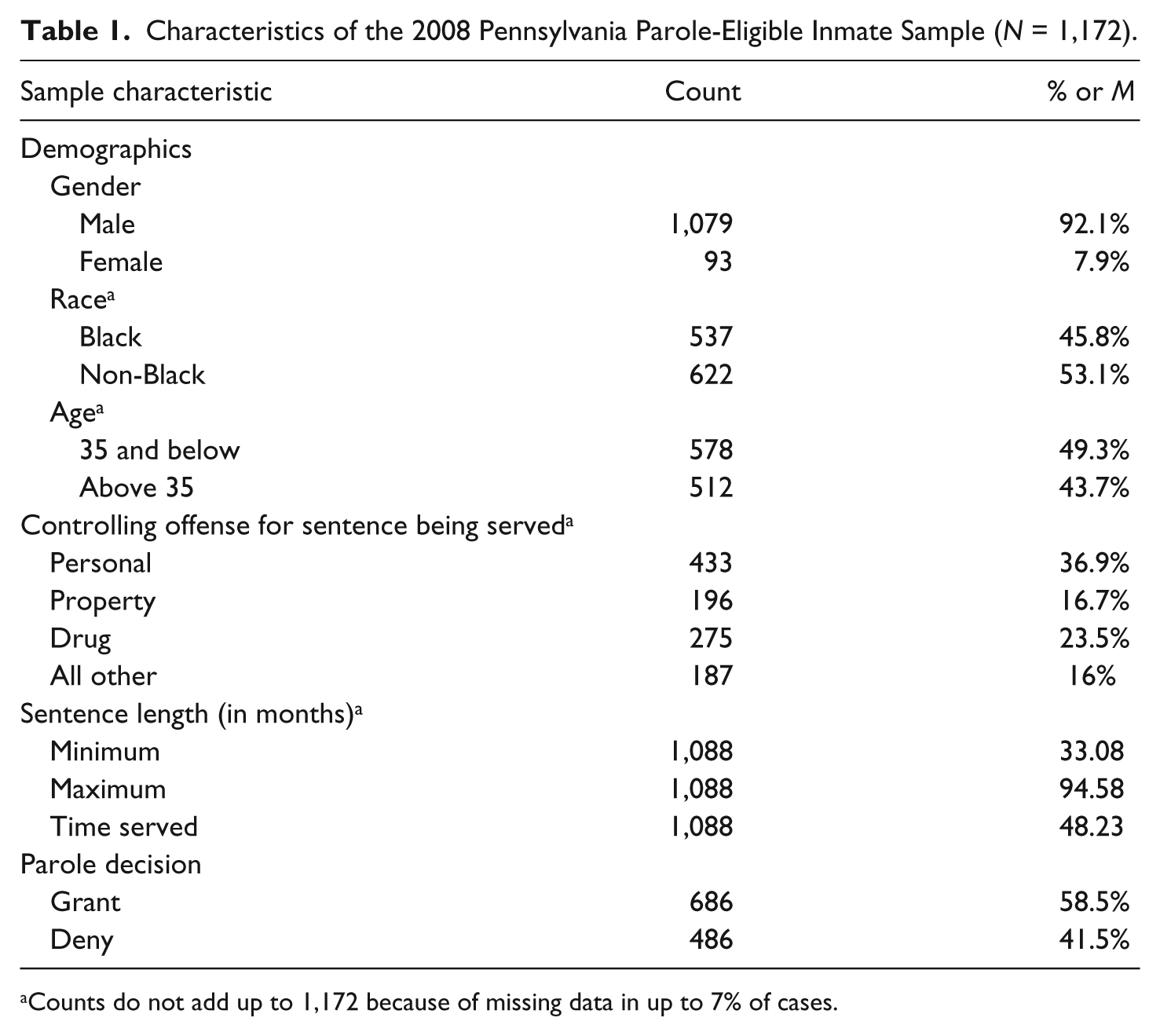
Counts do not add up to 1,172 because of missing data in up to 7% of cases.
Study Variables
The outcome variable, the parole decision, was coded 1 for the granting of parole and 0 for parole denial. As for the main predictors, the analyses also employed dichotomous variables for the following categories of offenses: personal, property, and drug crimes. 7 Specific personal (robbery and sex) and property (theft and burglary) offense variables were also used. The bivariate results, suggesting different impact directions for the robbery and sex offense predictors prompted the need to recompute the original personal offense variable, to include all types of offenses against the person with the exclusion of robbery and sex crimes. Thus, all three variables could be employed simultaneously in multivariate analysis without concern for multicollinearity and allowing for potential distinctive impacts of each. 8
The existence of prior parole review/denial was measured as a three-category variable: No prior denial was used as the reference category whereas dummy variables were created for inmates with one review only and for those with two or more prior reviews. This categorical version was deemed better suited to allow identification of the nuanced punitive inferences hypothesized regarding this predictor than the simpler alternative of any prior denial. To test for the impact of time served seen as a measure of the original punishment, the research derived two proportion measures based on the lengths of the minimum and maximum terms originally given, respectively (based on their expiration dates): (a) a proportion of the time served over the minimum sentence, to gauge how much on top of the minimum would earn an inmate release, and (b) proportion of maximum term given to an offender over the time served on that sentence, to gauge how much of the maximum sentence would earn an inmate release. To follow prior research, the time served measure by itself (length of incarceration from commitment to parole hearing date) was also used.
The pool of control variables included socio-demographics (age, gender, race, marital status, and employment and education at prison admission), criminal history (prior arrests, convictions, incarcerations, parole/probation revocations), and other risk-related factors (e.g., substance abuse). Institutional data included information on program participation and misconduct history. The key factors of the parole decisional instrument were also used as controls: the LSI-R risk score (a continuous measure), the institutional programming “score” (binary measure, coded 1 for inmates deemed non-compliant by showing unwillingness to participate in required programs, and 0 for those inmates deemed compliant with institutional programming), and the institutional misconduct “score” (binary measure coded 1 for inmates found to have committed serious misconducts in the past year or since last review). Additional factors expected to affect the parole determinations included the DOC recommendation (yes = 1, no = 0), as well as post-release–relevant information: whether or not the parole candidate has developed a home plan, or plans for seeking employment or continuing education, and possible living arrangements. All this was collected from the detailed interview data from individual inmate files. In short, the analyses aimed to control for a host of variables, including both factors available to the decision makers and ostensibly considered by them, as well as other factors that have been shown, however [in]conclusively, to be covariates of the parole decision.
Results
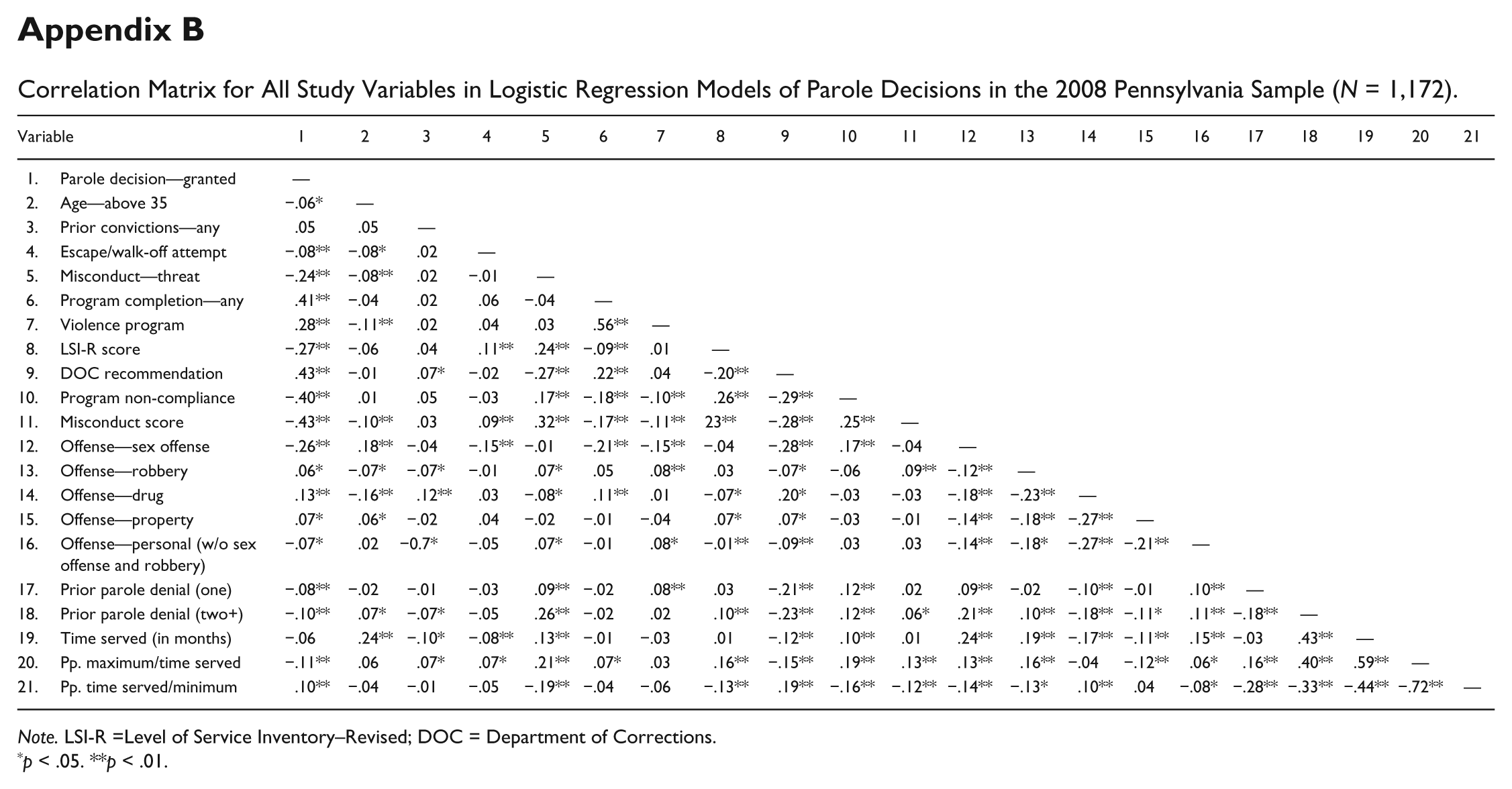
The first step in the analysis pared down the pool of potential independent variables by identifying those that covaried with the parole decision. Given the dichotomous nature of the outcome, this step relied on multivariate modeling through logistic regression techniques (Hosmer & Lemeshow, 2002). The analysis of the impact of the hypothesized predictors then was done on the basis of having modeled the best fitting predictors of the parole decision (as the “base model”). After screening for multicollinearity, each category of predictors was next added successively, starting with the offense-type predictors, followed by the prior parole review measures, and lastly, the time served measures. (Appendix A presents the descriptives for all study variables included in the final models, and Appendix B provides their collinearity matrix.)
Base Model
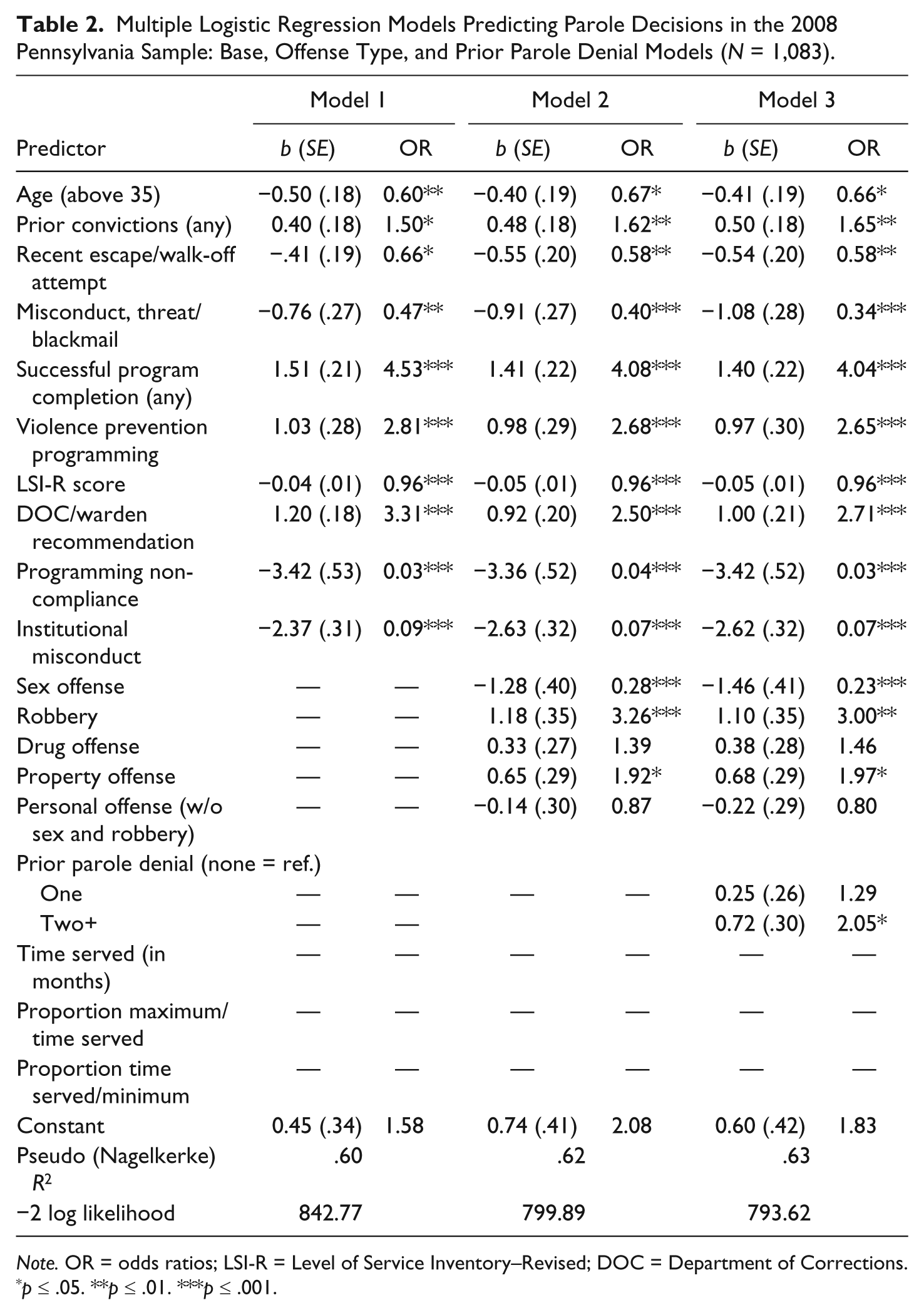
The multivariate modeling identified several factors as robust predictors of the granting or denying of parole across the sample (see Model 1 in Table 2). The predictors with the greatest impact were the key factors of the guidelines instrument. Not surprisingly, the indicator of non-compliance with institutional programming decreased the odds of being granted release by 97% whereas the indicator of institutional misconduct decreased those odds by 91%. In addition, the higher the LSI-R score, the lower the chances of parole. The DOC recommendation, too, carried great weight. A positive recommendation increased a parole candidate’s likelihood of release by more than three times. In addition, an inmate’s age (being more than 35) decreased the chances of release by 40% whereas a record of prior convictions increased those chances by 50%. Having any attempt of escape or walking off within the past 5 years decreased the chances of parole by 33% and committing a misconduct involving threats, extortion, or blackmail, decreased those chances by 50%. In contrast, any successful program completion increased an inmate’s odds of gaining release by four-and-a-half times. On top of this, participation in violence prevention programming increased an inmate’s likelihood of parole by almost three times. Notable, too, is the fact that some variables that might be expected to affect parole decisions turned out to be non-significant (and thus were excluded from the model). Specifically, none of the post-release factors predicted parole decisions, that is, having developed a home plan, or an employment plan, or potential living arrangements. Having identified the best fitting model of the outcome, which explained a great deal of its variance (60%), the analysis turned next to testing for the impacts of the main hypothesized predictors.
Multiple Logistic Regression Models Predicting Parole Decisions in the 2008 Pennsylvania Sample: Base, Offense Type, and Prior Parole Denial Models (N = 1,083).
Note. OR = odds ratios; LSI-R = Level of Service Inventory–Revised; DOC = Department of Corrections.
p ≤ .05. **p ≤ .01. ***p ≤ .001.
Impact of Controlling Offense Variables
Model 2 in Table 2 adds to the base model five offense variables: sex offense, robbery, drug, property, and personal (other than robbery and sex offenses). The impacts that stand out most are those of the sex and robbery offense predictors. After controlling for all other factors, persons serving time for sex offenses were 72% less likely to obtain parole than those serving time for other offenses. In contrast, individuals serving time for robbery offenses were three times more likely to be granted parole than other inmates. Persons serving time for property offenses were also more likely to gain release. The relationships with drug offenses and personal offenses (other than robbery and sex offenses) did not survive multivariate controls, though the direction of these associations remained as expected (drug offenders had increased odds of gaining parole whereas persons convicted of personal crimes had lower chances). Finally, the addition of the offense variables to the base model did not alter the impact of the previously identified predictors of parole decisions, whereas the variance explained increased to 62%.
Impact of Prior Parole Denials
Model 3 in Table 2 tests for the impact of prior parole denial. The results indicate that, after controlling for the presence of all other predictors, candidates with two or more prior denials were two times more likely to be granted parole than first-time eligible candidates. Inmates with one prior denial were about 30% more likely to gain release than inmates up for first review, although the impact of this variable did not reach conventional significance levels. As with the previous model, the addition of these new variables did not alter the effects of the previously identified predictors, including those related to the type of the controlling offense. The total variance explained by this model was 63%.
Impact of Time Served Variables
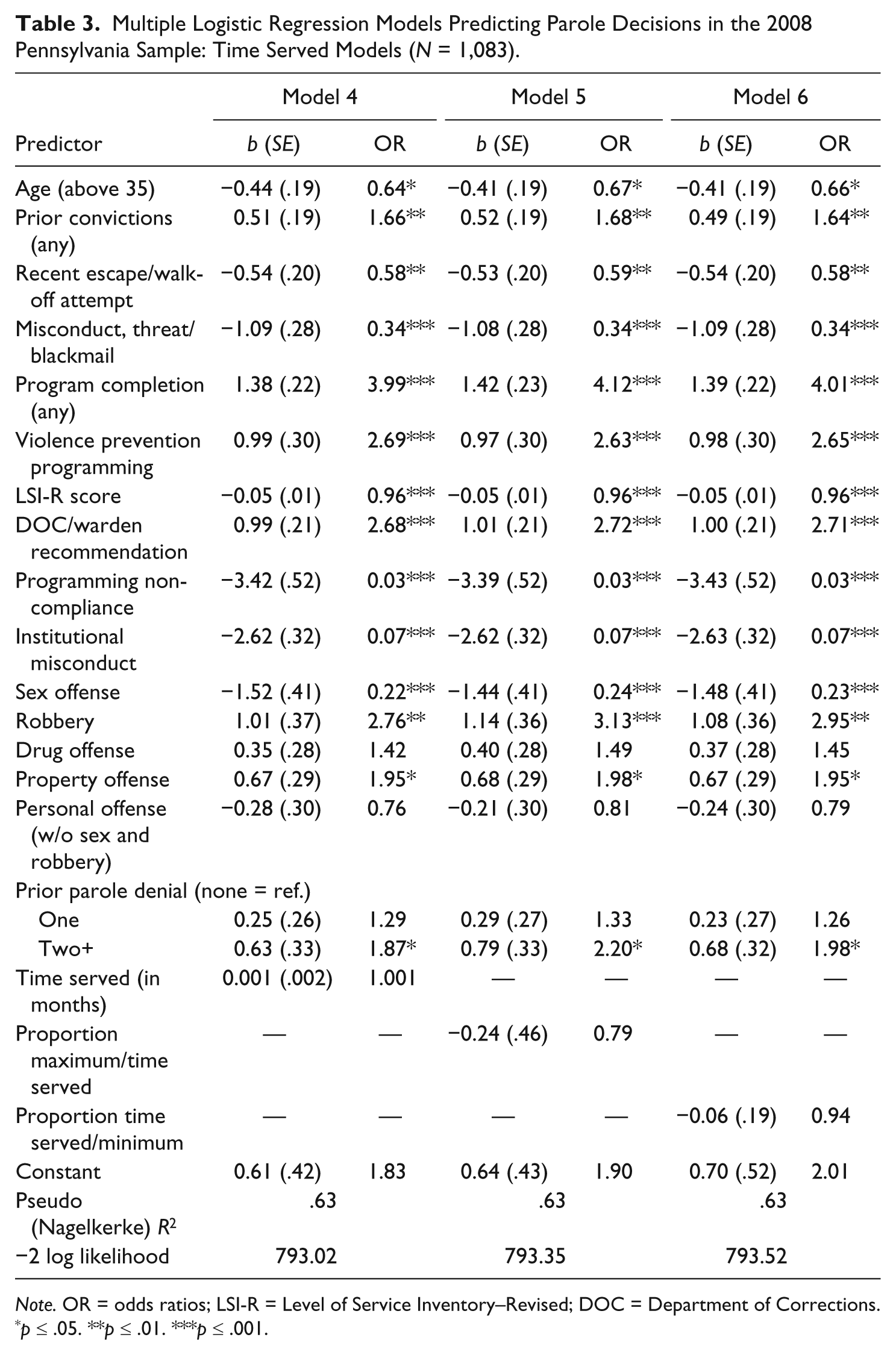
The study called for testing for two versions of time served in relation to the original punishment, proportion of the maximum term over the time served, and proportion of the time served over the minimum sentence. The analysis also tested for the impact of time served in itself (the length of time served in the current sentence). Each of these variables was added separately (Models 4, 5, and 6 in Table 3) to avoid multicollinearity issues. 9 Although both proportion measures were significant at the bivariate level, at the multivariate level, neither measure was significant anymore, nor was time served itself.
Multiple Logistic Regression Models Predicting Parole Decisions in the 2008 Pennsylvania Sample: Time Served Models (N = 1,083).
Note. OR = odds ratios; LSI-R = Level of Service Inventory–Revised; DOC = Department of Corrections.
p ≤ .05. **p ≤ .01. ***p ≤ .001.
Comparing the explanatory power of the base model with that of the predictive models including the punitive measures tested (pseudo-R2), 10 it can be observed that those measures that were significant added notably to the overall variation explained in the outcome (there was a 5% increase in the original variance explained). This being said, 37% of the total variance in parole decisions in this sample remained unexplained.
Discussion
To recap, the prediction regarding the influence of the nature of the offense was mostly supported, though the analyses also produced some seemingly conflicting results. The expectation regarding the impact of prior parole denials was supported. The analyses testing the impact of time served in relation to the original sentence produced null findings after controls.
Starting with the latter, it seems counterintuitive that parole decision makers do not consider in their determinations the amount of time served, however measured—although this finding aligns with others in recent studies reporting no effects of the length of incarceration on parole decisions (Caplan, 2011; Huebner & Bynum, 2008; Matejkowski et al., 2010). This result makes more sense when considering that the analysis included a host of other factors that predict parole releases, which possibly removed any association between time served and the likelihood of parole. Another possible interpretation can be that the parole board simply disregards the original sentence length in making its release decisions (see below).
Moving on to the impact of offense-type variables, most of the results are consistent with the punitive expectation drawing on consideration of offense seriousness. Of the most prominent impacts, the explanation for the positive odds of parole experienced by the inmates serving time for robbery offenses may lie in the fact that many robberies do not necessarily involve physical injuries to victims. Although the law conceives of robbery as an offense against the person, for the parole decision makers, used to seeing a wide range of offenses, most robberies might be treated closer to how property offenses would be. As such, most robberies might not be seen as deserving any special punitive consideration. The negative impact of serving a sex offense conviction (including rape and other sexual assaults) was the strongest in the model. Considering that a host of control variables was used, this finding suggests that the parole board is averse to granting release to inmates serving sentences for offenses generally regarded as heinous crimes, regardless of anything else that may help assess those inmates’ readiness for reentry into society (e.g., successful institutional programming and behavior). If a person is in prison for a sex offense, there seems to be little that he or she can do to improve the likelihood of gaining release.
Overall, the offense-related findings lend support to a punitive interpretation of parole decision making. Considering all the controls employed, the fact that the types of offenses for which inmates served time emerged as predictors is suggestive of a decision-making approach that pays close attention to the nature of the offense controlling an inmate’s sentence. At the sentencing stage, such consideration is generally retribution driven. Arguably, the same can be said about it at parole, if the board views itself as the authority tasked with deciding whether the original punishment aims have been satisfied.
An alternative interpretation should also be noted. Parole decision makers may look at the offense as an indicator of risk. They may default to using any available information, including that regarding the original offense, as cues to help assess parole candidates’ risk of recidivism if release is to be granted (Albonetti, 1991; Carroll, 1978). Even if acknowledging that the reoffending risk of persons convicted of serious personal crimes is low (as the recidivism literature has shown), the board may be concerned primarily with the societal stakes involved in any similar reoffending, however low its probability. Or, in cases involving offenders who are highly vilified in contemporary society (such as those committing sexual crimes), the board’s primarily preoccupation may be with ensuring that its decisions conform with society’s views of offender blameworthiness—whether or not the board may recognize that in the process, it contributes to the stereotyping of these individuals. This interpretation of the offense-related effects identified in the current study—both the notion that such information is used to justify decisions on utilitarian grounds (preventing future crime) or on the need to conform decisions with society expectations—would align with the focal concerns theory of criminal sanctions decisions (e.g., Albonetti, 1991; Steffensmeier, Ulmer, & Kramer, 1998). The theory, originating in courts and sentencing research, holds that protection of community and offender blameworthiness are two important concerns driving punishment decisions. As applied to parole decisions, the preoccupation with ensuring public safety would align closely with an incapacitation-driven approach to parole decision making, whereas the focus on offender blameworthiness would align with a punitive process. Although the current research was not intended as a test of the validity of the focal concerns theory as applied to parole decisions, most useful in shedding light on such a distinction would be qualitative data, which, unfortunately, were unavailable in this study.
This possible interpretation notwithstanding, the offense-related findings should be considered in light of all study results. Thus, the research also expected that inmates would enhance their likelihood of release by experiencing the process of denial first. The results support this expectation. To increase the chances of parole, an inmate needs to have at least one prior denial, standing even better chances if he or she was rejected twice before. This begs the following question: Why are prior refusals of release (from the same sentence) influential on current parole considerations? In the abstract, this result could be interpreted to reflect that an initial denial was deemed necessary because required programs had not been completed, for example, either because of non-compliance or because minimum terms were too short to allow completion. However, institutional behavior and programming factors are already accounted for. Moreover, if it was indeed deemed that more programming was needed, and the inmate was given the opportunity to build a more satisfactory track record, assumedly by the next review time he or she would have attempted to fulfill that recommendation in efforts to gain release the second time around. Yet, as the results indicate, a parole candidate will need to experience another denial to truly increase his or her chance of obtaining release. The process-as-punishment rationale proposed earlier seems then like a more plausible explanation. That is, parole decision makers may use the parole hearing as a process meant to punish the offenders. Regardless of their eligibility, institutional record, and prediction of likelihood of success if released, before being granted parole, the inmates need to earn their release by experiencing the anguish of a denial, with all its consequences. Such a punitive use of the parole process can express, for example, reproach that offenders did not show sufficient expressions of remorse or respect during the parole hearings.
With this in mind, when looked at together, the combined findings converge in fact to offer strong support for a view of parole decision makers as “punishers” or “second-round” judges. The null findings for the time served measures can stand for a disregard by the parole board of the original sentence; yet, they heavily take into account the nature of the original offense. This suggests that the board may rely on its own sense of offense-punishment commensurability in making release determinations. To top it off, the influential impact of prior denials on current decisions suggests that board members may use the parole hearing as a means to inflict an additional process punishment on inmates eligible for release.
An alternative view could be that the candidates denied release more than once are from the beginning deemed as “un-parolable” and kept in prison solely for incapacitation reasons. Eventually, they are granted release only because the prospect of letting them “max out” on their sentences looms on the horizon. This is a speculative view that can only be verified by interviewing board members. Based on the available data, the fact that the time served measures were not significant may speak against this interpretation—although the effects for this sub-group might be statistically undetectable across the whole sample. If this were true, however, if the parole board considers some candidates un-parolable and postpones their release for as long as possible, such an approach to deciding arguably the most difficult and high-stakes cases would suggest at best a reluctance of the board to release those individuals in most need of supportive and reintegrative services. At its most problematic, this kind of approach would reflect a denial by the parole decision makers of the main goal of the decision entrusted to them—to promote and facilitate offender rehabilitation and reintegration, including of those deemed as “most dangerous.”
This brings the discussion to the next point, the significance of the hypothesized punitive impacts when contrasted to the effects of all other factors emerging as predictors of parole decisions in this Pennsylvania sample. It should be acknowledged again that the key criteria scored in the parole guidelines (the institutional programming and misconduct indicators and the risk score) were among the most influential in explaining the decisional parole outcome. Other measures of institutional behavior also emerged as predictors. All these presumably are appropriate factors in deciding parole if taken to reflect concern for offender rehabilitation.
Regarding other risk factors, it may seem counterintuitive that inmates with prior convictions have increased chances of parole. Considering that most persons sent to prison have prior records of system involvement and many may have exhausted lesser means of intervention (e.g., probation sentences), this positive association does not seem unusual anymore. More conspicuous is the absence of some impacts, of predictors such as whether or not a parole candidate had developed a workable home plan or had taken steps to start seeking employment. These findings suggest that, when it comes to a candidate’s reintegration potential, factors reflective of that potential carry no significant weight in parole determinations. The influential role of the recommendation of the prison warden also cannot escape attention. This raises the question of whether the correctional input is seen as an act of vouching for an inmate or whether its influence is due to a desire to assist corrections in managing the prison population.
Finally, although the percentage of variance explained in parole decisions by the models tested in this study is relatively large (only rarely criminal justice studies report variance above 50%), considering the rich indicators employed as well as the inclusion of key parole guidelines factors, the question remains as to what else might explain parole decisions in this Pennsylvania sample. The unavoidable inference from the unexplained variance would be that there may be other factors, unmeasured or unobserved in this study, that the parole board considers in making parole determinations. As scholars have long suggested in the criminal justice decision-making literature (e.g., M. R. Gottfredson & Gottfredson, 1988), such unknown factors (i.e., other than the traditional predictors usually employed) are perhaps the most problematic, as they underscore the discretionary nature of criminal justice decisions.
Limitations and Future Research
Although the study benefited from a large sample, rich data with unique measures, and rigorous analytic techniques, limitations should be noted. The research relied on the use of certain measures as indicators of punitive interests. Although these may validly reflect punitive themes in parole decisions, arguably, inferences from the impacts uncovered here would be strengthened if qualitative data were also available. Interviews with parole board members regarding their deliberation process and criteria, as well as observations of parole hearings would be particularly helpful. Such inquiries remain the object of future efforts. For now, it suffices to note that it is customarily in quantitative studies that inferences about decision making are drawn based on data available to the decision makers at the decision time, as was the case in this study. Relatedly, agency data have known limitations related to their archival nature, though again they are widely employed in studying criminal justice decisions. Future research should also attempt to test for predictors not generally considered in parole decision-making studies. For example, one line of inquiry could look into effects of inmate visitation (by family, etc.), as a potential contributor to explaining variation in parole decisions. Finally, although Pennsylvania is a large jurisdiction, serving a diverse population and with a parole process similar to that employed in other discretionary prison release jurisdictions, generalizability of this study’s findings to other jurisdictions cannot be claimed. Only replication studies in other places would provide such external validity.
Conclusion
The inquiry presented here set out to test for punitive themes in parole decision making, an area of study largely neglected in contemporary criminal justice research on parole. The research found sufficient support for the punitive hypothesis, drawing on three separate categories of punishment-related measures. There are also strong indications in this study’s data that parole decision makers have not lost sight of rehabilitation as a driving goal for their decisions, as some in the past have questioned both in Pennsylvania (Carroll et al., 1982) and elsewhere (Burns, Kinkade, Leone, & Phillips,1999; D. Gottfredson & Ballard, 1966; Pogrebin, Poole, & Regoli, 1986; Roberts, 2009). Thus, the overall picture that emerges from the combined findings of this study is that of competing forces at play in parole determinations—both normative (punitive) and utilitarian (rehabilitation and incapacitation). Broadly, this is consistent with other recent research on parole, more explicitly pointing to conflicting forces affecting parole practices including economic, organizational, and political influences (Champion, 2002; Lin, Grattet, & Petersilia, 2010; Robinson & McNeill, 2015).
Regarding the utilitarian emphases in this study, given the combined findings, it is reasonable to conclude that parole decision makers seem concerned both with a desire to promote changes in offenders and to protect the public by preventing offenders from committing future crimes by relying on any available institutional means. In addition, the weight that prison recommendations seem to carry on the parole decisions in these data suggests that the parole board may also take on a managerial role, for the prison population. This is consistent with what Simon (1993) identified as the prevailing narrative of parole since the 1970s (the risk-management model), and more broadly with the literature on the new penology governing crime (Feeley & Simon, 1992; Garland, 2001; Robinson & McNeill, 2015; Simon, 2007). Although concerns for the safety and order of correctional institutions seem legitimate, the question remains as to whether the parole board can appropriately balance these interests with the main aims of the parole decision.
This being acknowledged, punitive themes in parole decision making are problematic. Most immediately, the study’s implications regard the role of the parole board and of the parole decision in the overall justice process. In regard to the former, especially if the current inquiry is put in a timeline with earlier Pennsylvania research (Carroll et al., 1982)—study differences notwithstanding—there would be reason to believe that over time, the attitudes of the parole decision makers have solidified toward acceptance of their role as “punishers.” The ongoing narratives adding emphases at parole beyond the traditional ones, such as “accountability to victims,” may be changing their mind-set—or create the potential for conflicting views of their own role in the justice process. Thus, the role that the punitive themes seem to play in parole determinations in this Pennsylvania sample may reflect a desire on the parole board’s side to please a changing political environment and scrutinizing media and public by adjusting accordingly its decision-making practices (see PBPP, 2013; Philadelphia Inquirer, 2013).
It is not surprising that the parole board would be attuned to such pressures. To start with, parole board members are typically politically appointed. Even assuming that they represent an independent institutional body, free of political ideologies, they are bound to pay heed and adjust their practices when justice policies are directly aimed at parole. For example, the Pennsylvania parole board’s current mission statement makes explicit reference to “protecting the safety of the public, addressing the needs of the crime victims . . . and . . . ensuring the custody, control, and treatment of offenders under the jurisdiction of the Board” (PBPP website). This language, especially the reference to victims’ needs, stands in contrast to the language of the Pennsylvania Parole Act of 1941 (discussed earlier in the “Introduction” section), still in place, which emphasizes that the parole process should serve as a vehicle for offender rehabilitation. In short, given the competing narratives in contemporary parole policy, it should not surprise that parole decision makers themselves would show conflicting views of their own role in the justice process.
The parole decision, however, should not be viewed outside of the context of the entire criminal justice process. Its unique role in this process is what sets it apart from sentencing and other critical justice decisions—that is, to promote and facilitate offender transformation and reintegration. The reluctance of parole decision makers to release persons deemed as “unworthy” based on punitive considerations would not just be an abdication of their decision’s function. It would also overlook serious potential adverse consequences. Thus, the longer an inmate spends time in prison over his or her minimum and the more parole denials he or she goes through, the more disgruntled he or she would likely become and less likely to follow further institutional requirements (West-Smith, Pogrebin, & Poole, 2000). Also, the closer the release to the sentence expiration, the more diminished the opportunity for meaningful transition and supervised reentry. In the end, by denying release, or postponing it for as long as feasibly possible, based on considerations that second-guess original sentences, ironically, parole decision makers may increase the chances of failure precisely for those individuals for whom they are concerned the most. Denying those individuals parole uses valuable system resources on their continued incarceration that instead could be deployed on their supervision in the community, which simultaneously would provide a vehicle for more successful reintegration. At the aggregate level, inmate discontent could influence the prison culture and could raise serious correctional security problems. Potential increases in overall recidivism rates should also not be discounted.
To conclude, the punitive use of parole would undermine not only the very roots of parole—as the main means, or incentive the system has to offer, to promote rehabilitation—but also the perceived legitimacy of parole in the eyes of the very population it intends to govern, eligible prospective parolees. Such parole practices would also underscore yet again the highly discretionary nature of the parole decision—emphasized in earlier scholarly efforts—and the scarcity of means available for its scrutiny. As others have pointed out (e.g., Roberts, 2009), in contrast to sentencing and other punishment-related decisions that occur in the courts, at parole, eligible candidates benefit from comparatively few due process protections aimed to guard against potential abuses and imposition of idiosyncratic decision-maker views.
Footnotes
Appendix
Correlation Matrix for All Study Variables in Logistic Regression Models of Parole Decisions in the 2008 Pennsylvania Sample (N = 1,172).
| Variable | 1 | 2 | 3 | 4 | 5 | 6 | 7 | 8 | 9 | 10 | 11 | 12 | 13 | 14 | 15 | 16 | 17 | 18 | 19 | 20 | 21 |
|---|---|---|---|---|---|---|---|---|---|---|---|---|---|---|---|---|---|---|---|---|---|
| 1. Parole decision—granted | — | ||||||||||||||||||||
| 2. Age—above 35 | −.06* | — | |||||||||||||||||||
| 3. Prior convictions—any | .05 | .05 | — | ||||||||||||||||||
| 4. Escape/walk-off attempt | −.08** | −.08* | .02 | — | |||||||||||||||||
| 5. Misconduct—threat | −.24** | −.08** | .02 | −.01 | — | ||||||||||||||||
| 6. Program completion—any | .41** | −.04 | .02 | .06 | −.04 | — | |||||||||||||||
| 7. Violence program | .28** | −.11** | .02 | .04 | .03 | .56** | — | ||||||||||||||
| 8. LSI-R score | −.27** | −.06 | .04 | .11** | .24** | −.09** | .01 | — | |||||||||||||
| 9. DOC recommendation | .43** | −.01 | .07* | −.02 | −.27** | .22** | .04 | −.20** | — | ||||||||||||
| 10. Program non-compliance | −.40** | .01 | .05 | −.03 | .17** | −.18** | −.10** | .26** | −.29** | — | |||||||||||
| 11. Misconduct score | −.43** | −.10** | .03 | .09** | .32** | −.17** | −.11** | 23** | −.28** | .25** | — | ||||||||||
| 12. Offense—sex offense | −.26** | .18** | −.04 | −.15** | −.01 | −.21** | −.15** | −.04 | −.28** | .17** | −.04 | — | |||||||||
| 13. Offense—robbery | .06* | −.07* | −.07* | −.01 | .07* | .05 | .08** | .03 | −.07* | −.06 | .09** | −.12** | — | ||||||||
| 14. Offense—drug | .13** | −.16** | .12** | .03 | −.08* | .11** | .01 | −.07* | .20* | −.03 | −.03 | −.18** | −.23** | — | |||||||
| 15. Offense—property | .07* | .06* | −.02 | .04 | −.02 | −.01 | −.04 | .07* | .07* | −.03 | −.01 | −.14** | −.18** | −.27** | — | ||||||
| 16. Offense—personal (w/o sex offense and robbery) | −.07* | .02 | −0.7* | −.05 | .07* | −.01 | .08* | −.01** | −.09** | .03 | .03 | −.14** | −.18* | −.27** | −.21** | — | |||||
| 17. Prior parole denial (one) | −.08** | −.02 | −.01 | −.03 | .09** | −.02 | .08** | .03 | −.21** | .12** | .02 | .09** | −.02 | −.10** | −.01 | .10** | — | ||||
| 18. Prior parole denial (two+) | −.10** | .07* | −.07* | −.05 | .26** | −.02 | .02 | .10** | −.23** | .12** | .06* | .21** | .10** | −.18** | −.11* | .11** | −.18** | — | |||
| 19. Time served (in months) | −.06 | .24** | −.10* | −.08** | .13** | −.01 | −.03 | .01 | −.12** | .10** | .01 | .24** | .19** | −.17** | −.11** | .15** | −.03 | .43** | — | ||
| 20. Pp. maximum/time served | −.11** | .06 | .07* | .07* | .21** | .07* | .03 | .16** | −.15** | .19** | .13** | .13** | .16** | −.04 | −.12** | .06* | .16** | .40** | .59** | — | |
| 21. Pp. time served/minimum | .10** | −.04 | −.01 | −.05 | −.19** | −.04 | −.06 | −.13** | .19** | −.16** | −.12** | −.14** | −.13* | .10** | .04 | −.08* | −.28** | −.33** | −.44** | −.72** | — |
Note. LSI-R =Level of Service Inventory–Revised; DOC = Department of Corrections.
p < .05. **p < .01.
Acknowledgements
The author would like to thank the three anonymous reviewers who provided valuable comments and suggestions for improving the manuscript.
Declaration of Conflicting Interests
The author(s) declared no potential conflicts of interest with respect to the research, authorship, and/or publication of this article.
Funding
The author(s) disclosed receipt of the following financial support for the research, authorship, and/or publication of this article: The author was supported by a Study Leave award from the Office of the Provost, Temple University, during the preparation of this article.