



Abstract
In Circles of Support and Accountability (CoSA), trained volunteers support an individual convicted for sexual offenses to reintegrate safely into the community. Developed in Canada, CoSA has been established in many jurisdictions with a growing number of volunteers; however, little is known about whether the training and support provided meets volunteer needs. Using a mixed-methods approach, the aim of the present research was to explore New Zealand CoSA volunteer experiences of the training and support they received and their perceptions about what contributed to the effective operation of a circle. In total, 18 volunteers took part in an interview and 23 volunteers completed a questionnaire. The findings found a mixed response to the training and support received, whereby some volunteers thought the training and support was adequate, whereas other felt the training support they received was inadequate. Findings also illustrate that adequate training, having access to a circle coordinator, selecting the right volunteers and core member, clear communication, and setting up boundaries were important factors in maintaining an effective circle. Findings are discussed in terms of implications for the training and support offered to current and future volunteers, as well as for maintaining the effectiveness of future circles.
Keywords
Circles of Support and Accountability (CoSA) is a community justice initiative that was developed in Canada to assist reintegration. CoSA was designed specifically for individuals convicted for sexual offenses and assessed in the medium- to high-risk category for sexual reoffending (Thompson & Thomas, 2017; C. Wilson, Bates, & Völlm, 2010; R. J. Wilson & Prinzo, 2002). Based on restorative justice principles, CoSA provides the opportunity for the community to take an active role in reintegration, restoration, and risk management of individuals that most people would rather never leave prison. Restorative justice has been described as “a process to involve, to the extent possible, those who have a stake in a specific offence and to collectively identify and address harms, needs and obligations, in order to heal and put things as right as possible” (Zehr, 2015, p. 37). Promoting a healthy, productive, and prosocial life, CoSA utilizes community volunteers to assist with the reintegration process. The volunteers provide practical, emotional, and social support; model prosocial and constructive strategies to deal with problems; and provide accountability for behaviours and attitudes that are not conducive to an offense-free life (Cesaroni, 2001; Thompson & Thomas, 2017; R. J. Wilson, McWhinnie, Picheca, Prinzo, & Cortoni, 2007; R. J. Wilson & Prinzo, 2002).
CoSA was developed in Canada in 1994, is now well established in the United Kingdom, the Netherlands, Belgium, and some states of the United States, and is gaining traction in Europe (Bates, Williams, Wilson, & Wilson, 2014; Duwe, 2013; Hanvey & Höing, 2012; Thomas, Thompson, & Karstedt, 2014; Thompson & Thomas, 2017). Alongside CoSA’s expansion, there has been a growing body of research examining CoSA’s effectiveness (Bates et al., 2014; Duwe, 2013; R. J. Wilson, Cortoni, & McWhinnie, 2009; R. J. Wilson, Picheca, & Prinzo, 2007b), volunteer motivation (Cesaroni, 2001; Haslewood-Pócsik, Smith, & Spencer, 2008; Lowe, Willis & Gibson, 2017; R. J. Wilson, Picheca, & Prinzo, 2007a), and volunteers’ experiences of working with people who have sexually abused (Haslewood-Pócsik et al., 2008; citation removed for blind review; McCartan, 2016; R. J. Wilson et al., 2007a). However, little research has specifically explored volunteers’ experiences of the training and support they received or what they believe contributed to the effective functioning of CoSA.
Appropriate volunteer training and support is important for preparing the volunteers for the challenges they will undoubtedly face: for example, recognizing negative patterns of behavior, ensuring awareness of maladaptive coping strategies used in the past and providing effective support for the core member through stressful times, and dealing with potentially negative reactions from the public (McCartan, 2016; C. Wilson et al., 2010). Furthermore, volunteer training is important for ensuring CoSA model fidelity and supporting volunteers’ well-being, especially given the potentially demanding effects of volunteering with individuals who have sexually abused (e.g., Haslewood-Pócsik et al., 2008; Snatersen, 2011; Thompson & Thomas, 2017; R. J. Wilson et al., 2007a). The aim of the current study was to examine volunteer experiences of training and support offered in New Zealand (NZ), as well as what volunteers considered important for the effective functioning of CoSA.
CoSA
In Canada, CoSA was developed organically and independent of government or statutory regulations. In the United Kingdom (and in other countries), instead of being a grassroots community initiative, CoSA was systematically implemented and controlled, in part, by the government (C. Wilson et al., 2010). Both countries have organizations that have worked to establish sufficient and sustainable funding of CoSA projects throughout their countries (Circles UK, 2017; CoSA Canada, 2017).
A Circle Structure
A CoSA is made of concentric circles whereby the “inner circle” consists of a group of four to seven community volunteers and an individual convicted for sexual offenses, known as the “core member.” The group is supported by an “outer circle” of professional members of the criminal justice system, such as psychologists, parole officers, and police officers (Hanvey, Philpot, & Wilson, 2011; R. J. Wilson et al., 2007; R. J. Wilson & Prinzo, 2002). CoSA circles also include a circle coordinator who is separate to the inner circle. The circle coordinator provides guidance and advice to the volunteers, bridges communication between the inner circle and the statutory agencies involved with core member, and offers ongoing support as required (C. Wilson et al., 2010). The outer circle of professionals provides further support and advice to the volunteers, and step in when required. Previous research has cited a number of factors that have contributed to fostering a mutual and trusting relationship within the inner circle, as well as establishing a working alliance between the inner and outer circles, including appropriate selection, training, and supervision of volunteers and circle coordinators; a systematic assessment of suitable core members and their risks and needs; and establishing a protocol for communication between the inner and outer circles (Hannem & Petrunik, 2007; Höing & Vogelvang, 2016; Höing, Bogaerts, & Vogelvang, 2013; Thompson & Thomas, 2017).
The functional relationship between the inner and outer circle is important because of the potentially difficult nature of volunteering with individuals who have sexually abused. For instance, volunteers have to deal with exposure to potentially traumatizing information such as the core member’s offense (Höing, Bogaerts, & Vogelvang, 2017), and while the relationship aspect of CoSA is important, there were initial concerns from professional members about potential boundary violations between the volunteers and the core member (R. J. Wilson, Picheca, & Prinzo, 2005). Previous research has found that volunteers have ruminated about risk between meetings, felt unsafe, developed an increased awareness of risky situations (Snatersen, 2011), and compartmentalize their work with CoSA as a defense mechanism against potential negative reactions (Lowe, 2018; McCartan, 2016). Research has also found that the volunteers have dealt with difficult or manipulative behavior from the core member to the point where some circles have experienced their core member reoffending or being recalled back into prison. The volunteers felt a portion of responsibility over the core member’s success in the community; as such, their experiences of recalls/reoffenses include a significant amount of stress and guilt, and feeling like they have failed the core member and the community (Lowe, 2018). Volunteer experiences of difficult situations emphasize the importance of both initial and ongoing training and support. Volunteers are central to an effective circle; as such, it is important that appropriate training, support, and accountability are in place for the work they do.
The Development, Training, and Support of a Circle
A circle will form generally about 6 months prior to the core member’s release from prison to foster relationships before the transition into the community. Volunteers are recruited from the community and trained by circle coordinators to work in a CoSA. Once screened, a volunteer will meet the other volunteers in their circle and complete training before meeting their core member. The training of volunteers was not intended to make the volunteers “experts” or be viewed as an alternative to professional care, but to familiarize them with potential issues they may face and to establish criteria for when to utilize the professional members in the risk management process (C. Wilson et al., 2010; R. J. Wilson et al., 2007). Through training, an understanding of issues surrounding sexual offending is gained and the volunteers become “more knowledgeable members of the community” (R. J. Wilson et al., 2007, p. 11).
The training process in both the United Kingdom and Canada utilizes a two-step process. The first step involves interviews and orientation sessions and provides an opportunity for screening prospective volunteers. Orientation sessions include information about CoSA core values, structure and purpose, as well as a basic history of CoSA. The orientation sessions take several hours and generally occur in the evening so that a broad community audience can attend. Following orientation sessions, individuals interested in volunteering with CoSA are registered with future training events (Correctional Services of Canada, 2002; C. Wilson et al., 2010).
The second step involves more intensive training (McCartan, 2016; C. Wilson et al., 2010; R. J. Wilson et al., 2007). In Canada, the second step involves a training phase and a circle development phase. The training phase takes place over the course of 4 days (or equivalent) and is used as an opportunity for further screening. The first part of the training phase, “The core workshop,” details the foundations of CoSA, provides an overview of the criminal justice system and relevant legislation, explores the difficulties of reintegrating an individual with sexual offense convictions, and examines issues relating to sexual offending, including power and control, human sexuality, and gender issues. Role-play demonstrations are used to show a basic circle experience and familiarize the volunteers with the various circle roles and logistics.
The second part of the training phase is “The skill building workshop” which facilitates volunteer understanding of the effects of long-term institutionalization, risk factors, relapse prevention plans in a circle context, typical core member needs, victims’ needs, conflict resolution, and awareness of boundaries and self-care. Following the “skill building workshop,” volunteers are given the opportunity to assess and evaluate whether they wish to continue. The next part of the training, the circle development phase, includes “forging a circle,” which occurs over the course of a few months and focuses on building group cohesion, crisis response strategies, meeting the core member and identifying needs, and building a covenant (an agreement about expectations between the volunteers and core member). Clear roles of the members of the inner and outer circle are also established during this phase. The final stage of circle development is “ongoing support,” which provides the volunteers with ongoing training about healthy circle dynamics, preventing burnout, how to amend the covenant, and how to close the circle (Correctional Services of Canada, 2002).
In the United Kingdom, the orientation and screening process is similar to guidelines set out in Canada. Following initial orientation, volunteers complete a month of training prior to meeting their core member. Training content was similar to the Canadian training whereby volunteers learn about the criminal justice system, issues surrounding sexual offending, the CoSA model, self-care and boundaries, conflict resolution, and circle dynamics. Prior to release, the volunteers were informed of the core member’s past offending and were required to meet regularly where the core member would share the work he or she had completed in treatment. The purpose of regular meetings while the core member was still in prison was so that the volunteers would be aware of the core member’s coping strategies and be able to recognize when the core member was falling back into negative behavior patterns (Circles UK, 2017; McCartan, 2016; C. Wilson et al., 2010).
In both the United Kingdom and Canada, professional members are included throughout the training process; for example, a probation officer (or other criminal justice employee) provides a basic overview of the how the criminal justice system functions and CoSA’s position within that system, and local police explain relevant legislation. Furthermore, a prison psychologist (or other professional) provides information about sexual offending, sexual deviancy, and risk factors, as well as self-care, boundary setting, and conflict resolution (Circles UK, 2017; Correctional Services of Canada, 2002). Follow-up training events (e.g., training around substance misuse), as well as ongoing support for volunteers, are offered in both the United Kingdom and Canada (Hanvey et al., 2011; McCartan, 2016; C. Wilson et al., 2010; R. J. Wilson et al., 2007). In the United Kingdom, volunteers were additionally invited to quarterly reviews to explore their experiences and support their personal well-being (C. Wilson et al., 2010). Finally, in both the United Kingdom and Canada, volunteers are supported by the circle coordinator who is trained in issues regarding sexual offending, risk management, and reintegration processes, as well as the needs of the individuals volunteering with people who have sexually offended (C. Wilson et al., 2010; R. J. Wilson et al., 2007).
Volunteer Experiences of Training and Support
While training protocols are in place, volunteering with individuals who have sexually offended can be particularly difficult, as it can be for professionals working in the area of sexual offending (e.g., Moulden & Firestone, 2007). Yet volunteers do not receive anywhere near the same amount of training that professionals receive, who may have trained for several years and receive ongoing supervision and professional development. There has been little research examining volunteer experiences of the training and support they received as a CoSA volunteer. In a study conducted in the United Kingdom, 62 CoSA volunteers completed an online questionnaire that included both Likert-type scale and open-ended questions examining their experiences as a CoSA volunteer, including their experience and opinion of the training and support they received (McCartan, 2016). The majority of the volunteers rated training as appropriate or very appropriate. Furthermore, the volunteers believed that the training they received was informative, enhanced their understanding of sexual offending in general, and prepared them to deal with discussions with the core member and the professional members (McCartan, 2016). The findings also highlighted that the volunteers recognized that they required internal resilience strategies because they were working with a challenging population. However, they also thought that additional training or formal/informal support could assist them to become more self-resilient (McCartan, 2016).
Similar results were found by Thomas and colleagues (2014) where 20 volunteers from six CoSA projects across England and Wales took part in interviews that were followed by a short questionnaire. The researchers found that most of the volunteers were satisfied with their training, believing that the training added to their knowledge of sexual abuse issues and prepared them for volunteering with CoSA. Furthermore, the volunteers’ relationship with the circle coordinator was important for providing the volunteers with support and a connection with the statutory organizations. However, there were volunteers who felt that “professional language” had infiltrated training content, and some of the volunteers thought that their training focused more on accountability than support provision (Thomas et al., 2014).
Finally, in the United States, Fox (2013) examined how and why CoSAs work; 63 volunteers took part in group interviews in their teams of three or four. A key finding was that volunteer training was regarded as one of the reasons why CoSAs work effectively. Furthermore, the volunteers believed the training was excellent for preparing them for their role in CoSA and they could not recall any situations where they felt unprepared. The volunteers also emphasized the importance of the circle coordinators for providing ad hoc training and support. However, the volunteers wanted more information from probation officers about insight into particular risk factors for their core member and certain parole conditions (Fox, 2013).
Together, the above studies highlight that the majority of volunteers believed that training adequately prepared them for their role in CoSA, enhanced their understanding about sexual offending, and circle coordinators were identified as essential for providing ongoing support and training. However, where some volunteers felt that there was an emphasis on accountability (Thomas et al., 2014), there were other volunteers who wanted more information about risk factors (Fox, 2013). With volunteers holding a central role within CoSA, understanding the training and support required for an effective circle is undeniably important. Thus, if CoSA is to continue expanding and gaining international recognition, then it is necessary to ensure that the volunteers’ needs are met.
CoSA in NZ
Restorative justice is not a new concept in NZ; indeed, NZ Maori have a system of balance and reciprocation known as Utu, a concept which predates European contact and protects individuals, as well as the group’s social stability and integrity (Barton, 2003). However, the CoSA model in NZ is relatively new compared with Canada or the United Kingdom. The development of CoSA in NZ was similar to that in the United Kingdom whereby CoSA was introduced at a prison-based treatment unit with government support. It was hoped that an existing community organization would eventually manage CoSA, or alternatively, a community trust similar to Circles UK or CoSA Canada would be formed (van Rensburg, 2012). Indeed, both instances occurred where in one city a trust was formed, and in another city, an existing organization agreed to manage circles in their area. Although initial volunteer training remained at the prison-based treatment unit, both organizations were contracted to recruit volunteers and provide ongoing support and ad hoc training. Unlike in the United Kingdom and Canada, at the time of writing, there was no nation-wide organization for CoSA in NZ.
Recruitment and Screening
Recruitment of initial volunteers was a slow process and utilized mostly a word-of-mouth approach. Furthermore, unlike in the United Kingdom and Canada, CoSA in NZ was aimed at individuals who were serving indeterminate sentences. The focus on indeterminate sentences was a unique feature of NZ and was chosen so that a circle could be formed long before the core member would be released (van Rensburg, 2012). Volunteers were primarily recruited from faith communities; however, they were also recruited from Māori iwi (extended kinship group, tribe, nation, people, nationality, race—often refers to a larger group of people descended from a common ancestor and associated with distinct territory; Iwi [Def. 1], 2017) and academic staff and students (van Rensburg, 2012). The development of the first circle coincided with an offer by a visiting church group to accommodate individuals who did not have suitable support in the community (van Rensburg, 2012). Following the identification of seven volunteers, the first circle in NZ was established in 2009. Similar to other jurisdictions (e.g., R. J. Wilson et al., 2007), recruiting volunteers has been the biggest operational challenge for CoSA in NZ (van Rensburg, 2012).
In NZ, prospective volunteer competencies were assessed during the selection procedure involving a written application that included references and an interview (van Rensburg, 2012). The screening process ensured that volunteers were not joining CoSA for inappropriate reasons, including to change or punish the core member. The selection criteria included compatibility with the core member and other volunteers so that a cohesive group with common interests could be formed. Important volunteer characteristics included emotional and social maturity, problem-solving skills, and an ability to deal with difficult situations so that the volunteer could appropriately hold their core member accountable and manage any issues that arose. Furthermore, it was considered important that volunteers demonstrated a restorative and socially inclusive approach, and a nonjudgmental attitude toward the core member, regardless of their offending profile, age, sexual orientation, and personality traits. The criteria also included that volunteers had no previous serious convictions, particularly for sexual offending, and no unresolved issues around sexual offending involving themselves or people close to them as victims. Finally, a balanced lifestyle was regarded as important to avoid volunteers becoming too intense and overbearing, or conversely, not having enough time to adequately support the core member or other volunteers (van Rensburg, 2012).
Training for a Circle
NZ volunteer training material was based on Canadian training material and adapted to suit the NZ criminal justice context (van Rensburg, 2012). Specifically, NZ training material incorporated information about NZ policies, sentences the core members were serving, and realistic expectations about parole conditions in NZ (van Rensburg, 2012). Training involved mandatory two or three half-day sessions to prepare the volunteers for their role in a circle (van Rensburg, 2012, 2014), with follow-up sessions offered by the two community organizations contracted to recruit and support volunteers. An initial information session provided a brief history of CoSA, outlined what a circle involved, and specified volunteer requirements. Interested community members contacted the CoSA coordinators and attended more formal training. The formal training took place at the prison, and similar to CoSA trainings in other jurisdictions, the volunteers learnt about CoSA in depth, sexual offending, pathways to offending, triggers and relapse prevention, and NZ laws. In-between the formal training sessions, the volunteers were encouraged to get to know each other so that they could remain consistent in front of the core member and offer each other support when necessary.
Initial training also included a session with the core member’s parole officer, and the core member’s parole conditions were made clear to the volunteers. Follow-up sessions provided further information on the core member’s specific release requirements and reiterated the importance of adhering to parole conditions. For example, some of the volunteers were not allowed to invite the core member to their house if there were children around. The formal training took place over two or three half-day sessions, and following these sessions, the volunteers were encouraged to discuss with family or household members about their involvement with CoSA and to ensure that the family/household member(s) were comfortable with the boundaries. The volunteers were also encouraged to meet each other outside the training/prison setting in between training sessions (J. van Rensburg, personal communication, November 20, 2013). Meeting in between training sessions was recommended so that the volunteers developed confidence in each other in order that they could remain consistent in front of the core member, hold the core member accountable when necessary, and support each other.
The training also examined the role of each member and ensured that the volunteers understood when the professional members were needed (e.g., a relapse with alcohol or drugs). However, apart from the parole officer, including other professional members during training sessions proved too complicated (van Rensburg, 2012). As such, members such as police officers would visit the circle when possible to confirm they were available to help if needed. Following the initial training sessions, and similar to the United Kingdom and Canada, the training involved a disclosure meeting where the core member detailed their background, offense and offending-related behaviors, triggers, and maladaptive coping strategies. Within the disclosure meeting, the core member’s sentence, temporary releases, and parole conditions were also discussed (J. van Rensburg, personal communication, November 20, 2013).
Consistent with the United Kingdom and Canada, prior to release, core members were required to complete temporary releases. The volunteers were encouraged to meet their core member during a temporary release so that a relationship outside the prison setting could be established. The relationship aspect of a CoSA has been noted as a benefit whereby modeling prosocial behavior was based on friendship and trust compared with authority and policies (van Rensburg, 2012, 2014; R. J. Wilson et al., 2007). Furthermore, the mutual relationships within the inner circle enabled the volunteers to hold the core member accountable without the core member feeling attacked (Lowe et al., 2017; Lowe, 2018). Therefore, the volunteers were encouraged to get to know the core member and other volunteers before their core member was released from prison. However, part way through data collection for the current study, temporary releases were suspended following an event where a core member failed to return to prison after a temporary release. Accordingly, although temporary releases were considered an important step in preparing volunteers for their role in CoSA, they were not possible after this event.
Research has shown that volunteering with CoSA can be both rewarding and demanding. On one hand, volunteers have reported feelings of connectedness and new friendships with the other volunteers (R. J. Wilson et al., 2007a); increased confidence, self-awareness, and self-esteem; and satisfaction at witnessing their core member change (Haslewood-Pócsik et al., 2008; Snatersen, 2011), yet on the other hand, a recall or reoffense committed by a core member can have a significant impact on the volunteers (Lowe, 2018). Therefore, adequate training and support is crucial given the challenges that volunteers undoubtedly face.
Research Aims
The present research aims to extend extant research by examining volunteer experiences of the operational aspects of CoSA in NZ using a mixed-methods approach and was guided by the following research questions:
Given the exploratory nature of the research, no hypotheses were generated.
Method
Research Context
The current paper is a part of a wider study that explored volunteer experiences and the motivation to volunteer with CoSA in NZ (Lowe et al., 2017; Lowe, 2018).
Data were collected between late 2014 and early 2016. In 2015, there were two community organizations external to the Department of Corrections contracted to recruit and support volunteers. However, in late 2015, a core member failed to return from a temporary leave and subsequently left the country. An investigation was launched and CoSA went under review. At the end of 2015, Government funding for the volunteer organizations was not renewed; while the organizations were unable to recruit more volunteers, they were able to continue providing ongoing support to active volunteers. All the volunteers who took part in the present research had completed the formal initial training provided by the Department of Corrections prior to the withdrawal of funding. In 2016, a project called Community Support Networks, which is similar to CoSA, was launched for individuals serving determinant sentences (Pennington, 2016). Only volunteers involved in the original CoSA project were included in the current study. Data collection for the present study began before the core member absconded and continued following the review; however, as there were no new core members or volunteers after the absconding, all the participants in the present study had completed initial training. Recruitment for the present study took place between mid-2014 and early 2016; during this time, the external volunteer organizations were contracted to recruit and train volunteers. Through these organizations, the role of a specific circle coordinator was established; the circle coordinator is separate to inner circle and acts as a link between the inner and outer circle. The role in NZ is unpaid. Prior to contracting these organizations, CoSAs in NZ did have a specific circle coordinator and the volunteers were trained by the psychologist heading CoSAs in NZ. Therefore, participants recruited in the early stages of the present research did not have established circle coordinator.
Participants
Information about the study was sent out via email to all active CoSA volunteers over two recruitment drives. The first email was sent to 55 CoSA volunteers and the second to 49. The volunteers were directed to contact the first author to arrange an interview. Of the 23 volunteers who responded directly to the first author, 18 took part in an interview (14 men, four women) and 23 (17 men, six women) completed the online questionnaire. Of the participants who took part in an interview, 16 identified as NZ European and two identified as NZ Māori, and ranged in age from 26 to 79, with an average age of 57. Of the participants who completed the questionnaire, 20 identified as NZ European and three identified as other, and ranged in age from 26 to 75, with an average age of 63. Most of the participants were religious, identifying themselves as Christian. See Table 1 for more detailed demographic information about the interview and questionnaire participants. The questionnaire was anonymous; as such, it was not possible to match questionnaire and interview responses, and it is unknown how many participants completed both an interview and the questionnaire.
Demographic Information of Participants Who Took Part in an Interview and Participants Who Completed a Questionnaire.
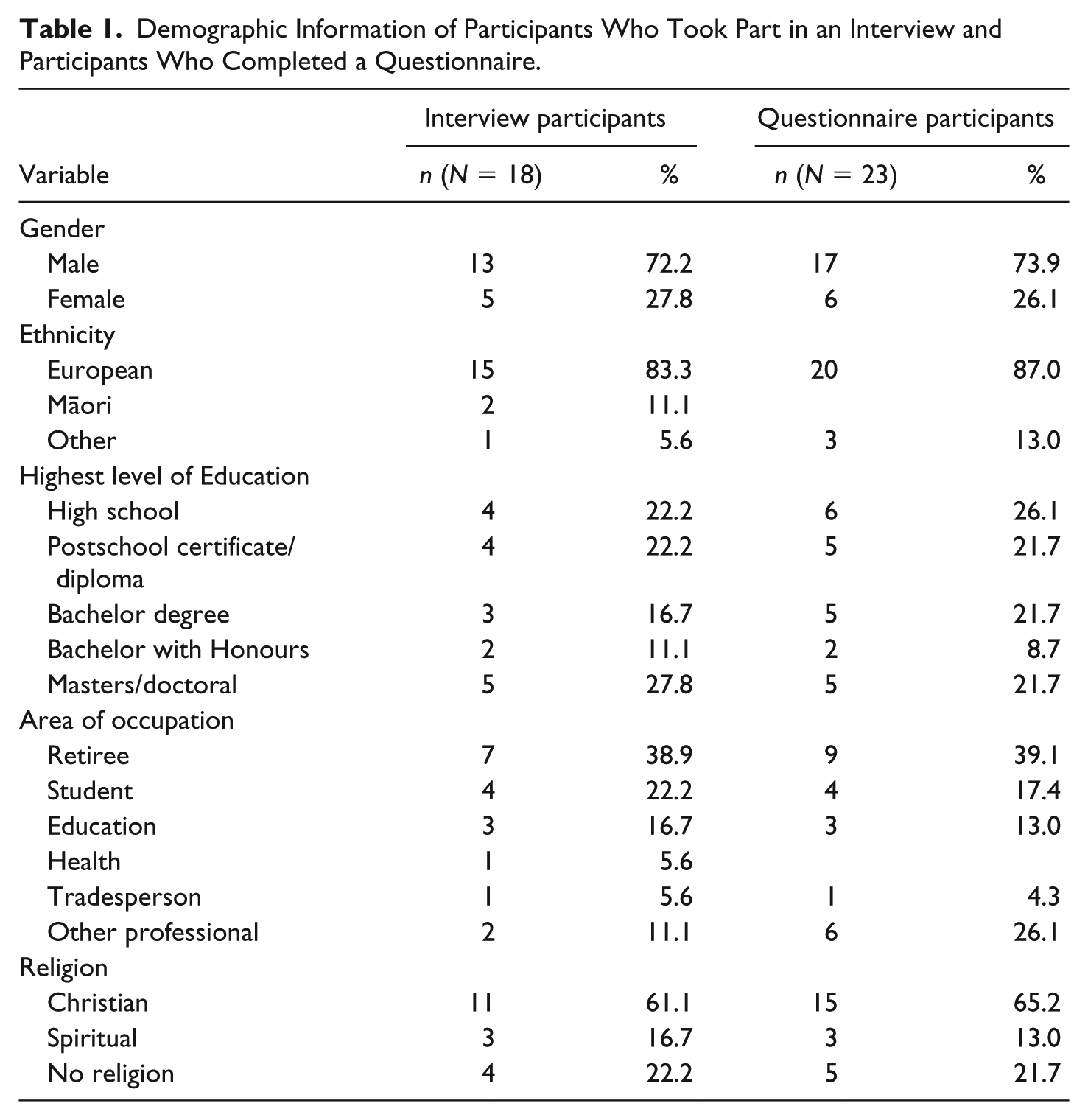
Most of the volunteers were involved with one circle; however, six of the participants were involved in two or more circles. The participants were involved in circles that were at different stages of development; seven participants worked with core members still in prison, five participants’ core member had recently been released, and six participants were either in well-established circles or coming to the end of the postrelease commitment time. The participants had been involved with CoSA from 4 months to 7 years.
Procedure and Research Design
To answer the research questions, the present research utilized an anonymous online questionnaire and a semi-structured, in-depth interview. The CoSA coordinator sent an email to all CoSA volunteers on behalf of the first author. The email included details about the study and information about the research team and instructed interested volunteers to make direct contact with the first author to arrange an interview. The invitation email also included a link to the questionnaire so that participants interested in being included in the study, but not willing to take part in an interview, could complete the questionnaire in their own time. Interviews took place at a time convenient for the researcher and participants, and where confidentiality could be maintained (e.g., participant’s house or an interview room at the university). The in-depth, semi-structured interviews lasted between 40 and 90 min, and recruitment continued until the point of saturation (Mason, 2010). With participants’ permission, all interviews were audio-recorded and transcribed verbatim by the first author. Transcripts were made available to the participants to ensure the transcription reflected their experiences. Participants were invited to edit their transcripts to ensure accuracy; 10 participants reviewed and edited their transcripts.
Online questionnaire
The online questionnaire was developed by the researchers in consultation with some of the key stakeholders of CoSA in NZ. Demographic information was assessed using questions adapted from the NZ census (Stats NZ: Tatauranga Aotearoa, 2013). The questionnaire included questions about the level of support participants received from various people involved with CoSA, including CoSA coordinators/professional members, parole officers, family or friends of the core member who were not a part of the circle, police, volunteers’ own family and friends, and other circle volunteers. Participants indicated their perceived level of support on a Likert-type scale ranging from 1 = “no support at all” to 7 = “high level of support.” Another question examined participants’ overall satisfaction with training, which was scored on a Likert-type scale ranging from 1 = “not satisfied at all” to 7 = “highly satisfied.” Finally, two questions examined participants’ intent to continue their involvement with CoSA by indicating the extent to which they agreed with the following statements: “It is likely that I will quit my work as a CoSA volunteer within 6 months,” and “It is likely that I will continue my work with CoSA for the next 2 years.” Both questions were scored on a Likert-type scale ranging from 1 = “totally disagree” to 7 = “totally agree.”
Semi-structured interview
Relevant literature and consultation with the key stakeholders of CoSA in NZ informed the development of the interview schedule. A semi-structured interview format was chosen to maintain a focus during interviews while not compromising on rapport and flow. The section of the interview schedule concerning experiences of operational aspects included questions such as the following: “How adequate was training for you in terms of being prepared to deal with and support your core member’s specific needs?” “Who did you receive support from as a CoSA volunteer? What was your experience of the support offered?” “How effective do you think your circle has been? What could be done to improve the effectiveness of circles in the future?” At the end of the interview, participants were given the opportunity to talk about anything they felt relevant but was not included in the interview schedule.
Data Analyses
Quantitative data were analyzed using descriptive statistics in SPSS (version 24). Qualitative data were analyzed using thematic analysis according the method set out by Braun and Clarke (2006). The analysis was underpinned by a realist epistemological stance. The realist position reports experiences, meaning, and the reality of the participants as conveyed in the interviews (Braun & Clarke, 2006). The primary author’s interest in restorative approaches to crime and justice informed the perspective taken in the present article. The primary author was not involved with CoSAs; however, she attended circle information sessions and prison information sessions and met with the developers and key members of CoSA in NZ.
The interviews were transcribed, proof-read, and reviewed by the first author to achieve immersion and familiarization with the data (Braun & Clarke, 2006). The transcripts were coded using NVivo 11, a computerized program to organize data for qualitative research. The first phase of coding involved extracting all data relevant to understanding the volunteers’ experiences of operational aspects of CoSA. The second phase involved coding data according to the a priori categories “experiences of training and support” and “what makes an effective circle?”. The codes were then analyzed for common themes, and quotes were extracted from the data to support the themes identified. The analysis process included reviewing themes and quotes to ensure consistency before naming and defining the themes. Discussion with the research team included developing a thematic map, discussing and reviewing themes identified, and challenging any analytic assumptions. Contact with the research team was maintained throughout the analysis process to ensure consistency of analysis and to facilitate a reflexive approach (Braun & Clarke, 2006; Morrow, 2005). Furthermore, to avoid confirmatory bias and simplistic interpretations, discrepant or disconfirming evidence was discussed. In qualitative research, descriptors such as “a couple,” “several,” and “most” are used to provide a sense of prevalence across the data set (Guest, MacQueen, & Namey, 2012). However, as the interpreted value or meaning of such descriptors is given primacy over numeral frequency, prevalence does not equal significance (Braun & Clarke, 2006).
Findings
Descriptive statistics were used to examine the overall level of support volunteers received from different people involved in CoSA, their overall satisfaction with training, and their interest in continuing their involvement in CoSA. As shown in Table 2, participants received most support from the other volunteers in their circle and CoSA coordinators/professional members and received the least amount of support from police involved with their core member. Experiences of support received from family and friends of the core member and the core member’s parole officer(s) were mixed. Table 2 details the level of perceived support.
Mean Level of Support Participants Received.
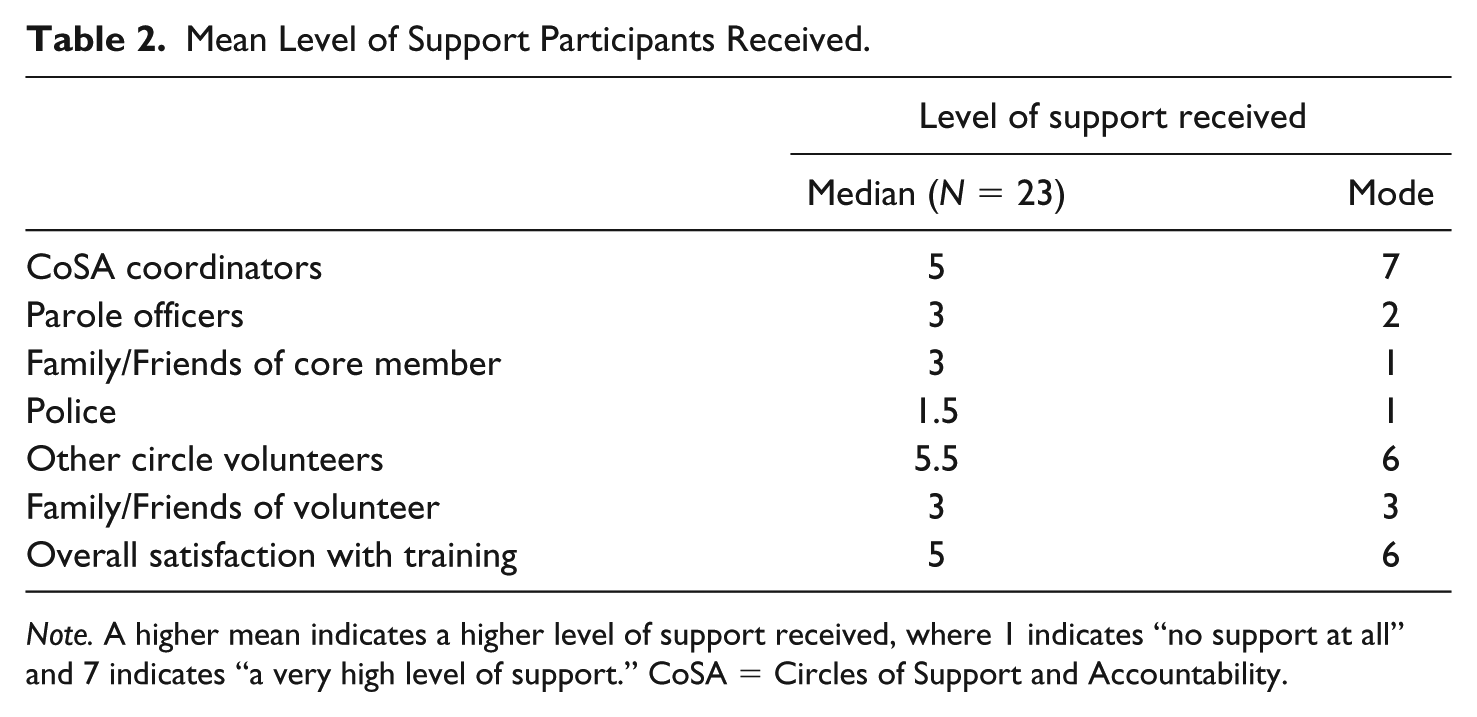
Note. A higher mean indicates a higher level of support received, where 1 indicates “no support at all” and 7 indicates “a very high level of support.” CoSA = Circles of Support and Accountability.
Overall, participants were generally satisfied with the training they received, and no participants reported that they were “not satisfied at all.” Just over half were moderately to highly satisfied with the training they received, whereas about a third of participants were moderately to slightly dissatisfied with the training they received.
Finally, 83% of the participants stated that they were unlikely to quit volunteering with CoSA for the next 6 months. However, only 52% of participants stated that they were likely to continue volunteering for the next 2 years.
Qualitative Examination of Operational Aspects of CoSA
Qualitative findings are presented according to the a priori categories “experiences of training and support” and “what makes for an effective circle?”. Figure 1 illustrates the themes via a thematic map. Main themes identified are described in detail in the following sections.
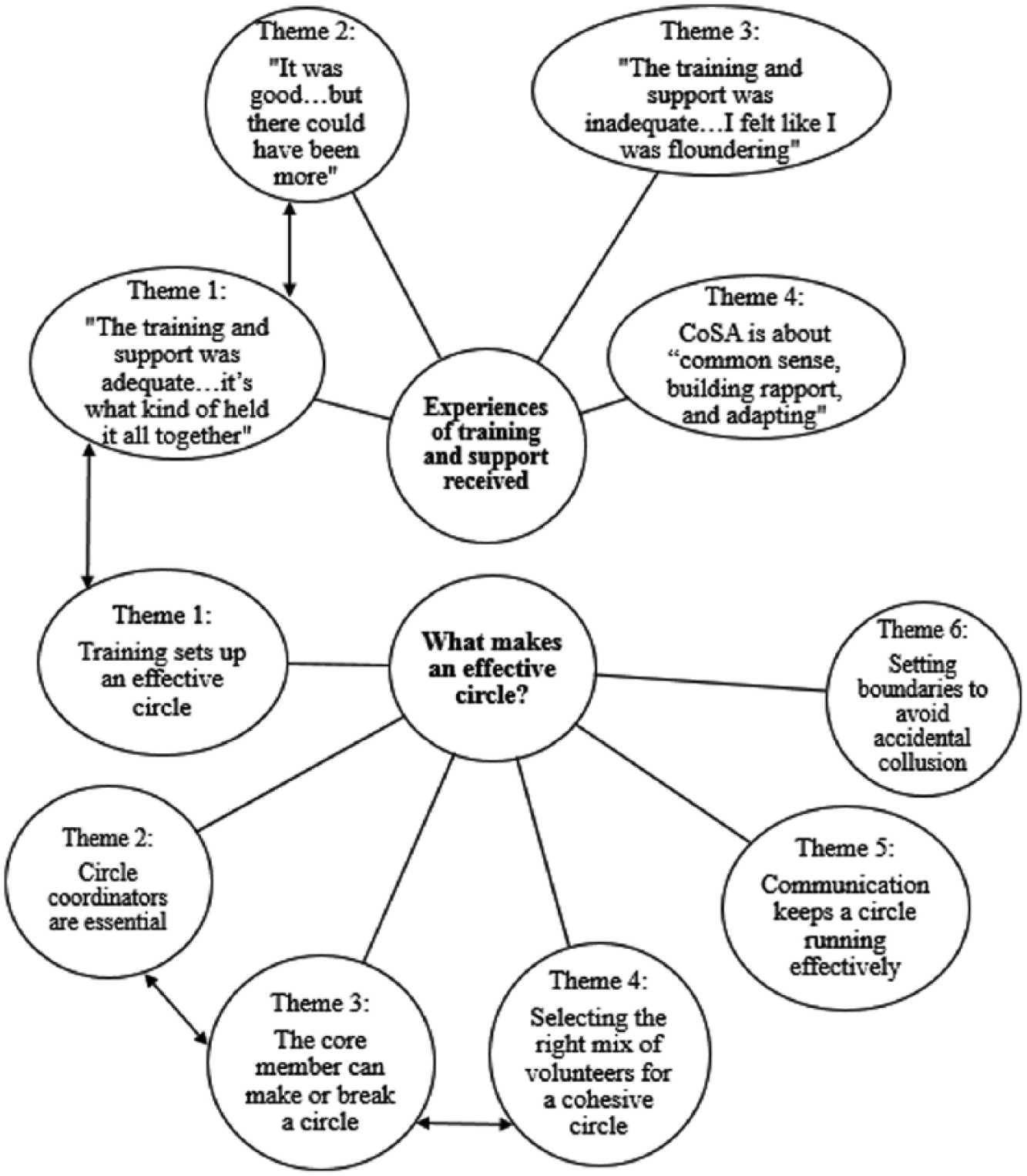
Thematic map illustrating themes.
Experiences of training and support received
Participants were split regarding whether they thought the training and support they received was adequate. Four main themes were identified that related to volunteers’ experiences of training and support received: Some participants believed that the training adequately prepared them to work effectively in a circle (Theme 1: “The training and support was adequate . . . it’s what kind of held it all together”); the thematic map (Figure 1) illustrates the relationship between receiving adequate training and maintaining successful circles. Other participants believed that while the initial training sessions were satisfactory, the training content and the amount of support provided was sometimes lacking (Theme 2: “It was good . . . but there could have been more”). Furthermore, some participants thought that the training was inadequate (Theme 3: “The training and support was inadequate . . . I felt like I was floundering”). Finally, there were participants who believed that CoSA was based on common sense and experience, and too much training could undermine the natural development of reciprocal relationships (Theme 4: CoSA is about “common sense, building rapport, and adapting”).
Theme 1: “The training and support was adequate. . . it’s what kind of held it all together”
About a third of the participants thought the training was adequate and they struggled to think how it could be improved. These participants explained that the training prepared them for their role in the circle, effectively communicated the CoSA philosophy and approach, and opened their eyes to the realities of reintegration. Furthermore, participants said that the training provided them with understanding of the criminal justice system in NZ, procedural information (e.g., rules regarding visiting the prison, adhering to parole conditions), and insight into the experiences of being institutionalized. All the participants said that the disclosure session with the core member was a vital part of training. The participants said they did not need to know too many details about the core member’s index offense; however, they needed the core member to be transparent about their behavior, leading up the offense, their triggers and coping strategies, as well as what their core member needed from the volunteers during a stressful period. The following quote highlights the commonly held notion that knowing their core member’s specific offending-related behaviors enabled the volunteers to hold them accountable or question them in a situation that may seem harmless to someone who had not been informed of certain behaviors: He listed all the danger areas for himself, he had to give his personal statement which told us all about himself his offending, his modus operandi and what danger signals there were such as boredom, withdrawal, argumentativeness etc . . . and you know, kind of childish behaviour and so on, and we recognised a lot of these and we could pull him up on them that’s part of the accountability thing. (Participant 11)
Many participants said that support was available if they needed it during a difficult time; for example, some of the volunteers experienced a recall of their core member; these volunteers explained that prior to the recall, the volunteers relied on their core member’s parole officer for support and advice, and following the recall, the professional members provided support and an opportunity to debrief. Consistent with findings from the questionnaire, volunteers explained that the majority of perceived support was offered by the other volunteers in their circle or from the CoSA coordinators. Finally, several participants felt the parole officer was proactive, came to their meetings, discussed the core member’s needs, and helped them if an issue arose.
Theme 2: “It was good. . . but there could have been more”
Other participants explained that while the initial training was good and prepared them to join their circle, they would have liked more ongoing or follow-up training. These participants believed that the quality of the training was high; however, they thought that without follow-up their training was not reinforced. Furthermore, the participants stated that because CoSA was an intensive framework to volunteer with, they felt that periodic follow-up training or supervision sessions would have been beneficial. The volunteers in the first recruitment drive for the current study explained that at the time of their interviews, unlike CoSAs in Canada or the United Kingdom, there were no circle coordinators to provide the ongoing support and follow-up training and provide the connection between the inner circles and the statutory agencies. The following quote is from a participant who took part in an interview when there was no external coordinator: What’s actually needed for Circles of Support and Accountability is more formal support mechanisms. Firstly, there needs to be a role…a person who’s actually appointed to coordinate and to . . . to maintain training and ongoing professional development for CoSA members. Secondly, it needs more formal links with the police and probation . . . so those links aren’t there at the moment . . . it’s very ad hoc . . . to have those links there would really strengthen CoSA . . . so they’d start to function more coherently and consistently a lot earlier on. (Participant 11)
Volunteers who took part in an interview following the second recruitment drive explained that there were two organizations that had coordinators who offered periodic training and ongoing support. Many of the volunteers acknowledged that CoSA was new in NZ, and thus, more training and support mechanisms would evolve over time. The volunteers were also mindful about how much time CoSA training could realistically take up and did not want burdensome training to discourage potential volunteers. Nevertheless, they felt that some form of professional development or facilitated meetings would have been valuable.
Theme 3: “The training and support was inadequate. . . I felt like I was floundering”
There were several participants who were not happy with the initial training that they received. Following the initial training, some of the participants felt that they had just been “thrown” into their circle and did not fully understand their role. The main reason participants were unhappy with the training they received was an overemphasis on procedural processes such as rules regarding prison visitation. Some of the participants also explained that they had attended other circle’s disclosure sessions and realized that their core member’s disclosure lacked information about offending pathways, maladaptive coping strategies, or specific offenses.
Several participants explained that while the CoSA objectives, model, and background were clear, there was a lack of information on what to expect during the CoSA process. For example, several participants said they would have liked a document that laid out the likely timeline of a CoSA and what to expect at different stages of release. Furthermore, the volunteers said while they knew all the formal rules and regulations while their core member was in prison, and all the parole conditions when released, there were certain “gray areas” that they felt should have been covered in the initial training or could be covered in a follow-up training session. Illustrated in the following quote, these gray areas included what to do in situations that were not covered explicitly in their core member’s parole conditions: If your prisoner has been very naughty and absconds . . . you report it at the nearest police station and ring this number . . . that was sort of very much a procedural issue. You know, What do you do when you take a person out to the shopping mall . . . how do you ascertain that the place where you’re going to sit down and have lunch or whatever is going to be a safe place . . . what are the best ways to look after a situation, say for example, if your person needs to go to the toilet and so on. (Participant 4)
Some of the participants also noted a lack of support from parole officers during the course of their circle; these participants believed the lack of ongoing support stemmed from a misunderstanding about CoSA’s function. Some of the participants felt the parole officer viewed the circle as obstructive, unable to appropriately manage risk, and did not have the ability to hold their core member accountable, whereas others thought the parole officer viewed CoSA members as another mechanism to monitor the core member in the community. The lack of support from some of the parole officers meant that some of the participants felt they were unable to approach the parole officer for advice.
Theme 4: CoSA is about “common sense, building rapport, and adapting.”
Several participants described how a circle enables a core member to become a community member rather than remain institutionalized. As such, the participants believed that the training should remain semi-informal and adaptable to avoid reinstitutionalizing the core member in the community by creating “wardens” out of the CoSA volunteers. Finally, the volunteers acknowledged that CoSA was an effective framework because each circle could be personalized to the core member. As such, the participants did not believe that the training should be too standardized. That is, the training must be adaptable: “It’s got to be a living document because every person is different so you’ve got to leave room in that for that particular person . . . you’ve also got to leave room for the circle to grow around that person” (Participant 11). Indeed, all the volunteers felt that the disclosure session individualized the training so that they could prepare for their core member’s specific needs.
Several participants described that there was only a limited amount that could be theoretically taught, and the rest was based on life experience and learning and adapting as a circle progressed. These volunteers believed that CoSA training was based on “common sense” and that it takes time to get to know their core member and how they will cope outside of prison. Some of the volunteers thought that the training was rather ad hoc, but that it worked. That is, the accumulation of time in CoSA enhanced their overall understanding of their role and the logistics of CoSA. The volunteers agreed that it was vital to learn about the procedural side of CoSA, the parole conditions, the role of the parole officer, and have the disclosure session. However, many believed that too much training could undermine the relationship aspect of CoSA and create relationships similar to the parole officer and parolee relationship. The volunteers explained that the relationship between the volunteer and the core member minimized the “established power difference” between the parole officer and parolee. As such, some participants believed that too much training would distract from the adaptable nature of CoSA; these participants believed that reciprocal relationships were necessary within a CoSA. The following quote illustrates that too much training could undermine the natural development of relationships: I mean the beauty of CoSA circles is that they’re sort of . . . they adapt . . . so it’s not about trying to standardise it too much . . . because then it loses . . . CoSA circles lose their ability to adapt. But I think that at least early on there should be a bit of structure and some definite sort of training targets. (Participant 5)
What makes an effective circle?
Participants described a number of elements that contribute to an effective circle. Six main themes were identified that related to volunteers’ experiences of an effective functioning of a circle. An effective circle included adequate training (Theme 1: Training sets up an effective circle), circle coordinators (Theme 2: Circle coordinators are essential), appropriate core member (Theme 3: The core member can make or break a circle), and volunteer selection (Theme 4: Selecting the right mix of volunteers for a cohesive circle). Figure 1 illustrates the relationship between Theme 2, Theme 3, and Theme 4 whereby all members of CoSA are fundamental to maintaining a successful circle. An effective circle also included clear communication between all members (Theme 5: Communication keeps a circle running effectively) and establishing appropriate boundaries (Theme 6: Setting boundaries to avoid accidental collusion).
Theme 1: Training sets up an effective circle
A lot of participants thought that getting the practical experience with their core member, both before release and after release, was the best way to learn about how a CoSA functions. Participants also thought that talking to other more experienced volunteers would be beneficial. All the participants said that the training received gave the volunteers a chance to get to know the other volunteers in their circle before their core member was released. However, they believed that it was vital that the volunteers were proactive and set up their own meetings outside of the prison. Developing a bond between the members to form a cohesive group allowed the volunteers to be prepared for their core member’s release. As such, many of the volunteers felt that “informal training” was just as important as the formal training provided by the professional members: “It wasn’t so much what they did, so much as what they asked us to do” (Participant 5). That is, the volunteers who followed up with each other after the formal training and arranged meetings found they were able to get to know the other volunteers in their circle and feel established in their circle by the time their core member was released. Participants described, “The strengths of a circle is in its unity and its ability to focus on the core member” (Participant 11); as such, utilizing the combination of both formal and informal training meant many participants felt that they were adequately prepared for CoSA and thus had effective circles.
Theme 2: Circle coordinators are essential
As described above, at the time of the first set of interviews, there were no circle coordinators in NZ. All participants believed having a circle coordinator would enhance circle effectiveness. For example, several participants described uncomfortable situations whereby an issue arose between the volunteers, but they felt unable to approach and confront their fellow volunteer. However, many participants believed that finding a balance between offering support to the volunteers who required it and letting them sort out their issues was important. The participants explained that CoSA is about the core member, and conflict between the volunteers detracted from the purpose of the circle. A couple of participants felt that it would be quite awkward to have to approach another volunteer in their circle if they had an issue with them and felt that an external organization to sort out significant issues would be good. Conversely, a number of participants believed that as adults they should be able to sort out issues themselves: Also keeping the environment in the group where it is ok for us to say, “as a group, look I think . . . we’re not working well as a group and maybe we need to change, this isn’t going to work” . . . (Participant 10)
All the participants believed that an external support organization would be beneficial so that a specific professional member would be available for conflict resolution and ongoing support and training and to provide advice about their core member.
Theme 3: The core member can make or break a circle
All the participants believed the selection of core member was central to creating an effective circle. The participants explained that volunteering with CoSA was resource-intensive; as such, they did not want to work with a core member who was not committed to being a fully participating member of their circle. The following quote illustrates the commonly held notion that the core member’s attitude was important for circle success: The other thing is that the key issue for a circle really, to me anyway, is . . . is that it can be time well invested . . . in a particular prisoner . . . because their own attitude to their recovery and beyond . . . I don’t want to waste my time on people who are going to be . . . you know . . . less productive if you like. (Participant 5)
The participants all explained that the core members went through a rigorous selection process before being accepted for a circle. The participants described that the success of a circle was dependent on the core member because although they could hold them accountable or question certain situations, the core member had the final decision about whether they would follow their circle’s advice or not. While a few participants described manipulative behavior from their core member, most participants explained their core member was respectful, set and accomplished goals, and was grateful for their circle.
Theme 4: Selecting the right mix of volunteers for a cohesive circle
All the participants described that they believed that the selection of volunteers was just as important as the selection of the core member for an effective CoSA: “The selection of the people and the core member are really important, you know like the combination of all the different people . . . our group sort complements itself quite well—we’ve got a few different people from quite different backgrounds” (Participant 10)
The participants explained that “matched diversity” was an important factor in a circle; that is, having a diverse range of volunteers that could also relate to the core member was important—for example, including Māori volunteers on a circle for a Māori core member. Most of the volunteers recognized that one individual cannot provide the core member with all the support they need. Therefore, as illustrated by the following quote, the volunteers explained that working in a diverse group allowed the volunteers to play to their strengths and also support the other volunteers: It’s really lovely because they are both younger people and it’s nice to have that, although you also need in a group, you need to have people who are world savvy, and that’s a problem for me because I’m very trusting and naive . . . you need a cynical old bastard [sic] in the middle of the group to keep it grounded. (Participant 6)
Finally, selecting volunteers who can fully commit to a circle for the required time would enhance the effectiveness of the circle. The participants believed a stable circle was paramount for an effective CoSA. They felt that a circle with reliable volunteer members provided the core member with greater stability when released. The participants explained that the first few months reintegrating into the community was an especially difficult time for the core member and thus having a stable and reliable circle would facilitate reintegration and provide a secure foundation of support if any issues arose: You’ve got to be very careful once you get that circle together because if someone is not wanting to carry on for much more . . . then how’s the core member going to feel with people coming and going, like this it’s very . . . it would make me feel quite insecure. (Participant 7)
Theme 5: Communication keeps a circle running effectively
Communication was also described as important for an effective circle: “it’s just communication—knowing each other and having confidence in each other” (Participant 5). Communication entailed that the volunteers were able to talk honestly to one another about any issues they had, as well as being able to communicate effectively with the core member. That involved establishing from the outset the importance of communication and making it clear the volunteers would share information if required: “we never tried to hide anything from him, there was never anything hidden” (Participant 16). The participants explained how important it was to share information between the volunteers, especially if the core member had spoken to one of the volunteers about an issue, another one of the volunteers, or a goal the core member wanted to achieve: We email each other after every visit because we’re only going as individuals . . . and so they’ll just email around the group and say, “I saw so and so yesterday, he’s feeling down, or, I talked about such and such, but he’ll be alright” or whatever. (Participant 5)
The participants felt that when communication happened effectively, they were able to manage any issues that could have potentially arisen, as well as help the core member achieve their goals. However, several participants described how they felt that communication was lacking in their circle, which had led them to feeling that their core member had been able to manipulate the volunteers. The experiences of a recall (for detailed discussion see Lowe, 2018) highlighted the importance of ongoing communication between the volunteers. The participants believed that ongoing communication was necessary to identify manipulative behavior (and other offense-related behaviors) and then confront and hold the core member accountable. The transparency established clear boundaries and ensured that the core member did not feel like the volunteers were just sharing idle gossip. The following quote highlights the importance of communication to minimize the risk of manipulation: Of course, we all knew that if he did that to ring and say “what actually happened?” and so this is what he said about you. So, I would confront him because I was running, leading the circle . . . I would confront him, take him out for coffee and say “you told such and such this the other day, what did you mean by that?”—give him a chance to back out . . . and of course when he realised that we were talking amongst each other . . . he stopped trying to play us off against each other. (Participant 16)
Theme 6: Setting boundaries to avoid accidental collusion
The participants explained that as part of the training, they were encouraged to think about boundaries that they would establish and to be clear about them with their core member. A lot of the participants described that while developing friendships was a positive by-product of being a member of a CoSA, they also understood the importance of boundaries. The participants explained that unlike a formal workplace, there are no strict guidelines governing the boundaries between the volunteers and core members. For instance, their core member’s parole officer would not give out their address to the core member; however, a CoSA volunteer may have their core member over for dinner or to stay for the weekend (provided this follows parole conditions). The participants described different boundaries that they were prepared to set with their core members. A couple of participants maintained strict boundaries with their core member; they explained how they kept CoSA and their core member separate from their friends and other social activities, and only spent time with their core member one-on-one or with the circle: There were lots of boundaries for me; I did not introduce him to any of my friends . . . I did give him a very limited view of what I did in my spare time as far as social contacts . . . just because I didn’t want him wanting to come along, I didn’t want him to wanting to follow me to these events . . .you know, so I did keep two totally separate lives. (Participant 1)
Furthermore, the female participants shared that initially they had to establish the working relationship with their male core member: “I need to emphasise like . . . so there’s no confusion . . . ‘I’m in your circle, you’re really great, we’re friends, don’t read further into this’ and . . . and it’s really useful having those conversations.” (Participant 17).
Where some participants established clear boundaries, other participants explained that the boundaries they had set up were similar to boundaries they would set up with a friend. For example, some participants had no problem with their core member coming over to their house or staying for the weekend: “haven’t set boundaries like that, he would be welcome to come to my house, as long as I don’t have other young people around” (Participant 11).
However, most of the participants had to take into account the opinion of their family or people they lived with; a few of participants would not have minded having their core member over to their house, but their family or people they lived with would not allow it. The participants were happy with the arrangement and explained that it was simple enough to work around. Many participants did explain that having boundaries kept the goal of CoSA at the forefront of their minds. Although the relationship aspect of CoSA was important, the participants described how they had to be careful about accidental collusion with their core member to maintain circle effectiveness: I think if things were to get blurred or you were to end up in . . . in my work they often talk about just like accidental collusion . . . and I think that can be a risk here as well, if you were to mix up your role. (Participant 17)
Discussion
A mixed-methods design was adopted to investigate NZ volunteers’ experiences of the operational aspects of CoSA. The current study aimed to explore volunteer experiences of the training and support received in NZ, as well as their experiences of what contributes to effective circle functioning. The findings of the present research show that the volunteers get the majority of support from the CoSA trainers/coordinator and their fellow volunteers and the least amount of support from police and family/friends of the core member. The support received from parole officers was mixed. The findings also showed that overall, the volunteers were satisfied with the training. However, the qualitative data highlighted mixed responses to the training and support they received. Finally, the majority of participants were very likely to continue volunteering for at least the next 6 months
The four themes identified in relation to experiences of the training and support participants received illustrated that the training and support received was not perceived as consistent. Where some participants explained that they were adequately prepared to work effectively in a circle, others were left feeling like they were floundering. Consistent with McCartan’s (2016) findings, the theme “It was good . . . but there could have been more” indicated that while the training received was excellent, the volunteers would have liked more follow-up training sessions. Finally, the theme CoSA is about “common sense, building rapport, and adapting,” which illustrated that not every aspect of CoSA could be taught in a classroom setting. The participants explained that the volunteers needed common sense and that it was important that the training could be adapted to suit the core member.
The differing experiences of training were likely a reflection of the stage that CoSA was at in NZ. Introduced in 2009 in NZ, several of the volunteers who took part in the current study were among the first volunteers trained in CoSA. As such, despite significant preparation conducted by the developers of CoSA in NZ (van Rensburg, 2012), the volunteers accepted that the trainers were also learning about launching CoSA in NZ.
Consistent with previous research, the themes identified in relation to what makes an effective circle highlighted how training was one of the reasons that ensures CoSAs are effective (Fox, 2013), including how training and support contribute to volunteers being able to communicate effectively and set up boundaries they are comfortable with (Hannem & Petrunik, 2007; Höing & Vogelvang, 2016; Höing et al., 2013). Previous research has noted that professional members have shown concern about lack of boundaries (R. J. Wilson et al., 2005). In NZ, the training encouraged the volunteers to establish boundaries they felt comfortable with. The female volunteers stated the importance of establishing clear boundaries so that they could focus on providing the core member support without the situation becoming awkward for them. Finally, both formal and informal training was highlighted as important. Similar to previous findings (McCartan, 2016; C. Wilson et al., 2010), the training delivered by the professional members needed to be complemented by the volunteers’ own proactive approach to getting to know other members of their circle, including the core member.
The findings also supported previous research that illustrated that screening the volunteers and selecting the right mix of volunteers were important (Correctional Services of Canada, 2002; C. Wilson et al., 2010), whereby having a diverse group of volunteers provided the core member with different points of view. Furthermore, including volunteers that could also relate to the core member fostered successful relationships and supported the group dynamic. Previous research has also indicated that communication and transparency were important for an effective circle (Höing & Vogelvang, 2016); the findings of the current study support this notion, with participants explaining that the training enabled them to develop effective communication strategies with both the professional members of CoSA and their core member. When the volunteers felt their communication was lacking, they believed they were more prone to being manipulated by the core member. Finally, consistent with previous research (Fox, 2013; Thomas et al., 2014), the findings emphasized the importance of including a circle coordinator who could provide ongoing support and training, provide advice during difficult situations, facilitate communication and conflict resolution, and provide a connection between the circle and statutory agencies.
Implications for Maintaining Effective Circles
Research has shown that volunteering with CoSA can be demanding on the volunteers; they have to navigate working with a stigmatized population, a resource-intensive volunteering framework (particularly when the core member has just been released), and potentially deal with difficult behavior from the core member. Previous research has noted the importance of boundaries as there is the potential that volunteers’ interpretation of risk may become biased (Höing et al., 2017; R. J. Wilson et al., 2005). Including the external circle coordinator provides an outside and impartial assessment of the core member’s risk. A circle coordinator functions as a mechanism for offering support and guidance regarding boundary maintenance as they do not form the same friendship that the volunteers develop with the core member. In NZ, CoSA does not have specific regulations about the boundaries that the volunteers should set up; however, the volunteers should be encouraged to discuss boundaries they feel are appropriate for themselves and their family with the circle from the outset. As part of release preparation, an assessment of the boundaries would ensure that risk is minimized, the volunteers and their family are comfortable, and parole conditions are adhered to. Furthermore, ongoing support should be offered so that the volunteers can maintain or alter boundaries in a safe way. Furthermore, the trainers and circle coordinators need to remain aware of gender-specific training or support needs which should be addressed in individual meetings and as part of ongoing support.
It is important that training prepares volunteers for potentially difficult or stressful situations, including negative reactions from the public, their core member reoffending or being recalled back into prison, or a clash of personalities in a circle. Volunteers acknowledge that internal resilience is important for effectively managing their role in CoSA (Höing et al., 2017; McCartan, 2016); however, support that promotes volunteers’ self-care would reduce the risk of negative experiences (Höing et al., 2016, 2017). For instance, supportive follow-up is paramount following stressful situations such as instances when the core member displays offending relating to behavior patterns.
An effective circle relies on a functional relationship with the professional members and statutory agencies; therefore, the roles of each stakeholder need to be clear and volunteers are aware of when the professional members will be required to step in (Höing & Vogelvang, 2016; Thompson & Thomas, 2017; C. Wilson et al., 2010). Including parole officers in training could minimize the likelihood that the parole officers would view CoSA and the volunteers in a negative way or as another mechanism for monitoring. Furthermore, ensuring that the volunteers have realistic expectations of CoSA and the criminal justice system needs to be clearly conveyed during training. For example, the Parole Board will lean toward caution and ensuring community safety; therefore, the volunteers need to be realistic about what they can expect to do with their core member when released (van Rensburg, 2012).
The above points emphasize the importance of an external circle coordinator to provide both a connection with the statutory agencies and deliver ad hoc training and support. While there could always be a few volunteers who will not be satisfied with the training, it is important that the initial training appropriately prepares the volunteers for their role in CoSA, without deterring potential volunteers. Being unpaid voluntary work, it is important not to burden the volunteers with significant amounts of training. Therefore, a circle coordinator who provides ongoing training/support on an as-needed basis is important to maintain the fidelity of the CoSA model; for example, maintaining contact with a coordinator for advice can support the balance between friendship and managing risk. During the first part of the current study, there was not an external coordinator and the volunteers relied on the professional members for training and ongoing support; these volunteers understood the importance of external support organizations and highlighted that such organizations existed in other jurisdictions (e.g., CoSA Canada, 2017; Circles UK, 2017). However, the second half of the interviews took place with volunteers when circle coordinators had been appointed who provided ongoing training/support. While experiences of the initial training were similar between the volunteers who had access to a circle coordinator and those who did not, the experiences of ongoing support and training were more positive when a circle coordinator was involved with a circle.
Limitations of the Current Study
Findings from the current study should be viewed as explorative. While the response rate was typical of similar qualitative studies (e.g., Hannem, 2013), the findings may not reflect all CoSA volunteers’ experiences of training and support. Selection bias could have occurred whereby volunteers who were satisfied with the training and support participated because they wanted to share their positive experience of training. Conversely, volunteers who were deeply unsatisfied with the training may not have responded because they were disappointed with their experiences as a CoSA volunteer. However, as the analysis illustrated both positive and negative experiences of training and a wide range of views were offered, it is considered unlikely that participants with a specific agenda participated in the interviews. Rather, it could be that those volunteers who had the time took part in an interview.
The training received in different jurisdictions will vary; thus, experiences will differ. Qualitative research emphasizes trustworthiness and credibility in data analysis, rather than proclaiming absolute truth (Morrow, 2005). Statistical generalizations and replication of findings are not expected; instead, it is anticipated that the current research will contribute to the broader understanding of volunteer needs. That is, regardless of jurisdiction, the volunteers will have basic training requirements to form a functional and effective circle. The present research hopes to inform current and ongoing training and support criteria so that the volunteers are prepared to participate in a circle.
Conclusion
The findings of the current study highlighted the importance of a circle coordinator, providing ongoing training and support, and selecting a diverse group of volunteers. The fundamental goal of CoSA is to prevent reoffending and promote a safer community. Effective training and ongoing support makes the difference between a volunteer feeling capable of adequately supporting and holding their core member accountable and feeling like they are floundering. CoSA has not been in NZ long; however, volunteering with CoSA offers a meaningful and important role whereby the volunteers can benefit both an individual and a community. The volunteers are central to the expansion and continuation of CoSA, as well as maintaining model fidelity. As such, it is vital that the training for the volunteers is of a high standard, prepares the volunteers for the realities of CoSA, and acknowledges and celebrates the valuable work they do.
Footnotes
Declaration of Conflicting Interests
The author(s) declared no potential conflicts of interest with respect to the research, authorship, and/or publication of this article.
Funding
The author(s) received no financial support for the research, authorship, and/or publication of this article.