



Abstract
The current study investigates the question of the specificity of sexual homicide offenders by comparing three types of crimes: sexual homicide, nonsexual homicide, and violent sexual assault. The comparison is based on victim, offender and modus operandi characteristics throughout 102 variables. The sample has been taken from a French national police database including 1,736 cases. Among these cases, there are 463 nonsexual homicides, 173 sexual homicides and 1,100 violent sexual assaults. Bivariate and multivariate analyses are performed to highlight the differences. Major differences are observed between, on one hand, sexual homicides and, on the other hand, nonsexual homicides and violent sexual assaults. These differences focus mainly on the offender and modus operandi characteristics. By analyzing specifically the type of observed differences, this research suggests that the sexual murderer and his crime should be analyzed through the lens of a unique type of crime. Findings present implications in terms of correctional practices, offender treatment, and rehabilitation.
Keywords
Introduction
Due in part to the lack of a legal definition (Roberts & Grossman, 1993), several attempts have been made over the years to suggest the best way to define sexual homicide and to identify the “true” sexual murderer (see Beauregard & Martineau, 2017; Chan, 2015; Higgs, Carter, Stefanska, & Glorney, 2017). For many, sexual homicide should be defined as the intentional killing of a person where there is evidence of a sexual element to the murder (Beech, Fisher, & Ward, 2005; Meloy, 2000; Myers, 2002; Porter, Woodworth, Earle, Drugge, & Boer, 2003). For others, the sexual activity is not necessary for the murder to be sexual as the act of killing itself may be sexually gratifying for the offender (Krafft Ebing, 1886; Money, 1990; Schlesinger, 2004). To facilitate the identification of these cases, the Federal Bureau of Investigation (FBI) suggested an operationalized definition of sexual homicide including six specific characteristics: (a) victim’s attire or lack of attire, (b) exposure of the sexual parts of the victims body, (c) sexual positioning of the body, (d) insertion of foreign objects into the victim’s cavities, (e) evidence of sexual intercourse (oral, anal, or vaginal), and (f) evidence of substitute sexual activity, interest, or sadistic fantasy (Ressler, Burgess, & Douglas, 1988).
Beyond these definitional variations, sexual homicide comprises a very small percentage of violent crime and trends indicate that they are becoming more rare (James & Proulx, 2014). Nonetheless, studies on this type of crime are of the utmost importance for the field of criminal justice. Due in part to its brutality and the gruesomeness of the acts, sexual homicide provokes fear in the community and as they typically receive the greatest news media coverage, it often contributes to the moral panic surrounding these crimes (Beauregard & Martineau, 2017). Adding to the seriousness of this particular crime, some studies have estimated the cost of sexual homicide of nearly US$20 million per incident (see e.g., DeLisi et al., 2010). However, because of the low base rate of sexual homicide, gaining valuable and reliable knowledge about these crimes and offenders has proven to be very difficult.
The study of sexual homicide and the sexual murderer can be traced as far back as the seminal work of Richard von Krafft-Ebing (1886), “Psychopathia Sexualis.” Although several studies examining this unusual and rare type of crime have been published over the years, very few have adopted a comparative approach to further our understanding of sexual homicide and its offender. It actually took a hundred years after the work of Krafft-Ebing to see the first study being published comparing sexual homicide offenders, sexual aggressors, and nonsexual killers. Langevin, Ben-Aron, Wright, Marchese, and Handy (1988), who compared 13 offenders from each group on several relevant factors, explained that such comparisons were necessary as “sex killers” represented both a subgroup of homicide perpetrators and sex offenders. The current study attempts to further our understanding of sexual homicide by comparing this type of crime to nonsexual homicide and violent sexual assault. We believe that such strategy will help answer the question of whether the sexual murderer is a distinct type of offender. The current study builds on the only published study thus far but is using a larger and more representative sample as well as including a greater variety of variables looking at the offender, victim, and crime characteristics.
Literature Review
Sexual Homicide Versus Nonhomicidal Sexual Violence
A certain number of studies have been conducted over the years comparing a group of sexual murderers with a group of nonhomicidal sex offenders (e.g., Chan & Heide, 2016; Proulx, Beauregard, Cusson, & Nicole, 2007). The main conclusion from these studies is that both types of offenders present more similarities than differences. However, most of the studies using such comparisons present several limitations. Probably the most important one following the small sample size is the fact that these studies have merged very violent offenders with nonviolent offenders, which could have introduced noise in the results. To offer a clearer picture of the differences and similarities between these two types of sex offenders, more recent studies have divided the group of nonhomicidal sex offenders into two different groups: the violent and nonviolent sex offenders.
Beauregard, DeLisi, and Hewitt (2018) have examined differences among the three groups of offenders on their criminal career. The first group, composed by nonhomicidal sex offenders (nonviolent), had more convictions for rape/sexual abuse and other sexual offenses relating to exhibitionism as well as being more specialized in their offending repertoires. Violent nonhomicidal sex offenders were more versatile in their offending patterns and had more assaults, homicides, kidnappings, and aggravated sexual assaults. Sexual murderers were similarly versatile and had extensive histories of armed robbery, kidnapping, and homicide. Interestingly, the group that presented with the most prolific criminal career profile was the violent nonhomicidal sex offenders, characterized with the greatest number of previous convictions and the most varied criminal career, which is typical of an antisocial offender.
In another study, Beauregard and Delisi (2018; see also DeLisi & Beauregard, 2018) compared the same three groups of offenders but this time on several developmental factors. Their analyses identified a number of developmental factors that are more likely to be found in offenders who have committed sexual homicide. Sexual murderers present a background characterized by abuse and a variety of problematic behaviors. Specifically, sexual murderers experience more chronic lying, angry temperament, running away, and reckless behaviors. Moreover, they are more likely to report cruelty against animals, whereas the violent nonhomicidal sex offenders are more likely to report rebellious attitude and neuropsychological deficits compared to offenders committing sexual homicides. Such findings show that sexual murderers adopt specific sexual behaviors early in childhood suggesting a strong need for sexual gratification, may not adequately address sexual needs, and potentially contribute to the seriousness of their sexual offending. It is possible to hypothesize that this investment in solitary, illegal, or obsessive sexual behaviors is the result of their need to regain some control over their lives, as suggested by several theoretical models of sexual homicide (e.g., Healey & Beauregard, 2017).
Finally, Beauregard and Martineau (2017) have examined differences among the three groups of offenders on several offender characteristics. Among the factors investigated, they have looked specifically at the differences related to paraphilias and personality. Findings showed that although sexual murderers are significantly more likely to have engaged in paraphilic behavior both as a juvenile and as an adult, they were less likely than the two other groups of sex offenders to be involved in the paraphilas of rape and pedophilia. Instead, they found it was the group of nonhomicidal sex offenders who were most likely to engage in pedophilia, whereas the violent nonhomicidal sex offenders were most likely to engage in rape.
These studies show the value of dividing the most severe offenders into conceptually distinct subgroups (Stefanska, Beech, & Carter, 2016). The findings presented above show there is important heterogeneity that is lost when offenders are not separated based on additional violence inherent to their instant offense. Despite their value for a better understanding of sexual homicide, these studies have not investigated the differences and similarities between sexual homicide and nonsexual homicide. As suggested by Skott, Beauregard, and Darjee (2018), if sexual murderers differ significantly from other homicide offenders, this could have important implications not only for future research but for interventions and rehabilitation programs. For instance, changes to custodial strategies and community management of sexual murderers might need to be addressed if these offenders are found to differ significantly from other types of homicide offenders.
Sexual Homicide Versus Nonsexual Homicide
To our knowledge, only three studies have compared cases of sexual and nonsexual homicides. The study by Häkkänen-Nyholm, Repo-Tiihonen, Lindberg, Salenius, and Weizmann-Henelius (2009) compared 18 cases of sexual homicide to 615 cases of nonsexual homicide in Finland. Results showed that sexual murderers tended to be more sadistic, psychopathic and antisocial compared to other homicide offenders, as well as having a higher propensity to substance abuse (Häkkänen-Nyholm et al., 2009). Moreover, victims of sexual homicide appeared to be younger as well as more commonly female compared to nonsexual homicide offenders (Häkkänen-Nyholm et al., 2009). However, Häkkänen-Nyholm et al. (2009) found that while it was equally uncommon for sexual and nonsexual homicide offenders to attack strangers, it was more common for sexual murderers to have a cooffender. In terms of method of killing, sexual murderers were more likely to strangle their victim compared to nonsexual homicide offenders and it was more common for sexual murderers to move and dispose of the body in another location (Häkkänen-Nyholm et al., 2009).
The second study compared 561 cases of sexual homicide (or referred here as rape homicide) to 2,876 cases of nonsexual homicide in South Africa (Abrahams et al., 2008). The authors identified several interesting differences between the two types of homicide. For instance, sexual homicide was more likely to be suspected among White victims than Black victims, as well as more likely among itinerant victims. Moreover, sexual homicide was more likely at crime scenes located in urban or rural public areas, compared to homes, as well as in cases where there had been more than one victim involved in the crime. As to the perpetrator characteristics, results showed that sexual murderers were on average 7 years younger than victims, compared to nonhomicidal sex offenders who were on average 1 year younger. Furthermore, sexual murderers were more likely to be stranger to the victim, to be convicted, and to receive prison sentences that were longer than 10 years. Finally, the pathology results showed that blunt force was the most common mechanism of death in sexual homicide, while death by firearm was less likely than in nonsexual homicides. However, results also showed that victims of sexual homicide were more than 10 times more likely to be killed by strangulation or asphyxiation compared to nonsexual homicide victims.
Finally, the third study compared 89 cases of sexual homicides to 306 cases of nonsexual homicide of women in Scotland on various offender, victim, and crime characteristics (Skott et al., 2018). At the multivariate level, the findings showed that sexual homicides were less likely to involve a White offender and an intimate partner. Instead, sexual homicides were more likely to be committed against a stranger, where there was no motive identified (e.g., fight, quarrel, insanity). However, cases of sexual homicide were more likely to involve indications of evidence destruction (i.e., forensic awareness). The authors concluded that sexual murderers should be considered a distinct group of homicide offenders, more similar to sexual offenders than to other homicide offenders.
Comparing the Three Groups of Offenders
As mentioned previously, only a few studies have compared sexual murderers to either nonhomicidal sex offenders or nonsexual homicidal offenders. Langevin et al. (1988) are the only one, to our knowledge, who have compared the three groups: sexual murderers, nonsexual homicide offenders, and nonhomicidal sex offenders. Although their findings showed more similarities than differences among the three groups (e.g., demographic variables such as age and education), sexual murderers had a more unstable employment history compared to the other two groups. Moreover, sexual murderers and nonhomicidal sex offenders were somewhat younger compared to nonsexual homicide offenders at the time of crime (Langevin et al., 1988). Langevin et al. (1988) found that the victims of nonsexual homicide offenders tended to be older than the two sexual groups and it was also more common for sexual murderers to attack a female victim compared to the nonsexual homicide offenders. However, both sexual murderers and nonhomicidal sex offenders more often attacked strangers compared to nonsexual homicide offenders, who more commonly attacked family or friends. In terms of the event, Langevin et al. (1988) found that similar to nonsexual homicides, sexual homicides commonly appear to take place within the victim’s home. Moreover, sexual murderers were more likely to strangle their victim compared to nonsexual homicide offenders and to nonhomicidal sex offenders, as well as to use more than one method of killing.
Aim of the Study
This study tests whether sexual murderers represent a distinct type of offender. In other words, the main goal here is to identify if sexual murderers constitute a unique or hybrid type of offender. A unique type of offender should be considered as a group of offenders characterized a very specific profile and modus operandi. However, the hybrid type should be considered as a group of offenders sharing similar characteristics with other violent types of offenders (e.g., nonsexual homicidal offenders). As early research on sexual homicide have focused on the description of these crimes and their offenders, more recent studies have attempted to further our understanding of this particular form of crime by comparing it to nonhomicidal sexual crimes. In their study, Healey, Beauregard, Beech, and Vettor (2016) concluded that sexual murderers could be both a unique and hybrid type of offender. Despite these interesting findings, this body of knowledge has left a large gap in our understanding of this apparent hybrid form of crime: the comparison with nonsexual homicide. To our knowledge, the only study who has performed such comparison between the three forms of crime was published 30 years ago and included only 13 offenders per types of crime. As mentioned by Langevin et al. (1988), however, such comparisons are necessary as sexual murderers represent both a subgroup of homicide perpetrators and sex offenders. Moreover, beyond providing a better understanding of the sexual murderer and his offense, such comparisons can improve the way these cases are managed by corrections, either in the institution (e.g., correctional programs) or once released back into the community (e.g., parole, surveillance). Therefore, the aim of the current study is to conduct comparisons between sexual murderers, nonsexual homicide offenders, and a group of violent sexual abusers using a large sample of offenders from France. More specifically, the current study tries to answer the question as to whether the sexual murderer represents a distinct type of offender. From this research question, we derived two specific hypotheses:
Method
Sample
The current study compares three types of crime: sexual homicide (SH), violent sexual assault (VSA), and nonsexual homicide (NSH). The sample was taken from a national police database operated by the Ministry of Interior in France and it is used to identify violent serial offenders. This operational database is compiled by crime analysts from criminal investigation files. Information included in these files is mainly filled out by police officers but also other experts that can be involved in the investigative process (coroner, psychologist, etc.). It is important to keep in mind that the data used in this study come from the police and has not been collected for research purposes. As shown by Chopin and Aebi (2017), police officers have more difficulties to obtain certain information (e.g., behavioral data) that can be missing.
The crimes have all been committed on the French Territory between 1979 and 2014. For the purpose of the study, information related to victims, offenders, and modus operandi has been considered. To be included in the study, all crimes needed to be extra-familial, solved as well as identified as completed crimes (no attempt), similar to the study by Beauregard and Martineau (2012).
For the SH, cases had to include at least one criterion of the Ressler et al. (1988) 1 definition. None of the victims included in the sexual homicide sample were only characterized by being found naked. This characteristic is always combined with evidence of foreign object insertion, evidence of sexual intercourse, evidence of substitute sexual activity, interest, and/or sadistic fantasy.
However, NSH was defined as an extra-familial murder with no apparent motivation (i.e., excluding gang-related murders, murders related to urban violence, as well as honor killings and domestic homicides). Finally, the third group included cases of VSAs, characterized mainly as cases presenting a high or extreme level of physical violence. These offenders had to have inflicted physical injuries to the victim that went beyond forced sex (e.g., beating of the victim, or any other physical injury beyond defensive wounds experienced by the victim) and serious enough to have led to the hospitalization of the victim. The sample included 173 cases of sexual homicides implying 178 victims and 146 offenders. In this sample are included also 1,100 cases of VSAs implying 1,341 victims and 998 offenders. Finally, cases of NSH are 463 implying 412 offenders and 463 victims. For victims of NSH, information is known for only 326 of them. The difference between the number of offenders and the number of cases implies that some of them have been identified has serial by the police.
Variables
The choice of variables has been guided by previous empirical work focusing on the comparisons between sexual homicide and other types of offenders (e.g., Beauregard & Martineau, 2017; Proulx, Beauregard, et al., 2018; Proulx et al., 2007). Doing so allowed us to examine the offender, victim, and the crimes characteristics related to sexual homicide.
Dependent variables
The dependent variable is a measure of the type of crime examined and presents three categories: (a) NSH, (b) SH, and (c) VSA. As to the independent variables, Tables 1, 2, and 3 provide an overview of the type of variables used for the analysis concerning victim, offender, and modus operandi characteristics. These variables have been coded in the same way as in the study by Beauregard & Martineau (2013).
Descriptive and Bivariate Statistics of the Victim’s Characteristics According to the Type of Crime (N = 1,556).
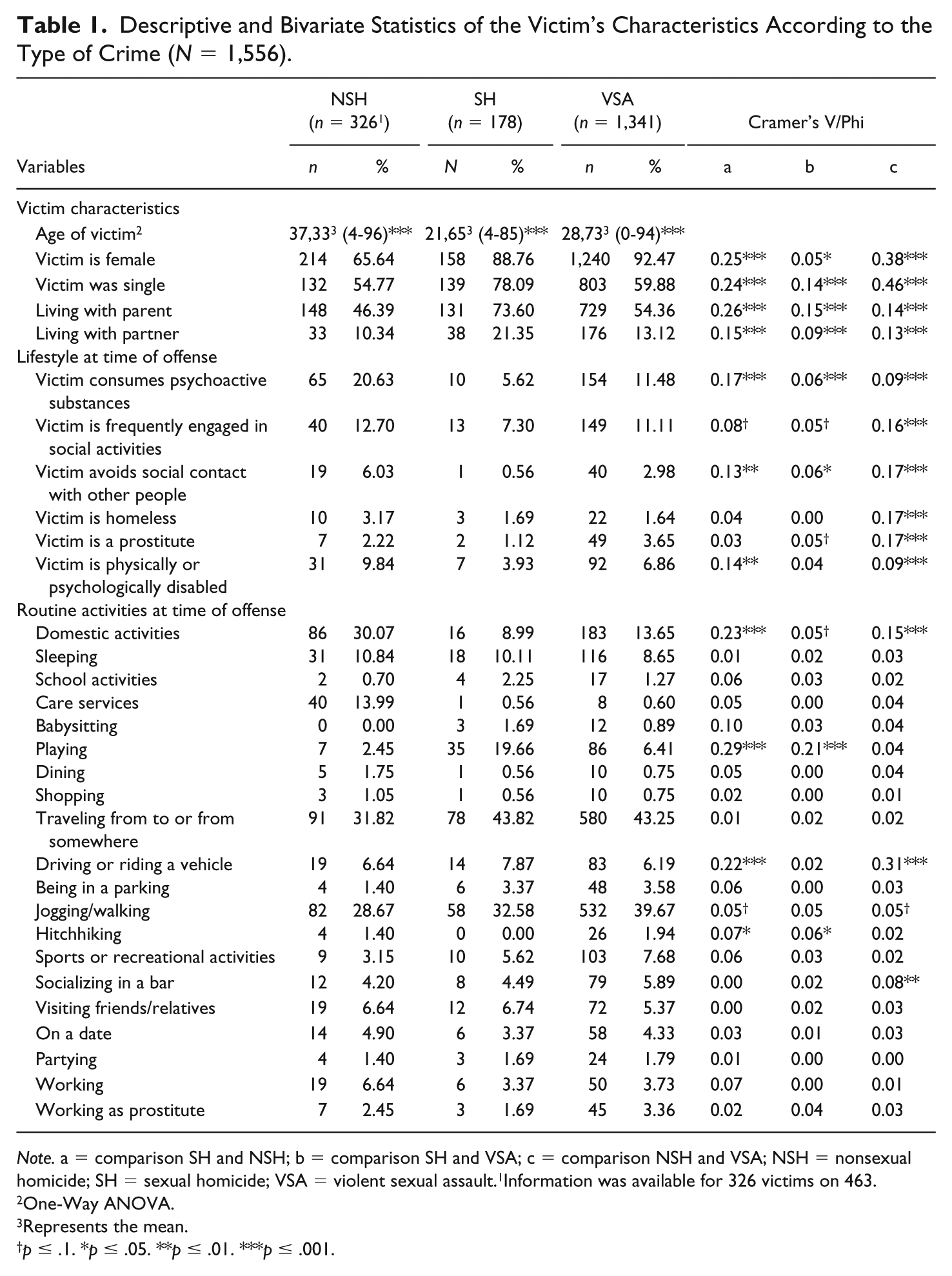
Note. a = comparison SH and NSH; b = comparison SH and VSA; c = comparison NSH and VSA; NSH = nonsexual homicide; SH = sexual homicide; VSA = violent sexual assault.1Information was available for 326 victims on 463.
One-Way ANOVA.
Represents the mean.
p ≤ .1. *p ≤ .05. **p ≤ .01. ***p ≤ .001.
Independent variables
Victims
A total of 30 variables describing the victims’ characteristics have been included. With the exception of the age of victims all these variables are dichotomous. Four sociodemographic variables are used to establish the basic victim profile: (1) age, (2) sex, (3) marital status, and (4) the person living with. Five lifestyle variables have also been included to examine the risk factors that may have facilitated the crime: (5) consumes psychoactive substances, (6) frequently engages in social activities, 2 (7) avoids social contact with other people, 3 (8) is homeless, (9) is a prostitute, and (10) is physically and/or psychologically (e.g., mental disorders) disabled. Finally, 21 variables examine the routine activities of the victim just prior to the crime: (11) domestic activities, (12) sleeping, (13) school activities, (14) care service, (15) babysitting, (16) playing, 4 (17) dining, (18) shopping, (19) traveling from/to somewhere, (20) driving or riding a vehicle, (21) being in a parking lot, (22) jogging or walking, (23) hitchhiking, (24) sports or recreational activities, (25) socializing in a bar, (26) visiting friends, (27) on a date, (28) partying, (29) working, and (30) working as a prostitute.
Offenders
A total of 22 variables looking at offender characteristics have been included in the current study. Sociodemographic variables are the same as the ones for victim characteristics: (1) age, (2) sex, (3) marital status, and (4) the person living with. A second set of four dichotomous variables is related to the physical build of offenders and includes (5) small, (6) medium, (7) large, and (8) obese. A third group of variables includes seven dichotomous variables associated with the sexual behavior of offenders: (9) evidence of paraphilic disorders, (10) offender has a sexual collection, (11) offender has a collection with a sexual orientation, 5 (12) offender has a collection with a violent orientation 4 , (13) offender has a collection involving adult victims 4 , (14) offender has a collection involving child victims 4 , (15) evidence of sexual dysfunction. Finally, five variables are related to the lifestyle of offenders at the time of the assault: (16) consumes psychoactive substances (alcohol and/or drug), (17) frequently engages in social activities, (18) avoids social contact with other people, (19) has no fixed address, (20) frequently engages in criminal activities.
Modus operandi
A total of 46 binary variables were included to examine the modus operandi of the offenders. A total of 46 binary variables were included to examine the modus operandi of the offenders. Two variables are looking at the victim–offender relationship, one variable looks at the victim–offender relationship, one variable looks at whether or not the victim was targeted by the offender, three variables look at the type of approach to commit the crime, eight variables examine the environmental aspect of the crime, seven variables examine the type of violence used during the assault, two variables look at the use of restraints, nine variables explore the use and type of weapon involved in the crime, one variable looks at the presence of unusual acts of violence, and finally, 13 variables investigate the notion of forensic awareness strategies.
Analytical Strategy
The first analytical step was to examine at the bivariate level, i.e., Chi-square, including Cramer’s V/Phi coefficients and analysis of variance (ANOVA) analysis, the differences between the three groups of offenders in relationship to all the independent variables. We have tested the differences between (a) SH and NSH, (b) SH and VSA, and (c) NSH and VSA. If at least one significant difference was observed for (a) or (b) comparisons, the variable was considered for multilevel analysis.
The second analytical step was to look at the differences between the three groups at the multivariate level, using binomial logistic regression. The goal here was to identify the differences between SH and NSH (Model 1) and SH and VSH (Model 2) at the multivariate level. We chose to perform binomial regressions rather than multinomial 6 because we aim to analyze and compare the differences observed through the odds ratio. Following the research question, the goal was to identify variables where significant differences were found only for model 1 or for model 2, and variables for which differences were present in both models. For the latter, two possibilities have been considered: the differences observed are convergent or divergent. If the odds ratios of models 1 and 2 followed the same direction (i.e., the two odds ratios are higher or lower than 1), this suggests that the differences observed are convergent. However, if the two odds ratios were going in opposite directions (i.e., one odds ratio is higher than 1 while the other is less than 1, or vice versa), this suggested that the differences were divergent.
Results
Results of the bivariate analyses on the victim characteristics are presented in Table 1. The results show that SH victims are younger than the victims from the other two groups. Also, the percentage of female victims is higher in cases of SH compared to the cases of NSH but lower than cases of VSAs. Victims of SH are more frequently singles than the ones of VSA and NSH. When victims of SH are not single, they are more likely to live with their parents or a partner, compared to the victims from the other two groups. However, victims of SH are less likely to have used psychoactive substances, to have an active social life, or to avoid social contact with other people at the time of the aggression. They are also less likely to have presented a handicap than NSH victims. As to their routine activities, results indicate that SH victims are more likely to be attacked while playing or jogging/walking. Victims of NSH and VSA are, for their part, less likely to be attacked while taking part in domestic activities, driving a vehicle, or when hitchhiking.
Table 2 presents the bivariate analyses on the offender characteristics. Results indicate that SH offenders are older than VSA offenders but they are younger than NSH offenders. Also, the findings show that offenders are more likely to be male in cases of crime of sexual nature (i.e., SH and VSA). Results show that SH offenders are more likely to have a small or a large physical build compared to the others. They are also more likely to present paraphilic disorders than the VSA and NSH offenders. Similarly, SH offenders are more likely to possess a sexual collection than the other two groups. They are also more at risk to present a sexual dysfunction than NSH offenders. As to the lifestyle at the time of the crime, SH offenders are more frequently engaged in social activities or, on the contrary, are more frequently considered as loner people than the other two groups of offenders. SH offenders are also less likely to use psychoactive substances than two other groups of offenders as well as less likely to be homeless than the NSH offenders. It is noteworthy that SH offenders are also less likely to be engaged in criminal activities than the other two groups of offenders.
Descriptive and Bivariate Statistics of the Offender’s Characteristics According to the Type of Crime (N = 1,982).
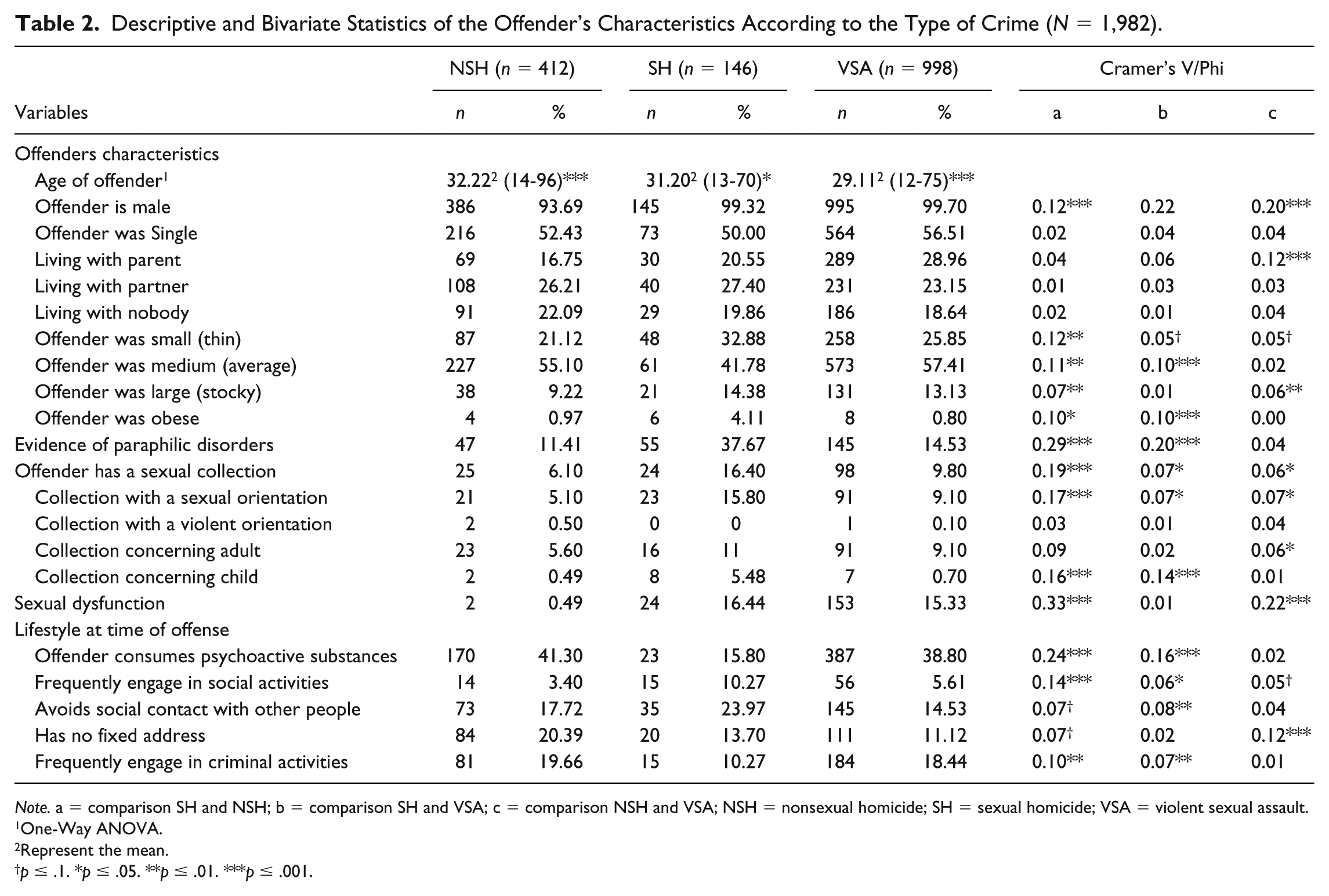
Note. a = comparison SH and NSH; b = comparison SH and VSA; c = comparison NSH and VSA; NSH = nonsexual homicide; SH = sexual homicide; VSA = violent sexual assault.
One-Way ANOVA.
Represent the mean.
p ≤ .1. *p ≤ .05. **p ≤ .01. ***p ≤ .001.
Table 3 presents the results of the bivariate analyses on the modus operandi characteristics. The findings show that in cases of SH, the victim and offender are more likely to be strangers at the time of the offense and these offenders are more likely to use both a con and surprise approach compared with the two other groups of offenders. In addition, significant differences are observed as to the location of the crime. Compared to NSHs, SHs occur generally more frequently in residences, transportation-related locations, or at entertainment locations. Moreover, compared to VSAs and NSHs, witnesses are more likely to be present during a SH. Victims of SH are also more likely to be beaten than in NSH or VSA but the offenders are less likely to be armed at the time of the crime. Finally, the findings show that SH offenders are less preoccupied by the forensic awareness strategies. As to the VSA offenders, they are less likely to take precautions for not being identified or to destroy evidence after the crime has been committed but they are more likely to act on their victim and/or the environment to try to avoid detection. Weapons are less likely to be removed from the scene and recovered by the police in cases of SH, compared to cases of NSH.
Descriptive and Bivariate Statistics of the Modus Operandi’s Characteristics According to the Type of Crime (N = 1,732).

Note. a = comparison SH and NSH; b = comparison SH and VSA; c = comparison NSH and VSA; NSH = nonsexual homicide; SH = sexual homicide; VSA = violent sexual assault.
p ≤ .1. *p ≤ .05. **p ≤ .01. ***p ≤ .001.
Results of the binomial regression concerning the victim characteristics are presented in Table 4. The model 1 compares SH cases with NSH cases whereas model 2 compares SH cases with VSA cases. Only the significant variables at the bivariate level were included in the multivariate analyses. Results from model 1 indicate that SH offenders are more likely to target a female victim, who is single, or living with a partner compared to NSH offenders. Moreover, SH are more likely to occur when the victims are playing prior to the crime but they are less likely to occur if the victims are involved in domestic activities prior to the crime, compared to NSH. Similarly, results of model 2 show that SH offenders are more likely to target a victim who is single, living with parents, or with a partner compared to VSA offenders. Moreover, SH offenders are more likely to target a victim who is playing prior to the crime compared to VSA offenders.
Binomial Logistic Regressions of the Type of Crime (SH vs. NSH and VSA) Using the Characteristics of Victims (N = 1,556).

Note. SH = sexual homicide; NSH = nonsexual homicide; VSA = violent sexual assault; CI = confidence interval.
p ≤ .1. *p ≤ .05. **p ≤ .01. ***p ≤ .001.
Table 5 presents the results of the binomial regression concerning the offender characteristics. Model 1 shows that compared to the NSH offenders, SH offenders are more likely to be male, stocky, as well as presenting evidence of some paraphilic disorders, sexual collections, and some sexual dysfunctions. However, SH offenders are less likely to be frequently engaged in social activities, use psychoactive substances, and engaged in criminal activities compared to the NSH offenders. However, results of model 2 indicate that compared to VSA offenders, SH offenders are less likely to present a medium or stocky physical build, but they are more likely to present evidence of some paraphilic disorders, to possess a pedo-pornographic collection, and to show signs of sexual dysfunctions. Moreover, compared to VSA offenders, SH offenders are less likely to use psychoactive substances and to be engaged in criminal activities, but they are more likely to be frequently engaged in social activities, avoid social contact with other people, and identified as homeless.
Binomial Logistic Regression of the Type of Crime (SH vs. NSH and VSA) Using the Characteristics of Offenders (N = 1,982).
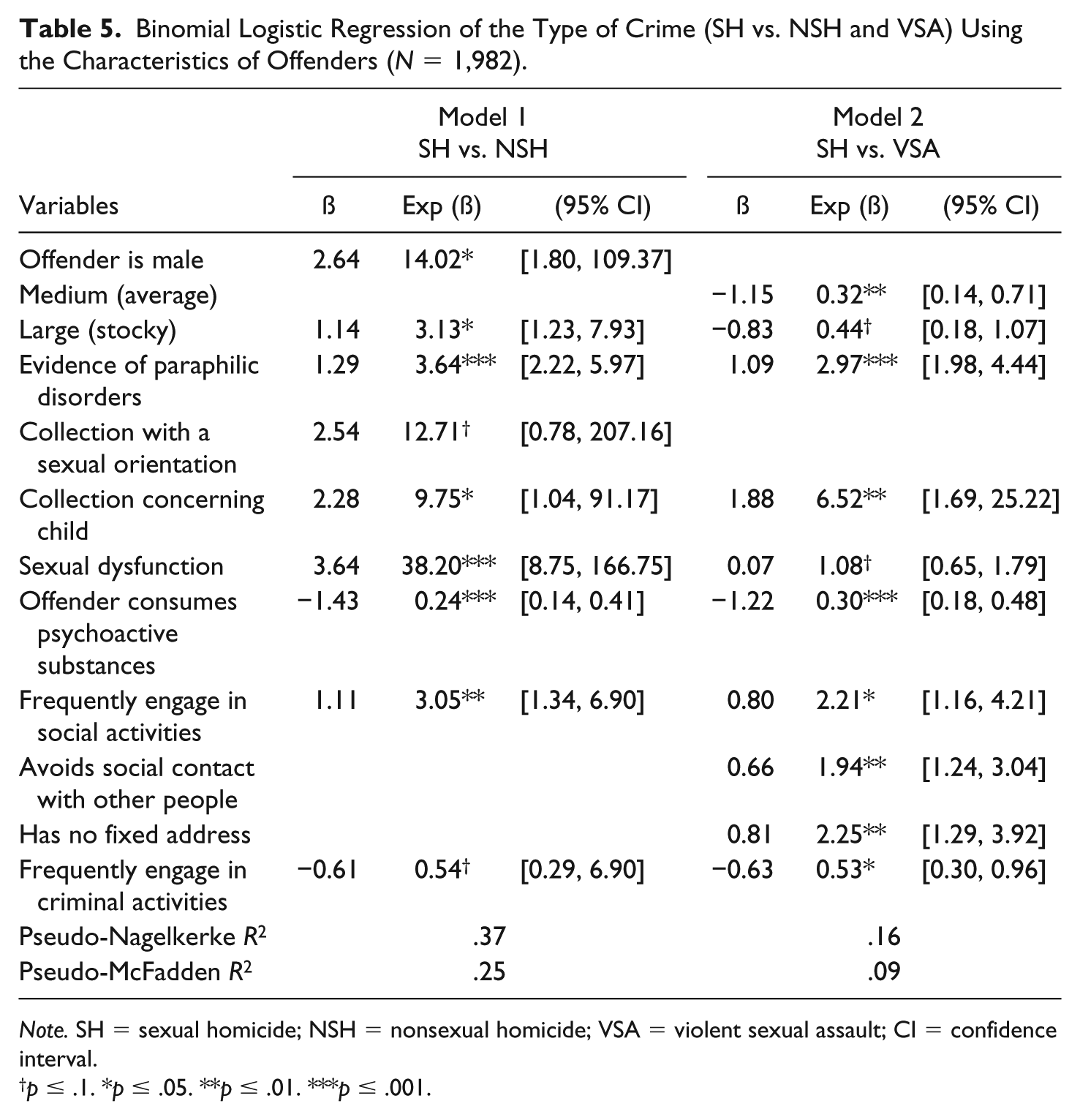
Note. SH = sexual homicide; NSH = nonsexual homicide; VSA = violent sexual assault; CI = confidence interval.
p ≤ .1. *p ≤ .05. **p ≤ .01. ***p ≤ .001.
Results of the binomial regression concerning the modus operandi characteristics are presented in Table 6. Results from model 1 show that in cases of SH, offenders and victims are more likely to be strangers at the time of the offense and these offenders are more likely to use a con or surprise approach compared to NSH cases. SH offenders are also more at risk of being seen by a witness during the aggression than the NSH offenders. As to the crime locations, SH offenders are more likely to commit their crime in a residence or at an entertainment location compared to NSH offenders. Victims of SH present a higher risk of being beaten during the crime compared to NSH offenders, but they are less at risk of being stabbed or asphyxiated. SH offenders are less likely to use their weapon intentionally compared to NSH offenders. SH offenders are also less likely to destroy or remove evidence from the crime scene but they are more likely to act on the victim and their environment. Finally, police officers are less likely to retrieve a weapon and to see the weapon removed from the scene by the offender in cases of SH than in cases of NSH. Results from model 2 show that SH offenders are less likely to use a con or a surprise approach compared to VSA offenders. SH are also less likely to occur indoors and especially in residence than in cases of VSAs. Compared to VSAs, victims of SH are more at risk of being beaten and to be shot with a firearm, but they are less likely to be asphyxiated. Finally, compared to VSAs, a weapon is less likely to be used intentionally in SH.
Binomial Logistic Regression of the Type of Crime (SH vs. NSH and VSA) Using the Characteristics of Modus Operandi (N = 1,736).

Note. SH = sexual homicide; NSH = nonsexual homicide; VSA = violent sexual assault; CI = confidence interval.
p ≤ .1. *p ≤ .05. **p ≤ .01. ***p ≤ .001.
Discussion
Following the pioneer work of Langevin et al. (1988), the current study investigated the differences between SH, NSH, and VSA as to the victim, offender, and modus operandi characteristics. Based on a much larger sample from France and using multivariate analyses, the findings confirmed what Langevin et al. (1988) had found early on, that is, important differences exist between these three groups of offenders. However, Langevin et al. (1988) did not look at the differences at the multivariate level and thus were not able to consider the overall pattern of differences between sexual homicide offenders and the other two groups of offenders. Although knowing that such differences exist between these three groups of offenders is interesting, it is important to consider also the possible implications of these findings at a more practical level.
Sexual Murderers as a Distinct Type of Offenders
As mentioned by Langevin et al. (1988), sexual murderers represent both a subgroup of homicide perpetrators and sex offenders. Thus, beyond the comparisons between the three groups, the current study attempted to answer differently a question initially raised by Healey et al. (2016): is the sexual murderer a unique type of offender? Healey et al. (2016) found that by comparing sexual homicide offenders (SHOs) to violent nonhomicidal sex offenders (NHSOs), the sexual murderer fitted both a unique and hybrid type of offender. However, the study by Healey et al. (2016) did not include a group of NHSOs. Another study attempted to answer a similar question by focusing on the criminal career. Beauregard et al. (2018) compared this time three groups of sex offenders—SHOs, violent NHSOs, and NHSOs—and asked the following question: Are sexual murderers sex offenders, murderers, or both? Despite observing several differences between sexual murderers and the other two groups of sex offenders, they came to the conclusion that sexual murderers did not seem to follow the same trajectory of a sex offender as to their criminal career. However, they also mentioned that to fully answer their question, a group of nonsexual homicidal offenders would be necessary.
Taking a different approach, the current study included a group of nonsexual homicidal offenders as suggested by Beauregard et al. (2018). Several differences between sexual murderers and the two other groups were observed and are summarized in Table 7. In addition, we have identified whether the differences observed were divergent or convergent. If the odds ratios of the models 1 and 2 followed the same direction (i.e., the two odds ratios are higher or lower than 1), this suggested that the differences observed are convergent. However, if the two odds ratios were going in opposite directions (i.e., one odds ratio is higher than 1 while the other is less than 1, or vice versa), this suggested that the differences were divergent. To answer our research question and more specifically test our two hypotheses, we proposed that variables with odds ratios following a convergent direction could be interpreted as the sexual murderer being a distinct type of offender. On the opposite, variables with odds ratios following a divergent direction could be interpreted as the sexual murderer being a hybrid type of offender, as suggested early on by Langevin et al. (1988).
Analysis of the Differences Observed Between SH and NSH or VSA.
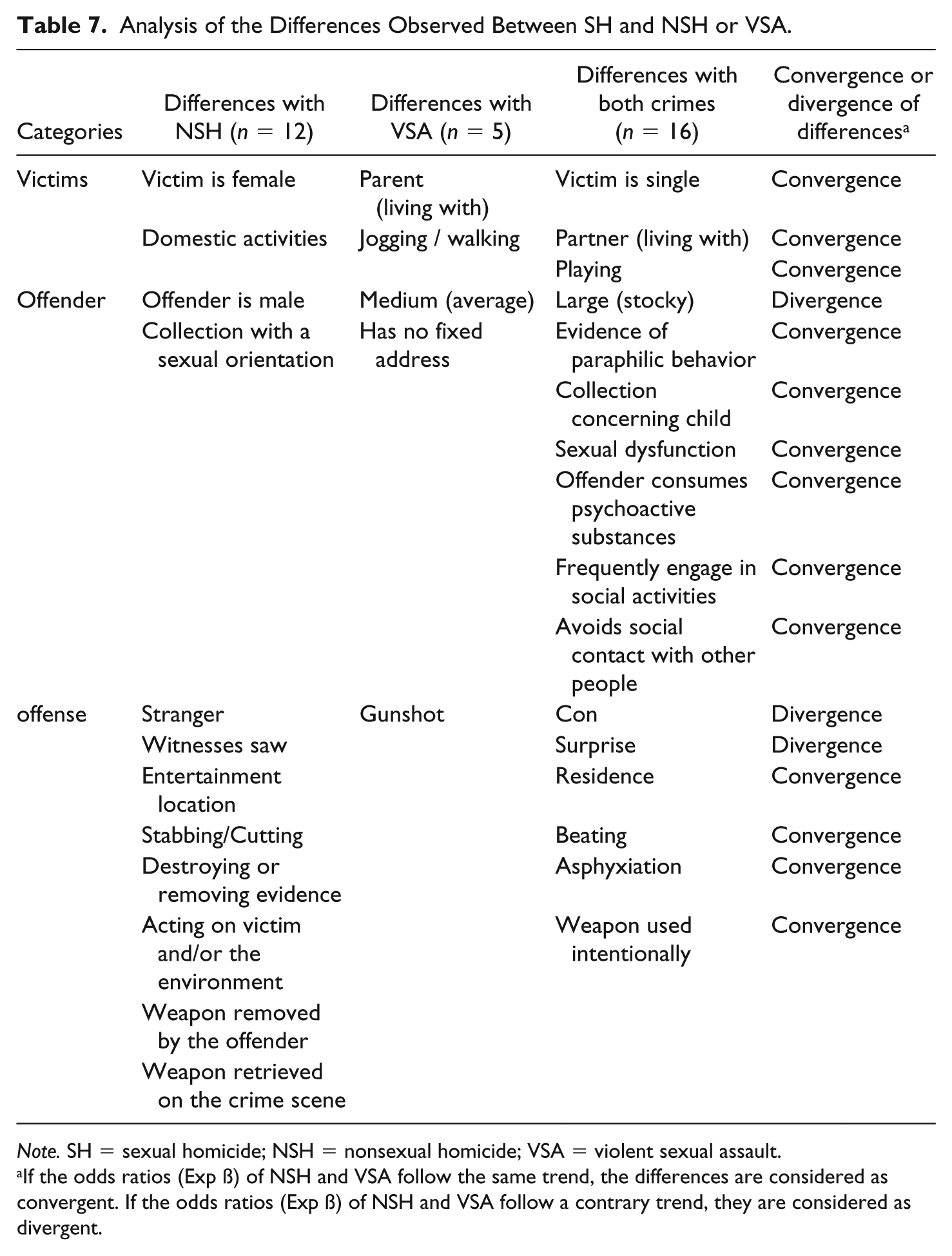
Note. SH = sexual homicide; NSH = nonsexual homicide; VSA = violent sexual assault.
If the odds ratios (Exp ß) of NSH and VSA follow the same trend, the differences are considered as convergent. If the odds ratios (Exp ß) of NSH and VSA follow a contrary trend, they are considered as divergent.
The multivariate models have highlighted 34 significant variables related to victims, offenders and modus operandi. First, among these variables, 12 show specific differences between cases of sexual and nonsexual homicides. At first glance, this is not surprising as sexual homicide, due to its sexual nature, should present different elements from nonsexual homicides. However, what is particular when comparing both types of homicide is that most of these differences concern the modus operandi and more specifically the forensic awareness strategies used by offenders. We believe this could be explained—at least in part—by the fact that as sexual homicide is typically committed against victims who are strangers to the offender, this requires a different modus operandi or at least the use of specific strategies to avoid detection (see Beauregard & Martineau, 2014, 2017).
Second, 16 variables indicate differences between sexual homicides and both nonsexual homicides and violent sexual assaults. It is noteworthy that among those 16 differences observed, 13 present a convergent direction and those major differences are not only related to the modus operandi but also to offender characteristics (e.g., offender possesses a sexual collection, presents sexual dysfunctions, uses psychoactive substances, has paraphilic behaviors). This suggests that the sexual murderer appears as a distinct type of offender, that is a type of offender who should be considered on its own and who should be distinguished from homicide offenders as well as sexual offenders.
These findings are partly in line with those of Healey et al. (2016) who found support for both the unique and hybrid hypotheses. In this study (Healey et al., 2016), the authors have identified groups of sex offenders with a diverse lethality level (i.e., angry, situational precipitated, and predatory), suggesting that these groups of sex offenders could end up killing their victims when certain situational factors were present. Our current findings do not allow to identify this type of hybrid offender. Instead, when analyzing the convergent differences observed between sexual murderers and the two other groups of offenders, it seems that sexual murderers represent a distinct type of offender with a clear intention to kill. Similar to what Higgs et al. (2017) have suggested, the convergent differences observed between the sexual murderers and the two other groups could represent what is the “true” sexual killer, that is an offender sexually motivated to kill his victim. The choice of certain victim characteristics combined with sexual preoccupations from the offender (e.g., sexual collection, sexual dysfunctions, paraphilic behavior), and specific modus operandi strategies indicate that the sexual murderer is different, and the combination of these differences seems to suggest a distinct type of offender. If we are correct, this reaffirms the need to develop specific knowledge on sexual homicide to further our understanding of this rare but particular type of crime.
Practical Implications
Such finding has implications for correctional practices as well. Sexual murderers pose specific challenges for corrections and this starts right at their admission. For instance, perpetrators of sexual homicide do not typically enter the correctional system with a label of “sex offender.” Being considered as murderers first and foremost, these offenders will typically be incarcerated within the general population. However, some cases who have been widely publicized in the media will face a different reality. Instead of seeing their homicidal act being the focus of correctional administrators and other inmates, it is the sexual nature of the act that will be predominant. As sex offenders do not typically benefit from the same status inside as other inmates, a decision will need to be made by correctional authorities as to whether the sexual murderer should be put in protective custody with sex offenders or if they can risk a placement in the general population. Such decision will have an impact not only for the security of the inmate but also for the security in the institution.
Knowing that the sexual murderer represents a distinct type of offender also has implications for the treatment programs, inside as well as outside prison. The fact that the sexual murderer does not follow the same trajectory of a typical sex offender seems to suggest that the “one-size fits all” treatments for sex offenders would not be recommended. At the same time, we believe it would be a mistake to assume that these offenders do not require treatment adapted to their specific needs. As was shown in the current study, sexual murderers are more likely to display paraphilic behaviors as well as maintaining a sexual collection involving children, compared to the two other groups of offenders. This suggests that this offender presents some issues at the sexual level that needs to be addressed adequately. Although tailored treatment programs for sexual murderers are not common, maybe initiatives such as the Sex Offender Treatment Program (SOTP) in the United Kingdom (Beech, Oliver, Fisher, & Beckett, 2005) should be replicated.
Finally, it is important to consider that in some cases, sexual murderers will eventually be released back into the community and that supervision conditions will need to be put in place. What type of supervision will be required for this specific type of offender is something that remains unknown as no study has investigated this aspect of sexual homicide yet. However, this is still an important question. Myers, Chan, Vo, and Lazarou (2010) looked specifically at juvenile sexual murderers and found that of the 11 cases for which follow-up community recidivism data were available, five remained free of further convictions for an average of 8.9 years, whereas six offenders recidivated after only 4.4 years later on average. While three of the offenders who recidivated committed nonsexual offenses, the three other offenders lasted an average of 5.3 years before committing additional sexual homicides (Myers et al., 2010). This suggests that despite sexual homicide being rare and uncommon, some of these offenders will eventually reintegrate to society and will need to be monitored adequately if we want to avoid recidivism for the same type of crime.
Methodological Considerations
Despite the interest of the current findings, our study is not without its limitations. As with each tool of data collection, issues of reliability and validity can be raised (Aebi, 2006). The reliability of police data has been underlined in the literature (see Snook, Luther, House, Bennell, & Taylor, 2012), nonetheless some measures have been taken to improve this aspect such as the centralization of the data collection (Chopin, 2017). In terms of the validity of data, two aspects can be discussed. First, only information known by the police is coded and the dark number is importantly dependent of the type of crime. The number of homicide reported to the police is high in Europe (Aebi & Linde, 2012), while the number of extra-familial rape is relatively low (16% in France; Chopin, 2017). Second, as highlighted in the introduction, sexual homicides present no legal definition. This aspect implies that some crimes could have been considered as NSHs by the police while they are unidentified SHs. Finally, police data are limited because a lot of useful information can only be accessed from the offender self-reports like their motivation or the real number of their victims, underestimated by police data (Chopin & Aebi, 2019). Third, this study did not consider the heterogeneity of sexual murderers (e.g., Beauregard & Proulx, 2002). Instead, it was decided to present a large sample of cases including a diversity of victim and context (e.g., victims of different age, variation of the offender–victim relationship). Therefore, it is possible that other differences would emerge as sexual murderers of women have been found to present certain differences with sexual murderers of children (Beauregard & Martineau, 2015; Beauregard, Stone, Proulx, & Michaud, 2008; Proulx, James, Siwic, & Beauregard, 2018) and sexual murderers of men (e.g., Beauregard & Proulx, 2007).
Conclusion
The current study compared three groups of offenders: sexual murderers, nonsexual homicidal offenders, and violent sexual abusers. Findings have revealed that sexual murderers present several significant differences with the other two groups, suggesting that this type of offender represents a distinct type of offender, different from homicide offenders and sexual offenders. Our findings suggest that the sexual murderer and his offense should be examined separately in order to propose more appropriate ways to manage these offenders during and after their incarceration. Our findings also suggested that contrary to Langevin et al. (1988) who presented sexual murderers as being both a subgroup of murderers and sex offenders, it is necessary to develop knowledge specific to this offender. It may well be that theoretical as well as clinical knowledge accumulated on murderers and sex offenders is not specific enough to this type of offender.
In order to fully answer the question as to how to view the sexual murderer and his offense, future studies will need to consider different data (e.g., supervision data). Similarly, although several differences were observed between the three groups of offenders, it would also have been interesting to be able to also consider clinical features pertaining to these offenders (e.g., personality). This type of information could have been useful for correctional practices, such as risk assessment, security placement, or treatment programming. However, recent studies have shown that this type of offender is different from nonsexual murderers as well as from nonhomicidal sex offenders on a variety of factors (e.g., criminal career, personality, developmental factors). The next step could be to look at the entire criminal event while taking into account the influence of the offender, the victim, and the context have on the outcome of the crime. This could potentially further our understanding of this specific type of crime and improve our ability to predict those offenders who are at risk of committing a sexual homicide.
Footnotes
Acknowledgements
The authors would like to acknowledge Mr. the Police Chief of the French Central Office for the Repression of Violence against Persons (Office Central de Répression des Violences aux Personnes) and Mrs. the Central Director of the French Judicial Police (Direction Centrale de la Police Judiciaire).
Declaration of Conflicting Interests
The author(s) declared no potential conflicts of interest with respect to the research, authorship, and/or publication of this article.
Funding
The author(s) disclosed receipt of the following financial support for the research, authorship, and/or publication of this article: Authors want to acknowledge the Swiss National Science Foundation who kindly supported this research (Fund no. P2LAP1_178193).
