



Abstract
While a number of previous studies have compared sexual homicides to nonlethal sexual offenses, there have been few studies comparing sexual and nonsexual homicides. This study examines whether sexual homicide offenders differ from nonsexual homicide offenders in Scotland regarding characteristics of the offender, the victim, and the homicide incident. Unlike previous studies, only homicides committed by males against females were examined. Data from a national police database were used to compare 89 male sexual homicide offenders who killed adult females with 306 male nonsexual homicide offenders who had also killed adult females using bivariate and multivariate (logistic regression) analyses. The findings revealed not only some similarities between the two groups, particularly regarding some victim variables, but also significant bivariate and multivariate differences. Sexual homicides appeared to be associated with indicators of instrumentality and sexual deviance. We conclude that sexual homicide offenders might be considered a distinct group of homicide offenders, more similar to sexual offenders than to other homicide offenders.
Introduction
Although there has been a recent increase in the study of sexual homicide, this still remains an under-researched area compared with homicide research more generally. In their comprehensive literature review on the subject, Chan and Heide (2009) identified 32 published studies that focused on sexual homicides since the 1980s, most of which were North American. The majority of these studies tend to compare sexual homicide offenders with offenders of nonlethal sexual assault. For instance, it has been found that sexual homicide offenders differ from nonhomicidal sexual offenders with regard to offender characteristics (such as developmental factors, sexual development, and personality traits) and characteristics relating to the criminal event (e.g., pre-crime situation and modus operandi; Beauregard, DeLisi, & Hewitt, 2018; Beauregard & Martineau, 2016; Choon & Heide, 2016; Darjee & Baron, 2018; Proulx, Beauregard, Cusson, & Nicole, 2007). A considerably more uncommon comparison in the literature is that between sexual homicides and nonsexual homicides. Although rarer in sexual homicide research, the comparison between sexual homicide and nonsexual homicide may have important implications. While previous studies comparing sexual homicides with nonlethal sexual offenses examine whether sexual offenders are comparable across severity of outcome, we still do not know whether homicide offenders are comparable across sexual and nonsexual types of crime. If sexual homicide offenders differ significantly from other homicide offenders, this could have important implications not only for future research but for policy, interventions, and rehabilitation programs for homicide offenders. Changes to custodial strategies and community management of sexual homicide offenders might, for instance, need to be addressed if these offenders are found to differ significantly from other types of homicide offenders. This, therefore, constitutes a gap in the current research on sexual homicide, which needs to be addressed.
Studies Comparing Sexual Homicide and Nonsexual Homicide
Since 1980, only a handful of studies have compared sexual homicide and nonsexual homicide. Such research has found that sexual homicide offenders tended to be more sexually sadistic, psychopathic, and antisocial compared with other homicide offenders, as well as having a higher propensity to substance abuse (Häkkänen-Nyholm, Repo-Tiihonen, Lindberg, Salenius, & Weizmann-Henelius, 2009; Langevin, Ben-Aron, Wright, Marchese, & Handy, 1988; Yarvis, 1990, 1995). Yarvis (1995) argued that sexual homicide offenders display differences with regard to psychopathology compared with both nonsexual homicide offenders and nonlethal sexual offenders. Langevin et al. (1988) compared sexual killers, nonsexual killers, and nonlethal sexual aggressors, and although they found more similarities than differences among the three groups, for instance, regarding demographic variables such as age and education, sexual homicide offenders had a more unstable employment history compared with the other two groups. Sexual homicide offenders and nonlethal sexual offenders were furthermore somewhat younger compared with nonsexual homicide offenders at the time of crime (Harbort & Mokros, 2001; Langevin et al., 1988). Häkkänen-Nyholm et al. (2009), however, did not find a significant difference between sexual homicide offenders and nonsexual homicide offenders regarding offender age.
Research has shown that victims of sexual homicide appeared to be younger and more commonly female compared with nonsexual homicide offenders. Langevin et al. (1988) found that the victims of nonsexual homicide offenders tended to be older than the two sexual groups, and it was also more common for sexual homicide offenders to attack a female victim compared with the nonsexual homicides (Langevin et al., 1988). Similarly, Häkkänen-Nyholm et al. (2009) found that most of the victims of sexual homicides were female.
Häkkänen-Nyholm et al. (2009) found that while it was equally uncommon for sexual and nonsexual homicide offenders to attack strangers, it was more common for sexual homicide offenders to have an accomplice or co-offender. Langevin et al. (1988), however, found that both sexual homicide offenders and nonlethal sexual offenders more often attacked strangers compared with nonsexual homicide offenders, who more commonly attacked family or friends.
Sexual homicide offenders also appear to differ in the method of killing compared with nonsexual homicide offenders. Examining serial sexual homicide offenders in comparison with serial nonsexual offenders in Germany, Harbort and Mokros (2001) found that sexual homicide offenders preferred a more direct method of killing, such as strangulation or stabbing. Moreover, sexual homicide offenders were more likely to strangle their victim compared with nonsexual homicide offenders (Häkkänen-Nyholm et al., 2009; Langevin et al., 1988) and nonlethal sexual offenders (Langevin et al., 1988). Langevin et al. (1988) also found that it was more common for sexual homicide offenders to use more than one method of killing. It furthermore seems more common for sexual homicide offenders to move and dispose of the body in another location (Häkkänen-Nyholm et al., 2009). Similar to nonsexual homicides, sexual homicides commonly appear to take place within the victim’s home (Langevin et al., 1988).
As these previous studies indicate, there appear to be important differences between sexual homicide offenders and nonsexual homicide offenders. Sexual homicide offenders more often tend to strangle their victims (Harbort & Mokros, 2001; Langevin et al., 1988), to attack strangers (Langevin et al., 1988), to have an accomplice, and to move the body after the homicide (Häkkänen-Nyholm et al., 2009). There is, however, no great consensus among these findings. While Langevin et al. (1988) identified female strangers to be a more common victim among sexual homicide offenders, Häkkänen-Nyholm et al. (2009) found that sexual and nonsexual homicide offenders attacked strangers equally often. Similarly, while Langevin et al. (1988) found that sexual homicide offenders tended to be younger, other studies did not find any significant differences in age between sexual and nonsexual homicide offenders. These differences might be related to the different jurisdictions where research was conducted, highlighting the need for conducting this type of study in different countries. However, these contrasting findings could also be related to the characteristics of the control group, namely, the nonsexual homicide offenders, and how sexual homicide is defined. Both Langevin et al. (1988) and Häkkänen-Nyholm et al. (2009) compared sexual homicides with nonsexual homicide of both male and female victims. However, as previous research has found (Polk, 1994), homicides against men and women tend to be different in their own right. As a large majority of sexual homicide is committed against women (Häkkänen-Nyholm et al., 2009), studies with a large number of male victim homicides in the comparison group may not help us understand the difference between sexual and nonsexual homicide beyond superficial differences determined by victim gender. In addition, a broad or nonexplicitly operationalized definition of sexual homicide may mean that sexual homicide perpetrators in different studies are different. For example, in some studies, sexual intimacy between a perpetrator and victim qualifies a homicide as “sexual” without proximal indicators of a sexual element before, during, or after the killing.
Previous studies comparing sexual and nonsexual homicide tend to focus mainly on the offender and incident variables of these crimes (Häkkänen-Nyholm et al., 2009; Harbort & Mokros, 2001). However, research has shown that variables relating to the victim can be equally important in these crimes (Langevin et al., 1988). Whether or not the victim is engaged in prostitution has, for instance, been found relevant to distinguish between these two crimes and for identifying the possible risks and vulnerability of individuals engaged in prostitution (Quinet, 2011; Salfati, James, & Ferguson, 2008). Similarly, victim gender has also been identified as important when differentiating sexual and nonsexual homicide (Langevin et al., 1988). Studies comparing these two types of homicide should, therefore, examine the differences on victim variables, and variables relating to the offender and the incident of homicide.
Research comparing these two types of homicide offenders across different jurisdictions and cultural contexts is necessary if differences between these two types of homicide offenders are to be understood. But findings from such research need to be placed in the context of where they are conducted. Although Scotland historically had been known as “the most violent country in the developed world” (BBC, 2005; The Guardian, 2005), homicide has more than halved over the past decade (Scottish Government, 2016). However, while homicides in Scotland are now at the lowest level since 1976, sexual crimes are at the highest level since 1971. Recorded sexual violence (rape, attempted rape, and sexual assault) has increased by 126% over the past 10 years alone (Scottish Government, 2016). Although this increase may be related to changes in reporting of both contemporary and historical sexual abuse and the recording of sexual crimes, this apparent increase in sexual violence in an otherwise declining picture of violent crime has not been explained empirically. Sexual violence, in general, and sexual homicide in particular, have been largely absent from Scottish research.
Given that the larger number of studies comparing sexual homicide offenders with nonlethal sexual offenders find more similarities than differences between these two groups, and the smaller number of studies examining sexual and nonsexual homicides have found many differences between those groups, it is plausible that sexual homicide offenders should be seen as an extreme variant of sexual offender rather than a sexual variant of homicide offender. Using a sample of only homicides by males against females will help explore this further. The aim of the present study is, therefore, to examine whether sexual homicide offenders differ from nonsexual homicide offenders in Scotland regarding characteristics of the offender, the victim, and the incident itself, only examining cases where males have killed females.
Method
Sample and Procedure
The sample was gathered from the Scottish Homicide Database (SHD), which is held by Police Scotland, and contains all homicides committed in Scotland that come to the attention of the police. Ethical approval was sought and received from Police Scotland before any data were gathered, and all data were anonymized (removing all names and street addresses) before any analysis was conducted. The data used in the present study include all sexual homicides committed by a male offender against a female victim between 1990 and 2015, and a random subsample of 70% of all nonsexual homicides committed by a male offender against a female victim during this time. Due to changes in the construction of the SHD and changes in recording, the missingness in the data is substantially higher before the year 1990. So, only data from 1990 onward were used in the present study. Despite this, some variables were found to be missing frequently, due to inconsistencies in coding practices and changes to the police forces over the years. This primarily involves negative categories (such as “no”) being falsely coded as missing. To deal with this issue in the present study, it was decided to collapse the categories “no” and “missing.” This is, however, important to bear in mind when interpreting these results. The sample furthermore only included cases classified as murders by Police Scotland, meaning that all culpable homicides were excluded. Culpable homicides were excluded from the present study since this included cases where the death did not result from a violent act by another person, such as, for instance, the self-administration of drugs and acts of negligence.
Cases were identified as sexual if the motive was coded as sexual by Police Scotland or if the case met the definition of sexual homicide provided by the Federal Bureau of Investigation (FBI), that is, the case had to include at least one of the following: (a) victim’s attire or lack of attire, (b) exposure of the sexual parts of the victim’s body, (c) sexual positioning of the victim’s body, (d) insertion of foreign objects into the victim’s body cavities, (e) evidence of sexual intercourse, or (f) evidence of substitute sexual activity, interest, or sadistic fantasy (Ressler, Burgess, & Douglas, 1988). A homicide was not considered sexual in the present study simply because the victim and offenders were intimate partners (i.e., engaged in a romantic or sexual relationship). Other sexual elements, as the ones described above, had to be present. If cases had been identified by the police as sexual, but did not meet the FBI criteria, then they were not coded as sexual homicides.
The data in the present study is furthermore based on the offender, with victim variables summarized at the incident level. This was decided since any homicide case in the SHD can involve more than one offender and more than one victim, and the number of offenders were substantially higher than the number of victims. Instead of summarizing both the offender and the victim variables to the incident-level, it was, therefore, decided to recode the dataset to the unit of the offender.
Overall, there were 395 homicide offenders over 367 cases in the SHD. Of these cases, 290 were resolved, and 77 cases were unresolved. Any case where the offender remained undetected was removed. A case was classified as unresolved by Police Scotland if the case remained undetected, the case was considered detected but no further legal proceedings had been taken, the case was awaiting trial, or the case had proceeded to trial where the offender was found not guilty or the case was found not proven. Since 1990, 78 cases were classified as sexual homicides, including 89 offenders. Another 289 cases were classified as nonsexual homicide cases, including 306 offenders.
Measures
Dependent variable
Since the present study aims to “predict” sexual homicides, the dependent variable measured whether or not the homicide was sexual.
Independent variables
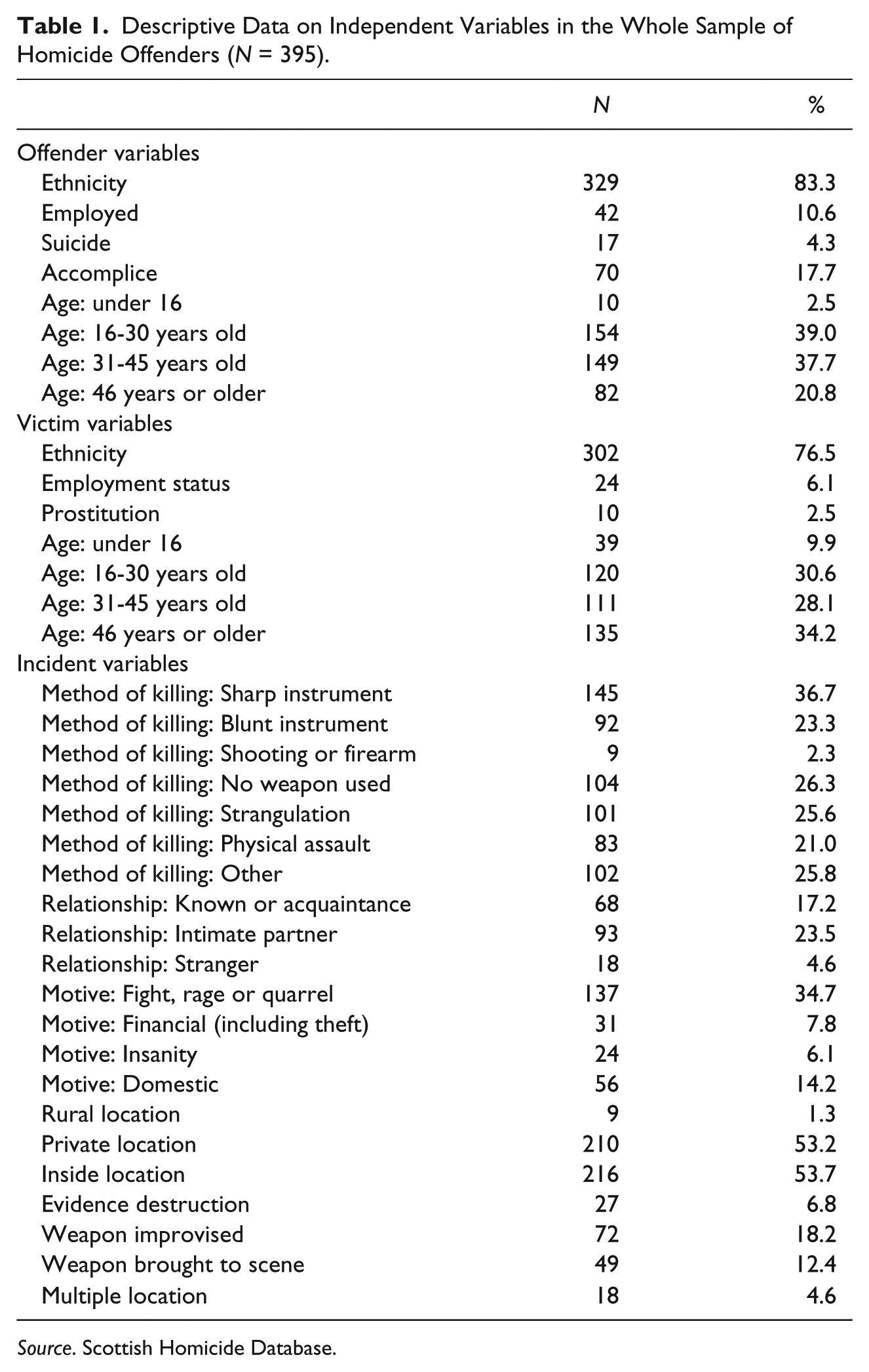
There were three groups of independent variables relating to the offender, the victim, and the homicide incident itself (see Table 1). All independent variables were dichotomous, coded 1 = yes and 0 = no (where “no” also included missing values). These variables were chosen based on what previous research has shown to be important when examining sexual homicide (Carter & Hollin, 2009; Chan & Heide, 2009; Dietz, Hazelwood, & Warren, 1990).
Descriptive Data on Independent Variables in the Whole Sample of Homicide Offenders (N = 395).
Source. Scottish Homicide Database.
The Offender variables included eight binary variables: (a) White ethnicity, (b) Employed (which also included students, people at school, and people who are retired), (c) Suicide of the offender, (d) If the offender had an accomplice, (e-h) Offender age (see Table 1).
The Victim variables included seven binary variables: (a) White ethnicity, (b) Employed (which also included students, people at school, and people who are retired), (c) If the victim was engaged in prostitution, (d-g) Victim age (see Table 1).
The Incident variables included 23 variables: (a) Whether the victim was stabbed to death with the use of a sharp instrument; (b) Whether the victim was bludgeoned to death with the use of a blunt instrument; (c) Whether the victim was shot to death with the use of a firearm; (d) Whether the victim was killed without the use of any weapons; (e) Whether the victim was strangled or asphyxiated to death with or without the use of a ligature; (f) Whether the victim was killed by physical assault; (g) Whether the victim was killed by other methods (which include drowning, poisoning, drugs, and cause of death cannot be established, or cases where it was uncertain what weapon was used); (h) Whether the victim and offender were acquaintances or known to each other; (i) Whether the victim and offender were nonintimate family members; (j) Whether the victim and offender were intimate partners; (k) Whether the victim and offender were strangers; (l) Whether the motive was fight, rage, or quarrel; (m) Whether the homicide was financially motivated; (n) Whether the motive was insanity of the offender; (o) Whether the motive was jealousy or revenge; (p) Whether the homicide was motivated by a domestic dispute; (q) Whether the homicide took place in a rural location; (r) Whether the homicide took place in a private location; (s) Whether the homicide took place in an indoors location; (t) Whether any evidence had been attempted to be destroyed (which include any or the following: the body had been moved more than walking distance from the place of the murder, the body was covered but not buried, the body had been buried, the body had been burned, and/or whether the body had been dismembered); (u) Whether the choice of weapon was improvised; (v) Whether the weapon was brought to the scene; and (w) Whether the homicide involved multiple locations.
Statistical Analysis
All independent variables were initially compared on the dependent variable using bivariate analysis with chi-square tests. The variables that proved to be statistically significant were subsequently used as predictors in a binary logistic regression analysis. This technique was chosen since it does not assume normality (Pallant, 2010; Tabachnick & Fidell, 2013), and initial descriptive analysis of the data showed that all variables included in the analysis demonstrated non-normality. Each group of independent variables (offender variables, victim variables, and incident-level variables) were introduced sequentially in the logistic regressions. All statistical analyses were conducted using SPSS version 19.
Results
Bivariate Analyses
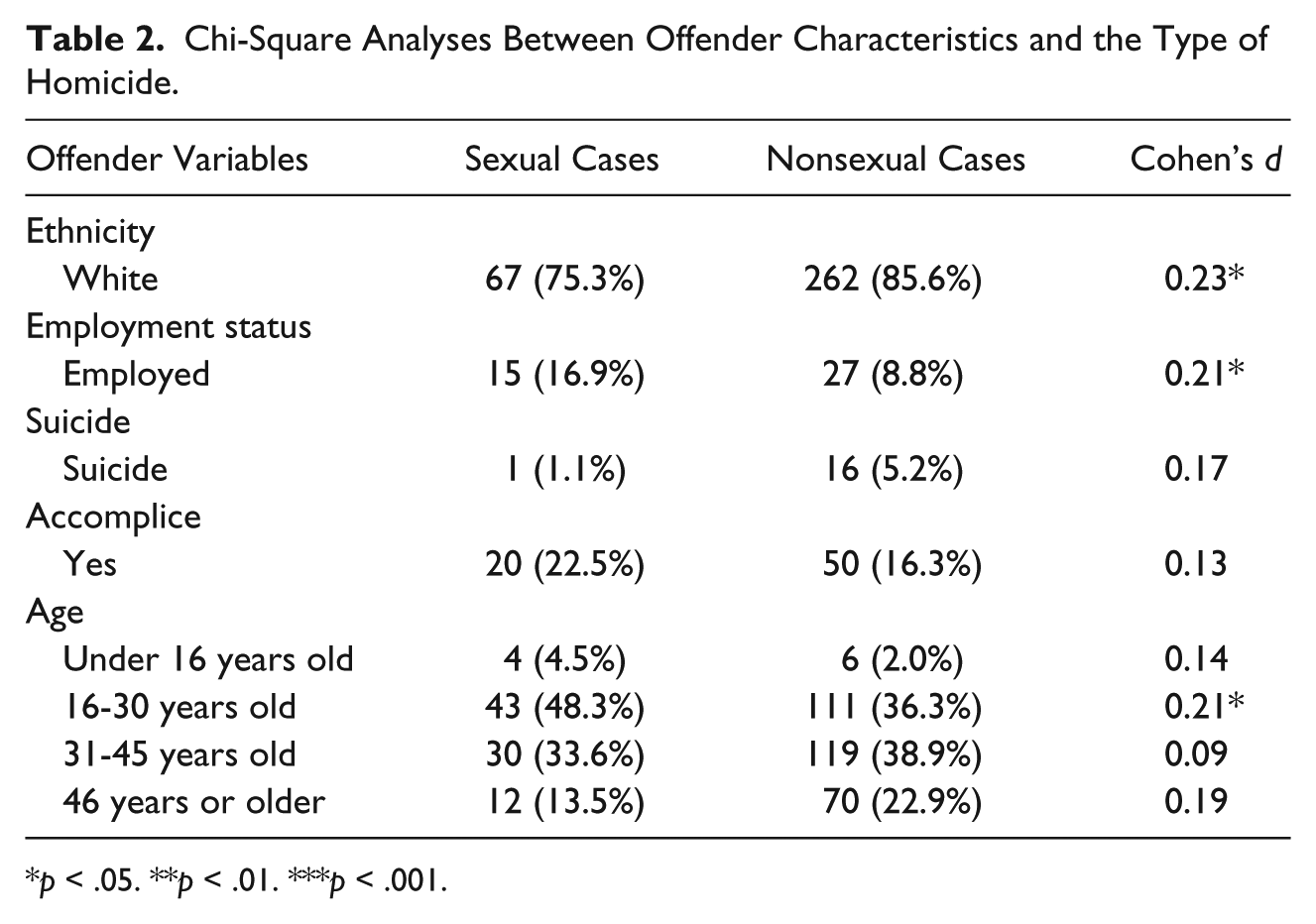
White offenders are more likely to commit a nonsexual homicide whereas offenders committing sexual homicides are more likely to be employed (Table 2). Despite both groups of offenders being comparable as to their age, the findings show that offenders aged between 16 and 30 years are more likely to commit sexual homicides. All these significant relationships, however, demonstrate relatively small effect sizes. 1
Chi-Square Analyses Between Offender Characteristics and the Type of Homicide.
p < .05. **p < .01. ***p < .001.
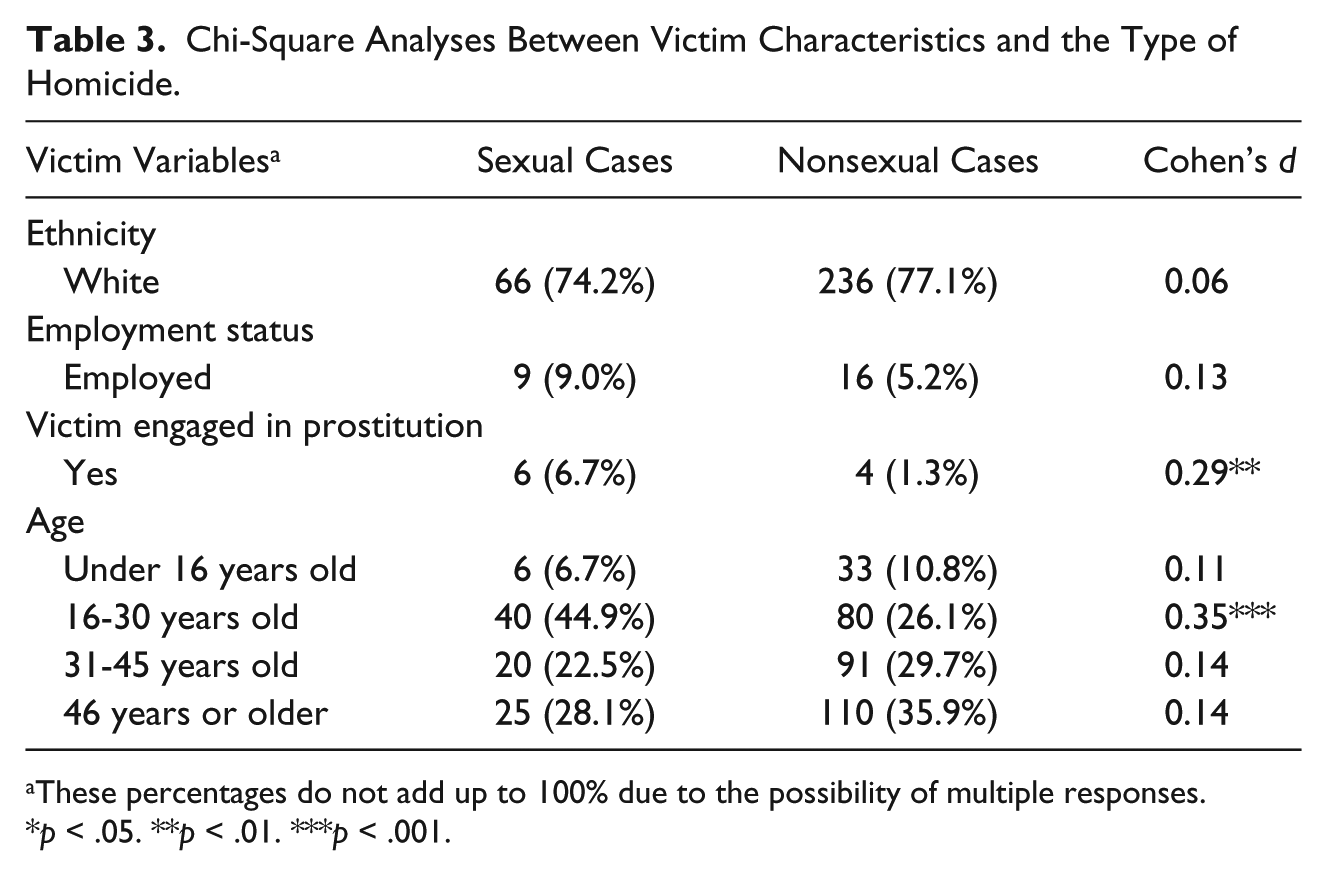
Although only involving a few cases, results show that victims engaged in prostitution are more at risk of being victim of a sexual homicide (Table 3). As with age, both groups are comparable, except that similar to the offender group, victims aged between 16 and 30 years are more likely to be victim of a sexual homicide. All these significant relationships, however, present relatively small effect sizes.
Chi-Square Analyses Between Victim Characteristics and the Type of Homicide.
These percentages do not add up to 100% due to the possibility of multiple responses.
p < .05. **p < .01. ***p < .001.
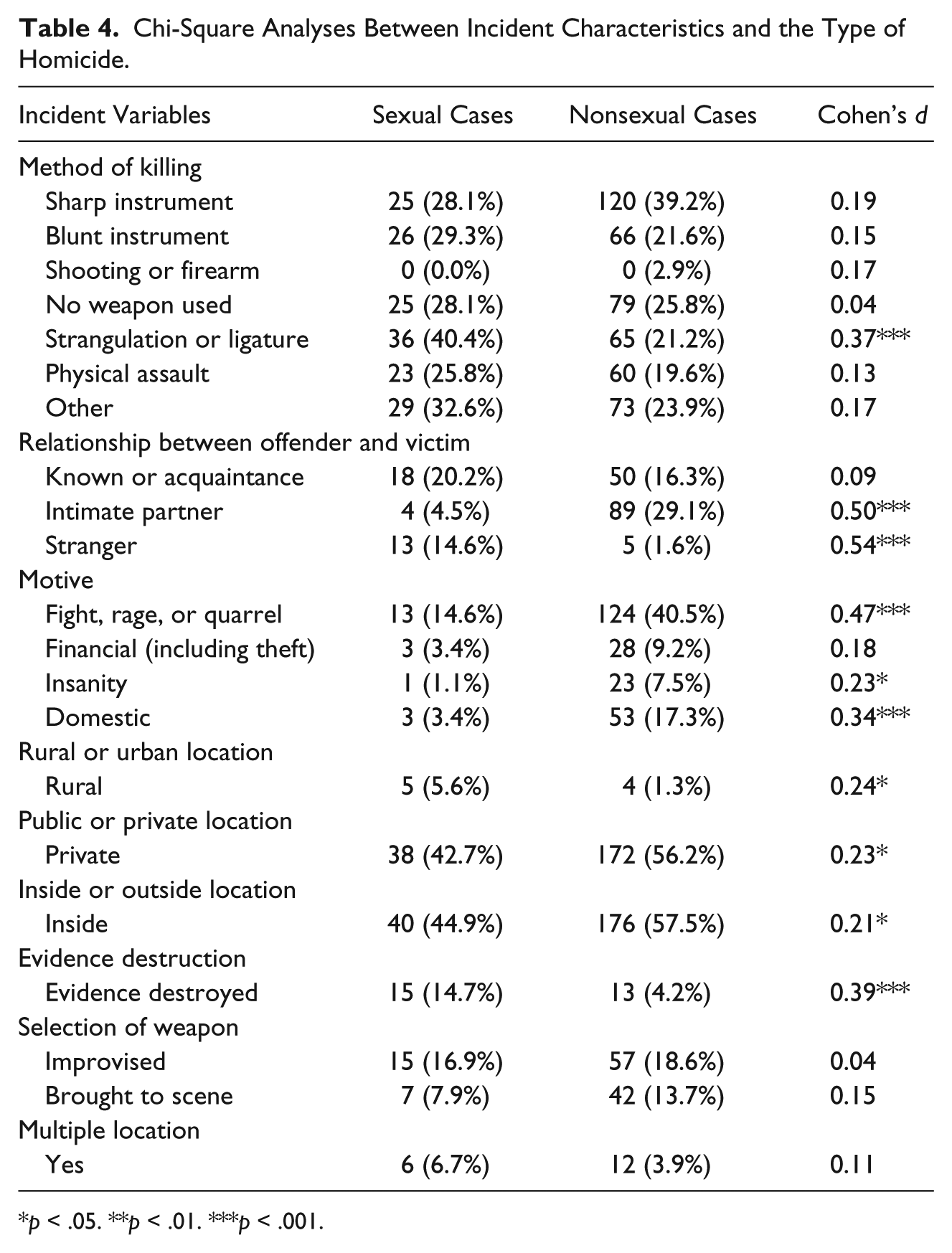
Strangulation/ligature is a method more likely to be used to cause death in cases of sexual homicide (Table 4) but with a relatively small effect size. As to the relationship between the offender and the victim, sexual homicides are more likely to involve strangers whereas in nonsexual homicide cases victims are more likely to be an intimate partner. These two relationship variables have medium effect sizes. As to the motive underlying the homicide, results show that nonsexual homicides are more likely to be motivated by fight/rage/quarrel, “insanity,” and domestic disputes than in cases of sexual homicide, with effect sizes varying between small and medium. It should be noted that this difference may be an artifact of recording practices, as a secondary motive was often not coded where the primary motive had already been identified as sexual in the database.
Chi-Square Analyses Between Incident Characteristics and the Type of Homicide.
p < .05. **p < .01. ***p < .001.
Homicide cases can also be distinguished based on where they occur. Sexual homicides are more likely to be committed in rural areas whereas nonsexual homicides are more likely to occur in an inside private location. These significant relationships also had small effect sizes. Offenders committing sexual homicides are more likely to destroy evidence at the crime scene compared with offenders involved in nonsexual homicides, and this relationship also showed a small effect size.
Multivariate Analyses
Table 5 presents the results of the sequential logistic regression analysis between all the significant variables at the bivariate level and type of homicide. The first model only includes the offender characteristics. This model is significant (p = .004) and presents a Cox and Snell R2 of 0.03 and a Nagelkerke R² of 0.05. When comparing the sexual and nonsexual homicide cases, the first logistic regression model shows that offenders being employed, odds ratio (OR) = 2.25, p = .022, and being aged between 16 and 30 years (OR = 1.63, p = .05), present higher odds of committing sexual homicides, whereas offenders who are White (OR = 0.52, p = .03) were less likely.
Sequential Logistic Regression.
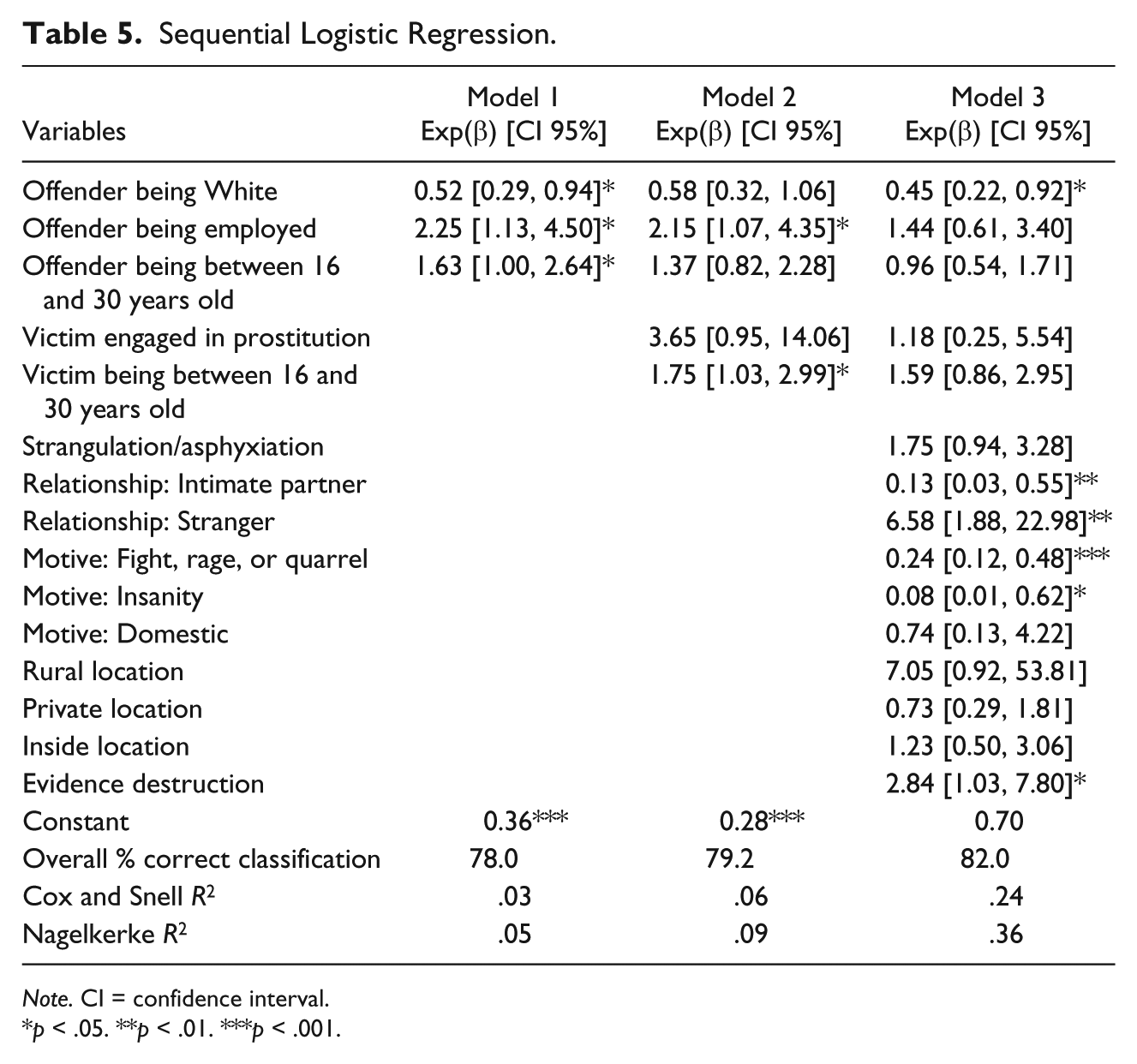
Note. CI = confidence interval.
p < .05. **p < .01. ***p < .001.
The second model includes the victim characteristics, while taking into account the offender characteristics. The second model is also significant (p < .001), with a Cox and Snell R² of 0.06 and a Nagelkerke R² of 0.09. As can be seen in the results, offenders who have a job (OR = 2.15, p = .033) still present higher odds of committing a sexual homicide. As to the victim characteristics, results show that victims aged between 16 and 30 years present higher odds of being involved in a sexual homicide (OR = 1.75, p = .04).
Finally, the third model includes the incident characteristics while taking into account both the offender and victim characteristics. This model was also significant (p < .001) with a Cox and Snell R² of 0.24 and a Nagelkerke R² of 0.36, explaining between 24% and 36% of the variance. Results show that contrary to the previous model, age and employment are no longer significant predictors of type of homicide. But offenders who are White still present lesser odds (OR = 0.45, p = .027) of being involved in sexual homicide. Moreover, none of the victim characteristics are now significantly related to the type of homicide. As to the incident characteristics, offenders who target strangers (OR = 6.58, p = .003) and who destroy evidence at the crime scene (OR= 2.84, p = .044) present higher odds of committing a sexual homicide. However, offenders targeting an intimate partner (OR = 1/0.13, p = .006), where the killing is motivated by fight/rage/quarrel (OR = 1/0.24, p = .001) or insanity (OR = 1/0.08, p = .016) present 7.69, 4.17, and 12.5 higher odds, respectively, of being involved in a nonsexual homicide.
Discussion
Sexual and nonsexual homicide offenders were compared on variables relating to the offender, victim, and the homicide incident itself. It was found that perpetrators of sexual homicide were less likely to be White and more likely to be employed compared with nonsexual homicide offenders. These findings, although not found in previous research, might indicate relevant characteristics that differentiate sexual homicide offenders from nonsexual homicide offenders. Sexual homicide offenders were furthermore more likely to be aged 16 to 30 compared with nonsexual homicide offenders, indicating that offenders of sexual homicide are younger than their nonsexual counterpart. 2 This finding is in line with previous research by Harbort and Mokros (2001) who examined serial sexual and nonsexual homicide offenders. This would indicate that sexual homicide offenders, regardless of whether the offender was a serial offender, tend to be younger compared with nonsexual homicide offenders.
All of these variables also proved significant in the first model of the sequential logistic regression, meaning that being employed, being 16 to 30 years old, and not being White all independently predicted sexual homicide. When the victim characteristics were taken into account in the second model, however, only employment status remained significant. In the third model, on the other hand, taking victim and incident characteristics into account, only ethnicity remained as a significant predictor of sexual homicide, where sexual homicide offenders were half as likely as nonsexual homicide offenders to be White. Therefore, apart from White ethnicity, victim and incident factors seemed to account for the offender factors in the third model.
When the victim characteristics were compared between the two types of offenders, it was found that similar to the offenders, the victims tended to be slightly younger in the sexual homicide cases. It was additionally more likely for the sexual homicide victim to be engaged in prostitution compared with nonsexual homicide victims. As previous studies have shown (Quinet, 2011; Salfati et al., 2008), victim prostitution is an important variable when comparing sexual and nonsexual homicide, not only because it marks a clear difference between sexual and nonsexual homicides but also in relation to the possible risks and vulnerability of individuals engaged in prostitution. Individuals engaged in prostitution have previously been found to be at an increased risk for becoming victims of homicide (Brewer et al., 2006). Victim prostitution was only significant in the bivariate analysis, however. In the multilevel analysis, this variable failed to disaggregate among sexual and nonsexual homicides in the third and final model. Nevertheless, whether or not the victim was engaged in prostitution appears to be an important variable when comparing sexual and nonsexual violence in Scotland.
When the incident variables were compared, there were quite a number of differences between sexual and nonsexual homicide on both the bivariate and multivariate analyses. Sexual homicide offenders were significantly more likely to kill their victims using strangulation or asphyxiation, with or without the use of a ligature. Although this variable only approached significance in the logistic regression model, this has been found in previous research comparing sexual and nonsexual homicides. Both Langevin et al. (1988) and Häkkänen-Nyholm et al. (2009) found that strangulation was a more common method of killing among sexual homicide offenders compared with nonsexual homicide offenders. Since strangulation was significant in the bivariate analysis and has been proven relevant across different jurisdictional contexts, this variable appears important when examining sexual homicides in a Scottish context as well. In their clinical Scottish sample, Darjee and Baron (2018) found that strangulation or asphyxiation was the most common method of killing and was associated with sexual sadism. Interestingly, the amount of variance explained increased quite markedly when the incident variables were introduced in the analysis, which could suggest that these variables are highly important when disaggregating sexual and nonsexual homicide.
Victims were more often intimate partners in nonsexual homicides, and strangers in sexual homicides. Both of these variables remained significant predictors in the multivariate analysis as well; in fact, sexual homicides were more than six times more likely to be committed against a stranger compared with nonsexual homicides. Previous research has produced contrasting results regarding this variable. While Langevin et al. (1988) found that sexual homicides more commonly involved stranger victims, in line with the present study, Häkkänen-Nyholm et al. (2009) found no difference between the two groups with regard to this variable. The differences between samples may be due to differences in how sexual homicide was defined, or this variable might be context dependent. Darjee and Baron (2018) also found that the majority of sexual homicide victims in Scotland were strangers. As this variable was one of the strongest predictors of sexual homicide in the model in the present study, whether or not the victim is a stranger appears important when analyzing sexual homicides in Scotland. Since nonsexual homicide very seldom involves strangers in Scotland, this could be an important variable for the police, both in the investigation process and when trying to identify possible sexual aspects of homicide cases. This study also found that it was more likely for nonsexual homicide cases to be motivated by some sort of fight, as well as by domestic disputes and the insanity of the offender. The motives fight, rage, or quarrel and insanity also remained significant predictors of nonsexual homicide in the regression model, showing that it was not very common for sexual homicide cases to have a secondary reported motive other than sexual. This contrasts with the findings by Häkkänen-Nyholm et al. (2009), who found that the motive of the sexual homicide cases seldom involved sexual desire but was rather about other things such as fights or jealousy. It would appear that sexual motivation is very prevalent in the present study. This might, however, be related to the way this motivation was recorded in the Scottish sample. Although the cases were coded as sexually motivated, this variable tended to be a behavioral indicator variable for sexual homicide cases rather than necessarily being a reflection of the underlying motive for the sexual killing. Other research has found that some sexual homicides are primarily sexually motivated, whereas others are motivated by anger, a reaction to the victim’s behavior or to eliminate the victim as a witness (Higgs, Carter, Tully, & Browne, 2017). So sexual homicides can have other secondary motives, which were not recorded in the data. More in-depth analysis of this needs to be conducted before any conclusions about this can be drawn.
Nonsexual homicides were more often committed against an intimate partner, and committed in the context of a domestic dispute. This suggests a higher proportion of nonsexual homicides are intimate partner homicides, which appear to demonstrate quite different patterns compared with sexual homicides. A homicide was not considered sexual in the present study simply because the offender and victim were in a sexual relationship. In fact, as the findings would suggest, very few of the sexual homicides were committed between intimate partners. In Darjee and Baron’s (2018) sample, only three out of 51 Scottish sexual homicides were committed against current or ex-intimate partners. This highlights the importance of how a homicide case is defined as sexual, which differs between studies. If a case is considered a sexual homicide because the offender and victim were engaged in a romantic relationship, then this would essentially conflate sexual homicide with nonsexual intimate partner homicide. This could prove problematic since this study has shown that there are clear differences between sexual and nonsexual homicides, which need to be taken into account when addressing these crimes and their perpetrators. For instance, studies of intimate partner homicide have demonstrated various different risk factors specific to this crime (see, for instance, Campbell et al., 2003), which is yet to be examined for sexual homicide. Future studies should, therefore, examine similarities and differences between sexual homicides and intimate partner homicides to ensure that these two crimes are not conflated inappropriately. Also, where there is an explicit sexual element to a homicide committed against an intimate partner, it will be important to examine whether such a homicide is more similar to a nonsexual intimate partner killing or sexual homicides against nonintimate partners.
The location of the crime also differed between sexual and nonsexual homicide offenders. Whereas sexual homicides were more likely to be committed in rural areas, nonsexual homicides were more likely to be committed in private, indoor settings compared with sexual homicides. Since none of these variables remained significant in the regression model, and no previous studies have found differences regarding these variables, it may seem that the location of the crime is less important when predicting sexual homicide. But just because location variables are statistically accounted for by other co-related variables, such variables can still hold some relevance as a marker for the investigation of these crimes. Some of the variables that remain significant in the third regression model might be difficult to determine or identify in the early stages of an investigation. It might, therefore, be of importance for investigative purposes to know that sexual homicides are more likely to be committed in rural settings compared with nonsexual homicides.
Finally, it was found that sexual homicide offenders were more likely to attempt to destroy evidence of the crime in comparison with nonsexual homicide offenders. This variable also remained significant in the regression model; homicides including evidence destruction were almost three times as likely to be sexual. This concurs with Häkkänen-Nyholm et al. (2009), who found that sexual homicide offenders more often moved the body after the crime compared with nonsexual homicide offenders. This variable might be highly important when analyzing sexual homicide, not only because it differentiates sexual and nonsexual homicide but also because this type of behavior could indicate a form of forensic awareness among sexual homicide offenders found more rarely among nonsexual homicide offenders. The destruction of evidence of the crime, such as moving, burying, burning, or dismembering the body, could severely delay and inhibit the police investigation of the murder. It might even thwart the identification of the offender altogether. The fact that sexual homicide offenders are almost three times more likely to engage in this sort of behavior compared with nonsexual homicide offenders in Scotland holds important implications for police investigators. As these cases are likely to be more forensically demanding compared with nonsexual homicides, sexual homicides might require a higher resource allocation compared with nonsexual homicides. Similarly, due to the connection found between evidence destruction and sexual homicide, investigators might also benefit from the knowledge that when a body is found that contains signs of evidence destruction, it is more likely that the homicide was sexual in nature. A recent study by Reale, Beauregard, and Martineau (2017) has shown that “investigative awareness” is a distinctive feature of sexual sadism. Research has also shown that a greater proportion of sexual homicides are likely to be instrumental rather than expressive in nature (Salfati & Canter, 1999; Salfati & Haratsis, 2001). So planning and acting to prevent detection seem to be associated with sexual homicides and particularly sadistic sexual homicides.
The characteristics of our Scottish police sample were very similar to the Scottish clinical sample of Darjee and Baron (2018) with regard to the variables that overlapped between the two studies: age of perpetrator, age of victim, relationship with victim, rates of prostitution in victims, method of killing, and having an accomplice. In Darjee and Baron’s sample, with cases going back to the 1960s, all victims and offenders were White, but in the present study, only going back to the 1990s, a quarter of both groups were non-White. This probably reflected not only the inclusion of more recent cases in the present study and the changing ethnic demographics of Scotland but also the intra-racial nature of sexual homicide. The strong similarities between these two samples of Scottish sexual homicide cases on the relevant variables indicate that the current sample is representative of Scottish sexual homicides. The present study was clearly dependent on variables available in the SHD, which was created for investigative rather than research purposes. In the present study, detailed data about offenders’ criminal histories, psychological development, mental disorders, crime scene behaviors, and proximal contextual factors were not available. The exclusion of culpable homicides (otherwise known as manslaughter in other jurisdictions) in the present study may have excluded some relevant cases, as although culpable homicide may occur where there has been no violence, in some cases violence leading to death may result in a conviction for culpable homicide as the perpetrator has a mental disorder, is provoked, or otherwise lacks the mens rea for murder. With the exception of the study by Häkkänen-Nyholm et al. (2009), this study is one of the most comprehensive comparisons between sexual and nonsexual homicide offenders in Europe, and it is the most comprehensive study comparing sexual and nonsexual lethal violence in the United Kingdom. This is the first study we are aware of that has compared a relatively large sample of sexual and nonsexual homicides controlling for the gender of the victim, a potential major confounder in the small number of previous studies.
Conclusion
Overall, this study has shown that sexual homicide offenders are different from nonsexual homicide offenders in various aspects related to the offender, the victim, and the homicide, and might, therefore, be considered a distinct type of homicide offender. The fact that previous research has found similarities between sexual homicide offenders and other sexual aggressors (Beauregard et al., 2018; Beauregard & Martineau, 2016; Choon & Heide, 2016; Darjee & Baron, 2018; Proulx et al., 2007), while there is no great consensus among the studies comparing sexual homicide offenders with nonsexual homicide offenders, would also suggest that sexual homicide offenders are more similar to nonlethal sexual aggressors than they are to nonsexual homicide offenders.
The variables that differentiated sexual from nonsexual homicide may be indicative of a more instrumental offense, against a victim who has little meaning to the offender in themselves, with aspects determined by sexual deviance. These findings may have important implications for the police in identifying sexual homicide cases, and in the investigation and resolution of such cases. Sexual homicide has been found to differ significantly from nonsexual homicide on several variables, such as offender characteristics, the relationship between the offender and the victim, and the destruction of evidence, which can help the police identify sexual cases and help inform investigative decisions in this rare, but serious, crime.
These findings may also have important implications for the correctional management and rehabilitation of sexual homicide offenders. As the present study would suggest, sexual homicide offenders are different from nonsexual homicide offenders, and since previous research has found that sexual homicide offenders tend to be more similar to nonlethal sexual offenders (Beauregard et al., 2018; Choon & Heide, 2016; Darjee & Baron, 2018; Proulx et al., 2007), it is arguably better to deal with these offenders as sexual offenders who escalate in their behavior and kill rather than with homicide offenders. There are legal and criminal justice processes for “murderers” and “sex offenders,” and as most sexual homicide offenders are seen as the former, sexual offender management strategies may not be available in such cases. This has implications for treatment programs, and custodial strategies and community management for these offenders that should be examined further.
Although this study was the first of its kind to be conducted in the United Kingdom, and one of only a handful of studies comparing sexual homicide to nonsexual homicides, no study is without its limitations. The present study was based on police data, gathered from the SHD, and although informative, it is mainly descriptive in nature. As the data were coded by different police staff for each case, there may have been reliability issues that we could not examine. Although the data contain information regarding the victim, the offender, and the incident itself, there is no in-depth information that, for instance, clinical interviews with the offenders would provide. In their Scottish study, Darjee and Baron (2018) have recently provided findings based on in-depth clinical interviews with sexual homicide offenders. This approach would be relevant for future research, to examine whether sexual homicide offenders are different from nonsexual homicide offenders on a more detailed level. It is also important to note that due to the low n and high number of variables, there is a risk for Type I error that might affect the findings. The effect sizes are also quite small; however, this might be related to the low n of the comparison groups.
Although previous studies have compared sexual homicide with various types of nonsexual homicide, the present study has attempted to reduce the “noise” associated with such a strategy by only selecting nonsexual homicide of female victims. This is the only study we are aware of that has attempted to match sexual homicides in this way. However, to refine further the findings, future studies should look into the possibility of matching the nonsexual homicide cases based on additional features, such as the offender–victim relationship and victim age.
Footnotes
Declaration of Conflicting Interests
The author(s) declared no potential conflicts of interest with respect to the research, authorship, and/or publication of this article.
Funding
The author(s) received no financial support for the research, authorship, and/or publication of this article.