



Abstract
Although self-control consistently emerges as one of the most robust correlates of delinquent behavior, limited empirical attempts have been made to explore the contextual variability of the relationship between self-control and delinquency outside of Western societies. Using data collected from 587 seventh- to ninth-grade students across 10 middle schools in a rural county of Southeast China, we examine self-control’s efficacy in explaining juvenile delinquency in the presence of external environmental factors, and investigate relative strength of self-control and contextual factors in predicting delinquent behaviors. Our results confirm that self-control is an important predictor of delinquent behavior in a non-Western cultural context. However, certain environmental factors rooted in family, school, and peer groups are also shown to be the predictors of delinquent behavior where strength seems to exceed that of self-control. These findings shed more nuanced insights on the nexus between self-control, external situations, and delinquency, and in a broader sense, contribute to the elaboration of a more comprehensive understanding of self-control theory.
Introduction
In the resurgence of criminological interest in individual-level explanations of criminal behavior from the 1980s, Gottfredson and Hirschi’s (1990) self-control theory has been undoubtedly among the most influential and widely cited theoretical perspectives to date. The central hypothesis that the level of self-control within individuals affects crime and analogous behaviors has been generally supported by empirical tests with different analytical techniques, methodological approaches, and dependent variables (see Pratt & Cullen, 2000). Despite the relative success, self-control theory is often criticized for the simplicity of its claim that self-control should be robust and sufficient for predicting crime regardless of situational circumstances encountered by the person. Gottfredson and Hirschi largely neglect the role of external environmental conditions in suppressing or exacerbating the expression of low self-control. They make unequivocal prediction that the effect of low self-control on “all crime, at all times” (Gottfredson & Hirschi, 1990, p. 117) should be uniform across different populations, stages in the life course, and social and cultural contexts.
Although the explanatory power of low self-control in explaining crime and delinquency has been generally supported by empirical tests, ongoing debates have surrounded the parsimonious nature of self-control. Gottfredson and Hirschi claim that self-control theory has universal applications across different cultures and societies. As they note, “cultural variability is not important in the causation of crime, . . . and that a single theory of crime can encompass the reality of cross-cultural differences in crime rates . . . ” (Gottfredson & Hirschi, 1990, p. 175). However, self-control theory has its root in individualistic values in Western societies, which tend to emphasize belief in independent relationships, uniqueness, personal goals, and autonomy. The theory has been subject to the criticism that cultural conditions distinct from Western societies, such as child-rearing practices, shared norms supporting the exercise of self-control, and age and sex composition of groups, might affect the extent to which self-control predicts criminal behavior (Tittle & Botchkovar, 2005). The contention of invariance thesis of self-control warrants research attention because almost all research has been conducted in well-surveyed Western countries (Antonaccio & Tittle, 2008). Very limited studies utilized data from non-Western society. Among the existing research attempts in non-Western society, few examined the robustness of self-control in East Asian society where external social forces are likely to exert a strong influence on individual behaviors. This is an unfortunate neglect because a central feature of self-control theory is that it transcends culture (Yun & Walsh, 2011).
To fill the research void, this study assesses the simultaneous effects of self-control and contextual factors in the generation of adolescent delinquency in rural China. Particularly, this study has two primary goals. First, this study examines the validity of Grasmick and associates’ self-control measure in a sample of adolescents in rural China, a widely recognized collectivistic cultural setting distinctive from Western society. Second, this study examines the explanatory power of self-control along with a larger array of contextual explanatory factors (i.e., family control, school control, and unstructured activities). Exploring these questions enables us to add to research on whether the findings of similar studies in the United States can be generalized to social and cultural contexts in East Asian society.
The Invariance Thesis of Self-Control Theory
Roughly 30 years ago, Gottfredson and Hirschi (1990) proposed the general theory of crime for which its central explanations are focused on the motivation of crime. Based upon the classical view of human behavior, self-control theory begins with the assumption that crime, like all other noncriminal behavior, “can be understood as the self-interested pursuit of pleasure and the avoidance of pain” (Gottfredson & Hirschi, 1990, p. 5). Given the assumption, committing crime is perceived “as easy as falling down a mountain” (Gottfredson & Hirschi, 2003, p. 6), which requires no unique motives, desires, capabilities, or plans. Thus, self-control theory seeks to explore what restricts the pursuit of acts of self-interest rather than what causes it. Gottfredson and Hirschi suggest that the major source of restriction is individual traits of self-control. They identify six essential elements of low self-control and suggest that individuals with low self-control tend to be impulsive, self-centered, and insensitive; prefer simple tasks and plans; have potential to seek risks; and favor physical activities (Gottfredson & Hirschi, 1990). According to them, low self-control, once developed from inattentive child-rearing in early childhood (at the age of 8–10 years), accounts for all variation in crime rates.
A key proposition of self-control theory is that the definition of crime should be derived from a conception of human nature that transcends social groupings and contextual environments. With this perspective, Gottfredson and Hirschi certainly de-emphasize the importance of exploring the contribution of the variations in external forces in explaining different crime rates. For them, measures of social factors are thought to be the consequences of self-control. People with low self-control tend to seek their opportunities for crime and “sort themselves and are sorted into a variety of circumstances that are as a result correlated with crime” (Gottfredson & Hirschi, 1990, p. 119). Possible explanations for crime rooted in outer circumstances can be ubiquitous and the correlations between these explanations and crime are largely spurious because each is simply a manifestation of self-control, which is “assumed to cause crime in the first place” (Gottfredson & Hirschi, 1990, p. 251). Gottfredson and Hirschi’s theoretical proposition leads to the bold prediction that the single mechanism of self-control should be robust and sufficient for predicting crime across environmental settings both within and across societies.
Since the inception of self-control theory, a convincing body of evidence reveals the expected relationship between low self-control and crime (Burton et al., 1994; Grasmick et al., 1993; Longshore & Turner, 1998), juvenile delinquency (McGloin & Shermer, 2009), as well as a variety of behaviors “analogous to crime” such as driving recklessly, drinking, and gambling (Burton et al., 1999; Cochran et al., 1998; Wood et al., 1993). However, Gottfredson and Hirschi’s (1990) contention that low self-control should be a single cause of crime has not received consistent support. Of particular interest, empirical research disconfirms the invariant thesis of self-control theory and indicates that the relationship between environmental factors and crime is not simply a spurious reflection of self-selection (e.g., Baron et al., 2007; Cretacci, 2008). For example, many studies show that the introduction of self-control into models does not fully eliminate the contextual effect, such as weak attachment to family, associating with delinquency peers, low involvement in conventional activities, or failing in school (Baron, 2003; Meldrum et al., 2009; Perrone et al., 2004). Moreover, studies indicate that the effect of some contextual factors may be stronger than the effect of self-control. Using Add Health data, Perrone and colleagues (2004) in their examination of the relationship between parental efficacy, delinquency peer, self-control, and delinquent behavior found that the measure of deviant peers was consistently the strongest predictor of delinquency.
The inconsistent findings with respect to the invariance property of self-control challenges the assertion that self-control is impervious to social environments. As Hay and Forrest (2008) suggest, self-control theory should not emphasize invariant nature of individual propensities at the expense of the importance of social environment. The varying strength of self-control found by the existing studies may reflect unmeasured contextual characteristics across different demographic groups, culture, and society that constrain or reinforce individual propensities. Increasing number of studies began to test the robustness of self-control in predicting crime and delinquency outside of the U.S. context (e.g., Hirtenlehner et al., 2015; Wikstrom & Treiber, 2007). However, the majority of the studies in this line have focused on data from Western society. Few comparative studies have been conducted in East Asian society, in part, due to the costs and the complexity of cross-national comparative study (Vazsonyi et al., 2004). Even fewer have employed the Grasmick and associates’ (1993) Self-Control Scale to explore whether self-control stands in contrast or coexists with the contextual factors in East Asian society. Given the central role that individualism may play in Western society, it is important to assess whether a general theory of crime built around the individualistic concept of self-control can serve to explain meaningful variance in crime in non-Western society.
The China Context
The concept of self-control has its roots in an individualistic ideology—a core value that has been the central distinguishing mark of Western European society (Huntington, 1996). Guided by individualistic values, the process of individuation involves developing an identity toward independence of collectives, prioritizing personal goals over the goals of others, and being motivated by self-preferences, needs, rights, and the contracts established with others (Triandis, 1995). Western culture highlights parents’ orientation toward children in their concept of valuing autonomous self-regulation (C. T. Lee et al., 2010). For Western adolescents, increasing autonomy and independence entails major confrontations in the family and emotional separation from parents (Le & Stockdale, 2005). Gottfredson and Hirschi downplay the function of family control after the end of early socialization. Nor are they optimistic about the buffer role of school in correcting inadequate socialization in contemporary Western society because of the lack of cooperation and support schools receive from families. In an individualist society, a direct and nonconditioned relationship is easily perceived between a person’s self-control and an individual’s involvement in crime and deviance.
Although Eastern and Western civilizations share certain characteristics, collectivism is widely seen as a distinctive value in the East, where the self is interdependent with the surrounding social context. The collectivistic values bind individuals to tightly knit collectives by emphasizing loyalty to in-group members, obedience to group authorities and traditions, and importance of group standards, rituals, and activities (Durkheim, 1973/1925; Graham et al., 2009; Haidt, 2012; Haidt & Graham, 2009; Mooijman et al., 2018). In Eastern collectivistic society and particularly in China, the family has always been the most salient institution that transmits and maintains collectivistic values. Specifically, parental discipline (guan) and filial piety (xiao) have been identified as significant to parent–child shared expectations in Chinese culture, which cannot be simply explained by globally defined parenting style (S. D. Li, 2004). Chinese adolescents tend to be self-sacrificing when the potential consequences of their personal pursuits may affect their relationships with their parents, potentially endangering family harmony (Bush et al., 2002).
Cultural features of Chinese society also facilitate the role of school as a primary institution in controlling the behavior of Chinese youth. The emphasis on respect for learning and high expectation of educational achievement associated with traditional Chinese culture extend the practice of obedience to group authorities from parents to schoolteachers and administrators. Schools in China place the dominance of whole-class teaching as a top priority, limiting the consideration of individual differences in learning. A disproportionate amount of recourses in supplementary education invested by Chinese families further enhance the capacity of school to exert control over students (Zhou, 1998). Schools in China are also enrolled as grassroots branches in national organizations that are responsible for students’ political and moral education such as the Young Pioneer Party and the Communist Youth League (Zhang et al., 1996). These organizations aim to inculcate prosocial values and morality education and strengthen the schools in exercising social guidance and control over students’ behavior (Jessor et al., 2003). In a collectivistic East Asian society such as China where social forces tend to exert great influence on individuals, it is reasonable to expect that the explanatory power of self-control is limited.
So far, specific tests of the invariance thesis of self-control in East Asian contexts are rare. Also, a limited number of studies in this area yielded mixed findings. For example, Lu and colleagues (2013) tested self-control theory among a sample of Chinese adolescents. They found the effects of social bonding factors such as belief and family bonding on risky behavior and minor delinquency persist when controlling for measures of self-control. This is also the case in Yun et al.’s (2016) assessment of the effects of self-control, peer delinquency, and family bonding on typical delinquency, drinking, smoking, and internet/cellphone addiction among South Korean youth. They created a Self-Control Scale derived from six traits of low self-control, and found that the magnitudes of the effects of peer delinquency outperform those of low self-control in predicting drinking. Self-control even fails to predict delinquency as Cheung and Cheung (2008) included contextual variables of social learning, social control, labeling, and strain in their study of adolescents in Hong Kong. Moreover, Chui and Chan’s (2016) study of native-Chinese adolescents in Hong Kong and Jo and Zhang’s (2014) study of South Korean youth suggest that the relationship between self-control, external factors, and delinquency can be further complicated by gender in East Asian society. The mixed findings of these Asian studies bring into question the invariant nature of self-control in the East Asian context. Moreover, although Grasmick’s scale has been recognized as the most representative and widely used measure of self-control (Tittle & Botchkovar, 2005), the previous studies rarely employed the scale to test the invariance thesis among different types of samples in China. Collectively, a dearth of research in this area highlights the importance of further studies that can contribute to a more precise and comprehensive understanding of the significance of self-control as an explanation of crime and delinquency in East Asia.
The Current Study
In the current study, we test self-control theory by situating self-control in an array of contextual variables in Chinese rural society. We do that by assessing the robustness of self-control and relative strength of self-control and contextual factors in predicting delinquent behaviors in a society that is culturally and historically distinctive from Western society. We utilize the most widely cited self-control scales—Grasmick and associates’ scale (1993)—to measure adolescents’ self-control level. Findings of an independent and direct effect of self-control would provide support for the robustness of self-control theory across countries, whereas findings of joint effects would suggest a development of self-control theory toward a more comprehensive approach to explain delinquency. In the cross-country study of self-control theory, the fuller range of possibilities has not been the subject of previous empirical tests so far but is investigated in the current study.
Method
Sampling and Data Collection
The data for this study are based on the Parental Migration and Children’s Well-Being Survey, a study that surveyed approximately 600 middle school students in Sihui County, Guangdong Province, in 2011. The main purpose of this study is to investigate children’s well-being and the effects of individual and environmental factors (e.g., parental migration). The study entailed a multistage cluster sampling design. First, a list of all middle schools in Sihui County, which included seventh, eighth, and ninth grades, was obtained from the county’s Department of Education. From this list, 10 middle schools with mostly rural students enrolled were selected as the primary sampling units. Based on each school’s student size, we randomly selected one to three classes in each selected school, with a total of 21 classes as our final sample. These randomly selected classes had a size ranging from 25 to 39 students. All students, excluding a small number with urban residential status, were considered eligible for participating in this project. A total of 587 students with rural residential status provided answers for most of the questions in the survey. Among these students, 31.6% were seventh graders, 28.9% were eighth graders, and 39.5% were ninth graders. The age of these students ranged from 11 to 18 years, with the average of 14.38 years. Girls and boys were half split in the sample. Table 1 provides a detailed description of included variables (mean, standard deviation, range, and reliability for scales) in the analysis.
Means, Standard Deviations, and Ranges of Included Variables.
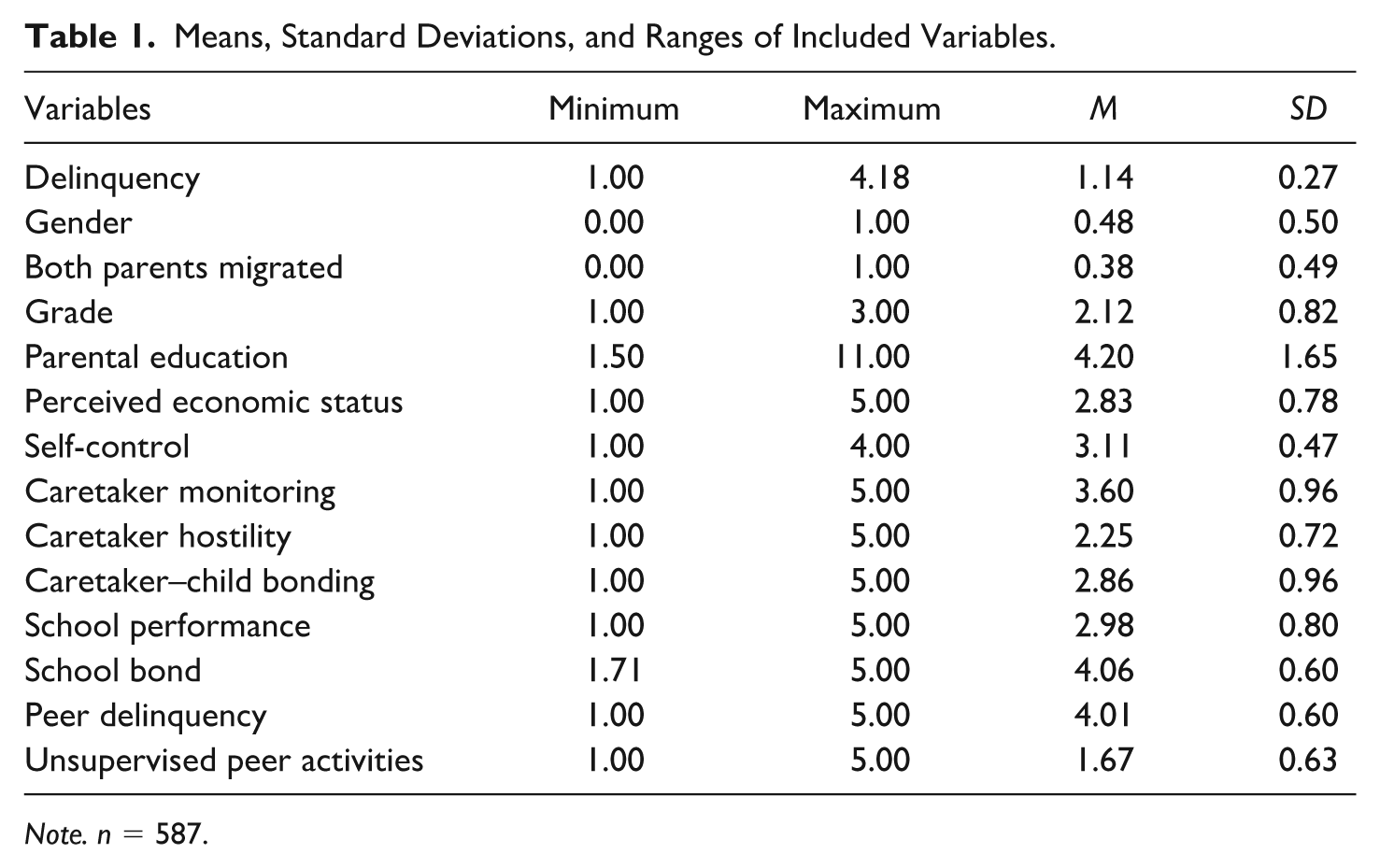
Note. n = 587.
Measurement
Delinquency was measured by 16 items representing the self-reported frequency of involvement in various delinquent activities in the last 12 months (Elliott & Ageton, 1980). Children were asked whether they engaged in deviant or delinquent activities such as stealing, graffiti, fighting, group fighting, truancy, drinking, smoking, damaging school properties, and taking money from other people. For each item, response categories were as follows: 1 = never, 2 = 1 time, 3 = 2 times, 4 = 3 or 4 times, and 5 = 5 or more times. A mean procedure was then conducted to create a composite score for delinquency (α = .86).
Independent variables
The key independent variable is the children’s level of self-control. Despite considerable debate with regard to the valid measures of self-control, the Attitudinal Scale developed by Grasmick and associates (1993) is the most frequently used self-control scale in the past decade. The scale comprises 24 items that are phrased to measure the six dimensions of low self-control Hirschi and Gottfredson originally developed. Borrowing from Grasmick et al., we used a 21-item scale to capture the six dimensions of children’s self-control: impulsivity, preference for simple tasks, risk seeking, physical activity preference, being self-centered, and bad temper. The response categories for each item ranged from 1 = completely disagree to 4 = completely agree. To compute the final composite score, we reverse coded all the 21 items and then calculated the average of these items (α = .95). A higher score indicates a greater level of self-control. Three items in the original scale were dropped from the current scale because these three items did not load well in a pilot test (see Table 2).
Frequency of Self-Control Indicators.

Note. Three items in the original scale, “I like to test myself every now and then by doing something a little risky,” “I almost always feel better when I am on the move than when I am sitting and thinking,” and “excitement and adventure are more important to me than security” were dropped from the current scale because these three items did not load well in a pilot test. N = 587.
To test whether the effect of a respondent’s self-control remains robust, we included a series of contextual variables in the analysis that have been extensively documented to be strongly associated with delinquency. First, three family process variables—caretaker monitoring, caretaker–child bonding, and caretaker hostility—were included in the analysis. Caretaker monitoring consists of five items asking students how often parents and other caretakers knew where they were after school, knew when they went out at night, how often they told caretakers whom they were with when they were out, how often caretakers asked where they went to, and whether they were expected to call when they were late (X. Li et al., 2000). Similarly, caretaker–child bonding was measured by five items asking respondents how often their children communicated with caretakers about their lives and daily problems (Whitbeck et al., 1993). These items include talking to caretakers about what happened, talking about their feelings, solving problems together, and receiving encouragement from caretakers. Caretaker hostility was a scale derived from questions asking adolescents how often during the last month they were criticized, shouted, or yelled at by their caretakers, or how often their caretakers were angry with them or argued with them (Conger et al., 1994). For all the three scales, response categories for each item ranged from 1 = never to 5 = very often. A mean procedure was then performed to create a composite score for each scale. All three scales have acceptable reliability, with Cronbach’s alpha to be .77 for caretaker monitoring, .76 for caretaker–child bonding, and .71 for caretaker hostility.
The second set of social process variables include a three-item scale measuring children’s school performance and a seven-item scale measuring children’s school bonding. School performance was measured by asking children what their academic performance was compared with other students in the class in three subjects: English, Math, and Chinese. The response categories ranged from 1 (the upper 25%) to 5 (the lower 25%). The final scale was then computed by averaging the three items, with a high score indicating better academic performance (α = .76). School bonding was measured by asking whether students agree with statements such as loving school, feeling safe in school, doing homework on time, believing education was important, being in school could change children’s lives, having good academic performance, and believing that everyone should finish high school. Response categories for each individual item ranged from 1 = completely disagree to 5 = completely agree. A mean procedure was then performed to create a composite score for children’s school bonding (α = .75), with higher numbers indicating stronger bonding with schools.
The third set of social process variables takes into account children’s association and activities with friends and peers. The measure association with deviant peers is a scale adapted from the National Youth Survey (Elliott et al., 1989). This measure asked participants how many of their current friends participated in a series of delinquent behavior in the last 12 months (e.g., damaging property, stealing, carrying weapons to school, fighting, cheating on tests, burglary, drinking, and smoking). For each item, response categories ranged from 1 = none of them to 5 = all of them. Similarly, a mean procedure was performed to create a composite score for this scale (α = .094). The second measure, unsupervised peer activities, asked students how often they engaged in activities such as going to an internet bar to play games, watching movies, pleasure riding, hanging around with friends, and shopping without parental supervision. Response categories range from 1 = almost never to 5 = almost daily. The final scale was computed by using the average of the five items (α = .63).
Control variables
A series of demographic variables that is associated with self-control and children’s engagement in delinquent activities were controlled in the model. Male (male = 1 vs. female = 0) and grade (sixth grade, seventh grade, and eighth grade) are straightforward measures widely used in Western literature. In addition, we controlled for children’s family socioeconomic status, inlcuding parental education (measured as the average of mother’s and father’s education) and child’s perceived family economic status in his or her village (ranging from the highest = 1 to the lowest = 5). These two elements combined can better capture socioeconomic status in rural China than family household income, which is unlikely to be accurately reported by middle school students. Finally, in our regression models, we controlled for parental migration because of the prevalence of rural-to-urban migration in rural China. Children were asked whether their parents migrated to other cities in the same province or cities in other provinces in the last 12 months. Among students who provided valid responses to these questions, more than one third (37.8%, n = 227) had at least one parent who currently migrated to another city/province.
Analytic Strategy
We began by performing a second-order confirmatory factor analysis (CFA) to determine whether the measure self-control loads into the six subdimensions and the 21 items as theoretically proposed (Grasmick et al., 1993). This technique is frequently used to verify whether the factor structure of a scale is consistent with what is theoretically proposed, which allows researchers to test the hypothesis that relationships between a latent construct and its subdimensions exist in a different cultural context (Kline, 2005; Tabachnick & Fidell, 2013). The second-order CFA is an extension of “first-order” model, acknowledging that more general and abstract latent construct may determine the first-order variables, which then directly influences the observed indicators (Bollen, 1989). Given that Gottfredson and Hirschi (1990) argue unequivocally that the construct self-control encompasses six subdimensions (e.g., impulsivity) and each of them can be measured by specific directly observed items and questions, we specified a second-order CFA to test whether these theoretically proposed relationships can be empirically validated in rural China. Standard fit indices such as chi-square score, comparative fit index (CFI), root mean square error of approximation (RMSEA), and standardized root mean square residual (SRMR) were used to evaluate whether the CFA model fits the data or not (Hu & Bentler, 1995, 1999).
Following this, we estimated the main effects of self-control on children’s delinquency involvement when demographic and family socieconimic variables were controlled in a series of multivariate regression models. To further examine whether the effect of self-control remains robust, we then added step by step the variables for family control, school control, and unstructured activities. This allowed us to explore whether and how including variables in different contexts of an Asian society affects the effect of self-control. Finally, missing data were not a major issue in the analysis. However, a small number of cases would be lost if a listwise method was used in our multivariate data analysis. To address this problem, we applied a full information maximum likelihood (FIML) approach, which computes maximum likelihood estimates and standard errors for regression models using observed data points (Enders, 2006; Little & Rubin, 1987). Previous studies have shown that compared with traditional techniques, FIML provides efficient estimation of statistical parameters and less biased estimates of standard errors (Schafer, 1997). In addition, FIML standard errors are estimated using the observed rather than expected information matrix, providing less biased standard errors even when data are not missing completely at random (Enders, 2006). We used statistical program Mplus 7.0 to perform these analyses in the present study (Muthén & Muthén, 2012).
Results
Second-Order CFA
Before conducting second-order CFA, we examined the distribution of each of the indicators used to measure self-control in rural China. Table 2 indicates that on the average, these children reported a relatively high level of self-control. Except for one item (the item “the things in life that are easiest to do bring me the most pleasure”), at least 70% students for the remaining 20 items chose disagree or completely disagree categories, indicating a higher level of self-control. It is also noteworthy that for almost every indicator, the mode was disagree, followed by completely disagree, and then agree and completely agree. In other words, there appears to be a high level of consistency in these children’s answers, which indicates that this scale based on Western culture has a reasonable level of reliability in the rural China context.
The second-order CFA (Figure 1) confirms these speculations. As suggested by Gottfredson and Hirschi (1990), we specified a factor structure in which seven latent factors are identified, including six subdimensions (e.g., impulsivity, risk taking propensity) and the overall latent trait of self-control. In addition, because the distributions of the indicators are somewhat skewed, we used maximum likelihood with robust standard errors (MLR) estimation method to adjust for the nonnormality in the data (Bollen, 1989). The results indicate significant factor loadings for all the 21 items on their six self-control subdimensions, with factor loadings ranging from .47 to .71. In addition, the loadings for all six subscales on the overall latent self-control are strong—ranging from .91 to .99—and highly significant, suggesting the majority of variance of these subscales is explained by the overall self-control scale. In fact, for the six latent subdimensions, the variance explained by the overall self-control ranges from 85.5% to 99.5%. Finally, this model fits the data quite well. Although chi-square scores were statistically significant, fit indices such as CFI (0.90), RMSEA (0.05, 90% confidence interval [CI] = [0.046, 0.056]), and SRMR (0.05) all suggested that this model fit the data reasonably well (Hu & Bentler, 1995, 1999). Consistent with previous studies (Chui & Chan, 2016; Jo & Zhang, 2014), the results provide strong evidence that the Self-Control Scale is empirically valid across multiple populations and that it can also be applied to children in rural China.
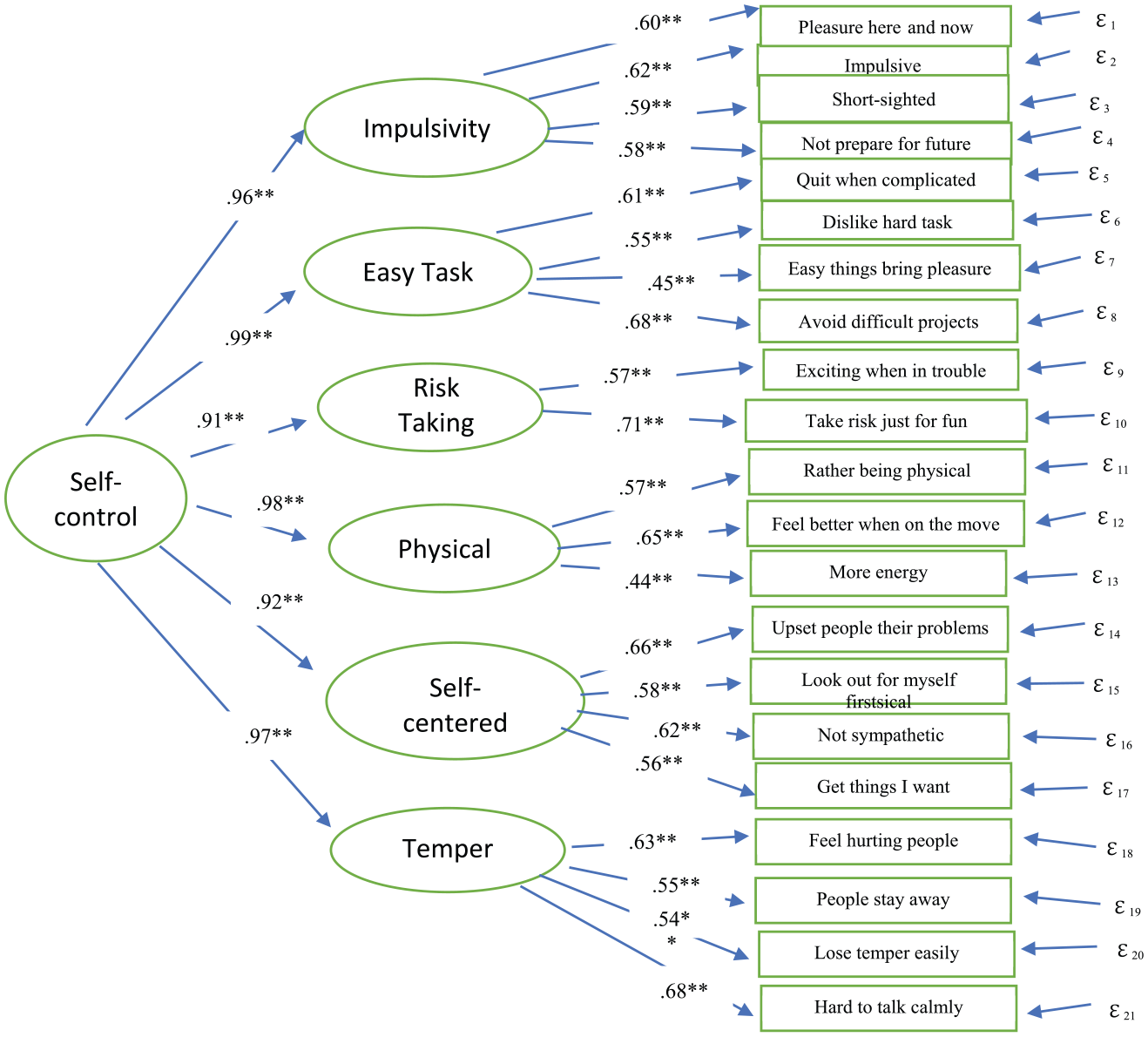
Second-order confirmatory factor analysis: self-control among children in rural China (n = 587).
Regression Analysis
Table 3 displays the ordinary least squares (OLS) regression models that predict delinquency. Model 1 regresses delinquency on self-control and social–demographic variables. As shown in Model 1, self-control exhibits a significant and negative effect on delinquency when holding constant the social–demographic variables. Consistent with Gottfredson and Hirschi, respondents in rural China who scored lower in the Self-Control Scale were more likely to report a higher level of delinquency involvement than those who scored higher in self-control. Model 2 adds the variables of caretaker monitoring, caretaker hostility, and caretaker bonding to test whether the association between self-control and delinquency may be attenuated by family contextual variables. Taking the variables of family context does not cause the coefficient for self-control to drop significantly. However, caretaker hostility is significantly and positively associated with the reported delinquency of adolescents. Our result clearly shows that self-control is not the single predictor of adolescent delinquency.
Regression Models Predicting Delinquency Among Children in Rural China.
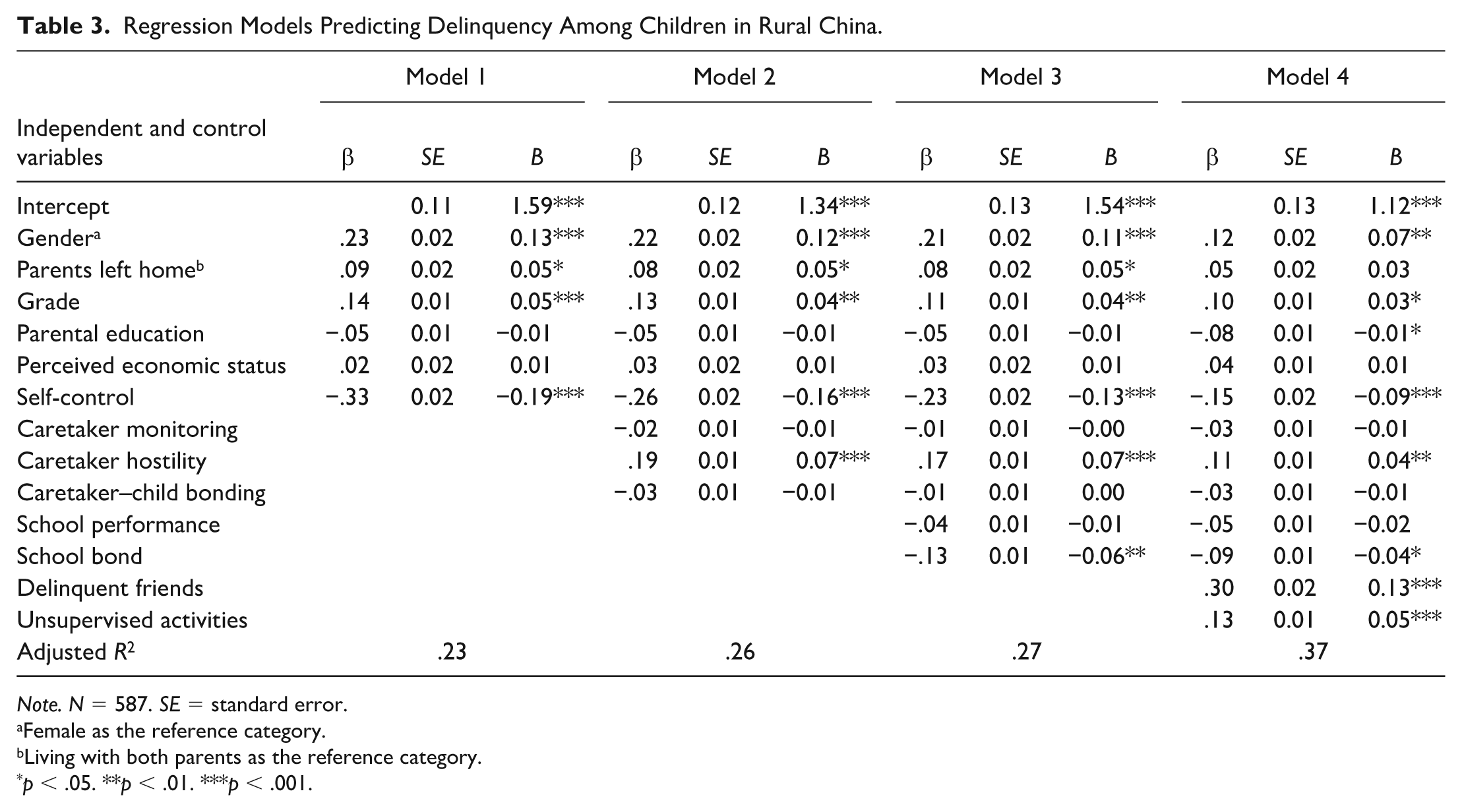
Note. N = 587. SE = standard error.
Female as the reference category.
Living with both parents as the reference category.
p < .05. **p < .01. ***p < .001.
The third model further adds school performance and school bond to examine how school contextual variables may affect the association between self-control and delinquency. Our result shows that school bond is a strong predictor of delinquency. Respondents who had stronger social bond were less likely to involve in delinquent behaviors. We note that once we include contextual variables of family and school in our model, the coefficient for self-control decreases by 31.6% (from B = −0.19 to B = −0.13). When the measures of family, school, and unstructured activities are included in Model 4, the effect of self-control on delinquency remains statistically significant (B = −0.09, p < .001). However, the magnitude of the significant effect of self-control diminishes by 52.6% (from B = −0.19 to B = −0.09) in the presence of contextual factors. This suggests that self-control continues to exert an independent effect, but the effect is greatly constricted by the inclusion of contextual variables. The attenuation is strongest when we add contextual measures in peer setting to the baseline model (i.e., unsupervised activities and delinquent friends). Meanwhile, self-control is not the single predictor of delinquency. Most of the contextual variables exhibit significant effects net of self-control. Respondents who reported having a higher level of hostility to parents and having more delinquent peers, who were heavily involved in unstructured activities, and who were weakly bonded to schools were more likely to report delinquency. Self-control is not a more important variable in explaining delinquency than contextual variables. The measure of delinquent peers has the strongest effect on delinquency (β = .30), followed by self-control (β = −.15) and unsupervised activities (β = .13), then hostility to parents (β = .11) and school bond (β = −.09).
Discussion
Ever since self-control theory was introduced, the original theory has evoked criticism and controversy. Much of the debate focuses on the strong claim made by Gottfredson and Hirschi about the universal application and self-sufficiency of self-control theory regardless of the presence and strength of other external control processes embedded in a specific social context. The unresolved debate has yielded increasing research efforts to assess the stability of self-control through cross-national comparison. However, despite the cultural differences between Western and non-Western society, existing research provides little insight concerning the extent to which contextual factors rooted in non-Western society affect the relationship between self-control and criminal behaviors. Our study seeks to explore the explanatory power of self-control by using a sample of adolescents in rural China, a collectivistic context that differs from Western society in values, mores, and practices. Our study makes improvements to the theory by advancing scientific knowledge with regard to the generalizability of Gottfredson and Hirschi’s postulate in an Eastern context.
To assess the validity of adapting the Self-Control Scale in different cultural contexts, we first conduct a second-order CFA and examine whether the factor structure of the Self-Control Scale is consistent with what is theoretically proposed. With regard to the distribution of each of the indicators utilized to measure self-control in rural China, our results clearly show a relatively high level of self-control reported by respondents to almost all indicators. The consistency in respondents’ answers reveals a reasonable level of reliability when using the Western culture–based scale in rural China. The second-order CFA further confirms our expectation by showing significant factor loadings for all 21 items on their six self-control subdimensions. In all, our model fits the data well, indicating that the Self-Control Scale is empirically valid and reliable across different populations and can be applied to children in rural China. Our study provides further support to the cultural validity of the Self-Control Scale used in East Asian countries, as evidenced by the previous Asian studies that assess the reliability of the scale (e.g., Chui & Chan, 2016; Vazsonyi et al., 2004). For example, Vazsonyi and colleagues (2004) used the Grasmick Scale and found supportive evidence of general similarity in the self-control construct for Japanese and U.S. male, and to some extent, female late adolescents. Chui and Chan’s (2016) study of self-control among Hong Kong adolescents indicated that the Grasmick Scale is quite reliable for both males and females (α = .80 for males and .72 for females).
With regard to the predictive power of self-control on delinquency, on one hand, our analyses confirm a basic relationship between self-control and delinquency. The finding that self-control predicts delinquency in the setting of rural China is in line with the stack of literature on self-control, which suggests that studies not incorporating self-control would be “potentially misspecified” (Pratt & Cullen, 2000, p. 936). On the other hand, our findings reveal that the assertion that self-control is the single explanation of crime and thus all contextual factors are the consequence of self-control appears to be inflated. More than half of the effect of self-control on delinquency is attenuated when we control for factors imbedded in social environments. Moreover, most of the contextual factors remain significant predictors of delinquency in spite of the presence of self-control. In fact, according to the analyses, unsupervised activities and friends’ delinquency show much stronger associations with delinquency than self-control. The findings resemble those of the previous studies in showing that self-control is at best only one of many important predictors of crime and not necessarily the strongest one (Antonaccio & Tittle, 2008; Meldrum et al., 2009). A single explanatory variable, such as individual propensity or contextual factors, is not likely adequate and correct, which challenges a strict interpretation of self-control theory of crime.
Conclusion
Using data collected from 587 seventh- to ninth-grade students across 10 middle schools in a rural county of Southeast China, we examine self-control’s efficacy in explaining juvenile delinquency in the presence of external environmental factors in the context of rural China. Our results confirm that self-control is an important predictor of delinquent behavior in a non-Western cultural context. However, certain environmental factors rooted in family, school, and peer groups are also shown to be the predictors of delinquent behavior with strength that seems to exceed that of self-control. Results also suggest that the effect of self-control is partially attenuated by environmental factors in rural China. These findings shed more nuanced insights on the nexus between self-control, external situations, and delinquency, and in a broader sense, to contribute to the elaboration of a more comprehensive understanding of self-control theory.
We view this investigation as a contribution, but the results should be interpreted cautiously in light of several potential caveats. First, the data used in this study only capture the external factors in the contexts of school, family, and peer groups. Although these contexts are the primary settings for youth developmental outcomes, they are not exhaustive. Research that assesses the role of context on the relationship between self-control and delinquency suggests that self-control effects may be subject to various contingencies such as strain, individual morality, and neighborhood characteristics (Jones, 2017; Wikstrom & Svensson, 2010; Zimmerman et al., 2015). In particular, empirical evidence derived from East Asian samples provided mixed findings with regard to the cultural-invariance thesis of self-control theory. The effect of self-control was found to be conditioned by gender, age, and country/region of the studies (e.g., Chui & Chan, 2016; Yun & Walsh, 2011). It would be beneficial for future cross-national studies to incorporate external factors from a wider range of contexts. For example, it is possible that school bond is less important than family bond in suppressing the negative effects of low self-control in urban China than in rural China where parents in a significant number of families migrated to urban areas. Therefore, there is a need to compare and contrast the interactive effects of self-control and contextual factors in urban China and rural China in future studies.
Second, our study assesses the effect of self-control across cultures; yet, we do not include a direct measure of Chinese culture. Similar to past research, we attribute the privilege of social forces over individual traits in effectively influencing the behaviors of Chinese adolescents to the collectivistic culture rooted in Eastern society. In doing so, we assume the distinctive effects of contextual factors found in our study reflect the cultural differences among societies. A more nuanced test would involve examining whether the effects of contextual factors on delinquency in Eastern society are related to cultural differences in inclination for individuality and independence. Third, the cross-sectional nature of our data limits our ability to disentangle the causal relationships between self-control, contextual factors, and delinquency. Gottfredson and Hirschi’s proposition of stability of self-control assumes causal priority of self-control that preconditions all social conditions. However, the nature of cross-sectional data makes it difficult to rule out the possibility that self-control measured at one time is a significant predictor of choosing risky or protective factors and consequently engaging in certain behaviors later. Longitudinal data are needed to address the potential causal ordering. An additional limitation that should be noted is that our results are based on the data collected from middle school rural students in southern China; thus, the sample is not generalizable. However, the aim of our study is not to generalize the results to an entire population. Instead, our sample provides a rarely tested setting, enabling us to assess the effect of self-control in an environment that differs from Western society with regard to cultural, social, and demographic characteristics.
Despite these limitations, our study provides notable insight to the joint effects of self-control and contextual factors in predicting delinquency in a non-Western society. As assessing self-control theory across different societies gained growing research attention, an emerging body of studies found evidence that the effect of self-control on crime is not invariant across Western and non-Western contexts (Cheung & Cheung, 2008; Chui & Chan, 2016; C. H. Lee et al., 2013). It is becoming increasingly difficult to rely on a rigid application of a self-control model to develop comprehensive understanding of crime and delinquency in broader and cross-national social environments. It is also hasty to conclude that inconsistent findings invalidate self-control theory, given the role of self-control as a salient individual predictor of crime. Our results, like many before, suggest that successful explanation and prediction of criminal behavior will likely require some form of theoretical integration. We encourage continued research on the various ways in which the social context can influence the strength of crime-preventive effects of self-control.
Footnotes
Declaration of Conflicting Interests
The author(s) declared no potential conflicts of interest with respect to the research, authorship, and/or publication of this article.
Funding
The author(s) received no financial support for the research, authorship, and/or publication of this article.
