



Abstract
Previous studies have assessed the association between food consumption and bullying perpetration, but most of them have not broadly assessed food consumption, neither the distinction between forms of bullying. The aim of the study was to evaluate the association between dietary patterns with bullying roles and its different types of bullying perpetration among adolescents. Data on a representative sample of ninth-grade students (N = 2,163; mean age = 14.8 years) taken from Sao Paulo Project for the social development of children and adolescents (SP-PROSO) were used. The independent variables were healthy and unhealthy dietary patterns obtained by exploratory factor analysis. The dependent variables were bullying role (victim-only, bully-only, bully-victim) and bullying perpetration (any type, social exclusion, psychological/verbal aggression, physical aggression, property destruction, sexual harassment). Multinomial and logistic regression models were performed for the total sample and stratified by sex (only for association with sexual harassment), adjusting for covariates. Adolescents who engaged in a healthy dietary pattern were less likely to be bullies (RR 0.67 [0.49, 0.92]), while adolescents with an unhealthy dietary pattern were more likely to be bully-victims (RR 1.29 [1.12, 1.48]). Unhealthy dietary pattern was associated with any type of bullying perpetration (OR 1.24 [1.12, 1.38]), mainly with sexual harassment and physical aggression. Boys who had an unhealthy dietary pattern were more likely to sexually harass another adolescent (OR 2.10 [1.20, 3.66]). In conclusion, adolescents who had a healthy dietary pattern were less likely to perpetrate bullying. Unhealthy dietary pattern was associated with bullying perpetration, especially with sexual harassment by boys.
Introduction
School bullying is considered a worldwide public health problem (Krug et al., 2002), and it is identified by a power imbalance between victim and bully, involving repetitive and intentional aggressive attitudes against peers (Olweus, 1993). Bullying can occur through overt forms, such as physical aggression (hitting, pushing) and verbal aggression (teasing, name-calling, racial or sexual harassment, threats), or covert forms, such as spreading rumors and social exclusion (Craig et al., 2009). In bullying situations, adolescents may take on various bullying roles, including noninvolved, bully-only, victim-only, or bully-victim (i.e., an adolescent who is both the victim and perpetrator of bullying) (Goldbach et al., 2018).
Evidence from a study conducted with adolescents from 40 countries found a prevalence of 12.6% for victimization and 10.7% for perpetration, being physical and verbal aggressions the most reported bullying behaviors (Craig et al., 2009). In Brazil, studies have found a prevalence of victims ranging from 8.3% to 18.2%. Regarding bullies and bully-victims, the prevalence ranges from 4.8% to 21.2% and from 2.0% to 10.4%, respectively (Loch et al., 2020; Silva et al., 2020).
Individual determinants of bullying victimization and perpetration have been identified in the literature. For instance, male gender, attention deficit and hyperactivity, and substance use may be predictors of involvement in bullying perpetration and victimization (Zych et al., 2021). More recently, the role of diet in bullying has been investigated. As a handful of studies have pointed similar results (Bruckauf & Walsh, 2018; Zahedi et al., 2014), a study with adolescents from countries in North America and Europe found an association between low diet quality and bullying perpetration (Jackson, 2017). Another one (Trapp et al., 2016) found that a higher score for a Western dietary pattern at 14 years was associated with an increase in conduct problems and aggressive behavior at 17 years, suggesting that food consumption could be associated with future problem behaviors.
Among children and adolescents, the literature indicates that the association between bullying behaviors and food consumption may be bidirectional, with victimization associated with greater adoption of unhealthy eating (Jackson et al., 2018; Smith et al., 2021) and an unhealthy diet increasing odds of perpetration (Bruckauf & Walsh, 2018; Holubcikova et al., 2015; Jackson, 2017; Solnick & Hemenway, 2012; Zahedi et al., 2014). The link between diet and bullying perpetration may occur through mechanisms in which unhealthy eating increases adolescents’ involvement in externalizing behaviors and affects their mood, thereby increasing bullying perpetration (Holubcikova et al., 2015; Kien et al., 2013; Oddy et al., 2009).
Previous literature has assessed food consumption with a focus on one specific type/category of food (e.g., soft drinks, junk food, sweets) or a diet quality index (Bruckauf & Walsh, 2018; Holubcikova et al., 2015; Jackson, 2017; Solnick & Hemenway, 2012; Zahedi et al., 2014), limiting the understanding of the role of dietary patterns in bullying. Dietary patterns represent a combination of foods that may be better associated with bullying than just one nutrient or food, as factor analysis can reduce and/or group data into patterns based upon intercorrelations (e.g., similar dietary composition) between different food items. This approach is an alternative method that assesses eating habits more comprehensively, understanding that people usually eat meals that contain lots of foods and nutrients (Kant, 2004; Newby & Tucker, 2004). Moreover, previous studies have assessed bullying perpetration without distinction between forms of bullying, and it is reasonable to suggest that dietary patterns have stronger associations with more overt forms of bullying perpetration, since previous literature has shown that lower quality diets are associated with fighting, acting aggressively, and engaging in delinquent behaviors (Jackson, 2016; Jackson & Vaughn, 2021; Oddy et al., 2009; Trapp et al., 2016).
Therefore, the purpose of this study was to evaluate the association between dietary patterns with bullying roles and its different types of perpetration among school adolescents.
Method
Study Population, Sampling, and Data Collection
We used data from the cross-sectional study Sao Paulo Project for the social development of children and adolescents—SP-PROSO (Projeto São Paulo para o desenvolvimento social de crianças e adolescentes) carried out in 2017. This study includes a representative sample of ninth-grade students from public and private schools in Sao Paulo, Brazil (Peres et al., 2018).
The sampling strategy included stratification by school type (state public schools, municipal public schools and private schools in Sao Paulo) and clustering by school class. The school participation was voluntary, and data collection was carried out only in schools whose principals agreed to participate in the research by Informed Consent Term. To estimate the classes to be drawn in each stratum, information was used on the number of adolescents enrolled per class and school in the ninth-grade, recorded in School Census 2015.
Participants were also invited to sign a consent form (after parents’ consent) and to complete a paper–pencil questionnaire based on questionnaires used in the longitudinal study Zurich Project on the Social Development of Children (Z-PROSO) and Montevideo Project for the Social Development of Children and Adolescents (M-PROSO), later translated to Portuguese. The questionnaire included demographics and familiar questions, related to relationships with friends and school environment, and aspects of adolescents’ food consumption and physical activity.
Data collection was carried out from August to November 2017. Of the 2,816 ninth-grade students present on the survey day, 2,680 answered the questionnaire. However, 57 did not report their sex and were excluded from the analysis. We also excluded adolescents missing information on age (n = 44), healthy (n = 157), and unhealthy eating markers (n = 177), as well as types of bullying victimization (n = 57) and perpetration (n = 25). The final sample size included in this study comprised 2,163 participants. More details of the sampling process are available in the SP-PROSO report (Peres et al., 2018).
Healthy and Unhealthy Dietary Patterns Assessment—Independent Variables
First, food consumption was obtained by the weekly frequency of beans, raw/cooked vegetables, fruit/fruit salad, fried food/French fries, sausages, biscuits/cookies, package snacks/potato chips, candies, and sugary beverages consumption. We grouped the frequencies in a dichotomous variable (<5 times/week or ≥5 times/week), hereinafter referred to as regular consumption (Azeredo et al., 2015; Jaime et al., 2015). The SP-PROSO questions about the frequency of food consumption in the previous 7 days are similar to the questions from the previously validated PeNSE questionnaire (Brazilian National School-Based Health Survey), and the indicator for regular consumption of healthy and unhealthy food provides satisfactory accuracy and validity compared to three 24-hour recalls (Tavares, Castro, Levy, Cardoso, Passos, et al., 2014). Then dietary patterns were obtained by exploratory factor analysis. In factor analysis, only shared variance between variables appears in the solution, and the shared variance is partitioned from its unique variance and error variance (Costello & Osborne, 2005). The Kaiser-Meyer-Olkin (KMO) criteria was used to assess sampling adequacy. KMO takes values between 0 and 1, with small values generally meaning that variables have too little in common to justify a factor analysis. A value of KMO = 0.84 was obtained, meaning good adequacy (Hutcheson & Sofroniou, 1999). The exploratory factor analysis was performed on the total sample.
Assessment of Bullying Roles and Bullying Perpetration—Dependent Variables
Bullying role was assessed through questions about victimization and perpetration. In August 2017, the adolescents self-reported the frequency of bullying victimization in the previous 12 months through five questions regarding specific types of victimization, following the general question: “Since August 2016, how often have you (1) been ignored or excluded on purpose, (2) been made fun of or called names, (3) been punched, kicked, bitten, or had your hair pulled, (4) had some of your belongings taken, broken, or hidden on purpose, and (5) been sexually harassed?.” Possible answers were 0 = never; 1 = once or twice; 3 = from 3 to 10 times; 4 = once a month; 5 = once a week; 6 = every day. We classified as victim-only those who reported having suffered at least one of the five types of bullying at least once a month in the last year. The same five questions were asked for bullies following the general question: “Since August 2016, how often have you (type of bullying; i.e., ignored or excluded on purpose) other adolescent?” We classified as bully-only those who reported having perpetrated at least one type of bullying, at least once a month in the last year. Adolescents who reported being a victim and having perpetrated at least one type of bullying, at least once a month in the last year, were classified as bully-victims. Those who reported not being victims neither perpetrators of any type of bullying were the reference category (noninvolved). Each type of bullying perpetration (any type, social exclusion, psychological/verbal aggression, physical aggression, property destruction, and sexual harassment) was also considered as a dependent variable.
Despite the lack of association between dietary patterns and the odds of being victim-only (Table 3), also found in other studies (Jackson, 2017; Jackson & Vaughn, 2018), we assessed the association with the individual types of victimizations and how expected, we found no significant association (data not shown). In addition, the literature suggests this association in the opposite direction (bullying victimization associated with greater consumption of unhealthy eating) (Jackson et al., 2018; Smith et al., 2021).
Covariates
We assessed sex (male, female), age (in years), color/race (white, non-white, non-response), maternal educational level (incomplete middle school, complete middle school, complete high school, complete higher education, non-response), physical fitness (<420 minutes/week, ≥420 minutes/week), screen-based sedentary activities (<3 hours/day, ≥3 hours/day, non-response), and Body Mass Index (BMI) (normal weight, underweight, overweight, non-response).
Statistical Analyses
The analyses were performed taking into consideration the sample design and weights to represent the population of school adolescents from Sao Paulo.
First, a descriptive analysis of the sample (total and according to sex) was performed to obtain the percentages and its respective confidence intervals (95% CI) of the variables of interest.
We calculate relative risk (RR) and 95% confidence intervals (CI) for the association between each dietary pattern and bullying role using multinomial regression models. Crude and adjusted odds ratios (OR) were obtained in the association analysis of each variable (healthy/unhealthy dietary pattern) with types of bullying perpetration by simple and multiple logistic regression.
Interaction analysis was performed to evaluate whether the associations of interest differed according to sex. The interaction term was statistically significant only for the association between healthy dietary pattern and sexual harassment. Therefore, such association was presented stratified by sex. p-Values <.05 were considered significant. All statistical analyses were performed using Stata SE version 13.0 software (StataCorp, 2013).
Ethical Aspects
SP-PROSO was approved by the Ethics and Research Committee of the University of Sao Paulo School of Medicine (research project 1.719.856), National Commission for Research Ethics (research project 2.014.816), and the 1964 Helsinki Declaration and its later amendments. No identification of the student or school was required in questionnaires (schools and students had an identification number in the questionnaire).
Results
Adolescents showed a similar distribution regarding sex (52.6% male) and had an average age of 14.8 years. Regular consumption (≥5 times/week) of beans was more frequent in boys (63.8%), whereas girls regularly consumed more raw/cooked vegetables (44.2%), biscuits/cookies (44.2%), candies (45.7%), and sugary beverages (48.7%). The regular consumption of fruit/fruit salad (38.3%), fried food/French fries (20.1%), sausages (21.6%), and package snacks/potato chips (22.5%) were similar between sexes (Table 1).
Characteristics of the Students’ Sample (SP-PROSO).
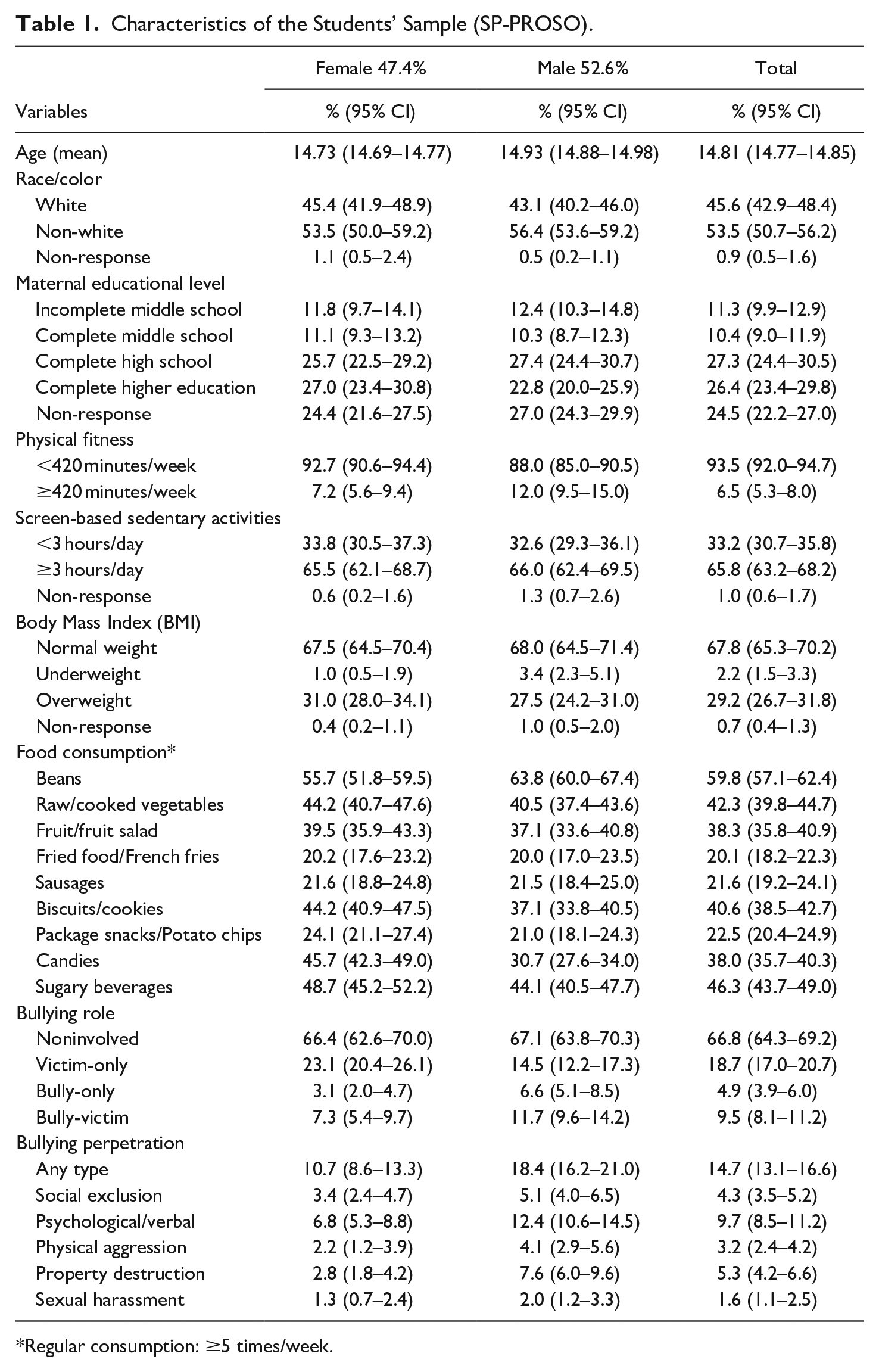
Regular consumption: ≥5 times/week.
We found that 23.1% of girls and 14.5% of boys were only victims, whereas 6.6% of boys and 3.1% of girls were only bullies. Almost 12% of boys and 7.3% of girls were bully-victims. Regarding bullying perpetration, 18.4% of boys and 10.7% of girls perpetrated any type of bullying. Psychological/verbal bullying was the most frequent type of bullying perpetrated by boys (12.4%) and girls (6.8%) (Table 1).
For the whole sample, two dietary patterns were retained, explaining 53.05% of the variance. The first pattern was labeled “unhealthy dietary pattern” and included fried food/French fries, sausages, biscuits/cookies, package snacks/potato chips, candies, and sugary beverages. The second pattern was labeled “healthy dietary pattern” and included beans, raw/cooked vegetables, and fruit/fruit salad (Table 2).
Factor Structure of Food Consumption Among Ninth-Grade Students From Sao Paulo, Brazil.
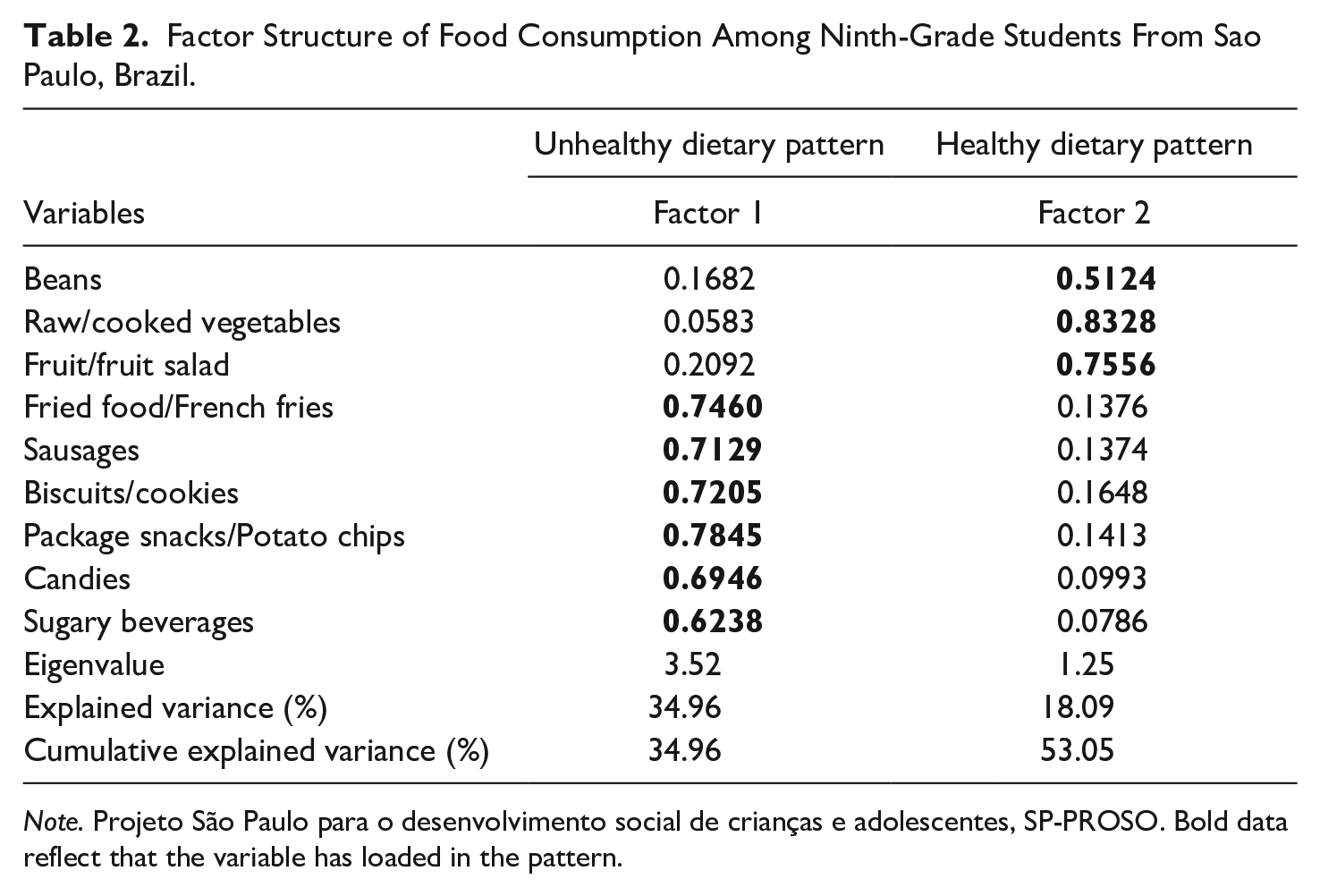
Note. Projeto São Paulo para o desenvolvimento social de crianças e adolescentes, SP-PROSO. Bold data reflect that the variable has loaded in the pattern.
In the adjusted multinomial regression models, adolescents who engaged in a healthy dietary pattern were less likely to be only bullies (RR 0.67 95% CI [0.49–0.92]). Adolescents who had an unhealthy dietary pattern were more likely to be bully-victims (RR 1.29 95% CI [1.12–1.48]) (Table 3).
Multinomial Regression (RR) of the Association Between Dietary Pattern and Bullying Role.

Note. Bold data reflect significant risk relatives.
Adjusted for sociodemographic variables (sex, age, race/color, and maternal educational level), physical activity, screen-based sedentary activities, and BMI.
Reference: not having a healthy dietary pattern.
Reference: not having an unhealthy dietary pattern.
In the adjusted logistic regression models, the unhealthy dietary pattern was associated with any type of bullying perpetration (OR 1.24 95% CI [1.12–1.38]), mainly with sexual harassment (OR 1.71 95% CI [1.13–2.60]) and physical aggression (OR 1.52 95% CI [1.18–1.95]) (Table 4). The stratified analyses found that boys who had an unhealthy dietary pattern were more likely to sexually harass another adolescent (OR 2.10 95% CI [1.20–3.66]) (Table 5).
Logistic Regression (OR) of the Association Between Dietary Pattern and Bullying Perpetration.
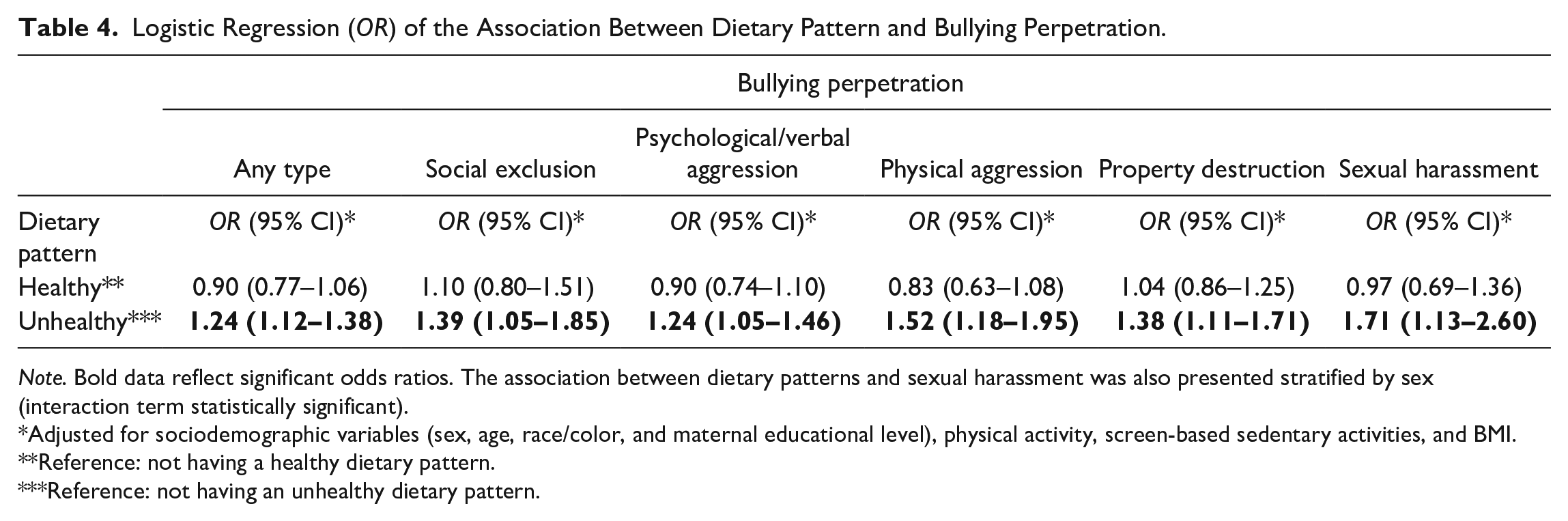
Note. Bold data reflect significant odds ratios. The association between dietary patterns and sexual harassment was also presented stratified by sex (interaction term statistically significant).
Adjusted for sociodemographic variables (sex, age, race/color, and maternal educational level), physical activity, screen-based sedentary activities, and BMI.
Reference: not having a healthy dietary pattern.
Reference: not having an unhealthy dietary pattern.
Logistic Regression (OR) of the Association Between Dietary Pattern and Sexual Harassment.
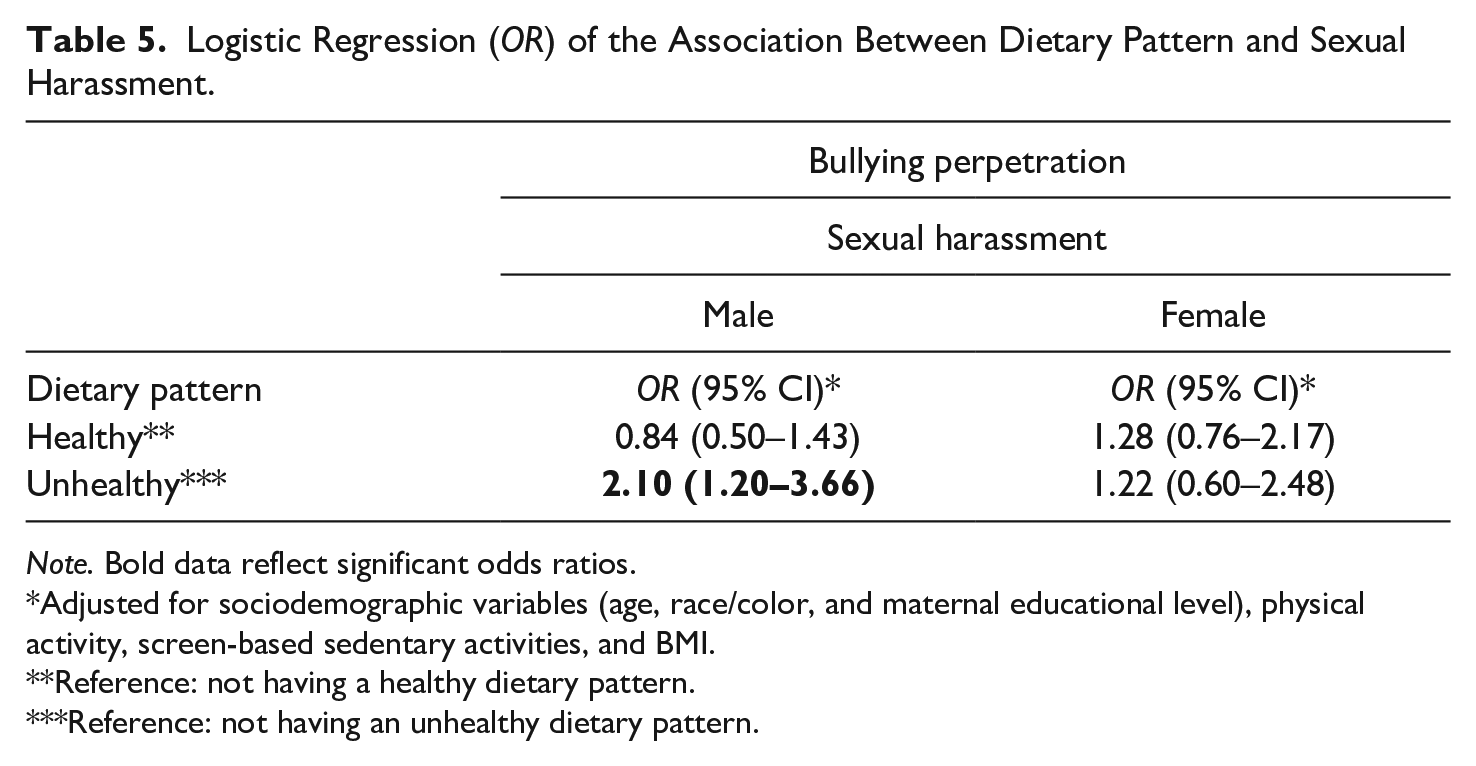
Note. Bold data reflect significant odds ratios.
Adjusted for sociodemographic variables (age, race/color, and maternal educational level), physical activity, screen-based sedentary activities, and BMI.
Reference: not having a healthy dietary pattern.
Reference: not having an unhealthy dietary pattern.
Discussion
Our results show that having a healthy dietary pattern was inversely associated with bullying perpetration, whereas unhealthy dietary pattern was positively associated with bully-victim role. Moreover, adolescents who engaged in an unhealthy dietary pattern showed a higher probability of perpetrating all bullying types, especially sexual harassment and physical aggression. Stratified analyses showed that boys who had an unhealthy dietary pattern were more likely to sexually harass another adolescent.
The literature suggests a bidirectional relationship between bullying behaviors and food consumption (Smith et al., 2021; Solnick & Hemenway, 2012), recently pointing out that unhealthy eating is associated with bullying perpetration in children and adolescents (Holubcikova et al., 2015; Jackson, 2017), which is in line with our findings. A recent study (Bruckauf & Walsh, 2018) found an association between sweets, chocolates, and non-diet soft drinks consumption with involvement in physical fighting and bullying perpetration. Another one (Zahedi et al., 2014) found that adolescents with daily consumption of sweetened beverages, fast foods, and salty snacks were more likely to be bullies. However, these studies considered each type of food as different exposures, separately associated with bullying perpetration. Our study assessed food consumption more broadly through dietary patterns, grouping, or reducing several foods into a single pattern (only one exposure) associated with bullying behaviors. This approach has moved toward knowledge of that association since combinations of many foods characterize people’s usual diet.
We found that adolescents who engaged in a healthy dietary pattern were less likely to be bullies. Adolescents identified as bullies have been found to be aggressive, hostile, a little anxious or insecure (Byrne, 1994; Craig, 1998; Olweus, 1995), impulsive and lacking in self-control (Björkqvist et al., 1982), with positive attitudes toward aggression and negative attitudes toward peers (Lagerspetz et al., 1982). Studies have suggested that healthy eating can improve adolescents’ mental health and reduce some of these characteristics and feelings (Kulkarni et al., 2015), which could trigger bullying perpetration (e.g., verbal and physical aggression) (Craig, 1998).
In addition, adolescents who had an unhealthy dietary pattern were more likely to be bully-victims. The literature shows associations between low diet quality (OR 1.79 95% CI [1.57–2.03]; Jackson, 2017) and high junk food consumption (OR 1.46 95% CI [1.36–1.56]; Jackson & Vaughn, 2018) with being a bully-victim. Some studies have explored the characteristics of adolescents who both bully and have been victimized. Bully-victims may have more depressive symptoms and aggressive impulsivity (O’Brennan et al., 2009), greater likelihood of engaging in substance use (Kaltiala-Heino et al., 2000), and worse social adjustment (Kelly et al., 2015). It seems that an unhealthy diet reinforces the greater presence of these characteristics in bully-victims adolescents, increasing their vulnerability (Kulkarni et al., 2015; Marques et al., 2021; Puloka et al., 2017).
According to our analysis, adolescents who had an unhealthy dietary pattern were more likely to perpetrate bullying. Our finding is in line with recent studies showing a possible association between a diet low in fruits and vegetables and plentiful in sweets/soft drinks with bullying behaviors (Holubcikova et al., 2015; Jackson et al., 2017; Trapp et al., 2016; Zahedi et al., 2014). Such association may be explained through two potential mechanisms. First, unhealthy eating (e.g., Western dietary pattern) could be associated with greater involvement in externalizing behaviors such as delinquent and/or aggressive behavior and conduct problems linked to bullying perpetration (Oddy et al., 2009). A study found that a high-palmitic acid diet (similar to the Western diet fat composition) was associated with anger and hostility (Kien et al., 2013), probably due to a central inflammatory process (Cintra et al., 2012) induced by increased secretion of TNF-ά by peripheral blood monocytes (Coll et al., 2008; Suarez et al., 2002), which could heighten anger and bullying perpetration. Second, daily consumption of components of soft drinks (e.g., aspartame) may lead to aggressive behavior through high fluctuations in the blood glucose levels (Tandel, 2011), which could be related to behavior deviations and violence (Benton, 2007). Moreover, the association between unhealthy eating and adolescents’ involvement in bullying perpetration may be mediated by frequent nervousness and irritability (Holubcikova et al., 2015), and low self-control (Jackson, 2017; Moon & Alarid, 2015; Wills et al., 2007).
Five types of bullying perpetration were considered for our analysis, obtaining different magnitudes of the association between unhealthy dietary pattern and each type of perpetration, with a stronger association for physical aggression (OR 1.52 95% CI [1.18–1.95]). Physical aggression and verbal bullying are considered overt aggression, and it is possible that adolescents who perpetrate such type of violence have lower levels of fear reactivity and effortful control, compared to perpetrators of covert aggressive acts (Terranova et al., 2008). There is a lack of studies that evaluate several types of bullying separately, which prevents us from comparing our results and better understanding the associations.
We also found that boys who had an unhealthy dietary pattern showed higher probability of sexually harass another adolescent. Gender is a significant risk factor for perpetrating sexual harassment, as boys are more likely than girls to engage in sexually harassing behaviors (Clear et al., 2014; DeSouza & Ribeiro, 2005; Fineran et al., 2001) and to admit they had sexually harassed other students (Clear et al., 2014; Hill & Kearl, 2011). Moreover, sexual harassment is overt aggression, and recent studies show that boys are more likely to perpetrate and experience such type of violence, whereas girls are more involved in covert forms of bullying, such as psychological violence and social exclusion (Bradshaw et al., 2015; United Nations Children’s Fund, 2014).
Limitations and Strengths
Despite the contribution of the present study, some limitations should be considered. The cross-sectional design of the study does not allow us to establish temporality between the variables of interest. Thus, future research is required to explore the possible causal links between healthy and unhealthy dietary patterns and the outcomes (types of bullying perpetration), as well as the potential mediators of such associations.
Our study used self-reported information, which may have provided some misreporting (differential information bias) in questions about bullying involvement (Cornell et al., 2014) and, consequently, underestimated prevalence. Despite this, the scores from 10-item self-report measure of bullying perpetration in adolescents (Z-PROSO) were validated and provided a reasonable general measure of perpetration that can be used across early to late adolescence and in both sexes (Murray, Eisner, et al., 2021). Moreover, the survey instrument covered bullying perpetration by the cut-off of at least once a month in the previous 12 months, taking into account the repetitive feature of this violence (Olweus, 1993), which resulted in significant associations with dietary patterns. Other studies have also used similar questions for the same exposures (Barros et al., 2017; Tavares, Castro, Levy, Cardoso, & Claro, 2014) and outcomes (Murray, Zych, et al., 2021), suggesting we had adequate ascertainment of such variables and allowing comparison with our results.
Only students present in class at the time the questionnaire was applied were included in the sample, which may affect the generalization of our results and generate some selection bias. In addition, the survey SP-PROSO does not account for adolescents not enrolled in regular education and perpetrators of bullying are more likely to miss classes and drop out of school (Gubbels et al., 2019); thus, some of them may not have been included in the analysis. Nevertheless, the study analyzed a significant sample of adolescents. It is also possible that there are differences regarding adolescents of age groups distinct from those reported in this study.
Despite its limitations, our study has strengths. To the best of our knowledge, this is the first study in Brazil to evaluate the association between food consumption and perpetration of bullying. The use of dietary patterns allowed a broad assessment of food consumption, considering possible antagonistic and synergistic relationships between nutrients (Collins et al., 2010; Hu, 2002), since people commonly do not eat isolated foods or nutrients, but combinations of several of these. Bullying was assessed through five types of perpetration, allowing the obtainment of different magnitudes of the association of dietary patterns with each type of perpetration.
In addition, the instrument used in Z-PROSO and M-PROSO was translated into Portuguese following recommendations for culturally sensitive translations (Behr & Shishido, 2016; Eisner & Ribeaud, 2007). Then the complete instrument was pre-tested in five schools to better assess the phrasing, understanding of the questions and the logical structure of the survey (Peres et al., 2018).
Conclusion
Adolescents with a healthy dietary pattern were less likely to be bullies, while those who had an unhealthy dietary pattern were more likely to be bully-victims. Moreover, unhealthy dietary pattern was associated with all types of bullying perpetration. In boys, unhealthy dietary pattern was strongly associated with peer sexual harassment. Our study underscores that improving dietary patterns may be an important key point in attenuating several bullying behaviors among adolescents, and indirectly reducing its negative health consequences such as psychosomatic symptoms, depression and anxiety, and behavioral problems (Kieselbach & Butchart, 2015; Pepler et al., 2008; Smokowski & Kopasz, 2005). Studies suggest that promoting nutrition for young people in schools can significantly benefit their food choices, making healthier eating with greater consumption of fruits and vegetables, fiber, water and healthy snacks, and lower intake of unhealthy foods (Wang & Stewart, 2013). This school-level approach can be most effective if done in partnership with health services, the family, and the community (Stewart et al., 2004). In addition, schools could also adopt policies to identify bullying behaviors, mainly peer sexual harassment, thus reducing intolerance and protecting adolescents through the development of healthier school environments (Gaffney et al., 2019).
Footnotes
Declaration of Conflicting Interests
The author(s) declared no potential conflicts of interest with respect to the research, authorship, and/or publication of this article.
Funding
The author(s) disclosed receipt of the following financial support for the research, authorship, and/or publication of this article: This work was supported by a grant from the British Academy/Newton Foundation (Award Reference AF160099), and Fundação de Amparo à Pesquisa do Estado de São Paulo—FAPESP (The Foundation for Research Support of the State of São Paulo) (Process Nr. 2016/22259-4). The postgraduate student L.M.O. receives a scholarship from Coordenação de Aperfeiçoamento de Pessoal de Nível Superior—Capes (Coordination for the Improvement of Higher Education Personnel).
Informed Consent and Anonymity
All participating schools took part voluntarily. At each school, there was a meeting with parents of students of the selected class, in order to present the project and obtain their consent. A letter and a folder with information on the project were also sent to the schools’ principals to be delivered to the parents. Parents’ refusal could be informed to the school board, or to the coordination, or yet to the research team, either by phone, e-mail, or in person, during the meeting. Only for those adolescents whose parents did not refuse participation, a questionnaire was delivered in class for them to fill in individually. No information that could identify the student or the school was retained.
