



Abstract
The properties of heat stabilisers Bisphenol-5 [4,4′-bis(2,6-di-tert-butylphenol)] and Vulcanox BKF [2,2-methylene-bis(4-methyl-6-tert-butylphenol)] and their efficiency in stabilising nitrile butadiene rubbers (SKN-1865 and SKN-2665) were investigated. The efficiency of the antioxidants was assessed from the thermooxidative ageing of the rubbers at 150°C over the course of 1 and 3 h. The Mooney viscosity and solubility of specimens with Bisphenol-5 change less during oxidation than those of specimens with Vulcanox BKF. The good stability of the Bisphenol-5 dispersion after additional treatment in a ball mill for 12 h was shown. Stability was assessed from the sedimentation rate of antioxidant particles and from the ratio of sediment to dispersion volume. The vulcanisation time and physicomechanical properties of compounds based on rubbers containing Bisphenol-5 and Vulcanox BKF were compared. The recommended content of Bisphenol-5 in SKN-1865 rubber is 0.23 parts, and in SKN-2665 rubber 0.3 parts. Bisphenol 5 can be recommended as a replacement for imported Vulcanox BKF for the stabilisation of nitrile butadiene rubbers.
Keywords
In view of the versatility of the service properties of articles manufactured from polymers, the production and consumption of the latter are constantly growing. Nonetheless, the demand for polymers is not always met by supply, which means that the service life of the end products has to be increased. The method most widely used to lengthen the service life of polymer articles is to introduce stabilisers – antioxidants [1, 2].
In spite of the present crisis and turbulence on the world market, Russia is continuing to increase the production of polymer products, but because of the small volume of stabiliser production in Russia, many enterprises are having to buy in stabilisers from foreign producers.
Phenolic antioxidants are widely used to stabilise rubbers, and among these we should single out bisphenol antioxidants, which are noted for high efficiency. One such antioxidant is 4,4′-bis(2,6-di-tert-butylphenol) (Bisphenol-5) [3, 4]. In order to broaden the prospects of using Bisphenol-5 at the Krasnoyarsk Synthetic Rubber Factory, the stabilising efficiency of this antioxidant in nitrile butadiene rubber in comparison with the industrial antioxidant Vulcanox BKF has been studied.
Antioxidant Bisphenol-5 is being produced on a pilot-plant scale to the TU 2492-002-40655797-2014 specification at AhmadullinS – Science and Technologies in Kazan. The technical requirements concerning Bisphenol-5 are presented in Table 1.
Technical requirements for antioxidant Bisphenol-5.

Vulcanox BKF is the phenolic antioxidant 2,2-methylene-bis(4-methyl-6-tert-butylphenol), CAS No. 000119-47 -1.
Dispersions of Vulcanox BKF and Bisphenol-5 were prepared in the laboratory of the Krasnoyarsk Synthetic Rubber Factory. The formulation and the regime for preparing the Bisphenol-5 dispersion are presented in Table 2. For preparation of the dispersion, the standard formulation and the regime used to prepare Vulcanox BKF dispersions (temperature 25°C; rotational speed of stirrer 150 rev/min; preparation time 30 min) were employed. The Bisphenol-5 dispersion was additionally ground in a laboratory ball mill for 12 h.
The formulation for the preparation of dispersions.

The content of the investigated antioxidants in the rubber amounted to 0.23 and 0.30 parts. A weighed sample of Bisphenol-5 was introduced into water with an emulsifier in several doses. Once the sample was completely wetted, stirring was continued for a further 30 min. Dispersions of the compared antioxidants were introduced into latex during stirring and their contact was continued for 10 min, at which point coagulant was introduced. The rubber was formed in accordance with technical regulations.
Suspension stability was assessed from the sedimentation rate of particles of Bisphenol-5 and from the ratio of sediment to suspension volume.
The stabilising efficiency of Bisphenol-5 was assessed from the results of thermooxidative ageing of the rubber at a temperature of 150°C over the course of 1 and 3 h. Theremooxidative ageing was carried out according to the GOST 9.024-74 standard.
The physicomechanical and rheological properties of standard rubber mixes and rubbers with Bisphenol-5 and Vulcanox BKF were compared according to GOST 270-75.
In the industrial introduction of antioxidants into polymers, a necessary condition for effective heat stabilisation of the rubber is the production of a stable dispersion of antioxidant and polymer. The stability characteristics of Bisphenol-5 dispersions with and without treatment in a ball mill in comparison with a Vulcanox BKF dispersion are presented in Table 3. It was shown that the standard formulation and the regime for preparing the Bisphenol-5 dispersion are not effective. Additional treatment of the dispersion in a laboratory ball mill for 12 h is very effective in terms of stability – no sediment is formed during subsequent storage for up to 2 h. A small sediment was formed after 4 h storage of the dispersion, amounting to 3.3% of the total dispersion volume. The improvement in stability of the Bisphenol-5 dispersion after ball mill treatment is due to the reduction in the size of the antioxidant particles, to their better distribution in the rubber, and consequently to more effective stabilisation of the polymer.
Comparative results concerning the stability of a dispersion of Vulcanox BKF and dispersions of antioxidant Bisphenol-5.
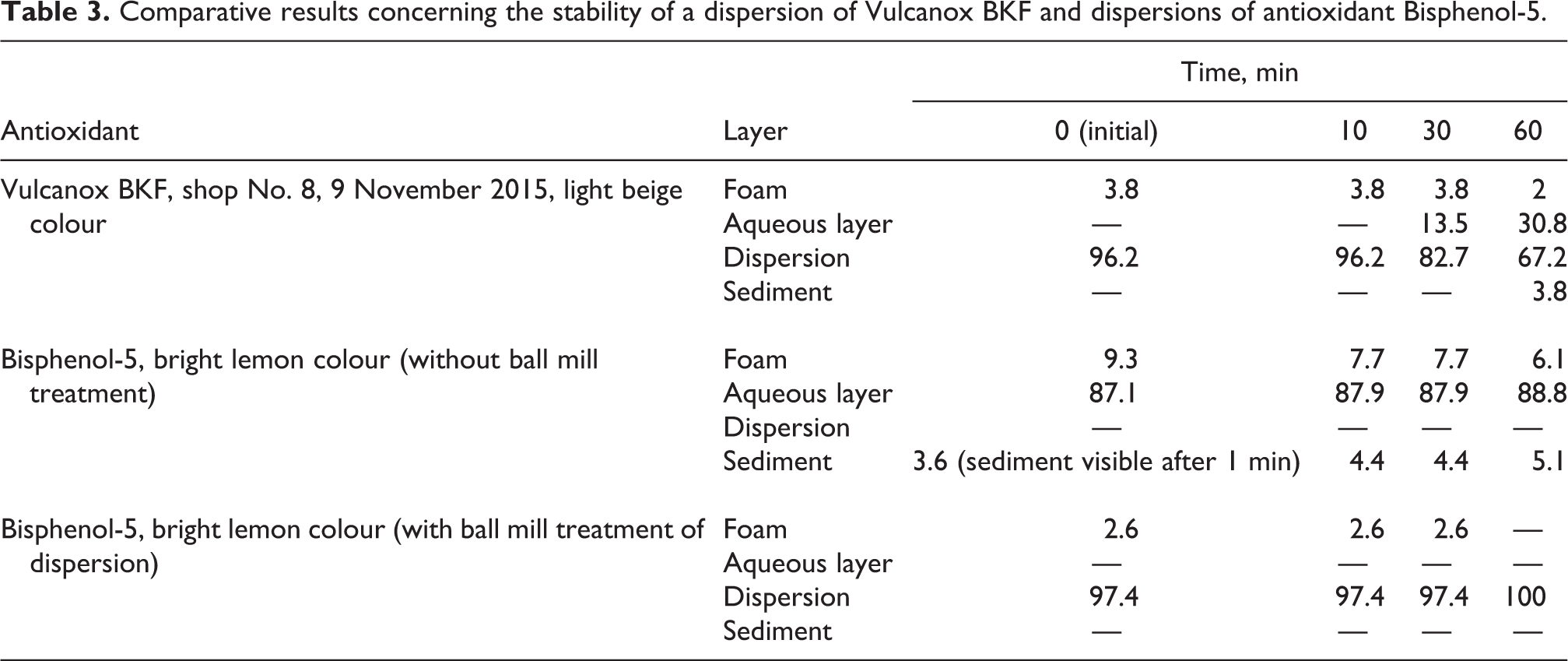
The obtained results indicate the need to manufacture antioxidant Bisphenol-5 in the form of a powder of specific particle size, and also show that an appropriate regime can be selected for preparing Bisphenol-5 dispersions on an industrial colloid mill in the polymerisation shop of the Krasnoyarsk Synthetic Rubber Works.
Table 4 presents results concerning the stabilising efficiency of Bisphenol-5, assessed from the thermooxidative ageing of SKN-1865 and SKN-2665 rubbers. The satisfactory level of plastoelastic properties of rubbers with a Bisphenol-5 content of 0.23 and 0.3 parts is shown. The solubility of the rubber with the trial antioxidant during ageing meets the specifications. No gel fraction is formed at all.
The results of thermooxidative ageing of SKN-1865 and SKN-2665 rubbers with antioxidants Bisphenol-5 and Vulcanox BKFa.
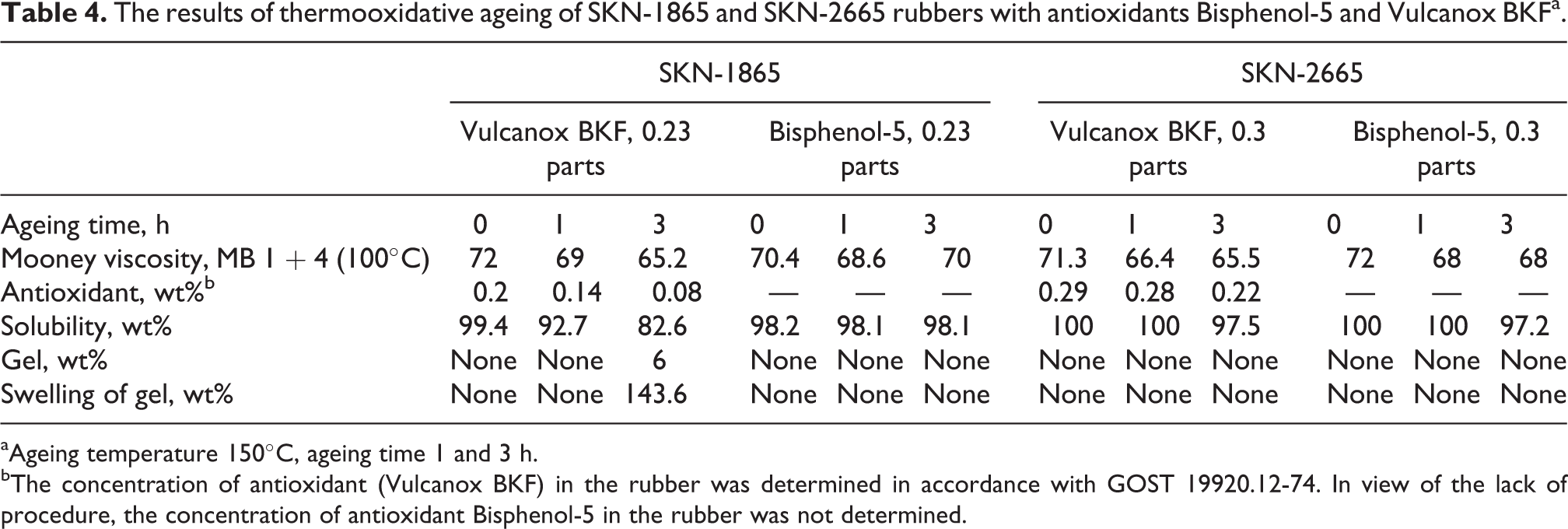
aAgeing temperature 150°C, ageing time 1 and 3 h.
bThe concentration of antioxidant (Vulcanox BKF) in the rubber was determined in accordance with GOST 19920.12-74. In view of the lack of procedure, the concentration of antioxidant Bisphenol-5 in the rubber was not determined.
The obtained steady stabilising effect of Bisphenol-5 during thermooxidative ageing at a dosage of only 0.23 parts is explained by the high potential of its stabilising action being associated with its ability readily to be oxidised to 3,3′,5,5′-tetra-tert-butyl-4,4′-diphenoquinone (DPQ) under conditions of thermal oxidation of polymers with the formation of an equilibrium system, with subsequent participation of the products of transformation in the inhibition of thermooxidative degradation of the polymers [4]. Here, the rubber acquires a yellow colour, as DPQ is an organic dye turning the polymer yellow.
The Mooney viscosity and solubility of specimens with Bisphenol-5 change less in the process of oxidation than those of specimens with Vulcanox BKF.
Antioxidant Bisphenol-5 is more efficient and shifts the degradation temperature and the temperature of weight loss towards higher temperatures, which promotes a broader working service temperature range and a longer lifetime of the polymer.
The effect of antioxidants on the stability of the physicomechanical properties of rubber articles was investigated in detail by Gorbunov et al. [5]. During the processing of polymeric materials, processes such as crosslinking and chain breakdown are observed. These processes lead to a reduction in the physicomechanical properties. The introduction of heat stabilisers into the polymer promotes a reduction in the degradation of macromolecules and to retention of the physicomechanical properties of the rubber.
Results concerning the physicomechanical properties of vulcanisates and the rheological properties of standard rubber mixes with Bisphenol-5 and with Vulcanox BKF are presented in Table 5. It can be seen that there is a small increase in the strength properties of vulcanisates with Bisphenol-5 in comparison with vulcanisates with Vulcanox BKF.
The physicomechanical properties of standard compounds based on SKN-1865 and SKN-2665 rubbers with the use of antioxidants Bisphenol-5 and Vulcanox BKF.
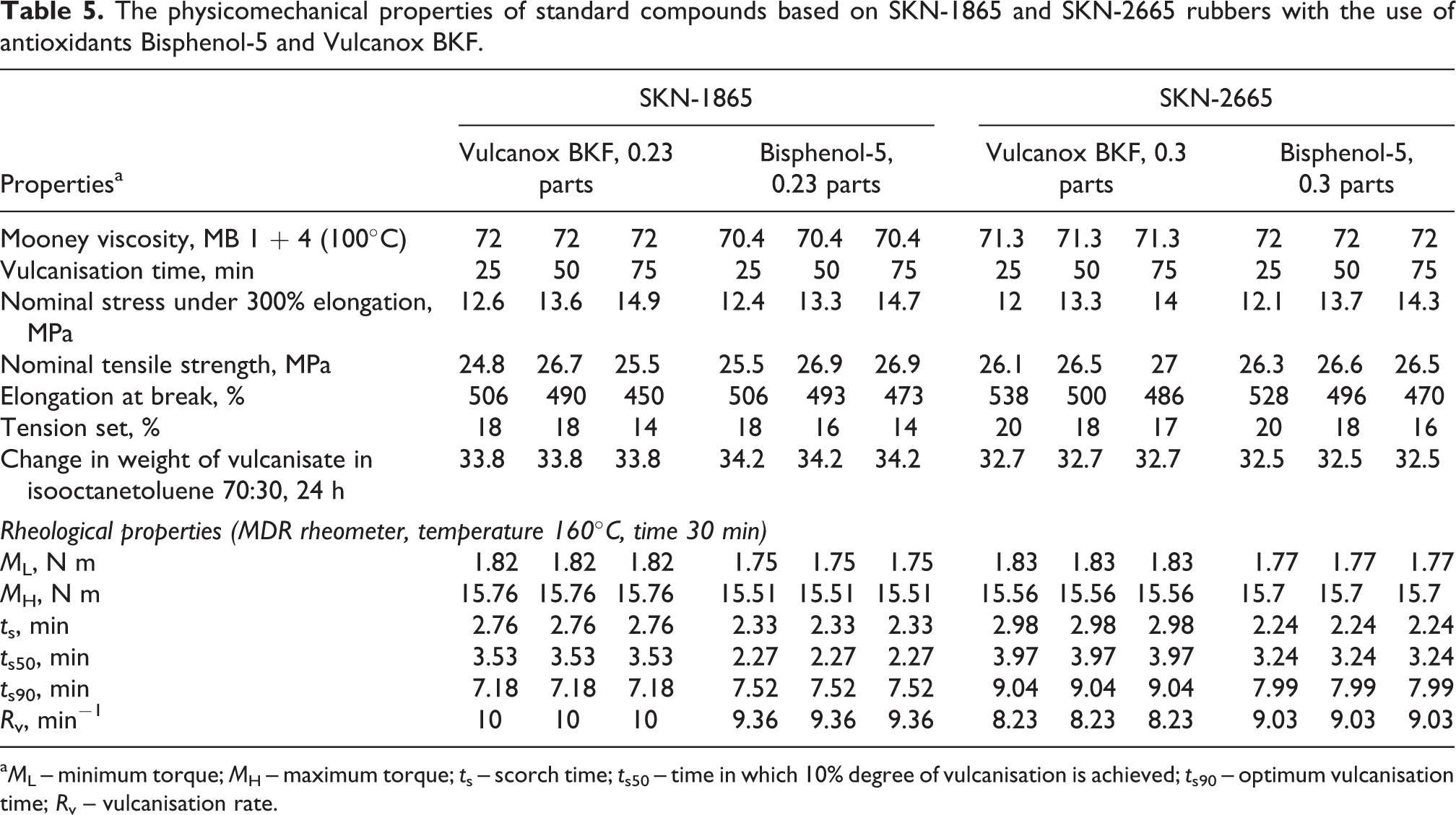
a M L – minimum torque; M H – maximum torque; t s – scorch time; t s50 – time in which 10% degree of vulcanisation is achieved; t s90 – optimum vulcanisation time; R v – vulcanisation rate.
From the data in Table 5 it is evident that, in terms of vulcanisation rate, SKN-1865 and SKN-2665 rubbers with a Bisphenol-5 dose of 0.23 and 0.30 parts are comparable with the control specimen.
Thus, in the course of the conducted work it was established that the additional ball mill treatment of a Bisphenol-5 dispersion leads to its stability during storage.
It was established that the results of thermooxidative ageing of SKN-1865 rubber with a dosage of 0.23 parts and of SKN-2665 rubber with a dosage of 0.30 parts Bisphenol-5 show satisfactory thermooxidative stability.
The physicomechanical properties of vulcanisates with Bisphenol-5 correspond to the regulated standards and are comparable with the properties of vulcanisates with Vulcanox BKF.