



Abstract
Introduction
Play occupation is central to children’s occupational lives and play is established as a fundamental right. While children with disabilities are at increased risk of play deprivation, few studies have explored the play occupation of children living with severe physical and intellectual disabilities.
Method
Informed by an ethnographic approach, this qualitative study involved 17 participants including five families of children with severe disabilities and six classroom staff. Methods combined observations of children’s play with adult interviews and focus groups to explore factors that influence play in home and school contexts. Findings were analysed using thematic analysis.
Findings
Three themes emerged: (a) play as an occupation, play as an activity; (b) an empowered and empowering play partner; (c) the ‘just-right’ play object and environment.
Conclusion
The influence of an empowering and empowered play partner combined with the suitability of the object and environment was central to successful play. A commitment to play for fun, for the wellbeing of these children, and by ‘playing with’ and not ‘doing-to’ the child was fundamental. Although the findings are specific to this study, play facilitators may use them to inform future play interactions through an enhanced understanding of empowerment and enablement for successful play occupation.
Introduction
Play is a fundamental right for every child (United Nations Convention on the Rights of the Child, 1989: Article 31). These play rights have been established based on the knowledge that play is fundamental for children’s health, wellbeing, and physical, cognitive, social, emotional and spiritual development (Committee on the Rights of the Child (CRC), 2013; Goodley and Runswick-Cole, 2010). Yet, according to the CRC (2013), certain groups of children are at increased risk of play deprivation, including children with disabilities (CRC, 2013). While there is a growing body of knowledge about leisure participation for children with physical disabilities (see for example Powrie et al., 2020), few studies to date have explored play occupation among children with more severe disabilities such as those living with severe/profound physical and intellectual disabilities (SPID). To address this gap in knowledge, the purpose of this study was to explore play occupation among children with SPID.
Literature review
Within the discipline of occupational therapy, play is commonly described in terms of core characteristics, including freedom, choice and control, otherwise referred to as play occupation or play for the sake of play (Bundy, 2012; Graham et al., 2018; Lynch and Moore, 2016). Play is noted as being different to leisure (CRC, 2013; Lynch and Moore, 2016) and is defined as ‘any behaviour, activity or process initiated, controlled and structured by children themselves’ (CRC, 2013: 5). Play is how young children explore and learn and is fundamental in early childhood (Lester and Russell, 2010). Its significance in early development is evidenced in the recognition of the need for a play-based curriculum in early years education in many countries (see for example UNESCO, 2016). Indeed, it has been noted that the absence of play is harmful for children’s wellbeing, development and resilience (Burghardt, 2005; Lester and Russell, 2010). In contrast, although leisure can also relate to learning, it is more linked to older children and adolescence, and associated with taking time out, often as a distraction from learning (Powrie et al., 2020). Therefore, play occupation must be taken seriously in and of itself, as an issue of concern for research, and particularly for children at risk of play deprivation.
Factors that influence play occupation include those related to the specifics of the child’s play preferences, abilities and available play opportunities (the occupation–environment relationship), that is, factors associated with the demands of the activity and the inherent abilities of the child (Brodin, 2005). A more playful child has more internal control, is more intrinsically motivated, is freer from some constraints of reality, and is better able to give and receive interactional cues than a less playful child (Bundy, 1997; Hamm, 2006; Harkness and Bundy, 2001). Although the child with SPID may not be able to independently engage in play opportunities in the immediate environment, considerations such as the arrangement of space (into clearly defined places, without the obstruction of furnishings) and the selection, presentation and adaptation of materials are known to help children orient and engage more effectively with play materials (Crawford et al., 2014). Accommodations regarding noise-levels, lighting and general accessibility also promote more positive play experiences for children of various abilities (Doctoroff, 2001).
Other environmental approaches to enhancing play for children with SPID have been explored through researching object play. Object play (also referred to as toy play) involves the use of a play prop, wherein an object is the vehicle of play. This type of play has been observed to be of particular importance in promoting child physical, cognitive and social development (Pellegrini and Gustafson, 2005). Children with SPID differ in the frequency, diversity, and complexity of their play with objects compared to their typically developing peers (Frey and Kaiser, 2011). Consequently, children with SPID often require adaptive technologies to participate in object play (Cook et al., 2000), and adaptive toys have been developed to accommodate the child’s physical abilities or moderate the cognitive demand necessary to interact with a toy (Hsieh, 2008). Ultimately, studies show that if children are offered an object that attracts them, in an environment that is conducive to their needs, they can exhibit more playful behaviours and engage more readily in play. The benefits of play multiply for the child living with a disability, be it physical or intellectual, as the acquisition of more sophisticated object play skills is thought to counteract the exacerbating delays associated with the disability (Childress, 2011). This, therefore, warrants further research to generate more positive play experiences for children who may otherwise be deprived of these experiences.
Despite these possibilities, children with SPID are at increased risk of limitations to participation in play compared to their peers (Graham et al.,2018). For example, spontaneous, independent play may not be possible for children who have physical and intellectual impairments due to an increased dependence on caregivers (Brodin, 2005). Furthermore, adults tend to take on the role of play director because children with SPID can take longer to respond and make less obvious responses (Cook et al., 2000). Children with SPID, therefore, can have more limited capacity for autonomy in their play and play choices, and often engage in more adult-chosen play. Consequently, the quality of their play may be compromised (Cook et al., 2000). Yet, studies also show that often a person who is familiar to the child is best able to promote a more comfortable atmosphere and facilitate more positive play experiences (Childress, 2011; Crawford et al., 2014; Frey and Kaiser, 2011; Graham, 2018). Though the evidence is not well established, research suggests that the role of the ‘play facilitator’ is pivotal in enabling playful experiences and subsequently enabling play development (Frey and Kaiser, 2011). The most appropriate role for the play facilitator is that of an equal partner in play, where the play facilitator focuses on ‘doing-with’ as opposed to ‘doing-to’, which provides more opportunity for discovery, learning and enjoyment by the child (Cook et al., 2000; Crawford et al., 2014; Frey and Kaiser, 2011). While current evidence relates primarily to adults as play facilitators, it is also acknowledged that this may apply to other players, such as siblings and other children, who know the child well.
Studies to date regarding play occupation have been found to exclusively address children with either a physical or intellectual disability, but rarely both. Therefore, there remains a need for research that investigates the factors that impact play for children with combined physical and intellectual disabilities, concerning the physical and social environments within which the child lives. The purpose of this study was to identify the factors that influence positive play experiences for children who are living with severe physical and intellectual disabilities. Furthermore, it aimed to explore how play is facilitated within the home and school environment, and to explore play for children living with severe physical and intellectual disabilities, their teachers and their parents.
Method
Informed by an ethnographic approach, this research utilised qualitative methods (observations, semi-structured interviews and focus groups) to explore the factors that influence play in home and school environments. Ethical approval was obtained for this study from the Social Ethics Research Committee in University College Cork (CT-SREC-2017- 18) and also from Community-Academic Research Links in University College Cork, both in 2017.
Recruitment
Purposeful sampling was used to identify participants from one special school in Ireland that provides education for children with moderate to severe disabilities. Inclusion criteria comprised children aged 5–10 years who were attending the school and were living with severe physical and profound intellectual impairments. A gatekeeper working at the school screened children attending the school and 10 children who met inclusion criteria were identified. These 10 families were invited to take part and were provided with information letters to inform them about the study. Six families agreed to take part, and written informed consent was obtained. Assent from the children was also sought through their preferred communication styles, as guided by best practice in Ireland (Department of Children and Youth Affairs, 2012). Also, a process of ongoing consent was employed during observations with these children (who were all non-verbal), which refers to attending to their responses and viewing any signs of unease or upset as a withdrawal of consent (Wiles et al., 2004).
Participants
A total of 17 participants offered informed consent/assent to participate in this study, including five families and six classroom staff (see Table 1).
Participants.
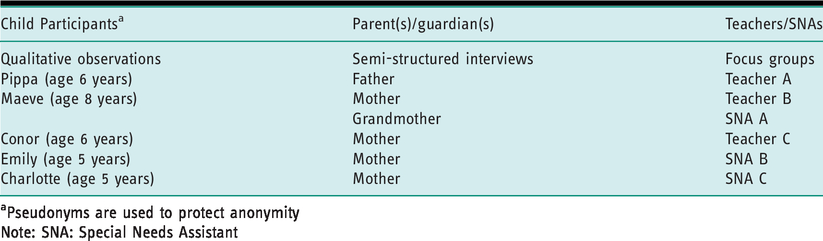
aPseudonyms are used to protect anonymityNote: SNA: Special Needs Assistant
All five children were wheelchair users, some were able to communicate but not using the spoken word, and none used communication systems. However, strategies were identified to elicit understanding of children’s experiences of play through the use of video observation of play events combined with insights from adults who knew them well. Therefore, the study was designed to combine observations of the child’s play with engagement with adults who knew the children to contribute as joint experts in the child’s play. While adults are frequently used as a proxy to provide a substitute perspective for the child (Sherifali and Pinelli, 2007), this study sought adult perspectives to facilitate interpretation of the meaning of the observed play occupation (Spitzer, 2003). This is an important consideration when the subjective meaning is difficult to ascertain among children who do not use the spoken word. Informed by Spitzer’s model for framing an occupation (2003), this approach reflects the interdependent nature of children. It acknowledges the role of the social environment in supporting play and facilitates interpretation of the play events being observed.
Data generation
Five semi-structured interviews were completed with five parents/guardians and one grandmother of a child participant in a location of their choice. Two focus groups were conducted with six teachers/Special Needs Assistants. Question guides were used, and the interviews/focus groups were audio-recorded and transcribed verbatim. Some classroom staff brought artefacts to the interview (for example toys/objects), which they spoke about in the group discussion. Observations of the children participating in object play were conducted within the school environment, facilitated by the onsite classroom staff. For these observations, particular attention focused on documenting the children’s non-verbal and verbal communication of pleasure/displeasure, joy or disengagement during each play event as a means of generating data on play experiences. Observations were video-recorded to enable analysis. Note-taking was not completed by researchers during observations to minimise potential impact on participants during observations. However, researchers formulated fieldnotes post-observation.
Measures
The Revised Knox Preschool Play Scale (RKPPS) (Jankovich et al., 2008), the Test of Environmental Supportiveness (ToES) and the Test of Playfulness (ToP) (Skard and Bundy, 2008) were used to inform the analytical approach by providing key considerations for analysis. While the RKPPS focuses on the developmental aspect of play (for example gross motor skills and language), the ToES assesses environmental factors influencing play, for example caregivers and objects. The ToP assesses the degree a child is playful and includes items such as ‘engages in playful mischief or teasing’ and ‘demonstrates positive affect during play’.
Data analysis
Analysis of the videoed child observations was an iterative process of describing and interpreting events and formulating notes. Firstly, videos were repeatedly reviewed and keywords identified to explain the captured processes. Videos were then transcribed by detailing the events of the video. Finding keywords that detail what is being researched was a vital step in the transcription of the videos (Lynch and Stanley, 2018). Through utilisation of the RKPPS, ToP and ToES (which appreciate the multiple contextual factors that influence the experience of play, for example social interaction, physical environment, child abilities), a more comprehensive and in-depth analysis of findings was possible (Reid et al., 2003). Narrative data were transcribed, and all data were combined. Thematic analysis was used to identify core themes (Braun and Clarke, 2006). Trustworthiness was sought through the use of multiple methods and researcher triangulation, member checking, provision of in-depth and thick description of findings, and use of an audit trail
Findings
Three core themes, each with two subthemes, emerged from analysis (Table 2). Pseudonyms are used throughout to ensure the anonymity of participants.
Themes and subthemes.

Play as occupation, play as an activity
Play was noted in the findings as embodying different purposes. This included process-orientated play (play as an occupation) and goal-orientated play (play as an activity). Both were recognised as valued play forms of significant meaning in the children’s occupational lives.
Play as an occupation concerned the fun aspect of play, which was a common feature observed within the classroom setting. For example, in one event where a teacher played a ‘peek-a-boo’ game with her pupils, the experience was described in terms of the pleasure and enjoyment it elicited: ‘like a big old towel or scarf or cloth and you throw it over them, and they have to find their way out … All kids love that kind of stuff’ (Teacher C).
Likewise, ‘play for play’s sake’ was emphasised in accounts of play that occurred within the home: ‘If you’re building a tower, she nearly finds it funny now to try and knock it down before you’ve had a chance to build it up properly – because that’s funny like!’ (Maeve's mother). In this example, Maeve’s mother describes a play event where Maeve shows agency and leads the play through mischievousness. This form of play was valued within the family culture: ‘In general, it’s just free play to have some fun’ (Pippa’s father).
Self-motivated play occupation controlled by the child also served a practical purpose, which provided added meaning to this form of play for the adults in the home. An enjoyable play experience may occupy the child for some time while their adult caregiver attends to other tasks. One parent remarked: ‘If we need a half an hour for cooking dinner … she’d empty the whole box [of toys and] play with it for a while’ (Pippa’s dad). Teachers also regarded having autonomous play as an important aspect of school life: ‘maybe it is about keeping somebody occupied for 10 minutes while I sort out the other two kids or whatever’ (SNA C). So, having enjoyable and independent play opportunities for the child was considered an important feature of childhood. Furthermore, the adult role in enabling autonomous play focused on orchestration of the play space as opposed to being involved directly in ‘doing-with’ social play.
Play as an activity was demonstrated in observations at school, with both parents and teaching staff utilising play as a medium for skill-development. Play as an activity is the most readily used play form within the educational setting; for example, a teacher was observed encouraging Pippa to grasp a brick and place it in a small hole in a box. The purpose of play in this instance was apparent: ‘the latest thing we are working on is their fine motor skills’ (Teacher A). However, the skill-development aspect was often disguised to make it more appealing: ‘We also bring out that stuff that looks like toys, but it could be so that they are grasping or choosing’ (SNA B).
Play objects that are seen to not sufficiently challenge and promote skill-development were not valued. For instance, the use of tablets was sometimes regarded as ‘a bad thing, because it doesn’t encourage them to build up their physical abilities, and you know the screen can only challenge them so much …’ (Teacher C). Yet this teacher valued screen play as a way to mediate the limitations experienced by these children: ‘For Conor to use his hands to lift a toy, you know that’s a huge amount of effort for him to do that, but that’s why I think they love the screens more so than [the] physical side of things cause it’s not as hard for them’ (Conor’s teacher, C). Parents spoke of the need to integrate object play into therapy: ‘Anything sensory, anything that makes a noise, anything that has a funny touch or feel on it – she loves that kind of stuff. They are stimulants for her in terms of physio even’ (Pippa’s father).
An empowering and empowered play partner
The significant role and influence of a partner in play was prevalent throughout the data, where it was more common that child participants were accompanied by a play partner in their engagement in object play rather than playing alone.
Play partners viewed themselves as play enablers more than reciprocal playmates. Positive play experiences were more associated with the centrality of the child in the play partnership and less associated with equal exchange and negotiating play preferences. In one event the child enjoyed throwing a ball and the teacher, acting as play enabler, complemented and elaborated on the play-action by turning it into a target game. The perceived role of the play enabler was fundamentally ‘to encourage them’ (Teacher C). Encouragement was presented in many forms, such as dramatic reactions to play: ‘You have to be like literally vaulting and handstands – and they absolutely love it’ (SNA A), and the response to mischief and teasing: ‘He’d drop [his toys] and you’d pick them up and then he’d laugh at you’ (Conor’s mother). These adults considered that by adopting the role of play enabler, the child is ‘empowered’ by being offered a sense of autonomy and independence, which, due to its scarcity, has added value for the child with a disability: ‘And I think, like the kids we’re working with are so vulnerable, like they do need a lot of help, so to give them that tiny little bit of independence, it means a lot to them! So, you have given them the opportunities’ (Teacher C).
It was also identified that certain traits regarding understanding and resourcefulness ‘empowered’ the play enabler to facilitate more positive play experiences for the child. Such findings were yielded from play observations, where the child’s play engagement, social participation and positive affect were observed to follow reciprocal responses from the adult playmate. Teachers and parents noted the importance of being familiar with the child through observing the child’s non-verbal communications, for example: ‘you can kinda read them by watching them after a while’ (Teacher C). An established familiarity with the play enabler was also considered important: ‘she would always go for the person … she’s had this charm’ (Emily's mother). In this case, Emily’s mother was commenting on the fact that Emily was drawn to a person who appealed to her and who she was both familiar and comfortable with. Familiarity was not the only empowering factor as an empowered play partner showed resourcefulness through repurposing objects – ‘I made him stress balls … out of balloons’ (Conor’s mother) – to promote positive play experiences, despite limited resources: ‘…going to become hoarders! … I might be able to use that’ (Teacher C). Overall, the adults adopted a supportive and nurturing approach rather than a directive, adult-led approach to promote play for these children.
Participation: the ‘just-right’ play object and environment
A prevailing theme among the findings was the positive influence of the ‘just-right’ play object and environment that appropriately challenges and stimulates the child. The safety and usability of the environment were crucial to ensuring the facilitation of a positive play experience, which included onlooker play.
The suitability of a toy or play object was found to be a factor in promoting positive play experiences. In one instance, Maeve was observed playing contently with a pink musical jewellery box with a rotating ballerina and a mirror on its lid, which was both attractive, ‘she likes girly things’ (Maeve’s mother), and stimulating, ‘something that spins … not too technical, basic enough’ (Maeve’s teacher, A), for the child. Parents and teaching staff alike spoke of the need to choose simple and not overly complicated toys. It was apparent that the play object must support the sensory preferences and motor capabilities of the particular child, and thus ‘ability-appropriate’ toys were selected over age-appropriate toys: ‘There’s no point buying age-appropriate toys because he’s not able for them’ (Conor’s mother), with teaching staff also stating: ‘I think a lot of the times in school they try to [be] age appropriate, which obviously in the severe and profound doesn’t match up’ (Conor’s SNA, B). Cause-and-effect toys were a favourite as they provided instant gratification and an atmosphere of anticipation: The Jack-in-the-Box, they would get to know the toy and they would anticipate that it’s going to pop up, some get excited, some get a bit scared or cover their ears … balloons are a favourite toy. They love the whole game of blowing the balloon up and then letting the balloon off around the room (Maeve’s teacher, A). As soon as she comes up into my arms … she will try and squeeze my nose, so that is play. So, we will do small things like blow on her face, pretend to sneeze, do raspberries … she loves it (Pippa’s father).
Participation was negatively impacted when the environment lacked comfort or was not familiar. For example, aversion to participation was observed when a child disengaged in object play in the presence of unfamiliar company, which resulted in decreased playful behaviours. Equally, the level of physical supportiveness of the environment was not always successful. For instance, while specialised seating was provided to compensate for physical impairment and enable table-top play, they sometimes served as a barrier to play participation: ‘Activity chairs do get in the way of interacting with each other’ (Maeve’s teacher, A). Specialised seating, albeit necessary, resulted in children being out of reach of other children and out of each other’s eyeline. Hence, this special equipment served as a physical barrier to social play in the classroom. Therefore, the environment and activity must be complementary to each other to enable a positive object play experience.
Play for these children often included watching, be it as an onlooker of others at play or a spectator of other visual stimuli. Indeed, play for this population is defined by one teacher as ‘a lot of watching and laughing at other things the other children would do’ (Maeve’s teacher, B). One parent noted that, particularly for the child with typically developing siblings, this play medium is present in everyday circumstance: ‘But if they want to play on their own, they will not bring her back … I say, “ok, you just stay here and be watching”. She loves that’ (Charlotte’s mother). In this example, while Charlotte did not engage at the same level as her siblings, they valued her presence and she was included in the play event. This was not only valued by her siblings and mother, it seems she herself valued it also.
Discussion
The purpose of this study was to explore factors in the physical and social environments of school and home that influence play for children living with severe physical and intellectual disabilities. This required an investigation into the context of play in these children’s occupational lives. Contrary to the belief that play cannot be truly experienced when activities focus on therapy, education or skill-development (Goodley and Runswick-Cole, 2010), the findings of this study suggest that play may be both process-orientated and/or goal-orientated depending on the player. Although play as an occupation more readily aligns with the definition of play in that it is child-led and improvisational, the findings indicate that play as an activity that is chosen and directed by an adult player may also classify as ‘true play’ for the child with SPID who experiences the play event. Goal-orientated activities may be accepted as play when the child’s engagement is process-orientated, rather than motivated by external reward, whereby the child is provided with an opportunity for autonomy (at least partly in control of the direction of play). The child’s play interaction is not bound by practical or reality constraints – they are engrossed in the activity. An example of this was given by the child who played with blocks. Parents and teachers in this study stressed the priority of skill acquisition for their children and used building blocks as an activity for skill-development. In contrast, the child seemed to experience it as fun and therefore as play. Therefore, the ultimate ideal of ‘striking the balance’ was identified, where play was concurrently adult-orchestrated yet appealing to the child. Furthermore, allowing the child to lead while the adult guided and scaffolded play was found to be elemental to achieving play balance, as is advocated in the literature (Lynch and Moore, 2016). The findings of this study therefore demonstrate that play events can combine play as an occupation and play as an activity, depending on the player’s subjective experiences. Both can ultimately provide value in benefiting children’s occupational lives.
Contextual factors that enhanced play included the play environment and the play object. For these children, the main form of play was object play, alongside manipulative play, body play and screenplay. Though toys are valued vehicles for play for all children (Levinovitz, 2017), the suitability and appeal of the play object is considered as particularly significant for children with disabilities. This is because they are often restricted in their abilities and opportunities to autonomously select and operate the play object. However, findings showed that unconventional purposing of objects into toys was also important, for example as observed in the teacher repurposing household materials. By integrating ‘non-toy’ toys into play choice, the child and play partner alike had access to more diverse play opportunities, which seemed to promote more playful interactions and positive play experiences. Parents and teachers modified and purposively designed toys and play spaces to enhance positive play experiences. The findings of this study showed that toy adaptation was more common than the use of universally designed toys, consistent with findings from Doctoroff (2001), for example.
For these children, play participation was evident from full engagement to structured onlooker play. However, onlooker play was a frequent and valued play process for these children, their parents and their teachers. Onlooker play has also been identified in other studies of children with disabilities and is a common form of play participation for them (see for example Graham et al., 2018). Notably, Polatajko et al. (2007) document that individuals can be fully engaged and participating within an activity despite limited performance. It has also been noted that play in general can include low-intensity activities such as watching others play (Lynch and Moore, 2016). However, there is a concern that children with disabilities are often assigned the role of onlooker in play without choice. Yet, if the role of the onlooker is assumed rather than assigned, onlooker play may be recognised as a valid play form. This means that for onlooker play to be an authentic form of engagement, it requires internal control, freedom and agency of the child who chooses to be the onlooker. This does not reduce the need for adults to maximise the potential for other forms of engagement and to find solutions for children with SPID. However, it is important to accept onlooker play as a significant contributor to belonging – being involved and feeling included (Hoogsteen and Woodgate, 2010).
Findings in this study are reflective of the literature in that play for children with disabilities is qualitatively different from that of their typically developing peers (Graham et al., 2018). Key to this difference is the existence of a supportive and nurturing approach by the adult play partners. Adults in this study demonstrated how they empowered their child to play through their own playful approach, resourcefulness and orchestration of play events and environments. For these children, positive play experiences were closely associated with the involvement and contribution of an adult or older child, as opposed to solitary play or peer play, similar to previous research (Cook et al., 2000; Crawford et al., 2014; Frey and Kaiser, 2011). This may be because adults and older children are more responsive to the play needs of the child with SPID than their peers. As such, they more readily undertake the role of a play enabler over that of a reciprocal partner. The need for adults or older siblings to facilitate play for children with disabilities is a common theme within the literature (Graham et al., 2018). This contrasts with studies of play with typically developing children, who reported an activity to be more characteristic of play when no adult is present (McInnes et al., 2009).
The findings of this study elaborate on the existing evidence in demonstrating that a play partner who is both empowering and empowered can promote successful play experiences for the child with SPID. By enabling autonomy and control for the child and possessing specific favourable characteristics in their playstyle and delivery, the child’s engagement was increased and enjoyment was elicited. The characteristics of adult players included warmth, sensitivity to the play preferences of the child, creativity in designing play events, and awareness of novelty and fun elements of play. Equally important was the focus on ‘playing-with’ and not ‘doing-to’, as noted in other studies (Frey and Kaiser, 2011). Furthermore, the valuing of autonomous play and orchestrating the play environment to maximise this autonomy was also evident. While play events were often moments unscheduled or unplanned, many were carefully structured to maximise children’s engagement. Overall, it was evident that a resourceful and creative play partner had the power to mediate and overcome barriers to participation.
Implications
Occupational therapists who work with children and their families are encouraged to consider enhancing play for play’s sake, i.e. play as occupation, and review with families the time that is being spent ‘playing freely, alone, with peers or family, and just being a “kid”’ (Harkness and Bundy, 2001: 85). Furthermore, intervention to increase the child’s play opportunities should be considered in context, and support provided to families to provide efficient ways to promote play engagement and participation for children with disabilities (Hamm, 2006).
Limitations
The challenge of accessing the meaning of play for these children living with SPID was a limitation of this study. However, by employing Spitzer’s approach to framing an occupation (2003), it was ensured that multiple forms of data were sought: the child was involved in data generation, as well as their parents and teachers/SNAs, reflecting the strong emphasis on adults’ participation in these children’s play (Brodin, 2005). This study used a small sample of participants, which could potentially reduce the transferability of the findings. While videoing participant observations is an effective method of generating data, there are also limitations to consider, such as the impact of the researcher as a participant–observer, and the influence of their presence in the natural environment, which can be a barrier to play (Lynch and Stanley, 2018).
Further areas of work
The study recognises play occupation as reflective of the subjective enjoyment that ensues for the child, as opposed to skill-development, where adults are called to be both empowered and empowering during play interactions. However, this finding is difficult to truly ascertain without knowledge of the child’s experiences of play, which are not adequately explored to date (Graham et al., 2018). Further research is required to elicit and understand experiences of children with SPID. Longitudinal studies are needed to gain more depth to understand the child’s communication styles and play experiences. Further exploration of flexible research methods to achieve this would be valuable. There is an ongoing need to examine the role of the human and non-human environment and the effect that this has on playfulness (Hamm, 2006, Harkness and Bundy, 2001).
Conclusion
This study identified multiple factors in the physical and social environment that enhance play for children with SPID. Findings revealed that offering opportunities for autonomy and self-directed play led to increased positive object play experiences for these children. The suitability of the toy and play space was deemed a critical component to ensuring a positive experience. Furthermore, the utilisation of non-toys or objects and the practice of onlooker play that could be enhanced by the supportiveness of the physical environment were identified.
Fundamentally, positive play experiences were enhanced through the maximisation of resources and minimisation of contextual constraints. Therefore, the pivotal role of a play enabler was central to enabling play occupation for these children with SPID. Central to successful play was the influence of an empowering and empowered play partner, who was ‘doing-with’ and orchestrating the play, with insights into the suitability of the object and environment for the child, and a commitment to play for fun, for the health and wellbeing of these children.
Key findings
Empowering play partners are pivotal in promoting successful play experiences for children with SPID. Onlooker play is a form of participation when the onlooker role is assumed, not assigned.
What the study has added
Although the findings are specific to this study, play facilitators may use them to inform future play interactions through an enhanced understanding of empowerment and enablement for successful play occupation.
Footnotes
Acknowledgements
The authors wish to thank Alice Moore for her assistance with proofreading and editing this manuscript. The authors would also like to thank the Department of Occupational Therapy, Cope Foundation, gatekeepers, and all participants for their contribution to this study.
Research ethics
Ethical approval was obtained for this study from the Social Ethics Research Committee in University College Cork (CT-SREC-2017-18) and also from Community-Academic Research Links in University College Cork, both in 2017.
Consent
All adult participants provided written informed consent for their participation in the study. In addition to parental consent, assent from children was also sought through their preferred communication styles. Also, a process of ongoing consent was employed during observations with children.
Declaration of conflicting interests
The author(s) declared no potential conflicts of interest with respect to the research, authorship, and/or publication of this article.
Funding
The author(s) received no financial support for the research, authorship, and/or publication of this article.
Contributorship
Deirdre O’Connor, Alison Butler, and Dr. Helen Lynch conceived the study in association with Cope Foundation Occupational Therapists. All authors designed the study, gained ethical approval, completed data collection and analysis. All authors were involved in writing the first draft of the manuscript. Deirdre O’Connor and Dr. Helen Lynch were involved in editing of the manuscript. All authors then approved the final version.
