




Abstract
This article discusses the different socio-economic legislation that the Canadian federal government introduced or passed during this inflation crisis. Its discourse is positioned in relation to existing and past social realities. Reflecting on the ontology of these laws, this article suggests that the federal government has displayed a sense of normative leadership toward citizens. Moreover, this institutional dynamic should not be perceived as a paradigm shift from its political economy of neoliberalism. That said, this study also offers few directions for future research on the significance of examining legal texts as artifacts of public governance and crisis management.
Introduction
In the past three years, Canada has witnessed a systemic inflation crisis never experienced before by its citizens since the worst recession of the early 1990s (Statistics Canada 2023). Inflation began picking up in early 2021 and has led to the rise of food price and housing cost. It has created a dire socio-economic situation where 44% of Canadians believe that they cannot afford housing cost such as rent or mortgage. Moreover, the federal government has not been passive in the face of the socio-economic challenges that have intensified during this crisis. To that end, this article aims to discuss the social policy interventions introduced or passed by the federal government during this crisis time in the form of legislation at the macro level. This is a relevant question to address given that in the field of public administration, law remains an omitted variable despite providing a set of decision rules and politics, and shaping decision-making arrangements (Amsler 2016: 703). This represents an epistemological contradiction given that law is one of the social science disciplines from which public administration originated (McDonald et al. 2022).
For clarity purpose, it is important to note that this article does not seek to identify the gaps between formal legal systems and how laws operate in society. This article is structured into three parts and is informed by the literature of multiple social sciences disciplines. The first part addresses the question of the relevancy of this article as informed by the state of research on public law. The second part discusses the institutional context and the method of policy analysis. In the third part, the political economy undertaken by the federal government in light of recent laws passed to address the socio-economic issues caused by this inflation crisis is discussed and situated within the context of past and present political economy.
Literature review and theoretical lens
Political leadership and crisis legislation
The first argument to why examining federal legislative interventions during this inflation crisis matters is that this institutional reality has not been discussed by scholars in relation to the Canadian public sector context. Nonetheless, there are few scholars who have addressed the question of legislation introduced during crisis with regard to state actions in other industrialized democracies. Among the leading themes addressed by these scholars are the roles of emergency power, the suspension of individual civil liberties, and the suspension of economic rules (Atiles & Whyte 2023). Of these themes, most of the research has focused on analyzing the risk that emergency laws pose in violating the constitutional order. For example, Cormacain (2020) has published an article in the journal of Theory and Practice of Legislation where he argues for the need to implement emergency legislation in such a way that ordinary laws are not subverted. He posits that these contingency laws should be implemented temporarily and not become de jure jurisdiction. Edgell et al. (2021) present a discourse on crisis that positions the pandemic as a period that gave states an upper hand to engage in undemocratic leadership practices. In theoretical terms, this means that crises often lead to the ‘authoritarianization’ of political leaders.
The second argument to why interpreting federal public legislation is relevant is because legal ideas have sociological meanings. This argument is informed by Cotterrell’s (1999) work on why legal ideas must be interpreted sociologically. He argued that laws are social texts and reinforces modes of understanding of social reality (p. 12). Laws can systemically and empirically be interpreted as a social phenomenon, not just as a legal doctrine. By empirically, he means that the social phenomena of law can be understood in actual historical patterns and not in abstraction. The notion of systematically is defined in terms of interpreting the particularities of law in relation to other perspectives that are relevant to law. Equally, Petrazycki’s argument that law can be studied as a variety of forms of consciousness and through introspection reinforces the relevancy of this article (Cotterrell 1999).
Third, this article presents an opportunity to extend the scope of understanding the Canadian federal government beyond the ideas of power, austerity culture, electronic governance, and New Public Management (Glor 2001). Austerity culture was one of the leading themes that dominated scholarly debates until the end of the Harper administration. It was studied in conjunction with New Public Management (NPM) introduced in policy domains since the Clark and Pierre Trudeau administrations and the adoption of free trade with the United States in 1989 (Glor 2001). But today, similar to public administration scholars in other countries, the interest of domestic scholars is moving away from NPA to new epistemological terrains (e.g. New Public Governance). In addition to the aforementioned goal, this article also seek to partially respond to the critique raised by Carboni et al. (2019) who pointed out that public administration research is distant or disconnected from social issues. Our field lags beyond the disciplines of sociology and political science where scholars have examined economic crisis in intersection with social policy. These scholars have presented economic crisis as a cause of welfare retrenchment rather than expansion. Crises are perceived as a driving force for the development of new institutions (Lampropoulou 2020). Even when the responses of central governments to economic crises are engineered to provide public goods, the model of policy interventions is usually informed by neoliberal values.
Moreover, it is fundamental to note that policy preferences are often influenced by political affiliation or ideology. Compared to Conservative parties who support the residual welfare model, Progressive or Leftist parties are more likely to adopt legislation that sustain the institutional welfare model. This dichotomy is highlighted by Beland and Oloomi (2017) and Hausermann et al. (2013) in their work on distributive politics and public spending. The first comparative analyses regarding the effect of political parties on distributive policies were presented by Douglas Hibbs, Edward Tufte, and Cristopher Hewitt in the late 1970s (Hausermann et al. 2013: 224). One of the theories dominating the literature on this variable of public policy is partisan politics theory. Plus, election timing or voters also influence the government’s social policy orientations (Hooghe et al. 2019). For that reason and to provide meanings to its narrative, this article discusses these legislation in relation to the agencies of Canadian political leaders and parties leading the federal government and represented in the national parliament.
Theoretical framework and lens
Critical theory is applied as a theoretical framework to discuss legislation of social policy nature because it is suitable to the purpose of this article. This theory is chosen because public administration is an interdisciplinary discipline that relies on other social science theories and methods. More importantly, it argues that scholars should view social structures as vehicles of domination and oppression of citizens (Box 2015). Rooted in the Marxist tradition of the Frankfort School, this theory is suitable for discussing social problems in an explanatory, practical, and normative manner. The first generation of scholars (e.g. Herbert Marcuse, Max Horkheimer) who pioneered this Hegelian philosophical idea (Delanty 2020) chiefly focused their critical endeavor on the questions of power, social order, and communication. According to Horkheimer (2002), an authentic application of this theory should encompass framing the narrative of social issues within a historical context. It should seek to offer a holistic critique by incorporating insights from all social sciences. In the second generation, Habermas was one of the leading proponents of critical theory (Geuss 1981). Like Horkheimer, Habermas also stressed the importance of using a socio-historical approach in explaining socio-economic and political realities. Over the past decades, scholars in sociology and political science have also espoused the same approach in their application of critical theory. Likewise, I decided to use a historical frame by discussing recent crisis time legislation in relation to past government policies to provide meanings to these legislations. But according to Box (2015), with a few exceptions, critical theory ‘has largely been ignored in public administration, a field in which people concentrate on micro implementation rather than macro societal context and often avoid questioning of oppressive or inequitable structures and practices’ (p. 3).
While public administration scholars continue to show little interest in espousing this theoretical construct, scholars in public policy have applied it in investigating governmental operations related to the privatization of public services and austerity culture. Within that scholarly realm, the dominant discourse held by public policy scholars is that government systems or policies are biased against citizens and are much more engineered to promote and protect the interests of corporations and the elites or capitalist forces at large. The consensus held among these scholars is that the neoliberal political economy that was supposed to improve social conditions and the welfare of citizens has failed to live up to those democratic values. It has instead contributed to what Habermas termed the disintegration of ‘public sphere’. In leadership research, scholars (e.g., Cels 2017) too have been critical of the state of politics. But they have done so in relation to ethical leadership and other leadership theories rather than from the angle of critical theory. The focus of their research has been on the questions of good governance and public trust. Moreover, Delanty (2020) argues that critical theory has failed to offer a robust and specific theory of society. The early Frankfurt school’s scholars chiefly promoted a tradition of ideology and cultural critique rather than empirical sociology. Despite this limitation, Delanty (2020) still believes that this theory offers better insights into today’s socio-political challenges. Arguably, interpreting the agencies of federal institutions through the prism of this theory can offer another insight into national governance systems.
It is fundamental to stress that critical theory is applied in this article from a functionalist perspective that is concerned with the question of how societies maintain internal stability and survive over time (Smith 2010). In explicit terms, the role of the federal government is critically examined and discussed in relation to the agencies of political leaders as providers of public goods. Therefore, the discursive tone used herein is more unitarist, normative, and less radical or idealistically utopian. It is geared toward developing an understanding of public affairs and the state that is encapsulated in the prism of constructive criticism. Finally, I would like to emphasize that critical theory is not applied herein with the intent of contributing to scholarly debates underscoring its theorization among contemporary scholars.
Methodological framework
Federal governance context
Before delving in the analysis of legislation introduced during this inflation, it is essential to situate the system of governance under which these laws are enacted and passed. The first element that needs to be highlighted is that Canada is a parliamentary democracy. This system of governance is modeled on the British Westminster system and operates as a bicameral legislative system with two deliberative houses: The House of Commons and the Senate. The House of Commons is comprised of parliamentarians directly elected by the constituents at the local level. The Senate is composed of individuals appointed by the Governor General to represent provincial jurisdictions and territories. Laws are chiefly debated and passed in the House Commons before moving to the Senate for scrutiny. Historically, parliamentarians have mostly come from the rank of three political parties: Liberals, Conservatives, and New Democrats (also referred as the NDP). The rules under which these institutions operate are set in the Constitution Act of 1982. The incumbent government is led by Prime Minister Justin Trudeau. It was essential to briefly delineate these stakeholders because the discourse provided in this article evolves around the agencies of these institutions. The second and last element is the need to provide clear boundaries given that Canada has a decentralized system of governance with subnational governments having the power to introduce legislation at the provincial level. Drawing boundaries is a necessary step to narrow down the narrative of this article and make it clearer.
Legal data search and analysis
In terms of method, the basic needs approach (BNA) was applied herein to search and identify crisis legislation data. The institutional origins of this economic approach go back to the 1976 International Labor Organization’s (ILO) World Employment Conference (Reinert 2021). While BNA has been extensively used by scholars in the 20th century, this concept has been neglected by today’s economics. This paradigm shift could be tied to the rise of neoliberalism and the erosion of the welfare state that have influenced scholarly discourses since the 1980s. This period marks the end of the Keynesian economics era that dominated the political economy of many Western democracies in the aftermath of World War II. But today, there is an increasing number of scholars (e.g. Chohan 2022) who are arguing for the return of Keynesian-style state interventions to address the societal challenges created by today’s crises. They argue that the market economic model promulgated by the critics (e.g. Milton Friedman) of the welfare state is inadequate to address today’s socio-economic challenges. Their rationale is informed by the belief that the private sector has failed to adequately address human needs through economic growth. It has instead created more social inequalities through the unequal distribution of wealth.
Reflecting on the work of early scholars, the application of BNA herein was informed by the typology developed by Streeten (1979). He classified human needs into six categories: food, healthcare, housing, water supply, education and clothing. Following the search of the database of the Canadian House of Commons through this typology, only the socio-economic legislation addressing healthcare, food, education, and housing affordability were identified. It is important to stress that the search was limited to legislation recently passed or in the process of being passed. In total, N = 6 legislation or bills of social policy nature were identified from the records of the House of Commons (see Figure 1). A thematic analysis was applied through the lens of critical theory to subtract the meanings and objectives of those laws. The discussion of these meanings was situated within the historical context of the political economy of the Canadian government and the socio-economic reality created by this inflation crisis.
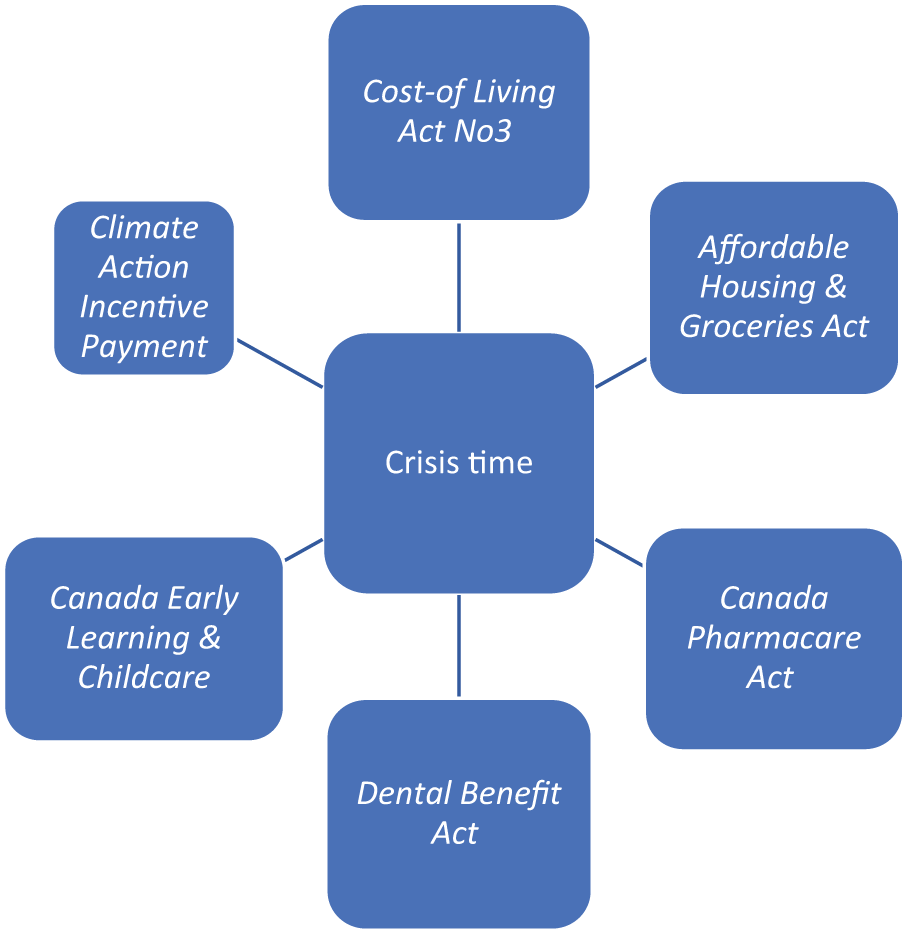
Federal legislation passed during inflation.
Public governance and macro-policy interventions
Housing affordability plan
The most significant legislation that was introduced by the federal government to deal with the issue of housing affordability during this inflation is the Affordable Housing and Groceries Act (also referred as Bill C-56). It was passed by the House of Commons in the Fall of 2023 following the amendment of the Excise Tax Act and Competition Act. Just like in Canada, governments in the United States, Europe, emerging markets, and developing countries are dealing with the same issue. For example, in the United Kingdom, the Affordable Housing Act 2021 was passed by political leaders to address the issue of housing. In passing Bill C-56, the Trudeau administration had two objectives to achieve. The first objective is to temporarily remove the goods and services tax (GST) on new residential rental developments. In financial terms, home builders will receive 36% of the GST or federal portion of the HST paid on a newly constructed home, up to a maximum of $6,300. The second objective is to regulate competition practices in the corporate sector to mitigate the monopolization of consumer markets by some firms. Arguably, this legislation acts as a check-and balance against corporate power. It is an artifact of collaborative governance given that it extends the influence of the federal government in regulating corporate behaviors. This artifact is underscored by the increasing power that is given to the Competitive Bureau and the Minister of Industry in investigating the malpractices (e.g. grocery price increase) of retail firms. Simply put, this legislation reinforces the culture of corporate accountability.
Moreover, the intent of political leaders in introducing Bill C-56 could be tied to the influence of followership on political decisions. Prior to the drafting of this legislation, Trudeau argued against the idea of the federal government getting involved on the issue of housing. His rationale is structured on the premise that housing falls under the responsibility of provincial governments. However, he changed his mind following the result of a polling of public opinions revealed that 40% of Canadians think his leadership is to be blamed for housing unaffordability (Ritchie 2023). Based on this factor, it could be argued that the crisis management approach adopted by the government is of a reactionary nature. This interpretation is substantiated by a 2006 report published by the Wellesley Institute (a think tank) that suggests that there was no national coordination on housing in Canada. Hence, this legislation can be defined as an indirect outcome of what political scientists (Hill & Hinton-Anderson 1995) theorize as an opinion-policy linkage process. Notably, this legislation represents an epitome of how mass opinion can play a positive role in influencing and reshaping elite opinion and public policies.
This inflation represents a policy U-turn given that the federal government disengaged from initiating affordable housing programs since the 1980s. From 1984 to 1993, the federal government cut almost $2 billion from housing programs. In 1993, it canceled funding for new housing units, and in 1996, it outsourced all the responsibilities of managing housing programs to provincial jurisdictions. In 1998, the federal government amended the National Housing Act to reduce the role of Canadian Mortgage and Housing Corporation (CMHC) in affordable housing initiatives (as reported by the Wellesley Institute 2006). The CMHC is a federal crown corporation that was founded since 1946 with the mandate to improve housing accessibility and conditions of Canadian citizens following the crisis of World War II. This implies that the issue of housing unaffordability is not a novel societal issue.
However, the clauses contained in Bill C-56 suggest that the government supports a corporate centric view of addressing the status quo. This is evidenced by the fact that developers are provided tax incentives to build new rental units in a housing market that is already controlled by the private sector (Thomas 2023). A report by the Office of the Federal Housing Advocate (2022) pointed out that this financialization of housing is contributing to rent increase as firms are driven by profits. It had advised the federal government, a year ago, to eliminate favorable tax incentives for these corporate actors. For that reason, the best way to address socio-economic issues during this crisis could be for the government to turn to the post war leadership strategies that led to the construction of affordable housings between 1941 and 1947 (Wade 1986). These strategies involve espousing a directive leadership approach (public sector run development process) rather than a delegative leadership approach (outsourcing the construction of housings to the private sector). Finally, it is also important to stress that Bill C-56 is a multifaced legislation as it is also intended to address the issue of food affordability. But prior to its introduction, the Cost-of-Living Act was passed by the House of Commons in the Spring of 2023 for the same purpose.
Food rebate and regulation
The Cost-of Living Act No3 or Grocery Rebate Bill C-46 was tailored to mitigate the negative spillover effects of inflation on 11 million low- and modest-income Canadian families through a grocery rebate plan. The government promised to spend $2.5 billion to meet that social policy objective. This legislation is an amendment of the Federal-Provincial Fiscal Arrangements Act. But it has come under criticism from advocacy groups on the idea that it only offers a one-time payment to Canadians and does not address the underlying problems of food security. Policy practitioners at the Institute for Research on Public Policy (IRPP) and Affordability Action Council (2023) have advised the federal government to provide additional income to low-income households. They justify their policy recommendation on the idea that the lack of income is one of the main sources of food insecurity. Simply put, they support a long-term strategy rather than a short plan on addressing the issue of food security. This policy perspective is logical given that the problem of low-wages is a perennial issue that is partly caused by the imbalance that exists between wages and inflations. Since the 1980s, the level of income has not increased at the same rate with workers’ purchasing power. Based on this economic factor, it could be argued that Bill C-46 reveals that the federal government does not have a longitudinal leadership vision of achieving social justice in the area of food security.
Moreover, in line with the objectives of this legislation, the federal government has succeeded in bargaining with grocery chains to reduce food prices. It has set up a Grocery Task Force to monitor the market practices of these firms. Trudeau has warned these firms that they will face additional taxes if they refuse to stabilize food prices. This means that the government has adopted a transactional leadership approach in dealing with the retail industry. But opposition parties (Conservatives, NDP) argue that this measure will not be effective enough in reducing food cost. However, the alternative policies proposed by these opposition parties are informed by political ideologies. Those on the Left want higher corporate taxation while those on the Right want more corporate tax cuts. Nonetheless, there is evidence-based research transcending political partisanship that infers that the language of Bill C-46 does not provide a holistic discourse on how to effectively address food insecurity. For example, the 13th edition of Canada’s Food Price Report, published by researchers from Dalhousie et al. (2022), notes that the overall food price of 5% is not only the outcome of corporate pricing behavior but also a consequence of supply chain disruptions at the international level. Climate change, rising geopolitical tensions, high energy prices, and a falling Canadian dollar are all contributing to food price increase. But Bill C-46 and Bill C-56 have fallen short from recognizing and addressing those non ‘greedflation’ contingency factors.
Bill C-46 does not only encompass the leadership behavior of a federal government that is only directed at mandating external actors (firms) to perform their social moral role, but is also self-reliant as it provides a cash transfer to low-income families to offset food costs. Some scholars (Stephens et al. 2023) perceive this subsidy as a path toward the development of a basic income model. They argue so on the belief that the direct cash transfer to low-income households moves away from the charitable approach that has historically characterized government responses to food insecurity. Families are provided with the freedom to spend this financial support on anything without being bounded to only buying food. However, it is important to admit that there are no simple ways for the federal government to address the problem food affordability given its complexity. Developing legislation that encompass all the above causal economic factors will raise the stakes for policymakers. This rationale is theoretically substantiated by research that show that crises have multiple co-occurring multi-layered networks and path-dependent causal processes. Systemic crises are much more difficult to solve than those that are less complex. But if not managed successfully, these crises can have long-term impacts on society to the extent of causing collapse in the social systems and the economy (Wernli et al. 2023).
Democratization of dental care
On healthcare, the Dental Benefit Act is the main cost-of-living relief measure introduced by the federal government during this inflation to help families offset healthcare costs. It was introduced in 2022 as part 1 of Bill C-31 to provide dental services to uninsured children under 12 years old of age. It is estimated that its implementation nationwide will cost $13 billion in public spending. Moreover, only families who make less than $90,000 can qualify for this insurance program. This legislation is a result of collaborative or bipartisan leadership between the Liberals and NDP. It is a trade-off legislation that the Liberal minority government agreed to adopt in exchange for receiving the support of NDP to stay in power. This healthcare policy was first initiated and had been advocated for years by the NDP. In the 1970s, for instance, at the provincial level, the Blakeney NDP government in Saskatchewan pushed for the need to provide a publicly funded dental program for school children with the goal of extending it to the whole population (Conway & Conway 2015). In 1999, the Liberal Prime Minister Jean Chretien and the premiers of most provinces signed the Social Union Framework Agreement where they stated that the delivery of healthcare services should be informed by the principles of universality and accessibility. Although conducted more than a decade ago, findings of a survey study by Quinonez and Locker (2007) suggest that public opinions had been in support of such legislation before its introduction by the federal government. Two-thirds of Canadians who took part in that survey stated that they want access to a publicly financed dental care system.
Plus, the idea of developing a universal dental care system was recommended by the 1964 Royal Commission on Health Services that helped shape the Canadian health care system but has yet to become a part of publicly financed health care (McClymont 2015). For decades, 95% of dental spending in Canada had come from work-related insurance and out-of-pocket payments. Only 5% of this spending came from government programs and this share is lower than that represented by the government in the United States. More than one in three Canadians lack dental insurance, and one in five abstain from seeking dental treatment because of financial hardship. But it appears that this vision has been achieved at the federal level given that Trudeau has just introduced a universal Canadian Dental Care Plan. This policy is an extension of the Dental Benefit Act as it extends dental coverage to all middle and low-income Canadians. It represents a paradigm shift from a private centered payment system to a publicly centered payment model.
However, 57% dentists are opposed to this nationalization policy with 33% planning to reduce the amount of public insurance in their practice (Levy et al. 2023). This perspective differential infers that there is an ideological divide between patients and care providers. Professional resistance to change is partly related to the fact that the process leading to the development of this legislation was chiefly driven by negotiations between government representatives and the Canadian Dental Association at the national level without including provincial dental associations. This means that the process of interorganizational collaboration leading to the design of this legislation was more vertical than horizontal. Dentists in provincial associations felt left out of the process and want to understand how the federal government plans to avert private insurers and employers from overhauling their existing coverage for low- and middle-income families and refer patients to the federal plan. They also wanted to know how the new universal dental care program will coordinate with existing public coverage provided by the federal, provincial, and municipal governments (Osman 2023). This reaction suggests that there is some level of policy dissonance with regards to the interpretation of this legislation among care providers. It is, therefore, essential for the federal government to develop clear policies and procedures to help external stakeholders on how they can harmoniously interpret this legislation. Doing so is essential because research suggests that the lack of clarity can lead to policy failure during the implementation process. If not addressed, it can lead to gaps in the understanding between national and local narratives in a healthcare system that is already decentralized (Hudson et al. 2019). Overall, this legislation represents a political will that implies that this inflation crisis has provided political leaders with the opportunity to address some of the core social needs that remained neglected over the past decades.
Universal pharmacare
Analogous to the Dental Benefit Act, Canada Pharmacare Act is another hallmark legislation that the federal government has introduced during this inflation crisis to address the issue of financial hardship. It is also a product of bipartisan collaborative leadership between the Liberals and the NDP. It was enacted in June 2023 and passed in February 2024 by political leaders of both parties through the introduction of Bill C-340 to set conditions and criteria of drug insurance plans. The goal underlying this legislation is to facilitate access to prescription drugs without financial or other barriers. According to the advisory agency (Council of Canadians) who designed and recommended this policy to the House of Commons, it sets a framework of a single payer public pharma care system. It is estimated that it will reduce the spending of Canadians on prescription drugs by $5 billion a year. However, this estimation seems to be contradictory to what the report of Parliamentary Budget Officer (PBO) has predicted. The PBO has pointed out that this legislation will be costly for federal and provincial governments. In financial terms, it will cost taxpayers $33.2 billion in fiscal 2024–2025, climbing to $38.9 billion in fiscal 2027–2028. But the problem of cost increase is not unique to this legislation given that total spending on prescription drugs in Canada already grew under the private insurance model. It, for example, increased from $3.5 billion in 1980 to $27.2 billion in 2011 (Morgan & Daw 2012).
From an historical and comparative point of view, this legislation tackles a social issue that the federal government had failed to do address since the Hall Commission of 1964, National Forum of 1997, and Romanow Commission of 2002 on the proposal of making the coverage of prescription drugs universal. This reform was not done during those years due to government resistance to such a change (Morgan & Boothe 2016). This attitude has chiefly been harbored by political leaders affiliated to the Liberal and Conservative parties. However, a recent polling study shows that there is a lack of public awareness on this legislation among citizens as 53% of surveyed participants mentioned that they were unfamiliar with this reform. This does not mean that they oppose this legislation given that findings of a 2015 national survey shows that 91% of Canadians supported the idea of a national pharmacare plan (Morgan & Boothe 2016).
For the time being, the delay in the passing of this legislation is causing frustration among policy practitioners and advocacy groups. This frustration has, for example, been expressed by one of the representatives of the Council of Canadians in the statement below. This statement can be interpreted as an indicator suggesting that the federal government is not very proactive in pushing for this legislation. From a theoretical point of view, this delay can be explained by what public administration scholars call the contingencies surrounding policy issues. There is no one size fit all process as ‘a number of variables can rise (or diminish) in importance as a function of other defining parameters’ (DeLeon & DeLeon 2002: 471). Yet, there is hope that this legislation will be passed by House of Commons and Senate as Trudeau has promised to implement it by 2024: It’s really hard to understand why it’s taken so long. Every day of delay means more people are going without their medication. There doesn’t seem to be that much urgency on the side of the government when we know how important this is for so many Canadians who are struggling with high drug costs. (Barry-Shaw, pharmacare campaigner at The Council of Canadians, CBC 2023)
While Pharmacare Act sets Canada on the right path, the federal government has not addressed all the values that citizens ascribed to healthcare. One of these values is that there is a greater need for shorter wait time for medical treatment in hospitals. A survey study completed by Leger during this inflation crisis shows that Canadians prioritize that basic need over pharmacare (Osman 2023). According to the Fraser Institute, the national average wait time to receive treatment is higher in Canada, namely 19.8 weeks (Barua & Jacques 2019). For that reason, Canadians want the government to provide more funding and build the healthcare infrastructure needed to resolve this systemic issue. Another study shows that public trust or confidence in the leadership of the government on handling healthcare issues in this time of crisis is low (Herati et al. 2023). Reflecting on this policy gap, it is logical to deduce that the federal government has employed a piecemeal legislative leadership approach to address the socio-economic needs of Canadians during this inflation.
The provision of energy and education subsidies
On the issue of energy cost, the federal government has decided to double the pollution price rebate (Climate Action Incentive Payment), from 10% to 20%. In simple terms, it is a tax-free benefit paid to help families offset the cost of the federal pollution pricing or the carbon tax. This policy will take effect on April 2024 and will especially benefit households in rural communities. It is a temporally program and is set to expire in 2027 (Office of Prime Minister 2023). Critics argue that instead of providing a temporary rebate, the government should instead scrap the carbon tax that was introduced when the Greenhouse Gas Pollution Pricing Act was passed in 2020. This Act was initiated by Trudeau to comply with the 2015 Paris Agreement on climate change. It has been subject of criticism from business leaders and Conservatives to the extent that this issue was sent to the Supreme Court of Canada for ruling. According to data from the Canadian Federation of Independent Business (2023), 85% of businesses are opposed to this tax policy. In early 2021, the court ruled that it was constitutional for the Trudeau administration to introduce this clean energy legislation. Once the Climate Action Incentive Payment expired, Canadian families will be required to pay the carbon tax. Arguably, this inflation crisis has not altered the ecological leadership values of the federal government. This institutional behavior can be explained by the assumption that for years, the Canadian government has been criticized for failing to reduce its greenhouse emissions target since when the Liberal Prime Minister Jean Chretien signed the Kyoto protocol in 2002 (Smith 2009). For that reason, Trudeau might have felt pressured to provide an ecological leadership that is not complacent.
It is important to note that the posture of the Conservative party today should not be conflated with the belief that they oppose the Kyoto protocol given that the Progressive Conservative Prime Minister Mulroney was one of the first Canadian political leaders at the international level to advocate for climate change in the late 1980s. In 1988, during the conference on the ‘Changing Atmosphere: Implications for Global Security’ held in Toronto, Mulroney called for a law on environmental sustainability and told delegates that ‘we all belong to one human family, and we are all in this together’ (Smith 2009). But questions remain to what extent the Climate Action Incentive Payment can reduce the rate (19%) of energy poverty that has been rising since 2013 across Canada. A number of economic studies partly associate this issue with the privatization of public services implemented in the past decades by subnational governments. In Ontario, for example, an Angus Reid Institute’s (2017) poll on public opinions conducted 6 years ago, showed that 76% of respondents believed that the sale of Hydro One to private investors will drive up the price of energy. In the same vein, a 2015 government poll showed that 73% of Ontarians oppose the privatization of Hydro One and wanted it to remain publicly own. Yet, despite these polling results, the provincial government under the leadership of the Liberal Premier Katherine Wynn decided to sell 60% of Hydro One to private sector actors (Cohn 2017). Arguably, this inflation crisis has only heightened the consequences of past poor public policies that have been accumulating over the past decade. It is, therefore, fundamental for the federal government to influence subnational governments to de-privatize the electricity sector to better serve public interests.
Pertaining to education, the federal government has implemented a $10 daily payment plan for early learning and childcare. A budget of $30 billion for a 5-year childcare plan is allocated to finance this social policy program. This measure is part of Bill-C35 or Canada Early Learning and Child Care Act that was passed on June 2023 by the House of Commons after a third reading. Compared to the above energy rebate plan, the government is committed to providing a long-term funding for this legislation. It provides a sense of policy harmonization given that only Quebec had such an affordability plan ($8 per day) for children. In most anglophone provinces (e.g. Ontario, British Columbia), childcare is unaffordable as families paid around $50 a day to have access to this basic service. This subsidy could lead to positive social outcomes considering that studies (e.g. White 2001) show that affordable childcare contributes to the improvement of women participation in the labor market. Just in Ontario, it is predicted that 100,000 more women will enter the workforce due to $10-a-day childcare. In subsidizing childcare, the federal government may be able to close the gap on early learning spending with countries such as Sweden and Iceland. Canada spends just 0.5% of its GDP and has been lagging in funding children education. In contrast, Sweden and Iceland spend 1.6%–1.8% of their GDP on affordable childcare. But, as epitomized in the following anecdotal statements, the Canadian federal government has decided to make chilcare a top policy priority during this crisis: As global market forces and inflation continue to hit Canadians, too many families are feeling the pressure on their monthly bills. Already, the Government of Canada has taken action on affordable childcare, home retrofits, grocery prices, and more. And we are now taking an ambitious next step with a new energy affordability package. (Office of Prime Minister, 2023) Canadian families are worried about the rising costs associated with raising kids, but they are not in this alone. Through our new Affordability Plan, the continued indexation of the Canada Child Benefit, and our Canada-wide early learning and childcare system, we will continue to prioritize the needs of children and families, and help put money back in the pockets of Canadians when they need it the most. (The Minister of Families, Children and Social Development, Karina Gould)
Post-Trudeau administration and return to neoliberal governmentality
While this inflation crisis provided an opportunity for a renewed Canadian welfare state, the above policy interventions should not be taken at face value as evidence that the government has abandoned its neoliberal political economy ideology. A few political scientists, such as Aquanno and Bryant (2021), have pointed out that none of these policies ‘has addressed systemic inequalities, all of which have become far more prevalent with the intensification of global economic competition’ (p. 518). Hier’s (2023) paper analyzing the Canadian government’s crisis communication through Valverde’s theory of moral capital also reaches a similar conclusion, arguing that crisis management during the Trudeau administration reinforced ‘the conjunctural norms associated with neoliberal governmentality’ (p. 1082).
A Foucauldian biopolitics study on the construction of Canada’s Covid-19 policy response by political parties reveals that the crisis narrative espoused by these institutions is consistent with the economic rationale of neoliberal governmentality (Biswas Mellamphy et al. 2022). Canada’s crisis response narrative appears ‘to favor economic priorities over other equally (if not more important) health and social priorities’ (p. 157). A comparative policy study by Béland et al. (2024) on the cost-of-living crisis and social policy responses in Western Europe also identifies the same neoliberal pattern. These responses were temporary and did not fully address the systemic socio-economic issues faced by citizens. In theoretical terms, political leaders in Canada and other advanced economies have implemented a type of crisis management approach that can be termed the ‘one-off welfare state’ modality (p. 145). Governments in these countries are now reverting to their pre-pandemic austerity politics.
Characteristics of a return to the status quo are apparent in the policy choices made by the new Liberal government led by Mark Carney. His government plans to reduce program spending by 7.5% in the fiscal year beginning in Spring 2026, followed by 10% in savings in 2027, and 15% in the 2028–2029 fiscal year. Some of the programs Carney seeks to cut are social welfare-related (e.g. Indigenous programs, veterans’ benefits), including public service jobs. At the same time, however, Carney has pledged to increase spending on military and transport infrastructure. Some policy experts argue that this neoliberal governmentality is reminiscent of the austerity measures undertaken in the 1990s by the Jean Chrétien government. In the same vein, British Prime Minister Keir Starmer attempted to introduce a bill this year to reform the UK welfare system. However, the legislation did not pass, following opposition from some Labor Party members and criticism from advocacy groups. If implemented, this social cut legislation would have pushed more than 150,000 people into poverty. In the United States, Trump and congressional Republicans introduced and passed the One Big Beautiful Bill Act, aimed at making tax cuts for the rich permanent while gutting Medicaid and other social benefits. Moreover, it is important to note that public spending in support of social policies during this inflation crisis is not uniform across advanced economies.
One of the major post-Trudeau administration pieces of legislation that bears the characteristics of neoliberal governmentality is the Free Trade and Labor Mobility in Canada Act, adopted by the Carney administration under the One Canadian Economy Act. The Canadian Union of Public Employees (CUPE) is critical of this legislation on the grounds that it poses a threat to workers. CUPE accuses the current government of attempting to dismantle essential worker protections under the guise of removing interprovincial trade barriers. In contrast, the Canadian Chamber of Commerce (2025) supports the Free Trade and Labor Mobility in Canada Act, claiming that ‘this legislation rises to meet the moment’ amid the ongoing trade war between Canada and the United States. Furthermore, in response to the 2025 Air Canada strike, the federal government invoked Section 107 of Canada Labor Code and directed the Canada Industrial Relations Board (CIRB) to order the striking airline workers (flight attendants) back to work. This decision was criticized and perceived by union leaders as an unconstitutional attack on collective bargaining rights (CUPE 2025). Arguably, corporate actors and trade unions differ significantly in their interpretations of the policy intentions underlying recent federal legislation on crisis interventions.
Directions for future research
Considering that the above legislation represent a form of active political leadership, public administration scholars need to integrate this policy dimension into their epistemological landscape. Some of the questions that scholars can address in relation to this dimension are measuring and evaluating the performance of societal stakeholders in the implementation of socio-economic legislation. One way to take on this endeavor is for scholars to integrate legal data or texts in the formulation and incrementation of public administration research methodologies. A number of scholars have pointed out the significance of taking this approach by arguing that measuring law ‘can yield meaningful insights into how broadly, deeply, and effectively policy makers’ efforts translate into public policy that achieves its objectives’ (as stated by Tremper et al. 2010: 243). This proposition is also consolidated by the limitation of legal scholarship that has chiefly evaluated public law in relation to public trust or opinions (Cope 2023). The scope of the proposed research agenda is not only limited to the Canadian political context. This inflation provides a historical opportunity for all scholars to study how socio-economic legislation in time of crisis translates into tangible public goods.
Looking at the causal effects of this legislation could contribute to the development of causal theories on public bureaucracies. This theoretical element is still lacking in public administration where the use of experimental designs has failed to generate causal theories (Yang 2021: 964). Arguably, by taking into consideration the above research proposition, scholars could be able to determine the effects of federal legislation on local governance systems. In practical terms, they could, for example, investigate how municipal governments and bureaucrats are implementing federal legislation on housing affordability in their communities. In Canada, in particular, federal-municipal machinery (internal coordination, nationwide consensus building, trilevel consensus building) remains a neglected area of research despite the federal government’s investment in urban infrastructures (Stoney & Graham 2009: 372). Looking at the performance of local bureaucracies is essential to identify policy gaps because research suggests that often political leadership and administrative leadership forces collide during policy implementation processes. Inter-governmental conflicts sometimes occur because the resources allocated by central governments to local leaders are not proportional to the objectives tied-up to those policies. Differences in political values also affect cooperation between these stakeholders. Adding to that, the constitutional order also affects inter-governmental collaborations. In Canada and the United States, this reality is illustrated by the power held by municipal councils to pass zoning laws that are blamed by policy experts as contributing to the housing crisis (Curran-Groome & Whittemore 2024). Simply put, municipal governments present the risk of using their constitutional power to override or restrict the execution of federal legislation at the community level. Arguably, tackling the above question could lead scholars to determine whether the normative leadership behavior associated with the federal government’s legislative interventions is also espoused by regional or local governments.
Considering that the federal government has espoused a market-driven approach to addressing the problem of housing, it is important to study the dynamics of collaborative governance between state and private actors. Public administration scholars have been studying cross-sector collaboration since the 1990s. According to Emerson and Nabatchi (2015: 720), most evaluation studies on collaborative governance have focused on process performance (outcomes resulting from collaborative process) rather than productivity performance (outcomes resulting from collaborative actions). Most policy domains and public services that have been discussed in relation to this burgeoning research area are environmental issues, security, social services, and health (Amsler 2016; Douglas et al. 2020). Housing is one of the basic needs that is the least discussed in intersection with collaborative governance. One particular question that public administration scholars can address is to measure the productivity performance of private actors in relation to their compliance with legislation associated with housing affordability. Overall, addressing the above questions is fundamental because as noted by Amsler (2016:708), public law remains undiscovered territory in research on collaborative governance.
Conclusion
Based on the quality of the above legislative interventions, it could be argued that the political behavior embodied by the federal government during this inflation crisis does not represent a challenge to the constitutional order as those legislations only aim to address socio-economic issues. On the contrary, they reveal the publicness of a government that is trying to address the basic needs of its citizens through economic stimuli. In theoretical terms, this political behavior can be classified as normative leadership or doing the right thing for citizens or the people. In addition, the narrative of these interventions suggests that the government simultaneously harbors a long-term and short-term vision of addressing those basic needs. Moreover, this normative leadership behavior should not be conflated with the belief that Canadian political leaders are no longer attached to the tradition of neoliberal governmentality.
