



Abstract
This paper demonstrates a set of techniques development by the River Campus Libraries at the University of Rochester (USA) which have facilitated a tight alignment between the services, collections, facilities, and digital presence of the Libraries with the academic needs of the undergraduate students, graduate students and faculty at the University of Rochester. At the heart of what has come to be called the ‘Rochester method’ is a belief that a greater understanding of the academic work practices of a university or college community can reveal unintentional misalignments between a library's services and user needs, as well as overlooked opportunities for a library to provide new services. The focus and study of academic work practices has been achieved through the adoption and adaptation of methods from anthropological and ethnography, which are then applied to the study of segments of a university community. The process begins with the identification of a question, such as “what does a student do between the time a research paper is assigned and the paper is complete?” A suite of research methods are then developed to explore the question, such as in situ interview, photo elicitation exercises, design charettes, and academic diaries. The application of those study methods results in data in various forms including photographs, drawings, interview transcripts, and blue-sky descriptions of ideal tools, spaces, and services. Diverse teams of staff from across the library study the data and develop findings. At this point in the cycle, those findings require an organizational response that results in real change which can vary from improved marketing, altered physical facilities, new services and web tools. The success at the University of Rochester has demonstrated that a greater understanding and appreciation of the academic needs of library users is not overly difficult nor costly to obtain. While the findings of the Rochester studies are unique to the unique community of the University of Rochester, the methods of study can and have been applied successfully to the study of library users on other campuses.
For centuries the prevailing assumption was that a great research university required an equally great library system. Increasingly, however, this assumption is being questioned. The causes vary and can include extreme economic constraints, the decoupling of the physical library from access to digital information, consortial and regional partnerships, and the growth of information services, such as Google, that have built an expectation of nearly instantaneous response to information queries. Today, academic libraries no longer exist in an environment devoid of competition and potential alternatives to some traditional core library services, as evidenced by projects such as Google Books 1 , DeepDyve 2 , OverDrive 3 and Ask.com 4 .
While librarians often argue that such alternatives fail to match the quality of information and services provided by academic libraries, as Clayton M. Christensen's research has shown, disruptive innovation enters a market at the lower end of the performance spectrum (Christensen 2005). Disruptive technologies bring a new proposition to the market that is usually cheaper and more convenient than traditional offerings. Often the established firms fail to pay early and serious attention to disruptive technologies in their ecosystems. By the time the time the traditional firms are able to see the full potential of the disruptive technology, it is too late for them to react. It is not inconceivable that the Internet and the ever-expanding services built upon it are in fact disruptive technologies for academic libraries (Gibbons 2007).
Academic libraries must acknowledge that they new reside in an increasingly competitive marketplace and should react accordingly. One form of response is the adoption of a more patron-centric, rather than collections-centric, orientation for a library. Traditional measures of libraries, such as size of collections and circulation statistics, fail to articulate or demonstrate the impact and value that an academic library offers its host institution.
This paper focuses on a particular set of techniques development by the River Campus Libraries at the University of Rochester (USA) which have facilitated a tight alignment between the services, collections, facilities, and digital presence of the Libraries with the academic needs of the undergraduate students, graduate students and faculty at the University of Rochester. 5 At the heart of what has come to be called the ‘Rochester method’ is the adoption and adaptation of methodologies from anthropologies and ethnography which are then applied to the study of the work practices of distinct segments of a university community. 6 These studies are driven by a conviction that a greater understanding of the academic work practices of a community can reveal unintentional misalignments between a library's services and user needs, as well as overlooked opportunities for a library to provide new services.
Brief background
Since the 1970s, the Xerox Palo Alto Research Center (Xerox PARC) has pioneered the practice of using social scientists to study work environments. 7 When David Lindahl left Xerox PARC to join the River Campus Libraries in 2001, he brought this idea with him. With funding from a federal granting agency, Institute of Museum & Library Services, the Libraries was able to hire anthropologist, Dr. Nancy Fried Foster, onto a project that studied the academic work practices of faculty in order to better understand why institutional repositories were not being used by researchers as had been initially predicted (Foster and Gibbons 2005). The success of that initial project spawned what is now nearly 9 years of anthropology and ethnography-based studies at the Libraries which have focused on a variety of research questions, including the work practices of graduate students (Randall et al. 2008), how undergraduate students create research papers (Foster and Gibbons 2007), the role of science library facilities in disciplines where so much of scholarly communication has gone digital, and how researchers discover information to inform the design of a new catalog interface (Foster et al. 2011).
As a participant in the work practice study projects at the River Campus Libraries for 8 years, over time I came to see the process as having distinct steps as illustrated in Diagram 1. The cycle began with the identification of a question, such as “how do students write their research papers?” Dr. Foster would then take the lead in determining and developing methods by which we could explore the question, such as in situ interview, photo elicitation exercises, design charettes, and academic diaries. The methods would all conform to the standards and protocols established in the United States which govern human subject research, with oversight by the University of Rochester’s Institutional Review Board. The application of those study methods would result in data in various forms including photographs, drawings, interview transcripts, maps, and idealized descriptions of new tools, spaces, and services. Diverse teams of staff from across the Libraries would study the data and develop high level findings, examples of which included the fact that the Libraries lacked collaborative learning spaces (Gibbons and Foster 2007) and that students were largely unaware of the services and expertise that the subject librarians can provide (Burns and Harper 2007). At this point in the cycle, those findings required an organizational response that resulted in real change which could vary from improved marketing, altered physical facilities, new services, and redesigned web interfaces (Foster, Dimmock and Bersani 2008). Change is difficult for any organizational culture to embrace and the River Campus Libraries was no exception. However, because the changes were grounded in the rigorous study of library users and the Libraries' administration fully embraced and supported the program, an organizational culture developed over time which embraced the need for the Libraries to continually realign itself to the rapidly changing academic community that it served. Moreover, the studies demonstrated how often our personal assumptions about our library patrons, which had guided years of decisions, were incorrect. Academic work practices are rapidly changing, in no small part due to technological changes, yet we too often assumed that our own college and university experiences are largely similar to those of students today.
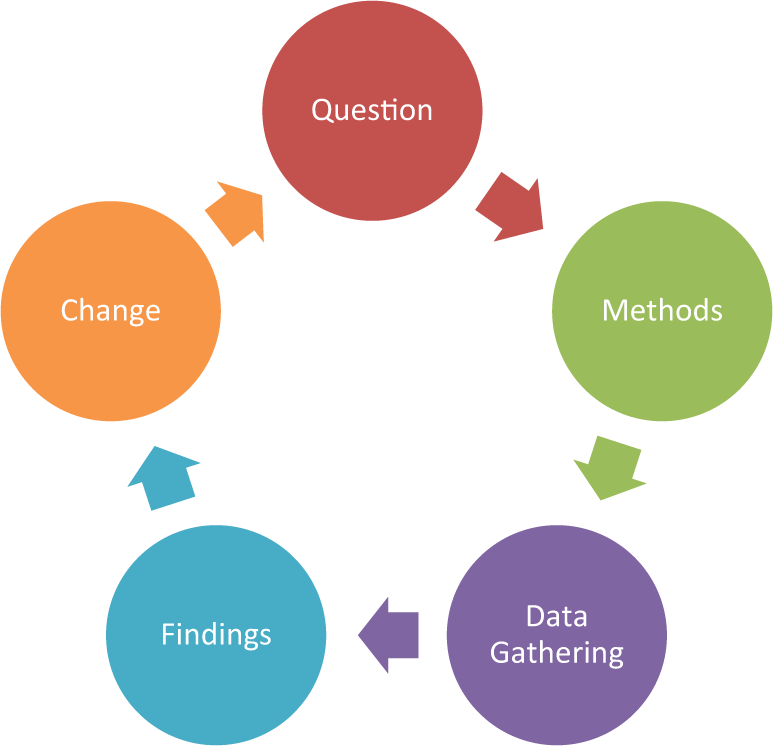
Rochester Method Research Cycle.
Examples of the Rochester Method in action
The power of the Rochester method is perhaps best explained by a few examples of movement through the research cycle in Diagram 1.
During 2004–2006, the Libraries undertook a focused study of undergraduate students. One of the questions was, what activities did students undertake when assigned a research paper? A group of volunteer students were identified and Dr. Foster remained in touch with the students throughout the semester, asking for updates on the progress of their research papers. When their papers were submitted to the professors for grading, the students were individually interviewed by Dr. Foster and asked to detail the activities involved in researching and writing their paper. In addition to a verbal narrative, each student was asked to draw the steps on a large poster board (Briden, Burns and Marshall 2007). When the data from the interviews and the drawings were studied, a curious feature emerged. Sometimes the student would involve his/her parent in the paper-writing process, such as asking for advice on the thesis of the paper or requesting that the parent help to edit the paper. This finding was consistent with a child/parent relationship paradigm emerging in American culture which has often been labeled as “helicopter parents”; parents who retain close involvement in the activities of their children even after the child leaves the home and goes to college (Strauss and Howe 2006). The Libraries' response to this finding was to consider how to leverage the close parent/child relationship to promote library services.
Historically, the Libraries had participated in freshmen orientation, which was a brief, lecture-style orientation to the Libraries within the students’ first days on campus. The effectiveness of the student orientation was questionable because the students, who had just arrived on campus, were much more focused on the upheaval of the transition to university than the great collections and services provided by the Libraries. The Libraries pulled out of freshmen orientation in 2006 and instead started the tradition of hosting a breakfast for the parents. The purpose of the breakfast was to deliver a very pointed message to the parents about the many ways in which the Libraries can assist students in the research and writing of research papers. We asked the parents to convey this message to their sons and daughters at the point of need, recognizing that the parents would likely know when the students needed library assistance before we would.
A second example of the impact of the Rochester method also came from the undergraduate research project of 2004–2006. Another question that the project explored was, what it was like, at a holistic level, to be an undergraduate student at the University of Rochester? In addition to observations, maps, academic diaries, and interviews, Dr. Foster recommended the use of cameras through a photo elicitation project (Briden 2007). Students were given disposable cameras and a list of items to take pictures of, including a place in the library where you feel lost, your favorite place to study, the things you always carry with you, and a picture of your dorm room showing your computer. Once the pictures were developed, Dr. Foster conducted an interview with the student, using the photographs as starting off points for broader conversations about life on campus.
For me one striking pattern that the photographs revealed was that students were coming to campus with a laptop, rather than a desktop, computer. Yet, that laptop computer was not included in the photograph that showed the items the students always carried with them. The cost of providing and maintaining hundreds of desktop public computers in the Libraries was considerable, yet if the laptops remained in the students' dormitory rooms, the Libraries had no option but to continue to provide desktop public computers. We began to explore the question about how to make the Libraries a more laptop-friendly environment. At the time, the weight of the laptops was one reason that the students did not wish to carry them about campus, but advances in laptop and battery technology have significantly decreased the weight. Battery life was another barrier to laptop use, particularly in the main library, Rush Rhees Library, which was built in 1930 and had very few power outlets. When we engaged the students in drawing their ideal library spaces, we saw power outlets drawn into some of the pictures. Wireless Internet connection and wireless printing were determined to be other criteria necessary for a laptop-friendly library space.
In 2007, the Libraries opened the Gleason Library, a renovation of 23,000 square feet in the Rush Rhees Library, with one, of many goals, being the creation of a laptop-friendly library space. The floor was cored to provide power outlets throughout. The ratio of table space to seats was increased to adequately provide enough room for a laptop to comfortably be placed into the workspace. Strong wireless signals throughout and wireless printing were given top prioritization in the technology specifications for the space. The space was designed with only ten desktop public computers, but they proved sufficient because the students brought their laptops almost immediately. Within a year, the percentage of students observed using a personal laptop in the Gleason Library was 49 percent (Briden and Maarshall 2010). This initial success led to small facilities projects to bring more electrical outlets into the book stacks and reference room, and to strategically place tables near power outlets. When a new power outlet could not be ideally situated, extension cords were provided at the circulation desk. Yale University Library finished a renovation in January 2012 of the Center for Science & Social Science Information in which lockers were built with power outlets inside every locker so that students can power-up their laptops, phones and other electronics securely.
A third and final example of the Rochester method in action emerged during a 2-year study of graduate students, 2007–2009. When exploring the question of the barriers to successful dissertation completion, in situ interviews were conducted with graduate students in the spaces where they most often worked on their research. While science and social science students at the University of Rochester often had laboratory or office space on campus, the humanities students frequently had no office-like space on campus. Moreover, the Libraries' few remaining study carrels were assigned to faculty and thus provided no assistance to the graduate students. The interviews revealed a sense of isolation among some graduate students, particularly those who lived and worked in off-campus housing and who had not formed peer support groups from amongst their fellow graduate students. We came to realize that the Libraries could assist in the success of our graduate students by providing study spaces dedicated to graduate students.
Design workshops with graduate students further articulated the type of space the students needed: quiet, with a variety of chairs and tables, and a mature style that emulated a faculty member's office, rather than an undergraduate students' study commons. The graduate students also expressed the desire that the space be for graduate students only. Initially, such a request seemed elitist; however, when we probed this question further, we came to recognize that at the University of Rochester, graduate students played many roles including teaching assistant, lab assistant, and tutor. The graduate students were seeking a place wherein they could focus on their primary role as dissertation researcher and writer without being interrupted by others, such as undergraduate students in their classes seeking assistance. The evidence for the need for a graduate student study was strong enough to convince a loyal supporter of the Libraries to fund the renovation of a tired, neglected room in the Rush Rhee Library into a stately graduate student study. 8 Before the renovation was even finished, the same donor funded the renovation of a second graduate student study. 9
This experience demonstrated the great power and effect of the Rochester method. Not only did the process reveal a need among the graduate students that the Libraries were well-positioned to address, but the process also provided credible and compelling stories, from the students themselves, about the significant impact the graduate student study space was going to make in their academic success.
Conclusion
As more and more alternative information providers and services chip away at the traditional offerings of an academic library, it is essential that a library more closely align itself with the unique needs of its host institution. This trend will likely necessitate that academic libraries become more dissimilar than similar, just as universities are increasingly striving to distinguish themselves from others. Librarians cannot rely on their own college and university experiences to inform the design and provision of services in today's academic libraries. Technology and the rapidly changing education landscape have made our own university experiences largely anachronistic.
The success at the University of Rochester’s River Campus Libraries, however, has demonstrated that a greater understanding and appreciation of the academic needs of library users is neither overly difficult nor costly to obtain, but very powerful. While the findings of the Rochester studies are unique to the distinct community of the University of Rochester, the methods of study can and have been applied successfully to the study of library users on other campuses as documented on the AnthroLib Map (Diagram 2). 10
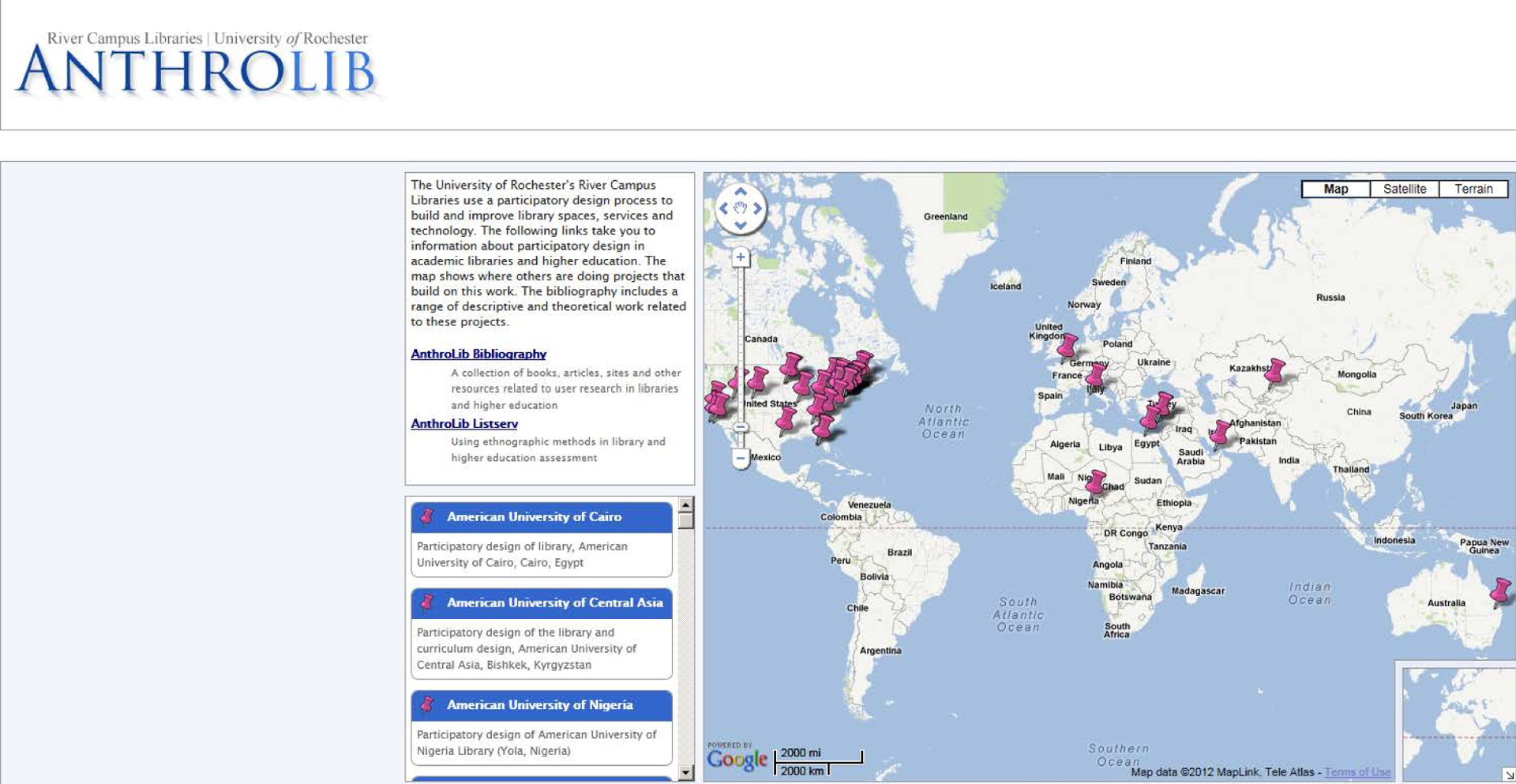
AnthroLib Map.
To be clear, the Rochester method will not quantify the precise return on investment that a university receives from each dollar or Euro invested in its library. However, the Rochester method can provide the foundation for evidence-based decision making and be a catalyst for organizational change. In the right organizational environment, the results can be a better, more evident, alignment between an academic library and its host institution, thus silencing the questions about whether a great university needs a great academic library.
Footnotes
Paper presented at the World Library and Information Congress: 78th IFLA General Conference and Assembly, 11–18 August 2012, Helsinki, Finland, in session 94: Creating a culture for innovation and change. Management and Marketing with Academic and Research Libraries.