




Abstract
This study draws from the 1979 and 1997 National Longitudinal Survey to compare patterns of wage mobility among the late boomer and millennial cohorts of young men. Estimating group-based trajectory models, the authors find that fewer men enjoyed rapid wage growth and more men fell into the steady and stagnant wage-trajectory groups. Furthermore, employment patterns in the new economy (e.g., changing employers, more part-time employment, and employment in low-end service occupations) increasingly determine the mobility rates of millennials compared with boomers and are stronger predictors of mobility chances in the millennial cohort than are family background and cognitive skills.
Keywords
The rate of career mobility rates is increasingly salient in a time of rising inequality. Some contend that even as inequality increases, a high mobility rate suggests that free labor markets are operating as intended and continue to reward individual skills (Corak, 2013; Welch, 1999). Others suggest that if mobility decreases as income inequality increases, social solidarity will decline, and distrust of political and economic institutions will increase (Houle, 2011; Sennett, 1998; Van de Werfhorst & Salverda, 2012).
Mobility studies have long occupied a central place in stratification research because they assess the relative importance of achievement and ascription in attainment (DiPrete, 2007; Morgan, 2006). Most prior mobility studies compared class or occupation of the family of origin with that of offspring, a useful exercise for comparing the fluidity and openness of stratification systems across time or across societies (Grusky & Weeden, 2006; Van Leeuwen & Maas, 2010). Still generally lacking, however, are analyses of intragenerational mobility (Leicht, 2008; Van Leeuwen & Maas, 2010), an important omission because attainment over the life course more clearly reveals how the structure of labor markets and employment experiences affect mobility patterns. At a time when inequality is rising and employment relations are changing, it is important to assess not only whether patterns of career mobility have changed but also whether the relative importance of ascription, family background, education, skills, and work histories have changed in determining rates of career mobility.
That is the purpose of this study. We use longitudinal data to describe and analyze patterns of wage mobility across two cohorts—baby boomers who entered the labor market in the 1980s and millennials who entered the labor market in the 2000s. We pose two research questions whose answers will contribute to the stratification/mobility literature. First, in early adulthood, has wage mobility significantly slowed for more recent labor market entrants? At this most critical time in the life course when young people embark on careers and set the conditions for later attainment (Bernhardt, Morris, Handcock, & Scott, 2001; Hall, 1982), has the incidence of upward mobility decreased and career stagnation increased? Second, are work histories associated with employment relations in the new economy more consequential in determining mobility for the millennial than boomer cohorts? Although employment relations and features of the new economy have contributed to the rise in income inequality (Morris & Western, 1999), there is no evidence linking new economy employment patterns to career mobility, especially among the most recent entrants into the labor force.
Background
Mobility and Macroeconomic Change
Sociologists have been studying intergenerational mobility since the middle of the past century, largely in an effort to understand how industrialization shaped attainment. Using survey data to cross-tabulate adults’ current and parents’ usual occupations and comparing these tables over time (or by cohort), sociologists provided empirical support for a logic of industrialism thesis; that is, as societies industrialize and mature into a service economy (with more nonmanual than manual or extractive jobs), rates of upward mobility generally increase (Breen, 2004; Erikson & Goldthorpe, 1992). Fifty years ago, sociologists attached status scores to occupations, making it possible to estimate the correlation between parental and adult statuses. The status attainment model generally affirmed that downward mobility was rare and that merit (especially educational attainment) more so than family socioeconomic status (as a measure of ascription) determined rates of upward mobility (Blau & Duncan, 1967; Jencks, 1990). With advances in measurement and analytic strategies, researchers have continued to investigate the generational transmission of status, focusing on the roles of inherited mental ability in educational attainment, and the accumulation of cognitive skills in adolescence for later occupational success (Arrow, Bowles, & Durlauf, 2000; Bowles, Gintis, & Groves, 2005; Conley, 2004).
In principle, the models of intra- and intergenerational mobility should be similar. If scholars are interested in the transition from an origin to a destination status, it should matter little whether origin status is measured by one’s family or by one’s first job. Yet, sociologists rarely examine intragenerational mobility, perhaps due in part to stricter data requirements; that is, intergenerational mobility can be measured in a cross-sectional survey, but measuring intragenerational mobility is best accomplished with longitudinal data (Leicht, 2008; Van Leeuwen and Maas, 2010). It is also clear that the mechanisms that intervene between origin and destination status are different for the two types of mobility; that is, educational attainment and cognitive skills acquisition for intergenerational mobility and labor market opportunities and employment experiences for intragenerational mobility (Morgan, 2006). Although sociologists have studied job changing and promotions (as a type of mobility) and economists have examined age–wage profiles, there has been no study comparing intragenerational mobility patterns among recent cohorts who are entering a new economy with distinctly different employment relations than was true in the past.
Work scholars, of course, have documented how employment relations have changed over the past three decades. From 1945 to 1973, core firms in the economy constructed internal labor markets (or job ladders) that progressively imparted skills, responsibility, and rewards to workers via regular promotions. This practice bound a worker to the same firm over the life course, not only amortizing the training costs associated with worker’s use of technology on the job and buying labor peace but also fostering workers’ upward intragenerational mobility (Capelli, 1999; Edwards, 1979). Of course, smaller employers with thinner profit margins could not afford to create internal labor markets, but they too sought to tie wages and benefits to seniority to bind workers to the firm (Hall, 1982).
When corporate profits declined after 1973, employers redrew the employment contract to acquire cheaper and more flexible labor. Broad swaths of the manufacturing sector relocated to find cheaper and more compliant labor (Bluestone & Harrison, 1982). In high-end professional and business services, employers converted many full-time workers into temporary and contingent workers, whereas low-end service employers increasingly relied on part timers and temporary staffing agencies for personnel (Barker & Christensen, 1998; Kalleberg, 2009; V. Smith, 2001). These employment strategies not only lowered wage and benefit payments but also heightened job insecurity for many workers (Kalleberg, 2000, 2011; Madrick, 2012). Corporate efforts to reduce employment security continued in the 1980s when employers aggressively fought unions, and the federal government slashed support for agencies that protected the rights, benefits, and health of workers (Bernhardt, Boushey, Dresser, & Tilley, 2008), efforts that further accelerated the declines in union membership and manufacturing employment. Finally, it is important to note that in the 1980s, the public sector began to resemble the private sector in its quest to operate more efficiently. Privatizing government services and subjecting its operations to the market principle began to whittle away at the career system of employment relations in hiring, rewarding, and promoting workers, which had previously fostered pay equality and career mobility, especially for minorities (Wilson, 2006).
As these economic trends have matured, there is mounting evidence that employment relations in the new economy differ from the past. For example, average employer tenure sharply declined (Hollister & Smith, 2014) and part-time and temporary-help employment is growing 3 times faster than overall rate of growth in the economy (Kalleberg, 2011). Similarly, the share of all workers who feel secure in their jobs has dropped from two thirds to nearly half (Kalleberg, 2009, p. 6). Perhaps most important, income inequality has increased. Much of this is due to the growth of services that now accounts for nearly 8 in 10 jobs in the economy (Morris & Western, 1999). Yet, the growth of administrative support, craft and repair, production, and operator jobs that fueled the growth of the middle class in the first half of the 20th century stalled at the end of the century. Rather, job growth has become increasingly polarized, as employment grew in both the good professional, technical, and managerial jobs at the high end of the occupational distribution and in the bad jobs (i.e., low skilled and poorly paid) in trade, entertainment, and personal service industries at the bottom of the occupational hierarchy (Fernández-Macías, 2012; Kalleberg, 2011; Wright & Dwyer, 2003).
Wage Inequality and Career Mobility in the New Economy
Linking employment in the new economy to rising income inequality has been the subject of prior research; much of it focused on the role of turnover (as a type of job mobility). Studies show an increasing temporal effect of employer changes on wage stagnation (Fuller, 2008) and inequality (Bernhardt et al., 2001; Polsky, 1999; Stevens, 2001), yet other studies find a weak or null effect of employer changes on wage inequality (Gottschalk & Moffitt, 1994; Jaeger & Stevens, 1999; Mouw & Kalleberg, 2010). Some contend that these findings conflict because a knowledge-intensive service economy rewards those with advanced technical and cognitive skills and punishes those without such skills (a theory of recent macroeconomic change referred to as skill-biased technical change; Card & DiNardo, 2002; Lemieux, 2008; Welch, 1999). Thus, employer changing among high-skilled workers often increases pay, whereas turnover among low-skilled workers does not (Campbell, 2012). Economists embrace the skill-biased technological change explanation for growing wage dispersion because it is consistent with other temporal trends, such as the increase in the wage premium for a college degree in the face of increased supply of college graduates (Morris & Western, 1999). Similarly, if the growing knowledge-intensive service economy increasingly demands and rewards cognitive and technical skills, this would explain both the temporal increase in income inequality (as high-skilled workers increasingly earn higher wages, while the wages of low-skilled workers stagnate) and the fact that within-group wage dispersion is far larger than between-group inequality (DiPrete, 2007; Morris & Western, 1999; Welch, 1999).
Although studies have examined the causes of rising income inequality, much less research has been done on how employment relations in the new economy have altered patterns of career mobility. DiPrete, Goux, and Maurin (2002) predicted that the decline of internal labor markets and the growing reliance on external hiring would weaken the association between employer tenure and pay and increase the association between educational credentials and pay. They confirmed these propositions in analyses using the Current Population Survey from 1983 to 1998, but cross-sectional data cannot show whether and how career mobility has changed over time. Another approach estimates intergenerational wage mobility via transition probabilities between quintiles of the income distribution, finding that mobility has generally slowed, especially for those in the lowest income quintile (e.g., see Buchinsky & Hunt, 1999; Mishel, Bernstein, & Shierholz, 2009). Yet, analyses of transition matrices often cannot investigate the relative strength of various determinants of mobility.
Several studies use longitudinal data to estimate latent growth models of wages (Bernhardt et al., 2001; Gottschalk & Moffitt, 1994; Haider, 2001; Kronberg, 2014; Stevens, 2001). Although models may vary, the basic strategy is the same: In a baseline model, repeated observations of pay are regressed onto age to estimate an average career, showing that wages increase slowly in early adulthood, rapidly until late middle age, and decline slowly thereafter. The residual term from the baseline equation shows individual deviation from the average career; that is, some will enjoy more rapid wage growth than average, and others will suffer below-average wage growth over their lives. The variance of the residual term is partitioned into two components: a permanent component for across-individual deviation from the average career and a transitory component for within-individual deviation in pay from the worker’s predicted career profile. Analyses across cohorts show that the variance of the residual has grown, largely due to the growth in the permanent component. In other words, in the past, more individual careers tracked closely to the average career profile, whereas in more recent cohorts, there was more deviation from the average career profile (i.e., more low and more high earners), providing further evidence that pay inequality has increased with time (Bernhardt et al., 2001; Kronberg, 2014).
Although provocative, these findings do not investigate whether and why the rate of mobility has slowed in the new economy. First, the earlier studies drew on samples of individuals who entered the labor market in the 1980s or before. Although many of the characteristics of the new economy emerged in the 1970s (e.g., deindustrialization), others started later and are now coming to full maturity (e.g., contingent and precarious employment; occupational polarization). Thus, a more complete assessment of the effect of the new economy on mobility patterns requires analysis of a younger cohort who began their careers at the turn of the millennium.
A second and related point is that the millennial cohort entered a labor market characterized by high income inequality, which means that career profiles are likely to substantially differ from the previously cited studies showing an average career in which pay grows slowly at first, increases rapidly, and then declines in late middle age. That is, some workers will earn high incomes at the start of their careers and see them grow rapidly over time, whereas many others may languish in a low-wage career trajectory over their entire lives (Campbell, 2012). We contend that people on such different wage trajectories represent more than just deviation from an average career and instead have qualitatively different careers (Leicht, 2008). To fully appreciate how the new economy affects mobility patterns requires an analysis that detects and analyzes the emergence of distinctly different career profiles.
Research Questions
Prior studies of intergenerational mobility largely establish the temporal constancy of upward mobility and the importance of acquiring educational credentials and skills for attainment beyond one’s origins. Yet, the emergence of a new economy characterized by increasingly contingent, unstable, and unrewarding employment suggests that upward mobility over the life course is more difficult to achieve, irrespective of individual skills and credentials. Given that mobility studies have generally ignored intragenerational mobility, especially for recent cohorts, a study that examines how the patterns and determinants of career mobility differ over time is warranted.
In addressing the limitations of prior research, we pose two research questions. First, has the emergence of the new economy significantly slowed rates of intragenerational wage mobility? To answer this question, we will compare the mobility patterns of those who started their careers in the 1980s (the baby boomers) to those who launched their careers after 2000 (the millennials). Unlike prior studies that measured dispersion around an average career, we will use a group-based trajectory modeling technique that identifies the number of distinct wage mobility trajectories. Examining cross-cohort change in the distribution of high- and low-wage career profiles (as well as those wage trajectories in between) will determine whether intragenerational mobility has declined in the new economy.
Second, do employment patterns in the new economy have stronger effects on mobility trajectories among millennials than baby boomers? To answer this question, we will estimate cohort-specific models of membership in the different trajectory groups identified in the analysis earlier. The predictors of wage mobility group will include traditional predictors such as family background, educational attainment, and cognitive skills, in addition to controls for employment patterns and work history (e.g., working part time, turnover, occupational and industrial employment). When comparing the mobility effects of work history and employment patterns across cohorts, we anticipate that employment histories will have a stronger effect on mobility in the millennial than in the baby-boomer cohort. Furthermore, if employment practices in the new economy are widespread and diffuse, then in the millennial cohort, we anticipate that measures of work history will have a stronger effect on mobility trajectories than will traditional predictors such as family background and cognitive skills.
Data and Measures
Sample
This study draws on the 1979 and 1997 cohorts of the National Longitudinal Surveys (NLS), datasets that have similar measures of mobility and its predictors across time. The baby-boomer cohort was 14 to 22 years old in 1979 and launched their careers in the 1980s. The millennial cohort was 12 to 16 years old in 1997 and entered the labor market around 2000 and thereafter. For both cohorts, we observe earned wages from age 18 until age 30. This is a critical point in the life course when lifetime attainment crucially depends on finding stable and rewarding work early in one’s career (Bernhardt et al., 2001; Hall, 1982). It is important to note that the potential length of careers (i.e., the number of repeated observations of wages) differs by age. That is, some of the youngest members of the millennial cohort had not reached age 30 at the latest survey in 2010, and some of the oldest members of the boomer cohort had already entered the labor force when initially surveyed in 1979. This poses no problem for estimating mobility trajectories given that our modeling technique (described later) can account for unbalanced data (i.e., missing wage data at some ages), and we can control for the length of potential careers by including age at survey inception as a predictor of career profiles. Finally, we limit the sample to men because women’s career mobility is to a greater extent affected by marital and birth histories (Hollister & Smith, 2014) and because women’s employment and mobility is in turn confounded with the rise of the new economy and rising income inequality (Morris & Western, 1999). The analytic sample consists of 5,939 and 4,163 men in the 1979 and 1997 cohorts, respectively. All analyses below were weighted to account for attrition and oversampling of minorities in each survey.
Hourly Wage (Logged)
The dependent variable is the respondent’s hourly wage at their current or last job at each interview. 1 Wages were set to missing in any year when respondents were missing in the survey or when they did not work for pay. Using the Consumer Price Index multiplier, wages were expressed in constant 2009 dollars, and extremely low (less than $1 dollar per hour) and high (more than $150 dollars per hour) hourly wages were coded as missing before taking the natural log of wages to correct for skewness. Approximately 2% of men in both cohorts reported fewer than 2 years of valid wages and were excluded from the mobility analyses.
Predictors of Wage Mobility
Descriptive statistics on the predictors of wage-trajectory group are shown in the Appendix. In addition to the previously mentioned control for age at survey inception, the models include several controls that are typically included in models of intergenerational mobility. For example, the status of the family of origin was captured in the measure of parental education, which was the higher value of the mother’s or father’s years of completed schooling. 2 A respondent’s cognitive skill level was the average percentile score on standardized tests (taken in middle school) on math and reading. Although it may be common to measure educational attainment continuously, employers often screen for hiring and promotion on the basis of credentials (Bills, 1988; Stiglitz, 1975). Furthermore, one study showed that maximum wage growth in later life was fostered by finishing schooling on time (Elman & O’Rand, 2004); thus, we control for educational attainment with a binary measure for completing a bachelor’s degree by age 24. 3 The analytic models also controlled for self-identifying as an African American (including 40 respondents in the 1997 cohort who defined themselves as mixed race) or Hispanic; non-Hispanic Whites comprise the reference group.
The work history measures (and additional controls) were measured by examining respondents’ reports of their employment situations across survey years and constructing counts; to correct for skewness, we incremented the counts by one and then took the natural logarithm of the count (by definition, the log of zero is undefined and therefore missing). First, to control for job precarity in the new economy, the analytic models include a (logged) count of the number of times across survey years respondents reported working part time (1–34 hours per week). Similarly, we identified workers who changed employers in the previous year if they had worked for their current employers 50 or fewer weeks. We then examined responses to a question of why they left their previous employer, distinguishing between involuntary and voluntary employer changes. Among the former, most people were laid off from their previous jobs (but some saw their plants close and a few were fired), and among the latter, workers gave a host of reasons for quitting their previous jobs. Thus, for reasons of brevity, we refer to these measures of turnover as counts of the number of times respondents reported being laid off from or quitting their former employers over their early-adult years. Second, to account for deindustrialization processes, we created counts of the number of times respondents reported working in the manufacturing sector or working in a unionized job. 4 In addition, we created a count of years working in government because like the manufacturing sector, it has historically provided mobility opportunities but has lost some of its worker protections in the new economy (Wilson, 2006). Third, we accounted for polarized job opportunities in the service sector by creating counts of working in good jobs (i.e., professional, technical, or managerial occupation) or bad jobs (i.e., sales or service occupation) over the early career. 5 In addition, we counted the number of times respondents earned a valid wage to control for unobserved heterogeneity between individuals (e.g., work ethic or social capital) that could affect mobility chances. Finally, because wage scales are lower in the South, we created a count of the number of years respondents reported living in the South.
Analysis Plan
To discern mobility patterns across cohorts of young men, we conducted latent class trajectory analyses (Jones & Nagin, 2007; Jones, Nagin, & Roeder, 2001). These models observe yearly wages from ages 18 to 30 to identify the number of distinct mobility paths in early adulthood. While making full use of an individual’s early pay history, this technique does not require the same number or spacing of wage observations over time, making it particularly appropriate for estimating wage trajectories for those with intermittent or unstable work histories. Latent class trajectory models assume that the samples of young men in each cohort are composed of a set of discrete classes or groups with similar patterns of wage growth as they age. Our first research question asks whether mobility has slowed in the new economy, which is answered by determining the number and composition of wage-trajectory groups in both cohorts (we use the Proc Traj user-defined software package, available in SAS, to estimate the number of trajectory groups). Determining the optimal number of trajectory groups is based on statistical measures (e.g., the Bayesian information criteria measure) and on practical and theoretical considerations (Jones et al., 2001). After determining the number and relative size of trajectory groups in both cohorts, we use ordered logistic regression analysis (and heterogeneous choice models) to examine the determinants of wage trajectory-group membership. Thus, in deciding on how many trajectory groups best describe mobility patterns for the boomer and millennial cohorts, it may be better to err on the side of fewer but larger trajectory groups because a proliferation of relatively small trajectory groups will increase the inefficiency of parameter estimates in models assessing the determinants of trajectory-group membership.
Results
Has Wage Mobility Slowed in the New Economy?
Wage-Growth Trajectories by Solution and Cohort, Men Ages 18–30 (N = 5,939 Boomers; N = 4,163 Millennials).

Note. BIC = Bayesian information criteria.
Preferred solution.
The three-, four-, and five-group models all provide an increasingly nuanced picture of changing mobility patterns, but none of these solutions contradict the general conclusion that mobility has declined over time. The four- and five-group solutions both identify a small group of downwardly mobile workers in the millennial (but not in the boomer) cohort, and the proportionate sizes of slow-growth trajectory groups (groups 3 A, 4B, and 5B) increase over time. At the same time, the proportionate sizes of groups enjoying rapid wage growth decline over time. Although the four- and five-group solutions fit the data better, they both identify small trajectory groups that exist in one cohort but not in the other, and in one case, an ambiguous group whose meaning changes over time (i.e., group 5D whose starting and ending wages look more like the upwardly mobile group 5E in the millennial cohort but more like the modest trajectory group 5C in the boomer cohort). Adopting the four- or five-group solution would necessarily involve combining small trajectory groups with larger ones to estimate efficiently the determinants of trajectory-group membership. By contrast, the three-group solution is notable for its parsimony and a relatively consistent definition of mobility groups across time. 7
The three-group solution also shows that career mobility patterns have changed in accordance with expectations in a time of rising income inequality, as seen in Figure 1 that plots the age–wage-trajectory groups by cohort. The slow-growth trajectory group (red lines) not only increased in proportionate size over time (from a little more than a fourth of boomers to one third of millennials), but slow-growth boomers and millennials had nearly the same real wages over their early careers (starting at $8 an hour at age 18 and increasing to only $10 per hour by age 30). Similarly, the steady-growth trajectory groups grew in proportionate size from 46% to 57% of the boomer and millennial cohorts, respectively. And, starting from roughly the same wage at age 18 (∼$9.40 per hour), their real wages grew at approximately 6% per year and differed only by $2.73 an hour at age 30 (i.e., $18.06 per hour for boomers and $20.79 per hour for millennials). The rapid-growth trajectory groups (green lines) declined from 27% to 10% of the boomer and millennial cohorts, respectively. More important, over the two cohorts, the earnings gap between the rapid- and steady-growth trajectory groups widened noticeably. That is, in the boomer cohort, the age-30 gap in expected wages between the rapid- ($31.87) and steady-growth trajectory groups ($18.06) was $13.81 per hour. For the millennial cohort, the gap in age-30 wages between the rapid- ($48.05) and steady-growth ($20.79) trajectory groups nearly doubled to $27.26 an hour. As income inequality grew, analysts have shown that there has been a growth in the number of low earners whose real wages are relatively unchanged over time and a shrinking pool of workers whose wages far outpace their less fortunate counterparts (Faux, 2012; Madrick, 2012; Mishel et al., 2009). The career mobility trajectories shown in Figure 1 are consistent with these descriptions of rising income inequality and suggest that achieving upward career mobility is more difficult for the most recent cohort in the labor market. These results suggest an affirmative answer to our first research question that indeed, rates of intragenerational wage mobility have declined in the new economy.
Wage trajectories, by cohort.
Do Employment Patterns in the New Economy Increasingly Affect Mobility Chances?
Determinants of Men’s Wage-Trajectory Group (1 = Slow, 2 = Steady, 3 = Rapid) by Estimation Technique and Cohort (N = 5,939 Baby Boomers; N = 4,163 Millennials).

Note. aCross-cohort slopes in the ordered logistic model significantly differ at p < .05 (one-tailed test).
Cross-cohort slopes in the heterogeneous choice model significantly differ at p < .05 (one-tailed test).
p < .05. **p < .01. ***p < .001.
A key assumption in comparing logit coefficients across groups is that the error variance is the same for all cases. When the error term is heteroskedastic, the slope parameters are both biased and inefficient, making comparisons of coefficients across groups invalid (Allison, 1999; Mood, 2010; Williams, 2009). Allison (1999) proposed calculating an adjustment factor for the residual variance in one group relative to the other so that the errors were homoscedastic across both groups, and then including this adjustment factor in the equations to estimate slopes. But, because Allison’s method could be used only on binary-dependent variables and assumed that other variables’ slope effects were similar across groups, Williams (2009) suggests using heterogeneous choice models (also referred to as location-scale models) when the dependent variable is ordinal and the purpose is to compare coefficients across groups. In these models (estimated with the ordinal generalized linear models (OGLM) procedure in Stata; Williams, 2010), the location or choice on the dependent variable (shown in the top panel of Table 2 in columns 3 and 4) is modeled after the log of the error term (the scale equation) is modeled (shown in the bottom panel of Table 2 in columns 3 and 4). Using stepwise regression, the scale equation identified five and two significant predictors of the logged variance of the error term in the boomer and millennial cohorts, respectively. 8 After correcting for heteroskedasticity, the slope parameters in the heterogeneous choice model are usually slightly smaller (as are the standard errors) but substantively similar to those of the ordinal logistic regression model (comparing slope effects across columns 1 to 3 and columns 2 to 4). Perhaps more important for our purpose, when cohort differences in slopes are tested for significance, 9 the simultaneous paring of the “a” and “b” symbols in the far-right column of Table 2 indicates that conclusions about slope differences across cohorts are the same regardless of whether the slopes were estimated from ordinal logistic or heterogeneous choice models. 10
Discrete Change in Probability of Wage Trajectory-Group Membership Across the Range of Predictors by Cohort. a
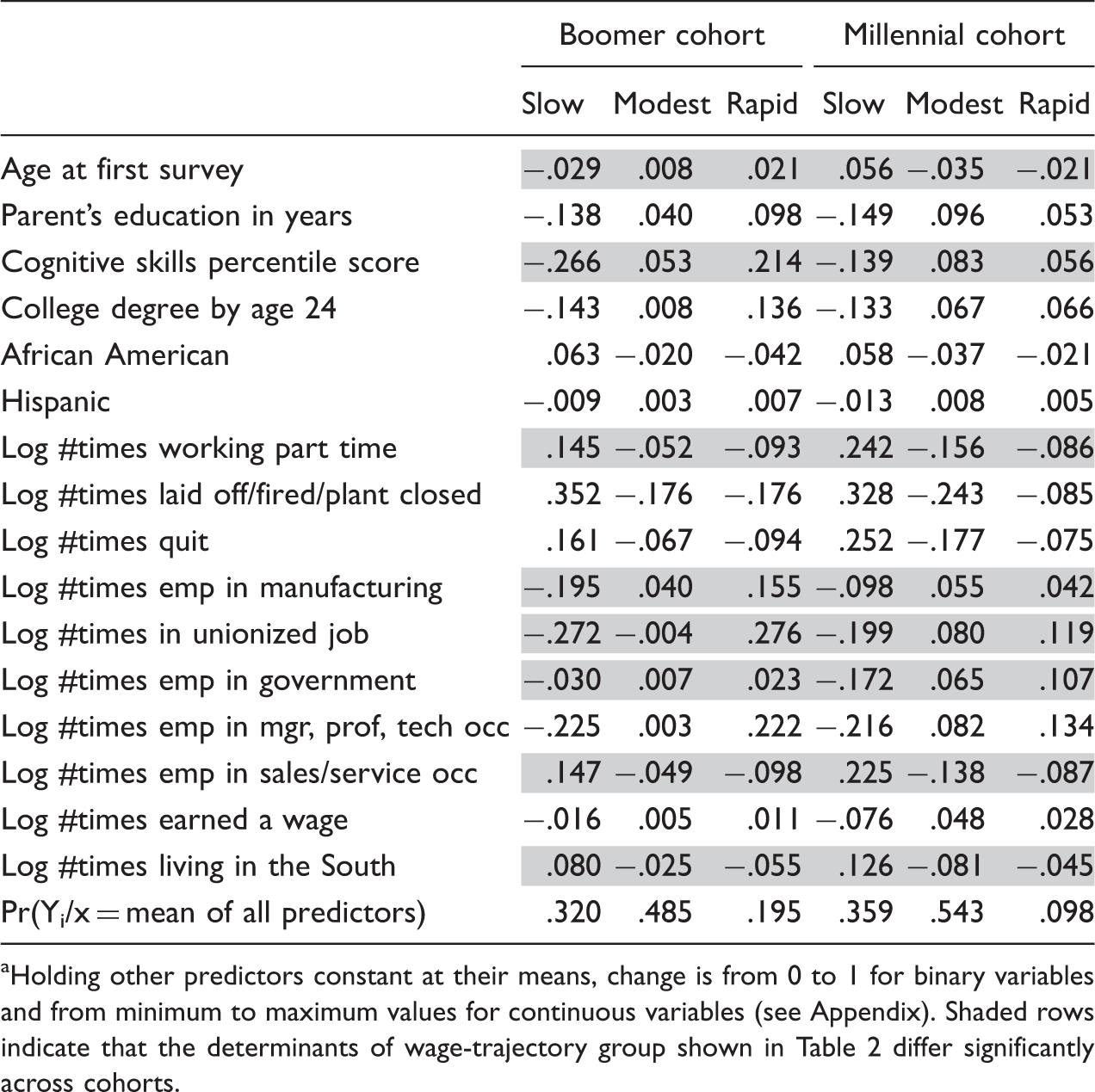
Holding other predictors constant at their means, change is from 0 to 1 for binary variables and from minimum to maximum values for continuous variables (see Appendix). Shaded rows indicate that the determinants of wage-trajectory group shown in Table 2 differ significantly across cohorts.
Turning now to the substantive determinants of wage mobility, age at survey inception is associated with more stagnant career profiles among millennials, as is residence in the South for both cohorts. For example, the bottom of Table 3 shows that compared with men who never lived in the South, boomer men who spent their entire careers in the South were 8% more likely to be in the slow-growth trajectory group. The effect of living entirely in the South increased for millennials, who were 12.6% more likely to have stagnant wages over their careers compared with men who never lived in the South.
The career mobility effects of family of origin and educational attainment are consistent over time and in accordance with expectations. That is, men who came from more advantaged families (as measured by parental education) and finished their college degrees by age 24 experienced higher rates of wage mobility over their early-adult years. For the parental education effect, if the slope effects in Table 2 (or the effect sizes in Table 3) were significantly increasing over time, this would signal a decline in mobility, but in this sample, the strength of the effects of family background on wage mobility are similar across cohorts. For example, as parental education increases from its minimum to maximum values, the probability of entering a slow-growth wage-trajectory group declines by nearly the same amount in both cohorts (13.8% among boomers and 14.9% among millennials).
Cognitive skills similarly increase wage mobility, but it is somewhat surprising that cognitive skills have a weaker effect on upward wage mobility among millennials than boomers. As Table 3 indicates, compared with men with the lowest stock of cognitive skills, millennial men who score highest on tests of cognitive skill experience nearly a halving of the inhibiting effect of having a slow-growth wage profile (13.9% vs. 26.6%) and are much less likely to move into the rapid-growth trajectory group (5.6% vs. 21.4%). This result is inconsistent with the skill-biased technological change argument that the new economy increasingly demands and rewards workers with mathematical and verbal skills; if so, we should see an increasing importance of possessing these skills in determining wage mobility for the millennial than the boomer cohorts. We offer two explanations for this contrary finding. First, if cognitive skills indicate the quality of schooling (Farkas & Vicknair, 1996), the weakening effects of cognitive skills on wage mobility may reflect a general perception of the decline in the quality of American schooling (Murphy & Peltzman, 2004). As employers in the new economy have more difficulty identifying workers with strong reasoning and computing skills, they may increasingly rely on a timely attainment of a college credential to hire and reward employees (Bills, 1988; Elman & O'Rand, 2004; Kaufman, 2010; Stiglitz, 1975). 12 Second, Liu and Grusky (2013) argue that skill is a multidimensional concept, and the skills imparted in schools (e.g., writing, grammar, mathematics) can also be learned and perfected with the use of software technology. Rather, the new economy tends to reward those with creative, analytic, problem-solving, and managerial skills (see also Jackson, 2006), skills that cannot be learned in a software program. When they measured the multidimensional skill content of occupations, they found that wage returns to verbal and quantitative skills were declining over time, while the wage returns to analytic and managerial skills were increasing over time. Our results for verbal and quantitative skills are consistent with those of Liu and Grusky and suggest that if we had measures of problem-solving and managerial skills, they may show a stronger wage mobility effect for millennials than boomers.
Race and ethnicity also affect mobility chances. Compared with Whites, Hispanic men experience similar rates of wage mobility, whereas African American men are less mobile. The results for Hispanics might be anticipated from case studies (Collins, 1997; Fernandez, 1981) and survey evidence (Bobo & Massagli, 2001) showing that White employers and workers hold less invidious stereotypes about Hispanics than African Americans, enabling the former to better integrate into workplaces where they can display their income-enhancing skills. Yet, there is much quantitative and qualitative evidence showing that employers discriminate against African Americans in decisions to hire (Moss & Tilly, 2003; Pager & Quillian, 2005), pay (Cancio, Evans, & Maume, 1996; Leicht, 2008), and promote (R. A. Smith, 2005; Wilson & Maume, 2013; Wilson, West, & Sakura-Lemessy, 1999) workers. Over the early life course, the cumulative effects of employer discrimination can be seen in the greater prevalence of stagnant wage profiles of African Americans compared with Whites. For example, Table 3 shows that relative to Whites, African Americans are approximately 6% more likely to be in the slow-growth wage-trajectory group for both cohorts.
With respect to the work history measures, they significantly affect wage mobility in expected directions, and their effects generally vary across cohorts. For example, as job precarity becomes more prevalent in the new economy, the inhibiting effect on upward wage mobility of working a series of part-time jobs is significantly stronger among millennials than boomers. That is, in Table 3, compared with never holding a part-time job, boomer men who hold part-time jobs over their entire early-adult lives are 14.5% more likely to enter the slow-growth trajectory group, compared with millennial men who are 24.2% more likely to suffer wage stagnation over their early careers. At a crucial point in the life course when millennials are seeking to establish their careers, fewer employers offer full-time jobs, resulting in greater wage immobility among the millennial cohort. Similarly, changing employers decreases the log odds of being upwardly mobile (Table 2), and this is true whether the employer change was voluntary (quitting) or involuntary (lay off). Yet, unlike the cumulative effects of part-time work, the strong effects of frequent employer turnover on wage immobility are similar across cohorts.
Prior generations of workers experienced upward wage mobility after finding employment in the manufacturing sector where workers were often represented by unions. Now, erosion of manufacturing employment coupled with employer efforts to weaken unions characterizes the new economy. It remains the case that more years working in manufacturing or in a unionized job fosters upward wage mobility, but the effects of these employment conditions on wage mobility have weakened significantly over time. Table 3 shows that the inhibiting effects of entering the slow-growth wage-trajectory group after working entirely in the manufacturing sector decline from 19.5% to 9.8% for boomers and millennials, respectively. At the same time, the probability of entering the rapid-growth wage-trajectory group after working entirely in manufacturing declines from .155 for boomers to .042 for millennials. Similarly, working entirely in a unionized job has a declining effect on the chances of entering the rapid-growth trajectory group for millennials (p = .119) compared with boomers (p = .276). Given that union representation was historically highest in durable goods manufacturing, the control for union representation in the millennial cohort likely means that the manufacturing count captures employment in consumer nondurables where wages are higher than in the service sector but lower than in durable goods manufacturing (DiPrete et al., 2002; Kaufman, 2010). Similarly, union representation in the new economy has slowly spread to the lower paying service sector compared with earlier generations of union members used in durable goods manufacturing (Cornfield, 1991; Fantasia & Voss, 2004). The changing nature of employment in manufacturing or in a unionized job means that the traditional pathways of upward wage mobility are not as certain as they were in the past, yet in the new economy, these employment locations are still surer paths to upward wage mobility than the alternatives of service employment or holding nonunionized jobs.
Unlike manufacturing employment and union membership, the public sector grew over the time period considered in this study, an important consideration given that government employment historically offered a career system of employment in which wages increase with seniority. Indeed, years of employment in government strongly fosters upward wage mobility for the millennial cohort, in contrast to its nonsignificant effect on mobility among baby boomers. 13 Table 3 shows that millennial men are 6.5% and 10.7% more likely to enter steady- and rapid-growth trajectory groups, respectively, if they always worked in government. By contrast, their boomer counterparts who worked entirely in government were only .7% and 2.3% more likely to enter steady- and rapid-growth trajectory groups, respectively. Thus, despite calls for the government to operate more like the private sector, employment in the public sector is an effective deterrent to having a career characterized by stagnant wage growth. This is especially important for the millennial cohort, where there are fewer pathways to upward mobility in the new economy.
Finally, the new economy is characterized by the growth of service occupations at the top and the bottom of the occupational hierarchy, and the effects of occupational polarization on wage mobility generally accord with expectations. For example, both boomers and millennials who spend more years working in professional, technical, and managerial occupations enjoy higher rates of wage mobility. Yet, the growth of low-end service jobs in the new economy means that for millennials more so than boomers, more years of employment in sales and personal service occupations decrease the chances of being in the steady- or rapid-growth mobility groups. For example, Table 3 shows that boomer men who worked entirely in low-end service occupations were 14.7% more likely to suffer wage stagnation over their careers. Among millennials, the risk of entering a low-wage career increases to 22.5% if they worked entirely in low-end service occupations.
In sum, the models shown in Table 2 had eight measures of work in the new economy characterized by job precarity, deindustrialization, declining unionization, and occupational polarization. Five of the eight measures were significantly more important in predicting the mobility chances of the millennial cohort than their boomer counterparts. These results strongly suggest an affirmative answer to the question of whether employment relations in the new economy contribute more strongly to immobility for milliennials than baby boomers.
Another indication of the importance of work history to mobility in the new economy would be whether the traditional predictors of mobility (e.g., family origins, skills, educational attainment) were weaker predictors of mobility than were the work history measures among those in the millennial cohort. To assess this, one can compare down the columns of Table 3 for the millennial cohort to examine how maximal change in predictors affects mobility chances. As we have seen, the effects of maximal change in cognitive skills and family background inhibit entry into a low-wage career by approximately 13–14%. But, except for the incidence in employment in manufacturing, the mobility effects of the work history measures are larger in magnitude than family background and cognitive skills. For example, the largest of the work history measures is involuntary layoff, in which maximal change on this measure is associated with a one-third increase in the probability of suffering wage stagnation over the early career. Also, sizable in magnitude are the effects of maximal increases in quitting, working part time, and working in low-end service occupations, all of them increasing by about a quarter the likelihood of suffering stagnant wage growth. Among the work history measures that increase the likelihood of enjoying modest or rapid wage growth, the effects of employment in a unionized job, in the public sector, or in a high-end service occupation, all increase the likelihood of enjoying more favorable mobility trajectories by about a fifth. Because the underlying metrics differ, the effect sizes of binary and continuous measures cannot be compared, but college degree attainment and African American minority status have important effects on mobility chances. Nevertheless, it is clear from Table 3 that the effects of family of origin and cognitive skills are weaker determinants of mobility chances than are the work history measures. These results suggest that employment relations in the new economy are diffuse and widespread, limiting the mobility prospects of everyone in the millennial cohort, including those who began their careers with social and skills advantages.
Does the Presence of College Graduates in the Sample Bias the Results?
One potential criticism of our study design is assessing wage mobility from age 18 to 30, rather than from the end of schooling to age 30. In particular, men who attended college may be more likely to take low-end service jobs that are part time and low paid, and after graduation enter a career in which they earn high pay at the start and see their wages increase rapidly. Combining these men with those who did not get a college degree may distort the patterns of changing wage mobility. We reestimated the trajectory models shown in Table 1 and the determinants of trajectory-group membership shown in Tables 2 and 3 after excluding all college graduates from the samples (16% and 20% of boomers and millennials, respectively, earned a college degree by age 30). Our main findings were unchanged: (a) wage mobility rates declined over time similar to the results shown in Table 1 and Figure 1 and (b) the mobility effects of the work history measures were significantly stronger among millennials than boomers, similar to the pattern of results shown in Tables 2 and 3. We conclude that the presence of college graduates in our analyses of early career mobility and its determinants has no bearing on the main findings of this study.
Summary
This study examined wage mobility in early adulthood among two cohorts of men. The baby-boomer cohort launched their careers in the 1980s when corporations used deindustrialization and contingent employment to lower labor costs and decrease work security. The millennial cohort entered the labor market in the decade beginning in 2000 when these processes had matured, private-sector job growth was polarized at the tails of the occupational distribution, and the public sector was increasingly pursuing reforms to match employment practices in the private sector. We used data from the 1979 and 1997 cohorts of the NLS to examine the growth in real wages from ages 18 to 30, a crucial time in the life course when early career moves have a significant bearing on later attainment (Bernhardt et al., 2001). Our analysis was motivated by two research questions: (a) has the rate of wage mobility slowed in the new economy, that is, are millennials less mobile than boomers? and (b) do employment patterns and work histories in the new economy have stronger effects on mobility chances among millennials than boomers? Our results provided affirmative answers to both questions. That is, we first found that compared with their boomer counterparts, more millennial men suffered wage stagnation in their early careers, and fewer millennial men enjoyed rapidly growing wages over their careers. Second, employment patterns characterized by more part-time employment, employer turnover, and employment in low-end services had stronger effects on entering a low-wage career for millennials than boomers. In addition, employment in manufacturing and union representation had weaker effects on upward mobility for millennials than boomers. Finally, employment patterns in the new economy were sufficiently diffuse and widespread that they had stronger effects on the career mobility of millennials than did the advantages of family background and possessing cognitive skills.
Conclusion
Studies of intergenerational mobility have long been a central concern of sociology because they indicate the relative importance of ascription and achievement in ultimate attainment. Still generally lacking, however, are studies of mobility over the life course, an important omission given that mobility patterns often reveal how individuals from different backgrounds and with different skills navigate the labor market and pursue careers. Furthermore, more study of intrageneration mobility is needed now that there is growing evidence that employers in the new economy no longer strive to provide secure employment at decent pay for workers, in contrast to the experiences of lifelong employment with rising wages enjoyed by many workers in the past.
To our knowledge, this is the first study to compare mobility rates in the millennial cohort with their boomer counterparts. Unlike most studies of intergenerational mobility that generally find a constant rate of upward mobility relative to one’s family of origin, our study of career profiles in early adulthood suggests that mobility has slowed significantly with time. To a large extent, we think our findings differ from those of prior mobility studies because researchers have yet to examine the attainment of the millennial cohort who entered the labor market as employment relations in the new economy have matured and diffused. We anticipate that when intergenerational mobility studies examine the attainment of the millennial and later cohorts, they too will find that mobility has slowed as employment practices in the new economy generally increase the precarity and instability of work while simultaneously reducing the rewards of work.
Another somewhat surprising finding in this study was that cognitive skills weakened over time as a predictor of career mobility, in contrast to the popular belief that returns to cognitive skills should be rising in the new economy. At the same time, attainment of a college degree was as important in fostering mobility among millennials as it was among baby boomers. We attributed these results to a perceived decline in the quality of schooling, and employers continuing to rely on college degree attainment as a signal of employees’ skills and work ethic when making hiring, pay, and promotion decisions. It is also possible that skill is multidimensional, and our study lacked measures of problem-solving, analytic, and managerial skills that have seen increased returns to pay in the new economy (Liu & Grusky, 2013). Future research should strive to measure analytic and social skills to determine if they do indeed foster upward career mobility.
Faring better as explanations of mobility patterns were work histories conditioned by employment in the new economy. Specifically, we found that more so among millennials than boomers, the growing precarity (i.e., more part-time work) and polarization of employment (more low-end service employment) increased the difficulty of launching a career. At the same time, avenues for upward mobility used by previous generations of workers—that is, employment in manufacturing and union membership—weakened significantly as predictors of mobility chances for the millennial cohort compared with boomers. Public sector employment did foster mobility in the millennial cohort, but government is not immune from calls to privatize its functions and operate more like the private sector, calling into question whether future cohorts will enjoy the same stable and rewarding careers enjoyed by past cohorts. In sum, the new economy characterized by job insecurity, deindustrialization, and occupational polarization represents a break with the past. Although their grandparents could graduate from high school and live comfortably laboring in working class jobs, the millennial cohort finds it increasingly difficult to find secure and rewarding jobs in a service-intensive economy. For them, the future looks like a series of holding good jobs on a contingency basis or servant jobs that pay near subsistence level, and compared with their ancestors, more millennials can expect to have careers typified by wage stagnation or modestly growing wages at best.
Of course, limitations in our study indicate at least three avenues for future research. First, our study examined the career mobility of young men ages 18 to 30, and these may not be the only workers whose careers are threatened by employment practices in the new economy. As work becomes less secure and rewarding, we may see older workers struggle to maintain a career, and their failure to do so may threaten their retirement security (O'Rand, 2011; Sennett, 1998). Similarly, we do not include women in our sample and that should be a priority of future research. Women’s mobility rates are more likely than men’s to be affected by marriage and childbearing, and even though a majority of women have rejected traditionally gendered notions of work–family responsibilities, there is little reason to think that workplaces have changed to better accommodate having a family and a career (Ridgeway, 2011). Second, if we are correct in our conclusion that mobility is declining in the contemporary economy, how does this affect other statuses in adulthood? Research has shown that growing inequality affects family formation, health, political attitudes, and so on (for a review, see Neckerman & Torch, 2007), and it is likely that as mobility declines, members of contemporary society are less happy and healthy, a proposition that needs further investigation. Third, interesting social and political questions are raised by the decline in mobility chances. That is, will immobile workers recognize their increasing economic marginalization and join together to pursue New Deal-like policies to strengthen the position of the working class in the new economy (Fantasia & Voss, 2004; Faux, 2012; Sennett, 1998)? More research is needed on the consequences and political implications of declining mobility to fully understand the effects of the new economy on individual attainment and social cohesion.
Footnotes
Appendix
Declaration of Conflicting Interests
The author(s) declared no potential conflicts of interest with respect to the research, authorship, and/or publication of this article.
Funding
The author(s) received no financial support for the research, authorship, and/or publication of this article.