




Abstract
We sought to examine how technology is currently utilized in home care and how the integration of new technologies in the completion of tasks may change the future of work for home care workers (HCWs), including personal care aides and home health aides. We triangulated data from three sources: A scoping review, interviews with HCWs, and monthly stakeholder input from 17 experts in home care and technology. Our findings suggest that while current technology use is limited and rudimentary within home care, technology may be especially beneficial in mitigating challenges around communication handoffs among HCWs. Our study points to the potential for the introduction and integration of technology into home care, particularly for communication to improve direct care worker experiences in providing care to vulnerable clients in their homes.
• We triangulated data from a scoping review, interviews with HCWs, and monthly stakeholder meetings with 17 subject matter experts (SMEs) in home care and technology, to examine technology utilization in home care and how the integration of new technologies may change the future of work for home care workers (HCWs). • Our findings suggest that implementation of basic technology is limited and that there is significant potential for the integration of technology in the home care field in the future. • We also found that HCWs face significant communication barriers, ranging from limited communication with the broader care team to a lack of communication among HCWs themselves, particularly across shifts of caring for the same client. Such tools for improving communication may be needed.
• Our findings suggest that a basic workflow process—communication among HCWs—is limited in many home care settings. Simple technologies could be developed and implemented to support HCWs to navigate the challenges of providing care to clients in their homes.What this paper adds
Applications of study findings
Home care workers (HCWs) including personal care aides (PCAs) are at the frontline of services to facilitate community living for older adults and individuals with disabilities. PCAs support patients with critical, non-clinical activities of daily living (ADLs) and household tasks (Reckrey et al., 2019). Another type of HCW, home health aides (HHAs), perform clinical tasks in addition to ADL assistance (Landers et al., 2016). While members of interdisciplinary medical teams (e.g., registered nurses, nurse practitioners, physical therapists, and physicians) may also provide services in home care settings, we focused on PCAs and HHAs because they have the most contact hours with clients and face several challenges in their roles. For example, standardized training is minimal, HCWs lack autonomy, and most of their work is performed individually and in isolation from the broader care team (Drake et al., 2020).
In parallel, new developments and innovations in home care technology have proliferated in recent years. For example, prior to the COVID-19 pandemic, telehealth, electronic visit verification, and wearable monitors were increasingly used in home care (Chapman et al., 2019), and the use of these technologies is expected to increase (Gaines, 2020). Even still, technology access and utilization in home care varies widely, and questions remain around how HCWs perceive technology in home care, potential unintended consequences, and what types of technology may be useful for HCWs for the future (Longly, 2020). Further, challenges with technology uptake in home care settings are likely to complicate its real-world impacts. Technology uptake challenges can occur because technologies often lack user-centered design considerations (Ahluwalia et al., 2021).
We sought to examine how technology is currently utilized in home care and how the integration of new technologies into task completion may change the future of work for HCWs. We were particularly interested in how technology may strengthen the role of HCWs as boundary spanners (Sauer, 2021), or in other words, how HCWs can serve as a bridge to the broader care team to elevate their roles and increase their status as frontline workers providing day-to-day care. This research addresses three critical, intersecting issues: the need to improve working conditions for HCWs, a lack of data regarding home care workforce readiness to incorporate new technologies, and identification of opportunities for greater integration of HCWs in the patient care team.
Methods
Data for this study come from three concurrent research activities spanning October 2021 to August 2022: (1) a scoping review; (2) interviews with HCWs; and (3) monthly virtual stakeholder group meetings with subject matter experts (SMEs) in home care and technology. The IRB at the RAND Corporation, # 2021-N0512-MOD-0 approved the study. Authors discussed data from each of the three sources on a weekly basis. Triangulating data enabled us to rapidly synthesize a variety of sources and perspectives in home care, which forms the basis for these results and directions for future research.
Scoping Review
We used a list of search terms around technology, home health care, and workers in several relevant databases including PubMed, Google Scholar, SCOPUS, and CINAHL. Supplement 1 provides extensive details (search terms, inclusion/exclusion criteria, and abstracted references). We screened 213 references at the full text stage and ultimately abstracted 55 papers from the past decade. During the title/abstract screening, the first 50 references were reviewed by all four members of the team to check agreement. After calibration, the references were divided and screened by one team member with any questions about inclusion determined by group consensus.
Interviews with HCWs
We conducted 60-minute in-depth interviews with 14 HCWs (HHAs, PCAs) to gain insight into how future technology may be incorporated into home care. We identified HCWs through our SMEs and other contacts in home care who referred us to HCWs or allowed us to send a recruitment email to a HCW local listserv. HCWs were located in Massachusetts and Colorado. We made a concerted effort to interview HCWs who identified as racial and ethnic minorities to reflect the demographics of the home care workforce (Campbell, 2017). We focused solely on HCWs who provided care to non-family members in clients’ homes. Respondents received US$50 e-gift card participation.
The interview protocol focused on how HCWs think of and define technology in home care, their current use of technology in home care, challenges faced in their jobs, and communication with other members of the care team. Interviews were conducted by a researcher and notetaker via telephone and were recorded with consent, transcribed, and de-identified. We analyzed the interviews using a matrix analysis (Gale et al., 2013), in which data were extracted from notes/transcripts, and organized thematically in a Microsoft Excel document according to the research questions. Categories of interest included respondents’ definitions or conceptualizations of technology in home care, current use of technology, perspectives on any technologies used, needed technologies in home care, and challenges experienced as a HCW. The researcher who conducted the interview completed this process following the interview, with review and further input if necessary by the notetaker. This included a close review of the transcript, synthesis of the key themes and categories of interest, and extraction of verbatim quotes from the transcript. The research team reviewed the matrix for comprehensiveness and data saturation and discussed the findings throughout data collection. This type of analysis is especially useful and productive for rapid but rigorous analysis (Taylor et al., 2018).
Stakeholder Group Meetings with SMEs
We gathered a separate group of 17 SMEs from six states across the U.S. for monthly discussion meetings over the course of nine months. SMEs included HCWs and representatives from a HCW union, HCW grassroots organization, home care documentation and education organization related to patient assessment, researchers in home care, and three experts in care technology for older adults. Because of the large number of SMEs, we divided SMEs into two groups based on scheduling needs. Each group met once a month virtually. One researcher facilitated SME discussions, and a second researcher captured verbatim notes, followed by a debrief with the team. We also conducted a separate monthly meeting with a home care client and her family caregiver, which involved the client communicating via an assistive technology device and her family caregiver assisting with the communication. These meetings provided insight into the consumer experience related to home care and technology and what additional supports may be needed.
Results
Scoping Review
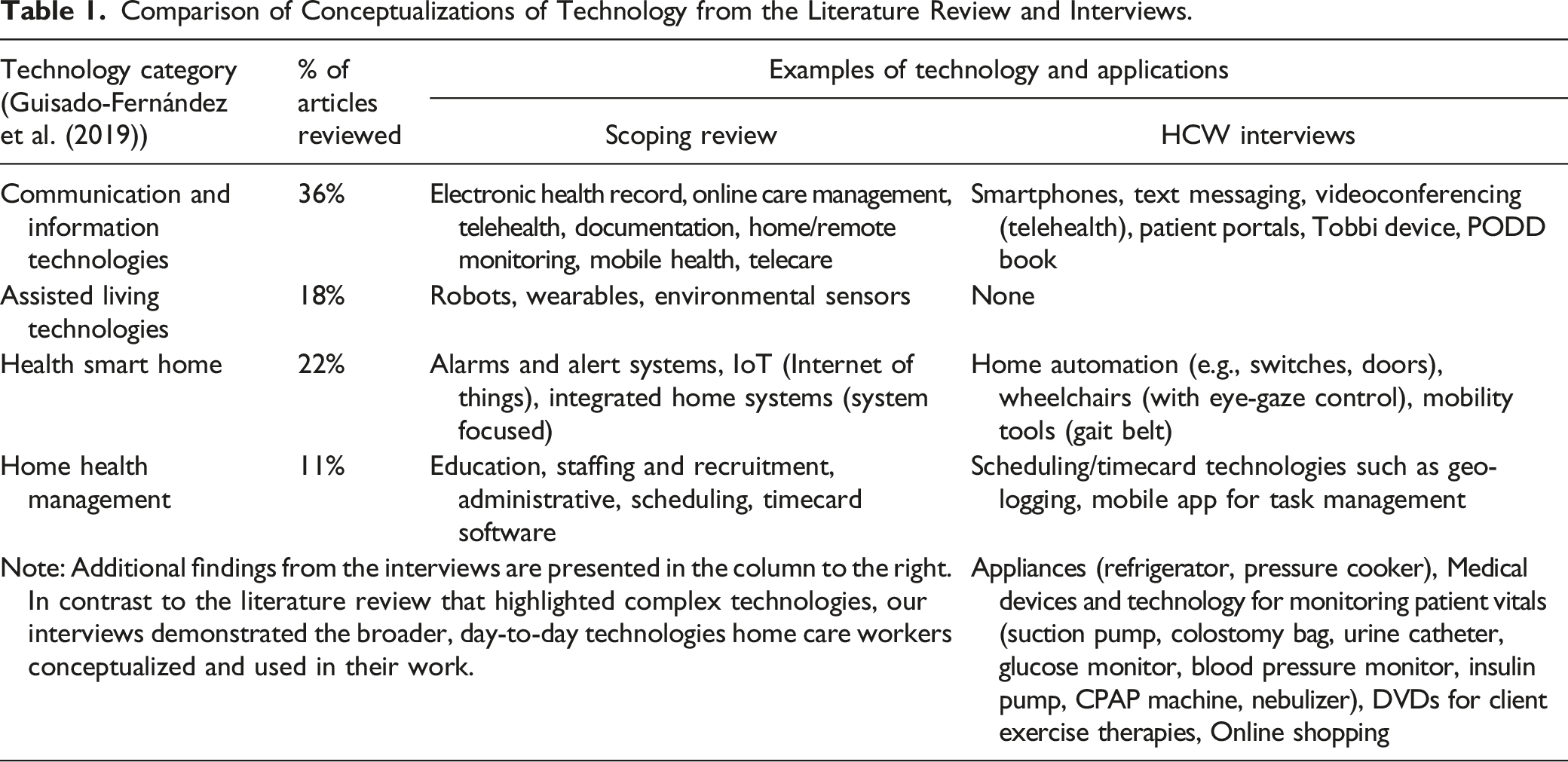
Comparison of Conceptualizations of Technology from the Literature Review and Interviews.
HCW Interviews
Findings from Interviews with Home Care Workers.
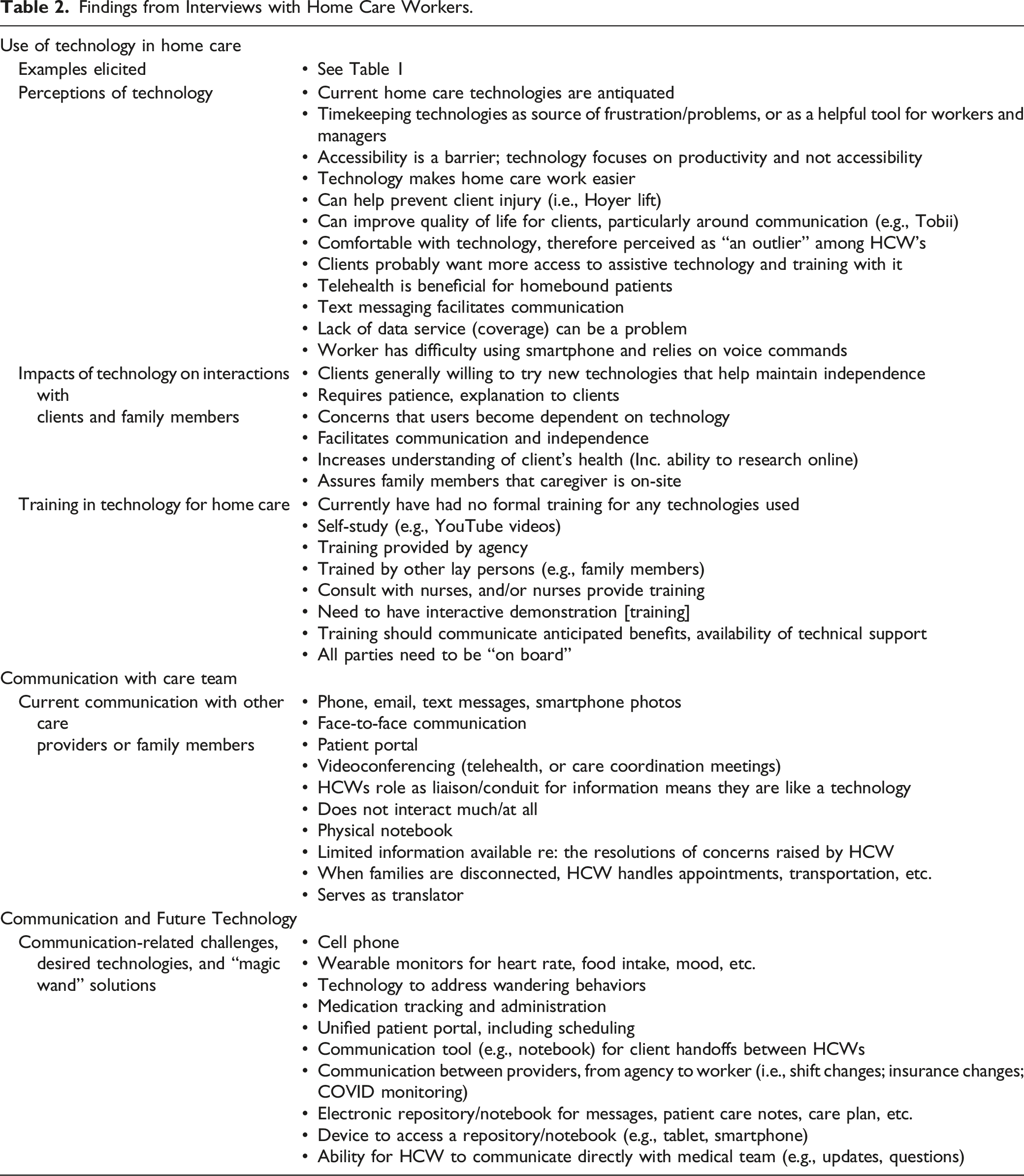
First, HCWs overwhelmingly reported minimal use of technology in home care but conceptualized technologies in a broad way that fell into a variety of relatively low complexity domains including: apps for scheduling, clocking in, and pay; clinical devices such as a blood pressure cuff; transfer and mobility supports/lift; communication technologies including telehealth, use of their personal phone to text the client or family, or communication devices such as a Tobii/Dynavox device; accountability such as photographs of tasks completed; and other technology use such as helping the client with online shopping.
Several HCWs reported using paper methods of completing their timesheet but desired a more up-to-date method such as email or an app-based method. For example, one HCW described faxing time sheets, which required driving to a local community center each week to access a fax machine. Some HCWs struggled with technology in their jobs (e.g., electronic timesheets), mainly due to a lack of training. Other HCWs welcomed greater use and availability of technology but noted that there were few possibilities available by their home care agency.
Second, interviews also explored communication in home care, as we were particularly interested in how HCWs may serve as boundary spanners between the client and broader care team. We learned, however, that several HCWs generally did not regularly communicate with the client’s care team, despite their day-to-day vantage point for monitoring granular changes in client wellbeing. Furthermore, there was generally limited communication among HCWs themselves, such as “handoffs” whereby the HCW could provide information about the client’s day to the caregiver on the next shift. This was a challenge for HCWs in delivering high-quality care to the client: “The only thing I would love to have is a way to communicate with the other caregivers. Sometimes we work with the client and there’s two or three of you [HCWs]. And you don’t communicate. It’s really hard and wish we knew what this caregiver felt about this situation and how can we communicate better.” “I think something good [type of technology] would be something all PCAs could use, write notes down about what happened on the shift before you so you could just kind of arrive and see what happened during the day for her.”
This lack of communication with the broader care team and even with other HCWs was surprising given that HCWs are involved in the day-to-day care of clients, emphasizing the great potential to improve the work experience for HCWs.
Stakeholder (SME) Group Input
We shared findings from the interviews and scoping review with SMEs during the monthly meetings. SMEs provided broader context for the findings, including limitations and barriers to use of technology in home care. SMEs articulated that HCWs are underutilized members of the care team and that communication is thus limited among HCWs (e.g., notes in binders located in clients’ homes may be used by some agencies, but there is not a formal infrastructure for HCWs to communicate amongst each other). SMEs also noted that limited resources in home care agencies (e.g., reimbursement) challenged the introduction and implementation of technology in home care. In reflecting on the future of home care, SMEs believed that technology may elevate the role of HCWs as key members of the client’s care team by integrating them into the team. However, paid training for new technologies implemented in home care is critical to ensure HCWs’ understanding and comfort with its use.
Discussion
Triangulated findings suggest that there is great potential for the field of home care to advance with the integration of technology. Despite a diverse breadth of potential technologies in home care reflected in the literature, input from HCWs and SMEs suggested that the status quo is relatively “low tech” and may remain so without significant investments in the infrastructure and workforce that supports these technologies in practice. This disconnect in the sophistication of categories of technologies—identified in the literature review, and identified in discussions with HCWs and SMEs—suggest a potential “digital divide,” which should be carefully considered when designing new technologies for this workforce. In other words, any new technology should be user-centered and incorporate the perspectives and preferences of home care workers themselves.
Furthermore, our findings point to little communication among HCWs and no formal infrastructure to support this communication, which may be one simple way to begin to address the potential for the incorporation of technology into home care. We heard that shift change communication in particular is lacking in home care, exacerbated by resource constraints. We also learned that HCWs prefer simple technological solutions. Taken together, our findings point to the need to take a step back from thinking about expensive and complex technologies for home care to redirect our attention to develop a thorough understanding of the challenges HCWs face in communication in home care, and potential opportunities for technologies to support this workforce in delivering high-quality care.
Our sample of HCWs was limited to those providing care in Massachusetts and Colorado and may not be generalizable to those working in other states with different policies and procedures. We also faced challenges in recruiting this population for research. However, we believe that our triangulation of data with ongoing input from SMEs from across the U.S. throughout the course of nine months and the scoping review strengthen our findings.
Conclusion
As we look to the future of growing demand for HCWs, it is important to consider how technology may be best integrated into the home care field with a view toward improving work for workers, particularly in the realm of communication. Innovations could start small and simple, given current limitations and challenges in home care. It is also critical that HCWs are involved in the design of new technologies through a usability-centered process and implementation that is specific to the context of their work. Innovations must effectively meet HCWs’ unique needs, while being feasible and acceptable. Furthermore, paid hands-on training is critical for ensuring that HCWs are comfortable independently using any new technology. These findings provide important context for additional research examining the home care workforce and home care technologies.
Supplemental Material
Supplemental Material - Low Tech, High Potential: Using Technology to Improve Communication across Home Care Workers
Supplemental Material for Low Tech, High Potential: Using Technology to Improve Communication across Home Care Workers by Julia I. Bandini, Daniel Siconolfi, Katie Feistel, and Jason Etchegaray in Journal of Applied Gerontology
Footnotes
Acknowledgments
We thank our external stakeholder members who provided ongoing support and expert input in this study. We also thank Julia Rollison, Debra Saliba, Lucy Schulson, Susan Straus, and Jessica Phillips for their support and input on this manuscript.
Declaration of Conflicting Interests
The author(s) declared no potential conflicts of interest with respect to the research, authorship, and/or publication of this article.
Funding
The author(s) disclosed receipt of the following financial support for the research, authorship, and/or publication of this article: This material is based upon work supported by the National Science Foundation under Grant No. 2128739.
Authors’ Note
The IRB at the RAND Corporation, 2021-N0512-MOD-0, approved the study.

Supplemental Material
Supplemental material for this article is available online.
References
Supplementary Material
Please find the following supplemental material available below.
For Open Access articles published under a Creative Commons License, all supplemental material carries the same license as the article it is associated with.
For non-Open Access articles published, all supplemental material carries a non-exclusive license, and permission requests for re-use of supplemental material or any part of supplemental material shall be sent directly to the copyright owner as specified in the copyright notice associated with the article.
