



Abstract
This study mainly intended to disentangle the role played by physical reserve as a mediator of the relationship between cognitive reserve and global cognitive functioning in older people aging well. A sample of 120 67–101-year-old community-dwellers was recruited in the Sardinian Blue Zone, an area characterized by the extreme longevity of its inhabitants. Each respondent completed a battery of tests examining cognitive functioning, perceived physical health, cognitive reserve, and physical reserve (objectively assessed through accelerometric-derived measures). Significant associations were found among measures of cognitive reserve, physical reserve, perceived physical health, and cognition. Besides, two mediational analyses pointed out that physical reserve and distinct indexes of cognitive reserve explained 18% and 32% of the variance associated with global cognitive functioning. In conclusion, the combination of high cognitive reserve and more preserved motor functioning seems to contribute to the maintenance of healthy cognition in older people aging well.
• One original aspect of this study is that physical health was concurrently assessed through self-reported and objective instrumental measures of physical activity in older individuals living in an area of exceptional longevity, the Sardinian BZ. • A further element of novelty is that this study examined the mediational role of motor functioning in the relationship between global cognitive efficiency and cognitive reserve of older people aging well. • Number of daily steps mediate the relationship between cognitive reserve and the global cognitive functioning of older people of the Sardinian BZ.
• The evaluation of motor functions through the administration of objective measures should be adopted in the clinical protocols. • The concurrent assessment of cognitive efficiency, and cognitive and motor reserves of older patients should be encouraged in clinical settings. • The implementation of interventions aimed at boosting life quality in late adulthood should include both physical exercise and cognitively stimulating leisure activities to promote successful aging.What this paper adds
Applications of study findings
Introduction
Cognitive reserve (CR) refers to a set of mental resources and strategies accumulated throughout one’s life that allow individuals to be resilient and cope with the consequences of age-related brain insults and deteriorations occurring during the last decades of life (Stern et al., 2020). CR is a latent variable that is assessed through indirect socio-behavioral proxy indices (Stern et al., 2020) of its facets (e.g., years of formal schooling, participation in cognitively stimulating leisure activities, vocabulary, occupational attainment).
There is evidence that CR favors the promotion of successful aging since it prevents or at least delays the occurrence of cognitive decline. In this regard, a recent longitudinal study showed that individuals who devoted their time to cognitively stimulating leisure activities (e.g., reading, traveling, learning a second language) in the late-life stage (i.e., over 65 years of age) and who were regularly engaged with the others in young adulthood (i.e., 13–29 years of age), were less exposed to cognitive decline at the 6-year follow-up (Litkouhi et al., 2023). Besides, it has also been documented that educational attainment (Godinho et al., 2022) and job occupation play (Kim et al., 2021) a crucial role as protective factors against cognitive decline in healthy aging and serve as compensatory resources in individuals exhibiting Mild Cognitive Impairment (for a review, see Corbo et al., 2023). Extending this, Calatayud et al. (2022) found that older individuals who performed intellectually demanding jobs, later exhibited better cognitive functioning but poorer functional development of basic and instrumental activities of daily life.
Moreover, physical activity (PA)—that has been defined by the World Health Organization “as any bodily movement produced by skeletal muscles that requires energy expenditure” to perform mobility, leisure activities, or work (WHO, 2022)—is a protective factor indicative of physical reserve (Sanchez Cabaco et al., 2023) for cognitively healthy aging. In this regard, the large body of literature which explored the effects of PA on cognition in older adults through behavioral and neuroimaging measures has demonstrated its beneficial effects in terms of enhancement and/or maintenance of cognitive functioning into advancing age (Etnier et al., 2019). In particular, it has been documented that older individuals who were regularly engaged in vigorous PA reported less cognitive decline over 2–10-year follow-up periods (Bherer et al., 2013) and exhibited more preserved brain structures. Moreover, even when specifically aimed at improving the cardiorespiratory fitness of older adults without known cognitive impairment, PA produces its largest effects on motor function and auditory attention, but even cognitive speed and visual attention can be favorably influenced by it (Angevaren et al., 2008).
Extending the above-mentioned outcomes, Cabaco et al., (2023) recently revealed that both self-assessed physical reserve and CR mediate the effect of age and educational attainment on memory efficiency and global cognition of 55–99-year-old individuals. In addition, Martinčević and Vranić (2023) found that a proxy of CR, namely, time spent for leisure activities, contributed to predicting self-reported physical activity in late adulthood.
A further trend of research has examined the impact of some proxies of CR and physical reserve on the successful aging of older people living in some isolated areas characterized by the exceptional longevity of the inhabitants. These areas are called Blue Zones (BZ) and are located in Ikaria (Greece), Okinawa (Japan), the central-eastern region of Sardinia (Italy), and the Nicoya Peninsula (Costa Rica) (Poulain et al., 2013). It has been found that older people of Ikaria, Okinawa, and those living in the Sardinian BZ who were physically more active, also exhibited better physical health and cognitive functioning, and greater psychological well-being than more sedentary peers (e.g., Fastame, 2022; Kreouzi et al., 2022; Legrand et al., 2019). However, to date, previous studies conducted in the BZs present at least four methodologic limits. First, CR was not evaluated using validated tools; that is, that construct was assessed using single socio-behavioral proxy measures, such as years of formal education and time spent in socio-cultural leisure activities at the time of the interview (e.g., Legrand et al., 2019; Ruiu et al., 2022). Second, in the studies conducted in the BZs, the physical reserve was usually assessed by applying qualitative methods (Spencer-Hwang et al., 2018) or through self-reported dichotomous measures correlated to daily activities implicating moderate-to-intense physical activity (e.g., “do you perform any sport?,” “do you spend time gardening?,” Fastame et al., 2018), or asking participants to self-evaluate their physical health and their lifestyle (e.g., Fastame, 2022; Legrand et al., 2021; Panagiotakos et al., 2011; Ruiu et al., 2022), or inferring the conduction of moderate-to-intense physical activities through some structured interview (e.g., Willcox et al., 2007). Indeed, to our knowledge, there are very few studies in which physical reserve was objectively assessed through instrumental measures in older people of the Sardinian BZ (Fastame et al., 2021) and those living in the Nicoya Peninsula (Madrigal-Leer et al., 2020). Third, apart from the evaluation of educational attainment, no studies have examined the CR of successful older people of the BZs over a lifetime. Fourth, research examining the interplay among CR, physical reserve, and cognition of older individuals living in areas of exceptional longevity is lacking. Therefore, the originality of the current study consists in the fact that it intended to overcome this gap, disentangling the relationship among CR, physical reserve, and global cognitive functioning of older individuals of the Sardinian BZ by the administration of a CR-validated tool used internationally, namely, the Cognitive Reserve Index questionnaire by Nucci et al. (2012; see the Materials section), and collecting a set of objective measures of physical activity, and cognitive health. Specifically, first, this study intended to explore the nature of the relationships among different indexes of CR, perceived physical health, physical reserve, and cognitive efficiency in older people aging well. Furthermore, this study was mainly aimed at examining the role of the physical reserve as a mediator in the relationship between CR and the global cognitive functioning of older individuals living in the Sardinian BZ.
Keeping in mind the exploratory nature of this study, following previous studies significant associations were hypothesized between global cognitive functioning and CR (e.g., Kim et al., 2021; Litkouhi et al., 2023), between CR as a measure of past work occupation and executive functions (Calatayud et al., 2022), and between the former and physical reserve (e.g., Bherer et al., 2013; Calatayud et al., 2022). Moreover, CR assessed in terms of time spent on leisure activities was expected to predict physical reserve (Martinčević & Vranić, 2023), and both CR and physical reserve were expected to predict the cognition of older participants (Sanchez Cabaco et al., 2023). Finally, due to the lack of previous evidence, no a priori hypotheses were proposed concerning the indirect effect of CR and objectively assessed physical reserve on the global cognitive functioning measure of successful older individuals of the Sardinian BZ.
Method
Participants
One hundred and twenty 67–101-year-old community-dwellers were enrolled in several villages of the Sardinian BZ (Italy). To take part in the study, participants had not to show severe signs of cognitive decline (i.e., they had to report a score
Materials
Each participant completed the following tests:
The MMSE (Folstein et al., 1975) was proposed as a measure of global cognitive functioning (maximum total score = 30). A score< 20 was used to identify individuals with suspected cognitive decline, whereas cognitively healthy participants exhibited a score >23.
The socio-demographic interview by Fastame (2022) was proposed to collect some lifestyle and demographic information from the respondents.
Part A of the Trail Making Test (TMT-A, Reitan & Wolfson, 1985) was designed to assess the speed of processing, visual scanning, and number sequencing skills. Indeed, this task requires connecting 25 encircled numbers scattered on a white sheet, as fast as possible. The time to perform this task was used as the dependent variable. Moreover, the Part B of the Trail Making Test was administered as a measure of shifting and cognitive flexibility. Indeed, to perform this task the participants had to draw a line connecting a set of numbers and letters randomly arranged on a sheet. Specifically, respondents were asked to switch between numbers and letters in consecutive order, and as fast as possible. The final score was computed by subtracting the time spent performing the task Part A from the time necessary to complete Part B (i.e., TMT-B-A).
The 20-item Cognitive Reserve Index questionnaire (CRIq, Nucci et al., 2012) was designed to assess three facets of the cognitive reserve throughout one’s whole life: educational attainment (i.e., CRIq-Edu), work occupation (i.e., CRIq-Job), and time spent on leisure activities (i.e., CRIq-Hobby). This tool also provides a total measure of cognitive reserve (i.e., CRIq-tot). Following the procedure suggested by the authors, the raw scores were standardized using a scale with M = 100, and SD = 15, where a score <70 indicates a very low CR, whereas a score >130 reflects excellent CR.
Finally, objectively assessed performed PA was employed as a proxy of the physical reserve. To this aim, PA amount and intensity were calculated based on longitudinal data collected using a clinically validated three-axial accelerometer (Actigraph GT3X, Actigraph Co., Pensacola, FL, USA) previously employed in studies involving older adults (Gorman et al., 2014; Migueles et al., 2017; Bammann et al., 2021; Ngueleu et al., 2022).
Procedure
Each respondent provided written informed consent before the presentation of the MMSE, CRIq, and socio-demographic interview. Then, participants were required to wear the accelerometer on their non-dominant wrist for seven consecutive days 24 h/day and were instructed to remove the device only when performing water-based activities. At the end of the observation period, the examiner individually administered the Trail Making test and collected the devices. The raw accelerometric data (collected in 60-s epochs at 30 Hz frequency) were downloaded on a PC and processed by means of the dedicated ActiLife software (v6.13.3 Actigraph Co., Pensacola, FL, USA) to extract the following variables: • wear time (i.e., the number of hours which refer to valid accelerometric data) • step counts (on a daily and weekly basis) • Accelerometric counts per minute (CPM), calculated on the basis of the Vector Magnitude (VM, square root of the sum of the squared counts in x, y, and z axis) • PA intensity, calculated as the percentage of time spent in each of the following three categories defined according to the associated value of metabolic equivalent (MET): sedentary behavior (SB, 0–1.5 MET), light intensity PA (LPA, 1.5–3 MET), and moderate-to-vigorous PA (MVPA, >3 MET). Such discrimination was carried out based on the cut points for accelerometric CPM proposed by Migueles et al. (2021). In the analysis, we considered and included only acquisition days characterized by a wear time of at least 16 h.
Statistics
The data were analyzed using IBM SPSS Statistics version 24 (SPSS Inc., Chicago, IL, USA) and version 2.3 of the Jamovi open-source package (The Jamovi Project, 2022). Statistical significance was set to p-values <.05. Descriptive statistics were performed to illustrate the characteristics of the sample. Pearson product-moment correlations were calculated to examine the nature of the relationship among CR, perceived physical health, physical reserve, and cognitive measures. Based on the findings of the correlational analyses, two mediational analyses were conducted to explore whether the measure of steps count (i.e., that was used as an indicator representative of physical reserve) mediates the relationship between the global cognitive functioning measure and cognitive reserve (i.e., total cognitive reserve and time spent for leisure activities, respectively). Thus, in each mediation analysis, the MMSE score was used as the dependent variable, the number of daily steps was the mediator, whereas the CRIq-tot and CRIq-Hobby measures were, respectively, used as the independent variable. In each condition, the indirect effect was tested using a bootstrap estimation approach with 5000 samples (Hayes, 2017). The significance of the direct and indirect effects was tested. It was assumed that there was a significant effect of the daily steps over the cognitive reserve measure when the indirect effect was statistically significant (p < .05).
A priori power analysis using the G-power program (Faul et al., 2007) revealed that to perform two-tailed correlational analyses, a convenient sample of 112 participants was necessary, when r = .3, power = .9, with alpha at .05. Finally, following Sim et al. (2022), to conduct simple mediation analyses maintaining power close to .8 or greater with an alpha level of .5, it was calculated that the minimum required sample size was 90 participants.
Results
Socio-Demographic Characteristics of the Participants Recruited in the Sardinian BZ.
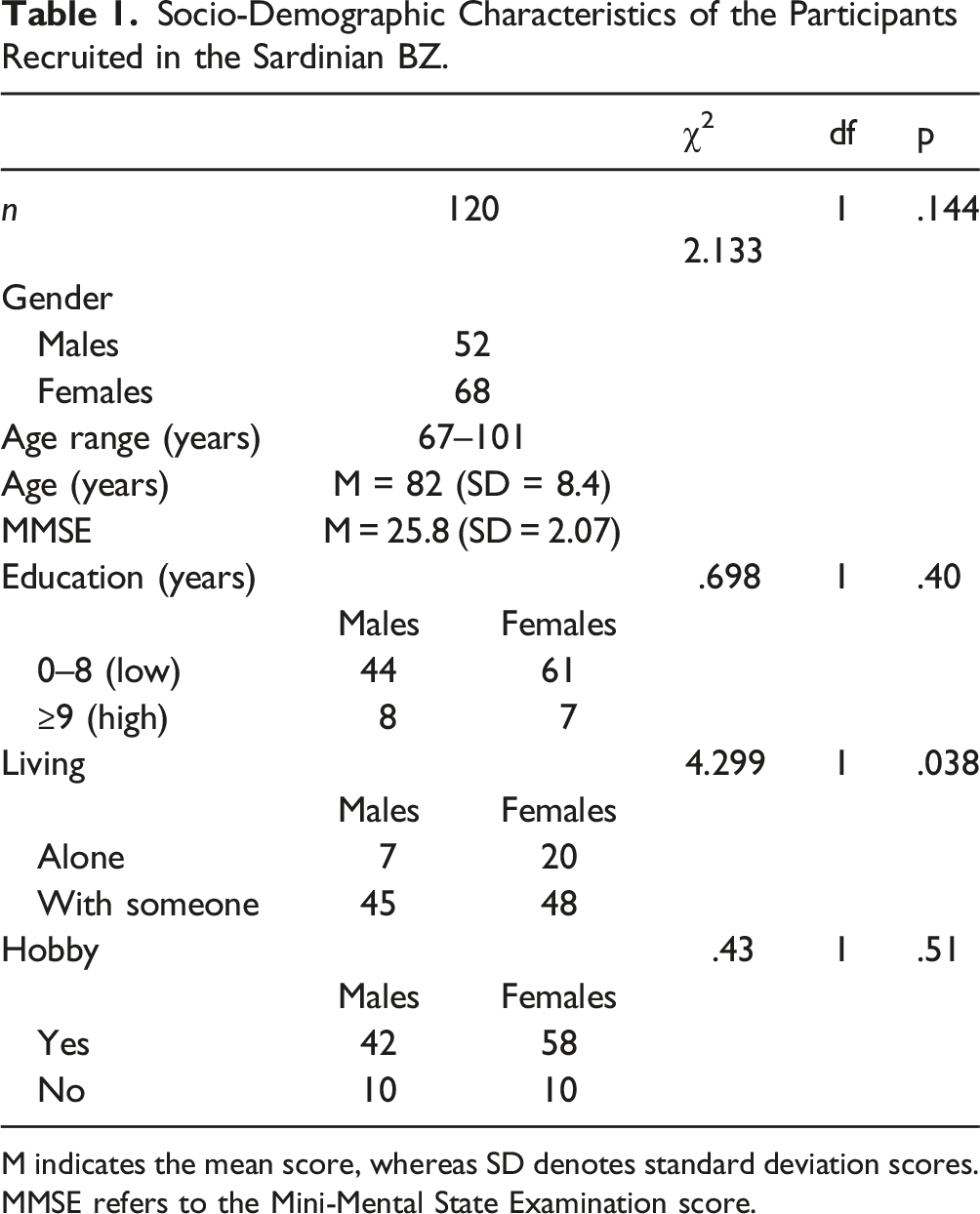
M indicates the mean score, whereas SD denotes standard deviation scores. MMSE refers to the Mini-Mental State Examination score.
Pearson’s Correlations Among Global Cognitive Reserve (i.e., CRIq-tot), Educational Attainment (i.e., CRIq-Edu), Work Occupation (i.e., CRIq-Job), Time Spent With Leisure Activities (i.e., CRIq-Hobby), Perceived Physical Health (i.e., PHYS), Mini-Mental State Examination (i.e., MMSE), Part A (i.e., TMT-A) and Part B-A (i.e., TMT-B-A) of the Trail Making Test, and Motor Functioning (i.e., Daily Steps, Percentage of Time Spent in Sedentary Behavior, and Accelerometric Counts (VM-CPM) Were Computed.

Note. *p < .05, **p < .01, ***p < .001.
Based on the findings emerging from the correlational analyses, two mediation analyses were carried out to explore whether the measure of daily steps significantly mediates between the total cognitive reserve score (i.e., CRIq-tot) and the index of global cognitive functioning (i.e., MMSE). It was found that the CRIq-tot score was a significant predictor of the daily Steps [b = 55.953, SE = 21.319, p = .009, (path a in Figure 1)], and the daily steps index significantly predicted the MMSE score [b = 1.60 × 10⁻⁴, SE = 4.65 × 10⁻⁵, p < .001, (path b in Figure 1)]. These outcomes show that the mediation hypothesis for the global cognitive functioning outcomes is supported. After controlling for the daily steps value (path c’ in Figure 1), CRIq-tot remained a significant predictor of the global cognitive functioning index (b = .009, SE = .004, p = .048). Besides, the indirect coefficient was significant (b = .009, SE = .004, p = .048; 95% CI = .001, .065). Overall, the standardized effect size indicated that 18% of the variance in the MMSE condition was explained by the daily steps and CRIq-tot indexes. Figure 1 illustrates these results. Predicted mediational patterns for the MMSE score, using the daily Steps index as a mediator of the relationship between the global cognitive reserve index (i.e., CRI-tot) and the global cognitive functioning (i.e., MMSE) measure.
Finally, a further mediational analysis documented that the CRIq-Hobby measure was a significant predictor of the daily steps [b = 61.664, SE = 19.930, p = .002, (path a in Figure 2)], as well as the daily Steps index significantly predicted the MMSE score [b = 1.68 × 10⁻⁴, SE = 4.95 × 10⁻⁵, p < .001, (path b in Figure 2)]. Therefore, the mediation hypothesis for the MMSE score is supported. After controlling for the daily steps (path c’ in Figure 2), CRIq-Hobby remained a significant predictor of the MMSE score (b = .0218, SE = .011, p = .047). Besides, the indirect coefficient was significant (b = .010, SE = .004, p = .021; 95% CI = .002, .020). Overall, the standardized effect size indicated that approximately 32.2% of the variance in the MMSE condition was explained by the daily steps and CRIq-Hobby scores. Figure 2 summarizes these findings. Results of the mediational model showing the significant mediating role of the daily Steps index in the relationship between the time spent for leisure activities (i.e., CRIq-Hobby) and the global cognitive functioning (i.e., MMSE) measures.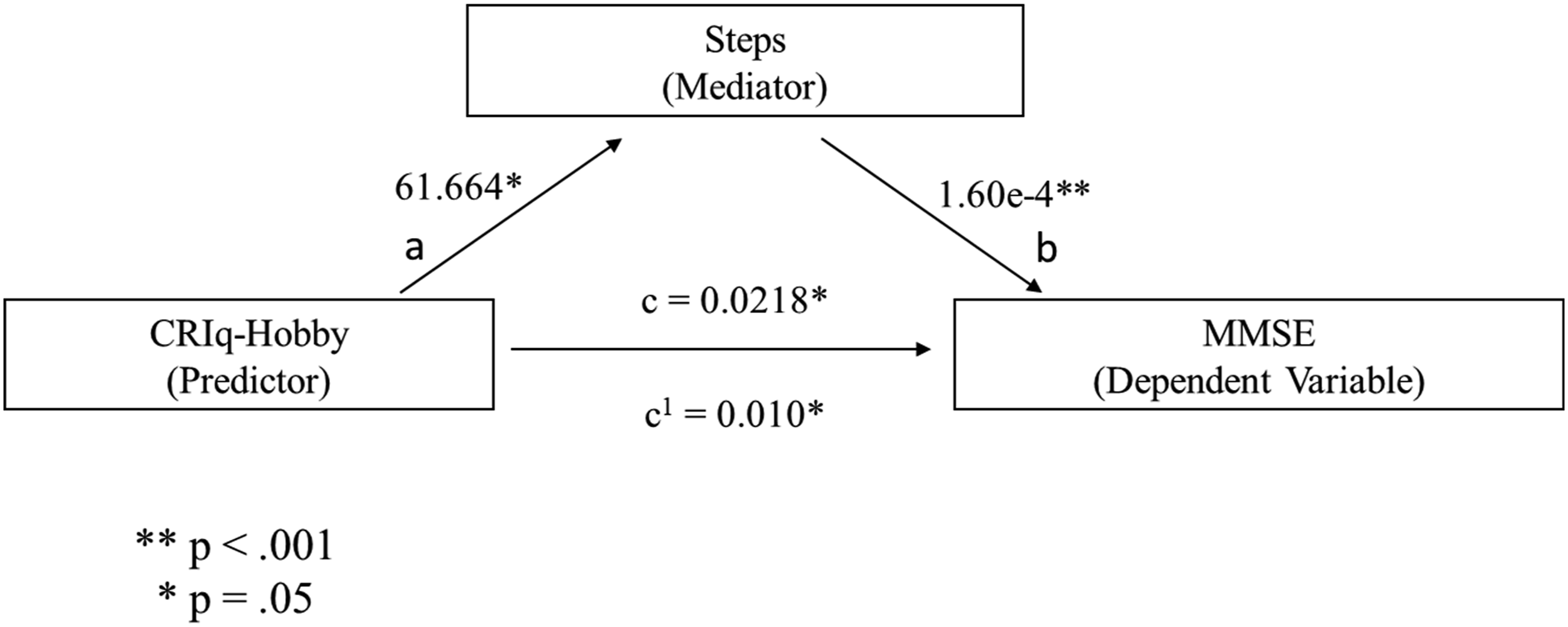
Discussion
The main goal of this investigation was to clarify the role played by physical reserve as a mediator of the relationship between CR and global cognitive functioning in a sample of older people living in an area of exceptional longevity, the Sardinian BZ. To the best of our knowledge, no studies examined the interplay among the above-mentioned constructs in late adulthood, especially in those individuals living in areas of exceptional longevity. A further element of novelty of this investigation consists in the fact that CR was assessed along one’s whole life via a tool that has been used in Italy and elsewhere (e.g., Martinčević & Vranić, 2023), namely, the CRIq by Nucci et al. (2012). In our opinion, the administration of a validated instrument that is also used internationally is beneficial, since it favors the replicability of the study and the comparison of the results. A further novelty aspect concerns the fact that in the current investigation physical reserve was concurrently assessed based on both self-reported and objective instrumental measures of PA. This is very important, since thus far, data about PA of older people living in the BZs were mainly assessed through diaries and recall questionnaires (e.g., Fastame, 2022; Panagiotakos et al., 2011; Ruiu et al., 2022; Spencer-Hwang et al., 2018) which represent the most widespread techniques owing to their low cost, easiness of use and versatility but that suffer from poor reliability and validity, participant recall bias and interpretation of questions (Silfee et al., 2018), and usually overestimate amount and intensity of movement performed (Boon et al., 2010). Thus, the integration of the two approaches (i.e., self-reported and objective measures) seems to be important to accurately capture detailed information about PA features.
Consistent with previous evidence (e.g., Kim et al., 2021; Litkouhi et al., 2023), moderate associations have been found between global cognitive functioning (i.e., MMSE score) and global CR and educational attainment. Similarly, the correlational analyses highlighted that those who exhibited better CR (i.e., educational attainment, work occupation, and total CR index) also showed a better speed of processing assessed through the TMT-A. Besides, following previous studies (e.g., Calatayud et al., 2022), formal schooling and work occupation were significantly associated with cognitive flexibility and shifting skills (i.e., assessed through TMT-B-A), suggesting that those who were more educated and performed more cognitively demanding jobs empowered their executive functions during their lifespan. Moreover, following Ruiu et al. (2022), a small and positive significant relationship has been found between perceived physical health and the CRIq-Hobby measure, suggesting that those who were more engaged with cognitively and physically demanding leisure activities also felt physically better. Extending this and in line with previous evidence (Bherer et al., 2013), we also found that physical reserve (objectively assessed in terms of daily steps) was associated with perceived physical health, CRIq-tot, and CRIq-Hobby. Overall, these outcomes suggest that a more active lifestyle along one’s life and engagement in cognitively demanding leisure socially-oriented activities are also associated with a better level of physical health in late adulthood.
Moreover, keeping in mind the exploratory nature of this study and the need for further evidence, this study suggests that physical reserve mediates the relationship between CR and global cognitive functioning. Indeed, it has been shown that the number of daily steps and the CR total measure explained approximately 18% of the variance in the MMSE condition, as well as 32% of the variance in the MMSE condition was explained by time spent on leisure activities and daily steps. Altogether, these findings extend those of previous studies that highlighted the predictive role of CR on physical reserve (Martinčević & Vranić, 2023) and of CR and physical reserve on healthy cognition in late adulthood (Sanchez Cabaco et al., 2023). Specifically, the significant indirect effect of CR—especially the CRIq-Hobby measure—and daily steps on the MMSE score suggests that the cognitive reserve and physical one contribute in preserving the global cognitive functioning of older individuals who age well. Therefore, as suggested elsewhere (e.g., Legrand et al., 2019; Martinčević & Vranić, 2023; Ruiu et al., 2022), the current outcomes seem to support the idea that the maintenance of an active lifestyle in which older people are engaged with moderate but regular physical activity and with cognitively stimulating leisure activities is essential for the promotion of successful aging. Indeed, as suggested by Stern et al. (2020), life experiences and lifestyle which enhance CR and physical reserve and therefore increase cognitive flexibility are crucial for coping with age-related cognitive and functional changes. Therefore, in line with the SOC model by Baltes and Baltes (1990), the accumulation of CR and physical reserve built through one’s life serves to compensate for the mental and motor losses characterizing late adulthood. In fact, older individuals select the cognitively or physically demanding activities that they can still perform, and optimize their performance through the use of cognitive strategies (e.g., mnemotechnics) or external aids which are necessary to perform those tasks and maintain independence in their daily life.
Assuming an applied viewpoint, as suggested by Calatayud et al. (2022), these results encourage the promotion of specific multidomain trainings aimed at boosting both physical reserve and cognitive health in later lifespan through regular and moderate physical exercises (e.g., walking, aerobic exercises, gardening), cognitively demanding individual activities (e.g., reading a book, playing a musical instrument), and leisure activities empowering both the cognitive and social functioning (e.g., hobbies implying novel information processing such as learning a second language or to use a computer, playing bridge). This kind of intervention would be particularly useful for physically inactive older individuals who are more at risk of developing cognitive decline (Li et al., 2023) and for those who performed high physically demanding jobs but with low cognitive demands, because they are more at risk to exhibit poorer cognition (e.g., less efficient executive functions) and lower performance in activities of daily living (Calatayud et al., 2022). In this context, our study confirms the pivotal role played by regular ambulation, which was previously found very beneficial in terms of successful aging. In fact, previous studies demonstrated that higher steps volume (objectively assessed using three-axial accelerometers) is significantly associated with lower hospitalization, and all-cause mortality risk in community-dwelling older adults (Manas et al., 2022), better cognitive functions (Calamia et al., 2018), and lower risk of all-cause dementia (del Pozo Cruz et al., 2022). Indeed, as suggested elsewhere, this would be useful to boost healthy cognitive aging, perceived psychological well-being and coping skills (i.e., necessary to face the physiological age-related decline), independence in performing the activities of daily living, and, to delay, if necessary, the occurrence of dementia (e.g., Fastame et al., 2018, 2022b; Iosa et al., 2014; Reas et al., 2019; Scarmeas & Stern, 2003).
However, some limitations must also be considered. Specifically, the participants were mainly cognitively healthy community-dwelling inhabitants of the Sardinian BZ, exhibiting low educational attainment but with an active lifestyle (i.e., they stated to be regularly engaged in leisure activities). Moreover, the battery of cognitive tasks was limited, and further crucial constructs for successful aging (e.g., quality of life, resilience) were not investigated. Similarly, specific tests aimed to evaluate the performance in basic motor tasks involved in activities of daily living (i.e., balance and functional mobility), as well as muscular strength were not examined. This would be useful to fully depict the functional profile of participants from the point of view of their residual abilities. Therefore, future research should overcome these issues, extending the number and type of tests to be administered. Moreover, to favor the generalizability of the current findings, the study must be replicated both with larger samples of cognitively healthy respondents recruited elsewhere and participants exhibiting Mild Cognitive Impairment, since CR and physical reserve may be fundamental as protective factors to contrast the impact of cognitive decline and the occurrence of dementia in late lifespan (e.g., Bherer et al., 2013; Corbo et al., 2023; Fastame et al., 2022a). Finally, future longitudinal research is necessary to clarify the role played by the developmental factors in the relationship among CR, physical reserve, and cognition in late adulthood.
Footnotes
Author Contributions
B.B. recruited the participants, collected the data, and was responsible for the scoring and the preparation of the input databases. M.C.F. conceived the study, was in charge of overall direction and planning, and she took the lead in conducting the data analyses and writing the manuscript. M.P. conceived the study and contributed to writing the manuscript. All authors discussed the results and commented on the manuscript.
Declaration of Conflicting Interests
The author(s) declared no potential conflicts of interest with respect to the research, authorship, and/or publication of this article.
Funding
The author(s) received no financial support for the research, authorship, and/or publication of this article.
