



Abstract
This study examined whether frailty mediates the relationship between sexual and gender minority (SGM) status and three types of outpatient healthcare utilization among adults aged 50 and older in the All of Us Research Program (2017–2022). We estimated controlled direct effects of SGM status across generalist, specialist, and mental health visits. Healthcare utilization and SGM status were self-reported, and frailty was measured using a survey-based deficit accumulation index. Both SGM status and frailty were independently associated with increased rates of all outpatient visit types. Regarding mediation, our results suggest that if all participants were robust, SGM adults would still have higher healthcare utilization compared to cisgender heterosexual older adults. This indicates that factors beyond frailty influence patterns of healthcare use in this population and highlights the importance of identifying additional determinants to ensure that older SGM adults receive appropriate and responsive care.
Sexual and gender minority (SGM) status and frailty independently contribute to increased generalist, specialist, and mental health visits. Frailty alone does not explain the higher healthcare utilization reported by SGM older adults. Emphasizes the need to assess additional factors influencing healthcare utilization patterns among SGM older adults.
Highlight the importance of developing targeted interventions and support systems that address specific factors driving healthcare utilization among SGM older adults. Healthcare providers and systems should enhance training and implement inclusive policies to deliver culturally humble and affirming care to SGM older adults.What This Paper Adds
Applications of Study Findings
Introduction
The population of older sexual and gender minority (SGM) adults in the United States is projected to exceed 5 million by 2030 (Fredriksen-Goldsen et al., 2015). As this population grows, existing health disparities—including higher rates of chronic conditions, mental health issues, functional limitations, and cognitive impairment—may persist or worsen (Flatt et al., 2021; Fredriksen-Goldsen et al., 2017; Gonzales et al., 2016; B. H. Han et al., 2020; Nelson & Andel, 2020). These disparities likely contribute to a greater burden of frailty among older SGM adults (Wong et al., 2023), a condition associated with increased mortality, disability, and healthcare utilization (L. Han et al., 2019; Rockwood et al., 2000; S. M. Shi et al., 2020). Therefore, understanding the association between frailty and healthcare utilization among SGM populations is essential for meeting their unique care needs and reducing health disparities.
The relationship between SGM status and healthcare utilization in older adults remains unclear, partly due to differences in study populations and how utilization is measured. Some studies report no difference in having a source of primary care or routine checkups between sexual minority and heterosexual older adults (Dai & Meyer, 2019; Fredriksen-Goldsen et al., 2017), while others found that older gay men and gender minority adults are more likely to have routine or annual wellness visits (Dai & Meyer, 2019). Aggregated data suggest that older SGM adults have a 14% higher outpatient visit rate compared to cisgender heterosexual peers (Wong et al., 2024). Mental health care utilization is also higher among SGM older adults, who are more likely to report receiving mental health care and have higher rates of outpatient mental health visits (Progovac et al., 2018; Stanley & Duong, 2015; Wong et al., 2024) However, evidence regarding specialty care is limited and mixed, with some studies noting higher utilization of certain specialties related to gender-affirming care, but no differences in others (Abramovich et al., 2020).
Frailty may be a key, modifiable factor underlying differences in healthcare utilization between older SGM and cisgender heterosexual adults. Frailty is defined as increased physiological vulnerability to stressors such as illness or injury (Rockwood et al., 2000) and is linked to greater outpatient healthcare use (Ge et al., 2020; L. Han et al., 2019; Ikonen et al., 2021, 2022). Notably, older SGM adults develop frailty at younger ages and experience a higher burden of frailty, likely due to their greater prevalence of chronic and mental health conditions, functional limitations, and cognitive impairments (Flatt et al., 2021; Fredriksen-Goldsen et al., 2017; Gonzales et al., 2016; B. H. Han et al., 2020; Nelson & Andel, 2020; Wong et al., 2023). Given these associations, frailty may help explain disparities in healthcare utilization by SGM status.
Here, we aim to understand the concurrent associations between SGM status, frailty, and three types of outpatient healthcare utilization: generalist, specialist, and mental health visits. This study seeks to build upon previous findings that frailty mediates the association between SGM status and overall outpatient medical visits (Wong et al., 2024), by examining whether these associations differ between outpatient generalist and specialist visits. The All of Us Research Program’s survey-based healthcare utilization data enable us to assess whether frailty mediates the relationship between SGM status and the frequency of specific types of outpatient visits including generalist, specialist, and mental health visits.
Methods
In this cross-sectional analysis, we used data collected by the All of Us Research Program between May 31, 2017 and June 30, 2022, from over 340 healthcare organizations or the enrollment website (Version 7 Curated Data Repository, Controlled Tier Database C2022Q4R11). The All of Us Research Program is uniquely positioned to examine disparities in healthcare utilization among older SGM adults, as it is the largest publicly available data source that assesses both sexual orientation and gender identity. Additionally, the All of Us Research Program includes a Healthcare Utilization and Access Survey, which incorporates questions about types of healthcare utilization based on the National Health Interview Survey (National Center for Health Statistics, 2016).
Further details on the All of Us Research Program goals, scientific rationale, recruitment methods, and sites are described elsewhere (All of Us Research Program Investigators, 2019) and were approved by the All of Us Ethics Committee/Institutional Review Board. The current study was reviewed and deemed exempt by the authors’ institutional review board (IRB #: 22-10-16).
Cohort
We included participants aged 50 years or older at enrollment with completed Basics, Overall Health, Personal/Family Health History, and Health Access and Utilization Surveys, which were necessary to calculate the All of Us Frailty Index (Wong et al., 2023) and assess survey-based healthcare utilization.
Independent Variable
Sexual orientation and gender identity were self-reported as sex assigned at birth, gender identity, and sexual orientation. Participants were classified as SGM if they reported a sexual orientation of gay, lesbian, or bisexual; a gender identity of non-binary, transgender, additional options: genderqueer/fluid, two-spirit, or questioning (aggregated as “diverse”); a sex assigned at birth of intersex (reclassified as “diverse” to align with gender categories); and/or having discordance between gender and sex assigned at birth. Participants with congruent sex assigned at birth with gender identity (cisgender) and a sexual orientation of heterosexual were identified as cisgender heterosexual participants.
Dependent Variable
Healthcare utilization was assessed with survey responses of self-reported generalist, specialist, and mental health visits in the past 12 months. Visit frequency was reported in the following categories: 0, 1–2, 3–4, 5–6, 7–9, 10–12, 13–15, and 16 or more visits. For analysis, we summarized each category using the lower bound of the range. For generalist visits participants were asked “Have you seen or talked to a general doctor who treats a variety of illnesses (a physician in general practice, primary care, or internal medicine)?” For specialist visits participants were asked “Have you seen or talked to a medical doctor who specializes in a particular medical disease or problem (other than obstetrician/gynecologist, psychiatrist, or ophthalmologist)?” For mental health visits participants were asked “Have you seen or talked to a mental health professional such as a psychiatrist, psychologist, psychiatric nurse, or clinical social worker?”
Mediator
The All of Us Frailty Index is a deficit accumulation index, consisting of 33 deficits across domains including cognition, morbidity, physical function, geriatric syndromes, general health status, mental health, and sensory impairment. Participants were categorized as being robust (The All of Us Frailty Index <0.15), prefrail (≥0.15 to ≤0.25), or frail (>0.25) (Wong et al., 2023). Frailty was selected as the mediator because it is a modifiable factor, allowing for the development of targeted interventions to reduce frailty. Additionally, SGM status is associated with a higher burden of frailty (Wong et al., 2023) and higher frailty is associated with higher healthcare utilization among older adults (Ge et al., 2020; L. Han et al., 2019; Ikonen et al., 2021, 2022).
Covariates
Covariates included age, race and ethnicity (Black, White, Hispanic, Asian/Native Hawaiian or Pacific Islander/Middle Eastern/Northern African, and Other/Mixed), annual income (>$100k, $50–100k, <$50k), marital status (married or living with a partner, divorced or separated, widowed, never married), and human immunodeficiency virus (HIV) status. Self-reported general mental health (excellent, very good, good, fair, and poor) was included as a covariate only for the mental health analyses, as both frailty (Borges et al., 2022) and SGM status (B. H. Han et al., 2020) are associated with mental health.
Statistical Analysis
We compared sociodemographic characteristics between SGM and cisgender heterosexual groups using Fisher’s exact test, Wilcoxon rank sum test, and Pearson’s Chi-squared test, as appropriate. Statistical significance was defined as a two-sided p-value <.05.
Before conducting the mediation analyses, we assessed associations between SGM status, frailty, and healthcare utilization. Adjusted multinomial regression examined the association between SGM status and frailty category. Adjusted Poisson regression assessed the relationship between frailty category and healthcare utilization. We report the adjusted odds ratio (aOR) or adjusted rate ratio (aRR) adjusted for covariates listed above and 95% confidence intervals (CI).
To assess whether frailty mediates the relationship between SGM status and healthcare utilization (Figure 1) we estimated the controlled direct effect of SGM status on healthcare utilization while holding frailty constant at the “Robust” level. This approach estimates effects of exposures and mediators by modeling counterfactual outcomes and uses inverse probability weighting to adjust for both exposure-outcome confounding and mediator-outcome confounding (VanderWeele, 2009b). The consistency assumption is less central to our study because our goal is to compare outcomes across SGM and cisgender heterosexual adults rather than to intervene on SGM status, which is not directly manipulable. Because we are unable to define this intervention precisely we can imagine a stochastic intervention using possible values observed in the data (VanderWeele, 2009a). Under the non-interference assumption, we consider that each participant’s outcome depends only on their own SGM status and frailty, making it unlikely to be influenced by others. We visually assessed the distribution of the propensity scores across frailty categories (Supplemental Figure 1) and covariate balance of inverse probability weights for each type of healthcare utilization outcome (Supplemental Figure 2). Directed acyclic graph of the marginal structural model with frailty mediating the association between older sexual and gender minority status and healthcare utilization, adjusting for age, race and ethnicity, income, HIV, and marital status. Also included general mental health for mental health visit analyses. SGM, sexual, and gender minority; HIV, human immunodeficiency virus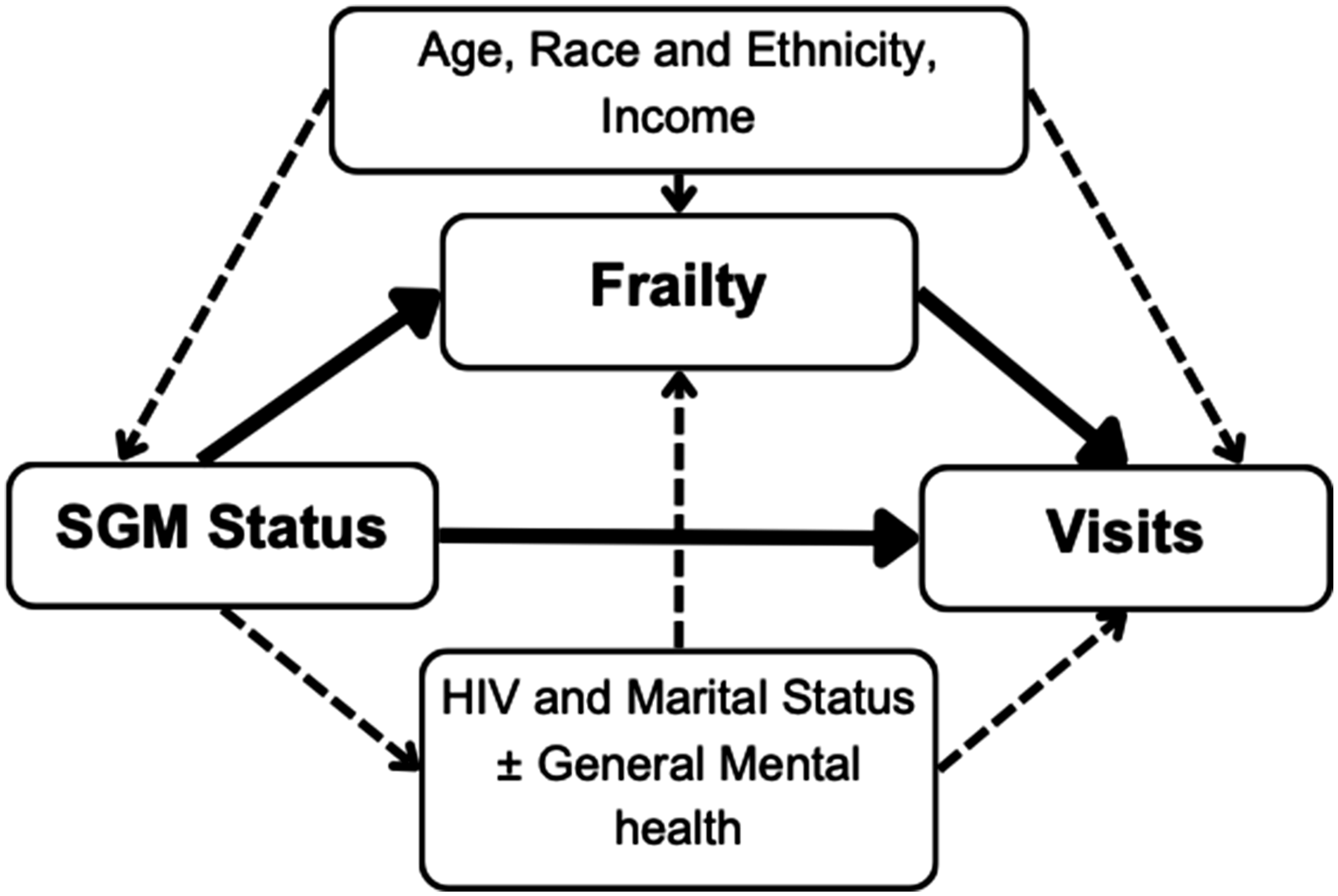
Separate models were constructed for each outcome (generalist, specialist, and mental health visits), resulting in three marginal structural models using Poisson regression (Supplemental Table 1). As a sensitivity analysis, we conducted the analysis using g-formula methods to examine consistency between two singly robust parametric methods (Supplemental Table 2). The total effect rate ratio represents the association between SGM status and healthcare utilization, while the controlled direct effect rate ratio represents the association if all participants were “not frail.” Both estimates were adjusted for covariates and we report aRR and 95% CI from 1,000 bootstrap samples using the CMAverse R package (B. Shi et al., 2021). All analyses were conducted in the All of Us Researcher Workbench cloud-based platform using R version 4.2.2 (R Core Team, 2022).
Results
Of 227,032 participants aged 50 years or older, 106,993 had completed the necessary survey data (Basics, Overall Health, Personal/Family Health History, and Health Access and Utilization Surveys) for this study. A total of 18,937 participants were excluded for the following criteria: 11,785 lacked sufficient data to calculate the All of Us Frailty Index (Wong et al., 2023), 6,031 were missing visit responses to the Health Access and Utilization Survey, and 4,273 had inadequate information to determine SGM status. The final cohort included 88,056 participants with 5,221 SGM and 82,835 cisgender heterosexual older adults (Figure 2). Flow diagram of participant cohort selection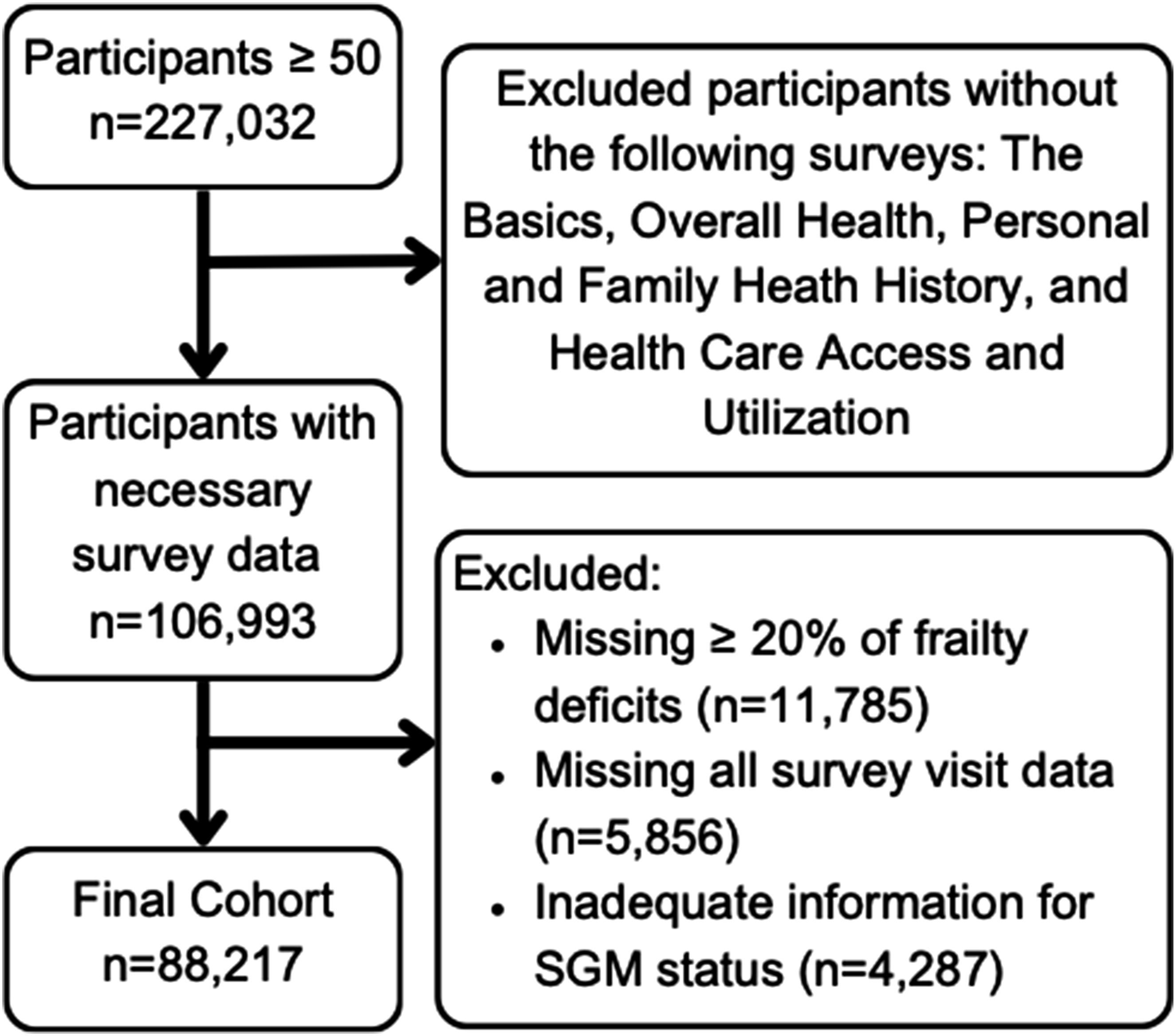
Characteristics of All of Us Participants by Sexual and Gender Minority Status

Notes. SGM, Sexual and Gender Minority; SD, standard deviation; NHPI, Native Hawaiian Pacific Islander; MENA, Middle Eastern North African; HIV, Human immunodeficiency virus. *p value < .05
aFisher’s exact test; Pearson’s Chi-squared test; Wilcoxon rank sum test.
SGM Status, Frailty, & Healthcare Utilization
Associations Between Older Sexual and Gender Minority Status, Frailty, and Healthcare Utilization
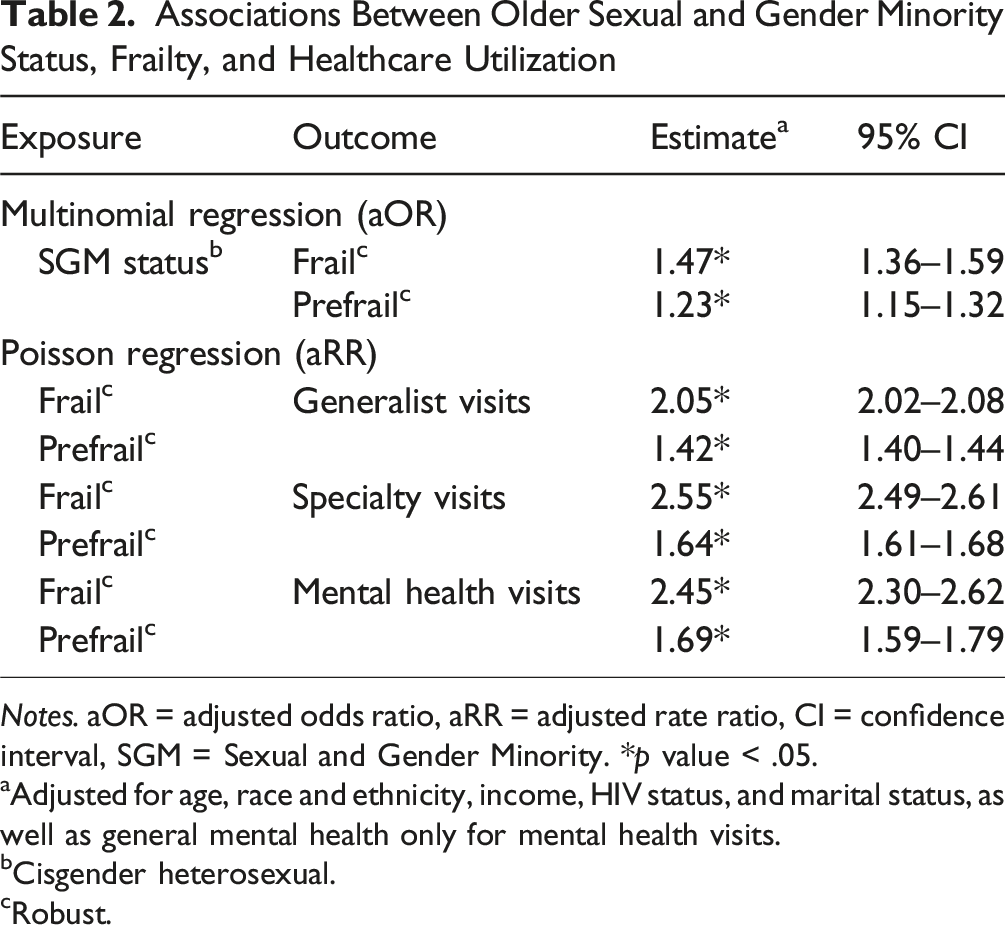
Notes. aOR = adjusted odds ratio, aRR = adjusted rate ratio, CI = confidence interval, SGM = Sexual and Gender Minority. *p value < .05.
aAdjusted for age, race and ethnicity, income, HIV status, and marital status, as well as general mental health only for mental health visits.
bCisgender heterosexual.
cRobust.
Marginal Structural Model Analysis
Older Sexual and Gender Minority Status, Frailty, and Healthcare Utilization: Mediation Analysis With Marginal Structural Model
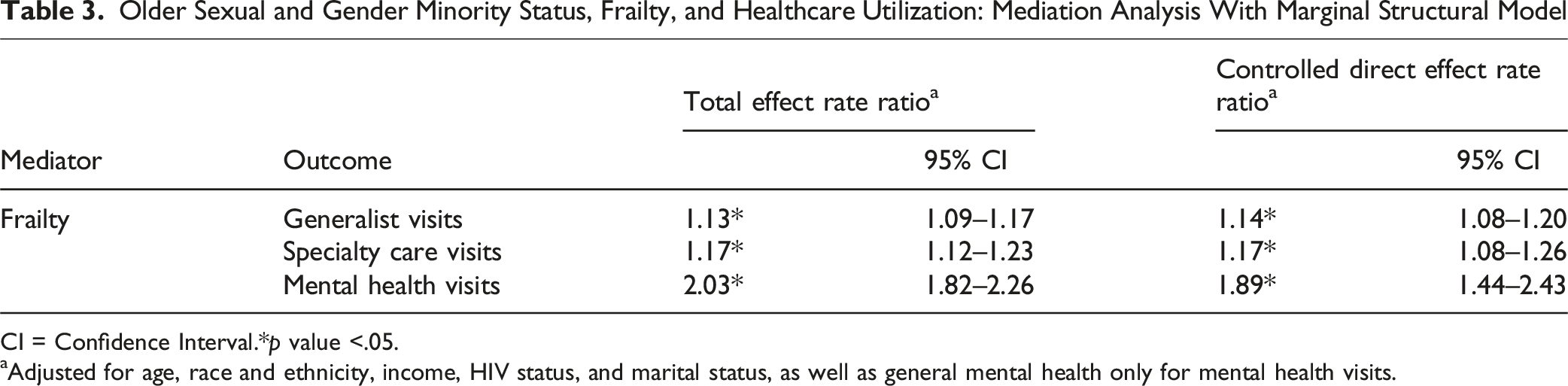
CI = Confidence Interval.*p value <.05.
aAdjusted for age, race and ethnicity, income, HIV status, and marital status, as well as general mental health only for mental health visits.
Discussion
In this study, we compared outpatient healthcare utilization—including generalist, specialist, and mental health visits—between SGM and cisgender heterosexual older adults using data from the All of Us Research Program. We also examined whether frailty mediates the relationship between SGM status and healthcare utilization. Our findings show that older SGM adults report higher utilization across all visit types compared to their cisgender heterosexual peers. While frailty was consistently associated with increased healthcare utilization, our results did not suggest that frailty mediates the relationship between SGM status and healthcare utilization.
Frailty as a Modifiable Mediator
We aimed to examine whether frailty mediated the association between SGM status and three types of outpatient healthcare utilization: generalist, specialist, and mental health visits. Our goal was to understand whether addressing frailty could impact healthcare utilization patterns among SGM older adults. Contrary to our hypothesis and prior research (Wong et al., 2024) we did not find evidence that frailty mediated the association between SGM status and healthcare utilization. There are two key differences that may account for this discrepancy. First, the self-reported data had more granularity which differentiated generalist and specialist visits, this was not available in EHR visit data in the All of Us Research Program. Second, both studies examined annual utilization, however, the survey utilization categorized visits with a maximum of 16+ per year, whereas EHR data measured visit-days, which could exceed 16.
The lack of mediation suggests that older SGM adults may have greater outpatient healthcare needs for reasons other than frailty. For example, SGM adults have higher rates of certain medical conditions and treatments—such as HIV (Phanuphak & Gulick, 2020), pre-exposure prophylaxis (Brady et al., 2019), or gender-affirming hormone treatment (Keuroghlian et al., 2021; Radix et al., 2024)—which require more frequent outpatient care. While our survey data could not directly assess the impact of these treatments on utilization, future studies using EHR data may provide further insights.
Healthcare system factors, such as SGM-focused clinics and inclusive practices, may also contribute to higher utilization among SGM adults. It is possible that organizations participating in the All of Us Research Program are more likely to have such practices in place. Overall, our results highlight the need for healthcare systems to be prepared to meet the unique needs of the growing older SGM population.
SGM Status and Healthcare Utilization
Older SGM adults reported higher outpatient healthcare utilization with 13% higher rate ratio of generalist visits, 17% higher rate ratio of specialist visits, and nearly double the rate ratio of mental health visits compared to cisgender heterosexual older adults. These findings are consistent with a recent EHR-based study (Wong et al., 2024) and provide robust evidence from the largest publicly available dataset on SGM individuals that older SGM adults have higher outpatient healthcare utilization.
The consistency of healthcare utilization results using the All of Us Research Program data may be the result of measuring healthcare utilization as a number of visits. In contrast, earlier studies which have produced inconsistent findings measured utilization as having a source of primary care or an annual checkup (Dai & Meyer, 2019; Fredriksen-Goldsen et al., 2017). Additionally, while previous research examined disaggregated SGM subgroups, our study aggregated SGM populations. We acknowledge that there is heterogeneity within SGM populations and by aggregating across groups we may be overlooking disparities between SGM sub-groups, however, this represents important next steps to improve understanding of SGM specific healthcare needs.
Our study also extends prior work by demonstrating that disparities in specialist visits are present among older SGM adults, echoing findings from younger gender-diverse cohorts (Abramovich et al., 2020). Similarly, our results demonstrate that older SGM adults have higher mental health care utilization, consistent with previous literature (Stanley & Duong, 2015; Wong et al., 2024). Collectively, these findings underscore the need for culturally humble, evidence-based care for older SGM adults as the population continues to grow (Burton et al., 2024; Fredriksen-Goldsen et al., 2015).
Frailty and Healthcare Utilization
Our findings reinforce the well-established association between frailty and increased healthcare utilization. Frail individuals had twice the rate of generalist visits and more than 2.5 times the rate of specialist visits compared to robust individuals, consistent with previous studies (Ge et al., 2020; L. Han et al., 2019; Ikonen et al., 2022). Frail adults also had nearly 2.5 times the rate of mental health visits. Prior research has shown that frailty is linked to a higher prevalence of mental health conditions, and that mental health issues can accelerate frailty and disability (Borges et al., 2022; Coventry et al., 2020). Addressing mental health may therefore be a promising strategy to mitigate frailty, particularly among older SGM adults who face a higher burden of both.
Limitations
This study has several limitations. The cross-sectional design of our study allows us to identify associations but not causality, specifically, we are not able to disentangle the temporality of frailty and healthcare utilization, which may be susceptible to reverse causality. This limitation emphasizes the need for longitudinal data to establish temporal relationships and examine whether interventions targeting frailty impact healthcare utilization patterns among SGM older adults. Nonetheless, the cross-sectional approach leverages the extensive survey data collected by the All of Us Research Program which covers multiple domains and factors that impact health. We acknowledge that we cannot fully rule out residual confounding due to unmeasured variables including healthcare site as this information is suppressed to protect patient privacy, however, we have addressed this to the extent possible given the available data by including a comprehensive set of baseline covariates, to address measured confounding. Another intrinsic limitation of the All of Us Research Program is that is it convenience sample, which may introduce sampling bias, but it remains the largest publicly available dataset of older SGM adults. By aggregating SGM populations, we may have overlooked differences among subgroups. Finally, healthcare utilization was self-reported in categorical ranges rather than as a continuous count, which may introduce recall bias and impact dispersion of visit data. However, we do not expect systematic over- or underestimation to have significantly affected our results.
Implications for Research, Clinical Practice, and Policy
The findings from this study offer several important implications for advancing equitable healthcare for older SGM adults. First, they highlight the need for additional research using longitudinal study designs to better understand the temporal and potentially causal relationships between frailty, healthcare utilization, and SGM identity. Disaggregating SGM subgroups is also critical to identifying meaningful within-group heterogeneity and informing targeted interventions. The All of Us Research Program offers a valuable foundation for such work, but further integration of survey and EHR data is needed to enhance both precision and generalizability.
Clinically, healthcare providers should recognize that older SGM adults may have greater healthcare needs independent of frailty. This finding underscores the importance of culturally humble, trauma-informed, and affirming care practices. The significantly higher rates of mental health service utilization observed in this study suggest that integrating behavioral health into primary care and geriatric settings may be particularly beneficial. Clinician education should include training in SGM aging, non-judgmental communication, and awareness of health risks specific to SGM adults to improve care quality and patient outcomes.
From a policy perspective, healthcare systems should proactively address the needs of the growing older SGM population. Creating inclusive clinical environments, expanding access to gender-affirming and mental health services, and ensuring that aging-related policies and programs explicitly include SGM populations are particularly important. Standardized data collection on SGM identity across healthcare and research settings is essential for monitoring disparities, informing policy initiatives, and guiding resource allocation. Finally, investments in workforce development, community-based services, and SGM-specific aging initiatives will be critical to promoting health equity and improving care delivery for this underserved population.
Conclusion
Both SGM status and frailty are associated with higher outpatient healthcare utilization among older adults, but frailty does not appear to mediate the relationship between SGM status and utilization. Our findings suggest that older SGM adults have greater outpatient healthcare needs, independent of frailty. The All of Us Research Program provides a unique resource for studying these patterns and highlights the importance of further research into healthcare utilization beyond outpatient care for this growing population.
Supplemental Material
Supplemental Material - The Mediating Role of Frailty in Healthcare Utilization Among Sexual and Gender Minorities: A Comparison of Generalist, Specialist, and Mental Health Visits
Supplemental Material for The Mediating Role of Frailty in Healthcare Utilization Among Sexual and Gender Minorities: A Comparison of Generalist, Specialist, and Mental Health Visits by Chelsea N. Wong, Robert Cavanaugh, Louisa H. Smith, Dae H. Kim, Carl G. Streed, Farzana Kapadia, Brianne Olivieri-Mui in Journal of Applied Gerontology
Footnotes

Ethical Considerations
The All of Us Research Program was approved by the All of Us Ethics Committee/Institutional Review Board. The current study was reviewed and deemed exempt by the Northeastern University Institutional Review Board.
Consent to Participate
Participant informed consent was collected by the All of Us Research Program.
Author Contributions
Funding
The authors disclosed receipt of the following financial support for the research, authorship, and/or publication of this article: CNW is supported by the National Institutes of Aging [T32 AG023480]. BLOM has been supported by the National Institutes of Aging [K01AG077972] for unrelated work.
Declaration of Conflicting Interests
The authors declared the following potential conflicts of interest with respect to the research, authorship, and/or publication of this article: DHK received personal fee from Alosa Health (ended on 12/31/2022) and VillageMD (ended on 12/13/2022) for unrelated work. CGS reports receiving consulting fees from EverlyWell, L’Oreal, the Texas Health Institute, the Research Institute for Gender Therapeutics, and the US Department of Justice unrelated to this work. All other authors have no conflicts of interest to report.
Data Availability Statement
Supplemental Material
Supplemental material for this article is available online.