



Abstract
The current investigation studied psychometric properties of the Homework Emotion Regulation Scale (HERS) for math homework, with 915 tenth graders from China. Confirmatory factor analyses (CFAs) supported the presence of two separate yet related subscales for the HERS: Emotion Management and Cognitive Reappraisal. The latent factor means for both subscales were shown to be invariant across gender. Furthermore, both subscales were positively related to homework purposes and behaviors (effort and completion) in the theoretically expected directions. Meanwhile, math performance was positively related to emotion management, but not cognitive reappraisal.
The aim of the current investigation is to evaluate psychometric properties of the Homework Emotion Regulation Scale (HERS; Xu, Fan & Du, 2016) for high school students. The HERS was developed for middle school students, as (a) students across nations frequently report unpleasant emotions during homework (Dettmers et al., 2011; Xu & Corno, 1998), (b) students’ unpleasant emotional states are more pronounced for homework than for classwork (Verma, Sharma, & Larson, 2002), and (c) regulating unpleasant emotional states is crucial for academic success and psychological well-being (Pekrun, 2006; Xu, 2011).
Emotion regulation is conceptualized as “the process by which individuals influence emotion they have, when they have them, and how they experience and express these emotions” (Gross, 1998, p. 275). In his model of emotion regulation, Gross (2002) has classified cognitive change as one major family of emotion regulation strategies, which is defined as “changing how we appraise the situation we are in to alter its emotional significance, either by changing how we think about the situation or about our capacity to manage the demands it poses” (Gross & Thompson, 2007, p. 14).
Previous research has, however, largely focused on cognitive reappraisal as one form of cognitive change (Gullone, Hughes, King, & Tonge, 2010), which “involves changing a situation’s meaning in a way that alters its emotional impact” (Gross & Thompson, 2007, p. 14). Thus, it would be intriguing to examine another form of cognitive change that involves changing how we think about our capacity to manage emotion impact (i.e., emotion management). Therefore, there is a need to investigate whether emotion management can be empirically distinguished from cognitive reappraisal. This line of investigation is especially important, as cognitive reappraisal as one form of cognitive change has a desirable influence on reducing the experience of negative emotion in Western countries (Gross & Thompson, 2007).
Using 796 middle school students, Xu et al. (2016) investigated whether emotion management could be empirically distinguished from cognitive reappraisal. Confirmatory factor analysis (CFA) showed that the HERS consisted of two distinct yet related factors: Emotion Management and Cognitive Reappraisal. Furthermore, these two factors were positively associated with mastery and performance orientation, desirable homework behaviors, learning strategies, and math performance.
As the items in the HERS are not middle school specific, the HERS holds the potential to be employed as a general scale for assessing emotion regulation of math homework for secondary school students. Yet, as individuals gradually learn to use more strategies to regulate their emotions over time (Eisenberg & Spinrad, 2004), and as high school students tend to take more initiatives to manage homework emotion than middle school students (Xu, 2011), it would be important to examine whether the HERS may be applicable at the high school level. Furthermore, as females tend to take more initiatives to manage homework emotion than males (Xu, 2011), it would be interesting to further test factor invariance across gender.
Consequently, our goals were (a) to test the factor structure of the HERS at the high school level, (b) to examine factor invariance across gender, and (c) to assess the concurrent and predictive validity evidence of the HERS. As the importance students place on studying is critical for their efforts and persistence (Eccles & Wigfield, 2002), their perceived purposes for homework influence how they handle homework (Xu, 2011). Therefore, we hypothesized that the HERS would be positively related to the Homework Purpose Scale (HPS). Consistent with theoretical expectation concerning the role of emotion regulation on task completion (Gross & Thompson, 2007; Pekrun, 2006), we further hypothesized that the HERS would be positively associated with homework effort and completion. In addition, as emotion regulation has a positive influence on academic performance (Gross & Thompson, 2007; Pekrun, 2006), we hypothesized that the HERS would be positively correlated with math achievement.
Method
Participants
Participants included 915 tenth-grade students from two public schools (56.7% females) in southeastern China. The average ages for male and female participants were 15.73 ± .37 and 15.68 ± .38. The average educational level for parents was 15.28 ± 2.47 years. Regarding math homework, 96.2% of participants received math assignments five or more days per week. On average, participants spent 64 ± 31 min on math assignments daily.
We secured the permission from the schools and parents for administering the instrument. Participants were assigned an identification number, which was used to link their standardized math test scores at the end of school semester.
Instrument
The HERS (α = .89) includes the same six items in the previous investigation with middle school students that has appeared in this journal (Xu et al., 2016). Response options include never (1), rarely (2), sometimes (3), often (4), or routinely (5). It consists of the following two subscales concerning how participants deal with unpleasant experiences while doing math assignments.
Emotion Management
This subscale assessed students’ efforts to down-regulate unpleasant emotions and up-regulate positive emotions (Xu, 2011; Yang & Xu, 2015), ranging from telling myself to calm down to cheering myself up (three items; α = .82; see Table 1).
Standardized Coefficients for the Two-Factor CFA Model.
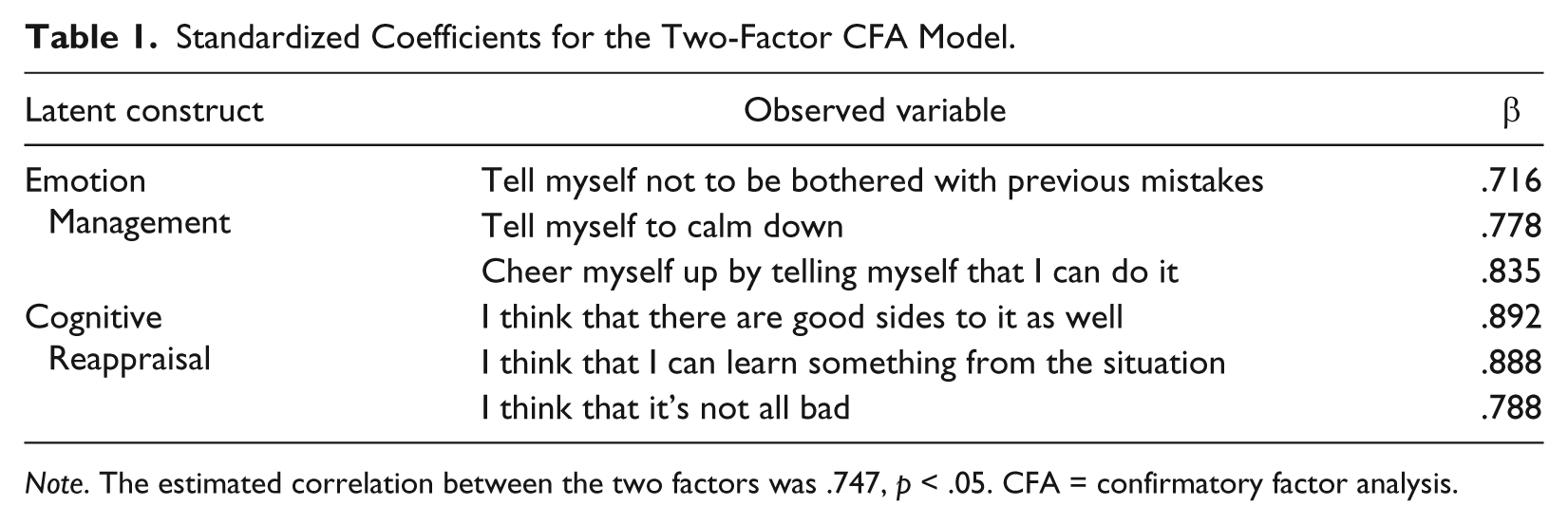
Note. The estimated correlation between the two factors was .747, p < .05. CFA = confirmatory factor analysis.
Cognitive Reappraisal
Informed by the literature on cognitive reappraisal (Gross, 2002) and homework (Xu & Corno, 1998), this subscale assessed students’ efforts to reframe a negative stimulus in less emotional terms (three items; α = .89).
Concurrent and predictive validity evidence
Three types of external measures were examined. First, homework purposes were measured by the HPS (Xu, 2010): (a) learning-oriented reasons (nine items; α = .91), (b) adult-oriented reasons (three items; α = .82), and (c) peer-oriented reasons (three items; α = .68). Regarding homework behaviors, more detailed information can be found in our previous study (Xu et al., 2016). Finally, math achievement was based on standardized test scores at the end of school semester (approximately 2 months following the administration of the HERS).
Results
CFA
CFA was performed using EQS 6.2 to test whether emotion management and cognitive reappraisal would be empirically distinct. As multivariate sample statistics were suggestive of nonnormality (Mardia’s normalized estimate = 59.04), we used robust maximum likelihood estimation method with Satorra-Bentler adjustment. Compared with the one-factor model (df = 9; *comparative fit index [CFI] = .912; standardized root mean residual [SRMR] = .081; *root mean square error approximation [RMSEA] = .147; 90% confidence interval [CI] = [.129, .166]; asterisk indicating robust statistics), the two-factor model produced a much better fitting model for the data (df = 8; *CFI = .993; SRMR = .020; *RMSEA = .045; 90% CI = [.024, .068]). Furthermore, the chi-square difference test between the one-factor and the two-factor models was highly significant, ΔS-Bχ2(Δdf = 1) = 149.733, p < .001. Thus, Emotion Management and Cognitive Reappraisal as two distinct constructs can be empirically distinguishable for high school students.
Regarding the two-factor model, an analysis of invariance was conducted across gender (519 females vs. 396 males). The results of configural invariance revealed an excellent fit of the model to the data (S-Bχ2 = 33.697; df = 16; *CFI = .992; SRMR = .022; *RMSEA = .049; 90% CI = [.025, .072]). We then tested factor loading invariance (S-Bχ2 = 40.780; df = 20; *CFI = .990; SRMR = .033; *RMSEA = .048; 90% CI = [.026, .069]). Thus, the factor loadings were invariant across gender, ΔS-Bχ2(Δdf = 4) = 5.388, p > .05.
In addition, we tested intercept invariance (S-Bχ2 = 45.326; df = 24; *CFI = .989; SRMR = .033; *RMSEA = .051; 90% CI = [.031, .072]). Therefore, intercepts were invariant across gender, ΔS-Bχ2(Δdf = 4) = 2.009, p > .05. Finally, we tested latent factor mean invariance (S-Bχ2 = 48.962; df = 26; *CFI = .989; SRMR = .033; *RMSEA = .053; 90% CI = [.033, .073]). Taken together, our results indicated that the latent factor means were invariant across gender, ΔS-Bχ2(Δdf = 2) = 3.529, p > .05.
Concurrent and Predictive Validity Evidence
As indicated in Table 2, correlation coefficients between the HERS, the HPS, and homework behaviors were consistent with our hypotheses. Math achievement was positively related to emotion regulation, but not cognitive reappraisal. One possible explanation is that it takes longer for the positive influence of cognitive reappraisal to take effect (Xu et al., 2016). Finally, results from the partial correlations provided additional empirical support to the presence of two distinct yet related subscales.
Pearson Correlations and Partial Correlations Between HERS, Homework Purposes, Behaviors, and Math Achievement.
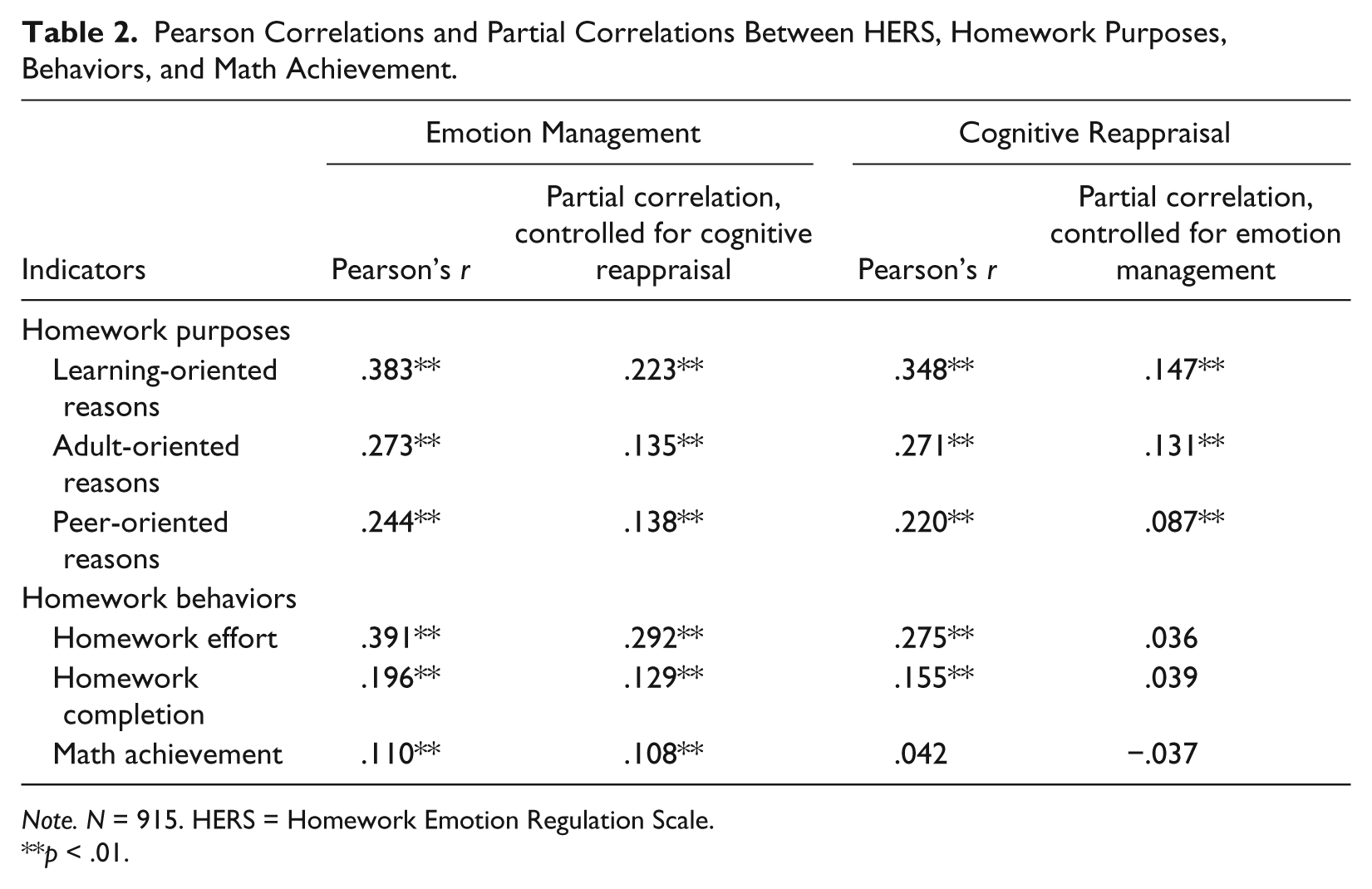
Note. N = 915. HERS = Homework Emotion Regulation Scale.
p < .01.
Discussion
Our CFA results supported the presence of two distinct yet related subscales for the HERS at the high school level. Furthermore, the HERS was significantly associated with homework purposes, behaviors, and math achievement in theoretically expected directions (except for 1 out of 18 possible correlations). In addition, our results concerning latent factor mean invariance suggest that the HERS is applicable to both males and females.
Taken together, the HERS represents a valid means to assess high school students’ emotion regulation in math homework. As our study suggests that there is a distinction between emotion management and cognitive reappraisal, attention can be more appropriately paid to the needs of those students who may fall into both or either one of these subscales.
As our results were based on 10th graders, there is a need to include students across high school grades in future research. Furthermore, as homework behaviors were assessed through self-report, it would be important to incorporate teacher ratings or direct observations in future research. In addition, consistent with the prior study with middle school students (Xu et al., 2016), the current investigation revealed that math achievement measured approximately 2 months later was positively associated with emotion management, but not cognitive reappraisal. Consequently, it would be beneficial to link the HERS to student achievement over a long period of time.
Footnotes
Declaration of Conflicting Interests
The author(s) declared no potential conflicts of interest with respect to the research, authorship, and/or publication of this article.
Funding
The author(s) received no financial support for the research, authorship, and/or publication of this article.