



Abstract
There are a variety of trends that are enabling and forcing organizational change. A crucial trend that has implications for a changing and growing demographic workforce includes Millennials and in particular Latinos/Hispanics as the world and particularly the U.S. workplace continues to have an increased aging workforce. Yet, while Latinos are members of the largest and also the fastest growing minority group in the United States, they are disproportionately underrepresented in more highly compensated professional and leadership roles across corporate America. The majority of existing career development and acculturation literature in the United States has focused narrowly on Anglo-oriented acculturation as a linear process. Unfortunately, as society has evolved so has the form of prejudices and biases. This is supported by the fact that well more than 50% of Hispanics experience discrimination through a variety of means including micro-aggressions. We believe that developing and maintaining an overlapping and compatible bicultural identity might not be enough and that we need to rethink what acculturation and biculturalism means for millennials and broaden our thinking to include cosmopolitanism as more encompassing of the millennials and their place in the world. We believe this article begins the dialogue for more research into this growing part of the U.S. workforce along with practical implications and applications.
State of the Workforce
There are a variety of trends that are enabling and forcing organizational change that include the technological evolution, educational challenges, an aging workforce, a growing Millennial population, and an increasingly diverse (particularly Latino) workforce. These trends create both challenges and opportunities for organizations and their leaders (Mouriño, 2017). A crucial trend and the focus of this article is the changing and growing demographic workforce that includes Millennials and, in particular, Latinos as the United States and its workplaces continue to have an increasingly aging workforce. Strack, Baier, Marchingo, and Sharda (2014) warned of a pending crisis by 2030 where there will be insufficient young workers to replace the aging workforce that is nearing retirement age. This will only make it that much more important to attract and retain an engaged workforce as competition increases for younger skilled workers.
While the 21st century is experiencing an aging workforce and will continue to do so into the foreseeable future, there is an increase in millennials who are also moving into the workplace. In fact, it is expected that by 2020, 50% of the workforce will consist of Millennials (Mathis, Jackson, Valentine, & Meglich, 2014). Millennials will overtake the number of baby boomers in the workplace and the motivations that drive these new workers are different from their predecessors. These new workers are motivated primarily by collaboration, recognition, innovation, and relationships (Tapscott, 2008). Millennials have been labeled impatient, technologically savvy, self-absorbed, and just plain spoiled. Clearly, this is not fully descriptive of millennials, they are also known to be resourceful and to have much concern for social issues such as sustainability (Hershatter & Epstein, 2010). The changing diversity of generations in the workplace will provide both opportunities and challenges in leader-employee relationships.
Today’s workplace consists of workers of all ages, not just Millennials searching for meaning and purpose in life, and yet the workplace seems to be the last place where workers are finding a meaningful purpose. In the 21st century, worker’s expectations are changing; unfortunately most companies have not evolved to keep pace or adapting fast enough to meet these changing worker expectations (Mackey & Sisodia, 2014).
The Growing Hispanic/Latino Millennial Workforce
While expectations of the workplace are changing, there is a generational change that is taking place with the Baby Boomers entering retirement at increasingly fast rates (Coulombe & Gil, 2016). All of this is occurring while the Millennial workforce is becoming the largest portion of the labor force, and among the Millennials, the increasing Latino demographic is the largest portion of this trend.
There are presently 53 million Latinos in the United States. This makes the United States a country with the second largest Latino population in the world and the second largest Spanish-speaking country with an average age of 27 years compared with 40 years for the U.S. White non-Hispanic population (Flores, 2017). This is further reinforced by the fact that Latinos will make up 74% of labor force growth by 2020 (Erickson, 2014a), and as of 2017, Latinos became the largest entrants into the workforce, which makes this group both an important part of the present workforce and customer base for organizations in the United States. In short, Latinos are expected to keep America both young and growing. In addition, Latinos will make up 29% of the growth in real income, more likely to participate in the workforce, and expected to add more than US$1.3 trillion in buying power (Eisenach, 2016).
As stated, the Hispanic population is the largest ethnic group in the United States and because of its growth trajectory over the next several decades it will continuously change the social demographic landscape of the United States (Cohn & Caumont, 2016). Yet, while Latinos are part of the largest and also one of the fastest growing minority groups in the United States, they continue to be disproportionately underrepresented in more professional and leadership roles across corporate America (Guadalupe, 2015). Figure 1 shows that 39% of White non-Hispanic individuals are listed as management and/or professionals compared with only 21% of Hispanics.
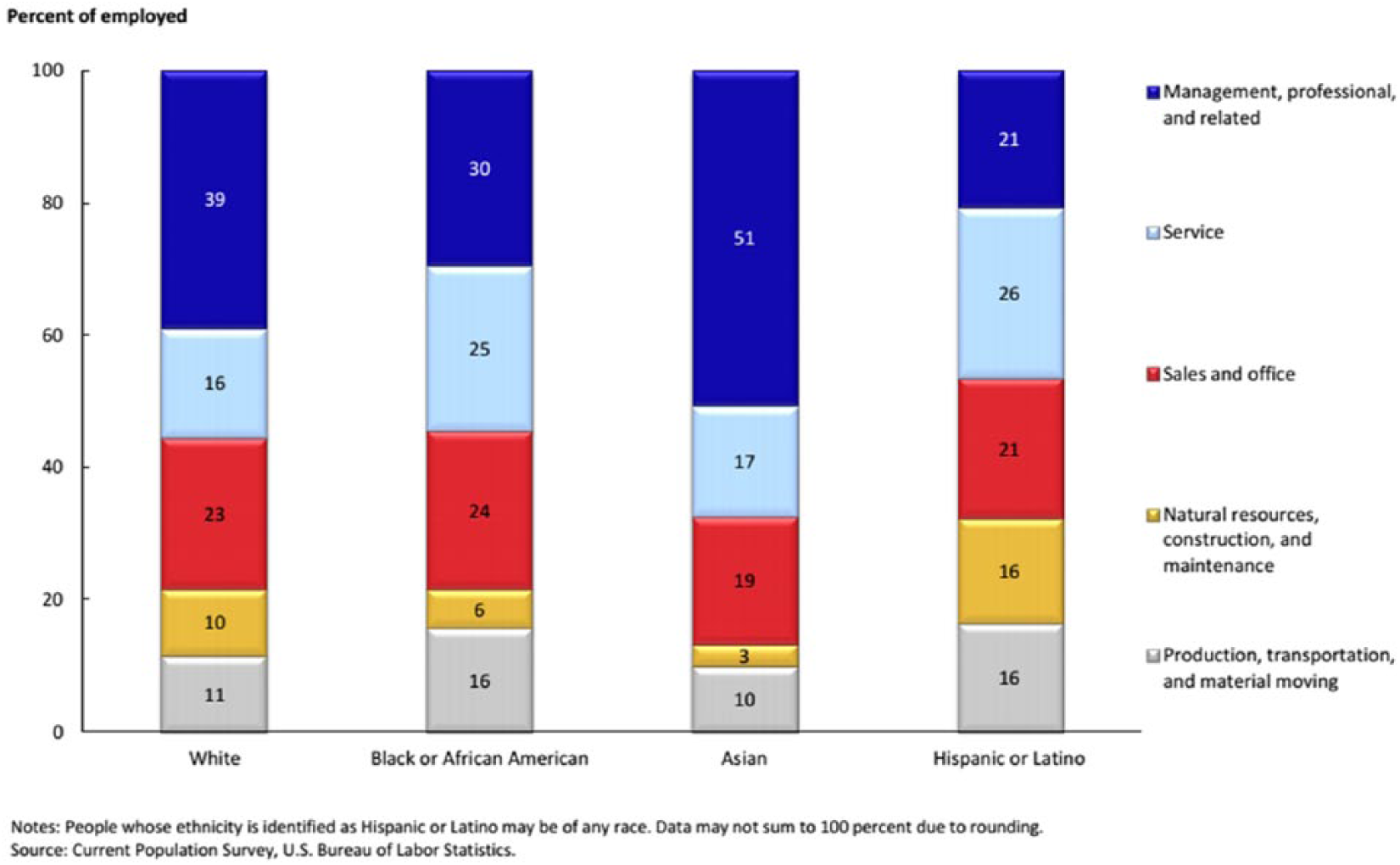
Labor force characteristics by race/ethnicity.
Furthermore, 32% of Hispanics are employed in the lower occupational categories of construction, maintainence, and transportation. So, inspite of their increasing educational attainment, Latinos as a group still lag behind non-Hispanic Whites and Asians in climbing the occupational ladder. As we move forward in time, it will be increasingly important for corporate America to find a way to incorporate Latinos in higher level occupational categories and in positions of leadership.
Enculturation and/or Acculturation
While the United States continues to evolve demographically, what has been traditionally accepted and researched is how immigrants and children of immigrants acculturate into the mainstream and into its social structure including institutions of higher education and corporate America. The process of acculturation is often differentiated from that of enculturation in research with Latinos. Specifically, acculturation is viewed as the adoption of and adaption to new cultural patterns that occur when different cultural, ethnic, or racial groups come into contact with each other, while enculturation is centered on the maintenance of one’s own culture as a result of this cross-cultural contact or independent of it (Quintana & Scull, 2009). Acculturation occurs when immigrants migrate into the new culture of the United States and adopt the values, beliefs, and practices of the dominant (American) culture. At the same time, immigrants often decide to maintain aspects of their own ethnic identity, home language, and cultural practices (Hernandez, Cohen, & Garcia, 2011; Siatkowski, 2007) and to transmit these to their children. Thus, many Latinos develop biculturally with commitment and knowledge of American culture and the culture of their ethnic heritage. Biculturalism is viewed as an asset in many work-related contexts because the Latino can easily accommodate a workplace situation in English and with American normative behaviors and also work with less acculturated ethnic heritage individuals in Spanish and in socially and culturally appropriate ways than might be distinct from American behavioral styles.
American corporations have typically had an Anglo-capitalistic cultural makeup that includes a mind-set of controlling one’s destiny, speaking and bragging about one’s strengths, successes, and a mentality of “look what I bring to the organization.” In contrast to this individualistic American style which may not be alien to bicultural Latinos, these same biculturals might prefer to present themselves through a Latino lens that includes humility, a focus on family, respect for elders, and faith in God (Rodriguez, 2007; Ruiz, 2005). As Latinos occupy more senior management positions in corporate America and in institutions of higher educations, it will be interesting to see how this moral compass, religious preferences, and cultural perspective will affect the American corporate workplace and how organizations recruit and diversy their workforce and offer management and leadership development both from an employee and customer point of view.
As suggested elsewhere (Cruz & Blancero, 2016; Padilla & Perez, 2003), much of the work on acculturation has focused on acculturation as a linear process which broadly means a one-sided movement along a continuum from an ethnic/cultural heritage enculturation to a greater alignment with American values and behaviors. The challenge will be to see how Latino Millennials adapt to the workplace as they strive toward, and obtain, successful careers given Latino values and the impact they have in bringing the corporate world more in line with their heritage culture. Some of this realignment is seen in business models adopted by multinational corporations. Remarkably, there has been no known theory or empirical research that has considered how cultural factors associated with the enculturation-acculturation process affects the objective and subjective career success of Latinos working in professional/management positions in the United States.
We maintain that the enculturation-acculturation experience is unique for Latinos (Cruz & Blancero, 2016) and may result in challenges for them in the workplace. In particular, experiences and challenges associated with being Latino, such as perceived discrimination, linguistic differences, cultural and social isolation, as well as bicultural stress may result in increased mental health concerns for Latinos that will be important to identify and offer supportive services if required (Cervantes, Fisher, Padilla, & Napper, 2015).
Bicultural and/or Cosmopolitanism
Embracing a bicultural identity may well be a key factor for Latino success in the workplace and in institutions of power in America. Of importance is that one of the key factors of successful acculturation is the ability to function in a manner that is congruent with the values, beliefs, customs, behaviors, and language of both the ethnic and host culture (LaFromboise, Coleman, & Gerton, 1993; Padilla & Perez, 2003). However, as compared with those who are English-language dominant, bilingual fluency in both Spanish and English has been linked to higher occupational prestige for Latina workers (Lee & Hatteberg, 2015) as well as enhanced cognitive performance and executive functioning in bilingual speakers, even with nonverbal tasks (Bialystok, 2011). There is mounting evidence that bilingual individuals enjoy significantly higher levels of life satisfaction and resilience than monolinguals who speak only Spanish or English (Marsiglia, Booth, Baldwin, & Ayers, 2013).
In the United States alone, Millennials are about 90 million strong, better educated than their parents and grandparents, typically more socially liberal in their attitudes on a wide range of topics, including cultural diversity, same sex marriage, interracial marriage, marijuana legalization, economic inequality and the poor, social justice concerns, gender equality, and environmental issues including minimizing one’s carbon foot print. In many respects, millennials have been the beneficiaries of the multicultural education fostered by earlier advocates for a multicultural society beginning with educational reforms that called for greater inclusion of diverse cultures and histories in the school curriculum.
In ways unbeknown to many, the millennial generation has internalized the goal of thinking critically about the value of a democratic multicultural society and practices many of the principles of multiculturalism that their parents still find difficult. Millennials move across social and cultural borders with far greater ease than generations before them. In addition, because of technology and their ability to literally speed across the globe in seconds in search of information, they have a totally different perspective of what it means to be a member of a global society.
Millennials are also America’s most racially diverse generation ever. Nearly half (43%) are non-White and within another 25 years, the full U.S. population will be majority non-White (Pew Research Center, 2014). Members of this generation too are more likely than others before them to hold a position that all ethnic/racial heritages should be respected, counted, and acknowledged (Espinoza, 2012). While this is occurring, today’s millennials identifying strongly with their ethnic heritage are also more oriented toward biculturalism and finding ways to present themselves as an ethnic person through their life style choices while also showing that they are American. There are also interesting studies (Morales & Hanson, 2005) showing how millennials use their bicultural/bilingual skills to translate for their parents and the process by which they transition their elders into the American mainstream. Once again, the combination of millennial values and Latino values seem to be a winning combination.
This is accompanied by an ever-increasing feeling of cosmopolitanism that is becoming commonplace for a large majority of ethnic heritage millennials. This has come about because of communication technologies and mass media, the ease of circulation of people from one country to another because of low airfare cost, the movement of commodities and commercial products on a massive international scale, and the growth of global cities. In the United States alone, we can point to New York, Chicago, Los Angeles, San Francisco, Miami, Seattle, Boston, Houston, and San Antonio as global cosmopolitan centers. While some of these cities have long been meccas for globalization (e.g., New York), others are relative newcomers (e.g., Miami), but collectively these cities have changed in character because of the remarkable developments in technologies that have brought many people from around the world closer together. Importantly, it is harder to make the case that within any of these global cosmopolitan cities, there is an ethno-cultural group that can claim to be the “host” or majority group that other groups must follow.
Here, we can ask ourselves, what does this new cosmopolitanism look like? The large majority of people of color today live in cosmopolitan global cities. In their everyday life, they experience the sights, sounds, and surroundings of globalization. And importantly, their ethnic/racial/cultural heritage and identity has taken on new meaning which is just beginning to take hold in the consciousness of many millennials. In this new world of cosmopolitanism, the view is that every culture possesses elements that are valuable while also pointing to a diminishing loyalty to any single culture orientation. Thus, people are more open to adopting ideas, behaviors, and cultural products such as foods from other cultures and demonstrating a greater degree of open-mindedness and cultural empathy toward members of other cultures (Van Oudenhoven, 2006).
Discrimination, Micro-Aggressions, and Isms
Biculturalism is complex and involves numerous cultural, linguistic, and behavioral competencies meaning that there is no one set of characteristics that define a bicultural person (LaFromboise et al., 1993). And while for many, a bicultural world perspective is what they might have grown up with, much has changed as our world has flattened in the digital age so much over the last few decades that biculturalism as was mentioned above is being overtaken by a new worldview—cosmopolitanism—among millennials. Today, because of globalization, technology, and ease of racial/ethnic/cultural border crossings, people are expressing feelings of multiple identities and belonging while holding firm to a heritage identity especially when they experience micro-aggressions and/or discrimination against their heritage group.
What should make this of increased importance to employers is that the future workforce will be made up of the millennial growing workforce, and the Latino portion makes up 44% or the largest demographic segment of this group (Krogstad, Lopez, Lopez, Passel, & Patten, 2016) and many have experienced discrimination. This was further highlighted in a recent study that reported that individuals who were considered different (Latinos, African American, and women) might have more difficulty in successfully completing an employment interview (Burrell, 2016). This cannot be tolerated nor accepted. Not only because institutional discrimination is illegal and just morally wrong but also because these are the demographic groups that will continue to grow and constitute a larger segment of the workforce including their leadership, customer base, and overall diverse American society. What makes discriminatory practices increasingly difficult to accept and for organizations and its leadership to allow is the instant transparency of information made available through the Internet.
In a relatively short period of 3 decades, we have evolved into a global society interconnected because of incredible advancements in technology. Today’s millennials do not know a world without the Internet and social media. Pundits have described this generation as “digital natives” because of their high dependence on technology and their uncanny knowledge of how to use technologies without much instruction (Vogel, 2015). This means that if discrimination of any sort occurs, the world has access to the culprits and can call for a halt to these practices by enforcing an embargo on businesses, the media, or the institution that tolerates such behavior from its employees. This is exemplified by the recent “me-to” movement where both women and men are calling out persons in power for sexually assaulting them and a corresponding corporate response of saying that such behavior will not be tolerated and the persons responsible are losing their jobs, positions of power on corporate boards, or in the legislative halls of our state and federal government (Time Person of the Year 2017).
As society has evolved so has the form of prejudices and biases. This unfortunately is supported by the fact that more than 50% of Hispanics have experienced discrimination (Krogstad et al., 2016). More recently, other forms of biased behavior directed at persons of color have been variously labeled as implicit bias or micro-aggressions (Sue et al., 2007). Micro-aggressions are defined as, “Brief and commonplace daily verbal, behavioral, and environmental indignities, whether intentional or unintentional, that communicate hostile, derogatory, or negative racial, gender, sexual-orientation, and religious slights and insults to the target person or group” (Sue, 2010, p. 5). These forms of aggression against people of color have always existed, but have taken on new prominence in our post–Civil Rights era because it is harder to get away with overt hate crime acts whereas micro-aggressions are subtle and often difficult to prove that a racist act was committed, often even by the person who communicated the micro-aggression. This could be part of the reason for a recent article that highlighted a study where minorities “whitened” their resumes and had a better chance to get an interview (Gerdeman, 2017). These micro-aggressions are hurtful to the targeted person and as research has shown, it can have serious mental health consequences. Individuals who experience perceived discrimination and/or micro-aggressions because of their ethnicity, race, culture, sexual orientation, and religion may suffer from depression, psychological distress, and social marginality calling into question their place in a multicultural society. While the focus of this article is on Latinos, we acknowledge that many marginalized groups experience micro-aggressions.
Allowing bias and discrimination runs contrary to the research that highlights the advantages of diversity in the workplace that include decision making, problem solving, creativity, flexibility, and innovation, something needed by all organizations if they are going to remain competitive and enable them to reinvent themselves in the midst of constant change (Burrell, 2016). Bias and discrimination make no sense with a growing and needed demographic. This is probably one of the reasons that motivated Llopis (2015) to title his article “Without Hispanics, America’s Corporations Can’t Grow and Compete,” while emphazising the importance of this growing workforce for the U.S. corporations. Yet, here, we are in the Trump era where “isms” are seen as just nothing serious and begs the question if the United States is going backward when the demographics are continuing to evolve?
From an organizational and customer perspective, Latinos spent 1.5 trillion U.S. dollars in the retail and CPG market in 2015; moreover, this is expected to increase to 1.7 trillion U.S. dollars by the end of 2017 (Statista, 2017). This purchasing power is larger that the GDP of Mexico and bigger than all but 14 countries in the world (Meltzer, 2017). In addition, when comparing the 53 million Latinos in the United States to the BRIC countries, Brazil, Russia, India, and China, each of which have much larger populations, from a GDP perspective, the U.S. Latino demographic is at US$31K plus, while the next closest is US$11K, and from a year over year growth perspective, the U.S. Latino demographic is at 3.2%, while the next closest is 1.4% (Cartagena, 2013). This has serious market share implications and should be an important focus for organizations and their senior leadership as part of their customer focus within their strategic efforts going forward.
In this new global world where cosmopolitanism is commonplace, research points to youthful Hispanic consumers as very brand and fashion conscious, and status image-driven in their purchases (Guo, Vasque-Parraga, & Wang, 2006) and who enjoy shopping more that non-Hispanic youth (Shim & Gehrt, 1996). These findings break with possible stereotypes of Hispanic millennials as marginalized, and as Chattaraman, Rudd, and Lennon (2010) discuss, Hispanics are bicultural consumers who internalize their dual cultural identities and who are fashion and trend conscious as a way of locating themselves in an American context to demonstrate that they fit into the mainstream.
In the 21st century, an organization that has an engaged workforce has a tendency for higher productivity, and experiences reduced workplace accidents, a more stable employee base with fewer workers inclined to leave an organization, and higher customer satisfaction (Friedman, 2015). This will be important as the workforce of Latinos and Millennials continue to grow. Their talent will play an important role in the future of organizations (Erickson, 2014a).
As we have stated, Latinos in the workplace often encounter discriminatory behaviors directed at them that create unwanted and undue stress, and make navigating the corporate culture difficult. While these are clearly difficult and may result in pressures affecting career success, they are somewhat balanced in the very nature of being bicultural (Cruz & Blancero, 2016). Developing and maintaining a bicultural/cosmopolitan identity, which includes a strong ethnic identity, being bilingual, and strong social connectedness, can lead to success.
We suggest that because of the technological advances and globalization, we need to rethink what acculturation and biculturalism mean for millennials. We might need 21st-century concepts, theories, and measuring instruments to completely understand this new world. We also need to evaluate micro-aggressions and the impact these can have not only on the targets of such aggression, but how through social media the perpetrators of micro-aggressions can be identified and challenged on a scale never seen before. This is important for marketers as well as employers of every sort including our universities charged with the responsibility of educating our future leaders.
In sum, these changes will make it increasingly more important for senior leadership to ensure that their organizations and managers are working to educate their leaders on the changing trends affecting society and in turn organizations. An awareness of these changes can only help organizations attract and retain an engaged workforce as competition increases to replace an aging and monocultural workforce. Increasing engagement has become particularly relevant when most workers crave meaning and purpose in life and very few find this at work (Mackey & Sisodia, 2014).
For Latinos, work and the place they work in brings an extra perspective of pride along with an increased expectation of having a good relationship with their supervisor (Rodriguez, 2007). In addition, Latinos place a high value on the employees’ stability and reputation (Erickson, 2014b). This makes effective leadership through increased awareness of the advantages of diversity and ensuring leaders are enabling employee engagement an imperative in today’s organizations. We propose a model (see Figure 2) that highlights all of the necessary components in need of consideration from a systemic and holistic perspective.
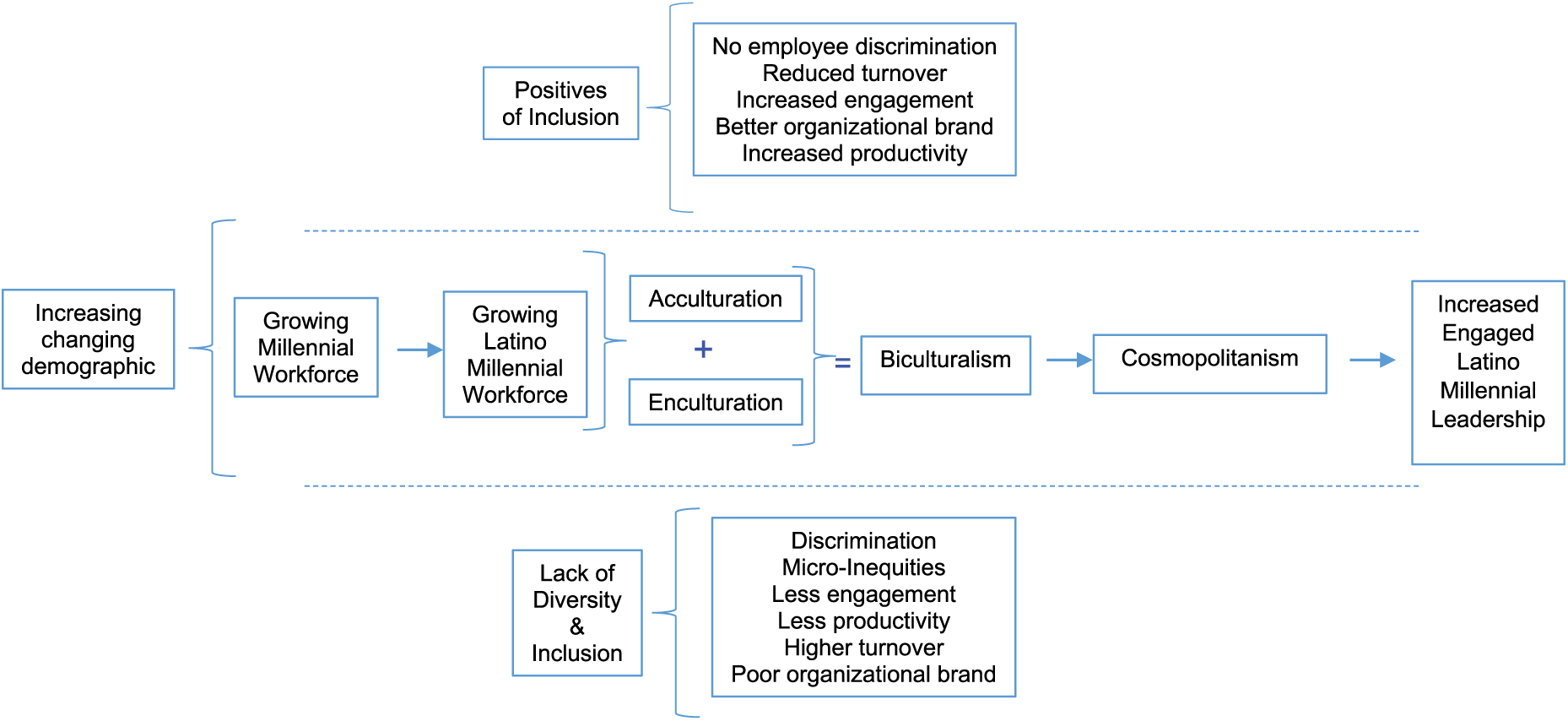
This organizational model highlights all the necessary components in need of consideration from a systemic and holistic perspective to be successful with a sophisticated and cosmopolitan Latino millennial workforce that demands inclusiveness and equality.
The organization and its leadership have a choice. It can accept the societal demographic changes (see the left side of the model) and use it as a competitive advantage and in turn use inclusion and diversity as a positive strategy for organizational success or disregard the changing demographics and increase the chances of a negative organizational brand along with possible discrimination lawsuits. Frank, Roehrig, and Pring (2014) have shown that the latter decision can have disastrous results and have pointed to the demise of such businesses as Kodak or Circuit City among others. While these organizations did not disappear due to the demographic changes posited here, these organizations did not adapt to the changing times, changing business models, and emergence of new competitors. While adapting to new business models are good strategies to consider, this does not exempt organizations from previous and current practices of discrimination as both Uber and Airbnb have experienced. For success to prevail, organizations will need more than just new business models, they will need to rethink their organizational cultures that accept the changing demographics and which do not tolerate discriminatory practices.
Present and future organizations need to consider a paradigm shift when it comes to acculturation and a possible evolution to the acceptance of cosmopolitism (see right side of model). Maintaining the status quo is not in the best interest of a business, consumers, or shareholders and will not ensure success for the 21st-century organizations. In his recent book, Jacob Morgan (2017) argued that the success for future organizations will entail giving employees the right office space, tools and technology, and creating an inclusive organizational culture (see top of Figure 2). The right culture for organizations in the 21st century with a changing and social media–sophisticated demographic that expect inclusivity as part of their work environment that differs from previous generations will mean that organizational leaders need to gain insight from their cosmopolitan-leaning employees and create a workplace environment that makes employees proud to be part of the organization, something very important for the Hispanic culture and workforce.
So What Now?
From a leader-employee relation’s perspective, it will be imperative for leaders to better understand how to relate to the growing and diverse workforce that no longer is compliant with discriminatory policies and practices. Senior executives will need to ensure they emphasize the importance of organizational culture change and model the behavior they expect from their management teams. In addition, it is important to recognize that the growing millennial Latino population is better educated than in the past and offers the potential for developing into future leaders in every organization and institution in the United States.
As senior leadership considers their organizational strategies for the 21st century, they need to ensure they have the right human capital strategy and that this strategy takes a holistic perspective. They need to ensure that their human capital strategy addresses human resources issues such as recruitment, development, retention, engagement, management capabilities to manage a growing diverse employee base, succession planning, performance management, and rewards among others. They have to have a workplace environment including its culture, policies, and practices that make it acceptable to this young Latino Millennial group who expect to find acceptance and engagement in the workplace through personal development, inclusivity, and advancement because of their merits.
Going Forward—Questions to Consider
In addressing Latino millenials in the workplace, numerous questions arise that organizations and universities must consider in order to ensure that the new diverse workforce is accommodated in a way that maximizes the full potential of Latinos. Some of the essential questions are as follows:
Does the organization have a human capital strategy to address the changing trends we see in how Latino millennials envision their world?
Is the organization creating the right environment from an employee, organizational, leadership development perspective, and aware of their new diverse customer base and their needs?
Is the organization capable of engaging and developing the growing workforce, both from a millennial and Latino/Hispanic perspective?
Does the organization have Latinos in their leadership ranks in a way that demonstrate there is an opportunity for younger Latinos to attain continued growth and be positioned in top roles?
Is the organization positioned to be an employer of choice with strategies to attract and retain the growing Latino millennial workforce?
Is the organizational leadership taking a holistic and systemic approach in addressing the growing and changing demographic through recruitment, personal development, leadership development, diversity, inclusion, and change management strategies?
These are just some questions that organizations, their leadership, and their human resources departments need to consider and reflect on as they develop plans (if they have not already done so) to address how they intend to assimilate Latinos into their ranks. Organizations that are not proactive will play catch up, be in a reactive mode, and possibly be too late to capitalize on the changing diverse wave that will affect organizations in this country in the coming two to three decades.
Implications for Organizations, Leaders, and Human Resources
Now that we have offered some seminal questions for organizations, going forward when it comes to working productively and creatively with the demographic changes that are continuing to evolve and which are changing the country, we will now offer a few comments on the implications of the central thesis of this article which is that the change in the workforce is no longer hypothetical, the reality is upon us and it is time to take stock of the following:
It is important to recognize and celebrate the differences and uniqueness of the 21st-century Hispanic/Latino Millennial and the times we are living and working in.
It is important to understand the diversity and non-monolithic nature of the Hispanic/Latino millennial.
Recognize and adjust to the shifting paradigm of career development within the Latino workforce and the fact that the times do not encourage employee loyalty unless the organization is able to adapt inclusivity and openness in employer-employee relations. This includes identifying strategies for engaging and retaining Latino millennials.
As part of the cultural restructuring of the organization, accept the impact of the times that include the globalization, technological explosion, and connectedness making the world flatter and smaller.
Understand that the demographic changes also affect the purchasing power of Latinos and where and how they choose to spend their money.
Consider how to create effective leader-employee relations that will be imperative for organizational success. Address this issue from a holistic perspective by focusing on attraction, organizational branding, recruitment, development, recognition, diversity, and retention.
Understand the issues related to acculturation and biculturalism of Latinos along with a possible cosmopolitanism view of the world that is becoming an important part of this generation of Latino/Hispanic millennials.
Consider the changing need for human resources and its practices from the 20th century to a more diverse workforce in a technologically connected global society in the 21st century.
Implications for Further Research
More research is clearly needed on this growing Latino demographic and its implications for the workplace. This research should address some of the issues mentioned above, from acculturation to biculturalism and more recently the growing trend toward cosmopolitism. In addition, there should be increased research on what organizations can do to improve the career growth of Latinos as it continues to increase in the workplace. Organizations and its leaders need to consider what implicit biases and micro-aggressions are working against Latinos from increasing their numbers in leadership roles?
We also recommend that there should also be research conducted on the differences of Latino millennials born in the United States and those born abroad. It will be interesting to note the difference, if any, of cultural values. Of course, Latinos are not a monolithic group and, ideally, research that allows for the comparison of domestic-born Latinos compared with those who were born in other countries would be useful. There should also be more research on the shift from acculturation and biculturalism to cosmopolitism, which is the argument we advance in this article. Have these constructs evolved and changed since they were first used in the study of Latinos and should our thinking be reframed as we study Latinos in American society in the 21st century? Research should also look into the leader-employee relationships needed in the 21st century with this growing demographic and workforce. As millennials are now of age to be in leadership positions, it is important to look at the leader-employee dyad when the Latino is the leader as well as the employee. There is much to be done in order to have organizations be adequately prepared for future Latino/Latino millennial leadership.
Footnotes
Authors’ Note
While the authors recognize that Latino and Hispanic have different origins and have different meanings for some, the authors chose to use them here interchangeably simply for convenience.
Declaration of Conflicting Interests
The author(s) declared no potential conflicts of interest with respect to the research, authorship, and/or publication of this article.
Funding
The author(s) received no financial support for the research, authorship, and/or publication of this article.