



Abstract
The article investigates the ways in which young musicians explored new (unfamiliar) social landscapes and emotions during Covid-19 pandemic lockdowns, through learning to listen to the “music within their steps” while walking on their own or with members of their own families for the inter-disciplinary project ‘The Musical Steps’. The project examines the self-recorded essays, visual materials and reflections by the young musicians and their parents, which reveal new cultural perspectives of sound, space and silence, along with the thoughts about musical repertoire which were inspired by the walks. Methodologically, we applied the walking biographical method that enabled us to explore young musicians’ reflections on music and their lives during lockdowns from an inter-disciplinary perspective. The walking biographies approach to research on the move has been specially adapted for young musicians and their families by the authors. This article explores how walking changed young musicians’ emotional perceptions of music and what they heard and felt during and after their walks. Questions were raised as to whether the walks affected their physical and mental well-being, both personally and musically, and whether the walks influenced their understanding of their cultural background/origin.
Introduction
The article investigates the ways young musicians explored new (unfamiliar) social landscapes and emotions during the Covid - 19 pandemic lockdown, through learning to listen to the “music within their steps” while walking on their own or with members of their own families for a study called the ‘Musical Steps’ project. It examines the self-recorded essays by the young musicians and their parents, and reflections which reveal new cultural perspectives of sound, space and silence, along with the musical repertoire that was inspired by the walks. The ‘Musical Steps’ project involved the Music Mind Spirit Trust's Young Artist Musical Ambassadors (YAMAs) and their families, who before the pandemic lockdowns 2020–2021 had participated in a project called ‘Peak Performance through Musical Memory’: Musically Attuned Performances (MAPs). Methodologically we used the walking biographical method (O’Neill and Roberts, 2019) that enabled us to explore young musicians’ reflections on music and their lives from an inter-disciplinary perspective. The walking biographies approach to the research on the move was specially adapted for young musicians and their families by the authors. This article explores how walking changed young musicians’ emotional perceptions of music and what they heard and felt during and after their walks. Questions were raised as to whether the walks affected their physical and mental well-being, both personally and musically, and whether the walks influenced their understanding of their families’ cultural background.
The pandemic lockdowns of 2020–2021 changed young people's school and music learning routines and altered families’ daily routines and schedules. These were seen by us as an opportunity for interviewing families that spent COVID-19 lockdowns together (primarily using online method techniques). The pandemic turned both the idea and the practical aspects of traditional family gatherings ‘upside down’, but it also created a time for sharing memories. In search of new opportunities, our team looked at the physical activity of walking as a medium to share music and inter-generational dialogues.
In ‘Musical Steps’ we explored the following research questions:
How did walking change young musicians’ emotional perception of music? How did they reflect upon what they heard and felt during and after their walks? How did walks affect/influence their physical and mental well-being, both personally and musically? How did walks influence their understanding of their cultural background/ origin?
The government response to the COVID-19 pandemic included several lockdowns across the UK. Living within lockdown restrictions presented challenges particularly for young musicians in that it cut across their routines by restricting access to their usual patterns of lessons, rehearsals and performances; for a period of time even their exams became virtual.
High-achieving musicians typically strive for perfection and have a pressing need to process, refine and express their creativity (Evans, 1994, 2003; BAPAM, 2020). Expressing creativity is part of young musicians’ training and an ultimate goal for those who are making future plans for performing careers (Bull, 2019). This creativity is traditionally developed through in-person music lessons, ensemble rehearsals, performances and individual practice.
Physical and social distancing impacted the young musicians’ patterns of developing their musical skills, as well as their general well-being 1 . Walking as an outdoor activity and as a part of the regular daily routine created an opportunity to further explore and reflect on music.
Minimal research conducted to date focuses on the impact of walking on young musicians: lockdowns provided the opportunity to explore how walking could stimulate musical reflections for young musicians.
Methodological background - how we entered into the walking biographies arena
Application of the walking biographical method (O’Neill and Roberts, 2019) was a new exploratory step in our long-term inter-disciplinary work on young people and families’ identities and musical memories. By switching attention of our research on the young musicians- participants’ skills of listening and hearing sounds during the walks throughout the lockdowns, we tried to establish how the walks may contribute to reflections of their identities and their musicianship. Research on listening to music: type of music (recorded or live); hearing music and listening to music in a wide variety of everyday life circumstances (Bennett, 2005; Biddle and Knights, 2007; DeNora, 2000; North et al., 2004) and studies in music and mind and memory (Robertson, 2016; Sloboda 2004) are well-developed areas of interest in social sciences and arts disciplines. Research suggests that the circumstances and type of music may cast light on the individual life course and revive memories and life stories that may intimately connect with self-identity (Bourdieu, 2010; Boyce-Tillman, 2018; Roberts, 2002). Listening to music is also a part of the process of recollecting and reflecting upon music memories and the relationship between identities and music (Nurse, 2011; Nurse and Sik, 2011). However, some scholars observe that listening while walking has attracted less attention of researchers so far as compared to listening to a chosen type of music and other modes of mobility (Behrendt, 2019: 250). In our small pilot initiative ‘Musical Steps’ we aimed to explore young musicians’ reflections on listening to soundscapes created by nature and other urban noises while walking on their own or with their families. The specific features of soundwalks, that they ‘create the potential for opening our ears, bodies and minds to the sounds within us, around us and the soundscape of the world’ as defined by Behrendt (2019), were explored in our project within the context of lockdown.
Some recent research describes these soundscapes as a collection of sounds perceived in an environment, including three sources: biological, geophysical and anthropogenic sounds (Buxton et al., 2021). Pandemic lockdowns have had a significant impact on the balance of sounds from these sources, as recent research has continued to establish (Buxton et al. 2021, Nurse and O’Neill, 2020). Different population groups reflect upon these changes in a variety of ways. Our previous studies (Nurse and Sik, 2011), found that the meaning of music varies at different times and in different locations: public and private, during family time or in performances; however, listening to the music in natural environments was a new aspect of our work.
Parents of young musicians spend significant amounts of time nurturing their children's talent, assisting them with transport to their lessons (most of which takes place outside school hours and at weekends), rehearsals, concerts, music festivals and competitions, investing significant resources of time and finances to support their children in every possible way, producing a type of parenting which is described as intensive parenting (Bull, 2019; Hays, 1996; Lareau, 2011, 2015). However, most of the parents do not consider it being a burden, but rather a joy that they can share with their children. (Bull, 2019; Nurse, 2020). As in the previous work the preferred time for interviewing was connected with the time of families’ ‘calendared’ family gatherings that coincided with the holidays, particularly during Christmas, Easter and summer holiday breaks. Ironically, the pandemic lockdowns created a similar environment of ‘pausing’ or breaking from normal activities and life routine, and in some cases brought many generations of families together; however, the main difference was in separation from the social interactions with the ‘outer world’.
One of the questions that we asked our participants (children, parents and grandparents) in the earlier studies was to think about and to name the most treasured piece of music that they would take to a ‘desert island’ (Nurse and Sik, 2011). The question was inspired by the popular BBC4 ‘Desert Island Discs’ programme; this question had been hypothetical, as at that time we could not even think about circumstances under which people might get cut off from their normal lives and separated. The COVID-19 lockdowns for many of our participants felt like real desert islands, where most were left along with their memories of favourite music and musical instruments. However, the effect of the walks on the young musicians’ personal well-being and musical practices during the lockdown was also addressed in the Musical Steps study. The concept ‘mental-physical correlation’ for developing technical mastery had been introduced by an eminent twentieth-century violin pedagogue Ivan Galamian (1962). It refers to the young violinists’ awareness of their physical movements and allowed time to process them mentally during their practice so their kinaesthetic movements became more aligned to their cognitive signals increasingly instinctively and intuitively. As this became further established through diligent and efficient practice, an increase of confidence to ‘let go’ during a lesson or performance was noted, thereby allowing the essence of the music to be expressed more freely and expressively by the young musicians.
Social and emotional landscapes of music making – the musical steps project
Participants
Participants for this pilot project were drawn from the Music Mind Spirit Trust's YAMA and their families who had participated before the lockdown in the ‘Peak Performance through Musical Memory: Musically Attuned Performances’ (MAPs) project sponsored by Arts Council England (ACE) in 2018–2019, which was directed by co-author Dr Chika Robertson. The core group of the young musicians (violinists) attend (or have attended in the past) the Junior Royal Academy of Music on Saturdays. Their ages ranged from 13 to 20+-years old and their levels of violin playing proficiency encompassed ABRSM (Associated Board of the Royal Schools of Music) Grade 7, 8 and diploma standards. Another small group of participants were parents of the young musicians.
Many of the young musicians attend schools in the South-East of England, where they live. The participants come from a wide range of backgrounds: local native-born families and families of immigrant and mixed ethnic backgrounds. Participation in the new ‘Musical Steps’ (MS) pilot project was voluntary and by the invitation of Dr Robertson. We did not sample participants for the project. They were invited in an open way and some elected to join ‘Musical Steps’. Participants were duly informed about the new project and asked to give their consent for participation and for the use of data from the project for further analysis. However, we were aware that participants were all taught by a co-author, as their violin teacher, which on one hand can determine the participants’ eagerness to take part in the study, but also to treat it as a ‘home work’ exercise, given by their teacher.
Positionality
The design of the empirical study, procedures, and subsequent analysis of the data were done by a co-author, who is an educational sociologist and not involved in a teaching role or other capacity with participants or their parents. However, she was also involved in the previous study and was known to the participants. As her biographical experience includes knowledge and parental experience in raising children who were also classically- trained musicians, she understands the delicate nature of relationships between teachers and parents of young musicians. Both authors were involved in the interpretation of the results and provided an inter-disciplinary (sociological and musicological) insight in the data analysis.
Procedures
The ‘soundwalks’ were unmediated and exploratory in nature and can be described as artistic and educational practice, rather than “expert-driven” research. The most significant difference of the walking procedures was that all instructions were provided to the participants remotely by email, as the experiment took place amidst the lockdown and social distancing regulations. The researchers could not attend any walks and were unfamiliar with walking routes chosen by the participants. The participants had several options available, including practising a breathing exercise, which was more relevant to some walks than to others. The participants were also reflecting on the breathing exercise that was given to them in the instructions about the walks, which some initially found quite challenging as is discussed below. The participants were completing only ‘one project’: either a reflection of the past walk(s) and associated with the walk memories or a current walk for which certain steps were suggested in the Guide (see Box.1).
The Biographical Walking Interpretative Method as developed by O’Neill and Roberts (2019) was chosen due to its suitability to the new conditions of physical distancing, when the younger people could walk on their own or with members of their families from the same ‘bubble’ (parents and members of the extended families). The researchers provided a special set of instructions to the young musicians, who were instructed to record their observations in the form of an essay or walking map (see Box.1). Some essays were supported by visual data and ideas of new musical repertoire inspired by the walks.
Our main task was to guide the participants to explore the innovative nature of the daily walks that they were encouraged to take. Some young people walked on their own, others walked with their parents and grandparents. The participants were instructed on how to map their walks and what to observe. However, the overall guidance was simply to enjoy learning to hear the music within your steps and around you to keep in stride. Their main task was not only to map their walking routes, but to listen to the sounds of nature and pieces of music that they may have become aware of during their walk, to notice how the walks affected them, and to produce an essay or tunes that were inspired by the walks. The walks took place in June 2020 and the results were discussed subsequently at a webinar facilitated by Prof. Maggie O’Neill. Box 1 below shows the instructions given to the participants: 2
Please record your journey using words, drawings, photographs and / or musical notation. Remember to describe any feelings you experienced within a short essay, diary, memos, mind map, musical phrase or song, etc…the design and format are totally up to you.
Is there a particular walk that you did during the recent COVID-19 lockdown that you can recall clearly? What is staying in your memory? Why?
Have you undertaken the walk again or tried to re-create it elsewhere (e.g., in a different room or outside)?
-Write a short description of your walk, adding how you felt at various times.
-Does your walk remind you of a song /piece of music? Write down the name of a musical piece that could have been used as a film score during part of your walk.
Allow your walks to become ‘musical journeys’.
OR A CURRENT WALK:
Listen and be aware of any sounds that you hear.
-Write / draw a short description of your walk, including how you felt at various times.
-Does your walk remind you of a song /piece of music? Write down the name of a musical piece that could have been used as a film score during part of your walk.
-Walk in time to this piece of music. Write how it makes you feel.
Let this become your own ‘musical journey’.
Thank you for completing this exercise, which will contribute towards musical and scientific research.
The materials will be analysed/anonymised (no names will be mentioned) and presented on the MMST website to highlight the YAMAs and their innovative work.
The participants were invited to send their notes/essays electronically as a one-page Microsoft Word document. After a couple of weeks of walking, the participants submitted their observations and short essays. These were analysed by the researchers, and some of the evolving themes were explored further at a webinar at which the young musicians were invited to share their thoughts, expectations and reflections about the walks. Coding of the essays provided by the young and older participants and parents – participants of the younger musicians – produced several themes that evolved from the walking experiences, which are analysed below.
Lockdown-influenced music: indoors and on the move
Musical experiences during the pandemic lockdowns were characterised by a sudden shift away from public into private spaces, through online delivery. This necessary change affected music teaching, performing, composing, listening, learning and assessing. Falling under the umbrella of what the co-authors coined “lockdown-influenced music”, challenges were created that had not been previously experienced by either the young musicians or their teachers. The “lockdown-influenced music” describes entirely new music learning, listening and music-making ‘landscapes’ that began to evolve in the first lockdown. Prior to the pandemic, new technology had enabled experiences such as virtual choirs and orchestras (e.g., the pioneering work of Eric Whitacre's World's Largest Virtual Choir). However, such experimental musical works were part of leading professional musicians’ intentions to explore the technological advances in virtual music making as outreach, rather than to respond to the reality of social distancing. Pandemic-influenced music was an entirely new phenomenon, as it meant music-making predominantly ‘indoors’/online and in isolation/self-distancing. During the spring of 2020 we observed that the unprecedented circumstances of the COVID-19 lockdown put young musicians in a very complex situation. For the young musicians this was a double challenge as their learning of school subjects and music learning spaces became merged into one. Parents at home and other people online became the audiences to their performances, like the NHS's innovative “Connections through Music” online programme, in which some of our participants performed during the lockdowns 3 . The ‘Musical Steps’ pilot provided young musicians, their families and virtual audiences with an essential opportunity for self-reflection, utilising changed spaces for music making whilst promoting a greater sense of health and wellbeing as a response to the lockdown.
The significance of outdoor space also changed. Walking space became the only ‘public’ space which the young musicians could enter and share space with nature and other people, who typically became more distant rather than close. However, the members of their family became much closer to them, due to the amount of time spent indoors.
In this article, in order to answer our main research questions, we focus on the analysis of the themes that are linked to how the young musicians were affected by the walks: their emotional descriptions and feelings; pieces of music; and their reflections on the nature of the other sounds.
We have observed that during and after the walks all participants recalled music that they had played or listened to recently or before the start of the lockdown, as for example some participants recalled in the short essays written after the walks: I tried to think of some Debussy, some of his piano music and orchestral music, in particular his Prélude à l'après-midi d'un faune which I had played in an orchestra last year. (Participant 1, male, 13 years old)
My walk reminded me of a piece of music by Wieniawski that I had just listened to. I always struggle to get [understand] a piece of music after I listen to it and this was the last one I listened to so that is why I was reminded of it. (Participant 2, male, 13 years old)
Whilst walking in the expanse of the field with sparkling grass, I was loosely thinking of some accompanying music for the scene and the song that popped into mind was Mr Sandman by The Chordettes. This amused me as it's not a song I’ve listened to recently and did capture the chirpy quality of the bright afternoon. The song stayed with me to the end of the walk. (Participant 3, female, 20 + years old)
Both younger and older participants were very precise in their description of musical pieces (i.e., name of the composer, name of the piece and movement) and also of the circumstances where they either played or heard music that came to their mind while they were walking, which is one of the characteristic features of classical musicianship (Bourdieu, 2010), as compared just to general reference, observation about music with a good tune or familiar and favourite pieces (Nurse, 2011). They also reflected on the instruction provided by the researchers: allow your walks to become ‘musical journeys’, quite literally.
Although the walking exercise was designed for the young musicians, the parents who had regularly assisted their children with rehearsals (by making sure they arrived in time, with music and instruments in order) and attended their solo and orchestral performances, also participated in the pilot study. Our previous research which was described above included parents as participants in the study of families’ cultural and musical heritage. The pandemic situation brought several generations of the families closer due to the home schooling and restrictions to music education during the lockdowns. Shared working and learning spaces made parents part of the music learning process of their children. Significantly, the parent participants were also reflecting on the music that had been recently learned or practised by their children. The music which came into my mind was Rameau's Les Cyclopes (perhaps because this is the piano music X [her son] is practicing at the moment. (Parent of Participant 1, mother).
We have also observed that all participants mentioned just one piece which came to their minds while they were walking and the reasons they thought that piece of music was evoked by the walks. This may also be a result of the relatively short nature of the project when the participants chose which walk to reflect upon and to write about, as we did not set up or limit their time for walking.
Nature of other sounds during the walks
Sounds of birds were most often mentioned by the walking musicians of all age groups who participated in the musical walks. Comparisons were even drawn to the experience of composing bird sounds, referencing the French composer Olivier Messiaen, who famously notated birdsong sounds into music. Messiaen is also known for his conception of the relationship between time and music. Robins, starlings, parakeets and other birds created new pandemic ‘soundscapes’ for the young walking musicians. ‘Birdsong is the most wonderful music but can't be replicated, even by Messiaen’ (Parent of participant 1, father).
…As well as this there were a lot of birds singing. (Participant 2, male, 13 years old)
There were quite a few people out walking in the playing fields however the most dominant sound came from the birds – in particular the loud parakeets! (Participant 3, female, 20 + years old)
…I listened to the birdsong – robin and the fantastic sound of about ten starlings in a high tree, babbling and burbling. (Parent of Participant 1, father)
However, the level of detail in describing bird songs was more pronounced by the older participants in our study – especially parents. Nature created a new landscape/platform for listening to music and through internalisation and reflection on the new experiences, offered a new understanding of previously played and learnt pieces and repertoire. Research into health benefits of natural sounds demonstrates a strong impact on health and positive affect outcomes of which water and birds’ sounds come at the top of the list, with bird sounds having the largest mean effect size for stress and annoyance (Buxton et al., 2021: 2).
Feelings during and after the walk
It is important to mention here that although the initial setting of the walks workshop took place in the summer (June 2020), some of the participants sent their essays later and included their autumn walks’ observations. It was a wet and chilly November morning, but the autumn colours were beautiful, and I felt calm and content. Quietly happy, so to speak. (Parent of Participant 1, mother)
… it was chilly and damp, so I was quite cold, but I also felt quite relaxed. (Participant 1, male, 13 years old)
The participants were also reflecting on the breathing exercise that was given to them in the instructions about the walks, which some of them found quite challenging to start with and which is discussed separately as part of the music and well-being aspect of the pilot study. Both the young musician and his father (quoted above) were observing cold and chilly weather, but also felt ‘calm and content’. Feelings after the walks were also very important to the participants as they reflected on their emotional state and returned to their daily routines. The participants who reflected on their feelings after the walks noted emotional responses to the walks that were very positive and ‘spirit-lifting’. Cheerful enough. Looking forward to a cup of tea. Now drinking the cup of tea in the warmth. The sky out of the window is gorgeous. (Parent of participant 1, father)
The walk was very peaceful, the combination of the emptiness, the birds singing and the early morning made it very calm and tranquil and when I got back I felt more relaxed. (Participant 2, male, 13 years old)
It also aptly suited the character of the crow in our front garden that was cheekily breaking its bread by dunking it in our bird bath like a biscuit in a mug of tea which lifted my spirits. (Participant 3, female, 20 + years old)
However, participants followed their own ‘emotional and sound’ journey through the walks. Despite some similar aspects of the walks, such as walking in the parks, hearing other people around or just birds, each walk was a deeply personal ‘sound’ journey, a reflection on the individual's perception of the environmental sounds and musical thoughts. The participants have recorded their immediate feelings during and after the walks.
Walking with a family member - learning about their family background on the move
The participants were advised to record their journey by using words, drawings, photographs; however, only a few of them created visual materials of maps and photographs. The map created by one of the participants is not a mere journey across the land, but is also a journey through his family's cultural heritage – treasured memories which prompted reflections and planning of the future. A slow walk taken by the participant with his grandmother is pictured on the Google map, Figure 1. The participant described it as a ‘slow-paced and socially-distanced’ walk when he reflected on the nature of the walk, which included sit down chats and attempts at yoga.
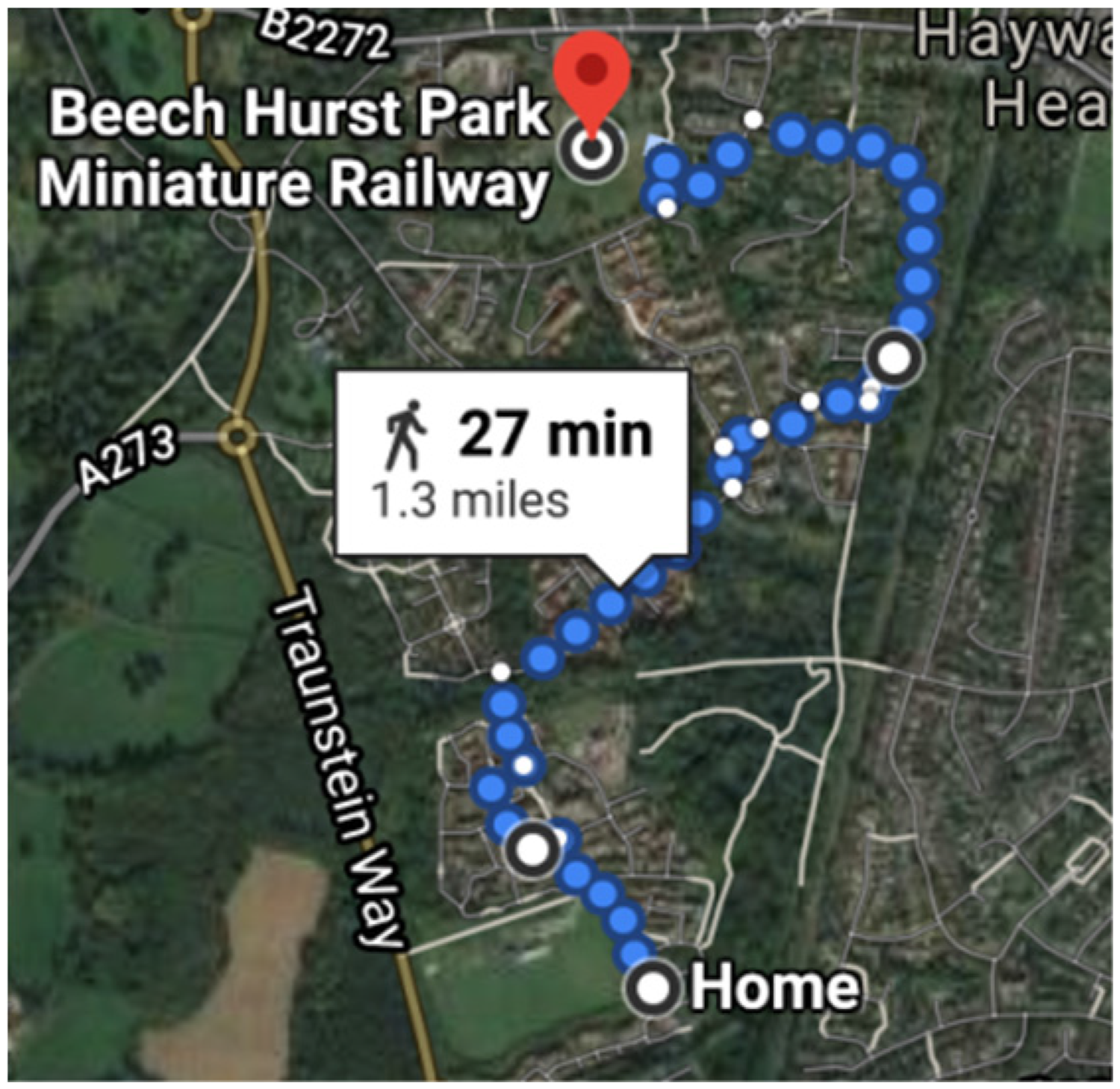
Map of the walk by Participant 4, male, 19 years old.
However, what was most significant about this walk is what the participant describes as: Feelings of gratitude in being able to spend time with grandmother as well as a greater appreciation for the beauty of our surroundings (especially at departure but also generally throughout the walk). Indeed, I recall my grandmother saying that “the flowers seem more fragrant!”, which also brought up memories of gardening together. (Participant 4, male, 19 years old)
Significantly the walk, which included some elements of yoga relaxation, reminded the participant about influences that are connected to his music practices, such as the Alexander Technique. It reminded me of the need to be more attuned with myself. The route back home was reminiscent of the walks we would take back together on our return from primary school. I had the familiar feelings of content and joy from the past walks together that- looking back- remind me of Here Comes the Sun. (Participant 4, male, 19 years old)
The importance of family connections and support is vital for classical young musicians and it constitutes part of the middle-class ‘concerted parenting’ approach to raising children (Bull, 2019; Lareau, 2011, 2015), when parents take a significant amount of time in learning music along with the child (e.g., Suzuki violin method) (Bull, 2019) and participating in music–related activities. Above we demonstrated a parent - participant's detailed knowledge of her son's musical repertoires and performances. However, this family involvement often includes grandparents and other members of the extended families of young musicians, who also influence young musicians’ early music listening choices, such as grandparents (Nurse, 2011; Nurse and Sik, 2011). Participant 4 reflects in his essay on the joy of walking with his grandmother, which he describes as a treasured moment and an opportunity to learn about ‘yoga’. Importantly, the parents’ and grandparent's involvement in the walking activities of their classical-musician children and grandchildren are considered by the young musicians as a ‘normal routine’ and as an opportunity to learn more about their families and identities (Hall, 1996).
Walking and the connection between well-being and music
The pilot project became a continuation of our research (prior to the pandemic) on the connections between music and well-being. It became even more crucial during the lockdowns. Throughout the pandemic, the opportunity for the young musicians to be able to dedicate bespoke time to reflect during and after their walks became vital for their general mental health and wellbeing. Research recently conducted for the British Association for Performing Arts Medicine (BAPAM) estimated that: ‘…around 75% of performing artists will experience a physical or mental health problem at some point in their career. … The environment (e.g., long hours, working late, isolation, experiencing lack of sleep and a poor diet) and the high demands performers make on themselves can all lead, potentially, to deteriorating physical and mental health and resilience. Schedules often mean that healthcare is not available when most needed. All of these factors can impact negatively on the success of creative practice, the longer term sustainability of a career and the health and well-being of the individuals themselves (BAPAM, 2021).
Inclusion of the walks in the young musicians’ schedules could potentially address the issues of musicians’ physical and mental health in the future. Therefore, the young musicians’ reflections on their emotional state after the walks were a testing ground for our approach to the development of practical techniques that can be learned and used by the young musicians. The creations of the ‘musical walking’ exercise provided the young project participants with an essential outlet of release and self-expression, both mentally and physically. The walk was relaxing and peaceful, especially in the woods <….> <…> I realised how calming or energetic (depending on what you are hearing in your ear) the music made the walk. (Participant 5, female, 14 years old)
Exploring how the walks influenced the young musicians’ well-being during the lockdown, especially as it was a period of making music in isolation outside of their normal environment of performing and practising for all of them, will undoubtedly require a longer period of observation than our pilot project allowed us. However, the young musicians’ and their parents’ positive responses to the introduction of a specific breathing exercise as part of the music-practising task suggest that there is a need to introduce it. Their responses presented here demonstrate that the breathing incorporated in the walks was initially a challenging exercise: I thought the breathing would be a bit hard to consciously try and continue, but after a few minutes it became more natural. (Participant 1, male, 13 years old)
Tried to recall a fragment but laughed because I can't remember a thing. Decided to listen to it later anyway. I like breathing in five and out eight as it is more relaxing. (Parent of participant 1, father)
Participants were offered slow breathing exercises that use music to harmonise respiration with the rhythms of their heart and the flow of their circulation (Osborne, 2020). Through combining the rhythmic breathing with the pulse of their imagined or sung piece of music as they walked, anxiety was reduced. They experienced a genuine sense of awe and awareness from becoming an integral part of something wondrous and larger than themselves. This process was incorporated into their musical training on their instruments and became a coping strategy by channelling adrenaline and performance nerves positively for the young performers. Through practising this flowing synthesis of music and movement, it became evident in their subsequent online lessons and virtual performances that they had gained valuable confidence and a freedom of expression when singing and playing.
Conclusions
How did walking change young musicians’ ways of listening and perception of music? Walking offered the young musicians the opportunity to become more aware of their own emotional, cognitive and physical reactions. By utilising external stimuli, they learned to organise their own internal rhythmic patterns. Creative musical energies require a stable grounding force, which is inherent within nature itself. Through becoming inspired and grounded as they walked along to the mesmeric sounds of birdsong, especially when they heard familiar sounds reminiscent of their earlier childhood years, their physical gait became entrained synchronously within their bodies and minds. Physical and mental entrainment also occurred when they recalled or heard a piece of music or song. They were ‘moved’ when their emotions were activated through association and ‘meaning’, highlighting the importance of experiencing significant musical memories throughout one's life. When their emotions were unleashed and expressed through their movements, they felt more ‘grounded’ and attuned within themselves and with others.
How did the young musicians reflect upon what they heard and felt during and after their walks? When the young musicians became more aware of their physical movements and had time to mentally process their practice (and during their walks, matching their gait and movements to the pulse of a piece of music), their kinaesthetic movements became more aligned to their cognitive signals (Galamian, 1962). As this became further established through diligent and efficient practice, responding from within a state of awareness via a strong mental directive to the muscles, an increase of confidence to be able to ‘let go’ during a music lesson or performance was noted. This enabled the young musicians to express the essence of the music more freely and spontaneously.
How did walks affect/influence participants’ physical and mental well-being, both personally and musically? The moments of synchronous musical freedom and growing confidence influenced participants’ perceptions about musical career opportunities and choices of repertoire. A variety of new musical practice and performance skills was incorporated. Analysis of the video-recorded performance of a young participant musician demonstrated his inspiration from the walks and new insights into his family's cultural background, which he experienced through his ‘findings’ from walking with his grandmother.
How did walks influence their understanding of their families’ cultural background? The musical walks demonstrated the importance of family connections for the young musicians (all of whom are learning classical string instruments), and the importance of family. The identity-sharing parenting was quite obvious in the response of families of musicians during the lockdowns. The parents continued their support and enjoyed the opportunity of sharing the joy of walks with their children.
The small size of the pilot study limits the validity of generalising parenting styles during the lockdown. The intensive parenting model was an invaluable resource for the families and young people. Further research is required into several areas of provisional findings and lines of enquiry that were opened up by the innovative research methodology.
Creative application of the walking biographical method was found to be successful in exploring young musicians’ perceptions of the emergent pandemic-related social landscapes and emotions, through learning to listen to the music within their steps while walking. The participating musicians found the method liberating, in unlocking new cultural perspectives of sound, space and silence.
Footnotes
Acknowledgements
The authors of this article would like to express their thanks to Professor Maggie O’ Neill for her comments on the design of the methodology of the study, and participation in the workshop with the participants.
Declaration of conflicting interests
The authors declared no potential conflicts of interest with respect to the research, authorship, and/or publication of this article.
Funding
The author(s) received no financial support for the research, authorship, and/or publication of this article.
