




Abstract
The aggressive behavior of clients toward employees in service organizations is an alarming phenomenon, which harms employees and damages the organization itself. Employees all over the public sector, especially in social service departments, are continuously exposed to aggressive behavior by clients. The focus of the current study is on understanding the short- and long-term implications of aggressive client behavior on social workers and the organization in which they operate. A qualitative approach was used to understand the perspective of the workers exposed to aggressive client behavior as well as its organizational implications. In-depth interviews were conducted with the 40 participants between February and May, 2009. The participants included district managers, agency managers, supervisors, social workers, and administrators, in 17 agencies all over the country. The study findings identified negative impacts of client aggression on several levels and on several focal areas. On the emotional, cognitive, and behavioral levels, both short-term and long-term consequences can be seen, which affect not only the attacked individual but also resonate throughout the organization. Individual events may diffuse to affect other levels of the service process by role-learning, imitation of behavior, and by noticing that the organization provides incentives for client aggression, while providing disincentives for assertiveness and self-protective actions on the part of workers.
Introduction
Aggressiveness has become a part of work life in service organizations, and employees are exposed to several forms of aggressive client behavior (Toscano, 1996). This is an alarming phenomenon that harms employees and damages the organization itself. One sector in which employees are especially exposed to aggressive client behavior is public service. Employees working in the public sector, especially in social service departments, are continuously exposed to aggressive behavior by clients (Bernovski, 2007; Sinai, 2007).
Clients are exposed to the organizational dynamics as well as the organization’s culture and atmosphere (Schneider & Bowen, 1993). Organizations where these include aggressive role models and incentives for aggressive behavior encourage clients to adopt aggressive behavior as acceptable and worthwhile. The outcome, although not volitional, leads to a situation in which the organization and the service environment serve as antecedents that trigger clients’ aggressive behavior toward service providers. Aggressive client behavior toward service workers is expressed at the organizational, group, interpersonal, and personal levels, and interrupts normal conduct inside and outside the organization. Studies confirm that in organizations where aggression exists, performance is impaired (Barling, Rogers, & Kelloway, 2001; Budd, Arvey, & Lawless, 1996), morale is low, and employees suffer from posttraumatic stress (Littlechild, 2005). Therefore, the phenomenon of aggression in general is harmful to the organization in the short and long term, both directly and indirectly. As a result of aggressive client behavior, the service delivery process is damaged, as is employee performance.
The focus of the current study is on understanding the short- and long-term implications of aggressive client behavior on social workers and the organization in which they operate. A qualitative approach was used to understand the perspective of employees who are exposed to aggressive client behavior as well as its organizational implications. In-depth interviews were conducted with social workers and managers at different organizational and structural levels. A holistic perspective of the implications of clients’ aggression for workers in the short and long term is rarely examined among social workers. Thus the question arises as to how the personal and organizational processes and perspectives feed each other and intertwine in the short and long terms, in light of the phenomenon of client aggression.
Service Interactions
A situation in which a person (a client, in this case) applies to the social service department often involves a large degree of distress and tension for all concerned. For the client, stressful, unsatisfactory service that threatens self-identity may evoke hostile responses (Godwin, Patterson, & Johnson, 1999). On the other hand, the employees themselves work under various constraints imposed by the legal, organizational, and ideological system. These constraints can place social workers in a stressful professional dilemma emanating from the conflict between personal feelings, such as the wish to assist the client and reality (e.g., work requirements, or the reluctance to deviate from legal criteria). This conflict is often expressed emotionally and manifested as exhaustion, lack of energy, depletion of emotional resources, and burnout (Deery, Iverson, & Walsh, 2002; Jackson, Schwab, & Schuler, 1986).
Clients’ aggressiveness constitutes an additional source of stress for the workers, negatively influences them on different levels, and has different types of implications: psychological (feelings of humiliation and stress disorders), emotional (negative mood), behavioral (burnout and decrease in motivation), and physical (personal injury and damage to private property; Harris & Reynolds, 2003).
According to the Theory of Reasoned Action (Fishbein & Ajzen, 1975), individual behavior stems from behavioral intentions, based on attitudes and subjective norms that people hold relevant to the behavior (Ajzen & Fishbein, 1973; Fishbein & Ajzen, 2010). As Festinger (1954) noted in his classic work, “a person’s cognition (his opinion and beliefs) about the situation in which he exists and his appraisals of what he is capable of doing (his evaluations of his abilities) will together have bearing on his behavior” (p. 117). These assumptions are focused on the individual actor; however, from the perspective of service interactions, at least two actors are involved. Gouldner (1960) discussed the important role of the norm of reciprocity in the organization. She found that beliefs and expectations regarding behavior of the other party involved serve as an information source (attribution processes) for future behavior and obligation (norm of reciprocity). Thus clients’ behavior toward workers is reflected later in the workers’ attitudes and behavior toward clients and the workplace.
Based on this, it is possible to conclude that the interaction between workers and clients and the way it is managed by the individual, team, and organization plays an important role in shaping future interactions as well as organizational development. Therefore, treating the problem requires an approach that would integrate the organizational level with the individual level.
Aggression Against Social Workers
Aggressive behavior in society in general and in the workplace in particular has been emphasized in the literature in recent years. While there is no single definition of aggression, a variety of definitions have been provided (e.g., Berry & Seiders, 2008; Boyd, 2002; Harris & Reynolds, 2003, 2004; Neuman & Baron, 1998; O’Leary-Kelly, Griffin, & Glew, 1996; Salin, 2003). Table 1 presents the multiple levels and perspectives that must be used when addressing the phenomenon of aggressiveness in the workplace (Koritsas, Coles, & Boyle, 2010; Martinko, Gundlach, & Douglas, 2002; Neuman & Baron, 1998; Spencer & Munch, 2003), on two axes. The first is the various perspectives of the actors involved, while the second deals with the different levels of the process.
Attacker and Attacked: The Aggression Process and Its Implications
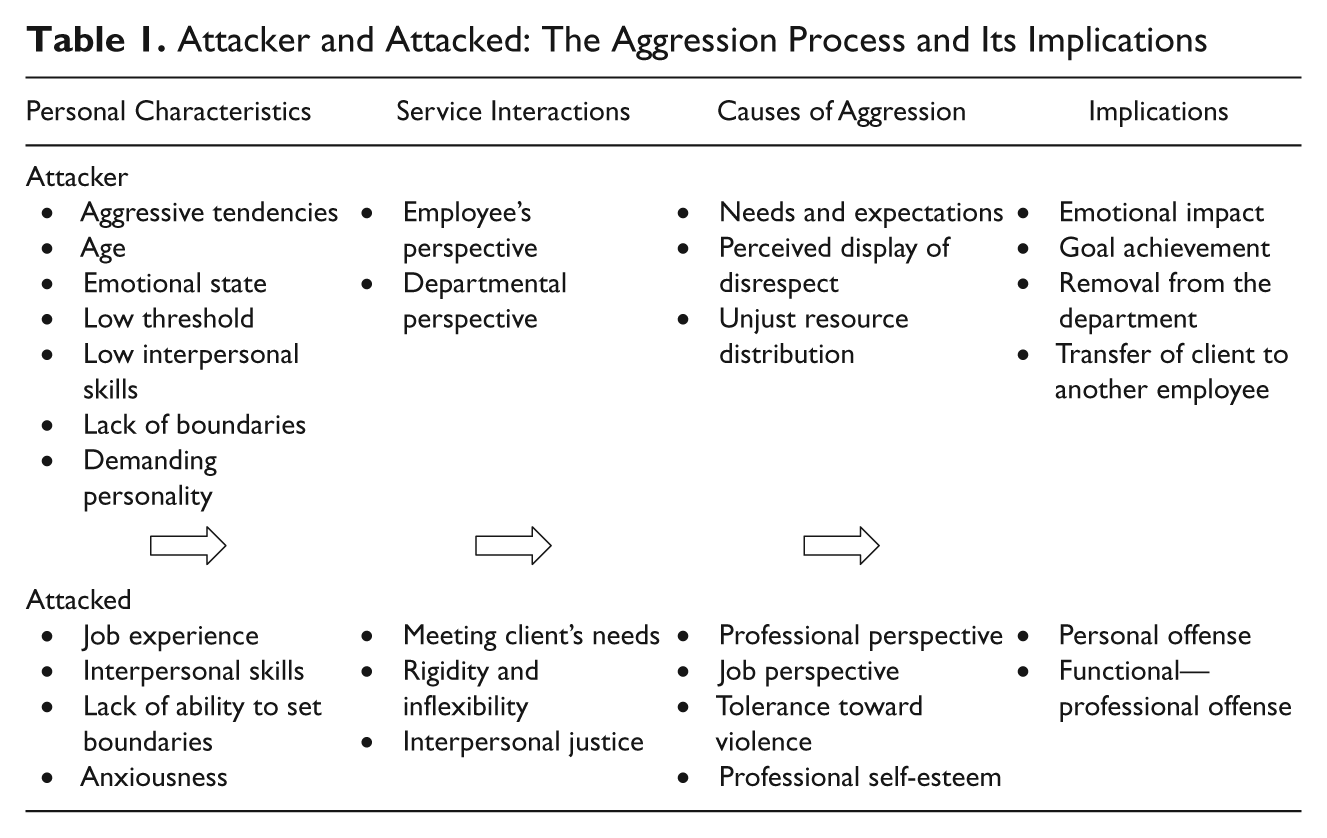
The first axis is the differential perspective of the aggressor and the attacked: the demographic and organizational characteristics of the actors involved, such as gender, age, socioeconomic status, as well as hierarchy and seniority in the organization (Koritsas et al., 2010; Martinko et al., 2002). The second axis relates to the process of aggressive interaction. This process includes the characteristics of the actors as well as the service interaction, the triggers of aggression, and its implications for the actors. Within this axis, we examine whether there are personal, organizational, situational, or other factors that might cause aggressiveness in the workplace (Koritsas et al., 2010; Martinko et al., 2002; Spencer & Munch, 2003). The final aspect of the process is the implications of aggressive behavior in the workplace (personal and professional influence) on the teams within a department (i.e., the team level—for instance, the impact of aggressiveness on the team’s state of mind) and on the organization in general. Whoever is dealing with the phenomenon and the attempt to reduce its proportions should consider the interaction related to the service process itself and to the entirety of organizational and personal factors pertaining thereto. The process of aggression and its implications for workers and clients is exemplified in several studies of clients’ aggression toward workers.
The phenomenon of client violence toward social workers has been documented in various parts of the world (e.g., Jayaratne, Croxton, & Mattison, 2004; Koritsas et al., 2010; Kosny & Eakin, 2008; Littlechild, 2005; Macdonal & Sirotich, 2005; Virkki, 2008). Although frequency and severity may change, depending on measurement tools and cultural differences, it is evident that the phenomenon itself was documented in various locations, including such countries as Australia (e.g., Koritsas et al., 2010), Canada (e.g., Kosny & Eakin, 2008; Macdonal & Sirotich, 2005), Finland (Virkki, 2008), the United Kingdom (e.g., Littlechild, 2005), and the United States (e.g., Jayaratne et al., 2004). Koritsas et al. (2010) found that 67% of Australian social workers had experienced at least one occurrence of aggression during the year preceding the study, with verbal aggression and threats being the most common forms of aggression reported. Demographic and organizational characteristics played a major role in determining the occurrence of aggressive interactions between clients and social workers. For example, younger workers were more prone to verbal violence, threats, and property damage, and women were found to be more exposed to property damage or theft than men. Location was also linked with aggression: social workers in rural areas were more exposed to violence than those in urban areas. Another study, conducted in England and Finland, examined aggression and its implications for the professional and private lives of social workers responsible for child care. Social workers who experienced violence reported increased anxiety levels, shock, depression, physical pain and anger toward the clients involved as well as perceived decrease in their ability to protect the child (Littlechild, 2005).
A different approach to understanding the phenomenon of aggressiveness can be found in another study conducted in Finland (Virkki, 2008), which dealt with the tendency of social workers and nurses to disregard signs of possible risk for aggressive behavior. Virkki (2008) argued that trust is built into the professional habitus of the helping professions and plays an important role in constructing social relations in the workplace. A similar, albeit somewhat different approach is taken by Stanley and Goddard (2002), who describe social workers working in the child protection field, as hostages. Drawing on hostage theory, they describe the feelings of helplessness, reality distortion, and identification with the perpetrator, as symptoms ailing social workers who have to confront on a regular basis aggressive clients and families. For social workers, it is improbable and counter to the processional socialization, to accept the idea that a client would be able to attempt hurting them (Macdonald & Sirotich, 2005). Therefore the ideology and values of social work as a profession serve as a hindrance to the awareness and recognition of client aggression. Therefore, many social workers live in a state of constant exposure to low levels of aggression (such as verbal aggression, threats, and minor property abuses) as well as relational aggression such as stalking (Macdonald & Sirotich, 2005; Regehr & Glancy, 2011) and gradually become habituated and suffer from increasing levels of stress and posttraumatic stress symptoms (Stanley & Goddard, 2002)
In the present study, we used qualitative methodology to understand the implications of clients’ aggression in the short term and the long term. Data were gathered using in-depth interviews with managers, workers, and other functionaries relevant to understanding the phenomenon of aggressiveness toward social workers.
Method
This study was part of a wider research initiative consisting of several phases, integrating qualitative and quantitative research methods. The need to understand a phenomenon’s basis in its specific context requires the researcher to understand the definitions and perceptions of the field in which it occurs. Thus the present report relates to the qualitative phase of the study, which was aimed at accomplishing this.
Process and Analysis
Data for this article were collected through semistructured in-depth interviews aimed at studying the participants’ experiences, meanings, emotions, and behaviors toward the studied phenomena without superimposing predetermined categories (Kvale, 1996; Rubin & Rubin, 2005). The main goal was to facilitate a critical reflective stance among the workers (Ben-Ari & Enosh, 2011; D’cruz, Gillingham, & Melendez, 2007; Enosh, Ben-Ari, & Buchbinder, 2008), which will allow them to relate to their experiences from both an experiential position and a reflective one, as recommended when interviewing victims of abuse (Enosh & Buchbinder, 2005). The interview guide was constructed through an iterative process, involving workers, managers, and administrative directors in the Ministry of Social Affairs and Social Services. Following several interviews with social workers, the interview guide was modified, resulting in its final version. The interview recordings were transcribed to allow for later cross-sectional analysis. The analysis was structured according to the guidelines of constructivist grounded theory (CGT; Charmaz, 2006). Charmaz (2006) presents clear guidelines for the processes of separating, sorting, and synthesizing data by using qualitative coding. These codes are initially written down as names, or short phrases, next to a word, line, or segment of the data (an interview transcription), and are later searched for the most significant or frequent codes to sort, synthesize, and organize large amounts of data. Eventually, following the categorization and analysis of the data and emergent themes, a theory is offered about the phenomenon that was studied. Another description of the process of interview analysis that took place in this study is the three stages of open coding, axial coding, and integration (Strauss & Corbin, 1998). Open coding refers to the stage during which the reviewer reads an initial reading of an interview and writes down his or her comments and questions. Reading through the interviews in this study brought the reader into the new and vast inner worlds of the interviewees. Therefore, initial comments or questions were written down to be reviewed later. During the second step, axial coding, emergent categories in the interview are connected, while trying to identify subcategories and finding relationships between the different categories and points expressed. This is where an interviewee’s way of “bringing himself out” and his or her relationship to the topics discussed is initially formulated by the reader. In the final stage, integration, connections are made between similar or opposing points/categories of the different interviews and themes and general categorization is formulated, leading to the findings of the study.
Trustworthiness and Credibility
Qualitative research is focused on achieving trustworthiness and credibility about the subject of the study, without claiming to finding an absolute truth (Hammersley, 1995), as opposed to quantitative research, in which validity means truth (Angen, 2000). In qualitative research, the focus moves from validity to validation, from a definitive sense of reality to a process of validation between the researcher and reader in which one’s subjective understanding is involved (Angen, 2000). The use of extensive quotations in the analysis and the researcher’s presentation of his “case” enable the reader to evaluate whether different aspects of the data collected create consistently rich and thick descriptions (Lieblich, Tuval-Mashiach, & Zilber, 1998; Lincoln & Guba, 1985; Padgett, 1998). In addition, qualitative research does not claim to generalize; since each study has its own unique influences derived from the context and the interviewees, there is no expectation to replicate what has been found in other situations (Schofield, 1993).
Sampling and Participants
The sample consisted of a representative dimensional sample of agencies throughout the country. In-depth interviews were conducted with 40 participants between February and May 2009. The participants included district managers, agency managers, supervisors, social workers, and administrators from 17 agencies. All workers were engaged in office duties as well as home visits at the time of the interview or at some other point of their career. All professional managers began their career as regular social workers, and experienced both office duties and home visits as part of the job requirements. The interviewees represented a cross-section of all four of the Ministry’s districts: 13 managerial functionaries in the municipal social service departments, 14 workers of both genders, and 13 functionaries from the Ministry of Social Affairs and Social Services and its different districts. Of all the interviewees, 80% were women, a similar percentage to that of women employed in the Ministry of Social Affairs and Social Services, which was 76% as of 2007. Given that the sample is a convenience sample, it should be kept in mind that it is not representative of the population of social workers as a whole and may be affected by selection and self-selection bias. The sample was mostly women (90%), ages ranged from 25 to 62 (M = 43.6; SD = 11.1), professional experience ranged from 2 to 38 (M = 21.3; SD = 10.4).
Ethical Considerations
Participation was voluntary. Participants were informed that they had no obligation to participate and were free to refuse or to stop the interview at any stage. Their identifying details were kept confidential. As the interview may have elicited intense memories and emotions, a list of possible support resources was handed to all interviewees. The study was authorized by the committee for ethical research on human participants of the University of Haifa.
Findings
The findings revealed that aggressive client behavior had meaningful consequences at both the individual and organizational levels. At the individual level, the interviewees reported both emotional and behavioral impacts. The emotional facet was related to feelings of stress and humiliation, mood changes, and emotional exhaustion. The behavioral facet included burnout, lack of motivation, role rotation, absenteeism, and so forth. At the organizational level, workers reported experiencing low morale and high absenteeism leading to low efficiency and effectiveness. In other words, the organization pays a dual price: first, the immediate cost of the reduced capacity of workers who are directly subject to aggression and the property damage that occurs. Second, the organization, as a whole, suffers indirectly, due to the effects on other workers and to their reactions, and the negative synergetic effect on the workplace climate.
One manager described the comprehensive impact of a single event on a social worker’s life:
I remember one violent event. A client arrived; he was angry with her; the reason is really not important now, but he rolled her down the stairs. She was physically injured. She broke an arm, if I remember correctly. But the main hurt was mental. She went to psychotherapy. She was absent from work for a year. She just could not come to work. She was afraid. She did not hang out socially because, you know, this is quite a small town and you meet your clients in the supermarket and at your children’s school, etc. So she wouldn’t leave the house.
Another example provided by a social worker emphasizes the time dimension as well as the indirect effects on bystanders:
It can happen in the morning and you feel like leaving work and getting out. It is a burden that is hard to bear throughout the day, and a month later, also. It is difficult to be the one who was harmed, or the one who was standing nearby, or the one who overheard what happened . . . it unsettles the work climate, leading to a lack of trust in the clients, and a lack of trust in the system that failed to protect you.
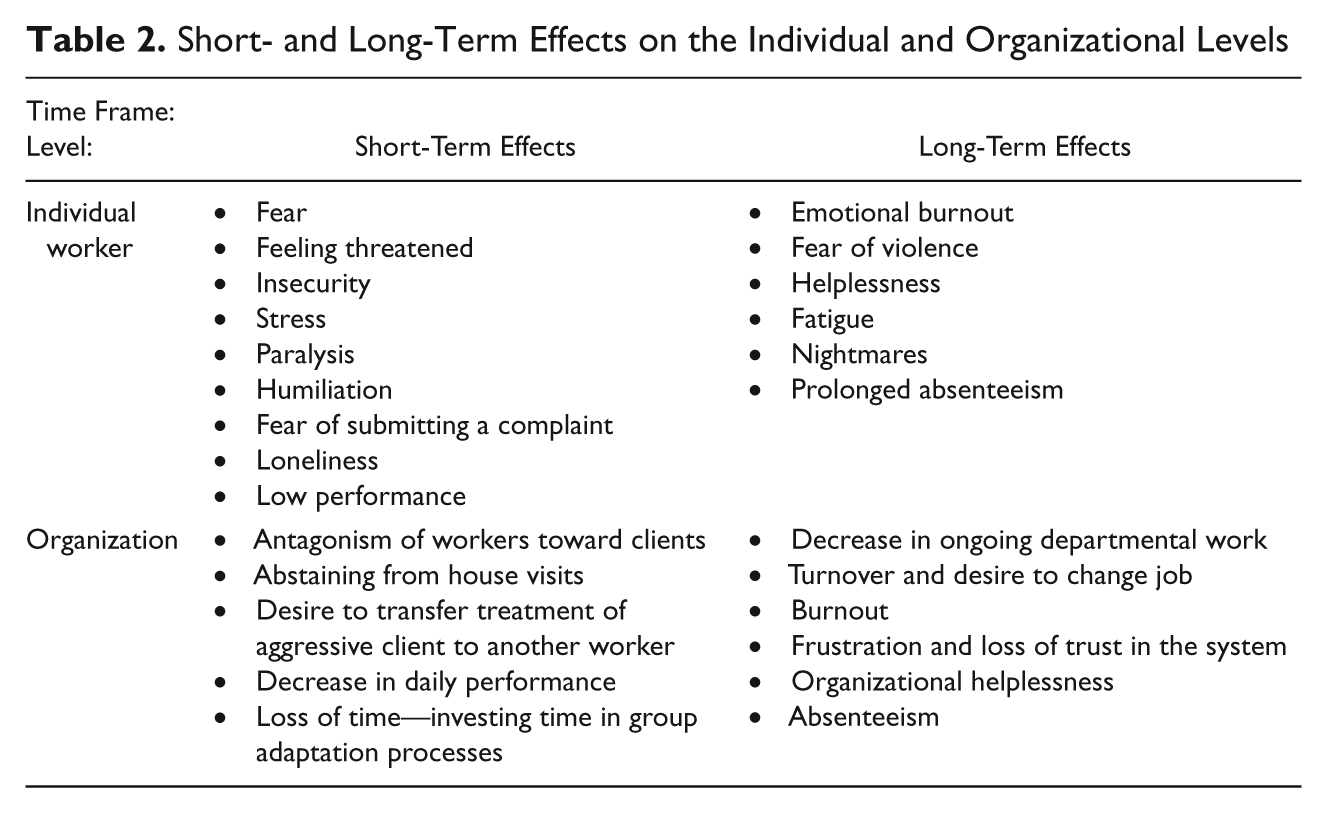
Table 2 presents the short- and long-term effects of client aggression at the individual and organizational levels. Based on the interviews, indirect and direct aggressive events appear to have a significant impact on the workers’ lives, both inside and outside the workplace. The consequences continue over time, starting from the time of the event itself and onwards.
Short- and Long-Term Effects on the Individual and Organizational Levels
Short-Term Impact on the Worker
Aggressive client behavior has immediate emotional and behavioral consequences for the worker. At the emotional level, interviewees described phenomena such as fear, insecurity, stress, and intimidation. At the behavioral level, they described decreased performance level, internalization, avoidance, and paralysis.
First of all, I became paralyzed. I was, I couldn’t—couldn’t shout or anything—because it really came as a surprise; because I didn’t see it coming, and another worker, who was pregnant, used me as a shield . . . as if, all of a sudden, I saw him [the client] with the cane. I was in total shock; I couldn’t scream or do anything else. And the other worker was dreadfully frightened; she screamed horribly. (Worker)
Another attacked worker described her humiliation and identification with abused clients:
I was ashamed to tell anyone about it at first, like some other people who experienced violence [. . .] I’ve never experienced domestic violence, but I felt like a battered woman. That is how I defined it.
Long-Term Effects on the Worker
The interviewees mentioned many long-term negative effects for workers who had encountered aggression. These negative consequences permeated all life systems: the work environment, home, family, social life. Interviewees reported emotional attrition, helplessness in similar situations that occurred later on, professional doubts, posttraumatic symptoms (such as nightmares and intrusive memories), and somatic effects (such as stomach aches and headaches). Workers who were exposed to aggression reported difficulty functioning at work, and the organization experiences prolonged absenteeism, low performance, and high turnover. A manager described the experience of one of her workers:
Then she avoided leaving her house. It really harmed all areas of her life. It damaged her work, her mental state and emotional life.
One manifestation of the gap between the short- and long-term effects may be expressed through denial in the short term and through increased anxiety in the long term. The following is an example of how one worker who had been attacked described the effects of the physical injury in the short and long term:
Nothing goes through your mind at that moment. And also afterwards, nothing goes through your mind, and it’s like the following day everything was great, I came to work, and all. And only much later [. . .] I can say that only two or three months afterwards, the anxiety and all those overpowering feelings hit me.
Some workers described a pervading feeling of anxiety expressed by obsessive thoughts on the cognitive level as well as compulsive behavioral patterns:
Look, I was attacked twice . . . I wasn’t prepared to sit in a room that has no escape. I had to constantly get organized around obtaining an escape route. Yes, of course it affects you. It is the fear that someone will come and hit you one day and you will not be able to defend yourself, and no-one will be there to help you [. . .] you are more alert on a personal level; checking the car, the brakes, to make sure that no-one did something to me because I was threatened. You organize your life differently. You do things that you wouldn’t have done before.
The worker’s performance in the workplace is also hampered in the long term:
Very simply, a person who is attacked, or a social worker who is attacked and feels that he doesn’t have support from the system, and all that, then he or she will become listless at work. They will give less of themselves, and will be afraid to treat clients in similar situations, and they will maintain a kind of low profile and give as little as possible.
An interesting finding was that some of the interviewees, workers, and managers believed that only short-term effects exist and denied the long-term effects of aggressive client behavior. For example, one manager claimed,
It affects performance. I think it is only temporary. I think that sometimes, if the worker was really subject to attack, then it is possible that for a short while, yes, it can have an effect. We are only human. It’s hard.
Similarly, one worker said, “It increases the anxiety level soon after the event and then you get over it . . . there is a procedure at hand.”
Short-Term Organizational Effects
Although the aggressive behavior is often directed toward one worker, its consequences are multilateral. One manager noted,
Someone here chased a worker and banged her head against the wall, so yes, this affected not only her, but many people who were around at the time.
In organizations in which an attack occurred, the nature of the relationship between the workers and clients changes dramatically. Workers’ reaction to client violence can be expressed through workers’ antagonism toward clients, avoidance of house visits, and use of coworkers as escorts for each visit. Furthermore, many such organizations experience high levels of burnout and workers even request to be transferred from the care of aggressive clients. Thus the organization faces decreased performance and organizational inefficiency for two main reasons: first, workers’ performance level is reduced, and second, the organizational costs needed to address the consequences and enable workers to cope with the situation (implementing workshops, security, and support) increase dramatically.
A significant example of lower morale can be found in the next quote, expressing a strong link between the worker’s emotional reactions and the manner in which the event is treated or not treated within the organization’s framework:
It was hard for me after the incident. It was hard for me because [the manager] did not hold a meeting immediately following the event; to sit with me and to reflect on what I should do; on whether I would have to work with him . . . I can’t continue working with this person, [and on the other hand] I can’t refuse to work with him . . . but even if I do, then some thought should be given to it. It shouldn’t be an arbitrary decision . . . and as I was very scared at that moment, because never . . . such violence. [. . .] so I said no [I will not approach the police], and it was out of fear, not out of discretion. It was out of fear that he would do something worse to me if I went to the police. (Worker) It has a very strong impact. It can get to the point when you use your vacation days just sitting at home. Just to relax. And it can get to the point when a worker is afraid to go home that day, in case someone is lurking about and waiting for her, or something like that. (Manager)
Long-Term Effects at the Organizational Level
In the long term, we may find organizational helplessness, expressed in attempts to satisfy clients’ demands, impingement of procedures, and disturbance of the ongoing work in the department due to high levels of turnover and burnout among workers. Together, these lead to frustration, loss of trust in the system and reduced performance, which are harmful to effectiveness and efficiency. Ultimately, the system does not achieve its goals its resources are wasted, creating an additional burden for a system already suffering from a severe shortage of resources.
I think that the fear that has taken root in the department over the last two years has definitely left its mark. For instance, it affects our way of thinking. If I have to make a house visit, then sometimes, there is avoidance or some sort of fear, and sometimes I ask someone to come with me. I will not go alone. (Manager)
One manager differentiated between single and ongoing occurrences. According to this perspective, whereas the effects of a single occurrence are only short term, continuous situations have long-term effects.
In cases of a large amount of violence or when a person’s violence persists over a long period of time, you see erosion, you see tiredness and you see a sort of giving up. In cases of a one-time violent event . . . it has an impact for two weeks, a month, two months, there is a bad atmosphere in that department too, but I think it’s temporary; it does not have an effect in the long run. On the other hand, lasting violence has a much greater impact in the long term.
Nearly all the interviewees drew attention to the need for a systematic and departmental support procedure for attacked workers, as exemplified by this worker’s comments:
I think that we pretty much know what should be done and how. It is really an individual matter of how you cope with someone whom you feel is problematic, so how do you recruit help in such situations? . . . it is terribly important to know not to be alone in these situations . . . and also in situations when someone crosses the line . . . then it should be clear that protecting the workers is the first priority.
Discussion
This study identified negative effects of client aggression on several levels and focal areas. On the emotional, cognitive, and behavioral levels, both short-term and long-term consequences can be seen, which affect not only the individual who had been the target of the aggression but also resonate throughout the organization.
As Lao Tzu once said, “a journey of a thousand miles begins with one small step” (Kaltenmark, 1969). The long journey within social service departments begins with professional socialization at the academic schools of social work and its emphasis on the clients’ needs (National Association of Social Workers [NASW], 2008). The complexity of the pattern of interaction between social workers and aggressive clients is rooted in their professional values and habitus (Bourdieu, 1977; Macdonald & Sirotich, 2005; Virkki, 2008). Dissonance is formed between the socialization and the values of the profession, which emphasize the client’s needs as the first priority as well as the social workers’ need for personal safety and mental wellness. Balancing the conflicting values leads to the questioning of personal beliefs and attitudes, and to doubting the values that were a key part of their education and professional socialization. On several occasions, the result is similar to what Stanley and Goddard (2002) identified as the hostage syndrome among social workers—being exposed on a regular basis to client aggression creates symptoms of numbness, identification with the perpetrator, and learned helplessness. As Virrki (2008) has found, violence is being excused as an expression of client distress, leading the workers to justify their own victimization. In a way, this tendency may be similar to what Walker (1984) has conceptualized as the “Battered Woman Syndrome,” characterized by minimization and denial of the violence, rationalization for the aggressor’s behavior, and self-blame for being abused. Furthermore, this tendency to overtrust and thus to ignore potential dangers is presented by Virrki as inherent in the socialization process of the helping professions, especially social work and nursing, and as a risk factor by itself, leading workers to ignore potential risk indicators in their interactions with clients.
These processes are then diffused from the personal level to the departmental and organizational levels. Needless to say, such individual effects at the workers’ level affect stakeholders as well, from clients to society at large. On the organizational level, as reported by the interviewees, the organization suffers from a loss of efficiency and effectiveness due to individual absenteeism, high turnover and low performance, as well as an overall negative organizational climate.
From a theoretical perspective, these findings can be seen as elaborating the theory of reasoned action (Fishbein & Ajzen, 2010) in an organizational context; whereas the theory of reasoned action focused on individual behavior resulting from behavioral intention based on attitudes and norms, our results point to a more comprehensive model, which integrates several levels of organizational systemic understanding. Theories that focus on the individual level (i.e., the theory of planned behavior and attribution theory) explain the effects of clients’ aggressive behavior on the person under attack. However, such a perspective is restricted and does a disservice to the complex reality of the organizational process.
Beyond the attacked individual, other stakeholders are indirectly exposed to aggressive behavior and its consequences, react to the situation, and change their attitudes and behaviors accordingly. For example, other workers react to their colleagues’ suffering and to the managerial and organizational reaction and the support or lack thereof, and consider possible implications for them. Other clients who are exposed to the event and its consequences may consider adopting similar approaches and behavior, increasing the probability of a recurrence of aggressive events. The organizational climate is likely to be changed and reshaped following each such occurrence. Thus, when examined from the organizational perspective, short-term effects on the individual level lead to long-term effects on the organizational and even societal level.
Following social learning theory (Bandura, 1973), individual events may diffuse to affect other levels of the service process through role-learning, imitation of behavior, or bringing to attention that the organization provides incentives for client aggression, while providing disincentives for assertiveness and self-protective actions on the part of workers. Thus, through a process of social learning, aggressive events may lead to a gradual process of change in the planned behavior of clients and workers. On the client’s part, while the personal attitudes may or may not change, the subjective norms are reshaped, through learning that such behavior is acceptable and rewarding. Furthermore, the clients’ perceived control (Ajzen & Madden, 1986) changes, leading to the possibility of new behaviors that were previously unacceptable (Tzafrir & Enosh, 2011).
Social services involve various stakeholders within an iterative cyclic process. The individual attitudes and behaviors of employees and clients affect organizational effectiveness and efficiency. Reduced effectiveness may further increase the organizational pressures on employees, in turn increasing the likelihood of workers’ emotional exhaustion and role conflict. Such a process leads to a negative organizational climate, which is then diffused back to the clients (Schneider & Bowen, 1993).
Describing and understanding the process of deterioration and escalation of aggression within social service departments is the first step toward its reversal. To achieve this, there is a need to back, support, treat, and help workers who had been victims of aggression as a primary and substantial organizational and managerial message in the battle against clients’ aggression. Second, managers need to take into account the micro, mezzo, and macro levels while trying to confront the issue of client aggression and must fight for the sake of their workers and organizational wholeness. Thus the organizational, team, and individual levels should be integrated and coordinated simultaneously, delivering a clear and unequivocal message of support to the workers and making clear the unacceptability of client aggression to all other stakeholders.
Footnotes
Author’s Note
Both two first authors have contributed equally to the article.
Declaration of Conflicting Interests
The authors declared no potential conflicts of interest with respect to the research, authorship, and/or publication of this article.
Funding
The authors received no financial support for the research, authorship, and/or publication of this article.