



Abstract
Research suggests that aggressive individuals exhibit a strong tendency to attribute hostile intent to the behavior of others when confronted with an ambiguous social situation. The vignettes method has become a standard procedure to assess hostile attributions. Vignettes represent incomplete ambiguous social stories, in which the subjects experience a negative outcome and are asked to attribute intent to the provocateur’s action. This article explores the ways in which subjects perceive ambiguous social situations and other people’s intentions, their tendency to refer negative outcome to oneself, and the components defining hostility in the interpersonal relationships. The sample consisted of male adolescent violent offenders (N = 45) recruited from the Social Therapy Department of the German correctional facility for juvenile offenders in Berlin. All offenders were incarcerated for a violent or sexual crime and were currently undergoing individual and group psychotherapy. The five hypothetical vignettes used in this study were originally designed to assess hostile attributions in both institutional and noninstitutional social situations. Participants’ responses were analyzed using thematic analysis. Thematic analysis revealed three key themes regarding the social perception—positive, negative, and neutral—and two themes regarding the components of hostility—provocateur-related personality features and relationship type. Although the vignettes were originally developed to detect hostility-prone perception bias, they seem to be able to reveal a wider set of different attributions of intent, both positive and negative. Thus, vignettes are not limited to assessment of hostility specifically. They much rather seem to be a measure which is sensitive to diverse attributions of intent in general. The diagnostic qualities of the vignettes, their area of application, limitations of the study, and future perspective are discussed.
Definition of Hostile Cognitions and Their Relation to Aggressive Behavior
Attributing a specific personal importance to ambiguous social situations provides individuals with the opportunity to assess the intentions of others and to make a decision of how to react in the concrete social situation (Crick & Dodge, 1994). Some individuals tend to perceive and interpret neutral, nonthreatening social interactions negatively and, thus, display a series of distorted cognitions, including hostility-prone cognitions. Hostility-prone cognitions are defined as overattributions of hostile intent to the behavior of others. They become prominent even in situations where hostile attributions are unjustified, for example, when the actual intentions of others are benign in their nature or when the social situation is ambiguous (Dodge, 1980; Dodge & Frame, 1982). Furthermore, hostility-prone attributions seem to affect the encoding of social cues and, thus, can lead to impulsive or aggressive overreactions that are incongruent with the situation (Crick & Dodge, 1996; Dodge & Coie, 1987).
An extensive number of studies suggest that individuals with aggressive tendencies often feel provoked by ambiguous behavior and attribute a negative, hostile intent to other people’s actions, particularly in uncertain, ambiguous circumstances (Crick & Dodge, 1994; Dodge & Frame, 1982; Dodge & Newman, 1981; Dodge, Price, Newman, & Bachorowski, 1990; Van Oostrum & Horvath, 1997; for overview and review, see Dodge, 2006; Orobio de Castro, Veerman, Koops, Bosch, & Monshouwer, 2002). This phenomenon is referred to as hostile cognitive/attribution bias (HAB). HAB relates mainly to the distorted perception of other’s intentions in an interpersonal social context. Initially, HAB was explored and defined as a phenomenon of the perception of children (e.g., Dodge & Coie, 1987). Later, similar results were found in adult samples as well as in the field of forensic science (e.g., Dodge et al., 1990; Seager, 2005; Serin, 1991; Vitale, Newman, Serin, & Bolt, 2005). For example, Dodge et al. (1990) found hostility-prone attributions correlated positively with aggressive behavior and number of violent crimes committed in a sample of juvenile offenders. However, there was no such relationship for nonviolent crime and socialized delinquency (Dodge et al., 1990). Furthermore, high-aggressive violent adolescent offenders—as opposed to low-aggressive subjects—tended to deal aggressively with social situations when they (a) perceived the problem in a hostile manner, (b) formulated and adopted hostile targets, (c) identified less additional facts to explain the situation, (d) generated less alternative solutions, (e) expected less negative outcomes for their aggressive behavior, and (f) provided less “best” or “second best” solutions that could be described as “effective” (Slaby & Guerra, 1988). Hostility-prone attributions of intent and their relation to violent behavior were also investigated in forensic samples of adults. Results suggested that subjects with psychopathic qualities ascribed hostile intent when confronted with provocative social situations. In addition, the subjects perceived the provocateur as highly disrespectful and were more likely to perceive and interpret the behavior of others as deliberately harmful, especially in situations in which they were placed in the victim role (Serin, 1991; Vitale et al., 2005). Moreover, the effect of hostility-prone attributions seemed to be moderately associated with persistent violence and general crime experience (Seager, 2005).
Research Methods: Assessing Hostility-Prone Cognitions in the Quantitative Paradigm
In the literature, hostility-prone attributions have been assessed mainly through two different methods. First, Dodge (1980) designed a real-time provocative situation. The participants (child sample) were instructed to compete against another child for completing a puzzle game. The experiment consisted of three conditions: (a) benign (the other child clearly attempted to help the subject to complete the puzzle but unluckily damaged it), (b) hostile (the child clearly tried to sabotage the puzzle and disassembled it intentionally), and (c) ambiguous (insufficient information about the other child’s intentions). The results showed that aggression-prone boys, compared with less aggressive subjects, were more likely to attribute hostile intent in the ambiguous condition (Dodge, 1980). Only a few other studies (e.g., Kirsh, 1998) have used an experimental design based on real-time social interaction to assess HAB. The results of a recent meta-analysis (Orobio de Castro et al., 2002) suggest that, in comparison with any other method, real-time experimental study designs show significantly larger effect sizes for the relationship between HAB and aggression because of direct participation and perceived personal commitment during the experimental tasks (Orobio de Castro et al., 2002). However, such experimental designs present numerous inconveniences. The complicated challenge to create an ambiguous and provocative scenario makes it a difficult method for investigating HAB. Consequently, it was necessary to develop a more efficient method to evaluate the construct. The second method, developed by Dodge (1980)—the vignettes—has now become the most common method and a standard procedure to assess hostile cognitions. Since their original generation, a multitude of variants of the vignettes have been developed and adapted to different research areas varying the content of the vignettes in different contexts. Essentially, this method consists of a series of stories (often referred to as vignettes or social scenarios), representing a problematic frustrating situation, in which, due to the actions of others, the subjects are exposed to a negative outcome. The situations are characterized by ambiguity of the intentions of the provocateurs which allows the subjects to produce diverse interpretations of the situations revealing their attitudes and beliefs regarding the intentions of others. The participants are asked to place themselves in the protagonist’s role in each scenario and to describe the provocateurs and their intentions.
Use of the vignette method, including different vignettes with a varying content across different contexts, has dominated more recent HAB studies with children. This method has been established as reliable and sensitive in differentiating between proactive and reactive forms of aggression, showing a specific relationship between reactive aggression and hostility (e.g., Crick & Dodge, 1996; Dodge & Coie, 1987), as well as between overt and relational aggression (Crick, 1995). Even in forensic samples, vignettes are the most commonly used instrument for assessing HAB and are usually preferred over other experimental methods such as self-assessment instruments or a real-time social experiment. To date, vignettes have been shown to have a relationship to many other violence-related constructs such as impulsivity (r = .48, p < .01), psychopathy (r = .66, p < .01), violence (r = .48, p < .01), number of committed crimes (r = .44, p < .01), self-reported participation in fights and assaults (r = .46, p < .01), and exposure to visual violence-related stimuli (weapons; r = .37, p < .01; Seager, 2005). Furthermore, the vignettes have been shown to distinguish well between violent and nonviolent offenders, as well as between offenders with and without psychopathy-features (Serin, 1991).
Focus of This Study—Qualitative Assessment
Vignettes as a study approach have now become the most common method and a standard procedure to assess hostile cognitions. Interestingly, the vignettes as measures of cognitive bias demonstrate qualities and characteristics of projective research methods, in particular sentence completion techniques. In contrast to structured (“objective”) personality tests, projective techniques typically present respondents with an ambiguous stimulus and ask them to disambiguate it, or require participants to generate a response following open-ended instructions. In addition, most projective techniques permit respondents considerable flexibility in the nature and sometimes even the number of their responses (Lilienfeld, Wood, & Garb, 2000).
Although the vignettes have adopted these principles, they are not traditionally classified as projective techniques, but instead, they have been validated using quantitative research strategies. A subject’s description and interpretation of behavior in the ambiguous situations are usually divided and coded as “hostile” or “nonhostile” and then correlated with other psychological constructs (aggression, impulsivity, psychopathy, etc.) or included in regression analyses. Little qualitative research exploring the actual themes appearing in the subject’s descriptions exists. Our aim was to contribute to the existing literature and research in this area and to develop an analysis revealing not only the presence of hostile cognition and attribution of intent but also other possible ways individuals perceive and interpret an ambiguous social situation. Specifically, we explored respondent’s subjective understanding of diverse social situations and the attributes they used to describe a particular behavior. We hypothesized that we would find evidence contrary to the dominating assumption that all negative descriptions of behavior in ambiguous social situations could be summarized as “hostile” and all positive descriptions as simply “nonhostile.” Most of the quantitative studies (e.g., James & Seager, 2006) coded hostility when subject’s responses “included perpetrating aggression and making negative comments about the other actor’s character or intent” (James & Seager, 2006, p. 50). In that way, perceiving and describing a person as “irresponsible” or “ruthless” represents a clearly negative attribution and would be coded as “hostile” according to the dominating quantitative paradigm. We sought to challenge the tradition of equating negative responses to hostile responses. We propose that perceptions of hostility are not derived from negative outcome situations per se, but by assumptions that the provocateur intended to harm, to act with malice, or desired to cause pain, injury, or distress to the subjects in the vignette. This definition suggests the presence of a strong self-related perception: a belief that the hostile act was directed toward oneself and was meant to intentionally harm. However, a simple negative attribution of the provocateur’s behavior and intention, such as “irresponsible” or “ruthless,” does not necessarily classify as “hostile” because it is not perceived as self-directed but instead as a general personality feature. It might suggest a negative judgment, but it is not necessarily perceived as important or related to oneself. In that case, the negative attribution is instead a perception of an immanent personality trait rather than a perception of an interpersonal dynamic in a social context. We hypothesized that there would be differences between a general negative and specific hostile perception and interpretation bias. We expected that the general negative bias would be more broad and vague while the specific hostile bias would be concretely associated with self-related perception.
Hence, our primary aim in this article was to critically explore how ambiguous social situations are constructed, perceived, and interpreted and how attributions of intent are made without forcefully categorizing them as “hostile” or “nonhostile.” By examining the specific elements in participant’s responses qualitatively with regard to social perception, we sought to develop a better understanding of how people perceive ambiguous situations, if they relate interpretations of behavior of others as directed toward the self or personality characteristics of the other, and given these interpretations, how they might react. The evidence gained by exploring HAB qualitatively could be used as a basis for developing more relevant and specific treatments and rehabilitation strategies for individuals who perceived ambiguous social vignettes in different ways. Furthermore, where hostility was detected, we aimed to identify its key components and the ways it was constructed in participants’ responses. This would be important in differentiating hostility from other related constructs as well as gaining a holistic understanding about the possible forms hostility can be expressed as. This could be also essential for individualizing treatment methods and adjusting interventions to the individual’s personal needs. With these aims, we conducted a qualitative thematic analysis.
Method
Sample
The sample consisted of male adolescent violent offenders (N = 45) recruited from the Social Therapy Department of a German correctional facility for juvenile offenders in Berlin (Jugendstrafanstalt Berlin). All offenders were incarcerated for a violent or sexual crime and were undergoing individual and group psychotherapy. Exclusion criteria included severe current active psychopathology (schizophrenia, schizoaffective psychosis), any kind of neurological disease, epilepsy, contemporary use of psychotropic medication, mental retardation, and poor German language skills.
Participants signed a written informed consent for their participation in the study, including information about the purpose of the research, participants’ right to decline to participate and to withdraw from the research, the lack of consequences of declining or withdrawing, confidentiality, data management, incentives for participation, and whom to contact for questions about the research and research participants’ rights. After completion of the study, participants were debriefed and provided with an opportunity to obtain information about the results and conclusions of the research. Monetary compensation for participation was provided.
Description and Evaluation of the Vignettes
The five hypothetical vignettes used in this study were originally designed to assess hostile attributions in both institutional and noninstitutional social situations. The development and validation of the presented vignettes was described in detail elsewhere (Seager, 2005; Serin, 1991; Vitale et al., 2005). In short, all vignettes represented a social scenario in which imaginary provocateurs acted in an ambiguous way, and their actions resulted in a negative outcome for the subject of the story. The participants were asked to imagine themselves as subjects in those scenarios and explain why the provocateurs acted the way they did and how the participants perceived the provocateurs’ behavior. The participants completed an identical questionnaire for each vignette that contained closed- and open-ended questions. We adapted the question set, developed by Serin (1991) and used in multiple studies (Seager, 2005; Vitale et al., 2005). It contained three main questions directly addressing subject’s attributions of intent, and four secondary questions constructed to assess possible negative (not necessarily hostile) responses to differentiate between general negative and negative hostile attributions. The three main questions were as follows:
What do you think is the most plausible explanation of this situation?
How would you describe the provocateur in the story?
Did he/she act intentionally or it was an accident?
The four secondary questions were as follows:
Do you think his/her/their actions were accidental?
Do you think his/her/their actions were intentional?
Do you think his/her/their actions were done out of disrespect?
Do you think he/she/they meant to harm you?
Procedure
The study was described to participants, and they received a packet containing an information sheet, consent form, and the Vignettes Questionnaire to complete. The information sheet outlined the purpose of the research, the anonymity of their participation, how data might be used, and how to withdraw data. After signing a written informed consent for their participation, the subjects were given verbal instructions describing the task procedures. Respondents were instructed to answer questions fully, giving specific examples and spending some time thinking about their answers before they started to write. After completion of the study, all participants received monetary compensation for their participation.
Analysis
Responses were analyzed using the thematic analysis procedure described by Braun and Clarke (2006). First, the dataset was studied for common patterns and themes in participants’ responses. The data were read carefully to identify meaningful units of text relevant to the research topic. Second, units of text addressing the same issue were put together into thematic categories and given provisional definitions. The same unit of text could be included in more than one category. Then, the data were systematically reviewed to ensure that a name, definition, and exhaustive set of data to support each category were identified. The thematic analysis resulted in 42 prime categories, which were grouped into three key themes in terms of attributions of intent and two themes regarding the components of hostility. The reliability of the themes was established by a second researcher who recoded 100% of the data with a high level of interrater reliability, ranging from substantial to almost perfect agreement (see Table 1).
Interrater Reliability for Each Vignette.
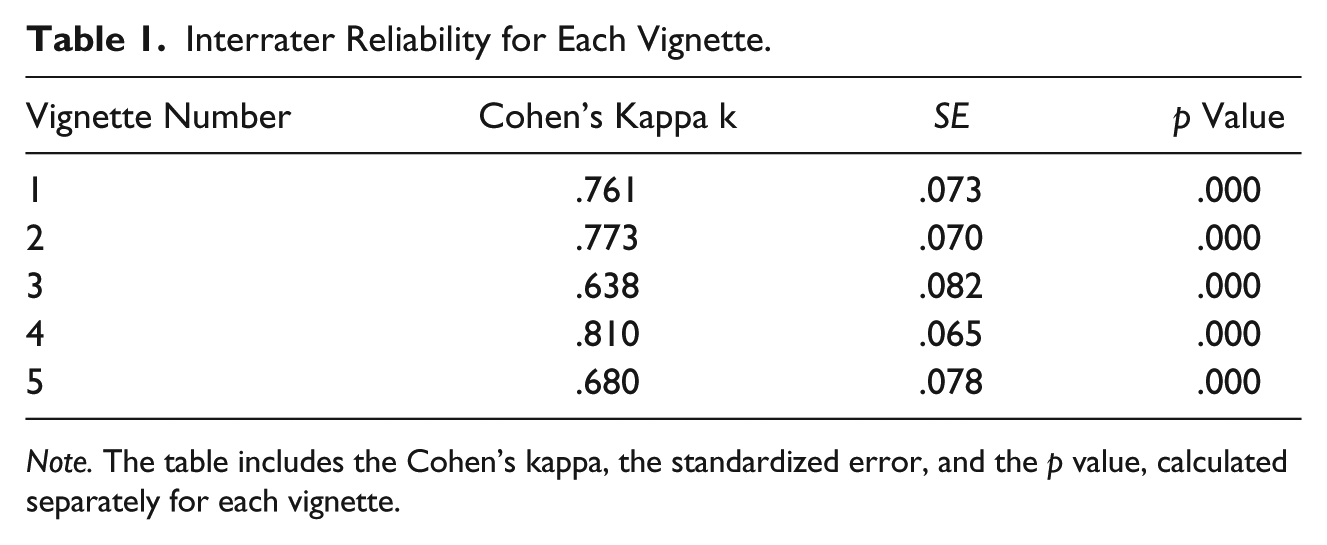
Note. The table includes the Cohen’s kappa, the standardized error, and the p value, calculated separately for each vignette.
Results
Descriptive Analysis of the Sample
The subjects ranged in age from 17 to 24 years (M = 20.5 years, SD = 1.8 year). Almost half were German (48.9%, n = 22); 42% of subjects (n = 19) had a foreign background, of which 26.5% (n = 12) identified as Muslim, 4.4% (n = 2) were Polish, and 11.1% (n = 5) were Eastern European (Serbia, Bosnia, Latvia, Greece). Four participants (8.9%) had an unknown nationality or were considered stateless, that is, not recognized as a citizen of any country. The length of imprisonment ranged between 24 and 78 months (M = 42.9 months, SD = 14.2 months). All respondents except one had been convicted previously. The majority were convicted for a crime similar or equal to the current offense (80%, n = 36). With respect to the highest educational level at the time of the current offense, more than the half of all inmates (60%, n = 27) did not possess a completed school degree, 33.3% (n = 15) had an elementary school degree, and 6.7% (n = 3) possessed a high school degree.
Current Offenses
An overview of the current offenses is shown in Table 2. In case of a registered combination of several offenses (e.g., inclusion of previously committed crimes), the most severe criminal offense has been coded. According to the guidelines of the Social Therapy Department of the juvenile correction center, all current crimes were classified as violent crimes (including sexually motivated violent crimes).
Frequency of the Committed Crimes.
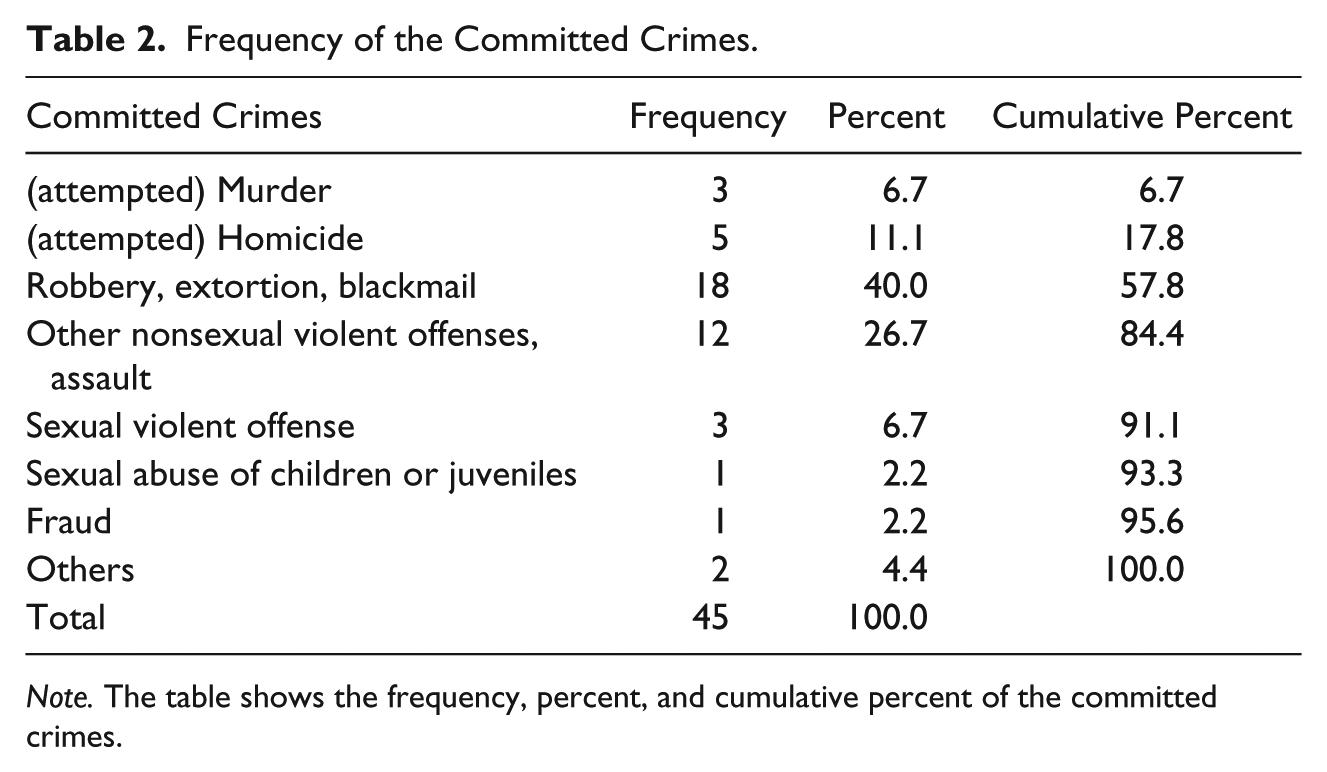
Note. The table shows the frequency, percent, and cumulative percent of the committed crimes.
Qualitative Evaluation of the Vignettes Questionnaire
We identified three themes addressing how participants perceived and interpreted ambiguous social situations and provocateurs’ behavior and two themes regarding the components of hostility.
Perception biases and attributions of intent
The first theme we detected in this category was a positive perception bias of the ambiguous social situation and positive attributions of intent. Surprisingly, in contrast to the mainstream theoretical and empirical research, participants showed a tendency to perceive the ambiguous social situations with negative outcome as a normal combination of circumstances or coincidence. Moreover, participants redefined the problematic social situation as a challenge or issue to solve and provided possible alternative solutions. For example, one of the hypothetical situations referred to a social worker not letting an inmate make an important phone call because of no phone credit left (see the appendix). Confronted with this situation, participants offered diverse solutions: (a) to go and call from a phone center, (b) to ask for assistance from another social worker who might be more helpful, or (c) to compromise and ask the social worker to make the call himself, gather information, forward it to the inmate, and so on.
A positive attribution of intent was also manifested through objective consideration of the situation’s specific nature, intellectualization and interpretation of the situation in relative terms (relativization). For example, for the same situation, explanations such as “When my phone call account is exhausted even the social worker can’t do much about it,” “I must have been very annoying with my constant request to make the social worker disagree,” or “The social workers are responsible for the whole department. Could be that they are busy with somebody else” showed a tendency to rethink the negative outcome in relative terms and to perceive the situation as a component of a bigger social phenomena and not as a single independent event. The situation was placed in a chain of social events, caused by a probable reason and leading to possible consequences, but never perceived as unlinked to other social situations. We consider such perspective very positive because it portrays one’s ability to overcome a rigid negative interpretation of a social situation and redefine ambivalence in a positive way. Relativizing the situation allows one to put himself or herself in another’s shoes and take a different perspective, thereby allowing a better understanding of the social situation in its entirety. Relativization, especially combined with a problem-solving orientation, resulted in a positive interpretation of the ambiguous social situation.
Positive interpretations of the social situation and positive attributions of intent were made by 22.22% (n = 10) of the participants. This positive perception bias was associated with German ethnic group, average age (M = 18.6 years), and lower frequency of misconduct measured by the number of registered disciplinary sanctions during imprisonment (M = 4.1).
The second theme we identified reflects a negative perception bias and interpretation of the social situation and negative attributions of intent. It consisted of many diverse negative attributions of intent, including negative assumptions about the provocateur’s motivation (“he is a greedy egoist thinking only about himself”); general negative definition of provocateur’s personality, temper, and/or behavior (“disrespectful,” “rude,” “lazy”); insinuation of power games or even expression of readiness and/or a direct threat to respond with instrumental violence or verbal aggression if such social situations appear in real life (“I’ll break his bones”). In contrast to the previous theme, participants perceived the situation as an isolated social event with no cause and no consequence. The provocateur’s motivation was not questioned, situational details were not considered, and participants identified fewer alternative interpretations to explain the situation. Negative attributions of intent appeared generalized, stable, unchangeable, and irreversible. Participants generated less (or no) alternative interpretations of the situation and could not relativize the provocateur’s intentions. The perception of the situation and the attribution of intent seemed rigid, robust, and resistant to rethinking. The provocateur’s behavior was commonly perceived not as personally self-directed (toward the participants), but as universal, stereotyped, and standardized.
A closer exploration of participants’ responses showed that 64.44% (n = 29) of the participants demonstrated predominantly negative interpretations of the social situation and negative attributions of intent. This negative perception bias was associated with Muslim ethnic group, lower age (M = 17.6 years), and higher frequency of misconduct measured by the number of registered disciplinary sanctions during imprisonment (M = 6.24).
We detected a hostile perception and interpretation pattern as a subcategory of the negative perception bias. Hostility was identified when the following three attributions were present: (a) The provocateur had a bad personal character/temper, (b) his actions were motivated by malice and conscious intention to harm, and (c) his hostility was clearly personally directed toward the participant (see also the “Components of hostility” section). Hostility reflected a “one-way-perception” in which the provocateur was seen as completely guilty and responsible for his actions. On the contrary, the participants perceived themselves as victimized peers who had to either subordinate or rebel against the injustice done to them. In any case, the “victim” was completely innocent and bore no responsibility for the negative outcome. Denial of reciprocity and a perception of both the provocateur and the social problem in a hostile manner seemed to be key aspects of interpersonal hostility.
The third theme we identified indicates a neutral perception bias and neutral attributions of intent, and responses were more practical and less personal or emotional to the ambiguous social situations. For the most part, those responses did not represent the participants’ opinion about the situation or the provocateur. They were rather distant and impersonal and consisted of application of complex life principles, general moral beliefs, abstract philosophical maxims, and proverbs, in principle rule-orientation. In this category, we included responses representing the following:
Sayings and metaphorical adages (e.g., “A promise made is a promise to keep,” “Do onto others what you wish for oneself”)
Rule-oriented consideration of the formality of the situation and its requirements (e.g., “in jail there are equal rights for everybody,” “nothing personal, the social workers are just doing their job”)
General life principles (e.g., “Therapy instead of violence”).
Although such responses might have also contained judgmental components expressed in a subtle and refined way, we considered them neutral because of their abstract vagueness and lack of concrete (positive or negative) attributions. They were characterized by common sense and ordinary observations and did not provide a realistic evaluation of the situation, but rather a simplistic general inexact remark or comment. Neutral attributions did not refer to a concrete person or social situation, nor did they have a particular aim. By responding in a manner that failed to disambiguate the stimulus, participants appeared to attempt to avoid self-involvement in the situation and to stay distant and unaffected by the negative outcome. Taking an objective observer perspective could imply various motivations, for instance, a self-protective mechanism (not letting a situation or person affect or concern oneself), inability to empathize, limited imagination, or general tendency to neutralize events with personal importance.
Neutral responses were found for 13.33% (n = 6) of the participants. Neutral perception bias and neutral attributions of intent were associated with German ethnic group, higher age (M = 18.8 years), and average frequency of misconduct measured by the number of registered disciplinary sanctions during imprisonment (M = 5.33).
Components of hostility
Person (provocateur)-related personality features: Hostility-prone versus nonhostile personality attributions
The first theme we identified reflected the ways of perceiving the ambiguous social situation, while focusing on the provocateur’s qualities, his personality traits, and/or his behavior in general. Participants perceived, interpreted, and explained the provocateur’s qualities as stable personality features and/or behavioral tendencies, which were not situation specific, but were expected to recur across similar situations. Provocateur’s features were defined as intrinsic, stable, and generalized, inherent for the provocateurs themselves, and were not perceived as self-directed or intended. The negative outcome in the social situation was interpreted as a result of the immanent personality traits of the other actor and/or his usual behavior (e.g., “lazy/indolent,” “not ready to help/not helpful,” “brazen/rude/impudent,” and/or “he did not have time for me as usual,” “he was busy with something else,” “he did not pay enough attention to me”). This still represented a negative attribution of intent containing a judgmental tinge; however, such attributions were not hostile in their nature because they did not have a “recipient” and did not aim to affect a specific person. This very intrapersonal static description was exclusively attributed to the provocateur’s character and did not take the social setup or whether the behavior was directed at the participant into consideration.
Another way of perceiving involved a more vivid, dynamic perception of the ambiguous situation in which the provocateur was not perceived as an isolated unit only but also set in relation to the subjects in the study. There was a social interaction between both the protagonists with an exchange of intentions and feelings. The provocateur’s character was not only perceived as generally evil or low, but also as evil or low in the concrete social situation toward the specific disadvantaged person. The dominating perception of the ambiguous situations was self-related: Participants interpreted the provocateur’s behavior as concretely directed and precisely intended for themselves. This way of interpreting situations considers one’s importance in the social interaction and puts oneself in an active position to accept or rebel against the negative outcome. The provocateur was not a static individual anymore, his behavior was not stereotyped or simply explained by his character; it was personal. Participants perceived the behavior as meant for them, as an individualized interaction between both the parties. This dynamic explanation of the situation signified the personalization of the situation. Perceiving someone’s behavior as directed toward oneself indicated a specific importance given to oneself and to the own personality in the social situation—a personal involvement. Hostility was usually not named directly but expressed through a larger set of attributions including “ignorance,” “aggression,” “egoism,” arrogance,” “ruthlessness,” and “disrespect.” The actor was perceived as “untrustworthy,” “unreliable,” and “provocative” and involved in “power plays.” Hostility was explicitly linked to an interpersonal context in which the participant felt taken advantage of, used, underprivileged, or involved in an unequal power ratio. Attributions of hostile intent contained a judgment about the provocateur’s character (ignorant, arrogant, bad) and judgment about his intentions (“willing to provoke,” “searching for trouble,” and “showing off who the boss is in here”). Hostility was perceived when (a) the provocateur was perceived as a bad person and (b) when his actions were interpreted as personally related to the participant. The provocateur was perceived as somebody who intended to do ill, was driven by the desire to harm, and acted with malice. Such an interpersonal dynamic interpretation, suggesting a link between the provocateur and the recipient of the action, clearly involved at least two opposing parties placed in an unequal power position. Attributions of hostile intent were always displayed concretely as participant-directed, never as general or aimless.
The relation between the participant and the provocateur: Known versus unknown interaction partner
The second theme we identified referred to the relationship between the participant and the provocateur. Surprisingly, we found higher attributions of hostile intent when participants were confronted with a known or familiar interactional partner (provocateur), or when there was a close relationship between both of them. A close friend not keeping his promise (M = 2.75, SD = 2.29) or a neighbor refusing to down the radio and disturbing one’s sleep (M = 5.35, SD = 1.86) evoked a higher feeling of being personally provoked and thereby a higher tendency to ascribe a hostile intent to the other party. Also well-known people placed in a better social and therefore better power position than the participants were perceived as more hostile than average (the social workers in the prison not letting an inmate make an important call: M = 4.33, SD = 2.34). Contrastingly, when the provocateur was an unknown person randomly met in a bar (M = 2.04, SD = 2.42) or an unidentified co-inmate taking one’s food portion (M = 2.11, SD = 1.95) attributions of hostile intent tended to reduce, likely due to the fact that there was no concrete subject defined to address hostility to.
This theme revealed an interesting insight into the dynamic nature of hostility-prone attributions and underlined the importance of association and co-dependence of both the social interaction partners. Participants frequently faced difficulties describing unknown people or providing a clear attribution of their behavior in the social situation, citing that they did not know those persons and therefore could not ascribe any features or intentions to them. In contrast, participants seemed to be quicker to judge known, familiar, or befriended people indicating that peer status played an important role. Designating a friend who had not kept his promise as “a liar,” “not a sincere and true human being,” or a “false and treacherous friend” implied that perception of hostility increases when betrayed by someone we trust and consider close. Contrastingly, an unknown person acting with potential hostile intention was more likely to be excused due to the lack of information about the person.
Discussion
Advantages of the Vignettes and Area of Application
Our primary research question was to explore how people perceive and interpret ambiguous social situations with a negative outcome. For that purpose, we used the vignette method as a qualitative questionnaire and conducted a thematic analysis. Although the vignettes were originally developed to detect hostility-prone perception bias and hostile attributions of intent (Dodge, 1980), they have potential to reveal a wider set of different attributions of intent, both positive and negative. Thus, vignettes were not limited to assessment of hostility specifically. They were used in this study to assess diverse attributions of intent in general. Vignettes describe life experience “from the inside out,” that is, from the perspective of the person involved. Thereby, they can contribute to a better understanding of social realities and draw attention to instructional perception processes, interpretation patterns, and social structural features. When used as a qualitative questionnaire, vignettes are advantageous in that they provide in-depth, detailed information about attitudes, feelings, and behavior patterns while exploring the wider context of a respondent’s individual experiences. This data-driven approach has the ability to decrease the potential for bias due to a researcher’s predetermined assumptions and to focus on meaningful key issues for the participants themselves.
This feature of vignettes makes them a useful tool for exploratory analyses. Applied at the beginning stage of a broader analytical process as a tool, which reveals general attribution tendencies, vignettes can provide an initial orientation in the general social-cognitive functioning of the individual. Vignettes appear to enable researchers and clinicians to capture perception biases and to differentiate between a positive and negative focus of attention when decoding social signals. Thus, based on the vignettes, researchers and clinicians can detect dominant trends in patients’ perception and identify possible perception bias, distorted cognitions, and/or persistent projections (one of the basic assumptions of most personality theories is that a person’s perception of others is influenced by his own personality characteristics and that individuals tend to identify with the psychological condition to which they are most prone). Vignettes also provide us with insight into an individual’s inner realities, specific cognitive processing strategies, potential interactional problems, and fears, beliefs, and ideals manifested through one’s experience. These can indicate a focus of treatment, which can be further concretized, examined, and precisely assessed with more sensitive tools. Thus, the vignette method provides a method for in-depth detailed exploration and also, at an individual level, serves the aim of gaining a more nuanced view of the inner world and subjective experience.
Hostility in the Interpersonal Perception: Relationship Type Matters
Through the application of thematic analysis of data obtained using vignettes, in addition to hostility-prone attributions, resulting from the provocateur’s character and personality, we demonstrated that one more factor—familiarity with the provocateur—plays an essential role in processing patterns, interpretation of ambiguous social cues, and attribution of hostile intent. Interestingly, participants tended to attribute higher hostility to known interactional partners than they did to unfamiliar or unidentified peers, indicating that participants might be predisposed to interpret the behavior of associates and acquaintances in ways that maintain already existing views of these peers. Such attitude and belief polarization in interpersonal relationships, ascribing well-defined contrasting attributions to both parties in the social interaction, seems to be related to a phenomenon called the confirmation bias. Confirmation bias refers to the tendency to search for and interpret evidence selectively, to reinforce current beliefs or attitudes (Fine, 2006). When people encounter ambiguous situations, this bias can potentially result in interpretations by each that support negative attitudes, even when they are inaccurate, thus increasing rigidity and disagreement between them (Lord, Ross, & Lepper, 1979).
In contrast, in our sample, not knowing the interactional partner seemed to reduce the attribution of hostile intent, probably because of the lack of previous experience with the concrete person. This finding suggests that despite the existence of a friendly relationship, when in doubt juvenile offenders are predisposed to perceive the ambiguous actions of their friends, first and foremost, as intentional and hostile, possibly resulting from previous negative interactions with these peers. However, based on past experience, juveniles may hold unfairly negative views of their acquaintances and ignore or discount their positive characteristics. When it comes to judging an unknown person, juveniles tend to be more cautious and reserved. Thus, different relationships with known versus unknown people might explain the two different interpretation processes.
Supporting data for the impact of the existing relationship is provided by diverse quantitative research. For instance, Peets, Hodges, Kikas, and Salmivalli (2007) tested the hypothesis that children’s hostile attributions and behavioral strategies in response to peer provocation and rebuff situations would depend on the relationship with the target peer (i.e., friend, enemy, neutral). Their results clearly demonstrated that children do indeed differentiate between relationship types in regard to hostile attributions and hostile strategies, with more hostility attributed and more hostile responses proposed toward enemies than toward other peers. In addition, this relationship effect was maintained even when the social and behavioral reputation of the target peers was accounted for.
The importance of considering the relationship context in human behavior and development was also highlighted by Lemerise and Arsenio (2000). They stated that the emotional valence of the relationship between two individuals affects the way information is processed and, as an outcome of that, what behavioral response is enacted. For instance, a negative act by a disliked peer is likely to be interpreted differently from the same behavior enacted by a liked peer. During the last decade, researchers have started to explicitly incorporate the interpersonal context in studies by using, for instance, social relations models. The results have shown that in addition to personal dispositions (i.e., provocateur’s effects and partner’s effects), there is considerable unique variance attributable to the relationship between two individuals (e.g., Coie et al., 1999; Hubbard, Dodge, Cillessen, Coie, & Schwartz, 2001; Simpkins & Parke, 2002). Although our sample and results differed somewhat from these findings, our data analyses supported that subjects tended to make different attributions of intent based on whether a prior relationship existed or not. It seems that the simple fact of having been able to interact with a peer for a while is a sufficient reason to quickly jump to conclusions about this person’s intent.
In addition, we found that hostility increased in situations when a power differential between the participants and the interacting partner was present (Vignette 5). The power differential is the enhanced amount of role power that accompanies any position of authority and represents the influence that empowered people have as compared with people in low-power positions (Dahl, 1957). In our study, the vignette describing a conflict situation between an offender and a social worker represented a classical power differential relationship based on formal organizational hierarchies, with some positions having authority over others. Prison employees, law enforcement officials, guards, and so on, usually have the more powerful position. They are the authority figures whose actions, by virtue of their roles, directly affect the well-being of the other. Naturally, offenders are in the more vulnerable position.
When confronted with this social scenario (Vignette 5), all participants took intuitively the perspective of a subordinate figure and tended to interpret the social situation from a disadvantaged and suppressed power position. Once participants assumed unequal positions of power, they were likely to perceive others as “misusing their power, selfish, malicious, less empathic, less understanding” or having an extreme personal attitude toward the participants (“they cannot stand me,” “they do not like me,” “they have picked me up and try to annoy/irritate/provoke me”). Consequently, participants assumed being susceptible to harm, more vulnerable to misuses of power and influence, and more dependent on and concerned about justice, equity, and fairness. Being placed in a low-power position in a power differential scenario seemed to heavily impact the interpretation of ambiguous social cues as hostile and to attribute hostile intent of behavior of others. The underlying thinking across this theme was to call for justice, rebel against perceived unfairness, and try to reinstate power equity. The effect of power differential not only triggered a strong hostile response but also seemed to have an activating effect on the participants, evoking strong reactive responses and readiness to act in order to neutralize the power differential and reestablish power equity.
Understanding the many impacts of the power differential is essential for the study of social perception in dyadic relationships. Future research should address the differences between high- and low-power contexts, verify their impacts on participants’ attitudes and behaviors, and evaluate how these contexts affect the relations with power holders or affect the ways people relate with each other.
Limitations and Future Perspective
In this article, we outlined and analyzed three themes that frequently occur in the perception of ambiguous social situations and attribution of intent and two themes regarding the components of hostility. The three means of perceiving an ambiguous social situation (positive, negative, and neutral) emphasize the significance of the individual experience, the plasticity (vividness) of an individual’s subjective interpretation of social events, and the focus of attention on negative as opposed to positive situational features. We illustrated how these themes were represented in a sample of incarcerated juvenile offenders convicted of violent and/or sex offenses. In contrast to mainstream quantitative research where responses to hypothetical vignettes are simply coded as “hostile” or “nonhostile,” we concentrated on the essential qualitative characteristics of the data and analyzed it from a qualitative perspective, using thematic analysis to provide a broader, more detailed and more in-depth understanding of attributions made by respondents.
Interestingly, we found a specific pattern for each theme with respect to the perception and interpretation of the ambiguous situation and behavior of others. While younger participants tended to demonstrate more negative interpretations, older participants seemed more flexible to view the problematic social situation in relative terms, redefine ambivalence in a positive way, or even take a practical neutral position toward the social situation. Negative interpretations seemed to be more prominent in the Muslim ethnic group, while Germans were more likely to provide a positive or neutral attribution of intent. A tendency for more frequent violent behavior and misconduct during imprisonment was also associated with negative interpretation bias.
These results have numerous implications. First, they suggest that differences in the ways individuals perceive and interpret ambiguous social cues might depend on the cognitive-emotional development and maturing process with interpretations transforming from negative to positive and neutral when age progresses. Second, the perceptual and interpretational differences might be partly explained by individual’s origin and socialization context, suggesting that there are certain ethnic-related characteristics that would make an individual more likely to interpret ambiguous situations in negative, positive, or neutral way. Third, the association between negative interpretations and frequency of misconduct reveals a potential link between negative (hostile attributions) and reactive aggressive behavior. Determining the different factors leading individuals to demonstrate specific positive or negative attributions is particularly relevant in developing best treatment strategies for juvenile offenders as well as identifying certain characteristics that might form individual’s perception and interpretation bias. Additional research might focus on potential variables that might influence the way individuals view ambiguous social situations.
Some of the limitations of the present study should be underscored. First, we should emphasize the design and methodology that was used in the current research. Specifically, as in prior studies, we assessed hostile attributions using hypothetical situations simulating a social interaction instead of staging actual negative interactions. We cannot rule out that due to other factors—such as the imagination capacity, cognitive empathy, and so on—participants might have had more difficulty imagining a provocative situation. The research would have more comprehensive results if it had explored how people perceive ambiguous social situations after being involved in one. Hence, staging a real-life ambiguous situation might contribute more to revealing instant attributions of intent and immediate behavioral responses after being confronted with a provocative social scenario.
Second, the vignettes used in our sample were characterized by fixed question ordering and hence possess a potential for order effects. The consecutive presented vignettes would possibly not have been judged independently of each other. A potential interpretation bias that could become active when evaluating a particular vignette might have later been applied to the subsequent vignettes, making their evaluation dependent on the one previously judged. Thus, the fixed order in which the vignettes were presented might have potentially impaired data quality by affecting respondents’ judgments and contaminating final results and research conclusions. Future research might focus on implications for how best to design and present vignettes, to avoid order effects that could impact results.
Third, the study was conducted using male adolescent offenders, and therefore, study findings may not be applicable to nonincarcerated samples and samples of different age groups or gender. Furthermore, due to the lack of a control group, the possibility that some other third variable (e.g., impulsivity, aggressiveness, psychopathy) may have influenced participants’ responses could not be ruled out. However, we decided to use only a prison sample to ensure similar exposure to potentially hostile situations for all participants. If we had used a control group of nonincarcerated participants, confounding variables such as current environmental differences could have been introduced, and thus, differences between violent and nonviolent groups might have arisen from differences in current environment (institutional – noninstitutional). However, the findings of the current study, while possibly not generalizable with regard to specific attributions, are consistent with research with other populations that suggests that the presence and nature of preexisting relationships has an impact on attributions made in response to ambiguous social scenarios.
Additional research might also focus on preexisting attributions versus attributions made in response to socially ambiguous situations with known peers and unknown peers to see whether attributions are based on past experience or are based more on negative overgeneralizations.
Abnormal neutral stimulus processing, including negative evaluation of neutral and ambiguous social stimuli as well as negative attributions of intent, has been found in various psychiatric conditions, for example, schizoaffective and substance-related disorders (McNiel, Eisner, & Binder, 2003), anxiety disorder (Bar-Haim, Lamy, Pergamin, Bakermans-Kranenburg, & van IJzendoorn, 2007; Cisler & Koster, 2010), generalized social phobia (Amina, Foab, & Colesc, 1998), borderline personality disorder (Arntz & Veen, 2001; Barnow et al., 2009), and posttraumatic stress disorder (Weber, 2008). Hence, a more detailed qualitative analysis such as thematic analysis might contribute for better understanding of the essential content of individuals’ attribution of intent and information processing biases across different populations. Qualitative analyzed data hold numerous clinical implications because of its explorative in-depth approach to respondent’s subjective understanding of diverse social situations as well as the attributes used to describe a particular behavior. An improved understanding of the interpersonal social perception and evaluation bias may, for example, help clinicians more effectively navigate through the relational problems that often occur during treatment. Ideally, research on therapy effectiveness should consider the extent of evaluation bias and interpersonal behavior problems as an additional outcome measure.
Footnotes
Appendix
Acknowledgements
The author thanks the supervisor Prof. Dr. phil. Klaus-Peter Dahle for his academic guidance.
Authors’ Note
This study was a part of the author’s individual PhD research. It was included in the project “Evaluation of the social therapy and of the offenders’ accommodation and treatment in the state of Berlin,” commissioned and sponsored since 2014 by the Senate Department for Justice and Consumer Protection Berlin at the Institute of Forensic Psychiatry of Charité Universitätsmedizin Berlin, Germany.
Declaration of Conflicting Interests
The author(s) declared no potential conflicts of interest with respect to the research, authorship, and/or publication of this article.
Funding
The author(s) received no financial support for the research, authorship, and/or publication of this article.