



Abstract
In much feminist literature, patriarchy has often been studied as a predictive variable for attitudes toward or acts of violence against women. However, rarely has patriarchy been examined as an outcome across studies. The current study works toward filling this gap by examining several individual-and neighborhood-level factors that might influence patriarchy. Specifically, this research seeks to determine if neighborhood-level attributes related to socioeconomic status, family composition, and demographic information affect patriarchal views after individual-level correlates of patriarchy were controlled. Findings suggest that factors at both the individual- and neighborhood levels, particularly familial characteristics and dynamics, do influence the endorsement of patriarchal views.
Keywords
Patriarchy is a historical and social system of male dominance over women (Chesney-Lind, 2006; Gosselin, 2010), which is used to both enforce and reinforce the inequity of power between males and females (Alvarez & Bachman, 2008; Gosselin, 2010) with social arrangements privileging males (Hunnicutt, 2009). Generally, it is believed that patriarchal beliefs are strengthened by common beliefs, customs, and laws that are built into the organization of society (Gosselin, 2010). Patriarchy has often been used as an explanation for violence against women—violence, such as domestic/intimate partner violence, rape and sexual assault, child abuse, and stalking (Tjaden & Thoennes, 2000) that is patterned along “gendered lines” (Hunnicutt, 2009) and thus impacts women disproportionately—as well as negative attitudes toward women, which perhaps enhances the likelihood of such violence (Hunnicutt, 2009; Stith, Smith, Penn, Ward, & Tritt 2004). Indeed, patriarchal views have been identified as strong predictors of violent acts against women, such as domestic violence and sexual assault (Hunnicutt, 2009; Johnson, 1995; Stith et al., 2004), presumably to perpetuate male dominance over women. However, while the literature examining violence against women has greatly expanded over the last several years (e.g., Hunnicutt, 2009; Tjaden & Thoennes, 1998), empirical explanations of patriarchy have not. This lack of scholarly attention has been attributed to a backlash against feminist explanations of violence against women, as well as the term patriarchy itself (Hunnicutt, 2009). As a consequence of this backlash, there has been “non-use, misuse, and varied use of the concept of patriarchy by criminologists” (Ogle & Batton, 2009, p. 160).
Previous literature has failed to produce a consistent operationalization or conceptualization of patriarchy, and, consequently, there is no uniform definition of patriarchy, patriarchal ideals or views, or patriarchal endorsement, in the literature (Hunnicutt, 2009; Ogle & Batton, 2009). Moreover, Ogle and Batton (2009) note:
By the 1990s, as a result of heavy criticism concerning the usefulness of patriarchy and some backlash, feminist criminologists seem to have given up on the concept of patriarchy and turned to the business of “doing gender.” This pursuit changed the focus entirely from macro-inequities to micro-inequities. There was very little work on conceptualizing or operationalizing patriarchy, and the work that utilized patriarchy as a variable at all, tended to use it as an undefined given. (p. 171)
Ogle and Batton (2009) thus indicate that research examining the effects of patriarchy often does not empirically measure patriarchy but rather assumes the existence of patriarchy without conceptualizing it. Furthermore, most of the research in this area has treated patriarchy as an individual-level phenomenon (Ogle & Batton, 2009), even though patriarchy is widely regarded as a social structure construct. In fact, Hunnicutt (2009, p. 557) argues that patriarchy refers to “social arrangements that privilege males, where men as a group dominate women as a group, both structurally and ideologically,” and that patriarchal systems exist at both the macro- and micro levels. Ogle and Batton (2009) note that both macro- and micro-level factors are important to patriarchy because the social structure influences the actions of individuals in society, and this social structure is often maintained and perpetuated by the actions of individuals. We agree that patriarchy may be influenced by both micro- and macro-level factors. In this study, we examine patriarchy as an outcome, instead of a predictor, of various individual- and neighborhood-level characteristics. We draw from research and theory suggesting that socioeconomic status (SES), various demographic characteristics, and family characteristics both at the individual- and neighborhood levels, impact patriarchal endorsement.
Gender
Research regarding patriarchal beliefs and gender stereotypes has shown that, overall, females are less likely than males to endorse these attitudes and beliefs (Allen, Swan, & Raghavan, 2009; Alvarez & Bachman, 2008; Boakye, 2009; Flood & Pease, 2009; Herzog, 2007; Nabors & Jasinski, 2009). Males might endorse stereotypical gender roles and patriarchal beliefs more than women because it benefits them to do so; that is, endorsing views that reify male dominance may actually lead to more male dominance, both in one’s household and in their local neighborhood, at the aggregate level. Therefore, one might speculate that when females outnumber males in a neighborhood, the patriarchal views held in that neighborhood might be diminished. It might also be speculated that when males outnumber females in a neighborhood, patriarchal views and stereotypical gender norms of masculinity and femininity might be endorsed more.
SES
SES has been stipulated to be related to patriarchal ideals, given evidence that the underclass and less educated are more likely to endorse or accept stereotypical gender roles and violence against women (Ahmad, Riaz, Barata, & Steward, 2004; Flood & Pease, 2009, Hunnicutt, 2009). However, often findings are not consistent in this regard, and Vieraitis, Britto, and Kovandzic (2007) note that there is no consensus in the literature on the impact that socioeconomic variables should take regarding patriarchy. One might stipulate that both those in higher and lower classes endorse patriarchal ideals, but that these attitudes are more easily recognized in the violent actions of the lower class that may threaten or use force to maintain control (McCloskey, 1996). For example, when men lose financial control (a traditional husband power) over their wives due to the necessity of a second income, men may feel like they have lost some of their masculinity and attempt to regain a sense of control through abuse or violence (MacMillian & Gartner, 1999; McCloskey, 1996). Conversely, men who remain in financial control because they either out-earn their wives or because there is no need for their wives to work, may still endorse patriarchal beliefs, in part because patriarchal ideologies reify male dominance in the household (Brittan, 1989; Hunnicutt, 2009), but they do not need to regain dominance through abusive actions.
Education among individuals, often an indicator of SES, has also been examined in relationship to patriarchal and sexist attitudes (Ahmad et al., 2004; Brownridge, 2002; Dhaher, Mikolajczyk, Maxwell, & Kramer, 2009). Research has found that lower levels of education are associated with increased endorsement of patriarchal ideas and beliefs as well as more traditional gender role beliefs and ideologies (Ahmad et al., 2004). One might speculate that with higher education comes more liberal ideas about the roles that men and women should play in society. This of course does not mean that all individuals with higher levels of education are more liberal in their views regarding gender roles and patriarchal views—in fact, some occupations that are male-dominated (e.g., lawyers, medical doctors, construction workers), or which necessitate high levels of education (e.g., an associate’s or technical degree), may expose individuals to and entrench them in very patriarchal work subcultures (Ogle & Batton, 2009). In such cases, higher levels of education may then be associated with stronger patriarchal ideas; these conflicting relationships likely lead to mixed expectations of how indicators of SES affect patriarchy (e.g., Vieraitis et al., 2007).
Income and employment are also factors that may affect patriarchy. Both are also generally associated with or used as pseudo-indicators for SES. Especially for men, unemployment may be related to increased patriarchal endorsement. Hunnicutt (2009) noted that the more disenfranchised and disadvantaged men are, the more likely they are to use violence against women, possibly in an effort to establish, maintain, or to reinforce their dominance over women in at least one area (gender; see also MacMillian & Gartner, 1999); however, it might also be the case that men at all levels of SES and advantage endorse patriarchy and only the most disenfranchised need to use violence as a method of maintaining patriarchal control. As suggested above, it could be that individuals in some of the highest levels of SES (as indicated by educational or occupational status) are exposed to patriarchal systems or benefit from patriarchy (i.e., their status and power are in part maintained through a patriarchal system—Ogle & Batton, 2009) and thus adhere to and even perpetuate patriarchal ideals themselves. Certainly the relationship that SES maintains with patriarchy is not completely clear and additional research is needed. For the purposes of the current study, we speculate that disadvantage and other indicators of low SES among males and females alike would be associated with higher patriarchal beliefs, while higher SES indicators might indicate less disadvantage and be associated with lower levels of patriarchal beliefs. These relationships may hold at both the individual- and macro-levels of analysis.
Race/Ethnicity
Ethnicity and race may also be linked to patriarchal views and attitudes toward women (Barata, McNally, Sales, & Stewart, 2005; Cowan, 2000; Morash, Bui, Zhang, & Holtfreter, 2007). Research has found or stipulated that members of minority groups (i.e., African American and Hispanics versus non-Latino Whites) are more likely to have negative attitudes toward women (Cowan, 2000). Since patriarchy can be considered within the broader social and hierarchical context of society, it is important to note that within American society, racial minorities have long held less power and been less privileged compared to Whites (Hunnicutt, 2009; Sampson & Wilson, 1995; Wilson, 1987). Thus, race or ethnicity may impact endorsement of patriarchy in much the same way as low SES—with minority men, especially, endorsing conventional gender roles that arrange men in a position of dominance and women in one of inferiority. That is, minority men may adhere to patriarchal values in an effort to maintain their positions of power within the household. Furthermore, higher densities of minorities within neighborhoods or aggregates may also influence the level of patriarchal ideals that are endorsed within a community. If African Americans and Hispanics are more likely than non-Latino Whites to endorse patriarchal beliefs, communities consisting of a majority of these groups may be more patriarchal than White neighborhoods.
Age
Age may affect patriarchal endorsement because it may reduce hostility toward women (Cowan, 2000). One reason for this association is that as one gets older they are exposed to different ways of thinking that might reduce their adherence to stereotypical gender roles, which in turn may affect their patriarchal endorsement. Research has shown that adolescents often obey strict adherence to gender and sex roles in norms as they are maturing (Terrance, Logan, & Peters, 2004). However, once they reach a certain level of maturity, and once they leave their childhood household, they may begin to be exposed to more liberal views of sexuality and gender norms. Therefore, it is thought that as age increases, a person’s adherence to patriarchal attitudes may decrease.
However, age may also be positively related to patriarchal views, especially among individuals who are older. Individuals growing up prior to the 1960s may endorse patriarchy more simply because American society during that time was more patriarchal than it is today. Twenge (1997) conducted a meta-analysis of studies examining attitudes toward women from 1970 to 1995 and found that individuals, especially women, have become more liberal over time, indicating that older generations have and may still endorse more stereotypical gender and patriarchal attitudes. Thus, individuals who were raised before the feminist movement, during a time when gender roles were strictly adhered to within families and patriarchal ideals were actively enforced in society, might still endorse these ideals. At the aggregate level, then, the impact of age on patriarchy may be mixed, since both the very young and the old are expected to endorse patriarchy at a higher level.
Family Composition
Family size might also be related to patriarchal views. Recall that patriarchy reflects a historical and social system of male dominance over women, and patriarchal views tend to emphasize traditional stereotypical views than nontraditional beliefs. Therefore, to the degree that family size reflects traditional and conservative family values (e.g., large families where the mother is the primary caregiver and the father is the sole breadwinner), family size for both traditional and alternative (i.e., blended, step-families, etc.) families may be an indicator of patriarchy. The family is regarded as one of the main social institutions in our society (Ogle & Batton, 2009). As such, families are highly likely to influence patriarchy for both the individuals in the household and the neighborhood in which the family is situated. Neighborhoods where families are, on average, large, may also endorse higher levels of patriarchy than neighborhoods with smaller, nontraditional families.
Religiosity
Finally, it has also been stipulated that religion is a vehicle for endorsing and reinforcing patriarchy (Hunnicutt, 2009; Ogle & Batton, 2009), because many religions are patriarchal institutions. In addition, religions often promote conservative family values and define strict roles for men and women that often fall along traditional lines (e.g., the man is the “king of the castle”). Therefore, people who are more religious may be more patriarchal as well. Moreover, individuals living in neighborhoods with higher levels of religiosity may also be more likely to endorse patriarchal views if these ideals permeate the whole community.
Purpose of Study
In much feminist literature, patriarchy has often been studied as a predictive variable for attitudes toward or acts of violence against women. However, rarely has patriarchy been examined as an outcome across studies (Ogle & Batton, 2009). The current research works toward predicting patriarchal views by examining several individual- and neighborhood-level factors that might influence patriarchy. More specifically, this research seeks to determine if individual- and neighborhood-level attributes related to SES, family composition, demographics, and religion impact patriarchal views in and across neighborhoods. The specific research questions are as follows: (a) Do individual- and family-level factors (e.g., SES, demographic characteristics, family characteristics) predict patriarchal endorsement? (b) Do neighborhood contextual factors (i.e., neighborhood composition, SES) influence patriarchal views, after individual and family correlates have been accounted for?
Method
Data
The current analysis used data from the Project of Human Development in Chicago Neighborhoods (PHDCN; Earls, Brooks-Gunn, Raudenbush, & Sampson, 2002), which examined how families, schools, and neighborhoods affect child and adolescent development. The PHDCN collected data from 343 neighborhood clusters (NCs) in Chicago; these NCs were derived from 847 contiguous census tracts in the city. Each of the NCs comprises about 8,000 residents. From these NCs, data for the PHDCN were collected in several different components—data from the Longitudinal Cohort Study (LCS), the Community Survey, and the 1990 United States Census were used in this study to derive the measures described below.
All individual-level measures used in this study were created from data collected during the first wave of the LCS (between 1994 and 1997). From the 343 NCs described above, 80 were selected via stratified probability sampling from seven categories of racial/ethnic composition and three levels of SES; it was from these 80 NCs that respondents for the LCS were selected. The LCS sampled 6,226 children, adolescents, and young adults from within these 80 NCs and followed them over three waves of data collection, for a total of 7 years. During the LCS, the primary caregivers, the adult male or female who spent the most time taking care of the subject, in the household were also interviewed. 1 Young adult subjects of the LCS who were 18 years or older were also asked the same questions as the primary caregivers of younger children. Because this study is concerned with patriarchal views against women, it focused only on female caregivers and female young adult subjects who reported being in a cohabiting relationship (married or otherwise) within the year prior to the PHDCN study. Hereafter, the subjects of this study (e.g., the female caregivers and young adult subjects) will be referred to as the respondents. The final sample included 3,407 respondents. 2
The neighborhood-level data investigating contextual effects on patriarchy were derived from the 1990 U.S. Census and the Community Survey portion of the PHDCN. The Community Survey took place between 1994 through 1995, and surveyed a sample of residents drawn from all 343 NCs. The Community Survey segment of the PHDCN followed a three-stage sampling design where city blocks were sampled within each NC, dwelling units were then sampled within blocks, and one adult resident was sampled within each dwelling unit. 3
To derive the neighborhood census data, each NC was matched to its corresponding census tract information. This matching was completed by staff at the Interuniversity Consortium for Political and Social Research (ICPSR) to ensure the confidentiality of the subjects in the PHDCN. This data included information about neighborhood compositional characteristics (gender ratios, racial-ethnic compositions, median household incomes, employment rates, education levels). The census data, taken in 1990, precedes the LCS data (including patriarchy), which was collected between 1994 and 1997.
Measures
Outcome variables
The outcome variables were intended to measure patriarchal endorsement among males. Two measures were created to tap this construct. Patriarchal decisions was a dichotomous variable depicting whether the male partner made most or all of the household decisions. A similar measure for patriarchy was used in previous research that determined that patriarchal dominance was present when male partners made the household decisions (Morash et al., 2007). In addition, previous work has defined a patriarchal society as one where male heads of households hold the power (Ogle & Batton, 2009). Therefore, it is reasonable to use our patriarchal indicator as a valid operationalization of patriarchy. As shown in Table 1, 35% of respondents indicated that the male made most of the decisions within the household.
Descriptive Statistics
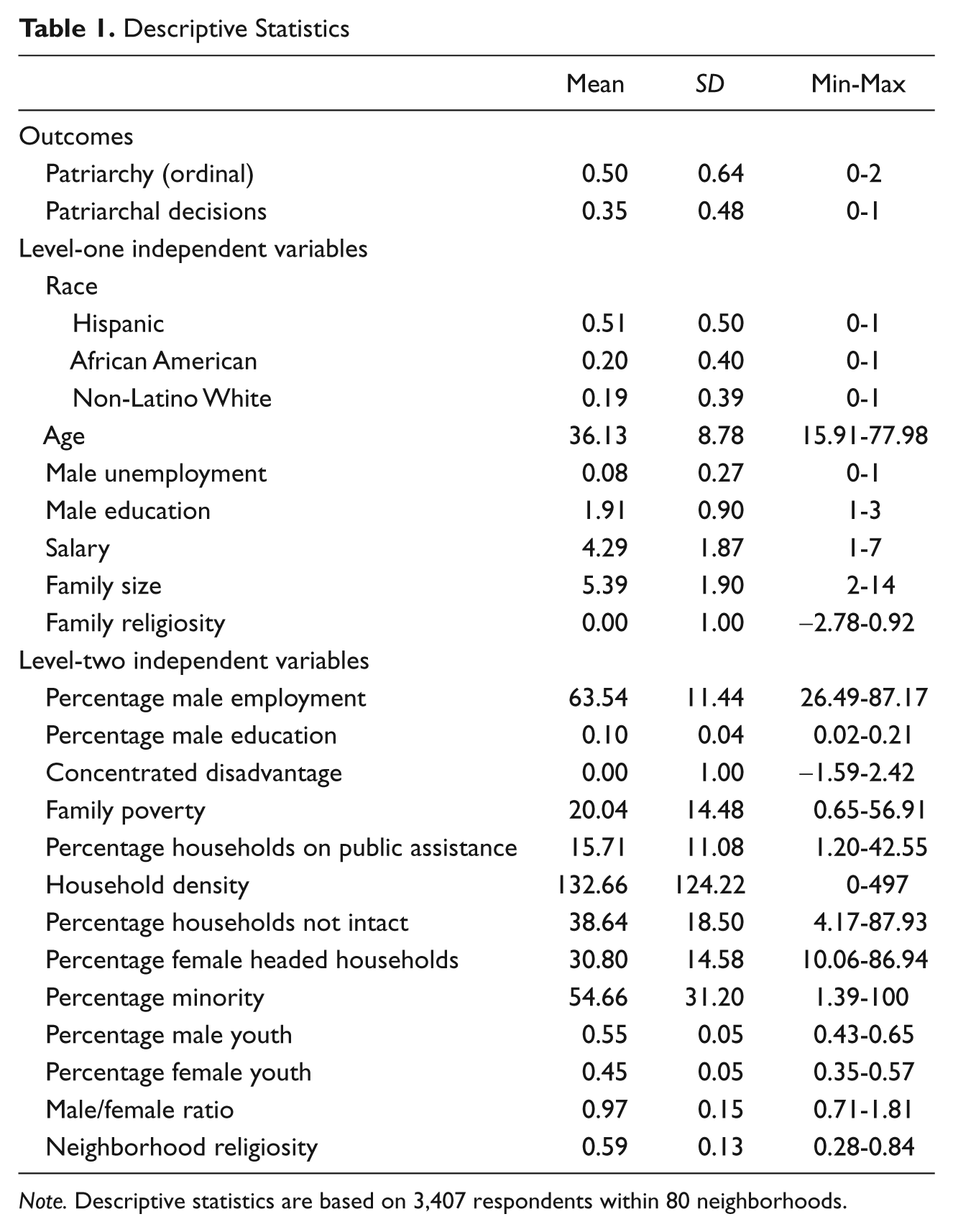
Note. Descriptive statistics are based on 3,407 respondents within 80 neighborhoods.
Patriarchy was an ordinal variable indicating the level of patriarchal endorsement by the male in the relationship (0 = no endorsement; 1 = some endorsement; 2 = high endorsement). Respondents were asked whether the male made most of the household decisions and whether partners had equal say in decisions made within the household. Respondents reporting that the male did not make most of the decisions and that both partners had equal say in decisions, received a value of 0 on the patriarchy scale (56.8%) whereas a value of 1 indicated that either the male made most of the decisions or partners did not have equal say in decisions within the relationship (33.1%), and a value of 2 reflected that the male made most of the decisions and partners did not have an equal say in decision-making within the household (8.3%).
Individual-level predictors of patriarchy
The individual-level, or level-one, independent variables were selected based on the predictors of patriarchal views discussed above. Many of the individual-level variables also parallel the neighborhood-level measures in the analyses.
Male’s race was denoted by two dichotomous variables, Hispanic and African American, with non-Latino White serving as the reference category. Age was the male’s age in years. Male unemployment was a dichotomous variable indicating whether the male was unemployed at the time of the PHDCN study or had been unemployed within the past year. Male education was an ordinal scale indicating the highest level of education reached by the male (1 = less than high school . . ., 3 = more than high school). Household salary was an ordinal variable (1 = <US$5,000; 2 = US$5,000-US$9,999; 3 = US$10,000-US$19,999 . . . , 7 = >US$50,000) denoting the total maximum personal or household income earned in the past year. Family size reflects the number of biological and nonbiological members of the family living in the household. Family religiosity was a scale created through principle components analysis of four items (α = 0.47). 4 Respondents were asked whether each of the following statements was true or false: family members attend church/synagogue often; family members often talk about the religious meaning of holidays; family members believe sin will be punished; and the Bible is very important. Higher numbers on this scale reflect higher levels of religiosity within the family.
Neighborhood-level predictors of patriarchy
Measures pertaining to neighborhood level (level-two) SES, demographic information, and family-related indictors were derived from the 1990 U.S. Census, and religiosity was created from data from the Community Survey. Percentage male education reflected the percentage of males in an NC with less than a 12th grade education. Percentage male employment was the percentage of males in an NC that were employed at the time of the census. The concentrated disadvantage scale included the percentage of residents in an NC who were below the poverty line, receiving public assistance, African American, unemployed, younger than 18 years old, and living under female headed households (α = 0.70). Family poverty reflected the percentage of families living below the poverty line within a neighborhood. Percentage households on public assistance indicated the percentage of households within an NC that received public assistance at the time of the census.
Household density indicated the total number of households within neighborhoods with 1.51 or more occupants per room; higher numbers indicate more dense households. Percentage households not intact reflected the percentage of households within a neighborhood that only have one parent living in the house. Percentage female-headed households was the percentage of households in an NC that were managed primarily by a female instead of a male caregiver. The percentage of the population in a neighborhood that was non-White was reflected by percentage minority. Gender indicators at the neighborhood level consisted of percentage male youth and percentage female youth in their respective NCs. The male/female ratio also provided the gender ratio of the total population (adults and youth) within each NC. Finally, neighborhood religiosity indicated the proportion of residents in an NC who belonged to a church or other religious organization.
Analysis
The current analysis utilized multilevel modeling techniques (Raudenbush & Bryk, 2002) using HLM 6.06 (Raudenbush, Bryk, & Congdon, 2004) software to estimate the separate and combined effects of individual-level predictors on patriarchy. The dichotomous variable, patriarchal decisions, was examined using a Bernoulli model, while patriarchy, the ordinal outcome measure, was analyzed through hierarchical ordinal regression in HLM (Raudenbush & Bryk, 2002). To adjust for concerns about the reliability of the level-one intercepts and random coefficients, the Empirical Bayes estimates of the level-one intercepts and slopes were modeled at level-two (Raudenbush & Bryk, 2002; Raudenbush, Bryk, Cheong, Congdon, & du Toit, 2004).
The analyses began by estimating unconditional models for patriarchy and patriarchal decisions to determine whether the endorsement of patriarchy (both outcomes) varied between neighborhoods and to examine the amount of patriarchal endorsement that occurs at both the individual (level-one) and neighborhood (level-two) levels. These analyses revealed that both measures of patriarchy significantly varied across neighborhoods.
Level-one models predicting patriarchal decisions and patriarchy were then estimated, separately, to determine the individual and family level predictors’ effect on patriarchy. These variables were grand-mean centered. In addition, random coefficients were examined to determine if level-one variables’ effects on each outcome varied significantly across the aggregates. Those individual-level relationships that did not vary significantly across neighborhoods were “fixed.” All other variables were treated as random effects.
The next step of analysis was the estimation of level-two main effects on patriarchy to see if patriarchy varied across neighborhoods. Due to collinearity between the predictors, 10 separate models were estimated to examine these effects. The first four models examined the effect of socioeconomic indicators on patriarchal endorsement (separate models for male education and male unemployment, concentrated disadvantage, neighborhood poverty, and households receiving public assistance). The fifth model examined familial characteristics related to density, family structure, and female-headed households. The next set of models examined separate models for neighborhood demographic characteristics: (a) percentage minority, (b) percentage male youth, (c) percentage female youth, and (d) neighborhood gender ratio. Finally, the last examined the effect of neighborhood religiosity patriarchal endorsement.
Results
Individual and Family Effects on Patriarchal Endorsement
Table 2 displays the final level-one random effects models for both outcome measures. As shown, only one individual-level predictor was significantly related to the ordinal measure of patriarchy: age. Age 5 was positively related to patriarchy, indicating that older individuals endorse more patriarchal views. However, no other level-one variable was significantly related to patriarchy in this model. Finally, the effects of male age, unemployment, and family size varied randomly across neighborhoods, meaning that these variables have stronger relationships with patriarchy in some neighborhoods versus others.
Random Coefficients Model Predicting Patriarchy
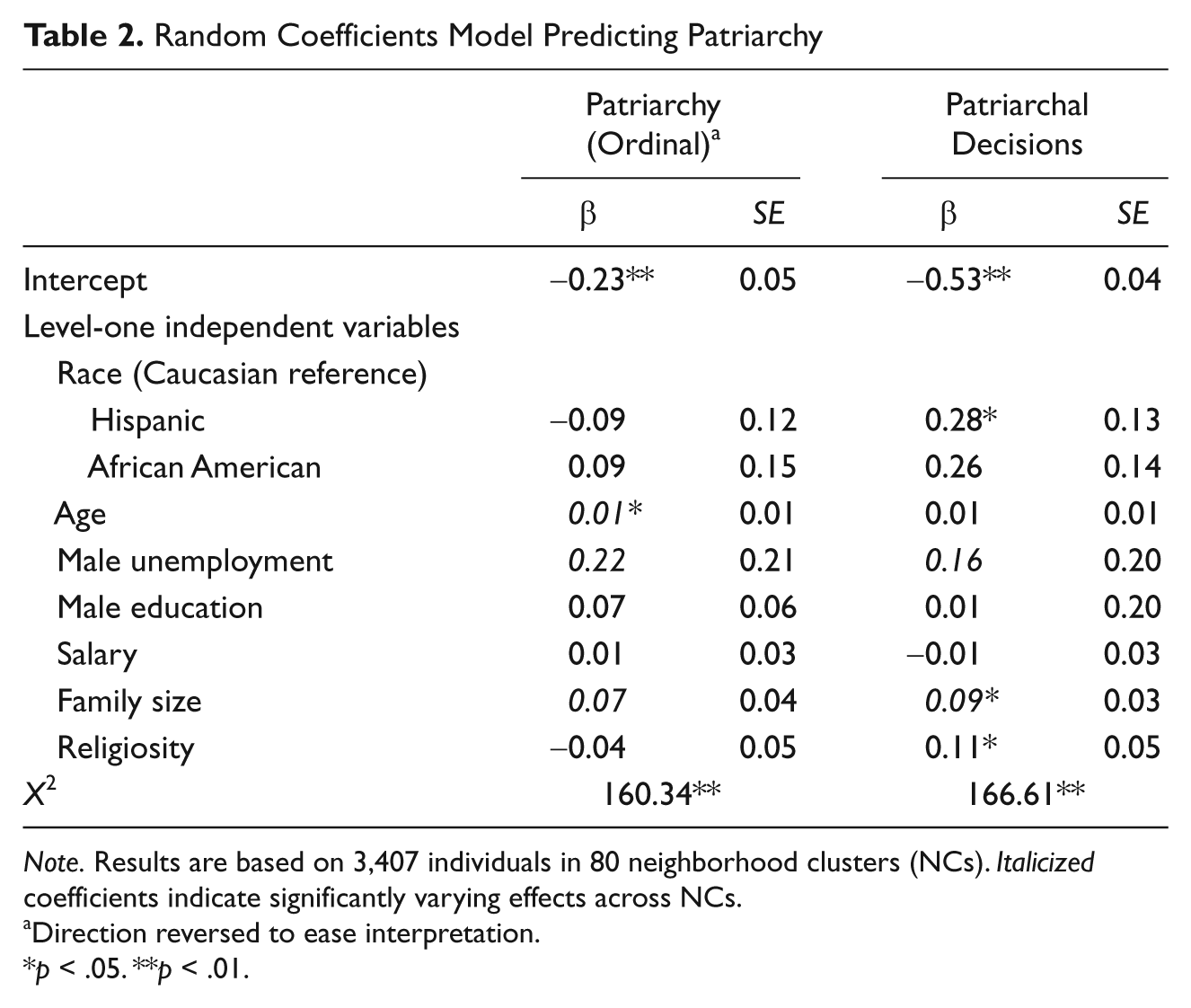
Note. Results are based on 3,407 individuals in 80 neighborhood clusters (NCs). Italicized coefficients indicate significantly varying effects across NCs.
Direction reversed to ease interpretation.
p < .05. **p < .01.
Table 2 also displays the final level-one random effects model on patriarchal decisions. As shown, only three individual-level predictors were significantly related to patriarchal decisions: family size, religiosity, and the male’s race (Hispanic). Family size was positively related to patriarchal endorsement, meaning that the odds that the household supported patriarchal decision-making increased as the family size increased. Religiosity was also positively related to patriarchal decision-making, as was the partner’s race/ethnicity, with Hispanic partners more likely to endorse patriarchal decisions when compared to non-Latino White partners. However, African American partners as compared to White partners, partner unemployment, education, age, and household salary did not significantly affect patriarchal endorsements in households.
In addition, two factors varied randomly across neighborhoods: male’s unemployment and family size. Therefore, unemployment and family size may have a stronger impact on patriarchal decisions in some neighborhoods versus others. None of the other individual-level effects varied across the 80 neighborhoods.
Neighborhood Effects on Patriarchal Endorsement
As shown in Tables 3 to 6, there were several neighborhood factors that significantly impacted patriarchal endorsement at the neighborhood level. Measures tapping into neighborhood SES, such as concentrated disadvantage, neighborhood poverty, and the percentage of households on public assistance, were negatively related to patriarchy. This indicates that as neighborhood disadvantage or poverty increased, the patriarchal views endorsed within those neighborhoods decreased. These relationships were only significant for the ordinal measure of patriarchy, however; none of the SES-related variables were significantly related to the dichotomous measure of patriarchy.
Neighborhood Socioeconomic Status (Empirical Bayes Intercepts as Outcomes)

Direction reversed to ease interpretation.
p < .10. **p < .05. ***p < .01.
Neighborhood Family Characteristics (Empirical Bayes Intercepts as Outcomes)

Direction reversed to ease interpretation.
p < .10. **p < .05. ***p < .01.
Neighborhood Demographics (Empirical Bayes Intercepts as Outcomes)

Direction reversed to ease interpretation.
p < .10. **p < .05. ***p < .01.
Neighborhood Religiosity (Empirical Bayes Intercepts as Outcomes)

Direction reversed to ease interpretation.
p < .10. **p < .05. ***p < .01.
Turning to the family characteristics within neighborhoods in Table 4, the results indicate that the percentage of families that were not intact was significantly and negatively related to both measures of patriarchy. This finding could reflect the notion that more traditional families (intact ones) in a neighborhood may perpetuate traditional ideologies, like patriarchy. The percentage of female-headed households in a neighborhood was also significantly, but positively, related to the ordinal measure of patriarchy, but not the dichotomous measure. These results suggest that neighborhoods where more mothers, grandmothers, sisters, aunts, and so forth, are the head of the household, patriarchal views are held in higher regard. Household density was not related to patriarchy or patriarchal decisions.
Table 5 demonstrates that almost all of the neighborhood demographic factors were significantly related to both measures of patriarchy. The percentage of minorities in a neighborhood was negatively related to patriarchy (ordinal measure), as was the percentage of female youth (ordinal and dichotomous measures), indicating that higher concentrations of minorities and young females do not endorse patriarchal ideals. However, neighborhoods with higher proportions of young males were more likely to accept or endorse patriarchal views. The male-to-female ratio in a neighborhood was unrelated to either measure of patriarchy.
Finally, Table 6 provides the results of neighborhood religiosity and patriarchy. Consistent with expectations, neighborhoods in which families reported higher levels of religious beliefs and behaviors endorsed higher levels of patriarchal views. This effect was not, however, significant when examining the dichotomous measure of patriarchy.
Discussion
Although most research has used patriarchy as an individual-level phenomenon that predicts attitudes toward women and/or violence against women, patriarchal ideals should receive more attention in and of themselves because research is severely lacking in this regard (Hunnicutt, 2009; Ogle & Batton, 2009). All too often researchers do not attempt to measure or even conceptualize patriarchy (Ogle & Batton, 2009) but rather take it for granted that patriarchy exists. We attempted to address this concern in the current article. Our results point to three main findings worth consideration.
First, patriarchy can and should be measured. Even though our outcome measures of patriarchy are somewhat limited, they do seem to be capturing the phenomenon. Past literature has described a patriarchal society as one where male heads of households hold the power (Ogle & Batton, 2009) and a similar measure has been used previously to examine patriarchal endorsement (Morash et al., 2007). Therefore, our attempt to operationalize patriarchy has indeed shown that it can be measured. Future research should continue the attempt to fully conceptualize and operationalize patriarchy rather than to take its existence for granted.
Second, patriarchy is not simply an individual- or societal-level phenomenon, although research often tries to fit it into one box or another. While many of our individual-level predictors explained patriarchal endorsement, neighborhood factors were significant as well, and were somewhat more significant than the individual-level predictors. Still, it is important to note that not all of the stipulated factors at the individual level impacted patriarchy. Age, family size, religiosity, and the male partner being Hispanic were significant predictors of patriarchy at the individual level, while none of the SES variables at the individual level was significant. Socioeconomic factors are often included in research examining violence against women and negative attitudes toward women, but there are many mixed findings regarding how these factors affect such outcomes (Ahmad et al., 2004; Flood & Pease, 2009; Hunnicutt, 2009; Vieraitis et al, 2007). Similarly, Vieraitis et al. (2007) note that there is no consensus in the literature on how SES should affect patriarchy. Our findings support this stipulation, in that we found no relationship between individual-level SES indicators and patriarchal endorsement. However, we did find significant neighborhood effects relating to neighborhood-level SES and patriarchy. Clearly, additional research on this topic is needed in order to uncover more consistent results. Additional research is also need to further investigate how and why family characteristics influence patriarchal endorsement, as our results indicate that both family size and religiosity within the family significantly increased patriarchal endorsement.
Third, neighborhood-level measures can be used to predict neighborhood-level variation in patriarchal endorsement. Many of the factors theorized to potentially reflect patriarchy are in fact, predictive of patriarchy. 6 Importantly, SES-related variables indicated that lower SES areas endorse less patriarchal views. It might be that in areas with lower SES, there is more of a need for both partners in the relationship to be equal, have an equal say in decisions, and play an equal part in supporting the family. Again, there is no consensus regarding how SES should affect patriarchy (Vieraitis et al., 2007)—our findings failed to provide clarification on this issue because we found no definitive results on the relationships between patriarchy and neighborhood SES indicators, and our results were at times at odds with what was expected (i.e., female-headed households increased patriarchy). Future research should examine macro-level SES indicators and patriarchy to clarify these relationships.
Some neighborhood family characteristics were also related to patriarchy—nonintact households reduced patriarchal endorsement within neighborhoods, but the percentage of households headed by females (which is sometimes used as an indicator of nonintact homes) increased patriarchy within neighborhoods. Again, this indicates that what is going on in the family is important, but suggests that the specific dynamics are not yet well understood. For instance, our speculation was that female-headed households would reduce patriarchy in neighborhoods, but we found this not to be the case. It might be that in the neighborhoods where there are more female-headed households, there is more competition to find and keep a male partner—again, note that all respondents in our study were cohabitating with a male partner. Hence, when there is a limited supply of eligible partners, women may put more weight on having a male in the household and may be more likely to accept patriarchal beliefs to maintain their relationship with their partner. In addition, higher levels of religious values in a neighborhood were related to higher endorsement of patriarchy, perhaps because religions promote traditional belief systems whereby the male in the household is considered the head of the house, and is thus more dominant over the female. This seems to be a promising area of future research, since religiosity has been stipulated as a predictor of patriarchy, but the reasoning for such a relationship is not well understood at either micro- or macro levels of analysis.
Finally, we found that neighborhood demographic compositions were also related to patriarchal endorsement, and our results reflect the notion that, at the aggregate level, males endorse patriarchy while females do not, perhaps because patriarchal views can help ensure male dominance in a society. In addition, our results revealed that neighborhoods composed of higher densities of minorities were also less likely to endorse patriarchy. This result is somewhat surprising considering that other literature has speculated that members of minorities may be more likely to have negative opinions of women (Cowan, 2000) and would therefore be more likely to have higher patriarchal endorsement. Future research should investigate why this might be the case.
Conclusion
Our study is unique in that we attempted to measure patriarchy and explore the factors that might influence patriarchal endorsement, and we found support for factors often speculated upon in the literature but rarely empirically examined. However, it is important to note our study’s limitations. First and foremost, our measures of patriarchy are quite limited even though we constructed two separate measures. Given the complexities of patriarchy, a scale or index of measures would be preferable over the ordinal and dichotomous measures used here, and future research should continue to construct more extensive and comprehensive measures of this phenomenon. In addition, the PHDCN was never intended to measure patriarchy and future research aiming specifically at patriarchy and patriarchal beliefs is sorely needed.
Nevertheless, our study did reveal many relationships between demographic and familial characteristics and patriarchy. We found that families play important roles in patriarchal endorsement both at the individual- and the neighborhood levels. Future research should continue to explore this relationship. Also, religion at the neighborhood level was a significant predictor of patriarchy. Given that the United States is considered to be a fairly religious country, future research may explore patriarchal beliefs in societies where religion plays less of a role in society. Future research may also examine whether specific religions have more influence on patriarchal endorsement.
Patriarchy can and should be measured. The current study shows that individual- and neighborhood-level factors do influence patriarchy. We cannot continue to simply take patriarchy’s existence for granted in our society, rather we need to measure it and empirically support its existence. The current study took a step in conceptualizing and operationalizing patriarchy, but there is still work to be done. Future research should continue in this line of investigation.
Footnotes
Author’s Note
The data used in this study were made available by the Interuniversity Consortium for Political and Social Research. Neither the collectors of the original data nor the Consortium bear any responsibility for the analyses or conclusions presented here.
Declaration of Conflicting Interests
The authors declared no potential conflicts of interest with respect to the research, authorship, and/or publication of this article.
Funding
The authors received no financial support for the research, authorship, and/or publication of this article.