



Abstract
The correlation between victimization and offending (i.e., the victim–offender overlap) is one of the most documented empirical findings in delinquency research, leading researchers to investigate potential contingencies in this relationship. A small number of studies have found evidence of contextual variation in the victim–offender overlap, but these studies have produced conflicting results as to whether urban context amplifies or attenuates this relationship. To add clarity to this body of literature, the present study uses a nationally representative sample of adolescents from the National Longitudinal Study of Adolescent Health (Add Health) to investigate potential variation in the victim–offender overlap across school context. Results indicate that victimization is positively and significantly related to offending in all school contexts but that the relationship between victimization and offending is stronger in non-urban schools than in urban schools. Results also indicate that negative emotionality may play a key role in unpacking the mechanisms through which context moderates the victim–offender overlap.
The correlation between victimization and offending is one of the most documented empirical findings in delinquency research (see Jennings, Piquero, & Reingle, 2012; Lauritsen & Laub, 2007). Studies in this line of inquiry have demonstrated that offending predicts subsequent victimization and that victims often become offenders at a later time point (e.g., Lauritsen, Sampson, & Laub, 1991; Reingle, Jennings, Maldonado-Molina, Piquero, & Canino, 2011). This “victim-offender overlap” has been observed for both violent and non-violent offenses and across a variety of data sources (see Berg & Loeber, 2011; Posick, 2013). Several potential mechanisms underlying the victim–offender overlap have been elaborated, including retaliation and negative emotionality (e.g., Agnew, 2002; Berg, Stewart, Schreck, & Simons, 2012; Stewart, Schreck, & Simons, 2006; Swinford, DeMaris, Cernkovich, & Giordano, 2000). Regardless of the processes that perpetuate the victim–offender overlap, research has detailed the devastating individual, community, and societal costs of violence (see Welsh et al., 2008), which are elevated when individuals are dually affected by both victimization and offending. Understanding the etiology of the victim–offender overlap is critical for public health and safety, in particular because it may not be possible to fully understand victimization and offending apart from one another (Lauritsen et al., 1991).
Prior research has focused primarily on individual-level explanations of the victim–offender overlap, potentially oversimplifying the way in which the relationship between victimization and offending is depicted. For example, the victim–offender overlap may be context-dependent, conditional upon characteristics of the schools and communities in which individuals are embedded. Recent research has explored the role that neighborhood context plays in conditioning the victim–offender overlap. The small number of studies on this topic, however, has produced conflicting results. Studies by Berg and colleagues (Berg & Loeber, 2011; Berg et al., 2012) and Schuck and Widom (2005) suggest that the victim–offender overlap is pronounced in more disadvantaged neighborhoods, while at least one study (Wright & Fagan, 2013) indicates that the relationship between victimization and offending is attenuated in more disadvantaged communities (see also Zhang, Welte, & Wieczorek, 2001).
Our research contributes to the literature by investigating the victim–offender overlap across school context. To date, research has yet to examine variation in the relationship between victimization and offending across schools, a context in which the typical adolescent spends most waking hours during the school year (see Steinberg, 2000) and learns normative attitudes and behaviors through peer and teacher interactions (see Harris, Duncan, & Boisjoly, 2002). The school context is thus another proximal and relevant environ for investigating contextual variation in the victim–offender overlap. Using data from the National Longitudinal Study of Adolescent Health (Add Health), a nationally representative sample of school-aged youth in the United States, we examine whether the urban context of the school setting moderates the relationship between victimization and subsequent offending. Furthermore, we attempt to unpack the mechanisms responsible for the observed moderating effects. We begin with a brief discussion of the history of the victim–offender overlap.
Conceptual Background
The Relationship Between Victimization and Offending
Foundational research on the relationship between victimization and offending observed that victims and offenders share a common set of demographic characteristics (Mendelsohn, 1956; Von Hentig, 1940, 1948). This observation was validated in the latter part of the 20th century, when empirical research demonstrated that victims and offenders share the same set of demographic characteristics (e.g., age, sex, race) and risk/protective factors (e.g., lack of self-control, low levels of family bonding, associations with delinquent peers, strain) (for an overview, see Lauritsen et al., 1991). These findings led to the belief that offenders and victims represent the same persons. That is, not only do offenders and victims share similar personal characteristics, but they may also experience similar violent situations. In fact, the overlap of arrests between homicide offenders and victims is what led Wolfgang (1957) to aptly name the phenomenon the “victim-offender relationship.” Today, the term victim–offender overlap is commonly used, and we will use it throughout this article to refer to the relationship between victimization and offending.
The victim–offender overlap is one of the most documented empirical findings in delinquency research, but the etiology of the overlap is not well understood. Below, we discuss two lines of research that have attempted to unpack the mechanisms underlying the victim–offender overlap by highlighting retaliatory violence and emotionality as intervening pathways.
Unpacking Mechanisms: Retaliatory Violence and Emotionality
Retaliatory violence is a key tenet of subcultural theories of crime, which argue that a violent affront is a sign (perhaps the most potent sign) of disrespect (Anderson, 1999; Sampson & Wilson, 1990). To save face, and perhaps to circumvent future harm, victims must respond to victimization with violent retaliation. Anderson (1999) described this phenomenon with reference to adolescents’ adherence to a “street code” (p. 76) in disadvantaged neighborhoods. In Anderson’s (1999) view, responding to victimization with violence is not only expected but inextricably tied to an individual’s identity, self-respect, and honor.
Research since Anderson’s (1999) thesis has indicated that victimization is indeed a risk factor for offending, as Anderson argues, but also that subsequent victimization accompanies retaliatory offending in a cycle of violence. For example, Stewart et al. (2006) demonstrated that African American adolescents adopting the street code were at elevated risk for victimization. Similarly, research has found that gang involvement, which is a common form of self-help following victimization (Apel & Burrow, 2011), increases rather than discourages subsequent victimization (see Katz, Webb, Fox, & Shaffer, 2011; Melde, Taylor, & Esbensen, 2009). In short, subcultural theories of crime suggest that retaliatory violence, perhaps as a manifestation of strengthened antisocial values, is a mediating mechanism through which victimization leads to both offending and subsequent victimization (Brezina, Agnew, Cullen, & Wright, 2004).
An alternative perspective suggests that negative emotionality mediates the relationship between victimization and offending. That is, victimization foments emotions (e.g., anger, frustration, fear, depression) that are related, sometimes in complex ways, to offending. Anger is perhaps the most established empirical mediator of the victim–offender overlap (see Hay & Evans, 2006; Maschi, Bradley, & Morgen, 2008), while the roles of frustration, fear, and depression are less clear. Some studies have found that these emotions suppress the relationship between victimization and offending (e.g., Ganem, 2010; Moon, Morash, McCluskey, & Hwang, 2009), whereas other studies have found that they amplify the effect of victimization on subsequent offending (see Agnew, 2002; Manasse & Ganem, 2009; Watts & McNulty, 2013). To complicate matters further, it appears that the mediating role of emotions in the victim–offender overlap may vary across demographic characteristics such as sex (see Posick, Farrell, & Swatt, 2013).
Despite variation in the exact mechanisms through which retaliatory violence and emotionality mediate the victim–offender overlap, it is clear from prior research that these processes provide insight into the ways in which victimization and offending are related. However, a full understanding of the etiology of the victim–offender overlap calls not only for an examination of mediating effects but also for an explicit focus on how contextual mechanisms may condition the overlap.
The Victim–Offender Overlap in Context
Along with efforts to isolate the mediating mechanisms responsible for the victim–offender overlap, researchers have begun to consider the victim–offender overlap in context. This line of inquiry takes as a point of departure that the victimization/offending relationship is contingent upon social context. In other words, the nature and extent of the victim–offender overlap is not dependent solely on individual characteristics but rather on how different types of persons react to stimuli in different types of settings (see Wikström, 2004). As a result, some of the catalysts that lead to offending in one context may not do so in another. The small number of studies in this rather nascent vein of research has focused specifically on variation in the victim–offender overlap across neighborhood context, and, as will be discussed below, two competing hypotheses arise from the conflicting findings of these studies.
Three recent studies suggest that the victim–offender overlap is pronounced in higher risk neighborhoods (Berg & Loeber, 2011; Berg et al., 2012; Schuck & Widom, 2005). In one of these studies, Schuck and Widom (2005) used official data from a sample of maltreated children and matched controls to examine the moderating effects of census-defined neighborhood disadvantage and stability on the relationship between early child maltreatment and offending. Their results indicated that the effect of early child maltreatment on subsequent criminal behavior during adolescence and adulthood was amplified for individuals residing in the most disadvantaged neighborhoods.
Similarly, using prospective data from the Pittsburgh Youth Study (PYS), Berg and Loeber (2011) found evidence that the relationship between offending and victimization was pronounced in more disadvantaged neighborhoods but not significant in less disadvantaged communities. Relying on disadvantage as a proxy for oppositional neighborhood culture, Berg and Loeber (2011) argued, “To the extent that a retaliatory code is embedded in disadvantaged neighborhoods, violent offenders within these settings . . . have a pronounced likelihood of being victimized” (p. 431). But the authors noted that their study had limited generalizability, given that their sample consisted only of males in a single city. The authors also acknowledged that an indicator of subcultural community processes beyond concentrated disadvantage was necessary to more rigorously examine hypotheses about neighborhood variability in the victim–offender overlap.
Responding to calls for a more direct measure of neighborhood street culture, Berg et al. (2012) measured “the extent to which street code values that support the use of violence operated” (p. 371) in respondents’ neighborhoods. Using data from the Family and Community Health Study (FACHS), a multisite study (Georgia and Iowa) of extremely poor to middle-class African American youth, the authors found direct evidence that the effect of victimization on offending was particularly strong in neighborhoods where the street culture was prominent but weaker in neighborhoods where the street culture was less prevalent. Their results, consistent with those found by Berg and Loeber (2011), indicated that retaliatory violence amplified the effect of victimization on subsequent offending. Collectively, the work by Berg and colleagues (Berg & Loeber, 2011; Berg et al., 2012) suggests that the acceptance of retaliation as a means to address grievances and disrespect perpetuates a cycle of offending and victimization. This follows research indicating that street codes are related to both offending (Brezina et al., 2004) and victimization (Stewart et al., 2006).
The three aforementioned studies found that the relationship between victimization and subsequent offending was amplified in higher risk neighborhoods. These findings are consistent with the hypothesis that urban contexts promote offending behavior as a response to victimization by providing retaliatory street codes as coping and protective mechanisms (see Anderson, 1999; Wilson, 1996). If, as Kubrin and Weitzer (2003) suggest, that urban cultural systems tolerate, or even endorse retaliatory violence as an appropriate response to victimization, then we would expect to observe a stronger relationship between victimization and subsequent offending in urban contexts, including schools, than in non-urban contexts. Moreover, we would expect to observe this moderating effect because individuals in urban contexts are exposed to socialization processes that encourage retaliatory violence as a normative response to victimization.
However, at least one major study generated contradictory results. Using longitudinal data on adolescents and their neighborhoods from the Project on Human Development in Chicago Neighborhoods (PHDCN), Wright and Fagan (2013) found evidence that the relationship between child abuse and subsequent violence was attenuated (rather than strengthened) in more disadvantaged neighborhoods. The authors suggested that their results may be due to a saturation (see Zimmerman & Messner, 2011) effect. That is, the abundance of criminogenic risk factors in disadvantaged neighborhoods dilutes the effect of any single factor on crime (i.e., saturation; see Raine, 2002). Consistent with this argument, Zhang et al. (2001) hypothesized that the victim–offender overlap is attenuated in disadvantaged communities where the relationship between victimization and offending is confounded by common prior antecedent causes such as social disorder. Their results provided marginal support for this hypothesis, in that a deviant lifestyle led to victimization only in low-crime neighborhoods, although the delinquency/context interaction did not reach statistical significance (i.e., p > .05).
The results of these studies suggest that the relationship between victimization and offending may be attenuated in urban schools because of “crowding out” effects (see Zimmerman, 2010). That is, the relative effect of victimization on subsequent offending will be diminished in urban areas because the increased presence of criminogenic factors leaves less statistical variance to explain in the outcome. This hypothesis suggests that the criminal response to victimization should be weaker in urban areas where competing “social pushes” toward crime are maximized (Gibson, 2012; Raine, 2002). Under this argument, we would expect to observe a weaker relationship between victimization and subsequent offending in urban contexts, including schools, than in non-urban contexts. Moreover, we would expect to observe this moderating effect because individuals in urban contexts are more likely to experience multiple risk factors (e.g., negative emotionality) that crowd out the effect of victimization on crime.
Summary of Study Hypotheses
In short, the existing research suggests two competing hypotheses regarding the possible moderating effect of urban school context on the relationship between victimization and offending. The first hypothesis suggests that the victim–offender overlap will be amplified in urban schools where individuals are exposed to socialization processes that encourage retaliatory violence as a normative response to victimization. The second hypothesis suggests that the relationship between victimization and subsequent offending will be weaker in urban schools where individuals are more likely to experience multiple risk factors such as negative emotionality that crowd out the effect of victimization on crime. Of course, the null hypothesis is that the victim–offender overlap is a general phenomenon and will therefore be invariant to the school context. That is, victims should engage in consistently higher rates of offending than non-victims, regardless of the school context. The null hypothesis is consistent with research spanning more than 50 years that has confirmed the robust empirical relationship between victimization and offending across a variety of settings, samples, and measurement strategies (for a review of research, see Jennings et al., 2012). These competing hypotheses are examined using data on a nationally representative sample of adolescents from the Add Health.
Method
Participants
We assessed our hypotheses with data from the Add Health, a multiwave panel study of how individual, family, peer, and school factors contribute to youth development. The original study intended to examine how socioenvironmental and individual-behavioral factors during adolescence are associated with health and achievement outcomes among adolescents and young adults over time. The Add Health data consist of several components, including a school administrator questionnaire, an adolescent in-school interview, and an adolescent in-home interview. School administrators represent a sample of middle schools and high schools from the United States, selected to assure representativeness on size, school type, geographic region, urbanization, and racial composition (Harris et al., 2009). School administrators completed a self-report questionnaire covering issues related to school policies and procedures, and characteristics of teachers and students. Within the selected schools, a stratified sample of students enrolled in Grades 7 to 12 at the onset of the study were eligible to complete an in-school survey in 1994 (Time 1) and an in-home interview in 1995 (Time 2).
More than half of study subjects had missing data on at least one variable. Modest differences existed between subjects who dropped out of the study and those who remained in the study (missing persons had more risk factors and fewer protective factors), but a dummy variable for missing data was not significant in regression analyses. Therefore, we imputed missing data using chained equations to maintain statistical power and avoid potential estimate biases resulting from the list-wise deletion of cases (Acock, 2005; Schafer, 1997). Multiple imputation techniques in Stata 13 were used to produce parameter estimates and standard errors based on the combination of models from 12 imputed data sets. All independent and dependent variables, as well as auxiliary variables such as the Add Health survey design variables, were used for imputation (see Enders, 2010; Reiter, Raghunathan, & Kinney, 2006; von Hippel, 2007).
Our final sample size consisted of 14,393 respondents within 145 schools. All analyses corrected for the design of the Add Health survey data by using the primary sampling unit, stratum, and in-home grand sample weights (see Chantala & Tabor, 1999).
Measures
Violent offending
The dependent variable was constructed using two questions measuring violent delinquency during the 12 months prior to the Time 2 interview: (a) How often did you get into a serious physical fight? and (b) How often did you use or threaten to use a weapon 1 to get something from someone? Respondents’ responses to these questions were measured on a scale from 0 to 3 (0 = never; 1 = 1 or 2 times; 2 = 3 or 4 times; 3 = 5 or more times) and summed to create a scale ranging from 0 to 6. These two items were strongly correlated with one another (r = .35). This measure of violent delinquency coincides with those used in prior research with the Add Health data (see Kuhl, Warner, & Wilczak, 2012) and in prior research on contextual analysis of the victim–offender overlap (see Berg & Loeber, 2011).
Using the same items at Time 1, which were also highly correlated with one another (r = .36), we created a summative scale of lagged violent offending. This scale was grand mean centered. This allowed us to control for heterogeneity in the propensity toward violent offending preceding the measurement of the explanatory variables.
Violent victimization
Our focal independent variable was constructed using five questions measuring direct or indirect violent victimization during the 12 months prior to the Time 1 interview. On a scale ranging from 0 to 2 (0 = never; 1 = 1 time; 2 = 2 or more times), respondents were asked whether (a) someone pulled a knife or gun on them, (b) someone shot at them, (c) someone cut or stabbed them, (d) they got jumped, and (e) they saw someone shoot or stab another person. These items were first summed to create an index reflecting both the prevalence and frequency of violent victimization. To ensure that our results were not influenced by outliers, the resulting scale was then standardized and truncated at four standard deviations above the mean. 2 Fewer than 2% of cases exceeded this value. These items have shown adequate internal reliability and validity in prior research using the Add Health data (Schreck & Fisher, 2004). In our study, the Cronbach’s alpha of the items was .69.
Individual covariates
Our analysis controlled for a number of individual characteristics that research has identified as important covariates of both victimization and offending (see Schreck et al., 2004). Demographic variables measured at Time 1 include sex (1 = Male), race/ethnicity (White, Black, and Other), and age. We also included a squared term for age to account for possible non-linear age effects. The linear and quadratic age terms were grand mean centered.
Individual difference variables included negative emotionality, impulsivity/self-control, mortality salience, and peer delinquency. Negative emotionality, a key variable linking victimization to offending (Agnew, 2002), was measured using 19 items from the widely known and validated Center for Epidemiologic Studies Depression (CESD) scale (see Kuhl et al., 2012; Watts & McNulty, 2013). Specific items asked respondents about depressive symptoms in the year preceding the Time 1 interview (e.g., Did you feel depressed? Did you feel too tired to do things?). Item responses ranged from 0 (never or rarely) to 3 (most of the time or all of the time). The items were first summed, and the resulting scale was standardized and then truncated at four standard deviations above the mean to protect against model misspecification due to extreme outliers. The Cronbach’s alpha of the items was .86.
Impulsivity/self-control was constructed as the sum of four questions measuring cognitive decision-making, problem-solving, and outcome analysis skills. The items, ranging from 1 (strongly agree) to 5 (strongly disagree), were summed, and the resulting scale was standardized. Impulsivity/self-control is a known correlate of both victimization (Schreck, 1999) and offending (Pratt & Cullen, 2000), and this scale has been used and validated in a number of prior studies on violence using the Add Health data (e.g., P. Chen & Vazsonyi, 2013). The Cronbach’s alpha of the items in our study was .74.
Mortality salience, which has been linked to adverse outcomes and validated in prior research (see P. Chen & Vazsonyi, 2013; Harris et al., 2002), was measured using respondents’ responses to three questions at Time 1: (a) What are the chances you will live to age 35? (b) What are the chances you will be killed by age 21 (reverse-coded)? (c) What are the chances you will get HIV or AIDS (reverse-coded)? The items, ranging from 1 (no chance) to 5 (almost certain), were summed, and the resulting scale was standardized. The Cronbach’s alpha of the items was .58.
To construct a measure of peer delinquency, respondents reported whether each of their three closest friends smoked cigarettes daily, drank alcohol at least once per month, and used marijuana at least once per month in the year preceding the Time 1 interview. We added the nine binary variables and then standardized the resulting scale. This scale has been used in prior research (see Matjasko, Needham, Grunden, & Farb, 2010; Watts & McNulty, 2013) and had a Cronbach’s alpha of .58.
We also controlled for neighborhood bonding, based on the neighborhood effects literature (see Sampson, Raudenbush, & Earls, 1997; Simons, Gordon, Burt, Brody, & Cutrona, 2005), using five dichotomous items capturing respondents’ relationships with their neighbors (e.g., Do you know most of the people in your neighborhood? Have you recently spoken with your neighbors?). These items were summed, and the resulting scale was standardized. The items had a Cronbach’s alpha of .52.
Family covariates
Family-related variables measured at Time 1 include parents’ marital status (1 = Married), public assistance, and family bonding. The public assistance variable, representing the link between household socioeconomic status and deviance (Elliott, Huizinga, & Ageton, 1985), was a binary variable reflecting at least one form of household public assistance during the month preceding the Time 2 interview: social security or railroad retirement, supplemental security income (SSI), Aid to Families With Dependent Children (AFDC), food stamps, unemployment or worker’s compensation, or some form of housing subsidy. Family bonding captures parent–child connectedness and attachment and was measured as the standardized sum of four items (e.g., How close are you to your parents? How much do your parents care about you?). This scale has shown adequate reliability and validity in prior research (Schreck & Fisher, 2004). The Cronbach’s alpha of the items in our study was .73.
School covariates
School administrators were asked about several school structural and administrative characteristics. The key school-level variable included in our analyses is urbanity (1 = urban school; 0 = non-urban school). School-level control variables included school type (1 = public; 0 = private) and school support, variables that have been consistently linked to victimization and offending (see Stadler, Feifel, Rohrmann, Vermeiren, & Poustka, 2010). School support was measured as the count of 17 health-related services offered at school (e.g., treatment for injuries, mental health counseling). This count was subsequently standardized. The Cronbach’s alpha of the items was .77. See Table 1 for descriptive statistics of all study variables.
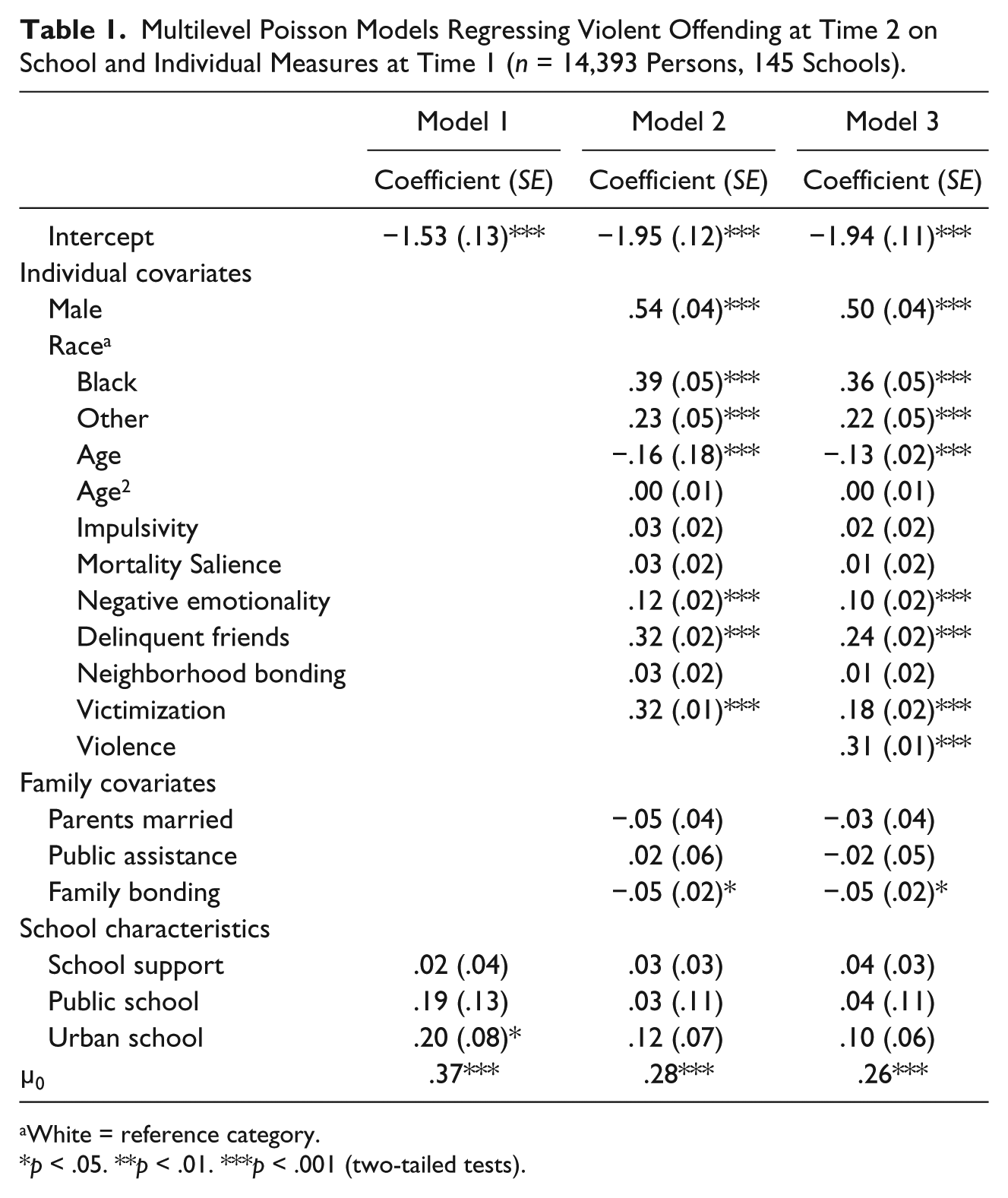
Multilevel Poisson Models Regressing Violent Offending at Time 2 on School and Individual Measures at Time 1 (n = 14,393 Persons, 145 Schools).
White = reference category.
p < .05. **p < .01. ***p < .001 (two-tailed tests).
Analysis
A two-level Poisson regression model (a hierarchical generalized linear model [HGLM]) was estimated to examine whether the relationship between victimization and offending varies as a function of school context (Raudenbush & Bryk, 2002). A Poisson model was appropriate because the outcome variable is a non-negative integer count with equal mean and variance. This approach allowed us to simultaneously examine individual- and school-level correlates of violent offending, to be confident in the slope estimates and standard errors when persons nested within schools share similar traits (i.e., are clustered), and to examine the victim–offender overlap across school context.
Our baseline model established the victim–offender overlap by replicating the association between victimization and offending, controlling for a host of theoretically relevant individual-, family-, and school-level covariates. We then investigated school-level variation in the relationship between victimization and offending using a random coefficients model, and we modeled the dependent variable as a function of a cross-level interaction between victimization and urban school context to examine the source of school-level variation in the victim–offender overlap. Finally, to explore one potential mechanism underlying the observed cross-level interaction effect, we examined (a) the relationship between school context and negative emotionality and (b) the moderating effect of negative emotionality on the victim–offender overlap.
All models were estimated using generalized estimating equations in Stata 13. To reduce multicollinearity and to make the intercept more interpretable, all individual- and school-level covariates were grand mean centered or standardized (Raudenbush & Bryk, 2002), as discussed above. We also note that none of the models were affected by multicollinearity based on the criteria of 3.0 for the variance inflation factor threshold and .40 for the tolerance threshold (Allison, 1999).
Results
Baseline Models
A two-level Poisson model (discussed above) without level-one or level-two covariates was first estimated to examine whether there was school-level variation in violent offending. The analysis indicated that adolescent violence varies significantly across schools (τ00 = .32, p < .001), lending credence to the multilevel modeling strategy. A series of multilevel models were then estimated to examine the association between Time 1 victimization and Time 2 offending, controlling for a host of theoretically relevant individual-, family-, and school-level covariates. The results are presented in Table 1. Model 1 in this table presents the school-level correlates of violent offending. The positive and significant coefficient for “urban school” (b = .20, p < .05) indicates that urban schools have higher levels of violent offending than non-urban schools.
Model 2 incorporates the demographic, individual difference, and family covariates. The positive and significant coefficient for victimization (b = .32, p < .001) establishes the victim–offender overlap and indicates that a one standard deviation increase in victimization is associated with a 38% [(e.32 − 1) × 100] increase in the rate of violent offending. The results also indicate that males are more likely than females to engage in violent offending (b = .54, p < .001), Black youth are more likely than White youth to engage in violence (b = .39, p < .001), and younger youth are more likely than older youth to offend (b = −.16, p < .001). In addition, associating with delinquent peers increases violent offending (b = .32, p < .001), stronger family bonds are protective against involvement in violence (b = −.05, p < .05), and negative emotionality increases violent offending (b = .12, p < .001). Note that controlling for these individual variables diminishes the effect of urban schools to non-significance (b = .12, p > .05).
To control for a relationship between victimization and offending preceding the measurement of the explanatory variables, we included a measure of lagged violence in Model 3. The inclusion of prior violence is critical, given that we did not explicitly model the potential reciprocal relationship between victimization and offending. As expected, lagged violence was one of the strongest predictors of Time 2 violence (b = .31, p < .001). Although the inclusion of prior violence resulted in attenuation of the coefficient estimates for the other covariates, victimization remained a significant predictor of Time 2 violent offending (b = .18, p < .001).
Does the Victim–Offender Overlap Vary by School Context?
To examine whether the relationship between victimization and offending varies as a function of school context, we allowed the coefficient for “victimization” to vary randomly across schools. The results indicated that there is significant variation in the slope of victimization across schools (µ victimization = .20, p < .001), a finding supported by the Akaike Information Criterion (AIC) model fit statistic.
To examine the source of the variability in victimization across schools, we modeled Time 2 violence as a function of a cross-level interaction between Time 1 victimization and urban school. Model 1 in Table 2 represents a random coefficients model that estimates the effect of urban school on the slope of victimization. The coefficient for the cross-level interaction between victimization and urban school is negative and significant (b = −.08, p < .05), indicating that the slope of victimization is reduced by more than 38% [−.08/.21 × 100%] in urban schools, as compared with non-urban schools.
Multilevel Poisson Models Regressing Violent Offending at Time 2 on School and Individual Measures and Interactions at Time 1 (n = 14,393 Persons, 145 Schools).

Note. The models control for all individual, family, and school covariates as in previous models. Although coefficients for the control variables are not presented, they are generally consistent with those from Model 3 in Table 1. AIC = Akaike Information Criterion.
p < .05. **p < .01. ***p < .001 (two-tailed tests).
Figure 1 presents a graphical representation of the relationship between violent victimization and offending in urban and non-urban schools. Even though victimization was positively and significantly associated with offending in both urban (b = .13, p < .001) and non-urban schools (b = .21, p < .001), the victim–offender overlap was attenuated, that is, the slope of the line is less steep, in urban schools.
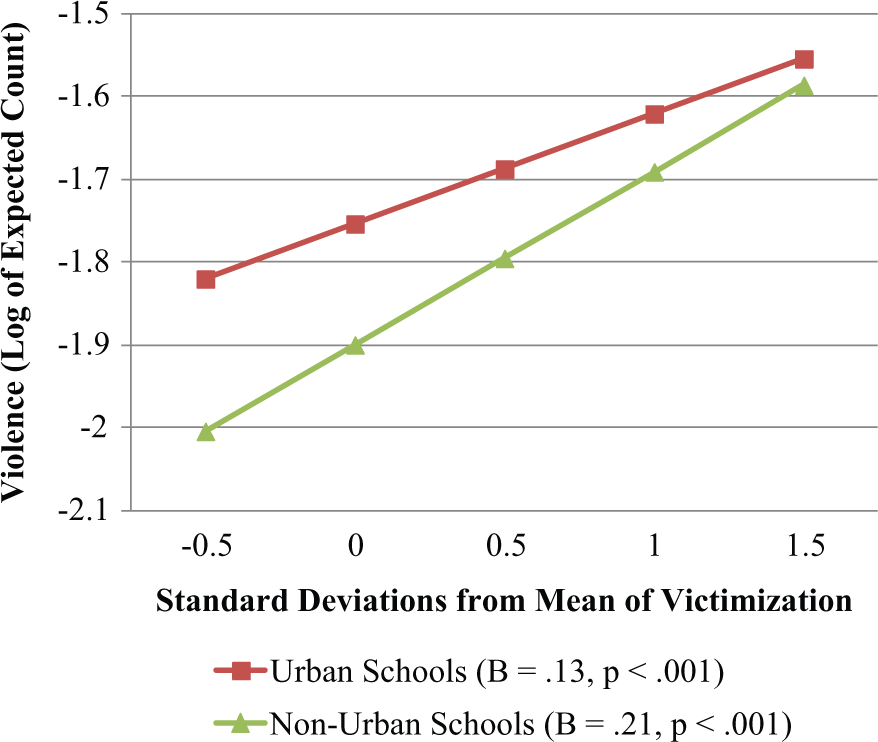
Violent offending versus violent victimization, by school environ.
Next, we explored one potential mechanism underlying the observed cross-level interaction effect by examining (a) the relationship between school context and negative emotionality and (b) the moderating effect of negative emotionality on the victim–offender overlap. We examined the relationship between school context and negative emotionality using a hierarchical linear model (HLM) regressing negative emotionality, which is normally distributed, on urban school. Contrary to expectations, the bivariate relationship between urban school and negative emotionality does not reach statistical significance. To examine the moderating effect of negative emotionality on the victim–offender overlap, we modeled the slope of victimization as a function of both urban schools and negative emotionality simultaneously in Model 2 of Table 2. Results indicated that negative emotionality tempers the effect of victimization on offending. Specifically, the coefficient for the cross-level interaction between victimization and negative emotionality was negative and significant (b = −.03, p < .001), indicating that a one standard deviation increase in negative emotionality reduced the slope of victimization by approximately 13% [−.03/.23 × 100%]. We confirmed this finding in Model 3, which models victimization solely as a function of the victimization/negative emotionality interaction. Overall, these results indicated that negative emotionality conditions the victim–offender overlap, as expected, but does not account for the attenuated effect of victimization on offending in urban schools.
We also note that Model 2, which models the slope of victimization as a function of both the urban school setting and negative emotionality, was the best-fit model according to deviance and AIC statistics. However, both the victimization/urban school and victimization/negative emotionality interactions were significant in this model. Moreover, the random coefficient for victimization was still significant in this model, indicating that we have not fully explained school-level variation in the victim–offender overlap.
Summary and Discussion
The goal of this study was to add clarity to the conflicting body of scholarship concerning the victim–offender overlap in context. We chose to examine contextual variation in the overlap across school context because the school setting plays an integral role in shaping adolescents’ exposure to, attitudes about, and involvement in violence.
Our results indicated that victimization was significantly associated with offending, net of an array of individual- and school-level covariates, establishing the victim–offender overlap. Moreover, this relationship was relevant in both urban and non-urban schools. But results from random coefficients models indicated that the relationship between victimization and offending was attenuated in urban schools, as compared with non-urban schools. This finding is congruent with previous research attributing a diminished relationship between victimization and offending in urban settings to saturation and desensitization effects (see Wright & Fagan, 2013). That is, in criminogenic settings, where several crime-inducing factors are prevalent, the effect of any single factor on crime may become diluted (i.e., a saturation effect). Saturation effects are commonly discussed in biological studies of crime, where individual risk factors are conceptualized as more potent correlates of crime in non-disadvantaged areas that do not have strong social pushes toward crime. Heightened levels of violence in criminogenic settings may desensitize students such that victimization fails to drive one toward retaliatory violence (i.e., a desensitization effect). This does not mean that street codes and violent attitudes are weaker in urban environments but rather that “adolescents become ‘tolerant’ of such risk factors and/or the messages they convey, and their behavior ceases to be influenced by these experiences” (Wright & Fagan, 2013, p. 240).
The results also indicated that high levels of negative emotionality (depressive symptoms) tempered the association between victimization and offending. This finding is consistent with research that has linked the victim–offender overlap to various indicators of negative emotionality (Agnew, 2002; Ganem, 2010; Hay & Evans, 2006; Manasse & Ganem, 2009; Maschi et al., 2008; Moon et al., 2009). We note, however, that the moderating effect of negative emotionality on the victim–offender overlap did not account for the attenuated effect of victimization on offending in urban schools. Thus, it is clear that negative emotionality plays a role in understanding the victim–offender overlap in context, but its role in unpacking the mechanisms through which context moderates the victim–offender overlap remains unclear.
We also note that we measured but one type of negative emotion: depressive symptoms. In the context of the victim–offender overlap, depressive symptoms may temper retaliation by weakening motivation and increasing self-blame rather than externalizing blame. They may also be related to “learned helplessness,” under which individuals avoid retaliation and help-seeking and instead opt to “take it.” Recent research on depressive symptoms and cognitions has also shown that they are important mediators when exploring the mechanisms at work in producing delinquent behavior (Allwood, Baetz, DeMarco, & Bell, 2012). As discussed above, negative emotionality in the form of anger, fear, and frustration, to name but a few, may also contribute to the understanding of the victim–offender overlap in context. We encourage future research on how different types of emotionality moderate the relationship between victimization and offending.
Our findings highlight key insights that have emerged from criminological inquiry. The results are consistent with a body of evidence that individual-level mechanisms responsible for crime are context-dependent. Indeed, there is growing awareness that a full understanding of crime necessitates a consideration of persons in context. Therefore, we do not view our results as necessarily contradictory to those found by Berg and colleagues (Berg & Loeber, 2011; Berg et al., 2012) but rather as complementary through an acknowledgment of context in the study of the victim–offender overlap. As a whole, recent scholarship on the victim–offender overlap contributes to the view that criminological phenomena vary across contexts and that more research is needed to disentangle the complex ways in which context contributes to the study of crime.
Practically, our results support targeted school crime prevention approaches. That is, while all instances of victimization should be taken seriously, victimization in non-urban schools warrants particular attention, where the relationship between victimization and offending may be amplified. Conversely, youth in urban schools confront a myriad of risk factors for violent offending, and focusing solely on coping with victimization may overlook other underlying factors that contribute to a cycle of violence. In such areas, broader forms of crime prevention may be warranted.
In addition, regardless of context, we found that victimization is a powerful predictor of subsequent offending. This suggests that programs and policies, particularly within the school, should focus on addressing the needs of those who experience victimization. Teaching victims how to effectively cope with feelings of anger, fear, or frustration is paramount. In turn, learning effective coping techniques can prevent retaliatory behavior and cycles of learned helplessness. Initiatives such as the Office of Juvenile Justice and Delinquency Prevention’s Safe Start program hold promise in this regard. A school-based program designed to address youth responses to both direct victimization and indirect exposure to violence, Safe Start aims to increase communication among communities, schools, and parents about youth’s experiences with violence and to promote positive coping experiences in the aftermath of victimization (Escudero, Garst, Langley, Nadeem, & Wong, 2010).
While these possibilities represent fruitful areas for research and policy, we note a few limitations associated with our analyses. First, our study focused on the school context, one of the most important contexts during adolescence. Broader contexts such as the peer network, the neighborhood, and the area of country influence development and socialization patterns and may contribute to the understanding of the victim–offender overlap. Second, while our nationally representative sample is certainly an advantage, it neglects youth who are incarcerated, homeless, or not in school (i.e., expelled or dropped out). Such populations may be particularly relevant for studying the victim–offender overlap warranting specific attention in future research. Third, our study focused on violent victimization and offending that did not consider intimate partner violence, sexual violence, or property offending. Furthermore, our offending and victimization measures themselves consisted of a limited number of items which do not distinguish between the initial aggressor and ultimate victim. We encourage future research to examine the victim–offender overlap in context with reference to alternative behaviors and additional measures for the constructs measured here. Finally, it should be noted that the data were collected approximately 20 years ago and over a fairly short period of time (i.e., 1 year). The school context has changed over this time period, most notably in response to the Gun-Free Schools Act of 1994. Care must therefore be taken in generalizing the study results to today’s school environ.
We conclude by highlighting the research implications of incorporating context into the study of the victim–offender overlap. Our study adds breadth to the recent work of Schuck and Widom (2005), Berg and Loeber (2011), Berg et al. (2012), and Wright and Fagan (2013), who all contextualized the victim–offender overlap. Such an approach expands the focus of attention beyond individual factors in the etiology of the victim–offender overlap to include broader contextual influences to which individuals are exposed. Ultimately, understanding the etiology of the victim–offender overlap and addressing the underlying factors that contribute to a cycle of violence necessitate an examination of persons in context.
Footnotes
Appendix
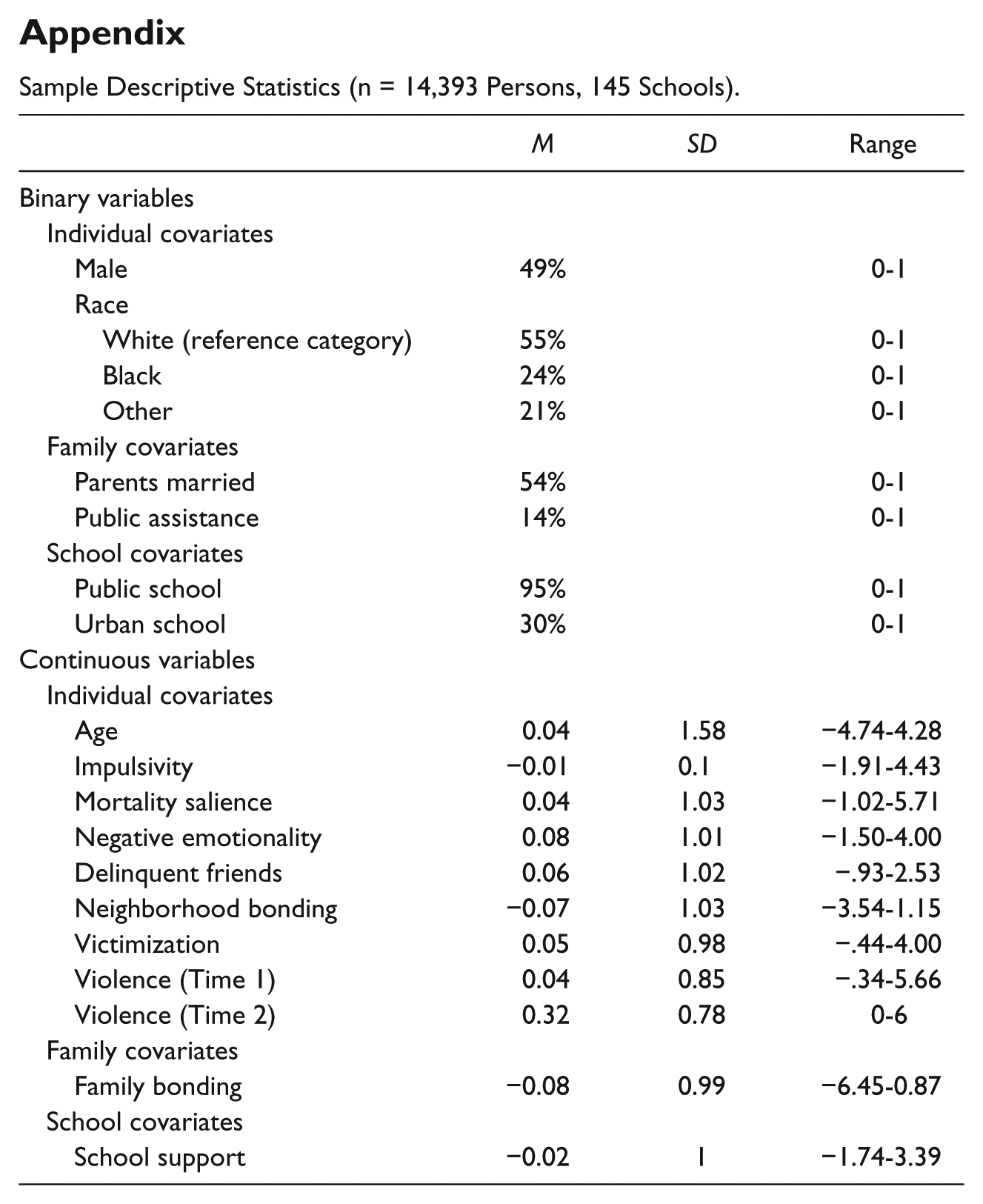
Sample Descriptive Statistics (n = 14,393 Persons, 145 Schools).
| M | SD | Range | |
|---|---|---|---|
| Binary variables | |||
| Individual covariates | |||
| Male | 49% | 0-1 | |
| Race | |||
| White (reference category) | 55% | 0-1 | |
| Black | 24% | 0-1 | |
| Other | 21% | 0-1 | |
| Family covariates | |||
| Parents married | 54% | 0-1 | |
| Public assistance | 14% | 0-1 | |
| School covariates | |||
| Public school | 95% | 0-1 | |
| Urban school | 30% | 0-1 | |
| Continuous variables | |||
| Individual covariates | |||
| Age | 0.04 | 1.58 | −4.74-4.28 |
| Impulsivity | −0.01 | 0.1 | −1.91-4.43 |
| Mortality salience | 0.04 | 1.03 | −1.02-5.71 |
| Negative emotionality | 0.08 | 1.01 | −1.50-4.00 |
| Delinquent friends | 0.06 | 1.02 | −.93-2.53 |
| Neighborhood bonding | −0.07 | 1.03 | −3.54-1.15 |
| Victimization | 0.05 | 0.98 | −.44-4.00 |
| Violence (Time 1) | 0.04 | 0.85 | −.34-5.66 |
| Violence (Time 2) | 0.32 | 0.78 | 0-6 |
| Family covariates | |||
| Family bonding | −0.08 | 0.99 | −6.45-0.87 |
| School covariates | |||
| School support | −0.02 | 1 | −1.74-3.39 |
Declaration of Conflicting Interests
The author(s) declared no potential conflicts of interest with respect to the research, authorship, and/or publication of this article.
Funding
The author(s) received no financial support for the research, authorship, and/or publication of this article.