




Abstract
African American adolescents are exposed to high rates of community violence, and recent evidence indicates that these youth may also be at high risk of polyvictimization. Guided by an ecological approach, this study explored individual, familial, and extra-familial correlates of single and multiple forms of violence exposures (i.e., witnessing verbal parental aggression, witnessing or being a victim of community violence exposures) among a sample of 563 urban African American adolescents. Findings indicated that boys reported higher levels of polyvictimization than girls. In addition, the correlates of violence exposures varied by typology and gender. These findings support the development and use of gender-oriented approaches for identifying youth at risk of various types of violence exposures.
Keywords
In the United States, adolescence is a developmental period marked by significant exposure to violence in the home and community. For instance, adolescents report high rates of witnessing interparental violence (IPV) and experiencing community violence both as witnesses and victims (Lambert, Nylund-Gibson, Copeland-Linder, & Ialongo, 2010; Romano, Bell, & Billette, 2011). Recent national surveys report that youth aged 15 to 18 years report an average of 2.7 victimizations in the past year (Finkelhor, Ormrod, & Turner, 2009). In addition, African American adolescents are at heightened risk of such exposures (Buka, Stichick, Birdthistle, & Earls, 2001), given that a disproportionate number of them reside in poorly resourced communities with high stressors (Osofsky, 1999).
Exposure to violence within the family and community domains are associated with a number of youth problem behaviors. For example, both community violence exposure and exposure to IPV have been connected to increased youth aggression (Bradshaw, Rodgers, Ghandour, & Garbarino, 2009; Voisin & Hong, 2012), lower academic performance (Huth-Bocks, Levendosky, & Semel, 2001; Mathews, Dempsey, & Overstreet, 2009), and post-traumatic stress disorder (McCart et al., 2007; Moretti, Obsuth, Odgers, & Reebye, 2006). In addition, an increasing number of cross-sectional and longitudinal studies have provided evidence that exposures to witnessing verbal parental aggression (VPA; Voisin, Hotton, & Schneider, 2014) and exposure to community violence are associated with increased sexual risk behaviors (Albus, Weist, & Perez-Smith, 2004; Brady, Tschann, Pasch, Flores, & Ozer, 2008; Voisin, 2003) and sexually transmitted infections (Brady et al., 2008).
Exposure to multiple forms of violence, known as polyvictimization, commonly occurs. Of youth exposed to one form of victimization in the last year, the majority are exposed to another type of victimization (Finkelhor, Ormrod, Turner, & Hamby, 2005). The effects of polyvictimization may be even more detrimental than exposure to single forms of violence. For instance, a recent study indicated that youth exposed to high levels of IPV, child abuse, and community violence were twice as likely to meet clinical criteria for depression, anxiety, and delinquency when compared with peers exposed to moderate levels of violence (Margolin, Vickerman, Oliver, & Gordis, 2010).
Although polyvictimization has severe negative sequelae, few studies have examined the correlates of polyvictimization. With one exception, Romano and colleagues (2011) documented in a cross-sectional study that parental rejection and lower friendship quality were associated with polyvictimization (i.e., verbal harassment, threat of and actual physical assault, school social exclusion, and discrimination). In addition, this study indicated that participation in out-of-school activity was a risk factor for polyvictimization. Taken together, these findings document that home and school factors are correlated with risk for polyvictimization. However, although Romano and colleagues drew on a nationally representative Canadian sample, the study included no data on the racial/ethnic characteristics of the sample. Understanding the correlates of polyvictimization among African American youth may be especially important. These youth are at higher risk of exposure to violence compared with their other ethnic counterparts (Buka et al., 2001). In addition, within cities, African American youth are twice as likely to witness violence as their Caucasian peers (Schwab-Stone et al., 1995), and many may live in ecological niches and household structures that may be potential correlates of such exposures. Consequently, additional research is warranted to understand the correlates of single and multiple forms of violence exposures among African American youth.
Factors Associated With Violence Exposures
The theoretical underpinning for this study is informed by Ecological Systems Theory (Bronfenbrenner, 1999), which suggests that individual, familial, and extra-familial domains may be related to various forms of violence exposures. Similar approaches have been applied to examining the correlates of youth problems such as sexual risk behaviors (Kotchick, Shaffer, Miller, & Forehand, 2001) and health promotion behaviors (Glass & McAtee, 2006; Hovell, Wahlgren, & Gehrman, 2009). In this framework, individual factors are considered personal dimensions that may contribute to violence exposures such as age, gender, internalizing, and externalizing behaviors. Typically, exposures to violence increase with age. For instance, studies have documented that some forms of violence exposures such as those occurring within the community increase as youth get older (Margolin & Gordis, 2000). Gender is also an important consideration, given that both exposures to and consequences of violence exposures often differ by gender (Evans, Davies, & DiLillo, 2008; Fowler, Tompsett, Braciszewski, Jacques-Tiura, & Baltes, 2009). For example, on average, girls compared with boys are exposed to lower rates of community violence both as witnesses and victims (Voisin, Neilands, & Hunnicutt, 2011). In addition, although findings have been mixed (Voisin & Neilands, 2010), some research suggests that coping responses to violence vary by gender; with more girls than boys coping with such exposures through withdrawal (Voisin, Bird, Hardestry, & Shiu, 2011).
Psychological symptoms such as internalizing and externalizing behaviors may also impact violence exposures (Mrug & Windle, 2009). While internalizing behaviors such as anxiety, depression, and withdrawal may be sequelae associated with violence exposures (Evans et al., 2008; Fowler et al., 2009), it may also be true that internalizing and externalizing behaviors contribute to the likelihood of youth violence exposures. For instance, evidence suggests that delinquent behavior and aggression put youth at subsequent risk of both witnessing IPV (O’Donnell et al., 2006) and community violence exposure (Farrell & Sullivan, 2004). Fewer studies have examined internalizing factors as risks for violence exposure, but some evidence indicates that these factors may also put youth at risk of exposure (Lambert, Ialongo, Boyd, & Cooley, 2005).
Family is a central influence on adolescent development (Bronfenbrenner, 1986), and there are a number of factors in the family that may influence the likelihood of victimization. Variables such as parenting structure (e.g., single- vs. two-parent households) and the number of children living in the household have been connected to violence exposures (Fantuzzo & Mohr, 1999; Romano et al., 2011). Family stress and violence may increase in households with a high number of members (Margolin & Gordis, 2000). In addition, in single-parent households, parents may have less time to monitor their youth, which may contribute to higher rates of exposures to violence outside the home (Voisin et al., 2008).
Domains beyond the family may also be implicated with violence exposures (Bronfenbrenner, 1999). During adolescence, the influence of peers is especially salient (Savin-Williams & Berndt, 1990). Although some evidence has been mixed (Lambert et al., 2010), youth associating with peers endorsing risky norms such as those in gangs may be at heightened risk of exposure to community violence (Lambert et al., 2005). In addition, schools are likely to influence the likelihood of violence exposures. Positive school engagement (e.g., high grade attainment, involvement in afterschool activities, and positive relationships with teachers) may prevent youth from frequenting dangerous situations where violence may occur (Voisin, Jenkins, & Takahashi, 2011). School engagement has been linked to lower levels of both victimization and witnessing community violence (Mrug & Windle, 2009).
While these studies suggest a number of correlates of violence exposure, most research examining correlates of violence have focused on single forms of exposures, preventing comparisons of correlates among IPV, community violence exposure, and polyvictimization. Building on studies examining correlates of singular forms of victimization, this study examined whether individual factors (i.e., age, gender anxiety, depression, and aggression), familial variables (i.e., household structure and number of household members), and extra-familial dynamics (i.e., afterschool participation, grade point average, student–teacher connectedness, gang membership, and risky peer norms) were related to single and multiple forms of violence exposure.
Contributions of the Present Study
This study extends the extant literature in several important ways. Little is known about the correlates of polyvictimization among African American youth, although preliminary evidence suggests that African American urban youth are at especially high risk of polyvictimization (Finkelhor, Ormrod, & Turner, 2007). This study examines three common types of violence exposures (i.e., witnessing VPA and community violence exposures both as witnesses and victims) in addition to polyvictimization, allowing for a direct comparison of correlates across victimization types. Furthermore, this study examines the role of gender with regard to the correlates of violence exposures. Few studies have explored these multiple forms of violence exposures and the role of gender across a single sample.
Method
Participants and Procedure
In 2006, prospective participants from a high school in a large Midwestern city were recruited by 20 trained master’s-level student research assistants. Participants were eligible for study enrollment if they self-identified as African American, were between the ages of 13 and 19 years, and were attending regular high-school classes (i.e., non-special-education classes). Research assistants first distributed parental consent forms to all students in their homeroom classes. Next, during a 2-week period, questionnaires were administered to all eligible students who brought in signed consent forms and self-identified as African American. Students who brought signed permission forms provided assent before taking the self-administered survey.
The questionnaire was developed for a fifth-grade (10 years old) or elementary school education level to facilitate comprehension. Prior research has indicated that this reading level is appropriate for this youth cohort (Woolley, Bowen, & Bowen, 2004). Participants were given US$10 for finishing the survey that lasted up to 40 min. The survey was administered to eligible students in a small school auditorium during non-instructional moments during lunch and after school. The final sample consisted of 563 urban youth, achieving an 83% participation rate. The university, local school council, and regional school office Institutional Review Boards approved the study. As a condition for securing study approval from the Institutional Review Board, the study was permitted to only assess questions on witnessing VPA, and not any other form of IPV or experiencing abuse within the home.
Measures
Separate but similar surveys were administered to boys and girls using gender-specific language. The psychometric properties for all scales were computed separately for boys and girls.
Individual factors
Gender was assessed by one item: “What is your gender?” Age was assessed by one question: “What is your age?” The Youth Self-Report (YSR) Survey was used to assess aggression, and withdrawal/depression and anxiety/depression. This 113-item survey assessing a wide range of behavioral and emotional problems, including aggression and anxiety/depression, is a self-administered version of the widely implemented Child Behavior Checklist (Achenbach, 1991). Youth described present or recent behaviors on a 3-point scale varying from not true to very true. Seventeen items on the survey assessed externalizing aggressive behaviors. Anxiety/depression was assessed with 13 items, while 7 items measured withdrawal and depression. Each of these three factors was summed on a continuous scale. Sample items included “I cry a lot,” “I would rather be alone than with others,” and “I get in many fights” for anxiety, withdrawal, and aggression, respectively. The alpha coefficients for anxiety were .78 for boys and .76 for girls; for withdrawal, .62 for boys and .69 for girls; and for externalizing behaviors, .80 for both boys and girls.
Family factors
Socioeconomic status was assessed by one item: “Do you or would you qualify for free lunch at school?” Household structure was measured by a single item: “The following best describes my household.” The following were response categories: “I live with both my (step) mother and (step) father,” “I live with only my mother,” “I live with only my father,” and “I live with someone other than my parents.” This item was recoded to a dichotomous measure such that 0 = youth living with both parents and 1 = all other responses. Number of persons living in the home was assessed by a single question: “The following best describes the number of persons who live in my home (including me).” Response options were as follows: “1-3 persons,” “4-6 persons,” “7-9 persons,” and “10 or more persons.”
Extra-familial factors
Gang involvement was assessed by one item: “Have you ever been a member of a gang?” Risky peer norms were measured by the Peer Network Scale (Voisin, 2003), which included three items assessing peer norms promoting unsafe sex and drug use. For instance, “How many of your friends believe that condoms reduce pleasure?” Responses were summed on a 7-point scale from 0 (none) to 6 (more than 6). The alpha coefficients were .72 and .65 for boys and girls, respectively. Students’ combined GPAs were obtained in their core courses, including math, English, social science, and science from their school records. Student–teacher connectedness was assessed by the Student Assessment of Teachers Scale (Klem & Connell, 2004; McNeely & Falci, 2004). Adolescents responded to 7 items measured on a 5-point Likert-type scale, ranging from 1 (strongly disagree) to 5 (strongly agree). For instance, “Teachers at my school care about me.” Higher scores on the scale indicated higher student–teacher connectedness. The alpha coefficients were .86 and .87 for boys and girls, respectively. Afterschool activities were assessed through two items: “Have you ever belonged to a sports team?” and “Have you ever belonged to a school club?” Items were combined to a single scale such that 0 represented no participation in afterschool clubs or sports and 1 represented participation in both sports and clubs.
Witnessing VPA
VPA was assessed by the Revised Conflict Tactics Scale (Straus, 1979). Participants were asked the number of times they witnessed their mother argue or heard her yelling or screaming with her partner. The correlation between the two items was .92. Items were assessed on a 7-point scale (0 = never to 6 = 6 or more times) and summed to create the measure (range: 0-12). This item was then dichotomized along a median split, with 0 = low exposure and 1 = high exposure. This classification is consistent with the treatment of scales in prior investigations (Fullilove, Fullilove, Bowser, & Gross, 1990; Voisin, 2003, 2005).
Exposure to community violence
Exposure to Violence Probe assessed both witnessing and victimization (M. B. Stein, Walker, Hazen, & Forde, 1997). Two items assessed direct victimization. For instance, “How many times has someone ever taken anything away from you by force or threat of force, such as a robbery, mugging or hold up?” Five items assessed witnessing community violence exposure. For instance, “How many times have you ever witnessed someone injured or violently killed in a non-gang related incident?” For both witnessing and direct exposure, items were assessed on a 7-point scale from 0 (never) to 6 (6 or more times). Each scale was summed to create a continuous measure, and then dichotomized along a median split, with 0 = low exposure and 1 = high exposure.
Polyvictimization
The polyvictimization measure was created by combining reports of witnessing VPA, witnessing community violence, and community violence victimization. We summed the median split bivariate measures of high witnessing VPA, witnessing community violence, and community violence victimization, resulting in a scale from 0 to 3. We then dichotomized the scale such that 1 = exposure to high levels of two or more forms of violence and 0 = exposure to high levels of one or fewer forms of violence.
Analytic Plan
Analyses were conducted in SPSS version 19.0. Preliminary analysis described the characteristics of the sample using one-way frequency tables and measures of central tendency. Correlations were computed among all study variables using Spearman rank-order correlation coefficients. Next, all study variables were compared by gender, employing t tests for continuous variables and chi-square tests for categorical variables.
Finally, a series of individual models were built using binary logistic regressions. Bivariate correlates that were significant for each type of violence exposures were included in multivariate models. At each step, the predictor with the highest p value was eliminated until only predictors significant at the p < .10 level remained. Given the exploratory nature of the study, p was set at <.10. Analyses were stratified by gender, as a primary aim of the study was to explore whether the correlates of violence exposure differed by gender. All models were controlled for the potential effects of age and family socioeconomic status.
Results
Sample Description and Gender Differences
The overall sample was comprised of 563 African American youth (219 boys and 344 girls). Mean age was 16.1, with the majority of boys and girls reported receiving “free school lunch.” In bivariate analyses, girls reported significantly lower levels of afterschool activities and higher GPAs. Significantly more boys belonged to gangs than girls, and more boys than girls reported higher levels of risky peer norms. In addition, compared with boys, girls reported higher levels of anxiety, withdrawal, and aggression symptoms.
With regard to violence exposures, significantly fewer girls than boys were exposed to high levels of community violence victimization, witnessing community violence and polyvictimization. There were no gender differences with respect to witnessing VPA. Table 1 presents the data for the sample description for males and females.
Sample Description.

Note. VPA = verbal parental aggression.
p < .05. **p < .01. ***p < .001 indicate significant differences between boys and girls.
Estimated Correlations
Table 2 reports correlations for boys and girls among the key study variables. Findings indicated low levels of correlations among the various types of violence exposure suggesting that these measures captured different constructs. For boys, higher student–teacher connectedness was correlated with lower levels of gang membership, anxiety, withdrawal, and aggression. In contrast, for girls, higher student–teacher connectedness was correlated with lower levels of risky peer norms and aggression. Finally, GPA was positively correlated with anxiety for girls but not boys.
Correlations Among Key Study Variables.

Note. Female correlations are on the sub-diagonal, male correlations are on the super-diagonal. VPA = verbal parental aggression.
p < .05. **p < .01. ***p < .001.
Correlates of Witnessing VPA
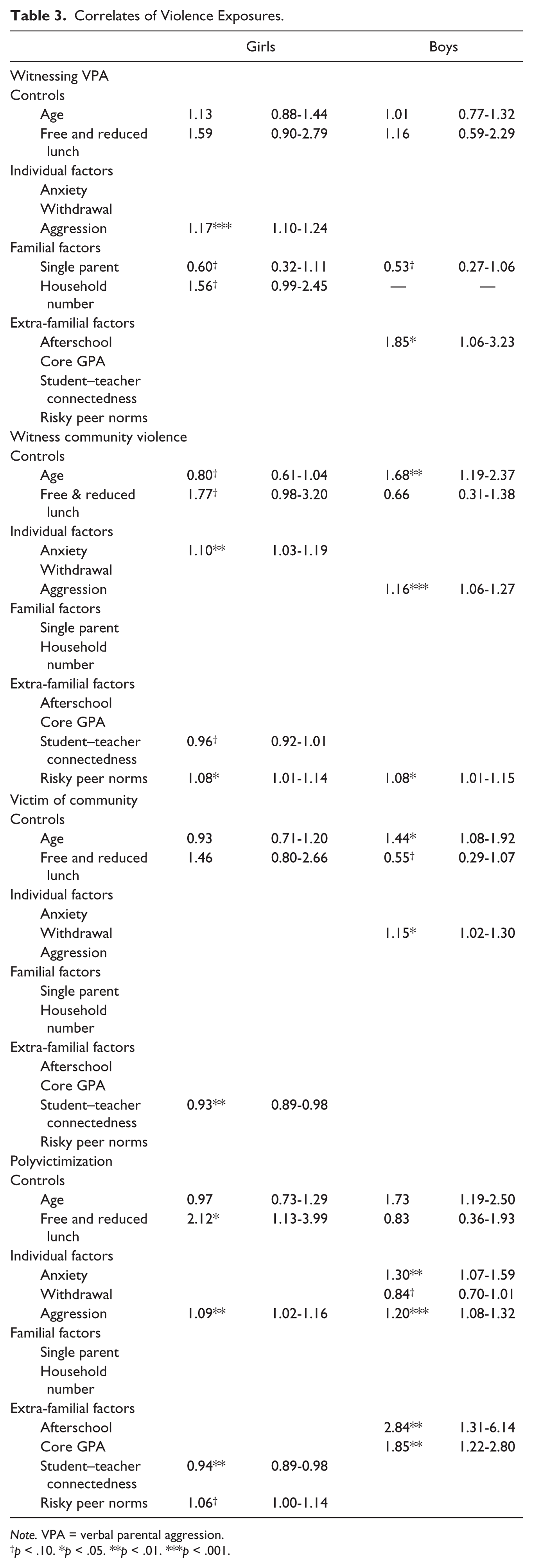
Correlates of witnessing VPA were different for girls and boys (see Table 3). For girls, household structure, household numbers, teacher–student connectedness, gang membership, risky peer norms, anxiety, withdrawal, and aggression were significant factors in bivariate analyses and were entered into a multivariate model. After controlling for age and socioeconomic status (SES), living in a single-parent household decreased the likelihood of reporting witnessing VPA for girls. A high number of household members was associated with witnessing family violence. In addition, reporting high aggression was associated with witnessing VPA.
Correlates of Violence Exposures.
Note. VPA = verbal parental aggression.
p < .10. *p < .05. **p < .01. ***p < .001.
For boys, household structure, afterschool activities, GPA, and aggression were significant in bivariate analyses and were entered into the multivariate model. After adjusting for age and SES, living in a single-parent household was correlated with lower rates of witnessing VPA, as with girls. In addition, higher participation in afterschool activities was correlated with witnessing VPA.
Correlates of Witnessing Community Violence
Significant gender differences were also noted for boys and girls with regard to correlates of witnessing community violence (see Table 3). For girls, GPA, student-teacher connectedness, gang membership, risky peer norms, anxiety, withdrawal, and aggression were significant in bivariate analyses and were entered into a multivariate model. After controlling for age and SES, anxiety was positively associated with witnessing community violence. Higher student-teacher connectedness was associated with a lower risk of witnessing community violence. Finally, risky peer norms were associated with witnessing community violence.
Among boys, afterschool activities, risky peer norms, withdrawal, and aggression were significant at the bivariate level for witnessing community violence exposures and were entered into a multivariate model. In the final model, being older was correlated with witnessing community violence. In addition, aggression was associated with witnessing community violence among boys. Finally, risky peer norms were associated with witnessing community violence.
Correlates of Community Violence Victimization
Correlates of community victimization can be found in Table 3. For girls, student-teacher connectedness emerged as a significant correlate of community victimization in bivariate analyses. Controlling for age and SES, higher student–teacher connectedness was associated with a lower rates of being a victim of community violence.
For boys, afterschool activities, anxiety, withdrawal, and aggression were significant at the bivariate level and entered into a multivariate model. After adjusting for SES, being older was associated with higher rates of experiencing community violence exposure. In addition, symptoms of withdrawal were associated with higher rates of experiencing community violence exposures.
Correlates of Polyvictimization
For girls, GPA, student-teacher connectedness, risky peer norms, anxiety, withdrawal, and aggression were significant in bivariate analyses and entered into a multivariate model. In the final model, girls who received free school lunch reported higher rates of polyvictimization. In addition, higher student–teacher connectedness was associated with lower rates of polyvictimization. Risky peer norms were associated with higher rates of polyvictimization. Finally, higher aggression was a significant correlate for polyvictimization.
For boys, household structure, afterschool activities, GPA, anxiety, withdrawal, and aggression were significant in bivariate analyses and entered into a multivariate model. After controlling for age and SES, anxiety was positively associated with reports of polyvictimization, as was aggression. In addition, reporting withdrawal symptoms were associated with lower odds of experiencing polyvictimization. Finally, participation in afterschool activities and higher GPAs were associated with higher odds of experiencing polyvictimization. A summary of the correlates of polyvictimization can be found in Table 3.
Discussion
The present study makes an important methodological contribution by examining correlates of single and multiple forms of violence exposures among urban African American adolescents. Findings indicated that overall, youth were exposed to high rates of violence, with significantly more boys than girls being exposed to community violence, both as victims and witnesses. These findings are corroborated by earlier studies (Schwab-Stone et al., 1995; B. D. Stein, Jaycox, Kataoka, Rhodes, & Vestal, 2003). Results indicated no significant gender differences with regard to witnessing VPA, also substantiated by earlier findings (McFarlane, Groff, O’Brien, & Watson, 2003).
With respect to polyvictimization, this study found that boys were exposed to higher levels of polyvictimization than girls, a trend consistent with prior findings (Finkelhor et al., 2007). However, the present findings did indicate higher rates of polyvictimization than comparable studies (Romano et al., 2011), perhaps driven by this sample being all African American urban youth, who are more likely than the general population to be exposed to violence (Buka et al., 2001).
Several important differences in correlates of witnessing VPA were noted for boys and girls. For girls, aggressive behaviors were associated with a higher risk for witnessing VPA. Typically, girls more than boys tend to spend greater time at home, given that they are often subject to stricter parental control (Li, Feigelman, & Stanton, 2000). Therefore, problematic aggressive behaviors may be more closely related to parental conflict for girls than boys. This relationship is most likely bidirectional as it is equally plausible that girls witnessing VPA may display aggressive sequelae as a result of such exposures. Longitudinal research is needed to clarify this temporal ordering.
Results also indicated that living in a single-parent household was associated with less exposure to VPA for both boys and girls. This finding may partly be driven by the fact that in single-parent versus two-parent households there are fewer partners to argue or fight with. Finally, a higher number of household members was associated with higher levels of witnessing VPA for girls, possibly reflecting higher levels of stress associated with parenting a greater number of children (Acevedo, Lowe, Griffin, & Botvin, 2013).
With respect to witnessing community violence, distinct correlates were also documented by gender. Anxiety was correlated with witnessing community violence for girls but not boys. Studies have found that youth, and particularly girls, who are highly anxious are more likely to identify ambiguous situations as hostile (Bell-Dolan, 1995), and thus may be more likely to report higher levels violent events. In contrast, self-reported aggression was correlated with a higher likelihood of witnessing violence for boys. In these cases, aggression may be a proxy reflecting variables not assessed in this study such as the composition of boys’ peer groups, given that aggressive boys are more likely to associate with similar boys perpetrating violence (Espelage, Holt, & Henkel, 2003).
With respect to community violence victimization, older boys were more likely to be victimized, whereas older adolescent girls were less likely to be victimized. This finding may reflect the fact that girls in general, irrespective of age, are more heavily monitored than boys (Svensson, 2003; Webb, Bray, Getz, & Adams, 2002), thereby reducing their levels of community victimization. Future studies should test this assumption. Findings also documented that withdrawal behaviors for boys were associated with higher community violence victimization, but not for girls. This may reflect data that suggest that in high violence communities, African American boys who are withdrawn are more likely to become targets of violent attacks than peers who are seen as more aggressive (Voisin, Bird, et al., 2011).
Findings from the present study also documented that for girls, but not boys, lower socioeconomic status was related to polyvictimization. Finkelhor and colleagues (2007) found that low socioeconomic status was a correlate of polyvictimization, but researchers did not examine whether gender moderated this relationship. The present study found that a proxy for low socioeconomic status (i.e., being a recipient of free school lunch) was a significant correlate distinguishing girls, but not boys, who experienced multiple forms of violence. Although boys and girls may reside in the same low-income communities, typically boys are less monitored than girls (Li et al., 2000; Webb et al., 2002) and may have friendship networks with differing levels of deviance (Svensson, 2003). Consequently, the experiences and social realities for boys and girls within these communities may still differ by gender. Consequently, the unique gender finding noted with regard to socioeconomic status may signal the presence of intervening variables (e.g., parental monitoring) that were not assessed in this study.
Across single and multiple victimizations, findings indicated that student–teacher connectedness was consistently correlated with lower rates of witnessing and being a victim of community violence exposure and polyvictimization for girls. This finding may suggest that for girls, positive prosocial school influences are correlated across multiple forms of violence exposures; however, further research is needed to clarify the temporal order of these two constructs. For boys, being involved in afterschool activities was associated with higher rates of witnessing VPA and polyvictimization. In addition, higher GPAs were correlated with polyvictimization. Similar findings have been reported, where Romano et al. (2011) documented that out-of-school activity participation was associated with higher polyvictimization for adolescents. We posit that this finding may reflect a bidirectional relationship, such that youth who are victimized may be more likely to seek out safety in afterschool activities. In addition, for African American boys living in high-violence communities, definitions of masculinity and having street credibility may not incorporate or support notions of doing well in school as such attempts may evoke responses of “trying to act White” or terms that may engender violence from peers (Fordham & Ogbu, 1986), although this idea has been challenged in the literature (Cook & Ludwig, 2008). Such assumptions would need to be empirically tested in future qualitative studies.
The findings from this study have important implications. However, before discussing these, several limitations warrant mentioning. The present study was cross-sectional, precluding the ability to make causal inference. As noted earlier, many of the relationships referenced (e.g., aggression and witnessing VPA, and afterschool activities and witnessing VPA) are likely to be bidirectional. In addition, this study assessed a limited range of exposures to violence (e.g., witnessing VPA and community violence and being a victim of community violence). There is little consensus in the extant literature of what constitutes polyvictimization, making it is difficult to compare findings for this construct across multiple studies. Future studies examining the correlates of polyvictimization should seek to include a broader range of the most common victimization experiences. In order to explore the odds of high exposure, this study employed a median split of all victimization scores. However, this analytic approach limited information available with regard to violence exposure. This study did not explore a dose-response relationship—a potential direction for future research. Finally, the present study drew on a convenience sample of African American youth and may not be representative of the wider African American adolescent population.
Notwithstanding these limitations, these findings highlight that the factors in a youth’s environment that relate to victimization vary by form of victimization. More specifically, this study suggests that screening prompts can be used to identify boys and girls at risk of certain types of violence exposures and possibly in need of related services. For instance, boys who exhibit higher levels of anxiety and withdrawal report higher rates of polyvictimization; such information could be included in comprehensive screening efforts to identify at-risk youth and accompanying prevention programs to reduce these exposures. There has long been an assumption of homogeneity when attempting to address youth problem behaviors; this study supports the development and use of gender-oriented approaches for African American boys and girls, given that the correlates for several typologies of violence exposures differed. In conclusion, this study makes an important conceptual contribution by examining the correlates of multiple forms of violence exposure across a single sample of African American adolescents. Though exploratory in nature, findings can help inform future studies with this under-researched and highly vulnerable group.
Footnotes
Declaration of Conflicting Interests
The author(s) declared no potential conflicts of interest with respect to the research, authorship, and/or publication of this article.
Funding
The author(s) disclosed receipt of the following financial support for the research, authorship, and/or publication of this article: This research was supported by funding from the National Institutes of Health, 1RO3 HD049283-01 awarded to Dexter Voisin.