




Abstract
In 2009, President Barack Obama signed the Mathew Sheppard and James Byrd Jr. Hate Crimes Protection act and thereby extended the list of previously protected classes of victims from actual or perceived race, color, religion, national origin, disability and sex orientation to gender and gender identity. Over 45 states, the District of Columbia and the federal government now include hate crime statutes that increase penalties when offenders perpetrate hate crimes against protected classes of victims. Penalty enhancement statutes sanction unlawful bias conduct arguably because they result in more severe injuries relative to non-bias conduct. We contend that physical injuries vary by bias type and are not equally injurious. Data on bias crimes was analyzed from the National Incident Based Reporting System. Descriptive patterns of bias crimes were identified by offense type, bias motivation and major and minor injuries. Using Multivariate analyses, we found an escalating trend of violence against racial minorities. Moreover, relative to non-bias crimes, only anti-White and anti-lesbian bias crimes experienced our two prong “animus” criteria of disproportionate prevalence and severity of injury. However, when compared to anti-White bias, anti-Black bias crimes were more prevalent and likely to suffer serious injuries. Implications for hate crime jurisprudence are discussed.
Introduction
The evolution of hate crime statutes reflects a trend of bias-related violence directed toward victims because of their membership in protected classes of citizens. Hate motivated violence has existed since the American Revolution but only recently has the unique harm of hate been found so severe that an extra penalty, commensurate with the degree of injury, been deemed appropriate. Indeed, hate crime scholars report disproportionate minority group victimization prevalence rates and multidimensional effects of injuries. Nearly fifteen years ago, McDevitt, Balboni, Garcia and Gu (2001) reported findings of extreme brutality, psychological and emotional trauma characteristic of hate crime victimizations from their sample of Boston police records. Their findings were later supported both theoretically and empirically by a number of hate scholars, including Herek, Gillis, and Cogan (1999); Perry (2001); Iganski (2001); Lawrence (2002, 2009); and Iganski and Lagou (2014), all concurring that hate crimes hurt more. Other studies have detected secondary victimization effects (Dunbar, 2006; Herek, Cogan, and Gillis, 2002) and, although scant, a few have tested and found in terrorum victimization effects (Lim, 2009; Perry & Alvi, 2012).
The U.S. Government’s acknowledgment of the uniqueness of hate crime injuries began decades ago when the Hate Crimes Statistics Act (1990) was enacted authorizing the collection and publication of hate crimes statistics from state law enforcement agencies. Thereafter, a plethora of federal and state legislation has been enacted to proscribe violence against an increasing number of protected groups. In 1994, Congress later passed the Hate Crimes Sentencing Enhancement Act (1994) which ordered the U.S. Sentencing Commission to increase penalties by three levels upon evidence that the defendant’s bias motivation facilitated the selection of a victim because of perceived or actual race, color, religion, national origin, sex orientation, or disability. Fifteen years later, the present Matthew Shepard and Robert Byrd Jr. Hate Crime Prevention Act of 2009 (18 U.S.C. § 249) extended the number of bias types afforded hate crime “status” protection to include gender and gender identity.
In addition, 45 states and the District of Columbia now statutorily proscribe bias crimes in a typology of statutes inclusive of sentencing enhancements, substantive aggravated offenses, and data collection statutes (Franklin, 2002; Gillis, 2013). Whether these statutes enhance the sentence or severity of the offense, the effect is an increase in sentence length when bias motivated conduct is determined. In the majority of these statutes, culpability is determined by discriminatory selection of victims; in others, culpability is established by evidence of animus 1 toward a “protected group” (Adams, 2005; Dixon & Gadd, 2014; Grattet & Jenness, 2001; Lawrence, 2002, 2009). While animus may be inferred from conduct stemming from discriminatory selection, the basis for blameworthiness represents a unique distinction in the rationale for promulgating hate crime statutes. Hate crime statutes modeled under animus look to the reason for the discriminatory selection and prohibit bias motivated criminal conduct because of prejudice and hostility toward the victim and the particular group he or she represents (Grattet & Jenness, 2001; Lawrence, 1999). Animus statutes require that defendants have acted out of hatred for a specific group and the victim as a member of that specific group (Lawrence, 2009). As an example, the New Hampshire Hate Crime Animus Statute increases penalties for hate crimes when the defendant “was substantially motivated to commit the crime because of hostility towards the victim’s religion, race, creed, sexual orientation (as defined in RSA § 21:49), national origin, or sex” (N.H. Rev. Stat. Ann. § 651:6 1F). Animus statutes focus attention on the reason for discriminatory selection; whereas the motivation for selection is less instrumental and more expressive (Grattet & Jenness, 2001).
Discriminatory selection statutes do not distinguish the reason for selection. The entire basis of the statute is the discriminatory selection of the victim within a broad-based bias category. For instance, Ohio’s ethnic intimidation discriminatory selection statute enhances penalty for ethnic intimidation when certain offenses are committed “by reason of” the victim’s race, color, religion, or national origin (Ohio Rev. Stat. Ann. § 2927.12).
Discriminatory selection statutes incorporate the broader definition of hate crime simply requiring that the victim was selected “because of” or “by reason” certain characteristics regardless of the perpetrator’s ideology or hatred for a particular group. Discriminatory selection statutes are more prevalent with over two thirds of the states and the federal government having enacted the discriminatory selection model of legislation (Grattet & Jenness, 2001).
Advocates and opponents of the hate crime discourse contend clearly debatable points on the merits and problems these statutes present, as the incidents of hate crimes and the number of status groups designated for protection have increased. Critics challenge both the constitutionality and practicality of penalty enhancement hate crime statutes (Franklin, 2002; Jacobs & Potter, 1998; Jacoby, 2002; Lawrence, 1999; Tatchell, 2002). They charge that penalty enhancement statutes for offenses against specially protected groups are over inclusive, reflect thought control and identity politics in violation of the First and Fourteenth Amendments. Alternatively, supporters assert hate crimes are qualitatively different and merit additional punishment because of the extra harm, the severity of injuries to victims, the victims’ community, and society at large (Iganski & Lagou, 2014; Lawrence, 1994, 2002, 2009; Levin, 1999; Levin & McDevitt, 1993). We contribute to this discourse by illuminating similarities and differences between bias and nonbias crimes and between general and specific types of bias.
Literature Review
The prevalence of the discriminatory selection statutes can be explained by several factors. First, in the early 1990s, two critically important hate crime cases were decided by the U.S. Supreme Court that shaped the form of all subsequent federal and state hate crime legislation. In R.A.V. v. City of St. Paul, Minnesota 505 U.S. 377 (1992), the defendant was convicted of violating a city hate crime ordinance by evidence that the defendant placed a burning cross on an African American person’s lawn. After granting certiorari, the U.S. Supreme Court struck down the City of St. Paul’s bias crime ordinance, asserting that it was impermissibly content-based and thus violated the defendant’s First Amendment rights. The Court ruled that “the ordinance proscribed fighting words of whatever manner that communicate messages of racial, gender, or religious tolerance. Selectivity of this sort creates the possibility that the city is seeking to handicap the expression of particular ideas” (R.A.V. v. City of St. Paul, Minnesota 505 U.S. 377, 1992). This finding led to the ruling that the ordinance lacked constitutionally required content neutrality. To this point, the Court noted, “the only interest distinctively served by the content limitation is that of displaying the city council’s special hostility towards the particular biases thus singled out. That is what the first amendment forbids” (R.A.V. v. City of St. Paul, Minnesota 505 U.S. 377, 1992).
However, in 1993, the U.S. Supreme Court in Wisconsin v. Mitchell 508 U.S. 476 upheld the constitutionality of the Wisconsin hate crime penalty enhancement statute and distinguished it from R.A.V. The Court noted the Wisconsin statute punished conduct, not content that posed special harm to the individual, secondary victims, and the community at large. Mitchell legitimated the discriminatory selection model and thereafter numerous penalty enhancement statutes were enacted throughout the United States.
In addition, courts in New Jersey and Washington have struck down animus statutes that exceeded discriminatory intent requirements because the proof required for racial animus often encroached on First Amendment violations of content neutrality. In states that require evidence of racial animus, to attain a conviction, prosecutors must demonstrate the defendant’s subjective state of mind by proving, beyond a reasonable doubt, that the act was precipitated by “animus,” “hostility,” “maliciousness,” or “hatred” (Grattet & Jenness, 2001). Because this burden is nearly impossible to meet, animus statutes are in a minority. Moreover, with the holding in the Wisconsin v. Mitchell decision, both substantive and penalty enhancement statutes proscribing conduct on the basis of discriminatory selection have emerged as the predominant form of hate crime statute throughout the United States. 2 The statutes vary in content and inclusiveness of victims; however, they predominantly define hate crime conduct as criminal offenses that manifest evidence of discriminatory selection of a defined protected group (Grattet & Jenness, 2001). By contrast, statutes constructed on the requirement of racial animus add a “because of” particularized bias selection incorporating a more stringent and difficult evidence criteria, particularly in cases that require proof of racial animus for prosecution. Inferring racial animus motive often borders on constitutionally protected First Amendment values. Grattet and Jenness (2001) noted, “While the animus model is desirable insofar as it targets bigotry directly, its weaker jurisprudential foundation in antidiscrimination principles render it more vulnerable to constitutional challenges” (p. 690).
Discriminatory selection statutes provide special protection with identical sanctions for all bias motivations for a broader number of protected groups. Still, it should be noted that the prevalence of the discriminatory selection model is also influenced by its practicality. Adams (2005) asserted that discriminatory selection models are administratively efficient because they cast a broader net and only require victim selection from protected classes to secure a conviction. However, Lawrence (1994, 2002) cautioned that discriminatory selection statutes, which provide generalized sanctions to all groups, might suffer from over inclusiveness because of the potential to include nonpurposeful, unknowing, or unconscious bias conduct absent actual animus. Culpability and administrative efficiency are just two of the issues debated by proponents and opponents of hate crime statutes.
The Hate Crime Debate
An evolving body of research in hate crime scholarship has supported the notion of broad range multivictimization effects of hate crime injuries. Advocates of hate crime statutes support penalty enhancement sentences because of the frequency and severity of injury to potential victims, and contend several justifications for more severe sentences for hate crime offenders. First, as decided in Mitchell, penalty enhancement hate crime statutes provide for protection of primary and secondary victims of the hate attack. In addition, they argue that government has a compelling interest in precluding retaliatory hate crime victimizations and creating sanctions proportional to the degree of harm.
According to Iganski (2002), the case for treating hate crimes more severely than otherwise nonbias motivated crime is quite simple. Hate crimes “hurt” more and should be punished more. Supporting this proposition, prior research has detected evidence of trends in hate crime victimization patterns that suggest hate crime injuries are qualitatively different from their ordinary crime counterparts. Levin (1999) reported the severity of injury associated with hate crime assaults were twice as likely to cause injury and 4 times more likely to require hospitalization. Levin and McDevitt (2002) reported findings of extreme brutality in a review of Boston police hate crime records. Furthermore, they found 50% of the hate crime cases involved severe physical injury requiring hospitalization.
Strom (2001) analyzed aggravated assaults derived from 1997 through 1999 National Incident-Based Reporting system (NIBRS) and identified trends in serious injury. Sixty percent of the total of bias crimes incurred serious injuries. Messner, McHugh, and Felson (2004) used a 1999 NIBRS incident sample file to analyze intimidation, simple, and aggravated assault cases. Using incident-level police data, they found that race and other bias assaults were almost 3 times more likely to result in major injuries relative to nonbias assaults. Although many of the previous studies were constrained with design limitations that confined their generalizability, they were able to detect patterns and trends which were also found with more representative national samples.
Recently, the incorporation of nationally representative victimization studies has overcome the design limitations of early empirical hate crime studies. Studies of hate crime victimizations reports, in lieu of official police records, are advantageous for several reasons. First, they tap into the dark figure of unreported hate crimes (Iganski & Lagou, 2014). This is important because several bias types (anti-Black, antisex orientation and anti-immigrant) are notorious for underreporting because of strained relationship with law enforcement (Berrill, 1990; Herek et al., 1999; Torres, 1999).
Capturing the elusive dark figure of hate crime victimization is possible through surveys of victims. To this end, Wilson (2014) assessed National Crime Victimization Survey (NCVS) hate crime victimization trends over a 9-year period from 2004 through 2012 and reported hate crime prevalence increased from 78% to 90%; in addition, serious violent crime accounted for a higher percentage of all bias crime victimization (27%) than nonbias crime victimization (8%). Similarly, Iganski and Lagou’s (2014) analysis of 6-year hate crime victimization trends within the Crime Survey of England and Wales (CSEW) confirmed many of the early findings of adverse psychological sequelae and behavioral injuries originally reported by Herek and colleagues (1999) and McDevitt and colleagues (2001).
Iganski and Lagou (2014) found bias crime victims were more likely to have had emotional reactions (anger, anxiety, crying/tears, depression, difficulty sleeping, fear, loss of confidence, feelings of vulnerability, and shock) than their nonbias counterparts. Moreover, they found that victims responded behaviorally to their victimization through avoidance behavior, constrained choices, and restricting oneself to the immediate safety of their community.
Vicarious deleterious effects of hate crimes on proximal and distal victims has also been theorized among hate crime scholars (Iganski & Lagou, 2014; McDevitt, Levin & Bennett, 2002; Perry, 2001, 2014; Weinstein, 1992). Weinstein (1992) posited that race violence inflicts an “in terrorem” effects on selected groups through the victimization of one or more members of the particular group. Perry and Alvi (2012) hypothesized “in terrorem” effects in their study of secondary victimization effects in focus group victimization discussions with secondary victims. They reported secondary victim in terrorem effects inclusive of victims’ feelings of shock, anger, fear, vulnerability, inferiority, and normativity. Similarly, Lim’s (2009) study of secondary Asian American victim narratives found that the offender messages of inferiority and fear were often effectively delivered to these secondary victims.
Perhaps the most distal victim of bias motivated behaviors is society as a whole (Iganski, 2001; Perry, 2014; Weinstein, 1992). Violence motivated by hate affirms natural intergroup suspicion, creates separation, and undermines the possibility of intergroup collective efficacy (Perry, 2014). Perry (2014) referenced this as a collateral damage impact on shared values. Voluntary self-segregation, self-imposed restrictions to home or immediate community and fear of repeat victimization are natural reactions to hate motivated violence. Arguably, the reactions are compliant with the intended purpose of the hate motivated behavior for marginalized groups to stay in one’s place.
To summarize, violent hate crimes are unlike nonbias motivated crimes as they inflict emotional and behavioral injuries. Worse, the most distal victim of hate crimes is society itself when democratic ideals of inclusion, trust, and cooperation are undermined by the legacy of intergroup suspicion and consequently voluntary group disassociation.
Hate crime statutes, regardless of whether drafted on the basis of discriminatory selection or racial animus models of culpability, are not without its critics. Constitutional scholars debate the legitimacy of hate crime statutes with the contention that they synonymize motive with conduct and therefore impermissibly regulate thought in violation of the First Amendment (Gellman, 2002; Jacobs & Potter, 1998; Jacoby, 2002; Philips, 2002). Moreover, opponents of hate crime statutes contend that these statutes violate the Fourteenth Amendment right to due process and equal protection (Jacobs & Potter, 1998; Tatchell, 2002). They argue that injuries to bias victims are not more severe than nonbias crime victims, and thus special protection of select victims reflects nothing more than identity politics. Other critics of hate crime statutes argue that these statutes may conceivably generate a number of unintended consequences such as resentment and social backlash that may actually increases prejudice (Gerstenfeld, 2013; Grattet & Jenness, 2001; Minow, 1991). Grattet and Jenness (2001) asserted that hate crime legislation potentially “reinforces perception of target groups as ultimately less credible participants in an array of social activities, especially those interfacing with the criminal justice system” (p. 655). Another unintended consequence has been the disproportionate prosecution of minorities the victims the statutes are supposed to protect (Dixon & Gadd, 2014; Franklin, 2002). Finally, Jenness (2002) contended that hate crime statutes are constructed with a “norm of sameness” positing the generalized construction of hate crime statutes minimizes unique group victimization experiences, and consequently, the social-political history and original basis for the group’s protection is obscured. Jenness (2002) noted,
Hate Crime laws are written in a way that elides the historical basis and meaning of such crimes by translating specific categories of persons (Blacks, Jews, Gays, Lesbians, Mexicans) into all encompassing neutral categories (race, religion, sex orientation, and national origin). In doing so, the laws do not offer these groups any remedies and protections that are not simultaneously available to all other races, religions, genders, sexual orientations, nationalities and so on. (pp. 24-25)
Both early and contemporary hate crime research has also found contrary findings to the contention that hate crimes are more physically harmful. Many of the studies incorporating samples of aggravated assault cases found that victims of bias assaults were less likely to suffer injuries than nonbias assault victims (Iganski & Lagou, 2014; Martin, 1996; McDevitt et al., 2001).
Martin (1996) analyzed comparable cases from New York City and Baltimore County bias crime units and found that nonbias (49%) exceeded bias (27%) injuries in Baltimore County. Similarly, nonbias (93%) exceeded bias (81%) injuries in New York City. However, Martin noted most of the injuries were relatively minor in both sites. Garcia, McDevitt, Gu, and Balboni (1999) found similar results in their study of the psychological and behavioral effects of bias and nonbias motivated assaults. Their study of a sample of 560 bias and 544 nonbias aggravated assault victims from Boston between the period of 1992 and 1997 detected a significant association between the extent of medical treatment received by respondents and type of victimization. Nonbias victims (52.1%) relative to bias victims (37.1%) received a significantly different higher rate of emergency medical services or hospital treatment. Similarly, Iganski and Lagou (2014) found no differences in the extent of severe injuries between bias and nonbias groups in their analysis of 6-year trends of hate crimes in England and Wales.
This study contributes to the hate crime debate by examining offender, victim, and situational characteristics from the 2010 NIBRS. However, it is important to note that NIBRS is a segment of the Uniform Crime Reporting (UCR) program. As official crime data from incidents known to law enforcement, NIBRS is limited by the reporting of hate crimes by victims to police. As such, our estimates from NIBRS are subject to the known limitations of police data, primarily the exclusion of the dark figure of unreported hate crime. When studying bias crimes within NIBRS, one needs to acknowledge some inherent limitations with such data. First, NIBRS is not a nationally representative sample. Second, as stated, a dark figure of unreported hate crimes suggests NIBRS hate prevalence rates are likely underestimated. Still, we think NIBRS’s rich incident, offender, and victim profile data can be used to uncover patterns and trends much like the reports from early studies. For instance, NIBRS collects incident-level information on the geographic location of the incident in relation to the location of the home. Prior studies have found victim blaming, a characteristic among away from home victimizations, absent in victimizations near home. Thus, the inability to control vulnerability and repeat victimization extends the psychological trauma in the aftermath of the victimization 3 (J. Levin & McDevitt, 2002).
NIBRS collects detailed information on the entire criminal incident, including data on the incidents, location, offenses, victims, and offenders. We focus on whether situational and demographic factors distinguish bias from nonbias motivations. NIBRS is uniquely capable of distinguishing the effects of bias as well as illuminate differences in the severity of injury between bias and nonbias motivated assaults, and between general and specific types of bias. According to Lim (2009), an advantage of NIBRS is its capability of capturing a wide range of incidents. Similarly, Gerstenfeld (2013) posited that the detail of the NIBRS data collection could provide insight into offenders, victims, and characteristics of the offense themselves. Furthermore, unlike the traditional UCR data collection system, NIBRS focuses attention on gathering information on the victim that has been found to serve as a compliment to national victimization surveys (Chilton & Jarvis, 1999). Because of its rich detail, NIBRS has significant utility for the purposes of our research.
This study hypothesizes that bias experiences will be qualitatively different and more likely to result in physical injury than parallel nonbias experiences. To test this hypothesis, three interrelated research questions were devised that focus on the nature of hate crime victimizations:
Method
To test our research hypotheses, we used the 2010 NIBRS Victim Extract file. In the Victim Extract File, the unit of analysis is the victim, and additional variables can easily be modified for victim-level analysis. The file is rich with incident-level data about police recorded offenses pertinent to the offender, victim, and the context of the victimization.
Sample
Of the 5,563,826 cases included in the Victim Extract File, a subset of 1,056,479 cases is included in the analyses. Each case included in our analysis was a victim of an assaultive offense 4 during the 2010 reporting period. Assaultive offenses included the NIBRS crimes of intimidation, simple assault, and aggravated assault. 5 These offenses were included in the analysis because they vary in degree of physical contact, weapon use, and injury sustained by the victim, while still encompassing the conceptual definition of an attack on a person. Table 1 shows the frequency and proportion of assault offenses by type. Of the victims of assaultive offenses in the study, the majority (668,318; 63.3%) were victims of simple assault, followed by intimidation (223,104; 21.1%), and then aggravated assault (165,057; 15.6%).
Variable Frequencies.

Despite the implication by its moniker, the NIBRS does not offer national coverage of crime. According to Haas, LaValle, Turley, and Nolan (2012), approximately 29% of the population is covered by NIBRS reporting, representing 27% of the nation’s reported crime and 43% of law enforcement agencies. Due to the lack of complete participation in NIBRS among U.S. states, we restricted our sample to include only states with at least 25% coverage of statewide crime and reported at least 25 bias crimes for 2010. 6
Dependent variables
Table 1 contains the descriptive statistics for the independent and dependent variables included in this study. There were two dependent variables used for analyses: The first dependent variable was a dichotomous variable that identified whether or not the assaultive offense was classified by law enforcement as a hate crime; the second assessed the extent of injury across bias and nonbias categories and by types of bias. This first dependent variable was used to answer the research question regarding whether biased assaultive offenses differed from nonbiased offenses in terms of situational characteristics. In this sample, it is evident that hate crime assaults are events that are rarely reported to or recorded by the police, such that 1,447 (0.14%) cases had some form of bias motivation compared with 1,055,032 cases with no bias motivation.
Hate crime assaults were further broken down into the bias motivation categories of racial (830), religious (114), ethnic (203), sexual orientation (271), and disability bias (29) motivations. Table 2 shows the reported bias motivation/type for all of the assaultive victimizations in the study. Several bias types were found to be more common than others, and in this sample 8 specific bias types accounted for approximately 90% of the victims of bias assaults. Racial bias was by far the most common motivation for hate crimes in the sample, accounting for more than half (830; 57.4%) of reported biased victimizations. Within racial bias, anti-Black (560) was the most frequent followed by anti-White (191) bias types. The second largest bias motivation was sexual orientation bias (271, 18.7%), with antimale homosexual bias (132) and antihomosexual bias (83) accounting for the majority of this type of bias motivation. Ethnic bias accounted for (203) 14% of all the hate crime victimizations in the study. Within ethnic bias, anti-Hispanic (114) occurred most often followed by anti-Other ethnicity or national origin (89). Approximately 8% of the bias assaults were motivated by religious bias (114), and of these anti-Jewish (48) and anti-Islamic (41) were most prevalent.
Bias Motivations and Types.
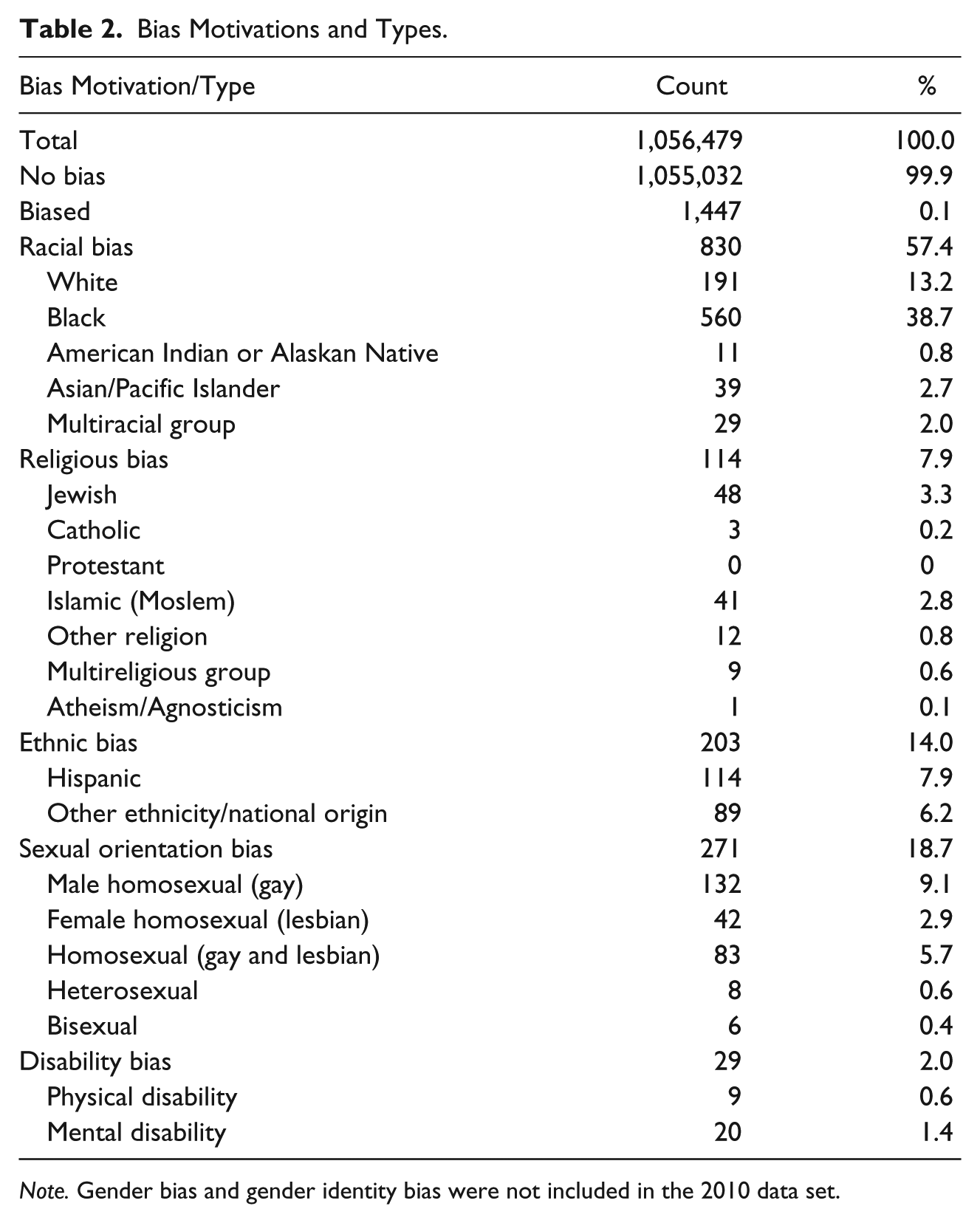
Note. Gender bias and gender identity bias were not included in the 2010 data set.
Our second dependent variable focused on answering the research questions regarding the extent of injury associated with bias compared with nonbias crimes, as well as the extent of injury comparing specific types of bias. This dependent variable, Injury, had three attributes—no injury, minor injury, and major injury. The NIBRS Victim Extract File records up to five types of injury per victim with details on the extent of injury sustained to include none, apparent minor injury, apparent broken bones, other major injury, possible internal injury, loss of teeth, severe laceration, or unconsciousness. The original attributes were recoded as none into no injury, apparent minor injury into minor injury, and the other injury types (apparent broken bones, other major injury, possible internal injury, loss of teeth, severe laceration, and unconsciousness) into major injury—taking into consideration the most serious injury type of the five possible types recorded. Our recoded variable showed that 618,851 (58.6%) victims of assaultive offenses sustained no injury, 392,886 (37.2%) reported minor injuries, and 44,742 (4.2%) victims sustained major injuries.
Covariates
Several covariates were included in the analyses of victims of assaultive offenses based on bias motivation and extent of injury. These included covariate measures for incident characteristics, victim demographics, and offender characteristics. These covariates are listed in Table 1 along with the variable descriptives. Due to the categorical nature of these covariates, dichotomous variables were created, and those covariates with multiple attributes had a reference variable left out of the analyses.
Victim race
As this article focuses on bias motivated crimes, the race of the victim is included in the analyses. Racial categories for the victim included White, Black, Other, and Unknown race. The majority of the victims in the study were White (65.2%), followed by those victims that were Black (30.8%), of Unknown race (2.8%), and Other race (1.3%). White was used as the reference category in the statistical analyses to allow for comparisons with minority victims.
Victim age
The age of the victim was recoded into a dichotomous category of ages 16 to 25 and other/unknown age. The age range of 16 to 25 was chosen because this age range is typically found to experience higher assault victimization generally compared with other age ranges (Messner et al., 2004). Victims between the ages of 16 and 25 accounted for 31.3% of the sample.
Victim gender
The gender of the victim was included as a demographic covariate to determine whether one gender is more likely to experience bias motivated assaults as well as more serious injuries from assaultive offenses. The majority (57%) of the victims of assaultive offenses in this study were female compared with male victims (42.4%). Thus, female was the reference category in the study.
Victim-to-offender relationship
The relationship between the victim and offender was included in the analyses in this study. Including unknown relationships, NIBRS records 25 possible victim-to-offender relationship categories. These different relationship categories were concatenated into the relationships of Stranger (87,882; 8.3%), Family (465,556; 44.1%), Known (356,614; 33.8%), and Unknown Relationship (146,427; 13.9%). Stranger victim-to-offender relationship was chosen as the reference category because we believe that bias crimes are most often perpetrated by persons unknown to the victim.
Weapon used
The type of weapon used by the offender against the victim is measured by NIBRS. Weapon use can influence the extent of injury sustained by the victim; therefore, it was included as a covariate in the study. Up to three types of weapons types could be recorded as being used by the offender(s) against the victim. The type of weapon used was matched to the most serious assaultive offense committed against the victim. Priority was given so that the deadliest weapon (i.e., firearm vs. knife, knife vs. personal weapons) would be captured in the recoding of these variables. Weapon used categories in the study included No Weapon (293,378; 27.8%); Firearm (37,619; 3.6%); Hands, feet, teeth (578,000; 54.7%); Other Weapon (127,114; 12.0%); and Unknown Weapon Type (20,008; 1.9%). “No weapon used” was the reference category in the analyses to see how injury was affected by the various types of weapons versus the absence of a weapon.
Number of offenders
The number of offenders in an assaultive incident was included as a covariate in this study to determine the existence of a pattern relative to the offense being biased and the extent of injury sustained by the victim. While the actual number of offenders is recorded by NIBRS, we recoded this into the categories of One Offender (858,247; 81.2%), Two Offenders (155,118; 14.7%), and Three or More Offenders (43,114; 4.1%). Situations of only one offender were utilized as the reference category to determine whether the likelihood of injury increases with the number of offenders.
Location of incident
Location of victimization was included as an independent variable in the study. NIBRS locations were collapsed into three categories: Residence (656,664; 62.2%), Street (128,246; 12.1%), and Other Location (271,569; 25.7%). The location of residence was the reference category in the study as it is suggested that most hate crime victimizations happen outside the home.
Substance use by offender
NIBRS records information as to whether or not law enforcement suspected the offender of being under the influence of alcohol or drugs during the incident. In this sample, offenders were suspected of using alcohol in 11.6% (122,253) of the victimizations. Suspected drug use by offenders was reported for 1.8% (18,982) of the cases in the sample.
Analysis
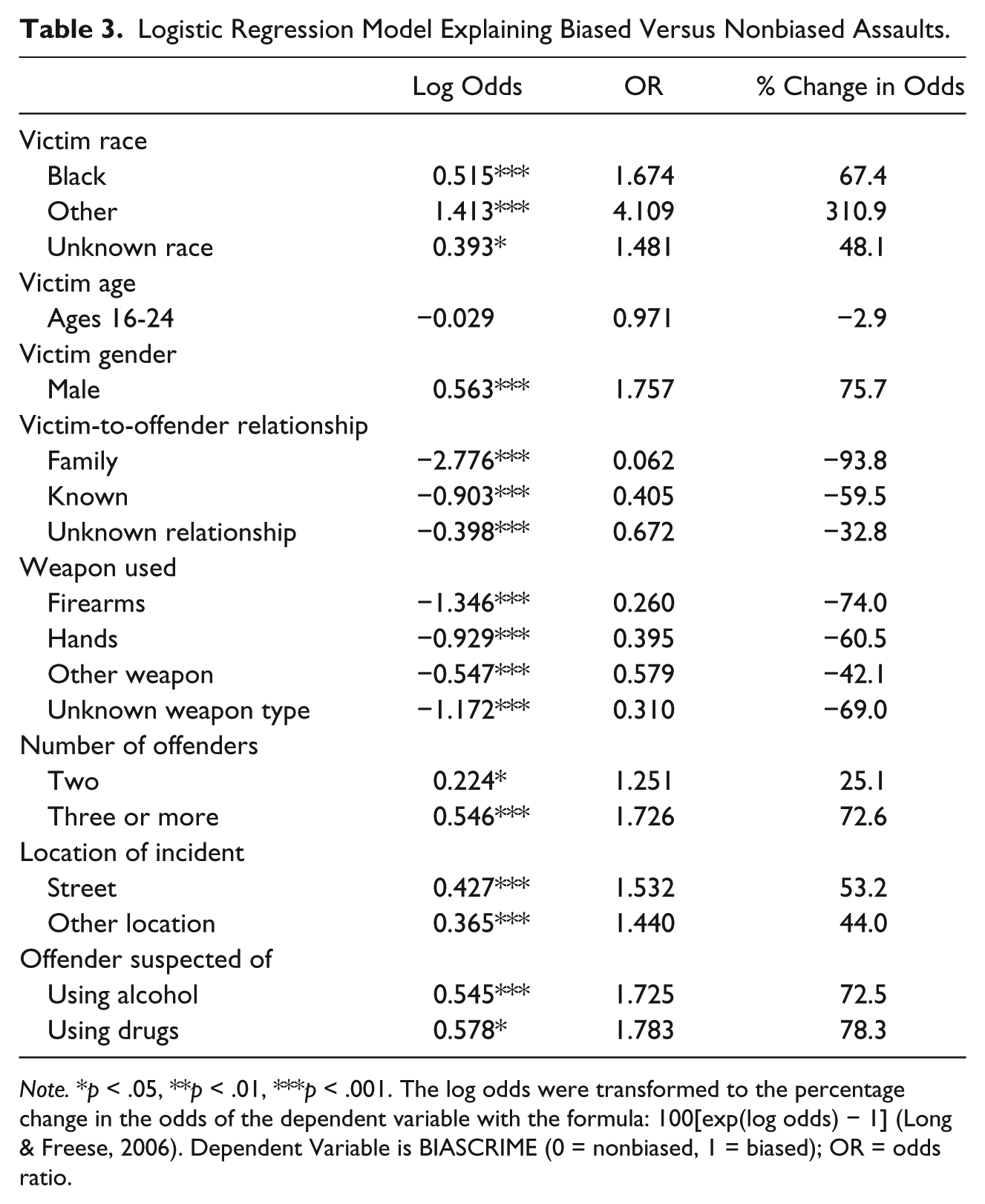
The first multivariate analysis utilized logistic regression to test for situational differences between biased and nonbiased assaults against victims. We controlled for potential procedural and operational differences in the reporting of hate crimes among law enforcement agencies by clustering on the Originating Agency Identifier (ORI), which is the unique identifier for each law enforcement agency in the sample. For a more intuitive interpretation of coefficients, the log odds were transformed to the percentage change in the odds of the dependent variable with the formula: 100[exp(log odds) − 1] (Long & Freese, 2006, pp. 135-136). Table 3 shows the results of the logistic regression analysis.
Logistic Regression Model Explaining Biased Versus Nonbiased Assaults.
Note. *p < .05, **p < .01, ***p < .001. The log odds were transformed to the percentage change in the odds of the dependent variable with the formula: 100[exp(log odds) − 1] (Long & Freese, 2006). Dependent Variable is BIASCRIME (0 = nonbiased, 1 = biased); OR = odds ratio.
Compared with nonbiased assault victims, victims of biased assaults were significantly more likely to be a racial minority than White. The odds of an assaultive offense being biased increase by 67% when the victim is Black compared with being White (odds ratio [OR] = 1.674, p < .001). When the victim is of another racial background (i.e., Native American, Asian, etc.), the odds of the assault having been motivated by bias increase by a factor of 4.1 (OR = 4.109, p < .001). Being between the ages of 16 and 25 was not significantly different between biased and nonbiased assaults (OR = 0.971, p > .05). In comparison with females, the odds of being a victim of a biased assault were 76% greater for males (OR = 1.757, p < .001). In terms of victim demographics, we found significant differences between biased and nonbiased assaults.
Analysis of the relationship between the victim and the offender found that biased assaults are significantly less likely when that relationship is known and especially familial. Relative to strangers, when the victim is known to the offender, the odds of an assault being motivated by bias is 60% lower (OR = 0.405, p < .001). The odds of an assault being biased is 94% lower when the victim is a family member versus a stranger to the offender (OR = 0.062, p < .001).
We also found significantly lower odds of biased assaults involving weapons compared with nonbiased assaults. In fact, compared with no weapon being used, every category of weapon had significantly lower odds of being used in a biased assault. The odds of a biased assault are 74% lower for the use of a firearm (OR = 0.206, p < .001); 61% lower for the use of hands, feet, or teeth (OR = 0.395, p < .001); 42% lower for other types of weapons (OR = 0.579, p < .001); and 69% lower for weapons of unknown type (OR = 0.310, p < .001) than for no weapon use.
We next analyzed the number of offenders to determine whether differences existed between biased and nonbiased assaults. The odds of an assault being driven by hate were 25% greater when two offenders were involved compared with only one (OR = 1.251, p < .05). The odds of an assault being biased were 73% greater when three or more offenders were involved in the incident versus a single offender (OR = 1.726, p < .001). Compared with nonbiased assaults, biased events were significantly more likely to involve multiple offenders.
Biased assaults had significantly greater odds of occurring outside of the victim’s residence. The odds of a biased assault are 53% higher when occurring in the street than at one’s residence (OR = 1.532, p < .001). The odds are 44% greater when occurring at other locations than the victim’s residence (OR = 1.440, p < .001).
Alcohol and drug use by the offender during the assault were the last variables analyzed. The odds of a hate crime increased by 73% when the offender was under the influence of alcohol (OR = 1.725, p < .001) and the odds were 78% greater when the offender was under the influence of drugs (OR = 1.783, p < .001). Biased crimes of assault were significantly more likely to occur when offenders were under the influence.
The next multivariate analysis looked to address whether or not biased assaults are more likely to result in injury than nonbiased assaults. As the dependent variable, Injury, was a discrete variable with three categories—none, minor injury, and major injury—the recommended analytic technique would be multinomial logistic regression. However, we tested for the independence of irrelevant alternatives (IIA) using the Hausman test, and the results indicated that IIA was not met. Thus, the dependent variable became a dichotomous measure for serious injury with the affirmative category representing major injuries such as apparent broken bones, possible internal injury, loss of teeth, severe laceration, unconsciousness, and other injury.
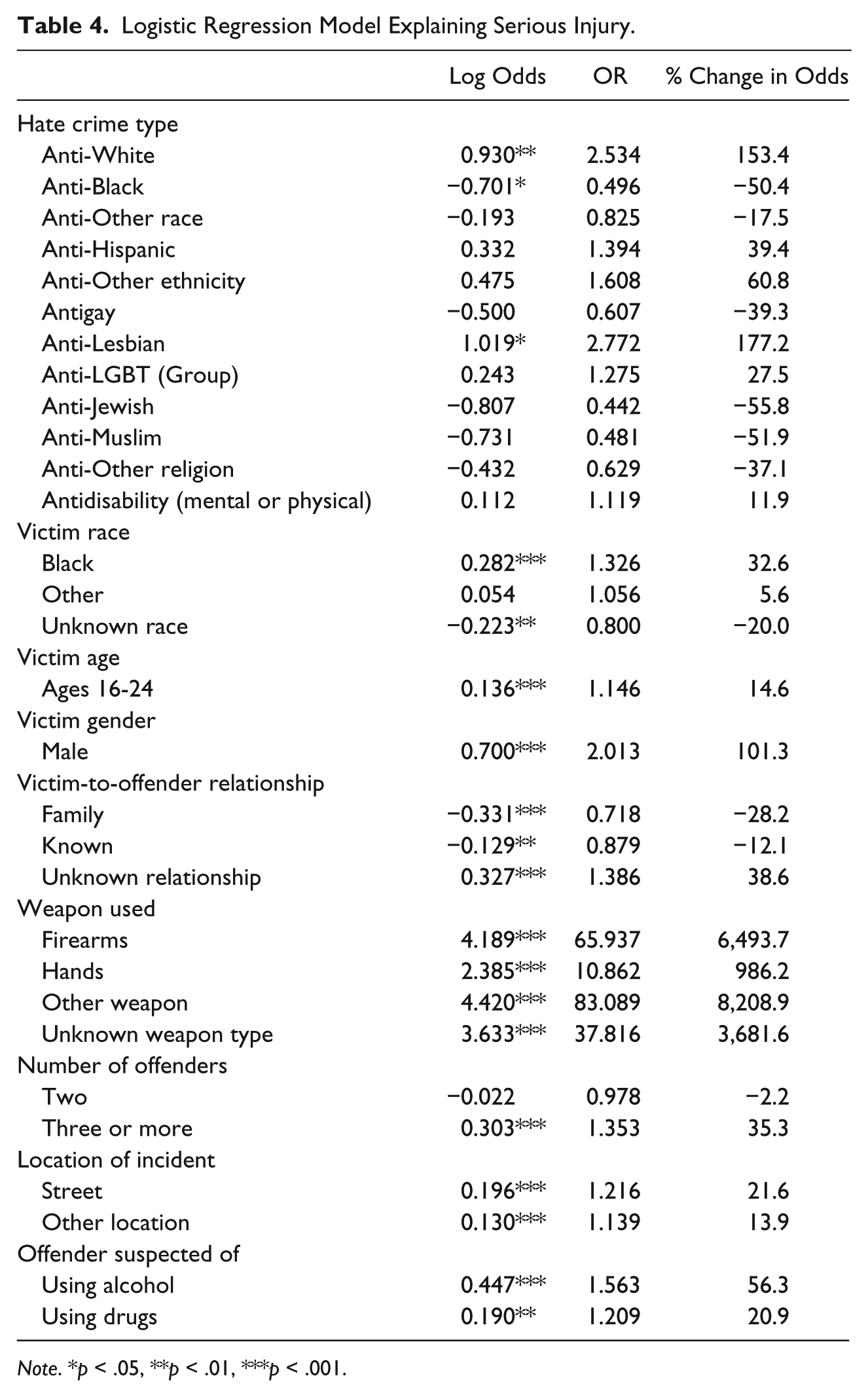
We also began with a model (not shown) that compared the odds of serious injury assaults across general bias categories (racial, ethnic, sexual orientation, religious, and disability bias) with nonbias assault cases. There were no statistical differences in the likelihood of serious injury between any of the general bias motivations and nonbiased assaults. The lack of statistically significant findings for general bias motivations is worth noting when comparing the results from the logistic model in Table 4, which analyzed the odds of serious injury for nonbiased assaults to assaults motivated by specific bias types.
Logistic Regression Model Explaining Serious Injury.
Note. *p < .05, **p < .01, ***p < .001.
Once general bias motivations were broken down into specific bias types (e.g., racial bias into anti-White, anti-Black, and anti-Other race), significant differences were found relevant to nonbiased assaults in terms of the odds of serious injury. Two bias types had significantly higher odds of resulting in serious injury, whereas one bias type had significantly lower odds of serious injury. Compared with nonbiased assaults, the odds of an anti-White assault resulting in a serious bodily injury increased by a factor of 2.5 (OR = 2.534, p < .001). Likewise, the odds of an anti-Lesbian assault resulting in a severe injury increased by a factor of 2.8 (OR = 2.772, p < .05). Anti-Black assaultive crime, relative to nonbiased assaults, had significantly lower odds (50%) of the victim sustaining serious injury (OR = 0.496, p < .05).
Certain demographic characteristics of the victim significantly increased the odds of incurring a severe injury. Controlling for all other variables, if the victim was Black compared with White, the odds of being seriously injured increased by 33% (OR = 1.326, p < .001). Compared with victims of all other ages, those between the ages of 16 and 24 had greater odds of a serious injury (OR = 1.146, p < .001). The odds of a male being seriously injured were approximately 100% greater than that for females (OR = 2.013, p < .001).
In regard to the relationship between the victim and the offender, the odds of a severe injury were significantly higher if the victim was assaulted by a stranger. This is supported by the finding that if the relationship was familial compared with that of a stranger, the odds of serious bodily injury were 28% lower (OR = 0.718, p < .001). The odds of a serious injury decreased by 12% (OR = 0.879, p < .01) if the offender was known to the victim versus a stranger.
The use of weapons in the assault significantly increased the odds of serious bodily injury. Compared with when no weapon was used, the use of other weapons (i.e., knives, blunt objects, etc.) significantly increased the odds of severe injury by a factor of 833.1 (OR = 833.089, p < .001). The use of a firearm significantly increased the odds of incurring a serious injury by a factor of 65.9 (OR = 65.937, p < .001). The odds of serious injury increased by a factor of 37.8 when a weapon of unknown type was used in the assault compared with no weapon (OR = 37.816, p < .001). If the offender used their hands, feet, or teeth to assault the victim, the odds of serious injury increased by a factor of 10.9 (OR = 10.862, p < .001). These results logically support the notion that weapons of any type increase the possibility of serious injury compared with when no weapon at all is used.
Additional situational characteristics were found to increase the odds of serious injury resulting from an assault. When three or more offenders assaulted a victim, the odds of a severe injury were 35% greater than when only one offender was involved (OR = 1.353, p < .001). Compared with assaults that occurred at one’s residence, the odds of serious injury were 22% greater for assaults that occurred in the street (OR = 1.216, p < .001) and 14% greater if they occurred at other public locations (OR = 1.139, p < .001). Elevated risks for serious injury were found when the offender(s) were under the influence. If the offender was suspected of using alcohol, the odds of a serious injury increased by 56% (OR = 1.563, p < .001). When the offender was suspected of using drugs, the odds of serious injury were 21% greater (OR = 1.209, p < .001).
Discussion
This investigation corroborates trends identified in other studies incorporating nonrepresentative samples. The findings indicate that bias crimes do hurt more, and certain groups experience bias crimes more than others, and more severely than others. Furthermore, the extant literature suggests that proximal and distal effects of bias crimes detected here have negative ramifications on community members in proximity to the primary victim and on society as a whole (Lim, 2009; Perry & Alvi, 2012; Weinstein, 1992). Although our study only examined the physical realm of victimization, it is important to note victims may also experience psychological, emotional, and behavioral injuries (Iganski & Lagou, 2014; Lawrence, 2009; J. Levin & McDevitt, 1993, 2002; Lim, 2009; Perry, 2001, 2009; Perry & Alvi, 2012). In this study, we addressed three research questions that focused on the nature of hate crime victimizations. Our first question sought to determine whether there were differences between bias and nonbias assaultive crimes in regard to situational context. Our second question addressed whether general bias crimes (i.e., racial bias, religious bias, etc.) were more likely to result in serious injury. Our last question addressed whether specific bias types (i.e., anti-Black, anti-Jewish, etc.) were more likely to result in serious injury than nonbias types.
First, we observed both similarities and differences between bias and nonbias crimes. More specifically, we examined demographic factors associated with the incident of the offense essentially comparing bias and nonbias assaults to assess the victimization experiences. We found demographic factors unique to the bias victimization experience. Victims of bias assaultive crimes were more likely to be a minority, male, and attacked by strangers. These findings corroborated Messner and colleagues (2004) and Strom (2001) who found that Black and other minorities experienced the most prevalent bias victimizations. However, no significant differences between victim ages below or above 25 were detected. We also detected situational crime factors that confirm many of the crime characteristics discovered in earlier studies. Bias events are likely to be committed by multiple offenders, with no weapons, by strangers, and in public places (Martin, 1996; McDevitt, Balboni, Garcia, & Gu, 2001; Messner and colleagues, 2004). We also affirm Messner and colleagues’s (2004) findings that alcohol and drug use by offenders are aggravating factors that increase the likelihood of a bias victimization. Our analysis found evidence that bias assaults are significantly different from nonbias assaults in terms of victim demographic and situational characteristics.
Next, we sought to determine whether bias crimes were more likely to result in injury than nonbias crimes. When we tested for this, we found that victims of nonbias assaults did not significantly differ from victims of assaults motivated by bias based upon race, ethnicity, sexual orientation, religion, or disability. There were no differences in physical injury between any of these general bias motivations and assaults without bias motivation. Our findings corresponded with those of previous studies that found bias crimes were no more likely to result in injury than nonbias crimes (Garcia et al., 1999; Iganski & Lagou, 2014; Martin, 1996). At this level of analysis, there appears to be insufficient support for enhanced penalties for hate crimes based on the severity of physical injury.
We further tested for differences in injury by dividing general bias motivations into specific bias types. The likelihood of serious injury to victims of the majority of these specific bias assaults were not significantly different from victims of nonbias assaults. In addition, victims of anti-Black assaults had lower risk of experiencing serious injury compared with victims of nonbias assaults. We did find that when we compared specific types of bias, victims of anti-White and anti-Lesbian assaults were significantly more likely to experience serious injury. These findings among victims of anti-White and anti-Lesbian bias assaults lend support for enhanced penalties for hate crimes because they are more likely to result in serious physical injury.
Limitations
Our analysis found only two indications where bias crimes were more likely to result in serious injury. Most of the victims of bias crimes in our study did not experience significantly greater risk of physical injury. However, one of the limitations of the study was that we were not able to study the harm of hate crimes in dimensions outside of the physical realm. It is entirely possible that hate crime victimizations have serious psychological injuries for primary and secondary victims associated with the victim’s group membership. NIBRS data do not have the capabilities to assess psychological injury or anything outside of physical injury.
The NIBRS data used in this study are limited to only the physical dimension of victim harm of incidents reported to the police. In addition, the study was limited by the scarcity of hate crimes that were reported through NIBRS. Our data consisted of fewer than 1,500 bias assaults, with more than 80% distributed among only six specific bias types. Detailed analysis of many bias types was not possible due to the limited number of cases present in our data. Thus, a complete picture of hate crime across all bias types was not capable of being generated. Along with this, it is important to note that our study was based on a single year, 2010, and the seriousness of injury sustained by victims, particularly for anti-White and anti-Lesbian bias assaults, may or may not be indicative of a pattern. This pattern may or may not be found in other years of NIBRS data.
Future Research
Our finding that broad categories of bias motivated assaults were no more likely to result in physical injury than nonbias motivated assaults is not without merit. This shows that the classification of hate crimes into general categories such as racial bias may be insufficient to fully study the nuances involved in these events. Our additional analysis confirmed this by showing within a general category such as racial bias, victims of anti-White assaults had greater odds of serious injury whereas victims of anti-Black assaults had lower odds. This was also confirmed by the differences found within the general category of sexual orientation bias, in which only victims of anti-Lesbian assaults experienced serious injury. These “within group” differences support the idea that not all bias crimes are the same and there is a need to study these events at a more detailed level where specific types of bias are analyzed. Future research should build upon this and focus on studying hate crime by specific bias types.
Moreover, to strengthen generalizability, victimization surveys should be used to study the multidimensional and multivictimization effects of bias crimes. Victimization surveys offer some important advantages over official crime reports. For instance, both the NCVS and CSEW collect and analyze victimization incidents in which some victimization experiences were reported and others not reported to the police. Thus, victimization data afford a unique view into the “dark figure” of bias crime that is notorious for being underreported, and consequently, underestimated. The study of victimization experiences of specific bias types may further the understanding of the uniqueness and multidimensional effects of bias injuries and the victim services needed for treatment. It is important to note that hate crimes, though infrequent relative to comparable ordinary crimes, are so toxic, even single incidents must be viewed in light of its multivictimization effects. Research evidence identifying these multivictimization effects will provide further support for the hypothesis that hate crimes hurt more, and therefore should be punished more severely.
Footnotes
Declaration of Conflicting Interests
The author(s) declared no potential conflicts of interest with respect to the research, authorship, and/or publication of this article.
Funding
The author(s) received no financial support for the research, authorship, and/or publication of this article.