




Abstract
Police researchers have long argued that favorable evaluations of the police eventually lead to citizens’ willingness to cooperate with the police. However, this assumption has barely been studied empirically. The current study examines the association between attitudes toward the police and crime reporting behavior of victims. Furthermore, the study explores the influence of victims’ characteristics on their decisions to report crime to the police. Using field data originally collected in Ghana, the study found that victims’ levels of confidence in the police and satisfaction with police work positively predict their decisions to report sexual assault and robbery to the police. Moreover, findings revealed that age, marital status, and employment status are important predictors of victims’ reporting behavior. Several practical and theoretical implications of the results are discussed.
Introduction
The primary objective of the present study is to examine the influence of victims’ attitudes toward the police on their decision to report or not to report crime to the police. In addition, the study explores the effects of several other factors that affect victims’ reporting decisions. The importance of reporting crimes to criminal justice officials, especially, to the police, cannot be underestimated. Researchers have noted that crime reporting affects the type of crime and the amount of crime known to the police (Slocum, Taylor, Brick, & Esbensen, 2010). Therefore, non-reporting biases official estimates of crime trends across time and space (Baumer & Lauritsen, 2010), and according to Skogan (1976), these biased estimates have implications for the distribution of resources in the community. It is argued that unreported offenders who still live in the community may continue to commit crimes and victimize innocent people (Skogan, 1984). However, the ultimate price paid for not reporting crime to the police rests on the individual victims. Victims who refuse to notify the police about their victimization experiences deny themselves the benefits of receiving psychological and medical treatments, which are necessary in coping and managing associated trauma (Van der Vijver, 1993).
Although several studies have been conducted to extend our knowledge on the etiologies of crime reporting (Acierno et al., 2001; Baumer, 2002; Boateng, 2015; Boateng & Lee, 2014; Burcar, 2013; Goff, Epstein, & Reddy, 2013; Goudriaan, Lynch, & Nieuwbeerta, 2004; Heath, Lynch, Fritch, & Wong, 2013; Slocum et al., 2010; Tarling & Morris, 2010; Warner, 1992; Wong & Van de Schoot, 2012) and citizens’ perceptions of their local police (Boateng, 2012; Kaariainen & Siren, 2011; Rosenbaum, Schuck, Costello, Hawkins, & Ring, 2005; Sunshine & Tyler, 2003; Tyler, 2005), limited research efforts have been directed toward examining the relationship between the two variables (Goudriaan, Nieuwbeerta, & Wittebrood, 2005; Goudriaan, Wittebrood, & Nieuwbeerta, 2006; Watkins, 2005). These limited studies have generally observed that victims’ opinions about the police may affect their odds of reporting crime to the institution.
The present study supplements the efforts of prior studies by further examining the relationship between citizens’ attitudes and reporting of specific crime types to the police using representative data collected in Ghana, West Africa. In addition to empirically unpacking the complex relationship between attitudes and crime reporting, this research builds upon previous studies in several ways. First, prior studies failed to recognize that citizens’ behavior toward crime reporting varies based on their victimization experiences. As a result, these studies operationalized crime reporting as a single variable, precluding an understanding of how attitudes affect reporting of certain types of crimes. Second, the study incorporates several indicators of crime reporting among victims. Third, as the data used were obtained from a non-Western society, results from this study will help develop a better understanding of police–citizen relations in postcolonial and emerging societies. To achieve the study’s stated objectives, it is argued, based on the rational choice theory, that victims’ attitudes toward the police weigh heavily on their decisions to make crimes known to the police.
Crime Reporting: A Rational Choice Perspective
This study is based on the argument that victims’ attitudes toward the police are more important in predicting whether victims would report experiences of victimization to the police or not. This argument reinforces the traditional notion that victims’ decisions to report crime are contingent upon their assessments of the cost and benefit associated with reporting (Bowles, Garcia, & Garoupa, 2009). Scholars have long utilized this line of reasoning in explaining crime reporting of individuals. The assumption derived from the rational choice theory stipulates that the decision to report criminal incidents is a complex process involving a consideration of both cost and benefits (Bowles et al., 2009; Felson, Messner, Hoskin, & Deane, 2002; Gottfredson & Gottfredson, 1988; Kaukinen, 2002; Skogan, 1984). According to the rational choice theory, victims who find the benefit of reporting to be greater than the associated cost will be willing to call the police (Bowles et al., 2009; Tarling & Morris, 2010).
Conversely, victims who consider reporting crime to be more costly than beneficial will be discouraged from making the event known to the police (Kaukinen, 2002). According to Kaukinen (2002), crime victims decide to contact the police based on their rational assessment of the event. For instance, victims who believe that the incident was minor will never call the police.
The costs associated with reporting crime to the police can be enormous and may include the possibility of retaliation from the offender, especially when the incident is domestic violence–related; shame and embarrassment (Boateng, 2015; Bowles et al., 2009); stigmatization of the victim; and a challenging trial process. There are several benefits victims may enjoy from reporting a crime to the police. According to victimology experts, the benefits may include receiving protection from authorities, receiving treatment from appropriate agencies and departments, and preventing future victimization by helping to get the offender arrested and punished. For example, in investigating women’s reasons for reporting sexual assault, Boateng and Lee (2014) found that most Ghanaian women want the offenders to be caught and punished. It has long been argued that, though victims may weigh the benefit of reporting against the cost, the importance they place on such assessment varies based on personal and situational characteristics (Tarling & Morris, 2010). The authors suggest that the cost–benefit analysis will be confounded by the characteristics of the victim, offender, and offense. For example, studies have shown that victims who are familiar with the offenders will be reluctant to report crime to the police irrespective of their assessment of the benefit (Boateng, 2015; Feld, 2009). This explains the complex nature of the decision-making process of crime reporting.
As part of the cost and benefit analysis, consideration of crime reporting, victims may also factor into the reporting decision-making their perceptions of the police. This aspect of cost–benefit assessment of crime reporting has not received much scholarly attention in neither the police nor the victimology literature. Despite this limitation, there is, however, higher degree of consistency among prior researches. For example, Watkins (2005) noted that perceptions and attitudes toward the police can affect the likelihood of crime reporting, which suggests that individuals who have favorable attitudes of the police will be more likely to report a crime to the police than those with less than favorable attitudes. Other researchers have also concluded that confidence in the police and perception of police effectiveness determine the probability that crime victims will report to the police (Anderson, 1999; Baumer, 2002; Goudriaan et al., 2004; Rosenfeld, Jacobs, & Wright, 2003; Sherman, 1993; Slocum et al., 2010; Solis, Portillos, & Brunson, 2009). Thus, victims who have more confidence in the police and perceive them to be effective in fighting crime may have increased propensity to report crimes they experience to the police without reference to the cost and benefit of making the report (Carr, Napolitano, & Keating, 2007). Social scientists largely disagree on the effect of attitudes on victims’ disclosure of events. For instance, Davis and Henderson (2003) argued that contact with the police is more important than perceptions in explaining whether victims will report or not. These authors did not find any relationship between perception and reporting of crime to the police.
Crime victims need to be confident that the information they give to the police will not be heard elsewhere and that such information will be handled with the highest degree of secrecy. In addition, victims may want to be assured that the police will treat their cases efficiently and fairly and that they will not be further victimized by the system. Studies have shown that the police attitude of blaming the victim instead of the offender hinders sexual assault reporting by victims (Boateng, 2015). Burcar (2013) and other scholars (Lindgren, 1996; Newburn & Merry, 1990; Shapland, 1986) postulated that victims may initially have moderate attitudes about the police, but as the proceedings progress, their attitudes worsen. This change in attitude by victims has been attributed to lack of information about the case as well as victims’ prior experience with the process (Burcar, 2005; Shapland, 1986). Victims who hold favorable attitudes of the police will be more willing to report a crime than those who hold less favorable attitudes. Based on this assumption, the following hypothesis was tested.
Although it is expected that attitudes toward the police will influence victims’ decision to report crime, the effects will be higher among sexual assault victims than robbery victims. This is because sexual assault victims suffer drastic psychological effects (Çelikel, Demirkiran, Özsoy, Zeren, & Arslan, 2015; Moscarello, 1990) than that experience by robbery victims. Labeling, shame, self-blaming, stigmatization, and name-calling are all negative effects associated with sexual assault victimization. The response to these effects is complete isolation of victims from the community. To avoid or minimize the occurrence of these effects, sexual assault victims may decide not to report the incident at all. However, if they decide to report, victims may strongly consider their views about the police. Robbery victims, however, do not experience the ordeal sexual assault victims undergo. These victims mostly suffer the loss of physical property and would prefer to report to the police with the hope of recovering such property. In view of this, robbery victims, unlike sexual assault victims, may not strongly consider their views about the police before making the report.
Demographic Differences in Crime Reporting Behavior
Studies examining the determinants of crime reporting have found a significant influence of victims’ demographic characteristics (Acierno et al., 2001; Clay-Warner & Burt, 2005; Goudriaan et al., 2006; Hart & Rennison, 2003; MacDonald, 2001; Zhang, Messner, & Liu, 2007). Regarding the effect of victims’ education, some researchers have noted that highly educated victims are more likely to report incidents to the police than less educated victims (Clay-Warner & Burt, 2005). In contrast, others have argued that victims who are less educated are more likely to report crime to the police (Goudriaan et al., 2006; Wolitzky-Taylor et al., 2011). Lizotte (1985) noted decades ago that because of the fear of losing economic and social standing, highly educated women who were sexually assaulted were often less willing to report their victimization to the police. Adding to the complexity is the observation made by some studies that education and crime reporting are unrelated (Boateng, 2015).
Previous studies have also found an age effect on victims’ attitudes toward reporting crime to the police, although findings about age have been inconsistent. For instance, Acierno et al. (2001) observed that older victims were less likely to report crime to the police. This finding supports the results from a recent study utilizing a Ghanaian sample (Boateng, 2015), which observed that older women who had been sexually assaulted were less likely to report the incidents to the police. An explanation for this behavior can be found in the conclusion made by Heath et al. (2013) that “women who endorsed higher levels of rape myth acceptance were less likely to report their rapes to police” (p. 1065). Rape myth acceptance (RMA) has been found to be higher among older people than younger ones (Kalra, Wood, Desmarais, Verberg, & Senn, 1998), and thus, older victims are more likely to blame themselves for the crime. Conversely, other studies have found that victims who are older are more likely to report crime to the police than those who are younger (Baumer, 2002; Felson et al., 2002; Finkelhor & Ormrod, 2001; Watkins, 2005). These authors believe that the majority of the crimes experienced by younger victims will never be brought to the attention of the police.
Furthermore, prior research on crime reporting intentions has found significant gender effects. Goudriaan et al. (2006) observed that female crime victims are more likely to report to the police than their male counterparts. A similar finding came from a later study conducted by Slocum et al. (2010), who examined youths’ crime reporting intentions and argued that female students were more willing to report crimes than male students. Moreover, victims’ socioeconomic characteristics such as employment status and income levels have been equally influential in explaining their decisions to contact the police. For instance, Goudriaan et al. (2006) found that victims who were gainfully employed (those who worked more than 15 hr a week) were less likely to report crime compared with other types of victims.
Given the conflicting results of prior research, the present study aims to explore the influence of victims’ characteristics on their decision to contact the police. Precisely, the study hypothesizes the following:
Crime Reporting: Formal Versus Informal Control Groups
Given the potency of informal control system in shaping victims’ reporting behavior, the effects of three informal control group variables are accounted for in the regression models. Although there has been limited attempt to untangle the relationship between informal control groups and crime reporting, results have been consistent. Prior studies have shown that victims of crime prefer to disclose their victimizations to groups such as romantic partners, parents, other relatives, and friends, instead of reporting to formal support groups like the police (Bachman, 1998; Boateng, 2015; Golding, Siegel, Sorenson, Burman, & Stein, 1989; Starzynski, Ullman, Filipas, & Townsend, 2005). Bachman (1998) concluded that crime victims choose to deal with the incidents informally through their informal networks of relatives and friends. Similarly, Golding et al. (1989) found that the majority of the victims they studied preferred to disclose their experiences to informal support groups. Consistent with this assertion is the finding obtained by Starzynski et al. (2005) that about 98% of women disclosed their assault experiences to informal support sources instead of reporting to the Chicago police. In a recent study, Boateng (2015) asked victims to rank six institutions that they would prefer to report crimes to. Results obtained from a mean analysis revealed that victims would consider reporting crimes to their families and friends rather than to their local police. These findings suggest the high priority that victims of crime give to informal network groups over the formal system of control regarding crime reporting.
In as much as this behavior of victims could be problematic, there are reasons for opting to report crimes to groups other than the police. The most plausible explanation is that the victim is most likely to receive a favorable reaction when disclosing victimization experiences to informal support groups than when reporting to the police or other formal social groups. Furthermore, victims’ desire to disclose victimization to groups other than the formal agencies may also be due to officials’ attitudes toward investigation of the incident. Although this may be true in all social contexts, the influence may be more prevalent in the African context. Blaming the victim for the occurrence of the crime and showing uninterested attitudes in the victim’s complaints are examples of behaviors that could possibly make victims turn to their informal control system.
Contexts: Crime Trends and Reporting Behavior Among Ghanaians
Criminal cases that came to the attention of the Ghana Police Service between 2000 and 2010 can be categorized as major offenses or commonly committed crimes. Official police statistics indicate that reporting of major offenses, which include robbery, murder, defilement, 1 rape, 2 and narcotic drugs (heroin, cocaine, and Indian hemp), have not only been low but have also shown few variations across time. For instance, the total number of major offense cases reported to Ghana Police Service (GPS) was 2,762 in the year 2000; 3,810 in 2001; 4,794 in 2002; and 4,492 in 2003 (see Appendix A for details).
Similarly, reporting of commonly committed offenses—attempted murder, manslaughter, causing harm, assault, stealing, fraud, abortion, and abduction—over the years have not shown much improvement and have not differed much from one year to another. For example, 153,423 cases were reported in 2000; 171,636 cases were reported in 2001; and 167,993 were reported in 2002. This trend is similar across the 11-year period (see Appendix B).
The low reporting rates for both the major and commonly committed offenses in Ghana are perplexing, given the 30% increase in Ghana’s population from 2000 to 2010, and the number of police officers that have been employed over the years. Several thought-provoking questions require answers: Is the low reporting due to previous maltreatment and mishandling of victims by the police? Is it the result of a deliberate attempt by the police to under record cases for political points? Alternatively, is it because Ghanaians do not believe justice may be served? Answers to these questions have not been forthcoming. However, there is a need to acknowledge the limited efforts made by prior studies. Boateng and Lee (2014) explained why women did not report sexual assault cases from a cultural perspective. The authors believed most victims in Ghana prefer to report incidents to their immediate family members for resolution. The family plays an important role in the lives of its members. Therefore, members, who have a feeling of belongingness, perceive the family unit as the first point of contact during crisis. Due to the existence of higher degrees of interdependency and interrelatedness among people from the same family unit, shame and honor are often considered as not just personal attributes but also familiar, in the sense that they are shared with other members of the family. Therefore, family members do everything humanly possible—including solving their own crime problems—to prevent shame from befalling the family.
Method
Study Participants and Sampling Technique
The current study utilized a subsample of respondents drawn from data originally collected in the Greater Accra region of Ghana in 2011. The region was chosen for the initial study because of its diverse population. Greater Accra’s population comprises people from all parts of Ghana and is noted for high ethnic heterogeneity. Being the largest city in Ghana, Accra has an estimated population of about 2.2 million as of 2012.
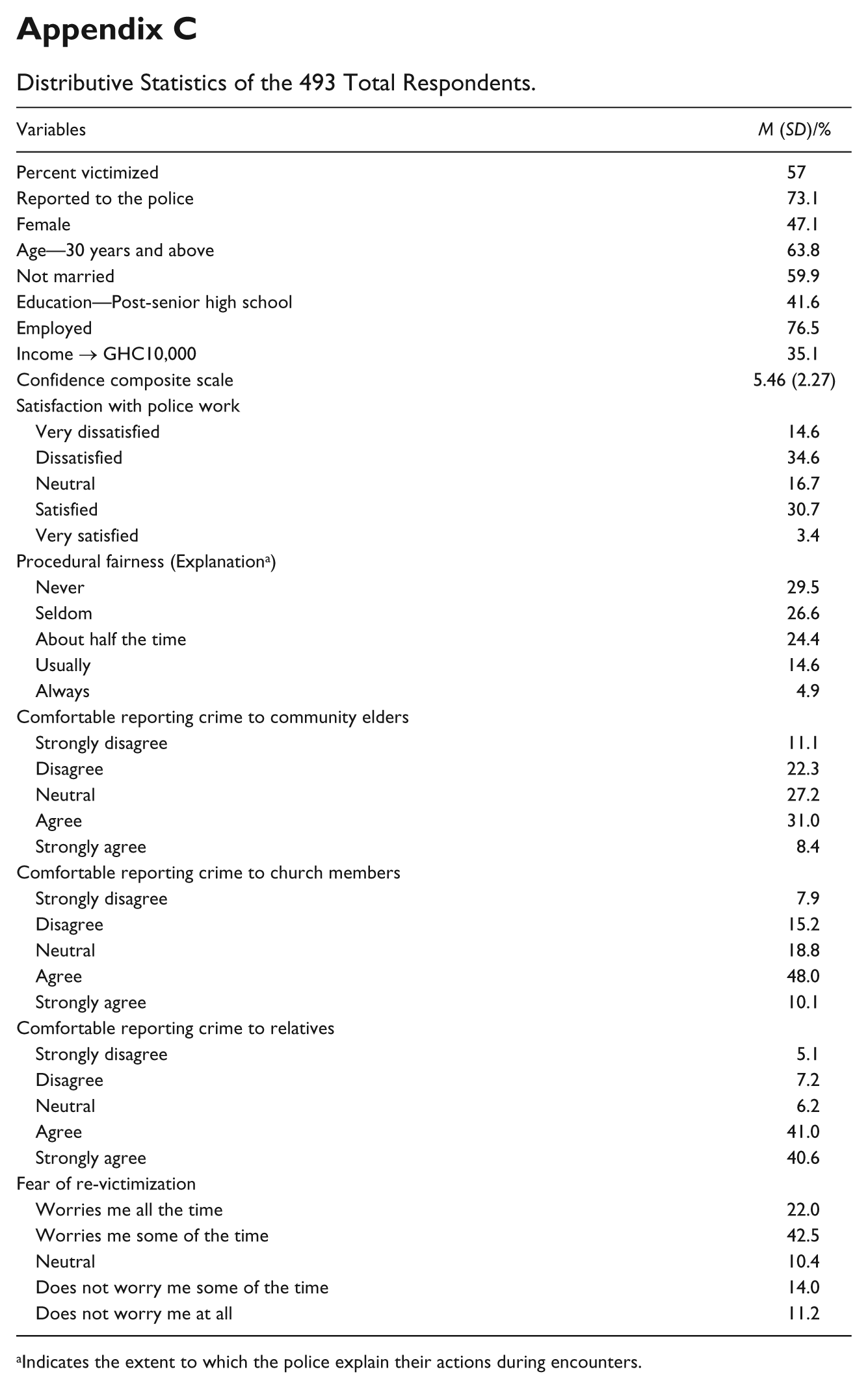
Questionnaires were distributed to 500 respondents (18 years and above) selected randomly from different households in five communities. Whereas the communities were conveniently selected, the households were randomly selected from the Census Enumeration Areas in Accra. In each household, one participant was chosen based on whose birthday was the nearest to the date of survey administration and was 18 years or older. Research assistants were employed to assist in the administration and collection of questionnaires and were thoroughly trained in the modalities of conducting a survey investigation and proper administration of questionnaires. The questionnaires were designed to solicit information about citizens’ opinion of the Ghana police, their experiences of victimization, and personal characteristics. Questionnaires distributed were completed on location, except when respondents specifically requested research assistants to return later for collection. The collection method ensured that the right participant completed the questionnaire and, accordingly, resulted in a good response rate of 98.6% (493 filled and returned questionnaires out of the 500 distributed). To abide by ethical standards of administering surveys, measures were adopted to ensure confidentiality of the information obtained from the respondents. Personal information that would otherwise link a respondent to a particular response was omitted on the questionnaire. Moreover, respondents were advised not to write their names or any identifiable information on the questionnaire. Finally, inform consent was asked by letting respondents know that participation in the study was voluntary and failure to participate would cause no harm to them. Of the 493 respondents, 281 (57%) had experienced prior victimization and 212 (43%) had no prior record of victimization. The analysis of the current study is focused on the 57% who had previously been victimized. See Appendix C for a detail description of the 493 respondents from the original survey.
Measures
Crime reporting variables
There are three dependent variables in the present study. Each of these variables required respondents to indicate whether they reported their victimization to the police or not. The first was sexual assault reporting, measured as a dichotomous variable, where 0 = no and 1 = yes; second was robbery crime reporting (0 = no and 1 = yes); and third was general crime reporting (0 = no and 1 = yes).
Attitudinal variables
Confidence in the police
Citizens’ confidence in the police was measured using two items. The first item was “to what degree do you believe the police to operate in the best interest of the public?” Responses ranged from not at all to to a great extent. The second item was “to what extent do you have confidence in the Ghana police to ensure adequate public safety?” Response categories ranged from very low confidence to very high confidence. Responses obtained were combined to form an additive scale, with an alpha value of .80, suggesting a high internal consistency of the scale.
Satisfaction with police work
Satisfaction was measured with a single five-item Likert-type scale used to gauge their satisfaction levels, and the response categories ranged from very dissatisfied to very satisfied.
Procedural fairness
Procedural fairness was also measured with a single five-item Likert-type scale asking respondents such question as “How often do the police give honest explanation for their actions to people they encounter on the street?” Response categories were 1 = never, 2 = seldom, 3 = about half the time, 4 = usually, and 5 = always.
Demographic variables
The effects of several demographic variables were examined in the current analysis. Gender was measured as 0 = male and 1 = female; victim’s age was measured as a dummy variable (1 = 18-29 years, 2 = 30-39 years, 3 = 40-49 years, and 4 = 50 years and above), with 18 to 29 years as a reference category. Victim’s education was measured as a dichotomous variable where 0 = senior high school (SHS) or less and 1 = post-SHS. Victims’ employment status was assessed as 0 = unemployed or 1 = employed. Victims’ marital status, which was included as a control variable, was measured as 0 = married and 1 = not married. Victims’ income levels were also controlled (0 = GHC10,000 or less and 1 = more than GHC10,000).
Informal support group variables
The effects of three informal support group variables were controlled in the regression models. These variables assessed victims’ willingness to report crime to community elders, church leaders, and relatives. Each of these items had the same lead-in question asking victims to indicate the extent to which they felt comfortable reporting crime to (a) community elders, (b) church leaders, and (c) relatives. A five-item Likert-type scale was used ranging from strongly disagree to strongly agree.
Fear of repeat victimization
Victims’ fear of repeat victimization was assessed with a single item, asking respondents the following question: “Does the fear that you will be re-victimized worry you a lot these days or not?” Respondents were requested to choose 1 = worries all the time, 2 = worries me some of the time, 3 = neutral, 4 = does not worry me some of the time, or 5 = does not worry me at all. It was assumed that victims who were least fearful of re-victimization would hesitate to report a crime to the police. The descriptive statistics of the study respondents are presented in Table 1.
Descriptive Statistics of Crime Victims.
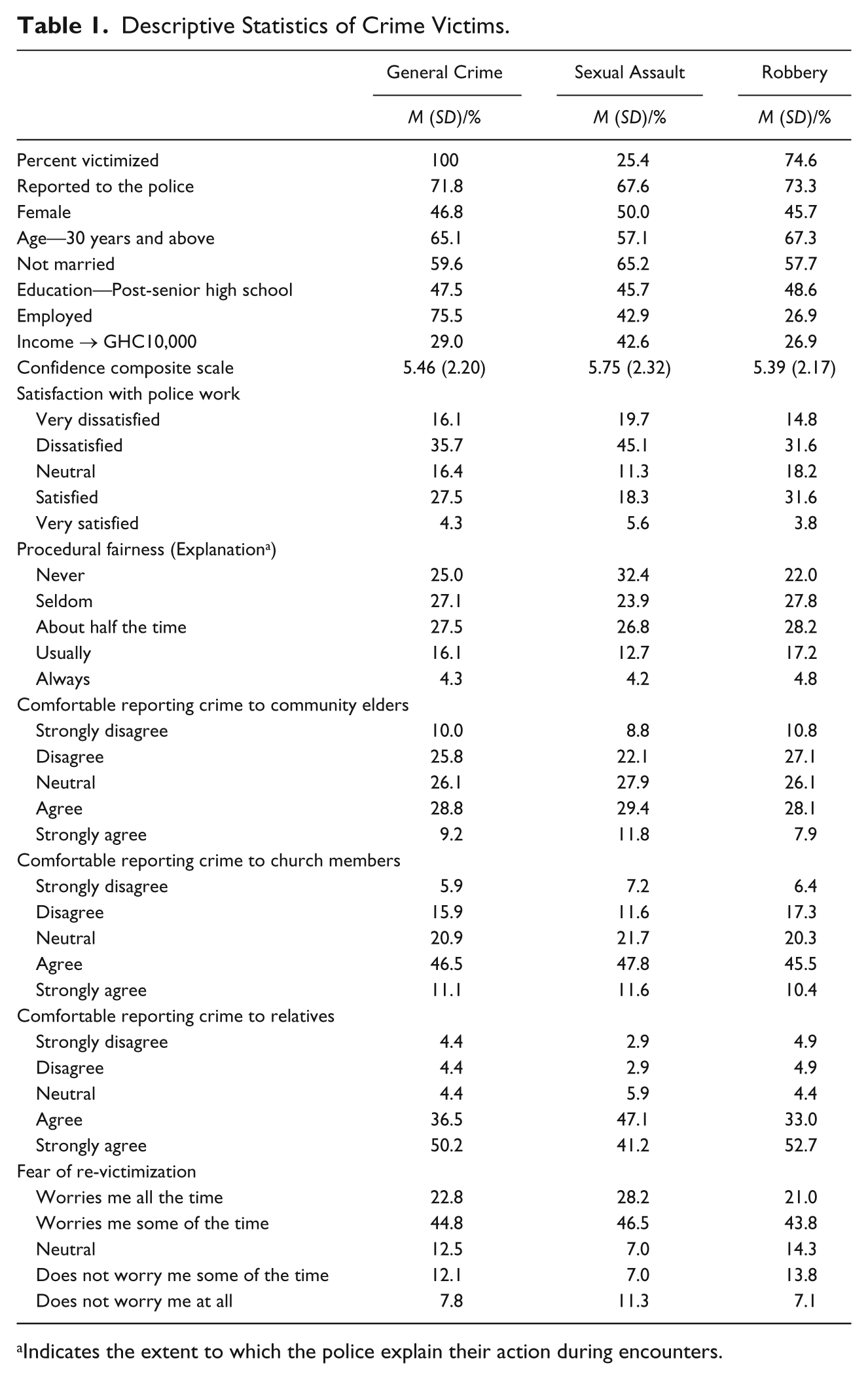
Indicates the extent to which the police explain their action during encounters.
Results
To explore the effects of the predicted variables on victims’ crime reporting behavior, series of multivariate binary logistic regression models were conducted, as presented in Table 2. The first model examines the effects on victims’ decisions to report crime in general to the police, whereas the second and third models discuss the factors influencing victims’ decisions to report sexual assaults and robberies, respectively. In all these models, the effects of the independent variables (satisfaction, confidence, fairness, female, age, education, employed, marital status, and income) and the control variables (fear of re-victimization and willingness to report crime to community elders and church members) were examined. However, victims’ willingness to report crime to their relatives was examined in the general crime and robbery models.
Logistic Regression Coefficients Predicting Reporting of Crime in General, Sexual Assault, and Robbery to the Police.

Note. OR = odds ratio.
Was not included in the sexual assault model, and by excluding it, improved the model significantly.
p < .05. **p < .01. ***p < .001.
Effects on Reporting Crime in General
The general crime model was significant (χ2 = 24.97, p < .05) and explained 15% of the variance in crime reporting. The results indicate that after controlling for the effects of other predictors in the model, satisfaction with police work (Wald = 3.49, p < .05) and confidence in the police (Wald = 1.62, p < .05) had significant influence on victims’ decisions to disclose incidents to the police. Victims who expressed being satisfied with police work were 1.37 times more likely to report crime to the police (OR = 1.37) compared with those not satisfied with police work. Similarly, crime victims who expressed greater confidence in the police had greater odds of reporting crime to the police compared with those with lower confidence in the police (OR = 1.09). These observations offer support for the first hypothesis that crime victims’ decisions to report crime to the police will positively be influenced by their assessments of the police.
Perceived police fairness was not found to be significant, indicating that decision to report crime to the police does not depend on victims’ assessment of police fairness. One demographic variable was found to predict victims’ reporting behavior, marital status—not married was significant (Wald = 3.06, p < .05) and with an odds ratio of 0.50; victims who were not married had 50% decreased odds of reporting crime to the police compared with married victims. The remaining demographic variables—gender, age, education, employment, and income—were not statistically found to predict victims’ reporting behavior, failing to achieve supports for the study’s other hypotheses.
Furthermore, two informal support group variables—reporting to church members (Wald = 3.41, p < .05) and reporting to relatives (Wald = 5.76, p < .05)—were also found to predict reporting crime to the police. Victims who expressed feeling comfortable reporting crime to their church members were 1.37 times more likely to report crime to the police. However, those who expressed feeling comfortable reporting crime to their relatives were 37% less likely to disclose crime to the police.
Effects on Reporting Sexual Assault
Columns 4 to 6 of Table 2 present the results regarding the effects on sexual assault victims’ decisions to report incidents to the police. The model was significant (χ2 = 17.59, p < .01) and explained 44% of the variance in sexual assault reporting. Victims’ assessments of police fairness (Wald = 3.65, p < .05) had a significant impact on their decision to report sexual assault incidents to the police. With an odds ratio of 1.07, sexual assault victims who considered the police to be fair had 1.07 times the odds of reporting sexual assault to the police compared with those who perceived the police to be unfair (OR = 1.07). Similarly, not married was significant (Wald = 3.83, p < .05) and with an odds ratio of 0.12, victims who were not married had 85% decreased odds of reporting sexual assault to the police. Moreover, education—post-SHS—positively and significantly influenced victims’ reporting decision (Wald = 3.35, p < .05). Victims who had attained more than SHS education were 3.35 times likely to report sexual assault to the police. Feeling comfortable reporting sexual assault to community elders (Wald = 2.40, p < .05) and fear of re-victimization (Wald = 3.96) both had significant positive effects on victims’ behavior. However, feeling comfortable reporting sexual assault to church members (Wald = 3.86, p < .05) negatively influenced victims’ decision to report sexual assault to the police. With an odd ratio of 0.13, victims who felt comfortable to report the incident to church members were 87% less likely to report the crime to the police. Confidence in the police, age, gender, employed, and income failed to predict reporting of sexual assaults to the police.
Effects on Reporting Robbery
The robbery model was significant (χ2 = 29.53, p < .01) and explained 23% of the variance in reporting robbery incidents. After controlling for the effects of other predictors in the model, the results revealed that satisfaction with police work (Wald = 0.61, p < .05) and confidence in the police (Wald = 2.02, p < .01) had significant impact on victims’ decisions to report robbery incidents to the police. With an odds ratio of 1.17, victims who expressed greater satisfaction with police work had 1.17 times the odds of reporting crime to the police compared with those not satisfied with police work. Likewise, robbery victims who expressed greater confidence in the police had greater odds of reporting crime to the police compared with those who had lower confidence in the police (OR = 1.19). These findings are in accordance with the study’s expectation that victims’ attitude toward the police will influence their decisions to report crime. Perception of fairness was not significant, suggesting a lack of effect on reporting of robbery.
Moreover, age was a significant factor influencing robbery reporting (Wald = 3.38, p < .05). Older victims (30 years and above) had 2.38 times the odds of reporting robbery attacks to the police compared with victims below the age of 30 years old, a finding that supports the assumption in Hypothesis 2. Employment status of victims was found to be a significant predictor orobbery reporting (Wald = 4.09, p < .05). Victims who were employed had 68% lower odds of reporting robbery to the police, achieving the study’s expectation that employed victims compared with the unemployed will have lesser odds of reporting robbery. Victims’ gender, income, marital status, and education were not found to predict reporting of robbery to the police.
Discussion and Conclusion
The present study extends the findings of previous research by exploring the influence of victims’ attitudes toward the police on their decisions to report general crime, sexual assault, and robbery. In addition, the study examines the influence of victims’ characteristics and their desire to report criminal incidents to informal support groups on their decisions to disclose crime to the police. The findings of the current study indicate that victims’ decisions to disclose crime to the police are positively influenced by their attitudes toward the police. This observation lends support to the study’s first hypothesis that crime victims’ decisions to report crime to the police will positively be influenced by their assessments of the police. Victims who are satisfied with the work of the police in their neighborhoods and those who have high confidence in the police are more likely to report sexual assault and robbery to the police. Similarly, individuals who perceived the police to be fair and explained their actions to the public were more inclined to report sexual assault to the police.
These observations offer support for the notion that favorable attitudes result in citizens’ voluntary cooperation with the police. Police scholars have long argued about the importance of trust and confidence in policing, asserting that the two variables lead to effective policing because the police enjoy voluntary citizen cooperation and citizen compliance with the laws being enforced (Hough & Roberts, 2004; Jackson & Bradford, 2010; Mazerolle, Antrobus, Bennett, & Tyler, 2013; Murphy & Cherney, 2012; Rosenbaum et al., 2005; Tyler, 1990, 2005; Stoutland, 2001; Sunshine & Tyler, 2003). The findings further shed light on the argument that favorable perceptions influence police effectiveness and enhance police legitimacy. Public trust, for instance, legitimizes police actions (Goldsmith, 2005; Hough, 2012; Hough, Jackson, Bradford, & Myhill, 2010; Sunshine & Tyler, 2003), and a legitimate police force faces minimal to no challenge to its authority (Tankebe, 2013).
From a victimological perspective, a plausible explanation for the observed effects could be that victims would want to be assured that the police would treat them fairly, handle their reports effectively, and protect their confidential information from getting to the public domain. This assurance could only be ascertained through their assessments of the police. In a study examining why sexual assault victims were not satisfied with the reporting process, Boateng (2015) observed that most victims were not satisfied with the reporting process because the police did not treat them well and did little about their complaints. Before deciding to report cases to the police, victims of all crimes would want to be confident that the police would handle the case effectively.
Another pattern of results observed was the effects of victims’ characteristics on their reporting behavior. Consistent with prior research (Baumer, 2002; Watkins, 2005), an increase in age increases a person’s propensity to report crime to the police, especially robbery incidents. Compared with younger persons, older individuals were more likely to report robbery incidents to the police. Two reasons may account for why reporting of robbery is higher among this segment of the population. First, older people may be heavily affected by the commission of the crime than the younger ones due to massive accumulation of wealth. Stated differently, older individuals unlike the younger people are more likely to have their valuables stolen during robbery and, as a result, more likely to report to the police with the intention of recovering their stolen properties. Second, older people who are mostly considered vulnerable in the society will not hesitate to get their victimizers arrested and punished. This will give them some closure and subsequently reduce their rate of fearfulness of future attacks. Regarding the relationship between employment status and reporting of robbery, it can be mentioned that victims who were employed at the time of the incidents were less likely to report robbery victimization to the police because of the lengthy criminal justice processes they will undergo, which might have undue effect on their productivity at work. To avoid going through several months of trial process, such victims may decide against reporting crime to the police. This is particularly true in non-Western societies where victims’ rights—the right against employer humiliation—are not well recognized.
An interesting observation was the influence of victims’ desire to report crime to informal support groups—friends, family members, church members, and community elders. The results demonstrate that sexual assault victims who felt comfortable reporting incidents to their church members were less likely to report the incidents to the police, whereas those who felt comfortable reporting to community elders were more likely to report to the police. This pattern is perhaps due to the differing feedback that victims might get from these groups: Church members, because of their strong faith in God, might advise victims to give their problems to God and pray for forgiveness of sin for the offender. Christians believe that God is the ultimate punisher of sins, and that, God will punish their victimizers. This kind of preaching may convince a victim from not going to the police. Conversely, community elders, because of their status in the community, may advise victims to report their victimizations to the police. These elders may develop a working relationship with the police to stop crime happening in their jurisdictions. Scholars have argued that the community is a co-producer of crime solutions, suggesting that the community has a role to play in crime prevention (Cordner, 2014; Kelling & Moore, 1989).
Understanding the mechanism through which attitudinal variables affect victims’ intentions to report crime to the police has serious practical and theoretical implications. Practically, the finding that attitudes about the police influence crime reporting offers insight into the kind of strategies to adopt to enhance victims’ willingness to report crime to the police. Attitudes and behaviors of the police that undermine reporting should be discouraged. Police officers must respect victims’ confidentiality and avoid leaking classified information about victims to people who are not supposed to have access. Adhering to the rules of confidentiality and respecting the rights of victims might increase confidence in the police, especially among crime victims. Keeping victims’ secret information secure will also make them more confident that the police can protect them against retaliation. In addition, programs that are aimed at developing favorable public attitudes about the police are encouraged. Officers must enhance their performance in the neighborhoods and go the extra mile to satisfy the communities they serve. The theoretical implications of the study’s findings are that it offers empirical evidence about the relationship between perceptions and crime reporting, and supports the general argument that favorable attitudes toward the police lead to citizens’ voluntary cooperation with law enforcement and compliance with criminal law.
Like many studies using secondary data, this study utilized a subsample of respondents selected from an original dataset that did not use a nationally representative sample. The original dataset contains information about individuals sampled from one geographical area of Ghana, limiting the present study’s ability to generalize its findings to a larger population. Furthermore, the study did not observe any effect for procedural fairness, suggesting that fairness during encounters does not predict reporting by victims. The lack of effect is problematic, given the importance of procedural fairness in shaping attitudes. As the lack of effect may be due to how the variable was measured—using a single item—further research is needed to incorporate several items into the measurement of procedural fairness. In addition, it is suggested that further research should study the link between attitudes and crime reporting by focusing on conducting advance analysis to determine whether aggregate attitudes of the community will predict reporting. This will further the discussion beyond the individual-level attitudes.
Despite these limitations, the present study has been able to address a major issue in the attitudinal and crime reporting literature. Based on the current analysis, we can safely argue with justification that citizens’ assessments of their local police can explain whether victims of crime will report incidents to the police or not. Confidence and satisfaction with police work have predictive effects on victims’ decisions to call formal agents of control. Specifically, victims who demonstrate higher confidence in the police as well as those who are satisfied with police performance in their neighborhoods tend to report crime more than their counterparts who are less confident and unsatisfied with the work of the police. Satisfaction with police work may signal to victims that the police are effective and can handle their case more effectively. Aside from these findings, the study has also shown that victims’ attitudes about reporting crime to their friends, relatives, church members, and community elders influence their attitudes about reporting crime to the police. For instance, those who prefer to confide in their church members about their sexual assault victimizations mostly do not report crime to the police, whereas those who go to community elders also go to the police. In short, the findings of the present study extend our knowledge on crime reporting by exploring the effects of variables that have barely been examined by previous studies, hence making a significant contribution to the police literature.
Footnotes
Appendix
Distributive Statistics of the 493 Total Respondents.
| Variables | M (SD)/% |
|---|---|
| Percent victimized | 57 |
| Reported to the police | 73.1 |
| Female | 47.1 |
| Age—30 years and above | 63.8 |
| Not married | 59.9 |
| Education—Post-senior high school | 41.6 |
| Employed | 76.5 |
| Income → GHC10,000 | 35.1 |
| Confidence composite scale | 5.46 (2.27) |
| Satisfaction with police work | |
| Very dissatisfied | 14.6 |
| Dissatisfied | 34.6 |
| Neutral | 16.7 |
| Satisfied | 30.7 |
| Very satisfied | 3.4 |
| Procedural fairness (Explanation a ) | |
| Never | 29.5 |
| Seldom | 26.6 |
| About half the time | 24.4 |
| Usually | 14.6 |
| Always | 4.9 |
| Comfortable reporting crime to community elders | |
| Strongly disagree | 11.1 |
| Disagree | 22.3 |
| Neutral | 27.2 |
| Agree | 31.0 |
| Strongly agree | 8.4 |
| Comfortable reporting crime to church members | |
| Strongly disagree | 7.9 |
| Disagree | 15.2 |
| Neutral | 18.8 |
| Agree | 48.0 |
| Strongly agree | 10.1 |
| Comfortable reporting crime to relatives | |
| Strongly disagree | 5.1 |
| Disagree | 7.2 |
| Neutral | 6.2 |
| Agree | 41.0 |
| Strongly agree | 40.6 |
| Fear of re-victimization | |
| Worries me all the time | 22.0 |
| Worries me some of the time | 42.5 |
| Neutral | 10.4 |
| Does not worry me some of the time | 14.0 |
| Does not worry me at all | 11.2 |
Indicates the extent to which the police explain their actions during encounters.
Declaration of Conflicting Interests
The author(s) declared no potential conflicts of interest with respect to the research, authorship, and/or publication of this article.
Funding
The author(s) received no financial support for the research, authorship, and/or publication of this article.