




Abstract
This study examines how youth interpret potentially violent encounters, their own identity as victims, and their responses to dangerous situations. The purpose is to understand when “victimization” does or does not lead to a violent response and how individuals negotiate risky situations. Qualitative interviews from 147 youth, aged 12 to 23 across three high-crime neighborhoods in Philadelphia, were examined. Of these youth, 86 individuals described 136 encounters with violent or threatening situations. Coding examined themes in youth perceptions of these encounters, as well as their responses. Three themes emerged in the youth’s accounts: youth as victims, youth as street smart, and youth action as self-defense. Youth’s understanding of risk and situational dynamics of the encounter shaped their perceptions of violent incidents and consequently if they responded with violence or used other strategies such as help seeking, avoidance, negotiation, or tolerance. Youth’s understanding of victimhood should be considered in research on the victim–offender overlap and generally in youth violence studies. Implications for the victim–offender overlap include incorporating a more nuanced perspective on social distance and power dynamics as understood by victims. Implications for policy include providing culturally sensitive violence reduction models and victim services that account for youth’s own understanding of their experiences.
Introduction
Although often viewed as distinct groups, victims and offenders share a strong empirical association, known as the victim–offender overlap or “the overlap” (Lauritsen & Laub, 2007). However, recent studies suggest that a more complex understanding of this phenomenon and its consequences is warranted. The relationship between victimization and offending varies across neighborhood contexts and individual routine activities (Berg, Stewart, Schreck, & Simons, 2012; McNeeley & Wilcox, 2015). In some cases, victimization may promote desistance from offending (Jacques & Wright, 2008; Ousey, Wilcox, & Fisher, 2011). Although there has been growth in this area of inquiry, few studies—with the exception of work on offending populations (e.g., Jacques & Wright, 2008, 2011) and police narratives of criminal events (e.g., Kubrin & Weitzer, 2003; Luckenbill, 1977)—have explored the meaning given to violent events. Additional work is needed in understanding the experiences of youth, including nonoffenders, and how they navigate dangerous situations in their own communities.
In addressing these gaps in the literature, the current study examines violent encounters across three high-crime neighborhoods in Philadelphia in which youth are the targets of violence or threats of violence. Although young men of color and economically disadvantaged youth are often the focus of criminal behavior, less emphasis has been directed to them as victims (Sered, 2014). Research is needed on their perspectives and how such experiences with violence may differ for males and females. Existing literature has found that gender shapes perceptions of risk and behavior within social contexts (Cobbina, Miller, & Brunson, 2008; Miller, 2008). In addition, evidence suggests that gender differences also exist in seeking help when victimized (Kaukinen, 2002).
Therefore, the purpose of this study is to (a) identify how youth understand and negotiate experiences with violence, including how they define themselves as victims and (b) how they respond to such incidents: Do they seek help, take personal action, or use other strategies? Youth’s own stories help us understand “commonly invoked explanations of behavior” through the viewpoint of the actor, his or her thoughts, and perceived alternatives (Becker, 1966). In other words, youth narratives can challenge assumptions about how they understand victimization and the ways in which they respond to violence. An understanding of youth accounts also provides insights about youth agency—whether youth seek informal counsel, mobilize the law, retaliate, or take no action (Black, 1998). In exploring these questions, this research adapts the concept of “legal consciousness,” which is defined as the way in which individuals think about and use the law (Ewick & Silbey, 1998). Specifically, it examines youth’s victim consciousness, how youth think about and respond to encounters with violence.
The current study advances knowledge of youth experiences with violent encounters and contributes to developing a more nuanced theory of the victim–offender overlap. Young people who align their experiences with the ideology of victimization or the ideal victim (Christie, 1986) are more likely to mobilize help and services associated with victims of crime. In contrast, those who give violent encounters a different meaning take alternative actions, including the use of violence. While structural risk increases the likelihood of violent encounters, the context of the specific event and the dynamics of power help to define victimhood and consequently who is a “victim.” The experiences and perceptions of youth can help to inform policies and programs that aim to reduce violence and respond to victims of crime. In particular, with knowledge of youth perspective on violent encounters, more appropriate services can be made available to their needs.
Social Contexts of Victim–Offender Overlap
Current understanding of the victim–offender overlap suggests that cultural, structural, and situational factors influence shifting roles from victim to offender and vice versa. In particular, the social context in which youth live may be important in shaping both risk and perceptions of risk. The subculture of violence perspective suggests that both victimization and offending stem from support for violence in which even the most trivial disputes are viewed as appropriate grounds for violent reactions (Wolfgang & Ferracuti, 1967). In neighborhoods with low “street culture,” victims were less likely to engage in offending, and offenders were less likely to be victimized (Berg et al., 2012). Violent attitudes or street codes supporting the use of violence may be rooted in a neighborhood’s broader structural problems, such as poverty, racial and ethnic segregation, and legal cynicism (Anderson, 1999; Kirk & Papachristos, 2011). The combination of over-policing (responding too aggressively to minor incidents) and under-policing (when responding to victims) attenuates already strained relationships between police and high-crime—often minority—communities. Victims instead must turn to informal sources of support, which may include the carrying weapons for self-protection, joining a gang or executing plans for revenge (Black, 1998; Klevens, Duque, & Ramírez, 2002; Rios, 2011).
Another way in which neighborhood context contributes to the victim–offender overlap is through repeated exposure to violent behavior. Exposure to violence lessens the ability of youth to avoid violence when encountering a risky situation (Sharkey, 2006) and might increase the likelihood of using violence (Wilkinson & Carr, 2008). In looking at criminal events, Luckenbill (1977) found that homicides resulted from an exchange between individuals taking on roles as victim and offender starting with a minor affront and escalating into more aggressive behavior. Conflicts illustrated how disputants tried to “save face” and build reputation by using violence. Fighting functions as a means to maintain or build reputation (Anderson, 1999). Violence also serves the role of retaliation or justice when formal social control is absent or unavailable (Black, 1998; Jacobs & Wright, 2006; Kubrin & Weitzer, 2003; Tedeschi & Felson, 1994).
The link between belief in street codes and victimization is also shaped by the nature of activities and time spent in public places (McNeeley & Wilcox, 2015). The number of motivated offenders in a particular social context shapes victimization risk and whether a potential victim is likely to encounter an offender. Individuals who live in areas with more offenders and those whose routines cause them to come into contact with these networks, either through peers or time and means of traveling in public, are at greater risk to be victimized (Cohen, Kluegel, & Land, 1981; Schreck, Fisher, & Miller, 2004). When these routines involve offending, such deviant lifestyles are likely to enhance risk for victimization (Jensen & Brownfield, 1986; Sampson & Lauritsen, 1990). Offending behavior presents additional vulnerability because people with this type of lifestyle are the least “ideal” victims and have less access to legal protection (Berg, Slocum, & Loeber, 2013; Black, 1998; Jensen & Brownfield, 1986; Topalli, Wright, & Fornango, 2002). Offenders who are victimized may not be taken seriously or may even be punished for their own criminal activities by the police and may be harmed by their peers for fear of snitching (Jensen & Brownfield, 1986; Rosenfeld et al., 2003).
Nonviolent Responses to Risky Situations
Even in neighborhoods with a higher tolerance of violence, the majority of residents do not want to live in violent neighborhoods (Harding, 2010). Although environment plays an important role in shaping behavior, youth agency is also an important factor. With knowledge of what places are dangerous, young people who feel confidence in their avoidance ability are less likely to use violence or associate with violent peers (Sharkey, 2006). Youth may consider themselves “street smart” by strategically avoiding people and places perceived to be dangerous (Cobbina et al., 2008; Harding, 2010). Youth also adapt through gender-specific strategies for minimizing risk. Cobbina and colleagues (2008) found that females avoided public life or sought the help of male peers and family members, whereas males made less striking changes in behavior, sticking to their own neighborhood boundaries and avoiding actions that might be perceived as offensive to rival groups (Cobbina et al., 2008). Evidence indicates that even drug dealers use methods of negotiation and avoidance in situations where there is a perceived economic benefit or to specifically minimize victimization risk (Jacques & Wright, 2011). These situational dynamics are important considerations in understanding youth perceptions of encounters.
Youth may also attempt other remedies and reactions, including seeking help from the police or informal sources in the community (Black, 1976, 1998). Even in “no-snitching” cultures, police may be called in some situations or circumstances (Clampet-Lundquist, Carr, & Kefalas, 2015; Jacques & Wright, 2013; Slocum, Taylor, Brick, & Esbensen, 2010). For example, youth acknowledge that the police may be okay to contact if a victim is undeserving of harm or if the fight is unfair. Harm against family members and elders may also be considered appropriate exceptions to the no-snitching rule (Clampet-Lundquist et al., 2015). Evidence using hypothetical situations also suggests that youth’s perceived victimization risk is associated with a greater likelihood of reporting to police (Slocum et al., 2010). These findings indicate that if youth are victimized themselves and in particular circumstances when harm is “undeserved,” they will be more likely to report to the police or another authority. In other words, despite cynicism toward police, a “true victim”—someone who cannot or should not fight back—may seek their assistance.
Understanding Who Is a Victim
Social and cultural contexts shape youth understanding of victimization. These influences go beyond the immediate social context of youth’s neighborhoods and peer networks but are often reinforced by these local structures. Mass media and popular culture define the meaning of victimization and legitimize some types of victims over others (Christie, 1986; Garland, 2001; Madriz, 1997; Simon, 2007). Common understandings of crime foster the idea that it is mostly random in nature and that most victims are individuals who are the most vulnerable (Madriz, 1997). Ideal victims engender feelings of sympathy and are not blameworthy. Ideal victims are clearly distinguished from the offender, who is unknown to the victim (Christie, 1986). These commonly held assumptions contrast with the majority of victims of violence, who, statistically, are young, minority, and male, and offenses that often involve acquaintances or other known perpetrators, as well as offenses in which the roles of offender and victim are not entirely distinguished (Luckenbill, 1977; Madriz, 1997).
Although victimization engenders feelings of sympathy for the victim and punishment for his or her offender, victim also has a negative connotation—that of weakness. In this sense, being a victim can be a stigmatizing identity. Victims of domestic violence, sexual assault, and other crimes often refer to themselves as survivors. The survivor identity aligns more closely with the notion of agency, strength, and resilience (Leisenring, 2006). Victimization also holds a negative meaning in masculine street-oriented contexts. Appearing vulnerable may enhance risk for victimization, which, in turn, may continue to place the individual at risk for future harm (Anderson, 1999). Therefore, youth in high-crime areas may not see themselves as victims or accept their status as victims as it is culturally understood, except in only the most justifiable situations.
Current Study
This study seeks to capture victimization and offending from the lens of young people who are confronted with violent and potentially violent encounters. It aims to understand the process by which people come to define themselves as a victim and views violent encounters as an interpretive process (Holstein & Miller, 1990; Rock, 2002). The participants’ experiences, interpretations, and responses to the incidents are not universal. The study takes into account the process of negotiating victim consciousness, the extent to which youth view their violent encounters as victimization, and evaluates accounts of young people’s responses to victimization.
Victim consciousness builds on the notion of legal consciousness, the way in which individuals think about and use the law. Legal consciousness also examines the situations and experiences in which the law is not invoked (Ewick & Silbey, 1998). Like legal consciousness, the notion of victim consciousness aims to identify the ways in which youth interpret situations with violence and their responses to these encounters. Legal consciousness is also utilized to understand the meaning of law as a reciprocal or constitutive process. Common understandings of law shape how individuals interpret their own experiences, and individual experiences shape a collective understanding of legality (Ewick & Silbey, 1998). Similarly, the notion of victimhood or who is considered an ideal victim may shape how youth interpret their own experiences and actions. Therefore, youth accounts are critical to understanding the link between victimization and offending and the conditions that facilitate the use of violence, the victim–offender overlap, mobilizing the law, and other responses.
Data and Method
The data in this study consist of narratives from young people in Philadelphia collected in the Young People and Crime Control project (Carr, Napolitano, & Keating, 2007). The purpose of the original study was to identify youth perceptions of the criminal justice system and to explore ways that young people could contribute ideas for crime reduction in their communities. Data were collected between January 1, 2002, and June 30, 2004. Three neighborhoods were selected because they each had a reputation for being a dangerous place. Police records indicated that these neighborhoods experienced a relatively large portion of serious crime, including high rates of homicide, rape, robbery, and assault, compared with other areas of the city. The neighborhoods were chosen to represent racially and ethnically diverse populations in which neighborhood boundaries were defined by the residents in the area (Carr et al., 2007).
After several months of collecting ethnographic data, forming ties with local residents, and gaining access to police records, the research team selected participants using a purposive sampling method through participant observation, community organizations, chain referral, probation offices, and day treatment facilities (Carr et al., 2007). Others were located through chain-referral techniques (Watters & Biernacki, 1989). Youth were purposely selected to represent the racial and ethnic composition of each neighborhood. In addition, the sampling procedure also aimed to have fairly equal representation of males and females. The last important criterion in the initial sampling was to include both delinquent and nondelinquent youth. The goal was to understand whether youth in similarly disadvantaged and high-crime contexts varied in their perceptions about social control by neighborhood, gender, and offending status.
Seven percent of recruited youth refused to participate because they were suspicious about the project and the amount of the incentive (see Carr et al., 2007). Each subject was given a self-administered questionnaire and then asked to participate in one in-depth interview. Each person was given US$25 for his or her participation, prior to the interview. All interviews were conducted with signed assent or consent from the participant and were tape-recorded. Participants were asked to describe their neighborhood, perceptions of crime and safety, delinquency, family and peer relationships, school, and their experiences and attitudes regarding the police. On average, interviews lasted approximately 1 hr. However, interview duration ranged from 15 min to 2 hr. Specific names and places were replaced to ensure the anonymity of the respondents (Carr et al., 2007).
Philadelphia and Its Neighborhoods
Philadelphia, a racially and ethnically diverse city, hosted a population of 1.5 million residents, according to data from the 2000 United States Census a few years before data collection began. Almost half the city’s population were African American (43.0%) and nearly 10% Hispanic (8.4%). Although the population had declined over the last few decades, most of these changes reflected the movement of White residents to the surrounding suburbs. Philadelphia had also been one of the most racially and ethnically segregated cities in the country. During the time of this study, census data indicated that just over half the city’s labor-force-aged population was working or seeking work (56%), the fourth lowest in the United States. About one fifth of the city’s residents were below the poverty line (22.8%) and only one third of adults held a high school diploma (Brookings Institution, 2003).
In 2002, there were 288 deaths by homicide in the city of Philadelphia. This number rose to 348 in 2003 and fell slightly to 330 in 2004 (Eichel, 2011). Philadelphia ranked among the top seven in homicide rates among major cities in the United States. Over the course of the data collection period, the homicide rate was 21.6 per 100,000 persons in Philadelphia compared with the national average of 5.6 per 100,000. Moreover, coinciding with the increase in social control nationwide (Garland, 2001; Simon, 2007), Philadelphia was consistently among the top five cities with the highest rate of incarceration. In 2005, 527 per every 100,000 residents were incarcerated (Petteruti & Walsh, 2008).
Within the city, this study focused on three neighborhoods: “Cedar Grove,” “El Barrio,” and “Plymouth” (Carr et al., 2007). Each pseudonym represents three communities featuring some of Philadelphia’s highest crime rates and economically disadvantaged conditions. Cedar Grove was a predominantly African American community (94.1%). Its proximity to an affluent and predominantly White suburban community exemplifies an extreme example of race and class segregation. Similar to the city as a whole, about one third of the area’s 28,985 residents had high school diplomas and nearly 30% lived in poverty (29.4%). Homicide rates in this neighborhood were 3 times higher than the city’s average and about 12 times higher than the national average, at 74.1 per 100,000 persons.
Plymouth, population 7,320, was a predominantly White community (94.5%) with only 2.5% Black and 4.7% Hispanic. Although the degree of concentrated disadvantage was incomparable for minority and White communities (Sampson & Wilson, 1995), Plymouth suffered much of the same problems of poverty and crime as Cedar Grove and El Barrio. While poverty was lower (15.4%) and the percentage of residents having high school diplomas was higher (34.8%) compared with the other neighborhoods, the homicide rate was approximately 3 times higher than that of Philadelphia, at 60.1 per 100,000 persons.
The third neighborhood, El Barrio, was home to 16,052 residents. Almost two thirds of residents identified as Hispanic (64.3%) with 28.2% Black and 20.1% White. El Barrio experienced the greatest disadvantage of all three neighborhoods with only a quarter holding high school diplomas (25.2%), and half of all residents fell below the poverty line. The homicide rate was the highest of any area in the city at 149.5 per 100,000. Each of these neighborhoods certainly represented from an outsider’s perspective, a dangerous place to live.
Data Analysis
Analysis of narratives can give voice to youth to account for their own thoughts and actions (Ewick & Silbey, 1995). To uncover the meaning of victimization, narratives were first explored to locate instances of violent encounters. Interviews were coded using ATLAS.ti 6.0 (Muhr, 2008). Coding included searching the narratives, for instances, of violence, threats, and other affronts. Coding included identifying the type of violent encounter, affront (a verbal or physical cue causing insult or harm), credible threat (a threat of harm with or without a weapon that the subject perceived to be serious in nature), assault (an attack or attempted attack with or without a weapon that resulted in a serious or minor injury; also referred to by youth as being jumped, stomped, rolled on), robbery/mugging (completed or attempted theft of cash or items by force with or without a weapon and with or without injury), sexual harassment or assault (unwanted sexual contact, sexual remarks, or romantic stalking), and other forms of harm that did not fall specifically in the categories above (e.g., hit and run, kidnapping).
Violent encounters included only those events in which a specific incident was described. For example, if someone said, “I was robbed,” this would not be examined in depth unless further details were provided. In most cases, the interviewer probed the subject to describe a specific example, but this was not always the case. Young people were asked about violent encounters through the question, “Have you (or any of your friends) been a victim of crime?” Participants were further probed for additional details if an incident was mentioned. Questioning varied for some youth who were probed for further information, or the question was asked in a different way. Some youth were provided examples of victimization: “Have any of your friends ever been a victim of crime? You know, assaulted or had something stolen from them?” Others were asked about victimization without using the word victim, “Has anyone threatened you or tried to hit you, you know threaten you . . . ?” Coding included identifying the relationship (if any) of involved parties, race/ethnicity, gender, current age, and age during the incident, as well as the participant’s emotion, reasoning for why the incident occurred, response (if mentioned), and reasoning for the response.
Results
In total, 147 interviews were used for the basis of identifying victim experiences, and 86 (58.5%) individuals experienced at least one specific violent encounter. In general, participants included in the analysis from the original sample (who described a victimization experience) were not significantly different from those who were not included (youth who did not describe a victimization experience), with the exceptions that youth in the analysis were more likely to have had a previous arrest or sold drugs and they were older than those who did not describe a violent encounter. Table 1 provides the sample characteristics of the subset of participants who described a violent encounter. A majority of participants were male (54.7%). Similar to the neighborhoods in which they were selected, 37.2% were African American/Black, followed by White (30.2%) and Hispanic/Latino (29.1%); 3.5% identified as mixed race or “Other.” A majority of the sample had family incomes below US$55,000 (88.3%). The mean age of the sample was approximately 17, but the range of ages was from 12 to 23.
Sample Characteristics.
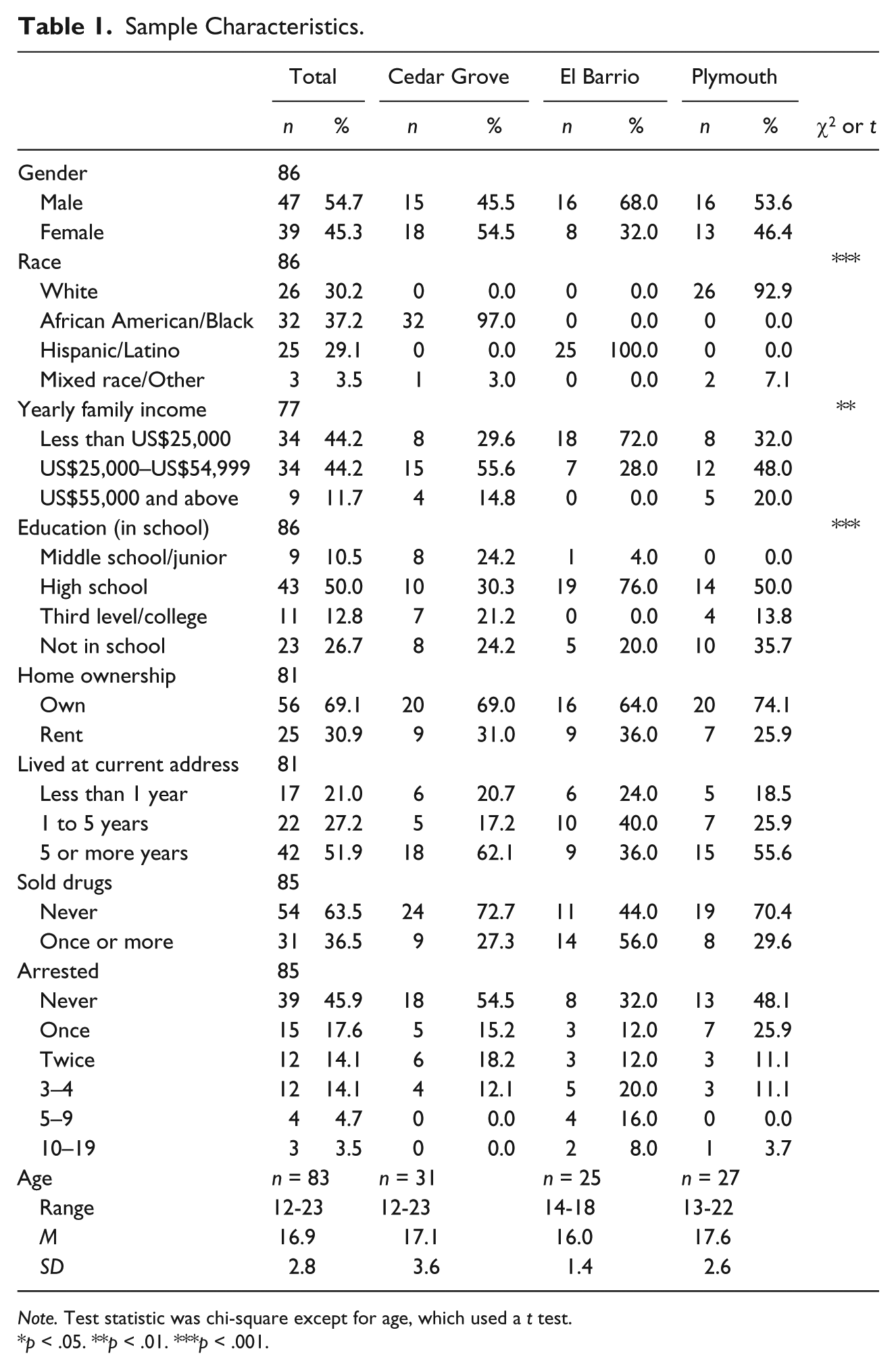
Note. Test statistic was chi-square except for age, which used a t test.
p < .05. **p < .01. ***p < .001.
The sample included youth across all three neighborhoods: Cedar Grove, El Barrio, and Plymouth. There were significant differences in race/ethnicity across neighborhoods as intended by the recruitment procedures (p < .001). In addition, youth from El Barrio reported lower family income (p < .01) and included more diversity in educational status (p < .001) at the time of the interviews. There were no significant differences by home ownership, gender, age, or offending history (had sold drugs or had previous arrest).
Among the 86 participants, there were 136 violent encounters. Most of the incidents involved a verbal altercation or minor physical contact (e.g., being pushed or shoved, bullied; 21%) followed by robbery or mugging (17%); being jumped or a more serious physical assault without a weapon (12%); assault with a weapon, including being shot, shot at, stabbed, or hit by an object (9%); serious threat to shoot or physically harm (7%); and the remaining cases included other forms of victimization, including sexual assault, attempted kidnapping, and hit and run by a drunk driver. Males were more likely to have encounters involving a threat, weapon, or being shot or shot at than females were. There were no significant gender differences in the likelihood of being jumped or experienced a verbal altercation/minor physical contact.
The goal of the study was to identify the extent to which youth described violent encounters through the lens of victimization, with particular attention to the characteristics of incidents, youth’s feelings, and youth’s actions (or nonaction). The primary mechanism to locate these dynamics was through the youth’s response to the question of whether they had been a victim of crime. However, it became evident that many youth denied being a victim of crime but later described experiences consistent with common definitions of victimization. Those youth who initially rejected the notion of victimization provided counternarratives that emphasized expertise in dealing with risky environments or redefining victimization through the lens of self-defense. Three overarching themes emerged from the youth narratives: victim consciousness, street consciousness, and defensive consciousness.
Victim Consciousness
Youth gave varied responses when asked whether they had been victims of crime. Some youth immediately described an incident in great depth. Others were more reluctant in acknowledging that they had a victimization experience or denied any victimization encounters. Youth who showed the strongest connection to their experience as victimization by affirming this status were identified within the schema of victim consciousness. Approximately one third of violent encounters fell within this category. Females were more likely than males to acknowledge their experiences as a victimization. Furthermore, youth without prior arrests were more likely than youth with prior arrests to describe incidents through a victimization lens. These findings were consistent with the social construction of ideal victimhood (Christie, 1986; Madriz, 1997). In other words, youth tended to view their own experience as victimizations when they most closely aligned with this stereotype. Characteristics of youth in this schema included feelings of fear, offenses committed by strangers, and unexpected encounters.
Victim consciousness and seeking help from police and other adults
Youth’s understanding of experiences is linked to different ways in which youth respond. Victim conscious youth were more likely than youth in other schemas to seek help, including reporting to the police or other adults, or by avoidance in running away and changing routine activities to avoid dangerous areas. Youth in this schema sought help from some type of authority in one of four incidents. Bianca described a typical example of an experience leading to police involvement. Bianca, a 14-year-old Latina, lived with her mom, two brothers, and her cousin in El Barrio and was enrolled in school. She had never been in trouble with the law, and throughout her narrative, she mentioned her fear of crime and drug use in her community. When asked whether she had been a victim of crime, Bianca initially hesitated. Then she recalled that she had been “stuck up one time.” She then described an incident that occurred while she was coming home from school:
I was in fifth grade, I think, and this guy . . . And this guy came up to me. I was walking with a group of my cousins. They was walking home, and my chain was inside but I guess when I bent down . . . he stuck me up, and he took off his glasses and all, I was real scared. It was some Black guy.
Was it an older guy?
Yeah . . .
Bianca’s robbery involved an older male of a different race who targeted her on her way home from school, even though she was walking in a group. She was much younger than her attacker, who also possessed a weapon. Bianca viewed her experience as bad luck because of the random nature of the incident. She was in the wrong place at the wrong time. Like some participants who viewed their experiences as “bad luck,” Bianca told her story in a racialized way, identifying the man as “some Black guy.” Bianca’s response to the street robbery of her necklace when she was in fifth grade was to tell her aunt, who, in turn, called the police. Bianca’s story illustrates how an encounter is understood to be a victimization when it aligns with many characteristics associated with the social contrition of ideal victims (Christie, 1986). She was harmed in the course of legitimate activities and overpowered by someone unknown to her. It also suggests that when an experience is identified as a victimization, help seeking and claiming victim status to others may be viewed as more plausible.
Contacting an authority was not limited to females or nonoffending victims. Joe, 19, a White male from Plymouth, had a history of selling marijuana and had been arrested on more than one occasion. When asked about experiences in which someone threatened or used a weapon on him, he told a story of being shot during a stickup. He was walking down the street with some female friends when this Black dude was walkin’ up with his hoodie tied down real tight, an’ he’s walkin’ up an’ I thought, I knew somethin’ was up with him the way he had his hoodie tied. An’, like, he just got up to me an’ put the gun up to my head an’ told us to get up against the wall. An’ he’s, like, tellin’ me to give him the shit . . . He, he pistol whipped me an’ I had four stitches on my chin somewhere.
When a neighbor saw what was going on, the neighbor shot into the air to scare the robber away. But, in reaction to the gunshots, Joe stated, “The Black dude just got scared an’ just started shootin’ at me. Shot at me, like, 5 or 6 times.” When asked how he felt, Joe said, “I was shocked. I was real high, so it wasn’t as bad as it would [have been] if I was normal. Like, it was numb.” When asked whether he called the police, Joe said he had and that they drove him to the hospital.
Similarly, Pete (22, mixed race/ethnicity, El Barrio), also with an arrest history, was caught off guard walking home one night when he was younger. He described an encounter when he was stuck up and hit, stating that this particular incident “hurt his pride” because the attackers—although there were two of them—were younger than he. When he walked around the corner, he saw a police officer sitting in his car, and he continued, “I came back down the block an’ told the cop, ‘Yo I just got robbed. Can you help me? Let me fill out a report or some shit.’” Although females and law-abiding youth were more likely to discuss their experiences through a victimization lens, both Pete’s and Joe’s stories show that this interpretation is not exclusive to these groups. It also challenges the common notion that offenders will not seek help from the police. Similar to Bianca, Pete and Joe were harmed unexpectedly when they were each overpowered by someone unknown to them.
Victim consciousness and avoidance
Another strategy in responding to unexpected events or incidents involving a power imbalance was to escape or avoid the situation. For many victims, running away from the attacker was a primary response. Others avoided harm by changing their routine activities, moving to a new home, or changing schools. Similar to victims who contacted authorities, young people who used avoidance strategies were disadvantaged against their attacker, without the ability to defend themselves. In about one in three victim conscious incidents, youth responded by either avoidance or retreat.
Around the age of 17, Rashid, a Black male from Cedar Grove, was walking by himself through a neighborhood that was not his own. Rashid had no criminal record and had never sold drugs. Occasionally, he skipped school and smoked marijuana, but he generally stayed out of trouble. When asked whether he had ever been a victim, he said no. However, when asked whether he had been robbed or stuck up, Rashid recalled one time. As he told his story, Rashid commented that if he were in his own neighborhood, he would not have been targeted.
He pulled out a gun, but he was checking for some coke or some shit, it said in the paper. I ain’t have it so they walked the other way. I was thinking so I just walked by behind the bricks, because if you shot a bullet it ain’t traveling too far behind them bricks, know what I’m saying them motherfuckers was walking . . . ’cause naw I’m trying not to get hit so I was alright.
Rashid describes his strategy as quick thinking to hide behind a wall so he could avoid being shot.
Bradley (15, White, male, Plymouth) also found himself in the wrong place at the wrong time. He was attacked while walking back home from a barber in the nearby El Barrio neighborhood.
I couldn’t do nothing though ’cuz there were like five of them and I don’t know if they had a knife or anything, so I didn’t try hitting them back. ’Cuz if I hit one of him, they could’ve pulled a knife on me, killed me. So I tried to just cover up.
Were they looking for money or . . .?
No, they were Puerto Rican, and I kinda had a feeling they were gonna jump me because I heard them talking, saying “there goes a White kid” or something like that. And I knew they were gonna jump me, so when they came at me, I just started running, but they surrounded me. There were five.
So you were kinda in their territory?
Yeah.
You don’t go around there much now?
Yeah. If we go to get a haircut, we just get driven up there. Someone drives us up there to get a haircut.
When jumped, he recognized that his opponents outnumbered him. Being by himself and an outsider to the neighborhood, he recognized his lack of power to handle the problem on his own. As a result of this incident, Bradley changed his routine activities and said he would never again walk alone to get his hair cut. Rashid and Bradley both described ways in which they adapted to reduce the odds of becoming a victim again, as well as their avoidance strategies in the short and long term. Furthermore, each of the youth who acknowledged and described encounters as victimization experiences illustrates how understandings of experiences as victimization were not specific to race/ethnicity or neighborhood but, rather, more strongly linked to the element of surprise and power differential between offender and victim.
Street Consciousness
When asked about experiences with victimization, many youth hesitated to acknowledge that their encounters aligned with this label. Some youth were more resistant than others. Of the 136 encounters, 18 youth indicated that their experiences were not a victimization because the incident was anticipated due to their lifestyle choices. Whereas victim conscious individuals viewed encounters with surprise and fear, many delinquent youth, particularly those who were squad affiliated or engaged in selling drugs, accepted violence as intrinsic to their delinquent lifestyle choices. 1 Nearly all youth embracing a street conscious perspective were male and had prior arrests. Attacks were often committed by people who shared similar lifestyles and in some cases even by people they knew. Most participants identifying with the delinquent lifestyle accounted their responses as being street smart in foreseeing the possible consequences of retaliation. Their narratives not only highlight the possible role of desensitization to violence as a barrier to help seeking but also illustrate that street-oriented lifestyles do not mean that they are primed for violence.
Street consciousness and toleration
Toleration, or “giving in,” was viewed as an important street-smart strategy for about half of the street conscious group. For example, when asked whether he had been a victim of crime, Curtis, a 22-year-old African American from Cedar Grove, laughed and said, “I can’t really call it a crime. . . . It’s an everyday thing.” He made sense of his victimization as something that should be “taken as a loss” and not worth the risk of further injury (see Jacobs, 2000; Jacobs & Wright, 2006). His comments indicate that, in viewing crime as anticipated, he may be desensitized to violence. However, his statements also suggest that he consciously takes precaution to avoid this known risk. By stating that he was “taking it as a loss,” Curtis emphasized that it is best to give in to the attacker by giving him money or property during a robbery, rather than risk further injury.
Tolerated incidents were identified when participants explicitly stated that they did not do anything or “took it as a loss.” When asked whether she had been a victim of crime, Jaclin (21, female, African American, Cedar Grove) stated that she had been robbed. She was hanging out on her friend’s block by her door when someone approached them with a gun. The interviewer asked whether charges were pressed, and Jaclin replied that she did not file a report because she “ain’t know where [the offender] were from.” Wes (22, male, White, Plymouth), who has been robbed on more than one occasion, stated that the best option in some situations is to give in. “Just being outnumbered with kids, maybe, it was younger yeah they said they had a gun, but I doubt they really did. So the best thing to do in that situation is just give up what they want,” he said.
Efran, an 18-year-old Hispanic male from El Barrio, also emphasized that in some situations, it is best to give in to the attack, as in an example where he was walking home from school: The guy put a .45 to my neck and was like, “If you don’t give me your chain you’re gonna die. I was like, ‘Oh, here, take my chain before you take my life.’ For real, for real.” And I just ripped it off my neck and I gave it to him.
Many youth who engaged in offending like Efran described violent events in their communities as anticipated, particularly the risk of victimization due to their lifestyles. Efran’s robbery was quite similar in terms of objective characteristics to Bianca’s robbery, which was reported to the police. However, Efran interpreted the same circumstances in a different way. While Bianca described the incident as scary, Efran argued, “I don’t let nobody put fear in my heart.”
Street consciousness and negotiation
Others who considered themselves street smart adopted negotiation techniques that were neither victim like nor passive in giving in to the offender. At times, these youth were successful, but other times were not. In a few cases, participants who were confronted by offenders attempted to reason with them. Victor (20, male, White, Plymouth) described his experience in which he used reasoning during a robbery:
I got robbed, I almost got robbed once goin’ on [street names]. Two Black guys jumped out of a Kia Sport, put guns up to me. I didn’t have nothin’ on me. I didn’t like make no case about it or nothin’, I just walked away. But that was the only time I ever got robbed or anything.
So, they didn’t take anything?
No, I didn’t have nothin’.
So they just let you walk away?
Yeah. I told ’em I ain’t got nothin’. I said “it must be practice.” They’re practicin’ on me [laughs]. I ain’t got no money. They better pick the next guy.
His reasoning that he had nothing the robber desired was effective in preventing a completed victimization. In contrast to the bad luck/unanticipated victimization, Victor even told the story humorously, rather than reflecting on the experience as a frightening event. However, Victor also utilized a racialized frame to describe his attacker, as did Bradley, Joe, Pete, and Bianca.
Scott (23, male, African American, Cedar Grove) also tried to prevent a robbery without using force or retreating. Although Scott carried a firearm for protection, he was not eager to use it: I wasn’t gonna shoot him, but he had another gun and I didn’t know that, so told him to go on about his business. Know what I mean? So I took the clip out of his gun, took the bullets out and then gave him his gun back, so he could go on about his business. He walked away and then he took about 15 steps and I turned my back and started walking, coming back over towards to this, and he just started shooting at me, and he ain’t hit me or nothing. I slipped, I ain’t slip I slid in the snow and got up under the car and then crossed in front of the car and got out and started shooting at him back.
Unlike Victor, Scott was not successful in convincing the robber to let him go. After his failed attempt at de-arming his opponent, Scott used force as a last resort. Narratives from youth who considered themselves street smart illustrate alternative ways to handle violent encounters that do not involve violence or retaliation. These youth provide a narrative counter to much of the literature on urban violence, which focuses predominantly on “street codes” as condoning violence rather than norms and values that frame street savviness through alternative means.
Defensive Consciousness
The last schema emerging from young people’s narratives was a defensive identity. About one third of youth embraced a defensive standpoint either for themselves or on behalf of a friend or family member. Youth adopted defensive identities primarily through fighting but also, in some cases, by using weapons. However, like the street-savvy youth who avoided conflict, those who used fighting as a means to resolve conflict rejected the notion of victimhood. There were no gender differences in youth using a defensive frame to describe violent encounters.
Defensive consciousness and self-help
Instead of “taking it as a loss,” most youth with this identity often viewed their response to fight back against an actual or perceived threat or harm as a method of conflict resolution. Black (1998) defined this behavior as self-help or the expression of a grievance through violence. Importantly, invoking the use of violence is viewed as a defensive or reactionary tactic rather than as a means to prevent attack or for other reasons, such as thrill seeking or pleasure. For example, when Angel, a 14-year-old Hispanic male from El Barrio, was asked whether he had been a victim of crime, he responded, “I haven’t been abused or anything like that…” But when asked whether he had been beaten up, Angel said, “Well, beat up, beat up that’s a different issue.” An important distinction, however, with the defensive identity is that the desire to fight back was most apparent in circumstances in which the fight was fair, that is, when there was a balance of power between opponents in terms of number of people involved, if there were any weapons, and difference in age or general size of the opponents.
Although young people adopting the defensive identity were participants in fights at varying degrees of culpability, they adamantly argued that the altercations were their opponents’ fault, allocating blame away from themselves. Although fighting was common among youth, very few participants in this study described instances in which they fought or started trouble without any provocation. Their response to fight was instigated, sometimes by trivial reasons and, at other times, by more serious ones. These young people nearly always suggested the catalyst was something that another person did or said. Along with deflecting blame, defensive respondents frequently named themselves as the winners of the fight, rejecting the notion and qualities associated with victims.
Fighting back was the most common response in situations in which the attack, affront, bullying, or perceived threat was considered a “fair fight.” The degree of force varied with the force used against the subject. Fighting back in these situations often entailed fights, equal numbers of opponents, and even scheduled fighting appointments. More serious attacks—categorized by youth as being jumped, stomped, or rolled on—were predominantly considered not fair fights and often resulted in more serious injuries. Fighting back took on several different roles across these contexts, including as a form of dispute resolution or a defense mechanism.
Many fighting youth, such as Mary (21, White, Plymouth) argued that while she gets into fights, it is not because she likes fighting but because she feels forced to fight. Mary said that she had been in fights, “but not that I start, like I don’t, you know if someone says something to me, I don’t back down, you know what I mean.” Fights resulted from verbal threats, gossip, and rumors, and physical actions, including being bumped, pushed, or tripped. For example, James (16, male, African American, Cedar Grove) explained, “This boy walked by and pushed me on purpose . . . It’s like he’s been pestering me the whole year. Then he finally just—he just pushed me for it. He said, ‘Alright, we gonna fight after school.’” Carlos (16, male, Hispanic, El Barrio) stated that he fought back during a lunch at school: I was sitting down eating my lunch, and uh, the one kid got up, came across the room, came across the lunchroom and smacked me in my face with the pizza . . . Said you fat stupid motherfucker you hit me in the face with that, the pizza, you hit me in the face with the pizza. So then when he called me a fat stupid motherfucker I just swung at him and started hitting him.
Youth described the source of these disputes as stupid and trivial. In this paradox, young people viewed the reasons for fighting as unimportant, yet also saw responding to them as necessary to defend themselves or someone they know. For example, David (18, male, White, Plymouth) described a fight defending his ex-girlfriend: Stupid stuff you know I try not to fight but like one time I fought cause I, uh, actually my ex-girlfriend, this one kid was talking about her and I was going out with her at the time so I fought him and then, uh, after I fought him I had to fight his cousin and then it was like a chain of events after that. So, uh, that’s kind of . . . it all squared up after that so it’s all right now.
In this case, the fight was needed to resolve the grievance between David and his two opponents.
Although fighting was a common response to trivial issues, it was also used in more serious situations. Derek (17, male, White, Plymouth) described an altercation in which his friend was assaulted: Some kids stab, I saw ’em, uh, Puerto Rican dude stabbed one of my friends in the face with a pencil so I put him in a locker and I turned it over and put a desk over him and I just beat his friend and I stabbed him, his friend, so. I got charged with like simple assault, uh, aggravated assault. Stupid stuff.
In this example, in which the attacker used a weapon, Derek’s responding use of force was elevated to using a weapon. In the context of fighting back, incidents were not truly unexpected or anticipated. In other words, youth did not describe incidents as expected, as did youth who were street conscious, nor did they indicate that events were entirely unpredictable, as did victim conscious youth. Youth narratives of self-help were consistent with Black’s (1998) theory. Youth were most likely to use violence in reaction to a grievance when the conditions included an affront or attack by someone similar to the victim. Youth in this category may not seek help from the law or other adults because such help may be unable to provide adequate social control. Youth in this sense are not legitimate victims.
Multiple Frames
Although each of these perspectives was evident in youth accounts, they were not mutually exclusive. Among the encounters, some youth did not clearly fall within one of the three categories. About a dozen youth expressed multiple frames in describing the same encounter with violence. An example in which multiple themes emerged to account for the same incident was present in Tyresse’s narrative. When asked whether anyone had threatened him, Tyresse stated, “Yeah, it happens. I mean, um, a guy tried to rob me. And he had a knife on him.” When responding to the robbery, Tyresse explained that he defended himself: “Well, I don’t know how, it happened so fast, I don’t how that knife missed me. But I know, in turn, I broke both my hands. It was painful.” Here he illustrates a street-smart theme in understanding that violence is something that is anticipated when he states, “It happens.” However, he did fight back in self-defense. Finally, when asked whether he pressed charges, Tyresse said he did, adding, “and you know he went to jail.” Tyresse also had some understanding of this incident as a victimization, viewing the police as a perceived response.
Discussion
Research on the victim–offender overlap and related work on community violence highlights the importance of social context in shaping victimization risk and subcultures of violence and retaliation (Anderson, 1999; Berg et al., 2012; Kirk & Papachristos, 2011; Kubrin & Weitzer, 2003). The current research confirms that in each of the disadvantaged communities, risk in experiencing a violent encounter was high. However, when examining three racially distinct but somewhat comparably disadvantaged neighborhoods, youth risk for victimization and interpretations of violent encounters were similar. This supports the notion that racial differences are tied to the social context in which youth live (Sampson & Wilson, 1995). Findings not only indicate an empirical association between victimization and offending but also show when strategies other than violence are used.
Three themes emerged in the youth narratives of violent encounters: victim consciousness, street consciousness, and defensive consciousness. In incidents that more closely aligned with the image of the ideal victim (Christie, 1986), youth were most likely to view themselves as victims of crime. This perspective was associated with help seeking and avoidance behavior rather than violence, even for youth who acknowledged they engaged in deviant lifestyles. It also supports the idea that even youth who are offenders may seek assistance under some conditions (Jacques & Wright, 2013).
The second theme emerging in narratives was that of the street conscious youth. Youth who aligned with this identity rejected the characterization of harms and potential harms as victimizations. Several youth, particularly those who engaged in offending lifestyles, prided themselves on being street smart and being able to do their own business without violence. Methods of negotiation and tolerance were often the preferred responses to experiences with conflict and robbery. Jacques and Wright (2008, 2011) have also found that young adults think strategically in using alternative techniques to violence in maintaining illicit drug networks. Exposure to violence has been linked to the desensitization of youth to violence. Violent encounters may engender the belief that harms or violence as anticipated become a normal part of social life as a defense mechanism (Buka, Theresa, Earls, & Birdthistle, 2001; Gorman-Smith & Tolan, 1998; Wilkinson & Carr, 2008).
The final theme evident in the narratives was defensive consciousness. These youth most closely aligned with prior findings on cultures of violence. However, very few youth accounted for attacks or responses to attacks as street codes. Instead, youth more commonly framed violent encounters as acts of defense or akin to the concept of self-help in responding to a grievance (Black, 1998). In some cases, defensive actions resulted in greater harm than the perceived or actual threat. The meaning that young people gave to these circumstances was that they had been wronged in some way, but rather than see themselves as victims—which is associated with weakness—they saw themselves as “survivors.” In this sense, youth accounted for their actions through agency and avoided the label of the victim as a stigmatizing identity (Leisenring, 2006).
Prior work has found gender differences in how males and female experience, understand, and respond to victimization (Cobbina et al., 2008; Kaukinen, 2002; Miller, 2008). Research has emphasized the dominance of males in urban public spaces and the role of masculine street codes as adaptation to structural disadvantage (Anderson, 1999; Cobbina et al., 2008; Miller, 2008). In the current study, a code of the street was not commonly invoked when confronted with violent encounters. Males, like females, often described using violence in self-defense. Although less common among the sample as a whole, the street consciousness frame was more clearly evident among male participants. In this schema, males described using street smarts rather than violence as a way to navigate dangerous situations. For youth narratives of victimization, females were more likely to note fear in their stories (Cobbina et al., 2008). However, both males and females accepted an identity as victims, particularly when circumstances were more random or unexpected in nature and when the offenders overpowered them.
Findings from this study also have implications for understanding the victim–offender overlap, including how victimization leads to offending, offending to victimization, and how social context may enhance the connection between victimization and offending. When theorizing when victimization leads to offending or vice versa, the literature has emphasized that cultural orientations toward street codes create an environment conducive to offending (Anderson, 1999; Berg et al., 2012). However, much of the literature has not thoroughly examined social distance (Black, 1998) and perceived power (Veenstra et al., 2007). In the current study, various social cues for social distance, including size, gender, and race, coupled with the unexpected encounter with a stranger or group of offenders were evidently more important than overall attitudes toward violence in the decision of how to respond. Similar to findings from Wilkinson and Carr’s (2008) research, even when “primed” for violence, youth show agency in determining when to be street smart. Such nuances may not be easily recognized in quantitative analyses because youth cues for social distance and power were not universal.
Policy Implications
Policy implications from this study emphasize the need to provide culturally sensitive crime policies and to be aware of latent consequences (Meares & Kahan, 1998). Adults may not understand the context and perspectives of youth and, therefore, may be disadvantaged to help them effectively (Anderson, 1999; Harding, 2010). Camino and Zeldin (2002) have recommended enhancing youth civic engagement through consultation in public policy issues, the inclusion of youth on community coalitions, and empowerment for youth to contribute to policy decisions. In developing programs and policies, expansive definitions of victimization should reflect the needs of victims who do not align with the ideal image, including young people of color and economically disadvantaged youth. When police are not a viable option, youth should have alternative sources of informal help so they are not limited to avoidance and tolerance of dangerous situations. Harding (2010) suggested reaching out to youth where they hang out to overcome distrust they may have with adults, police, and service providers. Such outreach may be helpful for youth experiencing trauma and victimization.
Greater attention needs to be directed to promote peaceful resolutions that may align with the norms of youth identities. Many young people in Philadelphia may not see themselves as victims because the victimization is understood in a way that is not relatable to everyday experiences with violence. In this sense, victim services may not be appropriate or adequately acknowledge youth norms and means to promote resilience. Furthermore, victim service agencies may not be designed to serve victims in this population and may not be equipped to address their particular needs (Sered, 2014). Youth offenders face additional challenges with criminal-justice-supported victim services when victimized (Zaykowski, 2015). Punitive crime policies justify harsh and exclusionary penalties in the name of protecting “the victim” (Simon, 2007) but in reality may have a detrimental impact on the majority of youth who are harmed in disadvantaged neighborhoods.
Conclusion and Recommendations for Future Research
While these findings provide a new perspective in understanding victimization and community violence, there are some limitations that open new avenues for additional inquiry. First, while this research focused on victim identity and responses to victimization in socioeconomically disadvantaged communities with high-crime rates, it is unclear whether similar perceptions will emerge in middle- and upper-class communities with lower crime rates. The sampling strategy was purposive in nature and intended to identify male and female youth from different racial backgrounds and include both offending and nonoffending youth, but not to compare low-income youth with young people from affluent backgrounds. Disadvantaged youth in high-crime areas witness serious violence much more than youth in affluent communities, who may be more isolated from direct exposure to violence (Jacques & Wright, 2008). The cognitive landscape of lower violence areas likely would contribute to victim identity through a more acute response to violence as an unusual event. It may be that in areas with less crime, victims take individual incidents more seriously (Cooney & Burt, 2008). It was also not clear whether the interview setting impacted the youth accounts. For example, youth embracing a defensive consciousness may account for their actions differently with their peers, such as adding more emphasis on actively seeking violence.
Second, this study addressed victim identity as it relates to personal experiences with violent victimization. Additional research is needed to explore the influence of identity and generally conceptualizing events as crimes as it relates to responses to property crime and negotiating experiences as witnesses to criminal activity. Property crimes are more likely to take place without a victim or witness present. It is unclear whether youth or adults would be more or less likely to see themselves as victims in these circumstances. On one hand, there is less ambiguity and fewer blurred boundaries between the victims and offenders. However, on the other hand, as in violent offenses, youth may feel self-blame for leaving property unsecured or may just not take these offenses seriously if the item is not of great value.
Finally, this study was a secondary analysis of qualitative data and consequently cannot address some aspects of violence and victimization worth further investigation. Interviews with youth in this study take into account reflections from only one point in time. A model incorporating young people’s life course into adulthood would provide additional insights into identity as a dynamic process (Napolitano, 2011). In addition, youth selected to represent each disadvantaged neighborhood were observed across the three schemas. However, violent events described by youth occurred both within and beyond the youth’s own neighborhoods. In some cases, the specific location of the event was not mentioned. Therefore, direct comparisons of incidents by location were not feasible. Future research should consider the mobility of youth across neighborhoods in understanding victimization risk and youth interpretations of violence.
In summary, the purpose of this study was to explore the experiences of youth and how they make sense of violent encounters. It examined how such negotiations may be related to youth responses to victimization. Findings indicated that interpretations of violent encounters were related to the context of each incident, including the relationship between victim and offender, consistent with prior work (Kaukinen, 2002). However, this work also illustrated that seemingly similar incidents may be interpreted differently across youth interpretive frameworks of the extent to which violence was anticipated or expected, the meaning of particular forms of violence, and perceived strategies for dealing with victimization. This study emphasized the importance of examining narrative accounts in uncovering these identities and understanding how young people account for their actions, which have the potential to be empowering and transformative.
Footnotes
Acknowledgements
The author would like to thank Ronet Bachman, Patrick J. Carr, Aaron Kupchik, Karen F. Parker, Colleen Reynolds, my colleagues at the University of Massachusetts, and the anonymous reviewers for their helpful comments and feedback on this article.
Declaration of Conflicting Interests
The author(s) declared no potential conflicts of interest with respect to the research, authorship, and/or publication of this article.
Funding
The author(s) received no financial support for the research, authorship, and/or publication of this article.