



Abstract
We know from the violence literature that a distinct sex disparity exists in the perpetration of other-directed violence (ODV). Some scholars suggest that this disparity is explained in part by gendered reactions to stress, strain, or violence victimization, in which males and females engage in different coping mechanisms, with males more likely to engage in ODV than females. Using a college sample, we investigate the behavioral responses of male and female victims of psychological intimate partner abuse. We find that although there is a sex disparity in the use of ODV as a coping mechanism, there is also a distinct gender orientation disparity. Our results indicate that victims who ascribe to a masculine identity are more likely than those of a feminine identity to engage in ODV, regardless of biological sex. These findings shed light on the impact of gender orientation as both a risk and protective factor in the use of ODV.
According to the Bureau of Justice Statistics, in 2014 a total of 5.4 million violent victimizations were suffered by U.S. residents 12 years of age and older (Truman & Langton, 2015). Other-directed violence (ODV), defined as “battery resulting in physical injury, sexual assault, or threats with weapons” (Swogger, Walsh, Homaifar, Caine, & Conner, 2012, p. 374), is a persistent public health concern for both women and men. We know from the literature that a distinct sex disparity exists in the perpetration of ODV (Agnew, 2001; Broidy & Agnew, 1997; Daigle & Mummert, 2014; Hines & Saudino, 2003). Some scholars suggest that this disparity is explained in part by gendered reactions to stress or strain. Males, it has been suggested, express emotional pain or frustration outwardly by engaging in violence against others whereas females express pain inwardly via self-harming techniques (Batton, 2004; Broidy & Agnew, 1997; Canetto & Sakinofsy, 1998; Foshee, Reyes, Gottfredson, Chang, & Ennett, 2013; Sadeh, Javdani, Finy, & Verona, 2011; Verona, Sachs-Ericsson, & Joiner, 2004).
Victimization is a stressor that is associated with a variety of negative emotional states and health outcomes, including anger, frustration, and depression (Hagan & Foster, 2001; Hay & Evans, 2006; Turanovic & Pratt, 2013). Agnew (2001) argued that victimization is worthy of study as a unique cause of violent behavior considering it is one of the most significant forms of strain that an individual can experience. In addition, victimization is a form of strain that is the most likely to produce negative affect states, which may result in deviant or violent behaviors as an individual may engage in a violence as a coping process (Agnew, 2001; Turanovic & Pratt, 2013). The coping mechanisms used to manage the emotional responses associated with victimization vary greatly across sex with males utilizing more violent methods, such as ODV (Agnew, 2001; Sadeh et al., 2011; Turanovic & Pratt, 2013) whereas females tend to engage in self-harm (Ang, Chia, & Fung, 2006; Broidy & Agnew, 1997; Devries et al., 2013; Meehan, Peirson, & Fridjhon, 2007).
In terms of intimate partner violence (IPV), several studies have concluded that females and males are more similar in their rates of psychological victimization compared with rates of physical victimization (Hines & Saudino, 2003; O’Leary, 1999; Romito & Grassi, 2007; Straus, 1979; Straus, Hamby, Boney-McCoy, & Sugarman, 1996). Examining responses to psychological victimization rather than physical victimization is methodologically advantageous and offers an enhanced opportunity to examine the role of gender orientation in the use of ODV across both sexes (Black et al., 2011; Hines & Saudino, 2003; O’Leary, 1999; Romito & Grassi, 2007). As such, we investigate the role of masculine orientation in the use of maladaptive coping strategies as a possible explanation for the sex disparity in ODV among those who have been victims of psychological intimate partner abuse.
Background
Although much research has investigated how violent victimization increases the likelihood of maladaptive coping strategies, such as engagement in violent behavior, little empirical research exists on behavioral responses among victims of a specific form of victimization: psychological intimate partner abuse (Baron, 2009; Hay & Evans, 2006; Turanovic & Pratt, 2013). Moreover, although many studies have established a sex disparity in ODV, there remains a dearth of empirically supported theorizing on what it is about “maleness” that is associated with ODV, particularly among those who have experienced victimization. In other words, beyond being a male, are socialized masculine qualities (i.e., masculine orientation) associated with ODV? For males in particular, scholars have found victimhood is often viewed as a feminine status—Thus, when men are subjected to victimization, they tend to utilize violence as a way to reconstruct or reestablish their masculinity (Anderson & Umberson, 2001; Daigle & Mummert, 2014; Jakupcak, Lisak, & Roemer, 2002; Messerschmidt, 1993). As one scholar noted, “when success, power (and also control), and competition are threatened by a partner then the man will respond by defending his masculine self-esteem” (O’Neil & Harway, 1997, p. 193). Although there is a considerable amount of research that examines masculinity and male victimhood, there is a paucity of research that investigates how masculine-oriented female or feminine-oriented male victims might cope and hence respond to victimization.
Why so little is known about the impact of masculinity on violence perpetration is likely because researchers often conflate sex (i.e., being male vs. female) with gender orientation (i.e., being masculine vs. feminine). Quite frequently, researchers state they are investigating “gender differences” in violence perpetration when in effect they are examining sex differences (i.e., male vs. female disparities; Anderson, 2005; Courtenay, 2000; Mahalik, Lagan, & Morrison, 2006; Messerschmidt, 1993). In addition, researchers routinely equate masculinity with males and femininity with females, neglecting the fact that gender operates on a spectrum in which individuals can express a range of both masculine and feminine characteristics (Courtenay, 2000; West & Zimmerman, 1987). As a consequence, little is known about whether masculine and/or feminine orientation might be associated with male versus female status in terms of propensity to use ODV. That is, it is currently unclear, for example, if “masculine females” are as likely to participate in ODV as “masculine males.”
Results from the few studies that do investigate the role of masculine orientation in violence suggest that masculinity, particularly hypermasculinity, is a significant predictor of ODV (Anderson & Umberson, 2001; Daigle & Mummert, 2014; Hunt, Sweeting, Keoghan, & Platt, 2006; Jakupcak et al., 2002). Hypermasculinity (Mosher & Sirkin, 1984; Parrott & Zeichner, 2003; Taylor, Nair, & Braham, 2013) has been examined as a condition or trait associated with violence perpetration in macrosystems that link “manhood” with dominance, toughness, and male honor (Counts, Brown, & Campbell, 1992; Johnson, Gilchrist, Beech, Weston, & Takriti, 2006; Mosher & Sirkin, 1984; Sanday, 1981). The adherence to rigid gender roles (societal or individual level) also appears to be associated with interpersonal violence (McConahay & McConahay, 1977; Stith & Farley, 1993). Several scholars have documented that males who prescribe to traditional and rigid masculine roles are more likely to engage in ODV whereas those with more gender-equitable attitudes are less likely to perpetrate abuse (Anderson & Umberson, 2001; McCauley et al., 2013; Peralta & Tuttle, 2013).
In addition, scholars have established that there are gendered differences in how women and men benefit from the use of violence (Dobash & Dobash, 1979). Men use violence to maintain patriarchal structures that elevate male status at the expense of female status (Anderson & Umberson, 2001; Messerschmidt, 1993). Male use of violence or threat of violence creates and maintains men’s control over their environment. Beyond gender as a structural condition associated with violence, scholars have highlighted the importance of how social norms can render violence perpetration acceptable in certain contexts (Koss & Dinero, 1989; Levinson, 1989; Mosher & Tomkins, 1988).
Literature Review
Psychological Victimization, General Strain Theory, and Gendered Responses
Research has consistently shown that both men and women experience psychological abuse by intimate partners at similar rates (Hines & Saudino, 2003; O’Leary, 1999; Romito & Grassi, 2007; Straus, 1979; Straus et al., 1996). According to the stress literature, psychological victimization produces feelings of anger, frustration, and depression among both men and women (Agnew, 2001; Broidy & Agnew, 1997; Mirowsky & Ross, 1995; Sadeh et al., 2011). This is consistent with the assertion of general strain theory, which suggests that other-directed aggression is the product of negative emotions, such as anger and frustration (Agnew, 1992; Broidy & Agnew, 1997). However, this literature also finds that men who experience victimization are significantly more likely than women victims to express these feelings through ODV (Agnew 2001; Broidy & Agnew, 1997; Ogle, Maier-Katkin, & Bernard, 1995; Piquero & Sealock, 2004). Thus, although psychological victimization produces similar feelings within men and women, the manifestation of those feelings differ by sex.
The rationale for employing a general strain framework is that general strain theory accounts for how coping mechanisms encourage or discourage ODV. Coping mechanisms can be positive, such as social support or exercise, or negative, such as substance abuse or violence. Broidy and Agnew (1997) suggested that these coping mechanisms are in fact gendered and that gender socialization plays a role in which behaviors men and women deem appropriate to pursue. Thus, men and women engage in behaviors that are consistent with their support or adherence to gender roles and norms.
Research has demonstrated that the manifestation of anger as ODV is more consistent with stereotypical beliefs about men and masculinity, whereas women’s responses to anger are appropriately displayed as depression or self-harm (Broidy & Agnew, 1997; Romito & Grassi, 2007). However, research has also found that the expression of anger is conditioned by the gender identity of the individual (Kogut, Langley, & O’Neal, 1992). As a result, men and women who tend to identify as highly masculine are more likely to engage in an outwardly aggressive manner than those who identify as less masculine (Kogut et al., 1992). As such, general strain theory provides a promising framework for evaluating the discrepancy between both females and males being exposed to psychological victimization and males being significantly more likely than their female counterparts to respond to this form of strain by engaging in ODV.
ODV, Masculinity, Emerging Adulthood, and College Student Status
ODV rates vary significantly by sex, with men at far greater risk for engaging in outwardly aggressive acts compared with women (Agnew, 2001; Batton, 2004; Broidy & Agnew, 1997). Although sex category differences have been exhaustively examined in the extant literature, little research has observed the effect of masculine socialization and sex simultaneously on outwardly aggressive behavior. A social constructionist theory of gender establishes a framework for understanding men’s risk status by positing that gender roles are learned and reinforced by socio-cultural mechanisms (Courtenay, 2000).
Men and women actively contribute to dominant gender norms through interaction with others. Although masculine ideologies vary by culture and context, a dominant form of masculinity, referred to as hegemonic masculinity, informs expectations and stereotypes of men, which may drive individuals to engage in health risks to adhere to gendered social expectations and to avoid femininity or homosexual characterization (Connell & Messerschmidt, 2005; Courtenay, 2000; Locke & Mahalik, 2005). Scholars of masculinity note that a singular masculinity does not exist but that masculinities exist and are informed by the intersecting nature of race, social class, and sexuality, among other identities (Peralta, 2007; Peralta, Tuttle, & Steele, 2010). Hegemonic masculinity in the present context refers quite specifically to White and heterosexual masculinity.
College students may be particularly at risk of engaging in violence, and this risk may be associated with their developmental stage: emerging adulthood. College students of traditional age are undergoing tremendous psychological and emotional development (see Edwards & Jones, 2009; Evans, Forney, Guido, Patton, & Renn, 2009; Pittman & Richmond, 2008). Moreover, researching college students provides an appropriate situated context to study gender given the gendered nature of the college experience (e.g., the gendered: organization of sexual assault among students, selection of major [e.g., engineering vs. nursing], participation in college athletics, availability and utilization of college resources and services such as sexual assault victimization support, academic and social organization participation, stratification of the academy by rank and/or administrator role/title [Allen, Ridgeway, & Swan, 2015; Watt & Eccles, 2008], the relatively high levels of ODV that occur among college students, and the unique developmental stage college students find themselves in regard to marital, employment, and parenthood status) (Black et al., 2011; Desmarais, Reeves, Nicholls, Telford, & Fiebert, 2012; Katsiaficas, Suarez-Orozco, & Dias, 2015; Mason & Smithey, 2012; O’Malley & Johnston, 2002; Salvatore, Taniguchi, & Welsh, 2012; Smith, Morrison, & Wolf, 1994). The processes of emotional and psychological development, coupled with gender role expectations for those entering emergent adulthood, are important to consider as facets of outward violence.
Interpersonal Violence: Sex Versus Gender
We know little about whether male college students are at higher risk of ODV due to their sex category or because of masculine socialization. We know even less about whether female students who demonstrate or exhibit masculine traits are similarly at risk for perpetrating ODV. We do know that outwardly aggressive acts are gendered behaviors that are symbolic of toughness, strength, virility, and heterosexuality, and are stereotypically associated with the male sex (Courtenay, 2000; Levant, 2011; Neff, 2001). Although sex category is uniform, masculine socialization can vary, which may explain why rates of risk behavior vary between both men and women as well as among men (Courtenay, 2000; Levant, 2011; Neff, 2001). Theoretically, students who strongly conform to masculine constructs but who experience victimization may be experiencing gender role strain, which may lead to ODV (Addis & Mahalik, 2003; Levant, Wimer, Williams, Smalley, & Noronha, 2009). Alternatively, students who conform to feminine constructs may be protected from such risk behaviors regardless of sex category.
Accounting only for sex category in interpersonal violence research may yield specificity and sensitivity error, which can result in the incorrect interpretation of data. For example, young women who have a masculine identity may engage in ODV. Using the conventional treatment of sex category, these women would be grouped with women who have a feminine identity. In doing so, significant differences between the two types of women become masked by a faulty reliance on sex category alone. Consequently, relying on sex category differences fails to account for within-group differences and within-person variability. Without examining sex and masculine socialization side by side, the effect of sex category can be confounded with masculine socialization. As a result, male sex can be a miss-specified target for intervention or prevention at the expense of masculine socialization, which may place both females and males at risk for harmful behaviors.
Although we are not examining self-identified “transgendered” identities per se, we are examining individuals who identify with characteristics stereotypically associated with the opposite sex. The cisgender nature of “masculine males” and “feminine females” conform with the dominant gendered order, whereas women or men who are not cisgender likely face social marginalization, albeit differently (see Gamarel, Reisner, Laurenceau, Nemoto, & Operario, 2014). It is important to note that men’s experience with masculinity and women’s experience with masculinity and hence violence are not the same, do not emerge from the same social contexts, and do not produce the same outcomes (see Lippa, 2008).
The Present Study
The gaps in the literature described above are important and inform our research questions. With the goal of determining whether responses to psychological victimization are gendered and, thus, at least partially responsible for the sex disparity in ODV, we explore three specific research questions:
To answer our research questions, we analyze survey responses from victims of psychological IPV via a general strain theory framework (Agnew, 2001; Broidy & Agnew, 1997; Piquero & Sealock, 2004). This approach allows us to determine how exposure to a strenuous life event—psychological intimate partner victimization—is related to the use of ODV by sex and gender. Although, it is worth noting that to date, researchers have yet to consider femininity as a protective factor for ODV perpetration. Thus, some of our hypotheses below are exploratory in that they consider femininity as potentially protective in terms of responding to strain via ODV.
As such, we address the following hypotheses:
Data and Measurements
Data Collection and Sample
To test the five hypotheses posed above, this project utilizes data from an online survey. The survey was developed to collect data on health risk behavior, criminal and deviant behaviors, and victimization among college students. The survey included measures of violence (including self- and ODV), alcohol and drug use, depression, victimization, and gender identity.
Participants were recruited through advertising to Introduction to Sociology students at a mid-sized Midwestern public university from fall semester of 2013 and spring semester of 2014. Advertisement and recruitment was extended to all Introduction to Sociology courses, except distance learning classes, as these classes contain a large number of high school students. Instructors of Introduction to Sociology courses provided students with a link to the survey. Students were eligible to participate as long as they were 18 years of age, enrolled in an Introduction to Sociology course, and thereby enrolled at the university in which the study occurred.
Data were collected using Survey Gizmo, an online survey service provider. Before students could answer any survey questions, they were required to provide informed consent by reading the informed consent page found at the beginning of the online survey. To protect respondents, no personal identifying information was collected and only the primary investigator and corresponding members of the research team had access to the data. Given the sensitive nature of the topics, respondents were also provided with a list of facilities and programs specializing in mental health, substance abuse, and violence prevention in case intervention was desired. The online survey took an average of 50 minutes to complete, and respondents were given the option to print the “thank you” note that appeared at the end of the survey to claim extra credit.
A total of 2,327 students were enrolled at the time of data collection and received invitations to participate. Of those students, 1,026 completed the survey, yielding a response rate of 44%. This exceeds the average online survey response rate of 33% (Nulty, 2008) and the average response rate (30%-40%) for surveys conducted by Survey Gizmo (Fryrear, 2015). Considering this article is focused on ODV among college students, any respondents below the age of 18 and over the age of 24 were excluded from the sample. This resulted in the exclusion of 148 cases.
As suggested by Poulin, MacNeil, and Mitic (1993), to detect participants who may have not been truthful in their responses, a fictitious drug was incorporated into the drug use section. However, very few participants (n = 19) indicated having taken the fictitious drug, suggesting that an overwhelming majority of participants were forthcoming in their responses to the survey questions. After excluding those below 18 and above 24 and those who reported taking the fictitious drug, the sample totaled 841 college students. From here, a subsample (n = 523) of students who identified as victims of psychological IPV were analyzed. After evaluating missing data, multiple imputation was used to account for missing observations. For regression analysis, multiple imputation was conducted using imputation by chained equations (ICE) in STATA. ICE creates several data sets from which it then imputes the average for the missing observations thereby creating a more reliable data set.
Measurements
The outcome variable, other-directed violence, is a dichotomous variable with 0 indicating no ODV used within the last year and 1 representing the use of at least one outwardly aggressive act within the year. Rather than limiting our observations specifically to IPV, we have chosen to use a general measure of ODV. By utilizing a general measure, we are better able to capture all incidents of ODV not just those that may result from self-defense. In addition, per general strain theory, coping mechanisms are not necessarily utilized in the exact moment of the experienced stress or strain. Rather, coping mechanisms are engaged over a period of time following the stressful event (Broidy & Agnew, 1997).
ODV was constructed using the 12-item Aggressive Behavior—SAGE Baseline Survey developed by Murray Straus (1979). The Aggressive Behavior—SAGE Baseline Survey measures self-reported aggressive and other high-risk behaviors with an internal consistency of .80 (Dahlberg, Toal, Swahn, & Behrens, 2005). Respondents were asked,
When was the last time you . . . (1) pushed, grabbed, or shoved someone, (2) hit or punched someone, (3) kicked someone, (4) was hurt in a fight, (5) hurt others in a fight, (6) threatened to hurt someone, (7) threatened someone with a knife or a gun, (8) used a knife or gun to injure someone, (9) watched a fight, (10) carried a gun, (11) carried a knife, (12) needed medical care for an injury from a fight.
Items 4, 9, 10, 11, and 12 were removed from the ODV variable because the behaviors themselves are not directly indicative of ODV. The Cronbach’s alpha for our measure of ODV is .83.
Psychological intimate partner violence was constructed from the Revised Conflict Tactics Scale (CTS2). The CTS2 is a 78-item questionnaire that assesses the amount of physical, psychological, and sexual aggression that occurs in intimate relationships. The psychological aggression subscale consists of eight items, which seek to measure the amount of both minor and severe incidents of psychological abuse and has an internal consistency of .70 (Newton, Connelly, & Landsverk, 2001). To indicate psychological victimization, respondents were asked to answer the following items in regards to their experiences over last 12 months: (a) my partner insulted or swore at me, (b) my partner shouted or yelled at me, (c) my partner stomped out on me during a discussion, (d) my partner did something to spite me, (e) my partner called me fat or ugly, (f) my partner destroyed something of mine, (g) my partner said I was a lousy lover, and (h) my partner threatened to hit me. The Cronbach’s alpha for our sample is .75.
From there, psychological intimate partner violence was collapsed into a dichotomous variable with 0 indicating no experience of psychological aggression from one’s partner in the last year and 1 representing psychological aggression from one’s partner within the last year. Almost two thirds of the original sample, 62.7%, had experienced psychological victimization from an intimate partner within the last year. This is commensurate with the rate of psychological intimate partner victimization in the general population (40%-60%), but is much lower than the reports of previous studies among college students (82%; Black et al., 2011; Hines & Saudino, 2003; Shook, Gerrity, Jurich, & Seagrist, 2000).
There are some limitations to the use of the CTS2 in measuring psychological intimate partner abuse in that the indicators consist of a range of behaviors from minor acts such as insults to more severe behaviors such as threats of harm (Follingstad et al., 2015). By including minor acts of psychological abuse, the rate of psychological IPV can be inflated. Thus, we make it clear here that we are utilizing a measure that includes minor (e.g., insults or swearing) and severe acts (e.g., threats of harm or destruction of property) of psychological aggression. In addition, the CTS2 has been criticized for its inability to account for the context of the abusive event (Follingstad et al., 2015). This is a difficult limitation to overcome in that our data are quantitative. We recognize the need for a qualitative component in assessing the circumstances surrounding acts of psychological aggression. Despite these limitations, many scholars continue to use the CTS2 to measure psychological aggression (Hines & Saudino, 2003; Black et al., 2011; O’Leary, 1999; Pico-Alfonso et al., 2006; Shook et al., 2000).
Our two key independent variables, masculinity and femininity, are interval (scale) variables ranging from 1 to 7 in which 1 indicates low levels of masculinity/femininity and 7 represents high levels of masculinity/femininity. Masculinity and femininity were constructed using the short-form Bem Sex Role Inventory (BSRI) created by Bem in 1981 to assess how much a respondent reflects traditional masculine or feminine roles (Holt & Ellis, 1998). The short-form BSRI constructs masculinity and femininity with 10 items rather than the full 60-item measure. The BSRI asks respondents to rate themselves on a scale from 1 = never or almost never true to 7 = almost or always true. Masculinity is measured as (a) defends beliefs, (b) independent, (c) assertive, (d) strong personality, (e) forceful, (f) takes risks, (g) dominant, (h) takes a stand, (i) aggressive, and (j) leadership with a Cronbach’s alpha of .83. Femininity is measured as (a) affectionate, (b) sympathetic, (c) sensitive to others, (d) understanding, (e) compassionate, (f) eager to soothe, (g) warm, (h) tender, (i) loves children, and (j) gentle with a Cronbach’s alpha of .88. The short-form BSRI has been tested using confirmatory factor analysis in other studies (Colley, Mulhern, Maltby, & Wood, 2009; Ozkan & Lajunen, 2005) with mixed results. However, the BSRI (original and short-form) has withstood various criticisms over the last few decades and continues to be utilized in various disciplines (Ballard-Reisch & Elton, 1992; Chervenak-Wiley, 2014; Daigle & Mummert, 2014; Hoffman & Borders, 2001).
A set of control variables that are typically associated with ODV were included in our analysis. Sex was coded as 0 = female and 1 = male. A dichotomous measure for heavy episodic drinking was constructed from the alcohol use variables in the Monitoring the Future Survey. Two questions, one for males and one for females, were utilized and combined to construct a heavy episodic drinking variable: (a) for males, “during the last 2 weeks, how many times have you had 5 or more drinks in a row”; (b) for females, “during the last 2 weeks, how many times have you had 4 or more drinks in a row.” If respondents indicated they had five (for males) or four (for females) drinks in a row, they were coded 1, if participants did not engage in this drinking behavior they were assigned a 0. Given the small sample of non-White racial minority groups, race was dichotomized and measured as 0 = Whites and 1 = non-Whites.
Depression is measured on a scale ranging from 0 to 21 using the Center for Epidemiological Studies Depression Scale–Short Form (CES-D 10). The CES-D 10 measures the presence and severity of depression symptoms within the past week. Respondents are asked, “How often have you felt this way during the past week?” (a) I could not get “going,” (b) I felt sad, (c) my sleep was restless, (d) I felt that everything I did was an effort, (e) I felt lonely, (f) I felt that I could not shake the blues event with the help from my family and friends, and (g) I had trouble keeping my mind on what I was doing with a Cronbach’s alpha of .79. Response categories included 0 = rarely/none, 1 = some/a little, 2 = occasionally/moderate, 3 = most/all days.
Social class is a composite measure comprised of the educational attainment of the mother and father of the respondent. It ranges on a scale from 0 to 8, where 0 indicates less education and 8 indicates more education. Employed is a dichotomous measure in which 0 represents unemployed and 1 indicates that the respondent is employed at least 1 hour per week. Lastly, importance of religion is comprised of the question, “how important is religion in your life?” Given limited variability within responses, this measure was dichotomized for which 0 represents “little to no importance” and 1 indicates “significant importance.”
Analytic Strategy
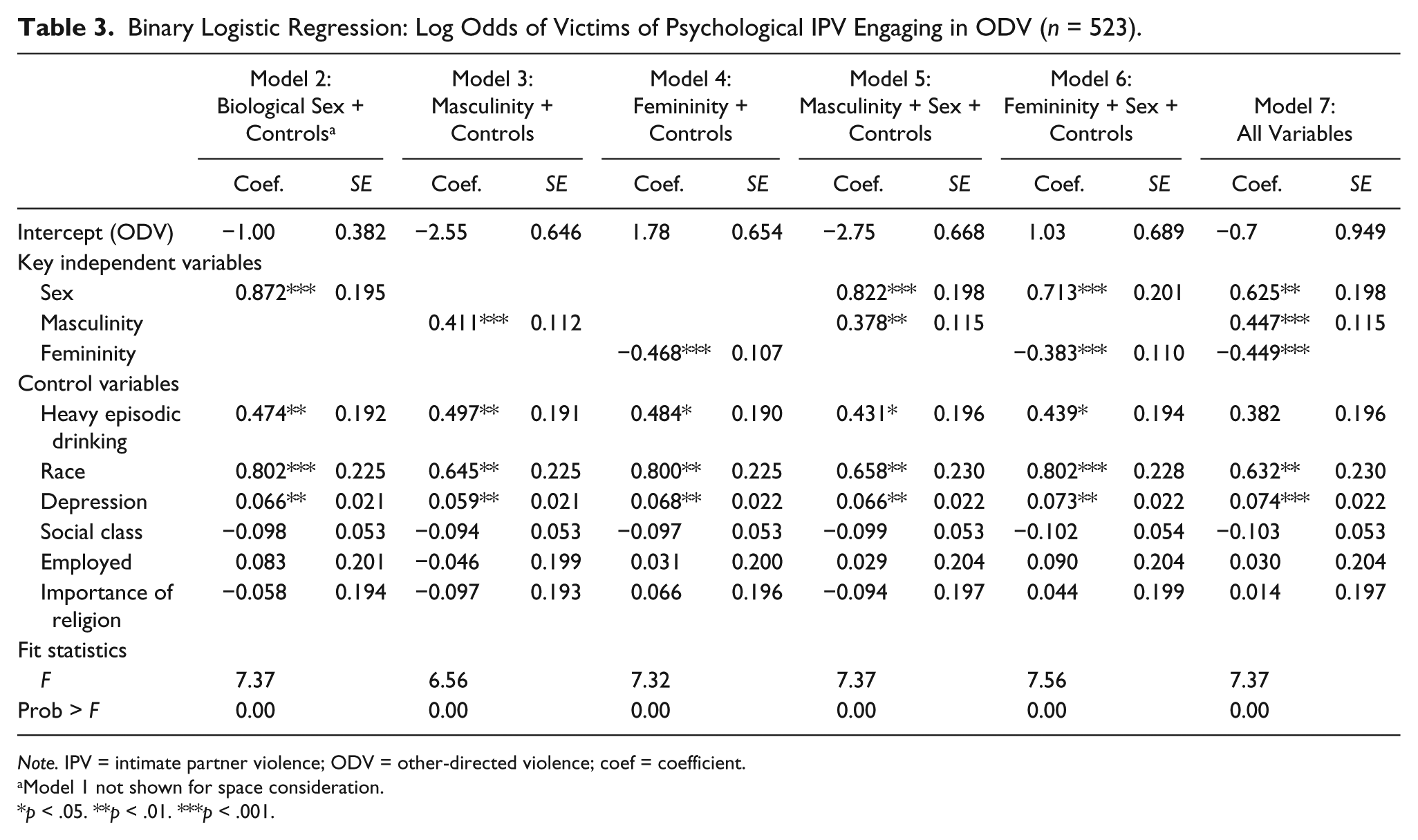
Considering the outcome variable, ODV, is dichotomous, binary logistic regression was used to determine the log odds of engaging in ODV. Binary logistic regression results are presented in Table 3. Model 1 is a base model (results not shown), which generates the coefficient for the log odds of ODV for the sample of victims without considering any exploratory variables. Model 2 introduces sex into the model to determine its effect on the log odds of engagement in ODV. Models 3 and 4 eliminate sex and incorporate masculinity and femininity, respectively, to examine each one’s effect on the log odds of engaging in ODV. Models 5 and 6 reintroduce sex into each model to determine whether masculinity and femininity, respectively, each retain their significance in estimating the log odds of ODV engagement. Model 7 is the full model that includes all study and control variables.
Results
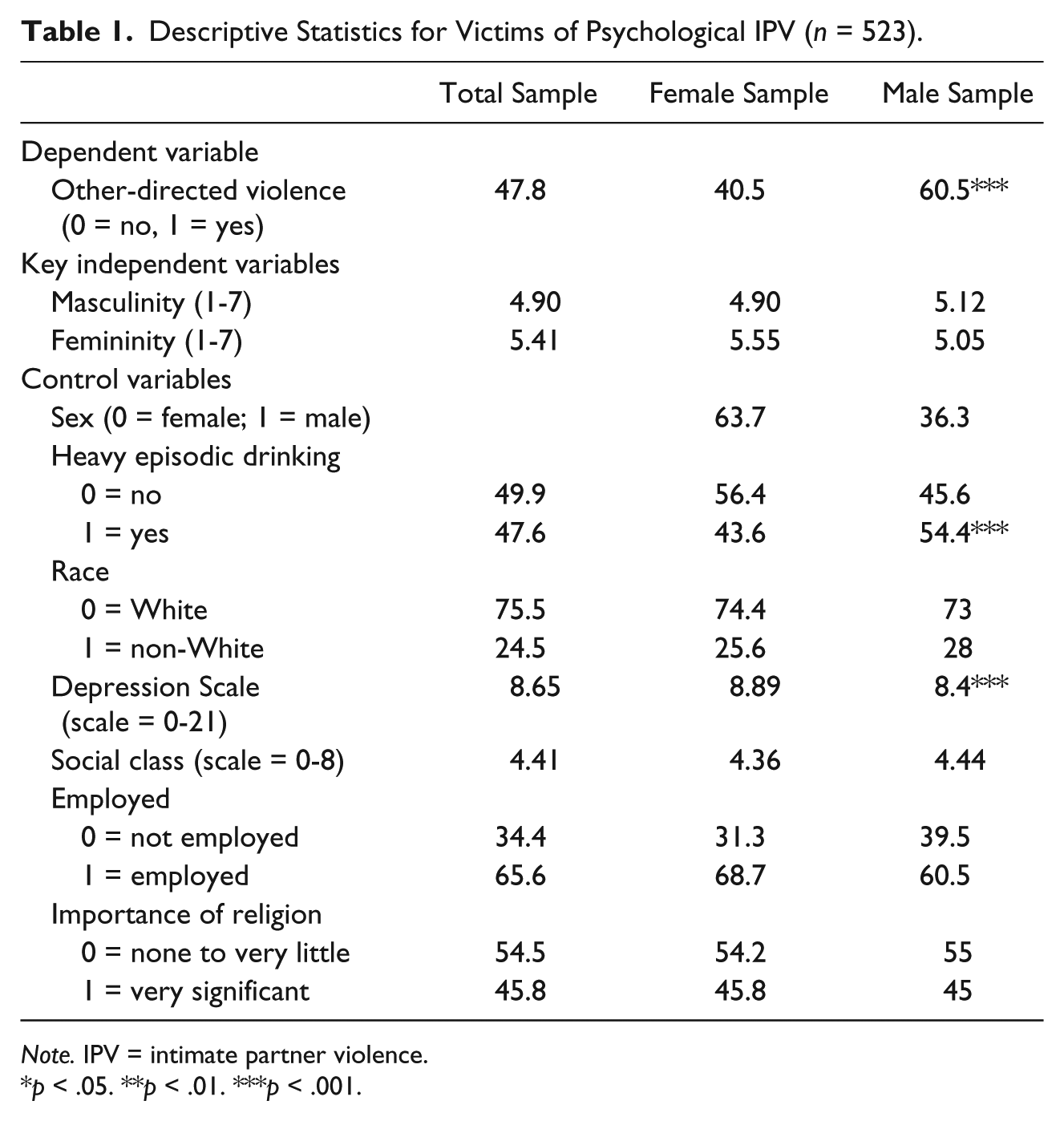
Descriptive statistics are illustrated in Table 1. Of all 523 victims, nearly 48% (n = 250) engaged in ODV within the past year. Forty-six percent (n = 239) participated in heavy episodic drinking within the last 2 weeks. The average depression score was 8.65. Demographically, 36.3% of the sample (n = 190) was male and 75.5% (n = 395) White. The average masculinity and femininity scores were 4.90 and 5.41, respectively.
Descriptive Statistics for Victims of Psychological IPV (n = 523).
Note. IPV = intimate partner violence.
p < .05. **p < .01. ***p < .001.
When the sample is disaggregated by sex, we can see that a significantly larger proportion of males engage in heavy episodic drinking, 54.4%, compared with 43.6% of females. These results yield a statistically significant difference in heavy episodic drinking between males and females (χ2 = 64.99, p < .001). There are also statistically significant differences in reported depression (t = 4.037, p < .001). The average depression score for females is 8.89 whereas the average score for males is 8.4.
Table 2 shows the percentage of psychological IPV victims who engage in ODV broken down by sex and gender. Of the 508 students who experienced psychological victimization, 92 identified as masculine males, 86 were masculine females, 92 were feminine males, and 238 were feminine females. These categories were constructed by subtracting each respondent’s masculinity score from their femininity score. If a respondent’s total was greater than 0, they were categorized as masculine, regardless of their sex category. Similarly, if a respondent’s total was less than or equal to 0, she or he was considered feminine.
Use of ODV by Victims of Psychological IPV by Gender/Sex (n = 508).

Note. χ2 = 43.34; p < .001. ODV = other-directed violence; IPV = intimate partner violence. Due to missing data on the BRSI questions, n = 508.
As illustrated in Table 2, 69.6% of masculine men (n = 64) who were victims of psychological IPV engaged in ODV. Interestingly, the next largest group to participate in ODV was masculine women (61.6%) followed by feminine men (52.2%), with feminine women exhibiting the lowest engagement in ODV (33.6%). These results suggest that the variation in ODV by the four gender/sex combinations is statistically significant (χ2 = 43.34, p < .001).
These findings illustrate the importance of considering both gender and sex when examining the use of ODV. For example, Figure 1 shows the proportion of psychological IPV victims who used ODV by sex only. As illustrated by the graph, 61% of males engaged in ODV compared with 41% of females. Thus, reiterating the expected relationship, males engage in ODV at much higher rates than females. However, when the gender of the victim is incorporated, the results are significantly more illuminating.
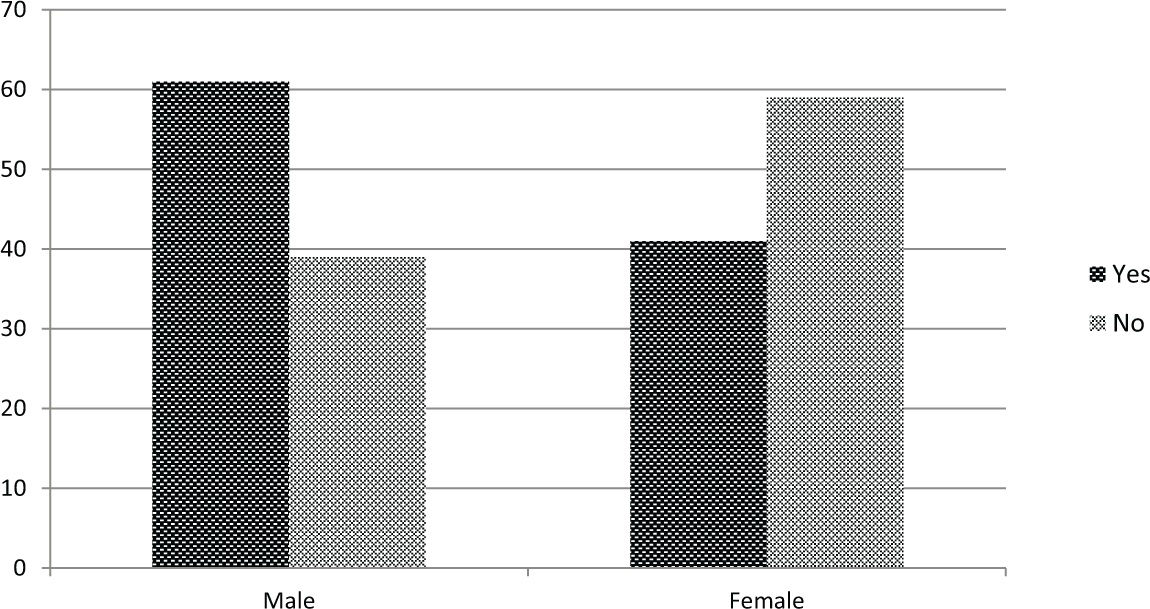
Proportion of victims who engage in ODV by sex only.
Figure 2 illustrates the proportion of psychological IPV victims that use ODV by both sex and gender. As demonstrated by the figure, the importance of masculinity in the use of ODV becomes apparent. Not only do masculine men have the highest rates of ODV but it is masculine women who make up second highest rate of ODV. These descriptive analyses suggest that (a) men and women have different behavioral responses to psychological victimization as illustrated in Figure 1, and (b) masculinity has an impact on the use of ODV, regardless of sex as demonstrated in Table 2 and Figure 2.
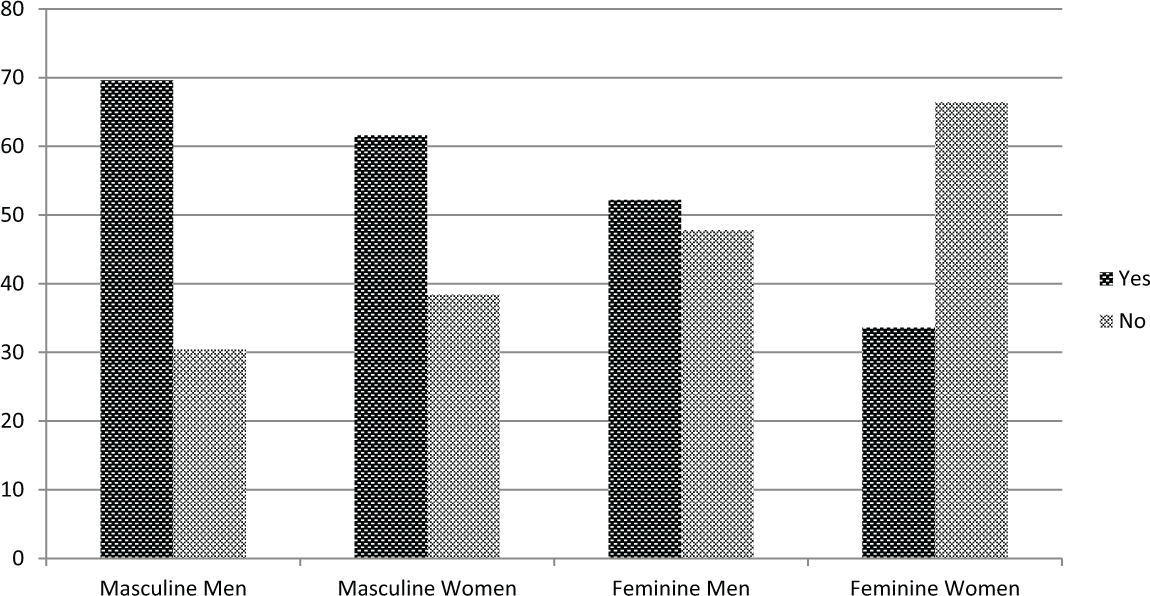
Proportion of victims who engage in ODV by gender/sex.
Results from the binary logistic regression are reported in Table 3 and support the patterns suggested by the descriptive statistics. Model 2 indicates that male victims of psychological IPV experience a .872 increase in the log odds of engaging in ODV, controlling for all other study variables. Thus, the expected odds of male victims using ODV is 2.39 times that of female victims. These results support H1.
Binary Logistic Regression: Log Odds of Victims of Psychological IPV Engaging in ODV (n = 523).
Note. IPV = intimate partner violence; ODV = other-directed violence; coef = coefficient.
Model 1 not shown for space consideration.
p < .05. **p < .01. ***p < .001.
As demonstrated by Table 2 and Figure 2, the descriptive statistics suggest that masculinity has an impact on the use of ODV. Those who use ODV at the highest rates are masculine men followed by masculine women. Model 3 indicates that for every one unit increase in masculinity, there is a .411 increase in log odds using ODV, without controlling for sex. Results also suggest that femininity acts as a protective factor against ODV as for every one unit increase in femininity, there is a .468 decrease in the log odds of using ODV, without controlling for sex. These results indicate support for both H2a and H2b.
To test whether masculinity has an independent effect on ODV, Model 5 includes masculinity while controlling for sex. Results suggest that although the masculinity coefficient decreases slightly when sex is controlled for, its effect on ODV remains significant (β = .378, p < .01). Thus, support is found for H3a. Similarly, to test whether femininity has an independent effect on ODV, Model 6 includes femininity while controlling for sex. Results indicate that femininity protects individuals from engaging in ODV, independent of sex (β = −.383, p < .001). Once again, we find support for H3b. In Model 7, we include all study and control variables. We find that when sex (β = .625, p < .01), masculinity (β = .447, p < .001), and femininity (β = −.449, p < .001), are all introduced into the model, each retains its significance. This again lends support to all our hypotheses indicating that gender orientation has an effect on the use of ODV net the effect of sex.
Discussion and Conclusion
Research continues to document a sex disparity in the use of ODV. However, little attention is paid to the role of gender socialization as an explanation for this gap. We sought to address this weakness by utilizing a general strain framework to examine the gendered responses of male and female victims of psychological IPV. General strain theory asserts that the presence of negative stimuli, in this case psychological victimization by an intimate partner, produces feelings of anger and frustration in both men and women. To ameliorate this stress, men express their feelings through ODV and women internalize their feelings. General strain theory argues it is the difference in the use of coping mechanisms that accounts for the disparity in ODV and that these coping mechanisms are gendered. Thus, men and women respond to stress in ways that are consistent with norms of acceptable male and female behavior. Gender stereotypes posit that an outward expression of anger is appropriate for males but not for females. Therefore, the disparity in ODV is at least partially the product of gender socialization. In particular, research has documented that men and women who prescribe to masculine identities are more likely to engage in ODV (Kogut et al., 1992).
Descriptive analyses indicate that our sample contains more females and is less racially diverse than the general population. Although national data on gender orientation is sparse, our sample’s masculinity and femininity averages are comparable with recent research that documents an average masculinity score of 4.90 and femininity score of 5.7 among a sample of adults in the National Longitudinal Study of Adolescent and Adult Health (Chervenak-Wiley, 2014). Our descriptive statistics also suggest that our sample participates in heavy episodic drinking at a slightly higher rate, 47%, than the national average of 39% among U.S. college students (U.S. Surgeon General & U.S. Department of Health and Human Services [USDHHS], 2010). However, consistent with previous research, our study reveals that males are more likely to engage in heavy episodic drinking than females (Wechsler & Nelson, 2008; Wilsnack, Vogeltanz, Wilsnack, & Harris, 2000; Windle, 2003). In terms of depression, our results are consistent with prior research that finds that females are more likely than males to experience depression (Adkins, Wang, Dupre, Van den Oord, & Elder, 2009; Borooah, 2010; Hyde, Mezulis, & Abramson, 2008; Rosenfield & Mouzon, 2013).
Our multivariate results indicate that men and women react differently to psychological victimization in which male victims experience increased odds of exhibiting ODV in comparison with female victims. This research also sought to determine the impact of masculinity on the use of ODV. We conclude that victims who ascribe to a masculine identity have higher odds of engaging in ODV whereas those with a feminine identity have lower odds of engaging in ODV. This could be because social expectations regarding femininity and masculinity are very specific. To be conventionally feminine is to be docile, caring, and friendly. Thus, it is strongly counter-normative for feminine individuals, and especially feminine females, to be engaged in crime and violence. This means that among our sample, feminine females would likely face significant social consequences and stigmatization by engaging in ODV, whereas masculine males would likely face minimal social consequences and stigmatization for engaging in ODV (and in some instances, may be encouraged to engage in ODV; see Messerschmidt, 1993). The distribution of would-be social consequences and stigmatization mirrors the groups that are least to most likely to engage in ODV in our study.
The fact that the effects of masculine and feminine identity remain even after sex is introduced into the model suggests that gender orientation has an independent effect on ODV perpetration. This may mean that the internal consequences of being counter-normative in regard to gender identity are more potent than the external consequences of being counter-normative. For example, because masculine females were more likely to engage in ODV than feminine males, identifying with feminine qualities may have a stronger protective effect in terms of violence perpetration than being identified as physically male or female by others, which is how criminologists have traditionally studied the sex disparity in violence perpetration. Whether one identifies as female or male and whether one feels or expresses a masculine or feminine identity may be important intersecting correlates of crime for scholars to consider moving forward (Belknap & Holsinger, 2006).
Limitations and Future Directions
Although the results of this study are intriguing, they should be interpreted with caution. The data were obtained via an online survey resulting in a convenience sample of college-aged students located in a Midwestern university. Therefore, we limit our interpretation and discussion of these results to this particular context. Moreover, there is a risk of selection bias considering the sample was self-selected and motivated to participate by an extra-credit opportunity. In addition, the sample is racially homogeneous preventing any meaningful analysis of race to be conducted. Due to a lack of minority representation, we were forced to collapse our data into two categories: Whites and non-Whites. As such, we know little about the variation in the use of ODV among our non-White population (e.g., Hispanic, African American; see Zullig & Divin, 2012). Due to the anonymous nature of the data, we were also unable to cross-validate responses and, therefore, rely solely on self-report data. Although the survey did include questions about past 2 weeks, past month, past 6 months, and past year use of ODV and experiences of psychological intimate partner victimization, we focused on the occurrence of these behaviors within the past year. Consequently, this project may over-estimate current experiences with these two behaviors.
We must note here that categorizations such as “masculine females” fail to capture the fluidity of gender that is central to gender theory (West & Zimmerman, 1987). Context and time period are important to how gender is expressed, especially in diverse and complex social systems. Moreover, such categorization also fails to capture the disparate societal reactions that might occur when gendered expressions are at odds with assigned sex. For example, masculine women can still experience sexism and masculine women may not benefit from the use of violence in the same ways in which men benefit from the use of violence within patriarchal social systems. Nevertheless, taking a “snapshot” of gender orientation is an important step in understanding how gender in the psycho-social sense might be associated with violent behavior.
The results of this study are commensurate with previous studies of psychological intimate partner victimization as well as the use of ODV among college students. Moreover, our measure of psychological intimate partner victimization combined several types of abuse in which some types were more severe than others. Our “gender orientation” variable was derived from the short-form BSRI, which has been heavily criticized for its focus on stereotypical personality traits typically associated with traditional gender roles (Hoffman & Borders, 2001). In addition, gender is an ongoing and contextual process. The BSRI only provides a measure of gender orientation for a single point in time. Finally, given that the data are cross-sectional, this project does not attempt to make a causal argument. Rather, this project assesses co-occurring behaviors of those who have experienced psychological victimization by an intimate partner within the past year. However, future research should attempt to collect or analyze available longitudinal data to determine whether prior psychological abuse by an intimate partner leads to future ODV.
Despite these limitations, our study has several strengths and offers an empirically supported theoretical understanding of how gender orientation, in conjunction with sex category, is related to variations in the use of ODV as a coping mechanism for psychological intimate partner victimization. First, we address the lack of investigation into the behavioral responses to psychological IPV. Much of the previous literature focuses on behavioral responses to violent victimization (Turanovic & Pratt, 2013). This study extends the use of Agnew’s general strain theory by examining the sex and gender differences in the use of ODV, a specific maladaptive coping mechanism. Second, this study directly addresses the gender versus sex gap more broadly by investigating whether masculine orientation is predictive of an increased use of ODV, regardless of sex. We found that masculine females were almost as likely to participate in ODV as masculine males. In addition, we discovered that whereas masculine victims were more likely to engage in ODV, feminine victims were less likely to engage in ODV as a coping mechanism. The effect of gender orientation remained even after controlling for biological sex. In closing, our study suggests that gender orientation, in conjunction with biological sex, contributes to the use of ODV as a potential coping mechanism for psychological intimate partner abuse.
Footnotes
Acknowledgements
The authors acknowledge the assistance of Dr. Jim Anthony in supporting the endeavors of the research, Jeannette Wade for assistance with implementation of the survey, and Dr. Carlos Rios, Courtney Blue, Marcella Mulhollem, and Jeannette Wade for assistance with preparing the data for analysis.
Author Contributions
All authors contributed in a significant way to the article and all authors have read and approved the final article.
Declaration of Conflicting Interests
The author(s) declared no potential conflicts of interest with respect to the research, authorship, and/or publication of this article.
Funding
The author(s) disclosed receipt of the following financial support for the research, authorship, and/or publication of this article: The sources of financial support for the conduct of the research were NIDA R25DA030310 (R. L. Peralta) and K05DA015799 (J.C. Anthony, sponsor).