



Abstract
This study explored patterns of controlling behavior, physical violence, and attitudes toward social limits in young Mexican university students in light of the effect that socialization processes have in attitudes toward social norms and violent behavior as indicated in some of the literature. A total of 437 male and female heterosexual participants residing in Ciudad Juárez, Mexico, provided information on their perpetration/victimization experiences of controlling behavior (by means of the Controlling Behaviors Scale) and physical violence (using the Revised Conflict Tactics Scales [CTS2]) and their attitudes toward social limits (using the Attitudes Toward Social Limits scale). Results indicate similar chronicity levels of experienced controlling behavior and physical violence perpetration/victimization between the sexes. Participants expressed major tendency to adjust to a social norm rather than overstepping it. Males tend to overstep social limits more often than females, although no significant linear relationship was found between abusive behavior and attitudes promoting the infringement of social norms. Higher chronicity levels were rather found by dyadic type, relationships with mutual physical intimate partner violence (IPV), and controlling behavior in comparison with relationships where unidirectional violence prevails. Implications of findings involve the acknowledgment of change in dynamics used by more educated young Mexicans, and the recognition of IPV in these populations as a heterogeneous phenomenon for primary and secondary interventions.
Empirical studies investigating physical intimate partner violence (IPV) and controlling behavior victimization (and fewer studies on perpetration) in young people’s romantic relationships or dating violence have paid attention mostly to physical violence and control perpetration arising from patriarchal social norms in Mexico (and other countries; see López-Cepero Borrego, Rodríguez-Franco, Rodríguez-Díaz, & Bringas-Molleda, 2014; Pick, Leenen, Givaudan, & Prado, 2010; Rivera-Rivera, Allen, Rodríguez-Ortega, Chávez-Ayala, & Lazcano-Ponce, 2006; Vázquez-García & Castro, 2008), whereas research on IPV stemming from other motives or nature in young relationships has not received enough attention and recognition (Rojas-Solís & Flores-Elvira, 2013), particularly in collectivistic societies, such as Mexico (Gonzalez-Mendez & Santana-Hernandez, 2001). For example, a bibliometric and bibliographic review of the IPV literature reports most studies (65%) have been conducted with female participants ascribing them the role of victims (and fewer studies of men studied under the role of the perpetrator, 9% of studies), and a minority of published research papers have focused on adolescents or young adults (10.6% of all studies found). In all, it is reported that only 25% of published studies have focused on providing dyadic data, that is, information on perpetration or victimization experiences from both partners, reported either by one or both intimate partners (López-Cepero Borrego et al., 2014).
Some dating violence studies in Mexico tend to mirror the trend in prevalence rates found in studies with university students in countries such as the United States. That is, gender symmetry or higher female perpetration (or male victimization) has been reported in some dating violence studies in Mexico (Castro & Casique, 2010; González Galban & Fernández de Juan, 2014; Rojas-Solís, 2013; Siller Rosales, Trujano Ruiz, & Ruiz Velasco Acosta, 2013); however, many local/regional (Olvera Rodríguez, Arias López, & Amador Velázquez, 2012; Rivera-Rivera et al., 2006) and large nationally representative IPV surveys (Mejía Guerra, 2015; Olaiz, Uribe, & Del-Rio, 2009) in Mexico have been designed and carried out under the notion that IPV/dating or domestic violence is a gender issue. As such, the majority of the latter have used the definition of IPV/domestic/family violence in the legislated Ley de Acceso de las Mujeres a una Vida Libre de Violencia (LAMVLV—Access Law of Women for a Life Free of Violence): any abusive act of power or intentional omission directed at women to dominate, submit, control, or aggress them physically, verbally, psychologically, patrimonially, economically, or sexually inside or outside their family address, by an aggressor with whom she had a relationship of consanguinity or affinity, marriage, concubinage, that have or had a factual relationship (Cámara de Diputados de la Federación, 2011).
The collectivistic nature of Mexican society has been related to its historic-sociocultural premises (HSCP). Affiliative obedience and abnegation of the individual in favor of the group (e.g., the family, the community) has been a central criterion upon which most Mexican HSCP (beliefs and norms) are founded. That is, in Mexican society the satisfaction of needs of others rather than the needs of the individual is fundamental, being self-modification (of individual needs and priorities) the preferred coping skill by men and women (Díaz-Loving, Rivera-Aragón, Villanueva-Orozco, & Cruz-Martínez, 2011; Flores-Galaz, 2011). Furthermore, dating violence empirical studies or IPV research with young men and women in intimate relationships in Mexico providing dyadic data (information on both partners’ IPV perpetration or victimization experiences; for example, Esquivel-Santoveña, Gurrola-Peña, & Balcázar-Nava, 2016) are virtually nonexistent (Rojas-Solís, 2013). This is particularly relevant for Mexico, a country typically characterized as a more collectivistic society (Díaz-Loving, 2005) with cultural links to patriarchal social norms (Rocha-Sánchez & Díaz-Loving, 2005) that promote and enhance structural gender inequality.
Studies that have often established a close relationship between gender violence (physical and psychological violence, controlling behavior) and structural patriarchal norms have established comparisons between men and women on the basis of the socialization processes that are shaped by stereotypical views about masculinity and femininity in Mexican society. These studies have typically attributed patriarchal social norms that determine the exercise of traditional sex roles to justify male-perpetrated IPV and other types of violence (Agoff, Rajsbaum, & Herrera, 2006; Centro de Estudios para el Adelanto de las Mujeres y la Equidad de Género, 2010; Centro Nacional de Equidad de Género y Salud Reproductiva, 2009). According to this notion, men are encouraged to adhere to a view of masculinity that praises the strength, lack of sensitivity (and anything that resembles femininity, as it is seen as a sign of weakness), and ultimately the use of violence to assert maleness (Híjar & Valdez-Santiago, 2010). In correspondence with this view, HSCP in Mexico describe features that ascribe abnegation and sacrifice, and lack of assertiveness as part of the self-concept of women (Díaz-Guerrero, 1974). That is, Mexican men are believed to typically hold more thoughts and attitudes that favor the infringement or transgression of socially established limits or norms in comparison with their female counterparts. This assertion has been linked to theoretical reviews that have suggested that these stereotypical views of masculinity, socialization processes, and patriarchal social norms are reflected in the higher prevalence of a wide array of criminal and violent behavior (e.g., thefts, homicides, sexual trafficking, and so on; Heise, 2011; Steffensmeier & Allan, 1996) by men in comparison with women, extending this association (male gender) to IPV. Indeed, power and control explanations suggest that the presence of power and absence of control contribute to conditions for adolescents to deviate from social norms, and that males are freer to deviate than females. According to this notion, relations of dominance established in the family teach mainly female adolescents (in comparison with their male peers) to avoid risks in general and the risk of legal sanctions in particular (Hagan, Simpson, & Gillis, 1985). This trend has been argued to be even more evident in modern patriarchal families (through more parental control in female than in male adolescents; Hagan, Simpson, & Gillis, 1987). That is, men are considered to overstep limits or rules of socially desirable behavior more often than women due to socialization processes experienced by the sexes within a patriarchal social structure. It is one of the research objectives of this study to empirically test this relationship between gender and overstepping social limits. With this in mind, gender violence has often been addressed in theoretical reports and empirical studies in Mexico; however, incipient research with Mexican samples indicates that IPV is a heterogeneous phenomenon (e.g., Esquivel-Santoveña et al., 2016; Ramos-Lira & Saltijeral-Méndez, 2008), something that empirical studies in other nations confirm (e.g., Graham-Kevan & Archer, 2003; Johnson, 2008). Furthermore, recent research with youths in the general population (Castro & Casique, 2010) and university students (Rojas-Solís, 2013) in Mexico indicates there is a symmetric pattern of physical and psychological IPV perpetration between the sexes or higher female perpetration and/or male victimization.
In light of the aforementioned changes in dyadic physical and psychological IPV perpetration/victimization patterns, HSCP about Mexican men and women throughout the years, and the changes in the self-concept of Mexican men (e.g., more desirable instrumental traits such as ordered, hardworking, punctual, and willing to collaborate with chores and with poise) and women (e.g., more emancipated and empowered and more instrumental attributes typically linked to men; Díaz-Loving et al., 2011; Padilla-Bautista, Díaz-Loving, & Reyes-Lagunes, 2013), the objectives of this study are fourfold: First, we sought to explore the chronicity levels of physical IPV and controlling behavior perpetration/victimization by the sexes; then, we aimed to investigate whether there is a major tendency of men (in comparison with women) to hold attitudes supporting the transgression of social limits; we also sought to test for a significant linear relationship between levels of controlling behavior and levels of overstepping a social limit; and finally, we set out to identify different IPV dynamics and associated levels of controlling behaviors and physical violence in Mexican male and female university students.
Attitudes About Social Limits in Mexican Youths and IPV
The link between attitudes about IPV and violent experiences within intimate relationships has been well documented (Fincham, Cui, Braithwaite, & Pasley, 2008; Nabors & Jasinski, 2009). Furthermore, attitudes toward social limits include norms regarding the use of physical and psychological violence toward other persons, and therefore, a relationship with IPV might be expected (Oudhof van Barneveld, 2002). However, prevention and intervention initiatives about IPV have been linked to socialization processes, attitudes toward infringing social limits, and IPV and violent behavior in general by men (in comparison with their female counterparts) in a collectivistic society such as Mexico (Hijar & Valdez-Santiago, 2010; Olaiz et al., 2009; Olvera Rodríguez et al., 2012; Vargas Urías, 2009). Such pattern of overstepping social limits has been justified by this literature on grounds of efforts of Mexican men to assert their “maleness,” as part of traditional HSCP. Hence, one of the objectives of this study concerns the exploration of attitudes toward general social limits (concerning expected social behavior in a general context, and not within the context of the couple) and actual reports of physical IPV and controlling behavior in particular.
Research on attitudinal reaction patterns toward social limits by young men and women appeared in the Netherlands around the beginning of the 1980s and currently has extended to nine countries (Belgium, Canada, Estonia, Germany, Holland, Mexico, New Zealand, Slovakia, and the United States; Velasco-Castellón, Hernández-Hernández, & Oudhof van Barneveld, 2009). Social limits have been defined in the literature as a demand (something which has to be done) or a prohibition (something which should not be done), that is, implicit or explicit rules, laws, norms, values, or expectations in a youth’s surroundings that regulate his or her behavior (Velasco-Castellón et al., 2009). Attitudes are a three-dimensional concept composed of a cognitive (person’s perceptions about the object and possessed information about it), an affective (feelings that the object raises), and a conative (tendencies, intentions, and actions toward the object) component (Oudhof van Barneveld, 2002). Research investigating attitudes toward social limits of young men and women around the world has identified four basic reaction patterns: adjusting to a social limit, retreating from a situation in which a social limit occurs, negotiating conditions imposed by a social limit, and overstepping (transgression) a given social limit (Oudhof van Barneveld, 2002; Rink, 1999). Incipient recent research on attitudes about social limits in Mexico has detected that youths know (cognitive aspect) mostly about reaction patterns of adjusting and overstepping a social limit, but prefer (conative aspect) the former than the latter. That is, they prefer to abide by existing societal norms in most situations where a social limit is involved (Oudhof van Barneveld & Robles Estrada, 2011). Furthermore, comparisons between the sexes in Mexican youths reveal that females know and prefer more frequently negotiating a social limit than males. That is, no significant difference has been previously observed in Mexican men and women in terms of other attitudinal reaction patterns: adjust to, transgress, or avoid a social limit (Oudhof van Barneveld & Robles Estrada, 2011). Therefore, one of the objectives of this study is concerned with investigating possible differences between the sexes in regard to their attitudes when confronted to general social norms of appropriate behavior. This is indeed important in light of the socialization differentials between the sexes (exemplified in traditional HSCP) and the associations that these socialization processes have with violent behavior, including IPV.
However, documented empirical research has revealed that IPV expands within a broad spectrum of types of violence with different characteristics and motivations (Dixon & Browne, 2003; Dixon & Graham-Kevan, 2011). Typological research confirms IPV perpetrators differ in their attitudes and motivations, controlling behaviors, and physical violence used (Holtzworth-Munroe & Stuart, 1994; Johnson, 2008; Straus & Gozjolko, 2014). Research on dyadic concordance types (DCTs) of IPV has contributed to the understanding of controlling and violent behavior in romantic dyads (Rodríguez & Straus, 2016; Straus, 2014; Straus & Gozjolko, 2014). Research with university students in 15 nations has shown a prevalence of 25% for father-only, 22% for mother-only, and 52% for mutually violent dyads. Higher chronicity of any form of IPV is reported by mutually violent dyads followed by father-only and mother-only dyads (Straus & Michel-Smith, 2014). Research identifying DCT in Mexico is up to now nonexistent, and one of the contributions of this study is to present such identification of violent dynamics with Mexican university students.
Besides typological research and few studies conducted with DCT (mainly in the United States), there are overwhelming empirical data from international studies investigating IPV using university student samples exploring prevalence trends between the sexes. Such research has revealed in virtually all regions of the world that IPV in younger dyads is mutual, and most studies with university student samples around the world conclude that physical and/or psychological IPV is symmetrical between the sexes, or female perpetration (or male victimization) is higher than male perpetration or female victimization (Straus, 2008). This kind of research (using a gender-inclusive perspective) is almost nonexistent in Mexico (e.g., Castro & Casique, 2010; Esquivel-Santoveña et al., 2016; Siller Rosales et al., 2013); hence, the present study intends to contribute by documenting the overall IPV/controlling behavior and DCT prevalence rate in university students living within a collectivistic society.
According to aforementioned considerations of IPV, particularly in more traditional collectivistic societies such as Mexico, men are expected to hold more attitudes toward social limits that confirm and legitimate their maleness (in comparison with women) and that this attitudinal trend is to be mirrored in more controlling and violent behavior, even within the romantic relationship. However, family violence research has identified IPV as a heterogeneous phenomenon and deems that controlling attitudes and behaviors in intimate relationships are determined by specific dynamics and motivations within the couple. Recent research with university students has actually found different personality traits in men and women experiencing IPV (Dowgwillo, Ménard, Krueger, & Pincus, 2016).
Controlling Behavior and IPV
Psychological aggression has been well documented and identified as a precursor of physical violence and has been categorized as a type of controlling behavior in intimate relationships (O’Leary, 1999). As such, controlling behavior refers to subtle forms of behavior along a continuum of abuse that can include emotional/psychological control or threats, intimidation, jealousy/possessiveness, verbal aggression, economic control, and isolation. Controlling behavior has been linked to physical IPV in typological research (Johnson, 2008; Straus & Gozjolko, 2014), and studies with clinical and nonclinical samples (Hines & Douglas, 2011; Leone, Johnson, Cohan, & Lloyd, 2004) including university students (Straus & Gozjolko, 2014). More deleterious mental health effects have linked to controlling behavior in comparison with physical violence (O’Leary, 1999; Próspero, 2008, 2009).
In light of evidence on the heterogeneity (dynamics, motives) of partner violence documented worldwide and marginally in Mexico, the stereotypical view of IPV caused by patriarchal social norms, and the changing sociocultural premises in a collectivistic society, the aforementioned objectives were addressed through the following research hypotheses:
Method
Sample
A total of 500 male and female students from social sciences (education, finance, law, psychology, and social work) and engineering (automotive, mechatronics, computer science, and software), undergraduate courses, at the Universidad Autónoma de Ciudad Juárez (UACJ) were invited to voluntarily take part in the study in their classrooms between October and December 2015. The project was presented to participants as a study of relationship dynamics and attitudes about everyday life situations. Participant consent was given by completing the questionnaire and returning it to the researchers. Ethical approval was obtained from the Coordination of Research and Graduate Studies at the UACJ. Participant response rate was 94%. Gay (4.1%) and bisexual (2.8%) participants were far too few to conduct meaningful statistical analyses and were thus excluded from subsequent analyses. No significant demographic differences (besides sexual orientation) were found between heterosexual and nonheterosexual students. A total of 437 heterosexual university students (40.3% males/59.7% females) with a mean age of 20.67 years (SD = 3.2) provided information about their perpetration and victimization experiences of physical violence, controlling behavior, and their views about known and preferred reactions (and their motivations) to situations that involved socially established limits.
Measures
Physical violence
The Spanish version of the Revised Conflict Tactics Scales (CTS2; Straus & Ramirez, 2007) was used to assess perpetration and victimization experiences of physical IPV used as tactics to resolve conflicts within the previous 12 months via 14 items on a 7-point scale (0 = never, 6 = more than 20 times). The CTS2 has shown adequate construct and discriminant validity, and reliability (α = .86) for its Physical Violence scale in its original version (Straus, Hamby, Boney-McCoy, & Sugarman, 1996). Reliability alpha coefficients obtained in the present study were .88 and .84 for the Perpetration and Victimization scales, respectively.
Controlling behavior
A Spanish version (Esquivel-Santoveña et al., 2016) of the Controlling Behaviors Scale used by Johnson, Leone, and Xu (2014) was used to assess perpetration and victimization experiences using controlling tactics against an intimate partner (e.g., isolation from friends and family networks, jealousy or possessiveness, partner monitoring and emotional control, verbal aggression, humiliating or ridiculing, economic control, and threats) within the 12 previous months on a 7-point scale (0 = never, 6 = more than 20 times). Suitable convergent validity has been previously documented (Johnson et al., 2014), with appropriate reliability (α = .86 and α = 91 for the Perpetration and Victimization scales, respectively) in the original adapted Spanish version (Esquivel-Santoveña et al., 2016). Reliability alphas in the present study were .82 for the Perpetration scale and .78 for the Victimization scale.
Attitudes Toward Social Limits scale
A 28-item scale presents vignettes that depict everyday life situations where a young man or woman is involved in a particular everyday situation facing a social limit. Every vignette is followed by a question that asks participants to state different ways someone could react in that situation (known reactions), then the participant is asked the way he or she would react (preferred reactions) in that situation, and a final question inquires on motivations for making that decision (Oudhof van Barneveld & Robles Estrada, 2011). An example is herein provided: “You argued with one of your teachers over an exam mark. Infuriated you get to the school’s parking lot and notice a bunch of stones nearby the teacher’s car.” An example for adjusting to the presented social limit would involve the student not stoning or damaging the teacher’s car; overstepping the social norm would be the student damaging the teacher’s car to “get even” or because he was emotionally upset. Negotiating the social norm would involve the student asking the teacher for options to increase his or her score mark (bringing an essay, special project, etc.), and retreating a social limit would involve the student to avoid talking to the teacher or walking by the teacher’s car.
In the present study, only the Reactions (known and preferred) scale is presented. The scale presents a total of nine social limits: nonuse of physical violence against others, not using nonphysical violence against others, nonuse of physical violence against a person’s belongings, avoiding committing economic or financial crimes, avoiding forging documents, respecting traffic and transit norms or rules, taking care of nature or the environment, helping others in emergencies, and respecting social norms of coexistence. There is a male and a female version of scale that only varies in the specific considerations made in regard to sex of the youth. The Attitudes Toward Social Limits scale has appropriate documented construct validity (Oudhof van Barneveld, 2002) with reliability coefficients of .99 and .96 for the Reactions and Motivations subscales (Velasco-Castellón et al., 2009) in the original Mexican version. In the present study, only the Reactions (known and preferred) scale is presented. The reliability alpha coefficient for the Reactions scale in the present study was .93.
Procedure
Information on the Attitudes Toward Social Limits scale was coded. For known reactions, all answers provided by participants were coded on the basis of attitudinal patterns toward social limits identified by the literature (adjusting to, overstepping, negotiating, and retreating a social limit). Therefore, participants could give several answers depending on the knowledge possessed by participants about different ways to react to an everyday life situation that involved them facing a social limit. The items that inquired participants on preferred reactions were coded using the same attitudinal reaction patterns, but in this case only one answer could be given, representing the single action chosen in each situation.
Physical violence items on the CTS2 and the Controlling Behaviors Scale were treated as scale variables, scored and coded according to recommendations made by the authors (Straus et al., 1996). Collected information was processed and analyzed using SPSS 21.
Deriving DCTs
To classify participants involved in one of three possible dyadic IPV perpetration types (male-only, female-only, and mutual), dyadic data about the problematic behavior are needed (experiences of perpetration and victimization). Because of the high prevalence of psychological IPV or coercive control (in comparison with physical violence) in university samples or youths documented elsewhere (e.g., Castro & Casique, 2010; Fernández-Fuertes, Orgaz-Baz, & De Lima-Silva, 2015; Sabina & Straus, 2008; Straus, 2008), controlling behavior is considered the focus for the dyadic categorization of perpetrators in this study. Male and female participants who perpetrated any form of control but did not experience any victimization from their partner are either classified as male-only and female-only, respectively. Respondents reporting perpetration and victimization experiences of control in their relationships were classified as mutually violent. Furthermore, participants reporting no perpetration or victimization experiences of controlling behavior are classified as nonviolent.
Results
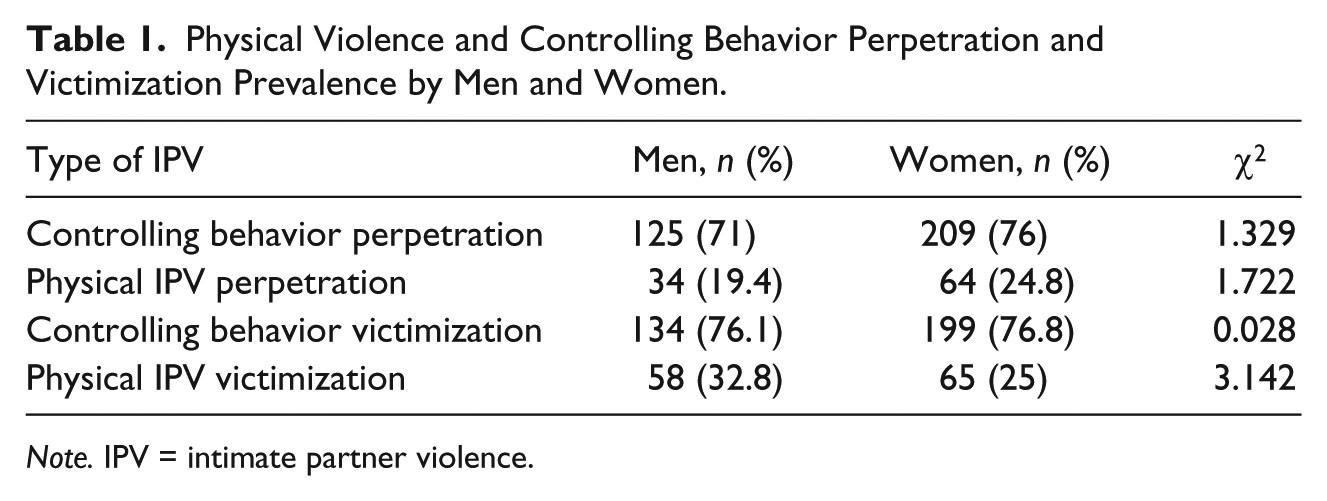
Descriptive statistics (Table 1) show more females perpetrated physical violence and controlling behavior than their male counterparts, whereas more men were victims of physical violence although this difference was significant only for physical IPV victimization, χ2(1) = 4.458, p = .035. Men and women experienced controlling behavior at similar rates.
Physical Violence and Controlling Behavior Perpetration and Victimization Prevalence by Men and Women.
Note. IPV = intimate partner violence.
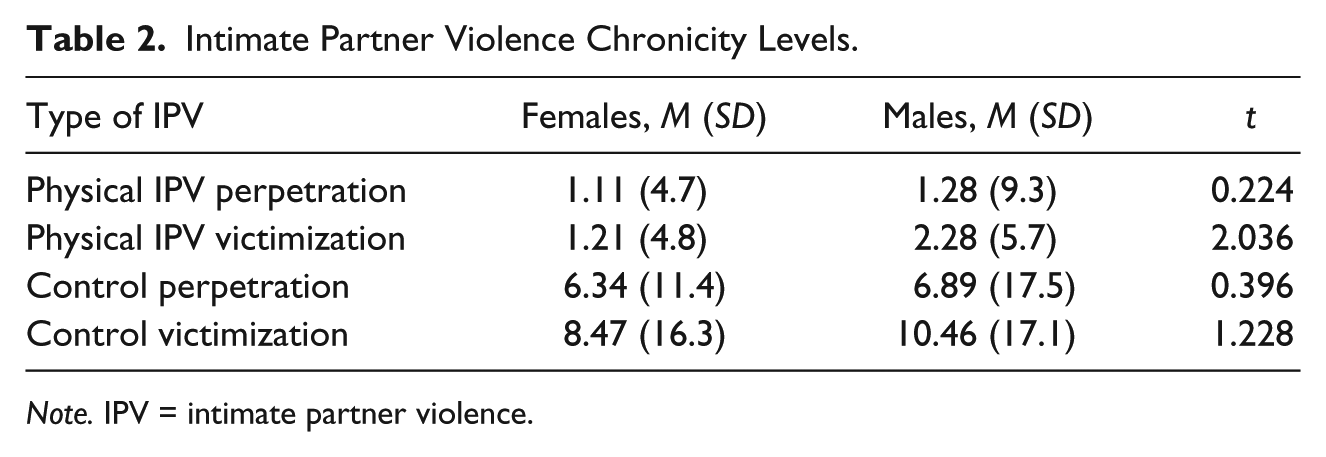
To address the first research hypothesis, separate independent-sample t tests were conducted (Table 2). The Bonferroni adjustment procedure was used to control for Type I error for multiple comparisons (four) resulting in a new p value = .01, and was applied to analyses related to the testing of Hypotheses 1 and 2. Sex differences in regard to physical violence and controlling behavior perpetration and victimization chronicity were not significant (see Table 2). It is notable that controlling behavior experiences by males and females were far more frequent among university students in comparison with physical violence perpetration/victimization experiences (Table 2).
Intimate Partner Violence Chronicity Levels.
Note. IPV = intimate partner violence.
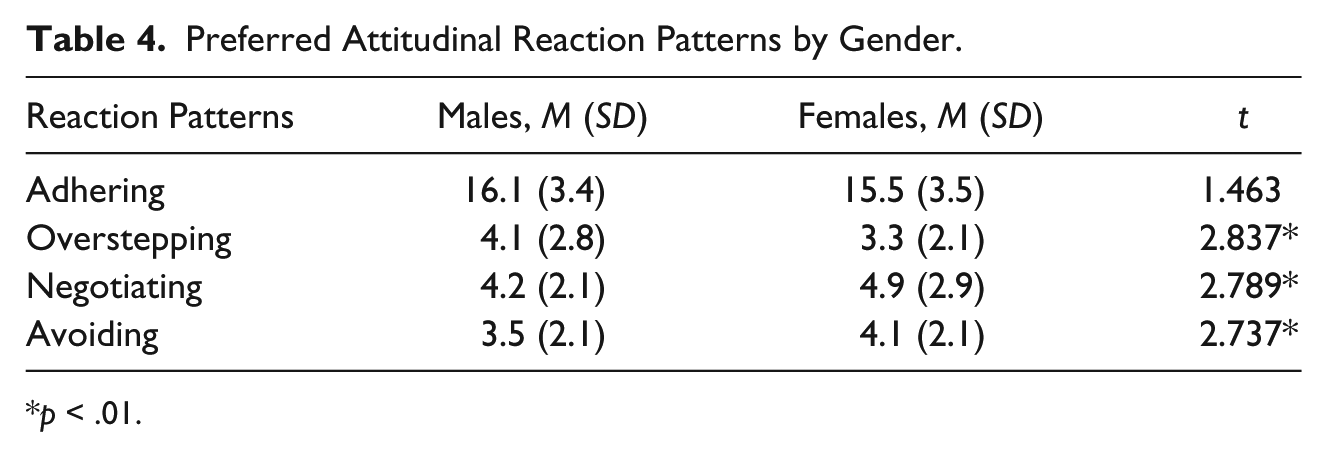
In general, in terms of descriptive statistics about attitudes toward social limits (see Table 3), the most frequently known (cognitive aspect) and preferred (conative aspect) attitudinal reaction pattern expressed by university students was adjusting to a social limit. Preferred reaction patterns between the sexes (see Table 4) yielded mean scores of males overstepping social limits, t(297) = 2.837, p = .005, more frequently than their counterparts, while negotiating (trying to change) a social limit, t(405) = 2.789, p = .006, and avoiding situations, t(407) = −2.737, p = .006, that involve facing a social limit were more frequently preferred by females.
Descriptive Statistics of Known and Attitudinal Preferred Reaction of University Students Toward Social Limits.

Preferred Attitudinal Reaction Patterns by Gender.
p < .01.
In regard to the third research hypothesis, no significant linear relationship was found between levels of controlling behavior (r = −.094, n = 392, p = .062) or physical violence (r = −.098, n = 390, p = .054) perpetration and the attitudinal trend to overstep social limits.
A DCT categorization (Table 5) of physical IPV and controlling behavior indicated a significantly, χ2(3) = 375.944, p = .001, higher prevalence of participants involved in mutually violent relationships (65.3%) in comparison with participants in either male-only (9.4%) or female-only (10.9%) violent relationships and nonviolent individuals (14.4%). To test for differences in the levels of (chronicity) perpetration/victimization experiences of controlling behavior and physical violence by dyadic type or pattern (see Table 5), separate one-way ANOVAs were computed. A significant effect was found for levels of controlling behavior perpetration, F(3, 428) = 14.629, p = .001, and for controlling behavior, F(3, 428) = 18.487, p = .001, and physical violence, F(3, 428) = 6.119, p = .001, victimization. Tukey’s HSD (honestly significant difference) post hoc tests (not shown) revealed higher levels of controlling behavior perpetration and victimization, as well as physical violence victimization in participants in mutually violent relationships compared with participants in relationships where unidirectional violence is reported (male-only, female-only). No other significant differences were found.
Levels of Controlling Behavior and Physical Violence Experiences by Dyadic Type.

Note. IPV = intimate partner violence.
p = .001.
Discussion
The present study has endeavored to explore sex and dyadic type differences in regard to violent behavior in intimate relationships and attitudes toward social limits of Mexican university students. Findings here support the first research hypothesis as there were no significant sex differences in the levels of chronicity (number of times IPV was perpetrated or sustained) nor in prevalence rates of controlling behavior and physical violence perpetration or victimization experiences. This is consistent with trends found in studies with youths in Mexico (Castro & Casique, 2010) or university students elsewhere (Straus, 2008), and is an indicator that even in a collectivistic society such as the Mexican, relationship dynamics have changed over time, particularly in younger, more educated populations. It is possible that perpetration/victimization experiences of physical violence and controlling behavior across different cultural contexts may be not so different. It is plausible that changes in Mexican family configuration, dynamics, and HSCP (Díaz-Loving et al., 2011; Padilla-Bautista et al., 2013) can account for physical IPV and controlling behavior self-reports at comparable rates between the sexes with results found in the United States and around the world when university students (generally younger males and females) are the unit of analysis. This, however, needs further investigation, particularly in Mexico.
In general, results in this study are consistent with findings elsewhere about the pervasive use of controlling behaviors, particularly in younger men and women as opposed to physical violence. These findings indicate a need to address control between the sexes in all prevention campaigns. The similarity and increasing rates of controlling behavior between the sexes in this study, and the fact that psychological aggression/controlling behavior has been documented as a precursor of physical violence, highlight the need to educate men and women from a young age how to relate to others in intimate relationships, communicating assertively and regulating emotions. This trend is indeed highlighted by this study in regard to controlling behavior and physical violence prevention strategies.
Results in this study are in accordance with the findings of Straus & Michel-Smith (2014) about the greater prevalence of mutually violent dynamics (over unidirectional violence, either male or female perpetrated) in university student samples. At the same time, findings here contradict Johnson’s (2008) considerations that mutually controlling/violent perpetrators are rare and appear to be in line with the notion about a shift toward more liberal norms that coexist with more traditional beliefs in younger generations. That is, findings here suggest that changes in HSCP in Mexico appear to be having an effect on controlling and violent dynamics in intimate relationships, while traditional beliefs about socialization processes and proneness to perpetrate IPV by males (over females) have not been confirmed. One of the elements that is, in fact, in accordance with Johnson’s typology is that controlling behavior is an essential element of IPV commonly found in intimate relationships. As such, the importance of controlling behavior as a predictor of physical violence (a risk factor) warrants further research about motivations, psychological, and physical violence in intimate relationships in Mexican society.
Although the most commonly known attitudinal reaction patterns toward social limits by university students are adjusting to and overstepping a social limit, it is important to notice that male and female students express to a greater extent their preference to adhere to more social limits than any of the other known reaction patterns (overstep, negotiate, and retreat). This is consistent with existing research in Mexico in the area of attitudinal reaction patterns toward social limits in youths in nonclinical populations (e.g., Oudhof van Barneveld & Robles Estrada, 2011; Velasco-Castellón et al., 2009). These findings are also in line with the notion that changes in HSCP and socialization processes in modern-day Mexican society may involve a preference for more liberal norms over traditional beliefs, particularly when it refers to differences in freedom (less coercion for women) during upbringing in Mexican society. Furthermore, results here do not find support for the second research hypothesis. That is, although males express preference to overstep social limits more often than females, this difference was not significant.
Likewise, no support was found for the third research hypothesis. That is, no significant linear relationship was found between an attitudinal preference to overstep a social limit and violent behavior (either coercive control or physical violence). This appears to be in line with current research that has followed up changes in the way Mexican men and women perceive themselves in light of current socialization processes. For example, this research has recently indicated young Mexican females ascribe more characteristics of emancipation, empowerment, assertiveness, and instrumental features to their self-concept (than Mexican women in previous ethnopsychological studies several decades ago; Flores-Galaz, 2011), and they consider themselves more self-confident, and with fewer features promoting the traditional HSCP (e.g., the abnegated woman, affiliative obedience of offspring, the supremacy of the father). Likewise, these studies show young Mexican men start expressing more positive and ideal instrumental features for women within intimate relationships (Díaz-Loving et al., 2011; Padilla-Bautista et al., 2013).
Indeed, research studying recent changes in the self-concept of Mexican men and women has unveiled there are contradictory traditional beliefs in Mexican society that coexist with more modern, liberal beliefs about young Mexicans (Díaz-Loving et al., 2015; Díaz-Loving et al., 2011). It appears that sex and attained educational level are crucial variables that help explain their coexistence. For example, nowadays, young Mexican women value more positive features such as assertiveness, particularly in terms of sexual openness and gender equality and women emancipation, but include traditional beliefs (e.g., absolute obedience to the father, abnegation of women, virginity) in their repertoire of HSCP. Lower levels of educational attainment have been found to relate to having more traditional rooted beliefs in Mexican men (Díaz-Loving et al., 2015). A dissociation of norms and beliefs of features depicting Mexican men and women indicates that, although they still hold traditional beliefs, norms are not necessarily implemented or deemed as a characteristic that describes them (Díaz-Loving et al., 2011). This indeed makes sense and is in line with findings here about known and preferred attitudes toward social limits, particularly toward an attitudinal pattern overstepping these norms (involving traditional self-reassuring features of “maleness” for men in light of socialization processes in Mexican society) and the nonsignificant linear relationship found between higher levels of violent/controlling behavior and overstepping social limits. That is, young Mexican men do not endorse attitudes that overstep a social norm more often than attitudes that adjust to these social limits. Indeed, the fact that higher levels of physical IPV and controlling behavior are not related at all to higher levels of approval of attitudes overstepping social limits in Mexican society suggests IPV perpetration/victimization experiences in young educated men and women may be better explained by a wide array of factors (e.g., lack of assertive communication skills, emotional regulation deficits, lack of nonviolent conflict resolution skills) that affects the couple’s dynamics more directly rather than by different socialization processes experienced by the sexes.
Findings here corroborate and support the final research hypothesis, and a global trend of physical IPV and controlling behavior dynamics in younger couples where mutual violence perpetrated at similar rates between the sexes in heterosexual relationships is the most frequent IPV pattern currently used (Esquivel-Santoveña, Lambert, & Hamel, 2013; Straus, 2008).
It appears that efforts in favor of women and human rights have started shaping how young Mexican men and women perceive themselves and intimate relationships. From the increasing structural gender equality levels gained in virtually all nations throughout the years (United Nations, 2013), the changing trend of violent dynamics used in intimate relationships by young men and women around the world (Straus, 2008), including Mexico (Castro & Casique, 2010; Valdez-Santiago, Ramírez, Rojas, Hidalgo, & Ávila-Burgos, 2007), and recent changes in how young Mexican men and women perceived themselves (Díaz-Loving et al., 2011; Díaz-Loving et al., 2015), findings here indicate it is necessary to study IPV in young men and women in a currently changing collectivistic society such as the Mexican from a gender-inclusive perspective, that is, deeming IPV as a heterogeneous phenomenon rather than a unitary one. It is also worthwhile important to notice that the generalization of findings here to more consolidated dyads or clinical samples should be made with caution as couple dynamics in these samples might be different from the ones found in samples of younger and more educated Mexican men and women. Furthermore, more traditional features and patriarchal social norms might be ascribed to older and less educated Mexican men and women, particularly those living in rural settings or indigenous communities in Mexico. Future research with these often neglected groups is indeed an alley of inquiry.
In all, victims of physical IPV and controlling behavior could benefit from an approach that understands the currently changing dynamics experienced within intimate relationships, particularly those in younger romantic relationships in Mexican society. Further studies conceiving IPV as a heterogeneous phenomenon are expected to confirm the aforementioned trends that young Mexican men and women are nowadays experiencing, and thus will guide primary and secondary (victim and perpetrator) interventions into more effective strategic planning and design of strategies aimed at eradicating IPV in these relationships.
In compliance with recommendations of the journal, a file that includes raw data collected in this study is available in .sav format upon request to the corresponding author.
One of the study’s limitations is the focus on dyadic patterns of physical violence and controlling behavior to reveal the chronicity or levels of IPV experiences in young men and women within a collectivistic society (in comparison with isolated IPV prevalence rates). As such, the exploration of other risk factors or confounding variables mediating the high levels of controlling behavior in mutually controlling dyads as depicted by DCT remains an alley of inquiry. This study, however, documented DCT patterns in a collectivistic society, and it is a good starting point to test changing intimate partner dynamics versus traditional expectations of power/control.
Another limitation of this study is that findings here about attitudes toward social limits may not entirely apply to same-sex perpetrators. It is plausible that individuals in same-sex couples may have less skewed views about traditional beliefs (HSCP) and acceptance of social limits. Prevalence and chronicity of controlling behavior and physical violence DCT in individuals in same-sex couples remain an alley of future inquiry.
Finally, results presented here on attitudes toward social limits (and infringement of norms), controlling behavior, and physical violence in DCT may not entirely apply to less educated individuals or people from indigenous communities. This is indeed an area yet to be studied, particularly in Mexico. Nevertheless, this study contributes to the body of knowledge on dating violence by providing insights of physical IPV and control experience by the sexes and their attitudes toward social norms of acceptable behavior (including the use of physical and psychological violence against others) in society typically characterized by its collectivistic features highlighting the need to address IPV from a gender-inclusive perspective in light of its current social and cultural changes.
Footnotes
Declaration of Conflicting Interests
The author(s) declared no potential conflicts of interest with respect to the research, authorship, and/or publication of this article.
Funding
The author(s) received no financial support for the research, authorship, and/or publication of this article.