



Abstract
Degree of injury, as measured by the Homicide Injury Scale (HIS), was examined to advance understanding of the dynamics of sexual killing. A total of 350 nonserial, male sexual killers were included, and the different ways that the sexual element of their offenses and the act of killing were connected was accounted for by determining that cases were either directly sexual (the sexual element and killing were closely bound), or indirectly sexual (killing was not a source of sexual stimulation). The two groups, direct and indirect sexual killers, were each subjected to multiple linear regression analyses to examine the group-specific relationship between level of injury and predictor variables previously found to be associated with increased severity of attack. No differences in the mean total HIS scores between the indirect and the direct cases were found, suggesting a comparable emotional intensity between the groups. However, given that the groups differed in terms of the functional role of fatal violence, severity of attack could not be sufficiently explained as driven by anger. In line with this hypothesis, different predictors appeared to be associated with increased degree of injury sustained by victims of indirect compared with direct sexual killers. As such, situational components appear to play a role in the behavior of indirect sexual killers, whereas the behavior of direct perpetrators tends to be linked with the enactment of existing deviant fantasies. The role of anger in sexual homicide is discussed further, and overall, it is argued that irrespective of whether violence was initially driven by anger, evidence of sexual arousal to severe violence must be scrutinized within sexual homicide research as well as in psycholegal contexts.
Introduction
Whether humans are inherently violent or violence is a learned attribute, it is generally accepted that violence and aggression vary in form and function (Hanlon, Brook, Stratton, Jensen, & Rubin, 2013; Meloy, 2006). The aim of the current study is to explore violent behavior in sexual homicides. The introduction reviews the current conceptualization of violence and its application to sexual homicide typology. The empirical research analyzes whether severity of attack is differentially predicted among direct and indirect sexual killing.
Over the years, studies examining violence have generated classifications with suggested criteria according to the affective–predatory axis, based on the autonomic, psychological, and behavioral state of the individual at the time of commissioning the act (Hanlon et al., 2013). Affective (also referred to as expressive) violence has its evolutionary basis in self-preservation. The violent act is preceded by high levels of autonomic arousal in response to a perceived threat and is accompanied by intense emotions of anger and/or fear. In contrast, predatory (also referred to as instrumental) violence is an adaptation of hunter-gatherer behavior. The violent act is viewed as purposeful and used proactively to gratify desires, with goals varying in accordance with the perpetrator’s motivation. Typically, it is not accompanied by strong emotions but includes rituals that serve to enhance the narcissism of the perpetrator (Meloy, 2006).
From a forensic viewpoint, researchers have argued that because affective violence occurs as a reaction to provocation, the perpetrator’s objective is to inflict pain on the victim. Ergo, the victim’s suffering is the primary target. Conversely, predatory violence ensues from the perpetrator’s interest in obtaining something from another person. Examples could include both material and immaterial aims such as valuable goods or gratification of vengeful fantasies, sadistic desires, or exercise of control. Whatever the desire, in this scenario, the victim is perceived as means to achieve the ultimate goal (Adjorlolo & Chan, 2017; Declercq & Audenaert, 2011).
Such a conceptualization may be applied to the full spectrum of violent offending, including serious interpersonal violence. Various studies have provided support for the affective/predatory classification of rape (e.g., Canter, Bennell, Alison, & Reddy, 2003), as well as homicide (e.g., Fox & Allen, 2014; Goodwill, Allen, & Kolarevic, 2014; Salfati, 2003). A recent review of such studies identified a range of homicide crime scene behaviors consistent with the affective/predatory typology (Adjorlolo & Chan, 2017). Offenders using affective violence were more likely to bring a weapon to the crime scene and target core representations of the victim by inflicting multiple injuries to the victim’s face, head, and/or torso. During the crime aftermath, these perpetrators were also more likely to surrender and confess to their crimes. Predatory offenders, on the contrary, were more likely to manually inflict injuries and deny their involvement in the offense. Unfortunately, many of the behaviors examined by the researchers could not be categorized as affective or predatory because of either too high or too low frequencies jeopardizing delineation of meaningful clusters (Adjorlolo & Chan, 2017). Nevertheless, the authors of the review noted many themes with elements similar to those observed in organized/disorganized and later in angry/sadistic typologies of sexual murderers (e.g., Beauregard & Proulx, 2002).
Specifically, according to the organized/disorganized model, the organized murderer is in control, which is reflected in the fact that his crimes generally show evidence of careful planning (e.g., the victim is targeted and the necessary materials such as restraints and weapons are brought to the crime scene). A methodical approach can also be noted in the post-offense behavior, such as incriminating evidence having been removed or the body concealed. The disorganized murderer, in contrast, leaves a chaotic crime scene displaying little planning of the offense, such as leaving the body in open view with little effort to remove evidence (Ressler, Burgess, & Douglas, 1988). The later developed angry/sadistic typology suggests that sadistic sexual killings stem from sexual excitement to sadistic fantasies. As a result, and similarly to the organized sexual killer, such crimes tend to be planned and the victim is targeted on the basis of specific criteria. These offenders are more prone to use control, humiliation, or torture and as such, the victim is more likely to be restrained, kidnapped, and confined for long periods. Incidences of postmortem sexual interference, postmortem mutilation, as well as ritualistic elements and bizarre crime behavior have also been noted. In contrast, the offenses of angry sexual killers tend to be triggered by something that a victim said or did. This is viewed as provocation, which results in a violent attack with evidence of “overkill” often being present. The impulsiveness of the offense, similarly to the disorganized sexual killer, is reflected in the crime scene as the victim does not tend to be preselected and the killing is unplanned with the weapon often being picked up at the crime scene. However, although lower frequency than in the sadistic group, there is some evidence of postmortem sexual interference and postmortem mutilation (Beauregard & Proulx, 2002; Beauregard, Proulx, & St-Yves, 2007; Beech, Fisher, & Ward, 2005; Clarke & Carter, 2000; Kocsis, 1999; Meloy, 2000; Stefanska, Carter, Higgs, Bishopp, & Beech, 2015).
At the same time, anger as a motivational drive in the typology of sexual killers has been questioned due to the unclear connection between the perpetrator’s mood and the sexual component of the offense (Myers, Husted, Safarik, & O’Toole, 2006). At a physiological level, Myers et al. (2006) argued that sexual arousal and anger are negatively related (i.e., that a fit of rage would inhibit penile erection). This is because the same brain structures in the central nervous system that are implicated in the regulation of excitatory and inhibitory systems during sexual arousal also regulate anger. Controlled by the central nervous system, penile erection reflects a series of events between exciting and inhibiting forces of the autonomic nervous system. To initiate and sustain an erection, among other physiological mechanisms, cerebral impulses via the sympathetic system inhibit the release of norepinephrine (responsible for penile detumescence; Myers et al., 2006). However, anger induces the release of catecholamines (including norepinephrine) through the sympathetic system and studies show that compared with anxiety, anger had the most pronounced effect in the decrease of penile tumescence (Beck & Bozman, 1995; Bozman & Beck, 1991; Myers et al., 2006). This suggests that physiologically, anger inhibits the ability to sustain an erection.
Yet the issue appears more complex than this. Yates, Barbaree, and Marshall (1984) examined the effects of anger on deviant sexual arousal. The study consisted of two stages: The first stage was used as a control to determine a baseline pattern of sexual arousal to both consenting and rape scenarios. In the second stage, participants were either insulted or not and their physiological responsivity was again measured by penile plethysmography. The overall results suggested that anger enhanced sexual arousal to forced sex, which was in line with earlier reports (e.g., Wolchick et al., 1980).
As Myers et al. (2006) point out, some men find subjecting another person to pain, and even killing, erotic. This could be because sexual arousal and aggression are processed in the same brain structures, which sometimes, due to pathological functioning, may result in both systems becoming activated at the same time (Money, 1990). The nexus between sexual excitement and the act of killing varies depending on the perpetrator’s personality and specific deviant interests, but such cases are considered to represent sexual sadism regardless of whether anger initially played a part in the offense (Myers et al., 2006). With regard to the study by Yates et al. (1984) described above, the participants were male university students. However, the wider literature indicates no differences in penile responses between sadists and nonsadists. The reason for this could be that phallometric rape scenarios might be better suited to assess sexually aggressive behaviors that are not overtly sadistic, or because phallometry does not tap into idiosyncratic sadistic fantasies (Longpré, Proulx, & Brouillette-Alarie, 2018). Therefore, while the effects of anger on not overtly sadistic nonconsenting sexual arousal can be shown, at the moment it is difficult to measure the possible interaction between anger and sadistic behavior.
Carter and Hollin (2014) further argued that capturing anger as a motivation in sexual killings describes a characteristic of the perpetrator but does not adequately explain the way that the sexual element to the offense and the act of killing were related. In contrast to sadistic offenses, where the act of killing and sexual excitement were closely bound, the sexual aspect in an angry perpetrator is not addressed. When looking at a sample of 26 murders, of which 12 were primarily motivated by rage, Cusson and Proulx (2007) found that the typical scenario included murder after a victim rebuffed the perpetrator’s sexual advances. There were also cases of murder after an argument which originally did not have sexual overtones but the sexual aspect of the offense occurred soon after the physical attack. In line with these results, Stefanska et al. (2015) noted that for some perpetrators motivated by anger, violence took place subsequent to the sexual acts, typically in response to something the victim said or did. For others, the sexual attack occurred after the victim was severely beaten and in some cases knowing that the victim was dead or being unsure if the victim was still alive. To overcome the problems with angry/sadistic typology in sexual homicide, Stefanska, Higgs, Carter, and Beech (2017) acknowledged that sexual killers are a diverse population of perpetrators and that it is hard to find a “real” type of sexual murderer. Thus, rather than assessing the motivation for the offending, the authors proposed to examine the crime scene behaviors and account for how the two key factors of sexual homicide, i.e., the sexual aspect and the act of killing, were related. Developed on the basis of Carter and Hollin’s (2014) proposed conceptualization, two types of association were utilized: (a) direct—where the act of killing and the sexual gratification were closely related, and (b) indirect—where killing was not a source of sexual stimulation, that is, the sexual element of the offense and the act of killing were indirectly related.
However, when considering different types of sexual murder, the dynamic nature of the interaction between the perpetrator and his victim during the criminal event should not be overlooked (Kennedy & Forde, 1999). Presence of a weapon (Chéné & Cusson, 2007), choice of weapon (Chan & Beauregard, 2016), victim characteristics (e.g., victim background; Mieczkowski & Beauregard, 2010), and presence of disinhibitors and the combination of disinhibitors present at the time of the crime (Mieczkowski & Beauregard, 2012) are some of the situational factors associated with the lethality and the severity of the attack. Furthermore, according to the rational choice perspective (investigating the decision-making process of aggressors), the perpetrator could have modified their behavior in response to various situational components met at the crime scene (Cornish & Clarke, 2002). This could explain the finding of “mixed” or “hybrid” elements in the affective/predatory classification noted in the review by Adjorlolo and Chan (2017). After all, it is difficult to establish whether a homicide resulted exclusively from affective or predatory aggression or whether the offender alternated between expressive and instrumental aggressive behaviors during the criminal event. Similarly, it is not always possible to define whether severe violence was a result of anger or it represented more predatory, sadistic acts (Radojevic et al., 2013). Nevertheless, Safarik and Jarvis (2005) argued that while the cause of death is an important component of homicide that needs to be considered, it is also important to consider the severity of injuries sustained by the victim, as it helps to gain an understanding of the dynamics of the criminal event. The authors argued that the behavior of the perpetrator who kills with little injury differs from the behavior of the perpetrator who spends considerable time and effort in inflicting excessive injuries.
The current study took into account the argument made by Safarik and Jarvis (2005) that in homicides, the severity of attack provides an insight of the dynamics of the criminal event. Aiming to explore violent behavior in sexual homicides of the current sample, the severity of the attack was examined using the Homicide Injury Scale (HIS; Safarik and Jarvis, 2005). The study took also into account the argument made by Carter and Hollin (2014) that in sexual homicides, it is important to consider how the two salient factors of that offense hybrid i.e., the sexual aspect and the killing, were related. This was achieved by examining the different ways the sexual element and the act of killing were connected in each case using the direct/indirect categories operationalized by Stefanska et al. (2017). Thus, the present aim was to explore similarities and differences between the direct and the indirect sexual killings, in terms of the factors predictive of severity of attack. The study’s primary research question was, “Is severity of attack differentially predicted among direct and indirect sexual killing?"
Method
Design
The present study examined the relationship between level of injury in direct and indirect sexual killings, and specific criminal event characteristics. Variables were selected based on previous research, which found associations between particular criminal event characteristics and severity of attack (level of injury including and in addition to fatal injury) in sexual killings. The hypothesis that variables predictive of level of injury would differ for direct and indirect sexual killings was explored.
Sample
The sample included 350 cases of nonserial, male sexual killers who served a custodial sentence for murder or manslaughter within HM Prison Service in England and Wales. Nonserial was defined as one or two victims without an emotional cool-off period (i.e., two victims killed at the same time or within a period indicative of a single event; Proulx, Cusson, & Beauregard, 2007). Six cases were identified as having two victims, in five cases the victims were killed very closely to each other, and in one case the period between the first and the second victim was approximately 3 hours. Only those sexual killers who perpetrated against female victims aged 14 years or above were included, to offer consistency with previous research (Carter & Hollin, 2010). The criteria for sexual homicide included offenses where a sexual element and/or a sexual motivation for the murder was evidenced, suspected, or admitted. These criteria are used in the United Kingdom at the assessment stage (when the offender begins his prison sentence) and are noted in the National Offender Management Service Offender Assessment System (OASys) research database. The sample represented a full data search of all cases stored electronically in the OASys database captured from the beginning of its existence in the early 2000s (i.e., from that date, the offender was still serving a prison sentence).
The majority (89.4%) of offenders in the sample were White. At the time of offense, 44% were unemployed while 38.3% were in full-time employment. The perpetrators’ age at the time of offense ranged from 18 to 59 years with an average age of 28.33 (SD = 8.79), whereas victims’ ages ranged from 14 to 94 with a mean of 33.88 (SD = 19.97). The majority of the offenses occurred in the 1980s, 1990s, and 2000s. The actual time frame of the index offenses committed by the perpetrators ranged from the 1950s to 2010s.
Procedure and Measures
Information was gathered from the electronic or physical lifer files in the Public Protection Unit Database. The records typically consisted of pre-sentence reports, police interrogation files, sentencing remarks, offense summaries, and various reports written post-sentence. All of the predictor variables (i.e., those that have been shown to be associated with increased severity of the attack) were binary, coded as either absent or present (0 = no, 1 = yes).
Ten predictor variables were included in the model. These were (a) precrime anger—defined as the cases where the offender is jealous or seeking revenge (anger present in the last 24 hours); (b) crime-phase anger—references to feeling angry during the offense, during the criminal event but before the killing; (c) premeditation—the Sexual Sadism Scale (SeSaS) item (Nitschke, Osterheider, & Mokros, 2009) pertains to the inner preparation and preoccupation of the perpetrator with carrying out specific crime scene actions prior to committing the offense, this must exceed merely deciding on or bringing about the scene or time of the offense; (d) intoxication—noted in the lead-up to crime when the offender was seen drinking or his blood tests indicated intoxication; (e) use of a weapon—in the lead-up to the killing, not scored if evidence suggested that the weapon was used post mortem only; (f) biting—marks noted by the pathologist; (g) body left as is—at the crime scene, that is, not moved; (h) exertion of power, control, and dominance—the SeSaS item (Nitschke et al., 2009) scored when the perpetrator clearly used more power, control, and dominance than would have been necessary to carry out the violent offense as such; (i) degrading and humiliating acts toward the victim—the SeSaS item (Nitschke et al., 2009) scored when the perpetrator attempted to humiliate that victim and committed actions or made remarks that were specifically intended to cause shame or disgust in the victim; (j) mutilation of sexual parts—included breasts, buttocks, vulva/vaginal area, and lower abdomen.
Severity of the attack was measured by the HIS (Safarik & Jarvis, 2005), which allowed for examination of the degree of injury inflicted on the victim. The scale ranges from 1 (single cause of death only: internal injuries only with no visible related external injuries) to 6 (two or more causes of death: related internal and/or external injuries in at least one of the causes of death identified as either excessive or overkill). The scale was adapted from medical trauma-scoring systems that aim to assess living patients. It focuses solely on the anatomical scoring of injuries observed, with the aim to quantify and provide a dynamic measurement of the injuries sustained by the homicide victim (for further details, see Safarik & Jarvis, 2005). Two raters blind-coded 10% of the same cases to establish interrater reliability of the framework, and the strength of agreement was excellent (Fleiss criteria, 1981; Cohen’s Kappa = .91).
Each case was further assigned as belonging to either the direct or the indirect group. This decision was based on the evidence accepted by the court at trial and available in the lifer’s files. In general, three different types of evidence were available: (a) disclosure from the perpetrator; (b) forensic evidence; (c) judge’s remarks (summarizing the evidence accepted). In cases assigned to the indirect group, the evidence pointed to the view that the killing was not a source of stimulation but rather the offense occurred in a sexual context. Three typical scenarios were apparent: (a) victim was killed to eliminate the only witness to the sexual assault; (b) victim was killed trying to escape a sexual assault; (c) there was no sexual violence but killing occurred in a sexual context (i.e., following consensual sex). In total, 176 cases were classed as belonging to the indirect group. Direct cases were defined as those where the killing was integral to the perpetrator’s pursuit of sexual gratification and/or the sexual aspect of the offense could be demonstrably connected to the death. Two typical scenarios were noted: (a) the act of killing was itself sexually gratifying or (b) the purpose of killing was to enable sexual acts to be carried out with the victim’s body. In 55 cases, a decision about the group assignment could not be made. These were cases where either the indirect or the direct hypothesis of the events could apply but (often in light of perpetrator’s denial) a decision could not be reached.
Although the group of 55 cases where the decision about the assignment could not be made resembles mixed sexual homicides described by Douglas, Burgess, Burgess, and Ressler (2006), that is, cases where inconsistencies in offender behavior exhibit varying degrees of both organized or disorganized behavior, we believe that in the current research the situation was somewhat different. Specifically, the current research analyzed the sequence of the sexual assault within the criminal event. If there was sufficient evidence to determine that at any point in the criminal event the perpetrator was able to gain sexual arousal and/or sexual gratification closely around or after the time the act of killing, the case would be assigned as direct regardless if it initially started as indirect.
As such, cases where the perpetrator appeared to deviate from an indirect to a direct pattern were regarded as direct. For example, in the second direct link scenario, that is, the purpose was to enable sexual acts to be carried out with the victim’s body, both homicidal necrophiles (those who kill to have sex with the corpse) and opportunistic necrophiles (those satisfied with sex with living partners, who would generally not think about having intercourse with a corpse but did so when the opportunity arose) were included (Aggrawal, 2009). This means that opportunistic necrophiles in this group did not kill specifically for the purpose of sexual intercourse but were included on the basis that at some point during or after killing they became sexually aroused and gained sexual gratification from performing sexual acts with the victim’s body, regardless whether the attack started because of anger, rape attempt, or other.
On this basis, in theory (and unlike the organized or disorganized where there could be evidence of both behaviors), it should be possible to assign each case to belonging to either the indirect or the direct group. In practice, perhaps not surprisingly, the study ran into difficulty when there was insufficient evidence and both hypotheses (based on the evidence that was available) could be valid, for example, the pathologist could not establish when the sexual assault took place. However, given that the research is exploratory at this stage, these cases were included in the direct group because there was, as a minimum criterion, partial evidence favoring the “direct” hypothesis. As a result, 174 cases in total were classed as belonging to the direct group (see Stefanska et al., 2017, for further details and examples of the assignment process).
Analytical Strategy
Multiple linear regression was used to examine the relationship between level of injury and the predictor variables. The two groups of sexual killers, indirect and direct, were analyzed independently using the same set of variables in two separate multiple linear regression models.
Results
The two groups of sexual killers, indirect and direct, were first subjected to an independent t test to examine severity of attack. The difference in the mean total score on the HIS (Safarik & Jarvis, 2005) between the indirect (M = 3.25, SD = 1.22) and the direct (M = 3.35, SD = 1.52) groups was not significant (t = .682, p = .49, d = .72).
Subsequently, the first multiple linear regression examined the relationship between the predictor variables and the severity of attack in the indirect sexual killers group. Preliminary analyses were conducted to ensure no violation of the assumption of normality, linearity, and homoscedasticity. The variance inflation factor (VIF) ranged from 1.036 to 1.255, indicating a low likelihood of issues relating to multicollinearity affecting the regression model (Field, 2009). However, using Mahalanobis distances, four outliers were identified and these four cases were excluded from the analysis. This resulted in one of the variables (mutilation of sexual areas of the victim’s body) having null frequency despite being included in the regression model.
A significant regression equation was found, F(9, 162) = 2.8, p = .004, with R2 = .135. Table 1 shows how the predictor variables contributed to the model. As shown, precrime anger; premeditation; biting; exertion of power, control, and dominance; as well as degrading and humiliating behavior toward victim did not contribute to the model. On the contrary, the severity of the crime was positively correlated with (a) body being left as is at the crime scene (β = .21); (b) use of a weapon (β =.19); (c) crime-phase anger (β = .18); and (d) intoxication (β = .16).
Multiple Regression of the Severity of the Attack in Indirect Sexual Killers.

p < .05. **p < .01. ***p < .001.
The second multiple linear regression examined the relationship between the predictor variables and the severity of attack in direct sexual killings. No violations of assumptions of normality, linearity, and homoscedasticity were found. The VIF ranged from 1.067 to 1.298, indicating a low likelihood of issues relating to multicollinearity affecting the regression model (Field, 2009).
A significant regression equation was found, F(10, 163) = 6.29, p <. 0001, with R2 = .28. Table 2 shows how the predictor variables contributed to the model. As shown, precrime anger; premeditation; intoxication; biting; body left as is; exertion of power, control, and dominance; as well as degrading and humiliating behavior toward victim did not contribute to the model. However, (a) mutilation of sexual parts and (b) use of a weapon were strongly correlated with severity of crime (β = .31 and β = .30, respectively). Severity of crime was also correlated with crime-phase anger in the direct group (β = .18).
Multiple Regression of the Severity of the Attack in Direct Sexual Killers.
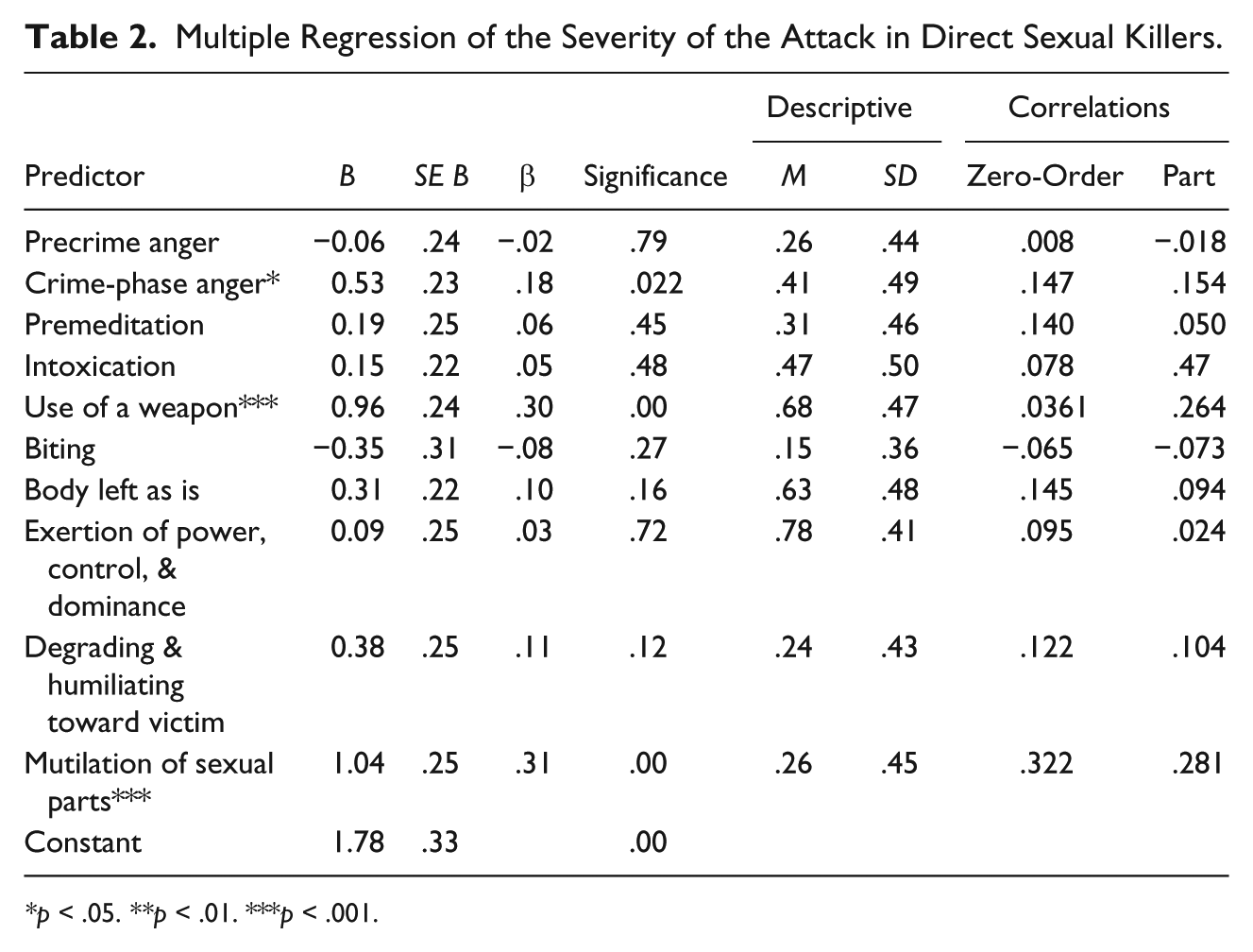
p < .05. **p < .01. ***p < .001.
Given that the use of weapon was a significant predictor for both the direct and the indirect offenders, chi-square analyses examined how the weapon was acquired. When a weapon was found at the crime scene, results suggested that this was no more likely among the indirect (n = 76, 43.2%) than the direct (n = 71, 40.8%) group, χ2(1, N = 350) = .203, p = .65. However, when a weapon was brought to the crime scene, this was more frequent among direct (n = 48, 27.6%) perpetrators than indirect sexual murderers (n = 31, 17.6%), χ2(1, N = 350) = 4.98, p = .026.
Discussion
Safarik and Jarvis (2005) highlighted that while the cause of death is an important component of homicide, the severity of injuries sustained is also crucial and needs to be considered as it helps to gain an understanding of the dynamics of the criminal event. After all, the behavior of the perpetrator who kills with little injury differs from the behavior of the perpetrator who spends considerable time and considerable effort in inflicting excessive injuries on the victim. The current study used the HIS (Safarik & Jarvis, 2005) to examine the degree of injury inflicted (a scale that focuses solely on the anatomical scoring of injuries observed, with the aim to quantify and provide a dynamic measurement of the injuries sustained by the homicide victim). The study further acknowledged that the current classification system of sexual homicide does not adequately capture the sexual aspect within the criminal event. Thus, following Stefanska et al. (2017), it classified cases as being either directly or indirectly related. Through this assignment, it aimed to (a) identify sexual killers based on their actions at the crime scene and not their motivation; (b) recognize that they are diverse population of perpetrators and that there would be heterogeneity even within subtypes of sexual killers; and (c) recognize that sexual homicide is a hybrid offense—a fusion of sexual assault and homicide and, because of this, classification should account for how the two salient factors of that hybrid (the sexual aspect and the act of killing) were related.
Interestingly, there were no differences in the mean total HIS score between the indirect and the direct cases. If the severity of the attack captures the perpetrator’s affect at the time of the homicide (occasionally manifesting in excessive violence or overkill), the results suggest a comparable emotional intensity between the groups. This could also suggest a comparable distribution of the angry perpetrators between the two groups of the sexual killers. Of course, as noted before it is not possible to always define excessive violence as stemming from anger given that in some cases the severity of the attack could also represent more predatory, sadistic acts (Radojevic et al., 2013).
The analysis of the relationship between the level of injury and the variables associated with the severity of the attack showed that the use of a weapon and crime-phase anger increased the risk of injury in both the indirect and the direct groups, although further analysis revealed that more direct perpetrators brought the weapon to the crime scene with them. Beauregard and Proulx (2002) found that precrime anger rather than crime-phase anger was more prevalent in the angry compared with the sadistic sexual killers, whereas Beauregard et al. (2007) noted that severity of the attack was significantly related to neither precrime anger nor crime-phase anger (although precrime anger was positively correlated with a fatal outcome). Thus, the results of this study are somewhat inconsistent with the previous research, although this could stem from the fact that different groups were compared. However, consistent with previous results, the use of a weapon during the criminal event increased the injury level (e.g., Beauregard et al., 2007; Reid & Beauregard, 2017).
In addition, the indirect perpetrators were more likely to be intoxicated and leave the body as it is at the crime scene. Taken together, these predictors might highlight the importance of a situational component in the criminal event for indirect sexual killers. If these perpetrators, for whatever reason, become angry when offending and they are intoxicated while also having (or having picked up) a weapon, the risk of the victim sustaining more severe injuries increases. In the aftermath of such a reactive crime, indirect offenders are more likely to leave the body at the crime scene.
The original intention of the perpetrator could be rape, but it could also be consensual sex (e.g., the perpetrator launching the physical attack after the victim rebuffed sexual advances, which were seen as rejection and provoked an angry outburst and physical attack; Stefanska et al., 2015). When thinking about the offense dynamic, the importance of resistance from the victim, for example, has been noted. Even though verbal and physical resistance can enable the victim to effectively avoid rape (Ullman, 2007), physical resistance has also been found to increase the chances of the aggressor becoming violent during a sexual attack (e.g., Balemba, Beauregard, & Mieczkowski, 2012). In fact, both physical and verbal resistance were found to increase lethality of a sexual assault if the perpetrator had a weapon. When the weapon was not present, physical resistance still increased the likelihood of the victim’s death (Reid & Beauregard, 2017). Research considering the rational choice perspective has also indicated that during the decision-making process, sexual offenders who use force do so mainly in response to victim resistance (Beauregard & Leclerc, 2007).
Conversely, for the direct sexual killers in the present study, severity of injuries was associated with mutilation of sexual body parts. According to Püschel and Koops (1987), there are four general motives that underpin mutilation. In defensive mutilation, the reason is to dispose of the body or make identification more difficult. In aggressive mutilation, killing is a consequence of a state of rage followed by mutilation. Offensive mutilation can stem from a necrophilic need to kill to carry out sexual activities with a dead body or a sexual urge to inflict pain where the mutilation may be initiated in a living person and continued after death. According to the fourth proposed type of motivation, necromaniac mutilation is carried out on an already dead body (with various causes of death, meaning that these are not necessarily homicide cases).
Given that defensive mutilation does not apply to the present findings due to the sampling procedure and inclusion criteria, and similarly necromaniac mutilation may not be captured by the present study, the mutilation of sexual body parts noted in the current study most likely represents a mixture of aggressive and offensive mutilation. Rajs, Lidberg, Broberg, Lundström, and Lindquist (1998) reported that in their sample, the perpetrators of aggressive mutilation tended to know their victim, and even though the acts of mutilation were the continuation of overkill, they also found mutilation of sexual areas. In the offensive mutilations in their series, the act of mutilation tended to be fundamental to the enactment of violent sexual sadistic fantasies or the enactment of necrosadistic fantasies. Mutilation of sexual areas was common, and the authors noted a possibility of other necrophilic acts such as penetration of the victim by foreign objects. Therefore, regardless of the underlying motive for the mutilation in homicide, it appears that mutilation of sexual body parts, as compared with mutilation of nonsexual body parts, is not typical. Moreover, as acts of mutilation often stem from existing fantasies, it is perhaps no surprise that mutilation was associated with the direct sexual killers group. In addition, the present results concord with previous findings that situational factors were particularly important in indirect cases, whereas the crime scene behavior of direct perpetrators appeared to be linked with the enactment of existing deviant fantasies (Stefanska et al., 2017).
Limitations
The process of assigning each case to the indirect or direct group was based on the evidence accepted by the court at trial and available in the lifer files. Although this strategy ensured consistency of the way the homicides were categorized, it is possible that in some cases a different decision would be reached with the benefit of additional information coming to light after the trial.
Inconsistencies in the content of the official documentation of each homicide case were also apparent. While some files included robust information, others provided more limited case details. In the event of discrepancy between the trial or the police information and reports written post-sentence (with information often provided by the perpetrator), the study used the former statements. Case files additionally included reports written by various professionals whose focus would differ depending on their role in the case. However, given that in practice clinicians also need to overcome a similar problem (and are likely to be restricted by incomplete access to reports, particularly police and trial reports), this study was able to bring together a range of sources rarely available to clinicians and improve the reliability of information through corroboration across sources.
The sample represented a full data search of all cases stored electronically in the Offender Assessment System in England and Wales captured from the beginning of its existence in the early 2000s (i.e., from that date, the offender was still serving a prison sentence), which resulted in a large sample size available for the study. Further strength of the sample selection criteria is that it allows exploration of the most common type of the sexual homicide, that is, adult male aggressor perpetrating against pubescent female victim. However, this means that the generalisability of the results should only be made to this type of scenario of the sexual homicide events.
Implications and Conclusion
Are there any advantages to the direct/indirect classification over other conceptualizations? Stefanska et al. (2017) argued that the strength of the direct/indirect classification lies in the fact that it does not aim to assess the motivation for the offending nor if the killing was intentional. Instead, it examines the crime scene behaviors to account for how the two very important factors of the sexual homicide hybrid (the sexual aspect and the killing) were related.
Are there perpetrators who are motivated by anger? Undoubtedly, yes. However, anger probably refers to the motivational force of the first violent attack on the victim or “the first blow,” and we argue that such understanding is not sufficient when classifying this type of crime. This is because there is a difference between an angry perpetrator who killed in the context of a consensual sexual situation during or following which he experienced an angry outburst and an angry perpetrator who killed in an angry outburst but who continued with the sexual attack knowing the victim was dying, or in fact knowing that the victim was dead. If at a physiological level sexual arousal and anger are negatively related (Myers et al., 2006), evidence of sexual arousal to severe violence must be scrutinized using the hypothesis that this was driven by specific deviant interests regardless of whether anger initially played a part in the offense. Indeed, the current results indicate that even though there was a comparable overt expressive aggression between the indirect and the direct cases, some different predictors appear to be associated with the increased degree of injury sustained by the victim. As such, a situational component appeared to play a role in the behavior of indirect sexual killers, whereas the behavior of the direct perpetrators tended to be linked with the enactment of the existing deviant fantasies.
Current conceptualizations do not account well for the specific mechanisms by which anger and sadism underlie sexual killing. Carter and Hollin (2014) noted that describing a subtype of sexual killer as angry in fact refers to a characteristic of the perpetrator. Myers et al. (2006) further cautioned against using anger as a synonym for aggression. While trait anger may be elevated in sexual murderers, similarly to other offenders, for example, those assessed to score highly on measures of psychopathy (e.g., Decuyper, De Pauw, De Fruyt, De Bolle, & De Clercq, 2009), this implies correlation and not causation. Some aggressive behaviors may not necessarily be associated with anger but with the more predatory behavior more typical of sadistic sexual homicides. In fact, while precrime anger was predictive of severity of attack for both groups in the current results, crime-phase anger was not. This possibly suggests that in some cases, overt expressive aggression was of a more predatory nature.
In England and Wales, but also other countries such as the United States and Canada, cases of sexually motivated murders lead to classification of the perpetrators as “sex offenders,” which in turn is likely to lead to risk and criminogenic need assessment, and treatment, as part of their sentence plan (Carter & Hollin, 2014). Aware of being perceived not only as murderers but also as sexual offenders, perpetrators may avoid addressing the sexual component of their crime and favor providing anger as a motivation for the killing. From the perspectives of legal outcome and safety in prison, offenders may presume it preferable to be seen as a “hot head” rather than a “sexual deviant” (Myers et al., 2006). This is why examination of crime scene behaviors and, we argue, assessing whether the sexual aspect and the killing were directly or indirectly related is so important. That is, the treatment needs of “angry: indirect” offenders would differ from treatment needs of “angry: direct” offenders, with the latter group needing to address deviant sexual acts and potential existing deviant interests and fantasies, regardless that anger may have been a motivational force for the initial attack. We believe that future research would benefit from methodological approaches cognizant of this.
Footnotes
Acknowledgements
The authors thank the Public Protection Unit, National Offender Management Service, UK, for enabling access to the Public Protection Unit Database.
Declaration of Conflicting Interests
The author(s) declared no potential conflicts of interest with respect to the research, authorship, and/or publication of this article.
Funding
The author(s) received no financial support for the research, authorship, and/or publication of this article.