




Abstract
In this retrospective study of 244 adult survivors of child sexual abuse (CSA), their experiences of childhood polyvictimization were analyzed as to their cumulative effect on trauma symptoms, education, and income levels. The data were gathered by anonymously sampling adult survivors of CSA from websites that were specific to this population (such as online peer support groups). Their experiences of victimization were examined as to Cumulative Polyvictimization, Witnessing Traumas (such as witnessing intimate partner violence), and Experiencing Traumas (such as child physical abuse). The majority of the sample (87%) experienced polyvictimization in childhood (in combination with CSA), with the largest part of the sample (83%) experiencing emotional abuse by someone close to them, and the smallest part of the sample (22%) experiencing child physical abuse by someone with whom they were not close. The results of the linear regressions showed that both experiencing and witnessing trauma were significantly associated with trauma symptoms for CSA survivors. These results suggest that both types of victimization (experiencing and witnessing) need to be treated as direct traumas, and a more holistic approach toward survivors of CSA is needed toward assessment and treatment.
Chronic or multiple victimizations during childhood can have detrimental developmental and lifetime impacts on the well-being and functioning of children, adolescents, and adults (Dvir, Ford, Hill, & Frazier, 2014; Finkelhor, Ormrod, & Turner, 2007; Kliethermes, Schacht, & Drewry, 2014; Layne et al., 2014; Miller, 2006). The cumulative impact of direct and indirect trauma exposure has been found to be highly correlated with psychological and emotional distress in comparison with nonvictimization, and even in comparison with chronic exposure to a single form of victimization, such as childhood sexual abuse, physical abuse, emotional abuse, witnessing domestic violence, and/or community violence (Álvarez et al., 2015; Espelage, Hong, & Mebane, 2016; Finkelhor, Turner, Hamby, & Ormrod, 2011; Miller, 2006; Richmond, Elliott, Pierce, Aspelmeier, & Alexander, 2009; Turner, Finkelhor, & Ormrod, 2006).
Research on the prevalence and incidence of polyvictimization suggests that some individuals are particularly vulnerable and some environments conducive to chronic exposure to multiple forms of violence and adversities (Anda et al., 2002; Finkelhor et al., 2007; Giovanardi et al., 2018; Hamby, Finkelhor, Turner, & Ormrod, 2010; Hillis, Anda, Felitti, & Marchbanks, 2001; Whitfield, Anda, Dube, & Felitti, 2003). Data from two prospective national surveys on victimizations experienced by children and adolescents in the United States have found that 22% to 49% of survey participants reported experiencing four or more types of direct and indirect forms of violence (Finkelhor et al., 2007; Finkelhor et al., 2011). Furthermore, children exposed to certain forms of victimization (including exposure to war or ethnic conflict, rape, bias attack, witnessing parental assault of a sibling, kidnapping, witnessing a murder, and dating violence) were more likely to report higher incidence and prevalence of polyvictimization. In both surveys, polyvictimization predicted higher levels of trauma symptoms, particularly anxiety, anger, posttraumatic stress disorder (PTSD), and depressive symptoms (Finkelhor et al., 2007; Finkelhor et al., 2011). In the 2011 National Survey of Children’s Exposure to Violence (NatSCEV) conducted with 4,549 children and youth, it was found that polyvictims were more likely to experience additional life adversities such as illness, accidents, family unemployment, parental substance abuse, and mental illness further increasing their vulnerability to the impact of chronic exposure to toxic stress (Finkelhor et al., 2011).
There is also growing evidence of the long-term impact of polyvictimization on well-being and functioning of adult survivors. The Adverse Childhood Experiences study provides one of the most extensive documentation of the longitudinal impact of childhood victimization and adversity on physical health (Brown, Thacker, & Cohen, 2013; Dong et al., 2005; Dube et al., 2009; Larkin, Shields, & Anda, 2012), sexual/reproductive health (Anda et al., 2001; Dietz et al., 1999; Hillis et al., 2004; Hillis et al., 2001; Ports, Ford, & Merrick, 2016), mental health (Anda et al., 2002; Chapman et al., 2004; Dube et al., 2001; Dube et al., 2005), and financial security (Anda et al., 2004) of adult survivors.
Adults with the highest reported exposure to adverse childhood experiences have also been found to experience the most life adversities in adulthood (Nurius, Green, Logan-Greene, & Borja, 2015). Later life stressors and adversities amplify the impact of chronic exposure to toxic stress during childhood and impact multiple life domains in adulthood, including education, work, relationships, sense of well-being, financial and housing stability, impaired daily activities, and psychological distress (Evans & Kim, 2010; Sansone, Leung, & Wiederman, 2012; Zielinski, 2009).
Some studies have also found an association between exposure to various forms of child maltreatment and education level, employment, earnings, and assets ownership among survivors (Currie & Wisdom, 2010; Sansone et al., 2012; Zielinski, 2009). Sansone et al. (2012) examined the impact of five forms of childhood traumas on employment during adulthood among 328 internal medicine outpatients, ages 18 years or older. They found that adult survivors of childhood sexual abuse reported greater number of full-time jobs and greater likelihood of getting fired. Adults who reported witnessing domestic violence as children were also more likely to get fired; however, impact of polyvictimization on employment was not assessed in this study.
Despite growing evidence that the cumulative impact of exposure to multiple traumas have more consequential impacts across multiple domains of well-being and functioning, few studies have examined the impact of polyvictimization during childhood on education attainment and income of adult survivors. Studies that have assessed adjustment to college among survivors of cumulative victimization during childhood have found that polyvictimization was a predictor of student college adjustment and mental health including academic and social adjustment, career problems, anxiety, depression, substance abuse, and suicidal ideation (Holt et al., 2017). Clearly, polyvictimization affects many areas of physical and emotional health, and social and economic well-being, across the life span.
Over the last decade, researchers across disciplines, and particularly in the field of child maltreatment and interpersonal violence (IPV), have identified the importance of obtaining complete victimization profiles (Espelage et al., 2016; Finkelhor et al., 2007; Ford, Elhai, Connor, & Frueh, 2010; Hamby, Finkelhor, Turner, & Ormrod, 2011; Richmond et al., 2009; Van der Kolk, 2005) by assessing and accounting for the cumulative impact of multiple victimizations. In the context of exposure to different and multiple domains of interpersonal trauma during childhood, the present study examines the impact of polyvictimization among adult survivors of childhood sexual abuse, and particularly assesses for impact of witnessing trauma versus experiencing trauma directly. We hypothesized that experiencing trauma would result in increased trauma symptom scores, and lesser education and income levels, whereas witnessing trauma would result in no change in these scores and levels.
Method
This study was approved by the University institutional review board (IRB). This study was conducted completely through the Internet, using SurveyMonkey. The use of online methods was purposeful, as research suggests that online studies are the preferred mode of participation for trauma survivors (DiLillo, DeGue, Kras, Di Loreto-Colgan, & Nash, 2006). This is due in part to the ease in which difficult information can be conveyed in an anonymous online setting versus face-to-face interviews (DiLillo et al., 2006). All responses to this study were completely anonymous.
We gathered the sample (N = 244) in 2013 by emailing adult survivor of child sexual abuse (ASCSA) organizations on the Internet (i.e., websites, trauma blogs, and Facebook groups) to ask their webmaster if a link to this study could be posted on their website. If they agreed, then we emailed the link to them and subsequently posted by them on their webpage. In total, 88 web addresses were contacted for permission, and 35 agreed to post the link to this study, for an overall response rate of 40%. To access the survey, potential participants clicked on the study link posted on one of these web pages. In order to be included in the study, all participants had to be adults (18 years old or older) and survivors of childhood sexual abuse. The final sample ranged in age from 18 through 73 years old. Also, out of our sample of 244 participants, 15% were men (n = 39), and 84% of the sample was Caucasian (n = 220). The other 16% of the sample consisted of Hispanic/Latinas and African Americans. In terms of education, 22% (n = 58) had obtained a college degree, and 27% (n = 71) had obtained a master’s degree.
Measures
The CSA Subscale of the Computer Assisted Maltreatment Inventory (CAMI) is a web-based self-report survey designed to measure multiple types of maltreatment using specific behavior indicators (DiLillo et al., 2010). The CAMI assesses for the sexual abuse experiences with the first three perpetrators, and uses 30 Likert-scaled as well as yes/no questions. The psychometric properties of the CSA subscale of the CAMI are strong overall, with a test–retest reliability ranging from .65 to 1.00 and strong criterion validity (DiLillo et al., 2010). In the present study, this measure showed excellent reliability with a Cronbach alpha of .935.
The Trauma Symptom Checklist-40 (TSC-40) is a 40-item self-report measure used to assess trauma symptoms in adults resulting from childhood (Elliott & Briere, 1992). The 4-point likert scale (0 = never to 3 = often) measures the presence of posttraumatic symptomology in six scales: Anxiety, Depression, Dissociation, Sexual Abuse Trauma Index (SATI), Sexual Problems, and Sleep Disturbance, as well as the total item score for the entire checklist. Findings indicate the TSC-40 has good predictive criterion and convergent validity, and is a reliable measure (Elliott & Briere, 1992; Zlotnick et al., 1996). In the present study, the Cronbach Alpha for this measure was .944.
The Brief Betrayal Trauma Survey (BBTS) is a 14-item self-report measure used to assess for trauma experiences in childhood and adulthood, and its validity and reliability are excellent (Goldberg & Freyd, 2006). The measure assesses items focused on physical, sexual, and emotional abuses in childhood as well as adulthood, and includes witnessing trauma (such as witnessing IPV and/or murder), as well as experiencing trauma (such as experiencing IPV, emotional abuse, etc.). For this study, only childhood trauma experiences were analyzed, and the Cronbach alpha for that was .769.
Data Analysis
We analyzed the data using Statistical Package for the Social Sciences (SPSS), Version 23. Missing data were coded as “999,” and was treated as missing data, so it was not used in any analyses. The three main independent variables were Cumulative Polyvictimization, Polyvictimization: Witnessing Trauma, and Polyvictimization: Experiencing Trauma, and these variables were created by using responses to questions from the BBTS (Goldberg & Freyd, 2006). To create the Cumulative Polyvictimization variable, the following variables (all before age 18) were summed to create one continuous variable: Witnessing the murder of someone close to the victim, Witnessing the murder of someone not close to the victim, witnessing violence in the family, experiencing violence with someone close to the victim, experiencing violence with someone not close to the victim, experiencing CSA with someone close, experiencing CSA with someone not close, and experiencing emotional abuse by someone close to the victim.
The variable for “Polyvictimization: Witnessing Trauma” was created by summing up the three “witnessing” variables: (a) Witnessed someone with whom you were very close (such as a parent or relative) committing suicide, being killed, or being injured by another person so severely as to result in marks, bruises, burns, blood, or broken bones. (b) Witnessed someone with whom you were not so close undergoing a similar kind of traumatic event. (c) Witnessed someone with whom you were very close deliberately attack another family member so severely as to result in marks, bruises, blood, broken bones, or broken teeth. The resulting variable was then formed into a dichotomous variable: No Traumas Witnessed, One or More Types of Trauma Witnessed.
The variable for “Polyvictimization: Experiencing Trauma” was created by summing up the “experiencing” variables (Experiencing severe violence with someone close and not close, and experiencing emotional abuse), and then forming a dichotomous variable (No Traumas—other than CSA—Experienced, and CSA plus One or More Other Types of Trauma Experienced). All study participants were adult survivors of CSA, so all other types of traumatization in childhood would have happened in addition to the CSA.
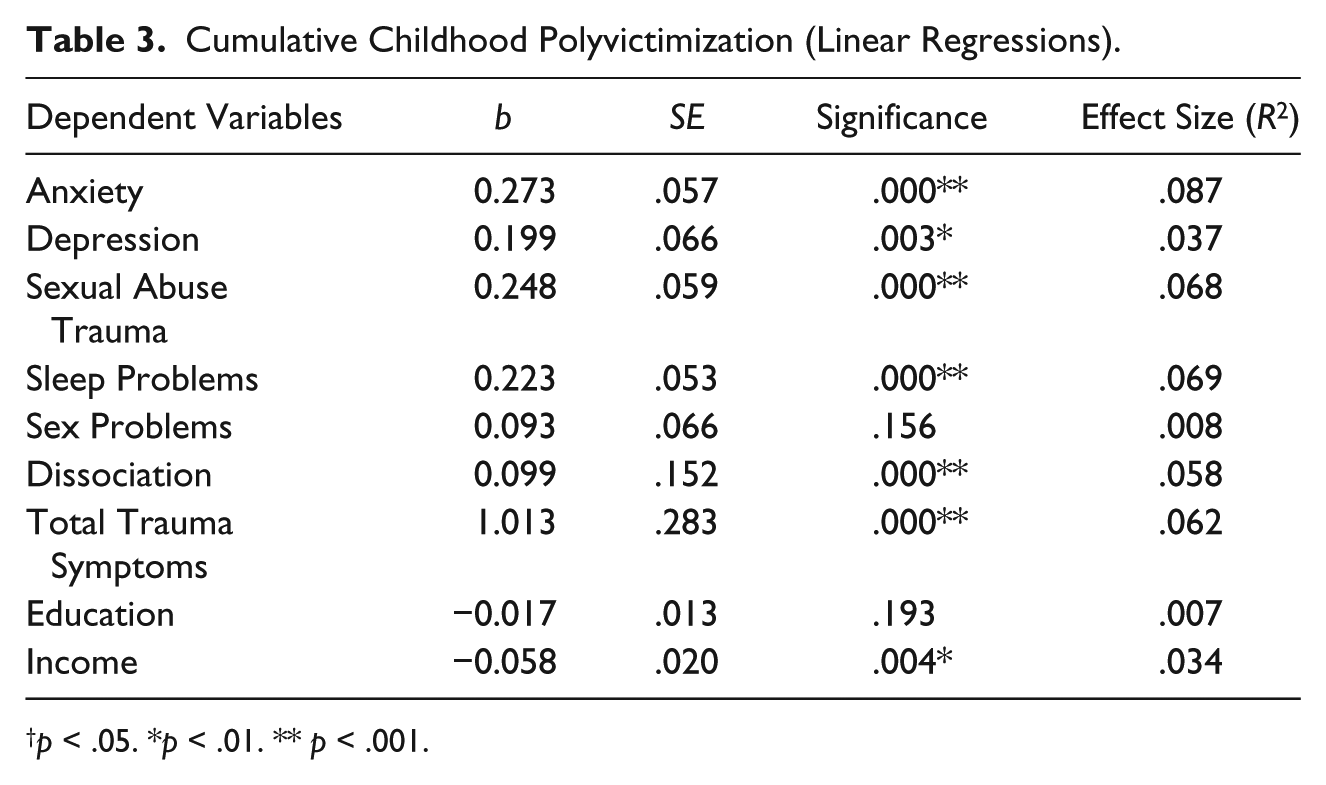
The Cumulative Polyvictimization variable was treated as a continuous independent variable, and Linear Regressions were used to examine the relationship between that variable and the following continuous dependent variables: Anxiety, Depression, Sexual Abuse Trauma, Sleep Problems, Dissociation, Total Scores on the TSC-40, Education, and Income Levels.
Results
The types of childhood polyvictimization experienced most by the survivors in this study were emotional abuse in childhood by someone close to them, whereas the least experienced types were physical abuse by someone with whom they were not close (see Table 1). The majority of the sample (86%) experienced some form of polyvictimization in combination with CSA.
Type of Polyvictimization Experienced by the CSA Survivors in This Study.

Note. n = 244. CSA = child sexual abuse.
Whereas 57% of the sample were polyvictims of witnessing trauma, 86% were polyvictimized through further experiences of trauma in childhood (see Table 2).
Descriptive Statistics: Witnessing and Experiencing Polyvictimization.

Note. n = 244.
CSA survivors who experienced any type of polyvictimization in combination with CSA were more likely to experience significant relationships on all of the tested dependent variables except for sex problems or education levels (see Table 3).
Cumulative Childhood Polyvictimization (Linear Regressions).
p < .05. *p < .01. ** p < .001.
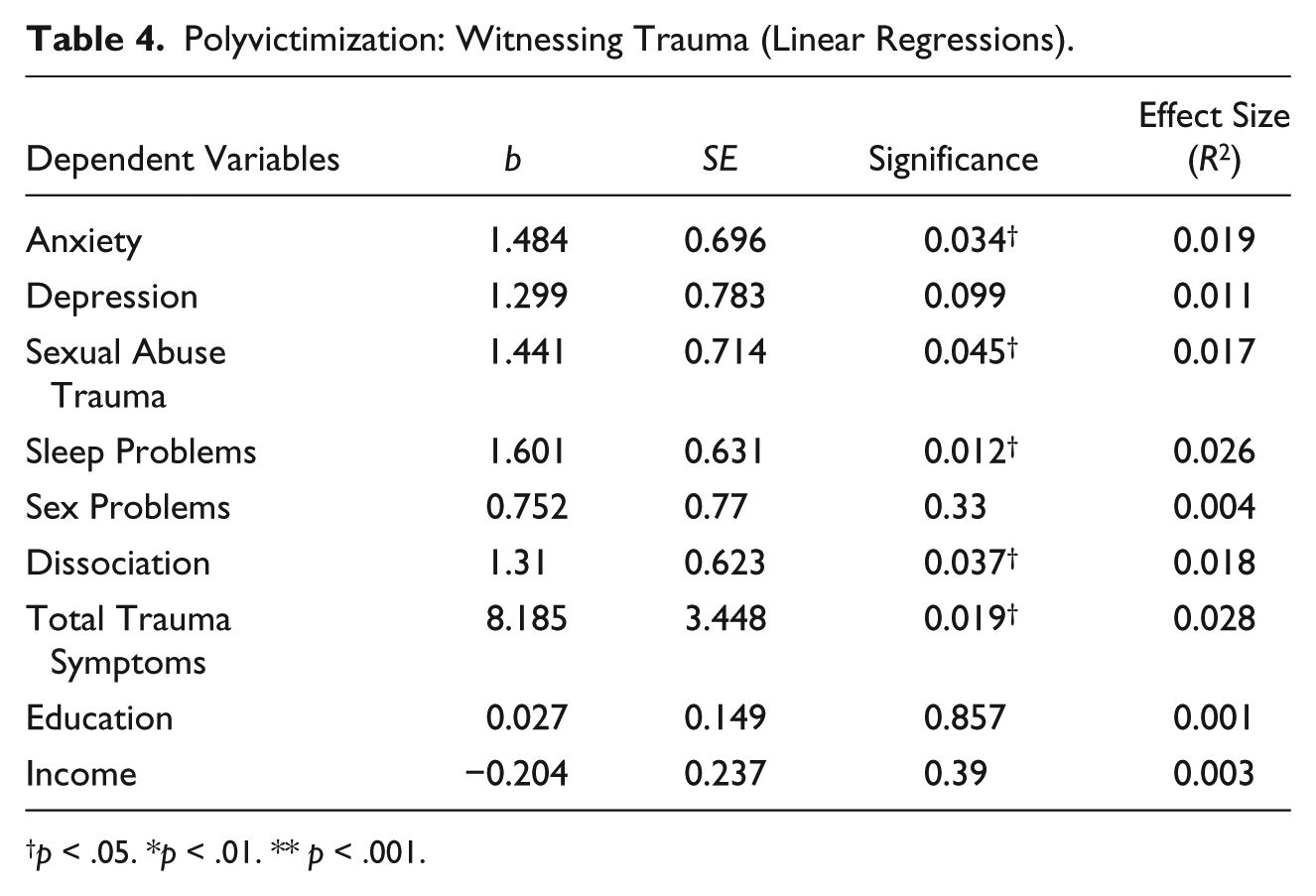
CSA survivors who witnessed trauma as their form of polyvictimization in combination with CSA were more likely to experience anxiety, trauma symptoms related to the sexual abuse, sleep issues, dissociation, and/or a higher score on the Trauma Symptom Checklist (see Table 4).
Polyvictimization: Witnessing Trauma (Linear Regressions).
p < .05. *p < .01. ** p < .001.
CSA survivors who experienced childhood emotional abuse and/or childhood physical abuse as their form of polyvictimization in combination with CSA were more likely to experience anxiety, depression, trauma symptoms related to the sexual abuse, sleep issues, dissociation, and/or a higher score on the Trauma Symptom Checklist (see Table 5).
Polyvictimization: Experiencing Trauma (Linear Regressions).

p < .05. *p < .01. **p < .001.
Discussion
The results of this study suggest that not only is there a high rate of polyvictimization among survivors of CSA but also that it has a direct effect on trauma symptoms, and in some instances, also on income levels of adult survivors. We hypothesized that directly experiencing trauma would result in increased trauma symptoms, and decreased education and income, whereas witnessing trauma would not have that same effect. Our hypotheses were incorrect, because these results show that witnessing interpersonal trauma in childhood is as harmful as experiencing physical and/or emotional abuse during childhood, in terms of significant associations with higher trauma symptoms. Furthermore, these results suggest that both types should be considered as traumatic events to these survivors (in terms of their effects on outcomes), and neither experiencing nor witnessing trauma alone had direct effects on education or income levels.
Since such a high percentage of survivors of CSA were polyvictimized in childhood, it would be beneficial for child and adult survivors of CSA to be screened for these other forms of abuse upon their initial contact and ongoing work with therapists or law enforcement. While a focus on the CSA (as the presenting problem) might require immediate attention, sole emphasis on sexual abuse and its impact, without assessing for polyvictimization, may fail to adequately account for the full range of individual and environmental factors that increase the vulnerability for these survivors. Clearly, CSA does not occur in a vacuum. This is particularly pertinent since each form of polyvictimization was associated with higher trauma symptomology in adults, and cumulative polyvictimization was associated with lower income levels. Given the long-term consequences of polyvictimization, thorough assessment is essential to prevention, treatment, and healing.
Gold (2000) proposed a conceptual framework to understand the adult functioning of survivors of CSA, particularly in the context of polyvictimization. He explains that survivors of child abuse often grow up in chaotic—and at the very least, deficient—families, and this kind of upbringing can be another risk factor for traumatic impact. Gold (2000) theorizes that, in such contexts, it is the familial dysfunction itself that is highly impactful toward the types of maladjustments often seen in survivors. As such, polyvictimization would be a natural result of such tumultuous environments.
Extant research suggests that there is a graded relationship between exposure, as a child, to physical abuse, sexual abuse, and witnessing domestic violence and adult victimization and perpetration of IPV among survivors, as well as other negative health outcomes (Dube et al., 2005; Hamby et al., 2010; Whitfield et al., 2003). For example, Whitfield et al. (2003) found that among 8,629 participants in their ACES study, women who reported exposure to all three forms of violent childhood experiences were 3.5 times more likely and men were 3.8 times more likely to report IPV victimization or perpetration in adulthood. Results from the present study as well as existing literature highlight the lifetime impact of polyvictimization during childhood and suggests that a holistic approach toward assessment and treatment may be valuable.
It is not only an expectation but also a general reality in America that higher education leads to higher income (United States Department of Labor, 2016). But the participants in this study did not experience this reality. Instead, even though their cumulative polyvictimizations did not have significant effects on their education, it did have significant effects on their income. There are many reasons for why this might be. Dissociation as a peri- and post-trauma-coping strategy has a profound impact on cognitive and emotional processing of traumatic experiences (Van der Kolk, 2015). The relationship between dissociation and different cognitive mechanisms such as focused versus selective attention (DePrince, Weinzierl, & Combs, 2009), reaction times (DePrince & Freyd, 1999), and memory for threatening information (DePrince & Freyd, 2004) is well established. It is possible that one of these, or a combination of these, are responsible for educational success. However, whereas dissociation might be a successful coping mechanism during educational attainment, it may not be enough to overcome the other symptoms of the combined trauma of polyvictimization when it comes to being able to perform certain jobs. Future research could shed light on the gap between educational achievement and income level of polyvictims with a history of childhood sexual abuse.
It is possible that after surviving multiple victimizations, trauma survivors need help with their self-esteem such that they learn that they are worthy and deserving of higher salaries/income. A difference of a few thousand dollars in a starting salary will cost many thousands of dollars over the life of a career, as raises/promotions are generally predicated upon that starting figure. Another plausible explanation for lower incomes among survivors may be related to reduced capacity for gainful employment due to the toll of polyvictimization during childhood on the physical and mental health of adult survivors. Childhood traumatic stress has been linked to increased hospitalization with diagnosed autoimmune disease in adulthood, as well as other somatic symptoms, substance abuse, higher medication, absenteeism, other job problems, and financial problems (Anda et al., 2004; Dube et al., 2009). Future research could further examine some of the facets associated with polyvictimization and income levels, such as self-esteem, starting salaries, and health/mental health and socioeconomic status correlates for these types of trauma survivors.
One of the limitations in this study was how the sample was gathered, in that it was obtained online. Online sampling would preclude those CSA survivors who did not have Internet access or who did not happen upon these particular websites during the time the study was open. Thus, it is possible that the participants in this study differ from a random sampling in the community. The individuals who may seek out such website on the Internet may result in a more severe sample size. Another limitation is that, in this study, the operationalization of the construct “polyvictimization” has been limited to six types of possibly traumatic exposures during childhood. Further research could examine a wider range of victimization profile among adult survivors of childhood sexual abuse (such as surviving war or ethnic conflict). Along the same lines, it is possible that the emotional abuse suffered was during the same CSA events that the participants survived, as CSA is inherently emotionally abusive.
This study’s results show that polyvictimization in childhood (both witnessing and experiencing) in combination with CSA has an effect on adult trauma symptoms, dissociation, and income levels. Such results suggest that clinical work with these survivors should take into account the types of victimizations survived in childhood, and its cumulative impact on adult well-being. Holistic interventions that take into account the complexity of the experiences of the survivors would be more effective in meeting their needs, and ensuring a path toward life-long healing.
Footnotes
Declaration of Conflicting Interests
The author(s) declared no potential conflicts of interest with respect to the research, authorship, and/or publication of this article.
Funding
The author(s) received no financial support for the research, authorship, and/or publication of this article.
