



Abstract
Most school-based prevention curricula for young children fail to address multiple types of abuse and limit instruction to a single day, despite evidence that polyvictimization is common and children learn better when allowed to practice material repeatedly. This study utilized a cluster randomized control trial design to evaluate a multi-abuse prevention program, the Monique Burr Foundation for Children (MBF) Child Safety Matters®, based on varying lesson structure. Participants included nine Florida schools consisting of 843 children in grades K-2. Schools were randomized within cluster to implement in two lessons, four lessons, or after study data collection (i.e., control group). Lessons averaged 34 minutes (SD = 8.8 minutes) in length for 2-lesson group and 23.6 minutes (SD = 6.9 minutes) for the 4-lesson condition. Knowledge was assessed before implementation and on average 11 weeks after implementation. There were no statistical differences between clusters. Controlling for pre-test scores, schools in the four-lesson group scored highest on a measure of knowledge of potentially risky and unsafe situations (M = 69.68, SE = .80) on post-test, followed by schools in the two-lesson group (M = 67.31, SE = .77), followed by schools in the control group (M = 62.92, SE = .76). Results support use of more frequent, shorter lessons for prevention programs and the promise of addressing multiple forms of child victimization.
An alarmingly high number of children – approximately 80% - experience at least one type of victimization (e.g., bullying physical abuse, sexual abuse, emotional abuse, theft, witnessing violence) in their lifetimes with approximately 30% experiencing five or more types of victimization (Finkelhor et al., 2013; Tucker et al., 2019; Turner et al., 2010). One form of victimization, child abuse and neglect, is linked to developmental delay (Bright & Thompson, 2018; Scarborough et al., 2009; Sullivan & Knutson, 2000), poorer reading skills (Johnson et al., 2008), poorer social skills (Darwish et al., 2001), poorer academic performance (Coohey et al., 2011), and fewer verbal/nonverbal abilities (Richards & Wadsworth, 2004).
Ultimately, adults bear the responsibility of protecting children. However, there is value in a child’s ability to avoid potentially risky situations, to say “no” or “stop” in a victimizing situation and to disclose to an adult if they have been victimized. Based on the theory of planned behavior (Ajzen, 1991), these behaviors can be changed by increasing children’s recognition (i.e., knowledge of what is a risky situation and how to respond), perceptions (i.e., beliefs that they have resources and self-efficacy to act), and intentions (i.e., wanting to avoid and disclose).
Schools provide an effective setting for dissemination of evidence-based interventions targeting these characteristics. In the classroom, children are primed for learning, typically have an established relationship with the person implementing the intervention (e.g., teacher, school counselor), and have regular contact with mandated reporters after the intervention in the event they choose to disclose victimization. Although children under age 5 have the highest rates of maltreatment overall, among school-aged children, primary school children have high rates of some forms of victimization like peer assault and parental maltreatment and sexual abuse rates begin to increase around age 10 (Finkelhor et al., 2010). There is an extensive literature demonstrating that school-based programs can reduce bullying victimization and perpetration (Evans et al., 2014; Gaffney et al., 2019), increase positive bystander behavior (Polanin et al., 2012), reduce drug usage (Faggiano et al., 2008), reduce risky sexual behavior (Fonner et al., 2014), increase media literacy (Jeong et al., 2012), and improve general mental health (Durlak et al., 2011) among other prevention objectives.
In a meta-analysis of CSA prevention education research, Walsh et al. (2018) found CSA prevention curricula were effective at improving children and youth’s knowledge of abuse, and some studies demonstrated evidence of improvements in self-efficacy and protective behaviors. Only one study examined the impact of a program on abuse disclosures and victimization (Oldfield et al., 1996). In this study, researchers found disclosures of abuse to be higher among the group of students who received the prevention program.
Most studies of school-based abuse prevention curricula designed for young children focus exclusively on a single type of victimization, namely child sexual abuse (CSA) (Walsh et al., 2018). Given that most children who experience one type of victimization also experience at least one other type of victimization (Finkelhor et al., 2007), programming that addresses multiple types is warranted.
Another limitation of many current safety curricula is that they are often designed to be presented in a single day, 59% according to one survey (Finkelhor et al., 2014). This is likely because of the time constraints common in public schools and the competing demands of classroom time. However, a significant amount of foundational research has demonstrated that greater exposure to a topic is linked to better learning and recall (Cacioppo & Petty, 1979; Gordon & Holyoak, 1983). Thus, it is logical to believe that these curricula may be most impactful when implemented across multiple sessions.
The Monique Burr Foundation for Children’s (MBF) Child Safety Matters® program is a school-based curriculum designed for children in grades kindergarten through 5 that provides content about physical, sexual, and emotional abuse, bullying, digital dangers, the importance of and methods of disclosure. Lessons are designed to be delivered in two sessions but can be shortened and extended to four sessions as needed. Consistent with the literature on skills-based learning, the curriculum includes a variety of videos and example scenarios as well as hands-on and interactive activities. Researchers have evaluated the curriculum for its efficacy in increasing knowledge of and retaining knowledge of risky situations in youth aged 5–11 years (Bright et al., 2022). These researchers found that children who received the curriculum increased their knowledge for the safety information included in the program, and that children retained this knowledge over a 7-month period.
In the current study, we extend the literature on school-based prevention curricula, and specifically the MBF Child Safety Matters® program by examining its efficacy in increasing knowledge about multiple forms of abuse with young children (aged 5–8 years) and in different implementation structures (2 vs. 4 sessions). We hypothesized that compared to fewer longer sessions, more sessions that were shorter would yield higher scores in knowledge of risky situations. Additionally, given the shorter attention span of younger children, we hypothesized that more sessions would be particularly beneficial for the youngest children (i.e., kindergarten).
Method
Design and Sample
This study was conducted from June 2018 to June 2019. Inclusion criteria were Florida public schools, serving grades K-2, that have not implemented the curriculum within the last four academic years. We excluded charter, private, and magnet schools, and classrooms with primarily special education students from the study. Recruitment included first receiving approval from the school district then contacting each eligible school within that district. A total of 26 eligible schools were contacted directly for recruitment. The first schools to express interest and agree to participate were enrolled. The sample included nine Florida schools within seven counties, 54 classrooms, and 843 children at pre-test (Figure 1). All schools enrolled completed the study; no schools were lost to follow-up. CONSORT diagram of school and child sample.
Schools were grouped (clustered) based on similarities in geography and size and then, within these clusters, randomly assigned to one of three study conditions: implement the curriculum in two lessons, implement the curriculum in four shorter lessons, or implement the curriculum after study data collection. Within each school, two classrooms per grade were randomly selected for a total of six participating classrooms per school. A random number generator was used to assign conditions. A research assistant created the random number list and assigned schools. This research assistant was not blind to condition. A different researcher analyzed data. This person was also not blind to condition . Using a 20-item knowledge assessment, schools in the 4-lesson group had significantly higher scores at post-test than did schools in the 2-lesson group. Schools in both treatment groups scored higher than did schools in the control group, after adjusting for pre-test scores.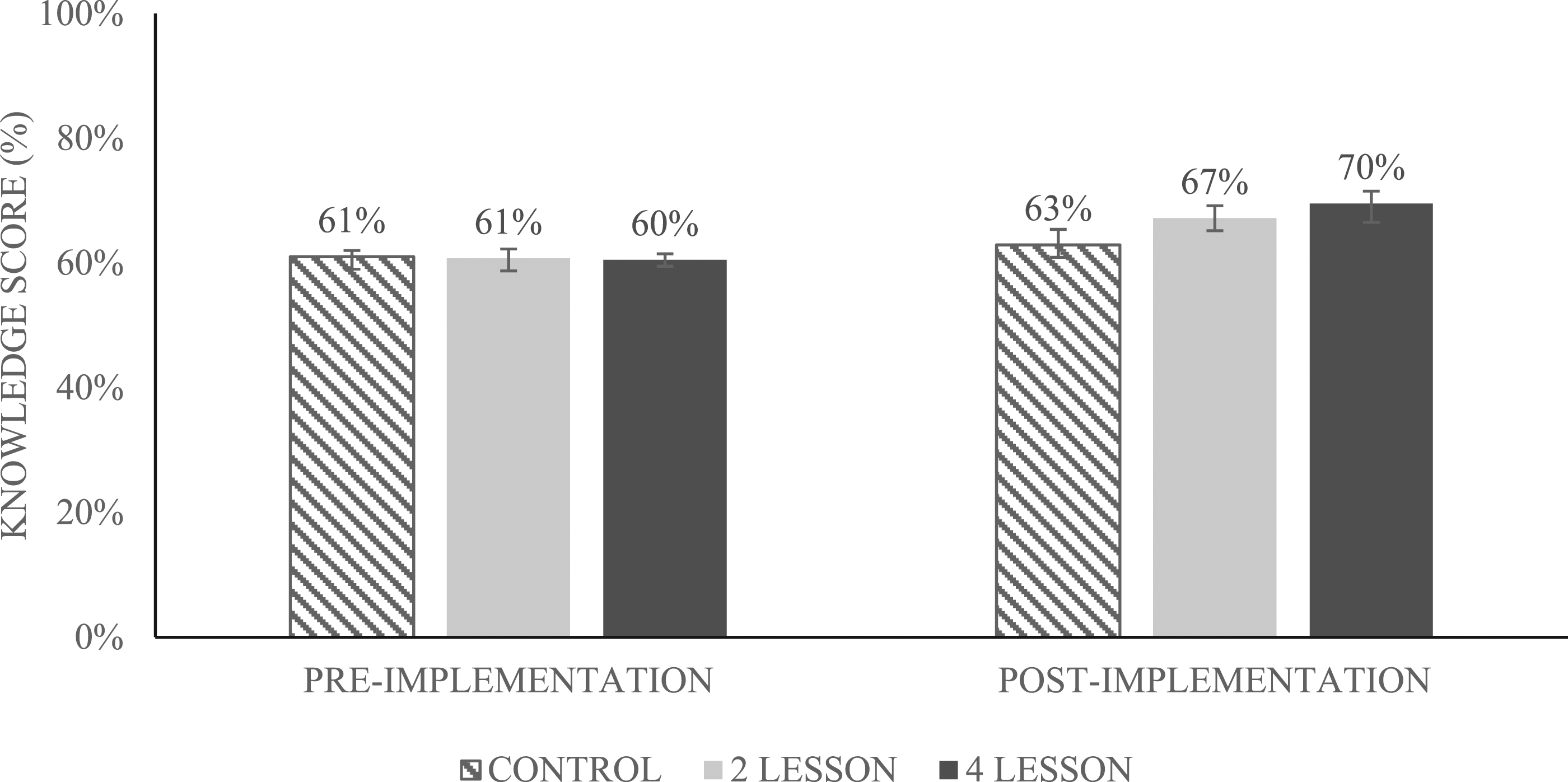
Descriptive Statistics for Schools and Classrooms.

aData obtained from United States Census Bureau, 2010 and National Center for Education Statistics (2016–2017).
Columns may not sum to 100% due to rounding. Because these data were only available at the school level, we could not analyze group differences in demographic characteristics.
We received approval from the Institutional Review Board from a state university and county school districts. We also received permission from school principals, assistant principals, and counselors of eligible schools based on our inclusion and exclusion criteria.
Procedure
We used passive consent and waited at least 1 week before scheduling pre-intervention assessment data collection. Passive consent included sending an informational sheet to parents which explained the purpose and procedure for the study and required parents to send back a portion of the sheet if they did not want their child to participate. Parents could also contact the researcher or school staff directly if they did not want their child to participate. Less than 5% of parents opted their child out of participation. Children whose parents opted-out of the study or curriculum were either sent to a different classroom, sat in another section of the room, or were given another activity. Each school received a $1500 USD incentive; facilitators received $500 USD incentive.
Curriculum
The MBF Child Safety Matters® curriculum is a school-based curriculum designed for children in grades K through 5. MBF Child Safety Matters® curriculum provides content to children directly and information to connected adults (school staff, parents, and caregivers) about physical, sexual, and emotional abuse, bullying, digital dangers, the importance of disclosure, and other topics on safety awareness. Schools may select any staff member to implement the curriculum (termed facilitator hereafter). Most schools select a school counselor to serve as the facilitator. Each facilitator must complete approximately 4 hours of online trainings to receive a free copy of the MBF Child Safety Matters® curriculum materials for their school. Materials include: a hardcopy of the MBF Child Safety Matters® curriculum Facilitator manual with scripts; a flash drive containing the Facilitator manual, videos, ready-to-print handouts of activities, and PowerPoint presentations for each lesson; and classroom posters and a school banner, which list the curriculum’s 5 Safety Rules and state “We Follow the Safety Rules.” The 5 Safety Rules are to be used in any potentially unsafe situation: Know What’s Up (i.e., ensure a safe adult knows where you are and what you are doing), Spot Red Flags (i.e., know the rules for appropriate vs. inappropriate situations and how to identify unsafe), Make a Move (i.e., if you are being harmed, or might be harmed, get away and stay away); Talk It Up (i.e., tell a safe adult if you spot red flags or feel unsafe); No Blame, No Shame (i.e., no matter what happens, it is not your fault). MBF also provides student reinforcement materials distributed after lessons are taught, which include a sticker, a coloring poster, and two bookmarks for children to give to their self-identified Safe Adults. Lastly, the curriculum creators also provide take-home parent information sheets and activity sheets for parents to complete with their child after each lesson. There is no additional content in the 4-lesson model. Instead, the MBF provides recommended “stop points” in the curriculum to break up material equally across 2 or 4 lessons.
Measures
Implementation Fidelity
Implementation data were analyzed to assess number of days elapsing between pre- and post-testing among groups as well as time between implementation days. Researchers also observed 32 of the 108 (30%) implementation sessions using a checklist of 22 expected events based on the curriculum: before lesson (e.g., did the facilitator write key terms indicated in the curriculum), lesson length, if a facilitator followed the script and delivered the lesson with enthusiasm, if take-home materials were distributed and explained to students, if the students’ teacher was present during the lesson, and if every activity specific to a grade level and lesson was completed as intended. Each observed lesson was given a score of 0–100 based on the percentage of these events that occurred as designed in the curriculum with higher scores indicating more events/activities were completed as designed. Observers also reported any unexpected interruptions, technical issues, engagement and behavior of children, teacher engagement, and possible reasons a lesson lasted longer or was cut shorter than expected.
Two researchers completed most (78%) observations together and then completed the remaining independently. Discrepancies in coding for the shared observations, albeit rare, were discussed and a resolved to create a single observation score. Researchers then used guidelines from the discussion of shared observations to conduct their independent observations.
Child Knowledge
A significant limitation of the literature is a lack of child-appropriate measures for evaluating prevention curricula. One of the most widely used and adapted is the Child Knowledge of Abuse Questionnaire (Tutty, 1997). The CKAQ includes 40 true/false items and has demonstrated moderate reliability in samples of young children (.76–.90). Mean scores at pre-test for children in kindergarten and grade 1 were 56% and 61%, respectively.
Prior to the current study, we conducted a pilot test using many of the items from the CKAQ with approximately 20 children in grades kindergarten through fifth. We found that the combination of limited attention from younger children and limited classroom time allocated for research necessitated a much shorter survey. Thus, we limited the measure to 24 items. For children in kindergarten, we further limited the survey to 20-item true/false questionnaire based on both previous curriculum evaluation studies and the diverse victimization topics covered in this curriculum (Bright et al., 2020; Tutty, 1995) (Table 4). Items were summed to create a total score with higher scores indicating greater knowledge. Analyses that combined grades included only the 20 items. Internal consistency for scores on the assessment were moderate, α = .53 at pre-test and α = .67 at post-test. Given the limited time for answering survey items, we were unable to include additional measures to test for convergent or discriminant validity.
A researcher guided children through completing the survey using an electronic student response system. With this system, survey items were pre-loaded into a PowerPoint presentation. Each student was given an electronic device that was pre-programed with their unique participant ID. The researcher read each question out loud and then “opened” the response tool for students. Once all students responded, the researcher progressed to the next question. If a student selected an option that was not possible (e.g., a number in a true/false question), then the researcher cleared their response and asked them to respond again. Only once all participants responded did the researcher progress to the next question.
Demographic Characteristics
To minimize our use of classroom time, and given the young age of our participants, we chose not to collect demographic information at the child level. We did, however, collect child demographic information at the school level (Table 1). Because these data were only available at the school level, we could not analyze group differences in demographic characteristics.
Analytic Plan
Knowledge (dependent variable) was analyzed with a mixed design that included a within-subject factor of time (pre, post) and the between subject factors of condition (treatment or waitlist control) and grade level (K, 1, 2). The mixed model also included the random multilevel effects of schools and classes within school. The first model tested was a three-level mixed model (school, teacher, and student) based on total test scores from the sum of the 20 items. There were 722 students who completed both the pretest and posttest on the 20 items. Since the three-level model showed there was no significance for the cluster of teacher level nested within schools, a two-level mixed model was structured with the school level based to examine the results from the ICC, R-Square, and design effect. The two-level model is: Posttest ∼ pretest group mean centered + Condition + Grade + (1|School). Data analysis was conducted using R 4.0.0.
To understand what topics were best conveyed in the curriculum versus not learned from the curriculum (either because they were known before the curriculum or not understood from the curriculum), we examined the proportion of children who answered items correctly at baseline, the proportion of children who answered each item correctly at pre- and post-testing, as well as the change in this proportion across time. We then compared change scores for schools in treatment conditions to change scores for schools in the control condition.
We conceptualized topics as easy/not learned in the curriculum if most students knew the correct answer before receiving the curriculum. That is, items may be easy if at least 75% of children answered correctly prior to curriculum and there was no statistical difference in change between control and treatment groups. When fewer than 75% of children answered an item correctly prior to curriculum and the increase in the proportion correct was statistically higher for children who received the curriculum (in both treatment groups) compared to children who did not receive the curriculum, we proposed that learning can be contributed to curriculum. When fewer than 75% of children answered an item correctly prior to curriculum but either a) the increase in the proportion correct was not statistically different for children who received the curriculum compared to children who did not receive the curriculum or b) the difference was only present for one of the treatment groups), we proposed learning for that item cannot be attributed to curriculum alone. When the proportion of children who answered an item correctly was <75% at both pre- and post-test and there was no statistical difference in proportion correct between groups, we proposed that this item may be confusing for students.
Results
Implementation
Average Days Between Testing and Implementing and Post-Test.
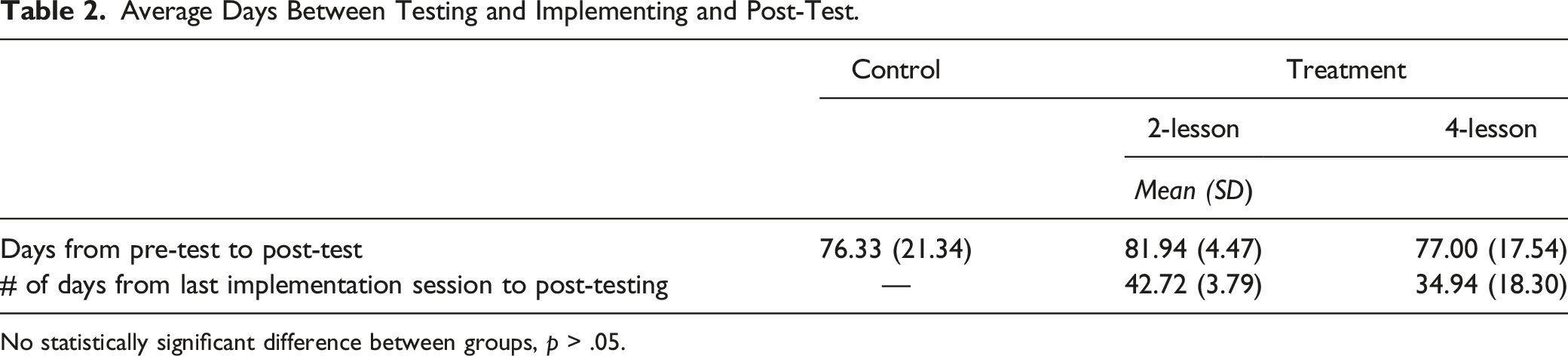
No statistically significant difference between groups, p > .05.
Schools in the 2-lesson group averaged 9.61 days between the first and second (last) lesson (SD = 3.43 days, range = 6–14 days). Schools in the 4-lesson group averaged 5.50 days (SD = 3.37 days) from first to second lesson, 10.94 days (SD = 8.79 days) from second to third lesson, and 5.33 days (SD = 4.86 days) from third to fourth lesson. Thus, schools in the 2-lesson group completed all material in approximately 10 days whereas schools in the 4-lesson group completed all material in approximately 21 days. There were approximately 43 days (SD = 3.79 days) from the last lesson to post-testing for the 2-lesson group and 35 days (SD = 18.30 days) for the 4-lesson condition with no statistically significant difference between them, p = .09.
Observations revealed that lessons averaged 34 minutes (SD = 8.8 minutes) in length for 2-lesson group and 23.6 minutes (SD = 6.9 minutes) for the 4-lesson condition, t (30) = 3.82, p = .001. Most (58%) lessons included two adults in the room (the facilitator and teacher) and an average of 14.78 children (SD = 2.5) present with no differences between conditions.
The mean score for implementation fidelity was 69% (SD = 23%; range = 14%–100%) and median was 79%. Schools that implemented in 2 lessons averaged lower fidelity scores (M = 58% SD = 26%) compared to 4-lesson schools (M = 78%, SD = 15%), t (30) = 2.78, p = .005. Of those that were not implemented with 100% fidelity, the primary deviations were presenting information without provided video, skipping content, and shortening discussions. Supplemental notes from the observers indicated that these deviations were likely because of technical difficulties and time constraints.
Child Knowledge
Descriptive Statistics for Knowledge Scores as Percent Correct.
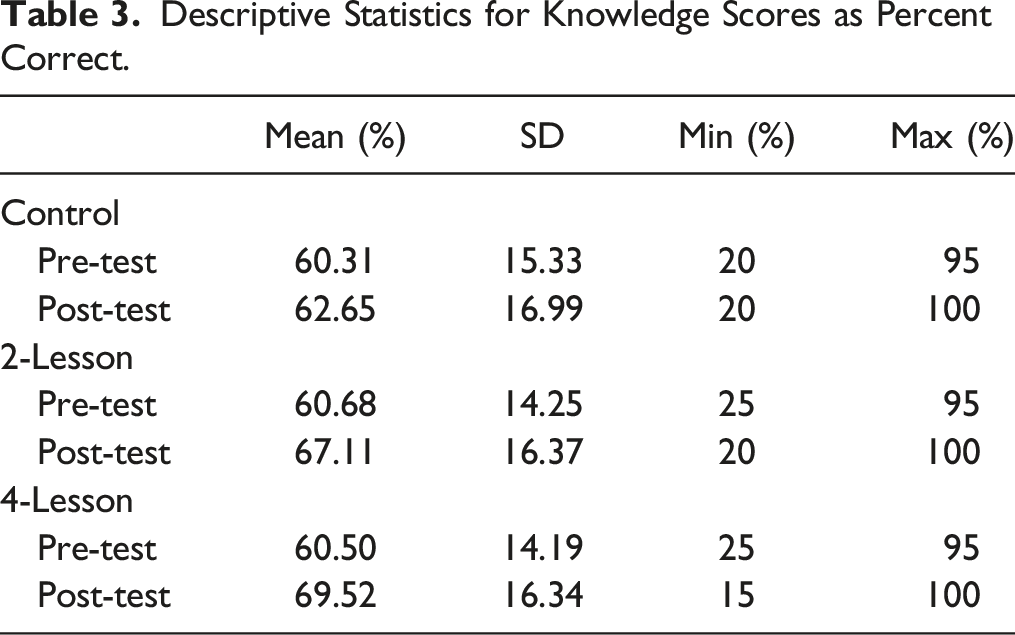
The mixed model began with an unconditional model with condition and school that showed that the effect of school was too small to be included in the model (ICC = .044). In contrast, the unconditional model with classroom showed a strong effect of classrooms (ICC = .373). Including the random multilevel effect of classrooms, three models were examined – (1) condition, (2) condition and grade, and (3) condition, grade and the interaction of condition and grade. According to the AIC and BIC, the best fitting model was model 2 (Chi-square difference between model 1 and 2 = 72.688, df = 2). Thus, the final model included grade and condition main effects with a random intercept for classroom (AIC = 5678.0, BIC = 5714.7, R2 = .819). From the mixed model, the effect of condition was significant with the four-lesson group scoring higher than the control group and the two-lesson group not being significantly different from either of the other conditions. Children in the four-lesson group scored highest (M = 69.68, SE = .80) on post-test, followed by children in the two-lesson group (M = 67.31, SE = .77), followed by children in the control group (M = 62.92, SE = .76).
Item-Specific Learning
Percentage of Children Who Answered Each Item Correctly, by Treatment Group.
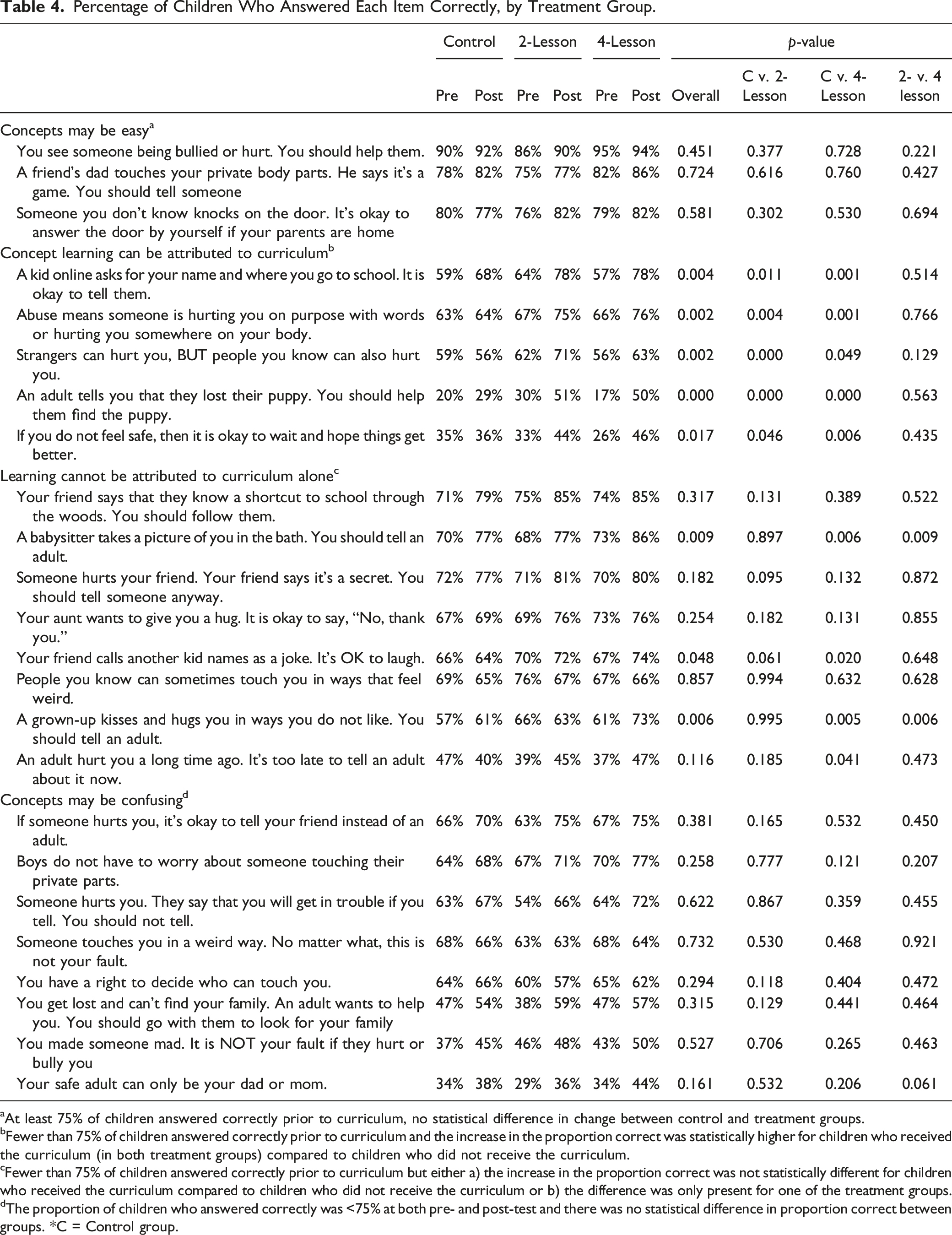
aAt least 75% of children answered correctly prior to curriculum, no statistical difference in change between control and treatment groups.
bFewer than 75% of children answered correctly prior to curriculum and the increase in the proportion correct was statistically higher for children who received the curriculum (in both treatment groups) compared to children who did not receive the curriculum.
cFewer than 75% of children answered correctly prior to curriculum but either a) the increase in the proportion correct was not statistically different for children who received the curriculum compared to children who did not receive the curriculum or b) the difference was only present for one of the treatment groups.
dThe proportion of children who answered correctly was <75% at both pre- and post-test and there was no statistical difference in proportion correct between groups. *C = Control group.
Discussion
We found that children within schools that received the MBF Child Safety Matters® curriculum demonstrated a greater increase in their knowledge of multiple types of risky situations than did children within schools that did not receive the curriculum. That is, after controlling for the pre-test, post-test scores were higher for schools receiving the curriculum. Our findings are consistent with a previous evaluation of the MBF Child Safety Matters® curriculum in youth aged 5–11 years as well as evaluations of other programs, which demonstrated success from school-based curricula in increasing child knowledge of child abuse and warning signs of victimization (Blumberg et al., 1991; Pulido et al., 2015; Walsh et al., 2018). Our findings add to the literature by examining a curriculum focused on multiple types of child victimization and measuring differential effect of number and duration of sessions.
We found greater knowledge acquisition in the 4-lesson group compared to the 2-lesson group, likely because there were more opportunities to reinforce the key learning elements and be reminded of messages (Gordon & Holyoak, 1983; Schmidt & Eisend, 2015). This finding is consistent with findings in educational research that repeated exposures to content lead to improved learning (Gordon & Holyoak, 1983). Thus, although most (59%) research prevention curricula are designed to be presented in a single day (Finkelhor et al., 2014), our findings support more and shorter presentations of prevention material.
The findings also show no interaction between grade and treatment condition. This means that children at all grade levels K-2 benefitted from the MBF Child Safety Matters® curriculum. This is encouraging because of some concerns that younger children may have a harder time learning the concepts.
Our findings revealed an interesting pattern of learning for some concepts more than others. It appears that children learn that keeping secrets about someone being hurt is not okay, that private parts are private, and that they are not at fault for victimization from outside of the curriculum. That is, these may be messages commonly conveyed by adults to children of this age regardless of formal programming. These findings suggest that prevention curricula may not need to emphasize these concepts and should instead focus on those that are uniquely conveyed through education programing. For example, what they seem to be picking up from this program are a couple of extra safety skills (responding to online requests, helping unknown adults), some important additional telling skills (i.e., you can disclose about injuries from a long time ago, you shouldn’t wait and hope things getting better), that people who you know can hurt you, and the definition of the word abuse.
This study has some notable limitations. Paramount among these is that the measured outcome was only knowledge acquisition and not actual increased safety or reduced victimization. Although increased knowledge is part of the Theory of Planned Action which outlines the predictors of decreased victimization, studies have not confirmed this link. There are reasons why knowledge may not increase safety, including the barriers to putting knowledge into actual behavior. For example, in studies of judgements on moral transgressions, researchers have found that young children (3 and 4 years) rate hypothetical events as more serious and more wrong than similar actual events. Thus, it is possible that although children in this sample were able to identify the correct behavioral choice, they may minimize the seriousness of an actual experience of potential abuse and not behave in the prescribed way (Smetana et al., 1993).
The knowledge questionnaire also has limitations. As described previously, the lack of child-appropriate measures for evaluating prevention curricula is a limitation of the literature. The CKAQ, likely the most widely used, includes 40 true/false items and has demonstrated moderate reliability in samples of young children (.76–.90). After a pilot study of these items, we determined that a much shorter survey was necessary. Thus, although we used and adapted items from the CKAQ, our questionnaire as used had not been validated.
Scores in our sample demonstrated a low internal consistency. Low internal consistency could be indicative of poor measurement and thus limit our ability to draw conclusions about the impact of the curriculum. However, a high alpha is not necessarily a good quality in knowledge tests (as opposed to personal trait or attitude assessments) that are intended to measure a diversity of facts. In this case, the summed items reflect the total learning without an expectation that learning one item would imply learning another (Taber, 2018). In addition, some of the items appear to assess knowledge that is widespread prior to training, and therefore may not be able to show effects of training. Given this limitation, the findings of overall learning should be considered with caution. In addition, given the lack of meaningful, valid, and feasible outcome measures for young children, further research on measurement development should be prioritized.
Fidelity in implementation is another potential limitation. Our median fidelity score was 79%, and only one observation earned a score of 100% indicating that most facilitators made at least one modification to the outlined curriculum. This mean score is lower than other studies of school-based CSA prevention research in which researchers have reported fidelity scores upwards of 90% (Baker et al., 2013; Pulido et al., 2015). Borelli and colleagues (2005) suggest a cutoff of 80% to indicate high fidelity, to which the median score in the current sample approaches (Borrelli et al., 2005). It is interesting that schools in the 2-lesson treatment group had, on average, lower scores of fidelity compared to schools in the 4-lesson group. Reasons for deviations to protocol were primarily time constraints and technology difficulties (which often created time constraints). It is possible that facilitators struggled to implement the CSM lessons with fidelity in a 2-lesson format. This further supports that a 4-lesson format is the better option when implementing the CSM curriculum.
We acknowledge the methodological and statistical limitations inherent to cluster randomized control trials such as bias in randomization and selection bias. Our primary factor for clustering was geography of school (rural, urban, suburban). Once a school agreed to participate, we grouped schools in geographic clusters. Then, within each cluster we randomly assigned condition (control, 2-lesson, 4-lesson). Although the research assistant responsible for recruitment was not blind to this randomization, the parameters for grouping were relatively simple and assigned was monitored by other members of the research team. Regarding selection bias, schools were not aware of their cluster assignment or randomized condition prior to agreeing to participate. Thus, we do not expect these biases to affect our findings.
Implications
Our findings have implications for research and practice. From a research perspective, our findings confirm what other studies have found – children can learn prevention concepts from school-based curricula. Our findings also reveal that understanding prevention concepts are difficult to measure, particularly with young children. Including multiple questionnaires for measure of validity are difficult given the very limited classroom time allocated for research activities but should be considered whenever possible to improve measurement. In addition, given that children are most likely to disclose experiences of abuse when they feel safe and believed (Ungar et al., 2009), measures of how confident children feel in their ability to talk to adults may be better measures of prevention effectiveness.
Our findings around item-specific learning also reveal that measuring complex concepts can be quite difficult and children may be able to answer correctly based on previous knowledge and/or guessing based on language of the question. Our limited ability to attribute learning solely to the curriculum also suggests that more research is needed in refining measures for this research. Importantly, we hope that children are learning these concepts outside of the curriculum from parents, trusted adults, and as part of a culture of safety in their school. The implication for research here is that when evaluating these programs, it is important to measure past experiences with curricula, any initiatives being used by the entire school, and content taught by parents.
From a practice perspective
Conclusions
Adding to the positive findings in the previous evaluation, this evaluation contributes substantially to the evidence that the MBF Child Safety Matters® curriculum achieves its objective to impart information about multiple forms of abuse to even young children. Although knowledge of appropriate response is a predictor of behavior, it remains to be seen whether this increased knowledge translates in actual behaviors and actual reductions in victimization. This should be the goal of additional evaluations of the MBF Child Safety Matters® curriculum. Moreover, evaluations are needed with various populations to understand how the effectiveness of the prevention curriculum generalizes to settings with different demographic characteristics, social norms around violence, and resources.
Supplemental Material
Supplemental Material - Randomized Control Trial of a School-Based Curriculum that Teaches About Multiple Forms of Abuse
Supplemental Material for Randomized Control Trial of a School-Based Curriculum that Teaches About Multiple Forms of Abuse by Melissa A. Bright, Mona Sayedul Huq, M. David Miller, Shivam Patel, Ziying Li, and David Finkelhor in Child Maltreatment
Footnotes
Author’s Note
Work for this project was completed while the first and second authors were affiliated with the Anita Zucker Center for Excellence in Early Childhood Studies. At the time of manuscript submission, the first author is now affiliated with the Center for Violence Prevention Research.
Declaration of Conflicting Interests
The author(s) declared no potential conflicts of interest with respect to the research, authorship, and/or publication of this article.
Funding
The author(s) disclosed receipt of the following financial support for the research, authorship, and/or publication of this article: This work was supported by the Monique Burr Foundation to the University of New Hampshire and the University of Florida.

Supplement Material
Supplemental material for this article is available online.
References
Supplementary Material
Please find the following supplemental material available below.
For Open Access articles published under a Creative Commons License, all supplemental material carries the same license as the article it is associated with.
For non-Open Access articles published, all supplemental material carries a non-exclusive license, and permission requests for re-use of supplemental material or any part of supplemental material shall be sent directly to the copyright owner as specified in the copyright notice associated with the article.
