




Abstract
Support for corporal punishment (CP) has been associated with religiosity. Yet, little is known about which aspects of religiosity predict support for CP. To close this gap in the literature, we investigated how individual and social religiosity, religious fundamentalism, belief in heaven, belief in hell, and demographic variables contribute for the support of CP. We analyzed population-based cross-sectional data, as gathered in the General Social Survey, with a final sample size of n = 671. Using ordinal regression, we found that increased support for CP was best predicted by belief in heaven and religious fundamentalism. These results suggest that support for CP seems to emerge mainly from absolute belief in divine reward and retribution. Religious parents might endorse CP as a means to ensure that their children enter heaven.
Corporal punishment (CP)—the application of physical pain, such as spanking, to abate undesirable behavior in a child—is fiercely discussed in academia and among the general public. Whereas some have argued in favor of CP (e.g., Ferguson, 2013; Gunnoe, 2013), most researchers have found that CP has no beneficial effects on child development (e.g., Gershoff, 2013). Going further, most studies show that CP leads to a range of negative long-term outcomes, such as aggression, depression, and even antisocial behavior in children. For example, in a recent meta-analysis, Gershoff and Grogan-Kaylor (2016) found that most of the analyzed effects demonstrate a substantial link between CP and increased detrimental outcomes in children. Importantly, CP itself is a practice that has been found to also make future child abuse more likely (Gershoff, 2002; Gershoff & Grogan-Kaylor, 2016). CP is generally understood as to constituting a continuum with physical abuse, such that if CP is performed too frequently or the CP is severe, it becomes physical abuse. Indeed, most parents who had abused their children stated that the abuse started with the intention to discipline their child (e.g., Afifi, Mota, Sareen, & MacMillan, 2017; Coontz & Martin, 1988).
Meanwhile, spanking has remained common around the world (Ryan, Kalil, Ziol-Guest, & Padilla, 2016). Approximately half of the children surveyed in 33 developing countries reported that they had experienced CP (UNICEF, 2010). In the United States, the prevalence of CP is even greater: In one study, approximately two thirds of 1-year to 3-year-old children were being spanked by their parents (Regalado, Sareen, Inkelas, Wissow, & Halfon, 2004), whereas another study reported that up to 94% of parents of preschool children had used CP in the previous year (Straus, 2010). From a legal perspective, most countries are passing laws that prohibit CP at home (Lansford et al., 2017). In addition, international governing bodies such as the United Nations have become strong advocates of children’s right to a violence-free upbringing.
Given that attitudes, such as support for CP, strongly affect information processing, behavioral intention, and behavior, researchers have increasingly focused on possible predictors of support for CP (Bohner & Dickel, 2011; Holden, Brown, Baldwin, & Caderao, 2014; Webb & Sheeran, 2006). One of these predictors is religiosity, but the findings about its effects have been inconsistent. Several studies found that Protestants tend to endorse CP more strongly than other religious groups. Further investigations revealed these differences to be mainly due to religious fundamentalism (Ellison & Bradshaw, 2009). Religious fundamentalism represents an attitude of certainty as to the ultimate truth of one’s religious beliefs (Beller & Kröger, 2017). Religious fundamentalists believe, among other things, that one’s own religion is the only true faith; that it is superior to the findings of science; and that one’s own religion provides unfailing principles that must be followed for eternal salvation, as laid down in sacred scriptures. In a Christian context, some passages of the Bible might be interpreted as encouraging CP. For example, Proverbs 23:13-14 states, “Do not withhold discipline from a child; if you punish them with the rod, they will not die. Punish them with the rod and save them from death.” Thus, fundamentalist parents might be encouraged to use CP to rescue their children’s eternal souls from hell. Similarly, religious parents might emphasize concepts of divine retribution and reward. As seen in the previous biblical passage, eternal reward in heaven might be seen to be only possible for those who repent their sins and submit their lives to God; those who fail to do so might burn in hell for all eternity. Consequently, it has been assumed that belief in heaven and hell are major predictors of behavior in believers (Ellison & Bradshaw, 2009; Hirschi & Stark, 1969).
Other studies have focused on individual and social religiosity, mostly in the form of prayer and church attendance. For example, Wolf and Kepple (2019) found that social religious practices predicted support for CP. In another study, Rodriguez and Henderson (2010) investigated the relationship between parental intrinsic and extrinsic religiosity and the potential for child abuse and found that the latter, but not the former, was related to CP. Other recent studies have found no associations between religiosity and CP. For example, Lee, Altschul, and Gershoff (2015) investigated the role of religiosity in CP among foreign-born and U.S.-born Hispanic parents. They found that religiosity, measured by the frequency of church attendance, was not significantly related to CP. Yet, other studies have even found protective effects of religiosity on CP (e.g., Carothers, Borkowski, Lefever, & Whitman, 2005; Petts & Kysar-Moon, 2012). Thus, although the potential impact of religion on support for CP is well recognized, findings regarding the effect of religion on CP remain inconsistent.
One possibility as to why the current literature contains inconsistent findings is that each study has simultaneously incorporated only a few aspects of religiosity. Although religiosity is a complex construct (Paloutzian & Park, 2014), most previous studies have only used religious affiliation, or single aspects of religiosity—typically, religious service attendance—to examine the contribution of religiosity to CP. However, if different aspects of religiosity exhibit differential effects on support for CP, it may also be expected that studies using different aspects of religiosity return different results (Beller & Baier, 2013). Empirically, it has been well-established that certain aspects of religiosity, especially individual religious practices, social religious practices and religious fundamentalism, exhibit differential effects on other types of violence (e.g., Beller, 2017; Beller & Kröger, 2018a, 2018b; Beller, Kröger, & Hosser, 2019; Ginges, Hansen, & Norenzayan, 2009). Thus, investigating whether different aspects of religiosity also exhibit differential effects on support for CP might help clarify previous findings that appear to contradict each other. Moreover, from a practical perspective, examining the impact of several aspects of religiosity at once may enable the extraction of religion’s “active ingredients.” If it is found that only certain aspects of religiosity, but not others, contribute to CP, then it might be possible to more effectively influence support for CP in practice.
The current study strives to fill this gap. We investigate the simultaneous effects of previously separately analyzed aspects of religiosity—individual religiosity, social religiosity, religious fundamentalism, belief in heaven, and belief in hell—on support for CP in a large population sample of the United States.
Method
We drew our data from the 2008 wave of the General Social Survey (GSS), a periodic cross-sectional survey that is representative of the adult population of the United States. The GSS collects core data on numerous variables, such as demographics and attitudes toward social issues. In addition, the GSS includes rotating modules from the International Social Survey Program for a random subset of participants. In 2008, this rotating module consisted of items relating to religion, and a total of 671 adults were given the relevant questions to answer. Missing values (0%-2.53% per item) were imputed using the missForest algorithm (Stekhoven & Bühlmann, 2012) to mitigate bias that could result from simply deleting participants listwise (e.g., the strongest supporters of CP might be less likely to answer questions regarding their support for CP). The missForest algorithm uses nonparametric recursive partitioning and is thus an imputation technique that is particularly suited for imputing data sets under minimal assumptions with mixed variable-types, such as in the current study (please note that similar results were obtained from a listwise deleted data set). Thus, the resulting total sample size was n = 671. As we only analyzed anonymized secondary data we did not need to obtain institutional review board (IRB) approval.
As the dependent variable, we used support for CP (i.e., how strongly the respondent agreed or disagreed that “a good, hard spanking” is sometimes needed to discipline a child). As predictors, we used individual and social religious practices, religious fundamentalism, belief in heaven, belief in hell, age, sex, education, income, and being foreign-born. The operationalization of our measures is further described in Appendix Table A1.
Statistical Analysis
First, we examined the bivariate relationships between variables via Spearman correlation analyses. To examine the relative impact of our predictors when accounting for the other variables, we conducted ordinal regression analyses utilizing the proportional odds model, which provides estimates of the likelihood to more strongly endorse CP via odds ratios. As our inclusion of multiple measures of religiosity as predictors may make the work susceptible to problems of multicollinearity, we also investigated the robustness of our results, and examined the effects of our predictors separately. If the effect of one aspect of religiosity did not vary much when excluding the other aspects from the analysis, we expected our results to be robust.
Results
Participants were on average 47.04 years old (SD = 16.45) and had 13.37 years of education (SD = 2.99). About 53% self-identified as female, 77% as White, 14% as Black, and 9% as other ethnicities; 12% were foreign-born. Participants had on average two children (M = 1.97, SD = 1.61). In addition, most participants reported to be Protestants (51%) or Catholics (24%). On average, participants prayed several times a week (M = 3.21, SD = 1.72), attended religious services several times a year (M = 3.44; SD = 2.73), believed in heaven and hell (M = 3.44, SD = 0.86; M = 3.15; SD = 1.04, respectively), and supported CP (M = 2.86; SD = 0.83). Men tended to support CP more strongly than women (Mmen = 2.95, SDmen = 0.75; Mwomen = 2.79, SDwomen = 0.90), and self-identified Blacks (M = 3.23, SD = 0.75) were more supportive of CP than self-identified Whites (M = 2.80, SD = 0.83). Support for CP did not differ substantially between participants with multiple children (M = 2.87, SD = 0.82) and participants with less than two children (M = 2.86, SD = 0.85).
Table 1 depicts the results of our correlation analyses. Religious service attendance, religious fundamentalism, belief in heaven, belief in hell, and being male correlated significantly with an increased support for CP. Prayer frequency, age, education, income, and being foreign-born were not significantly associated with support for CP. The significant correlations were of approximately medium size, with a range of .08 ≤ r ≤ .22.
Ms, SDs, and Intercorrelations (Spearman) of Support for Corporal Punishment and Its Religious and Demographic Predictors (n = 671).
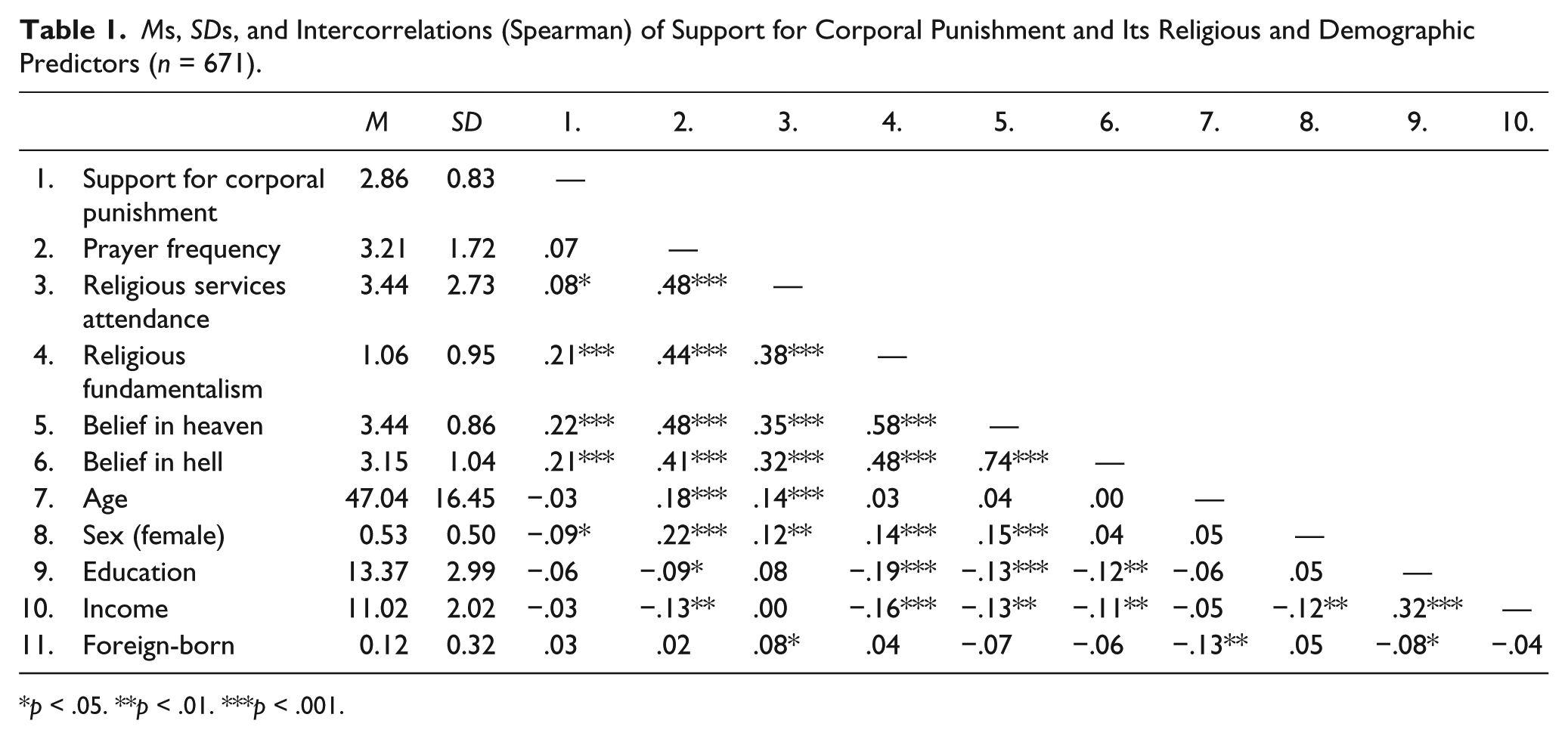
p < .05. **p < .01. ***p < .001.
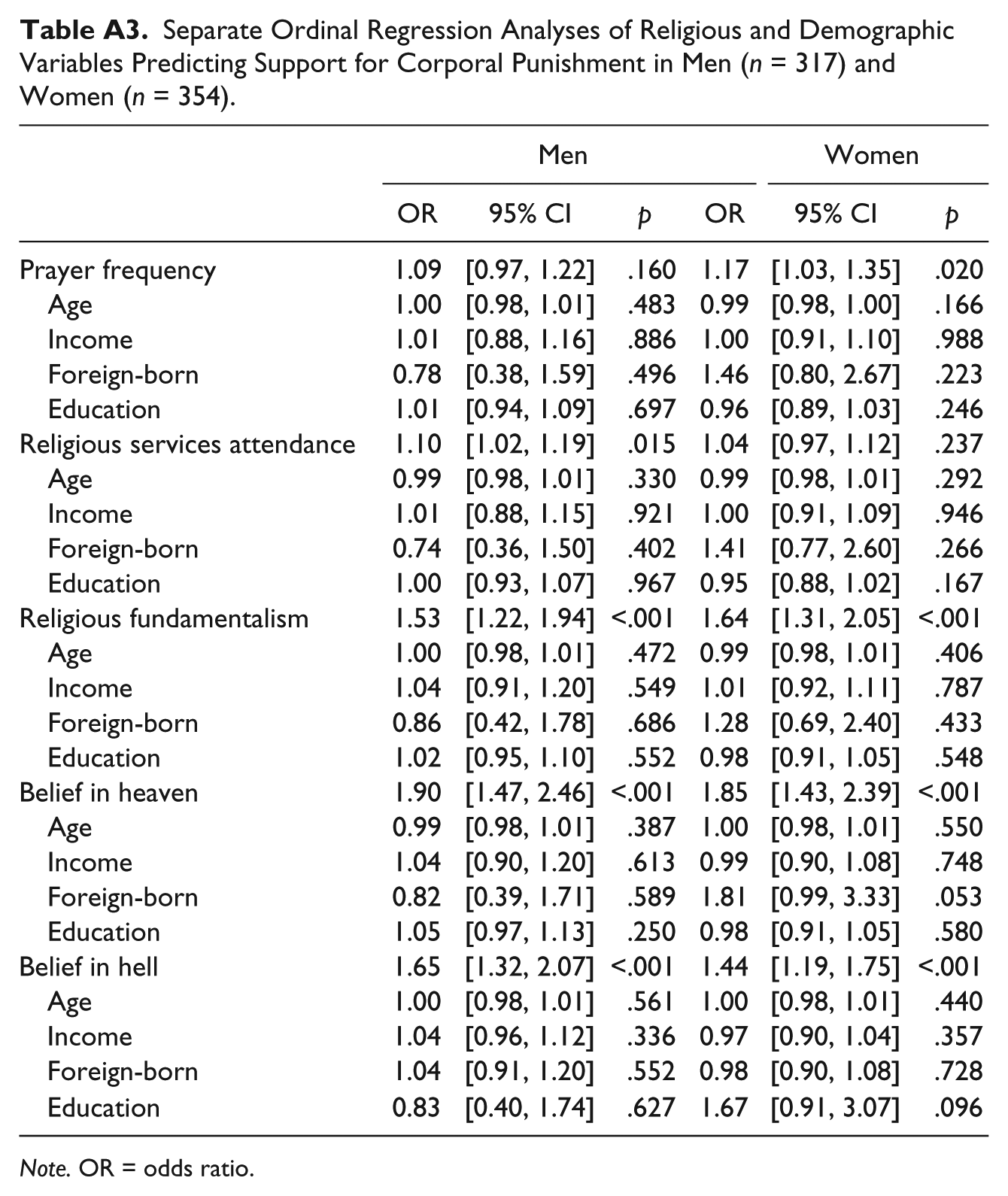
Table 2 displays the results of our ordinal regression analysis. Results emerged that were similar to those of our correlation analysis. However, only religious fundamentalism, belief in heaven, and the participant’s sex still significantly predicted increased support for CP. Prayer frequency, religious service attendance, belief in hell, age, education, income, and being foreign-born were not significantly associated with support for CP. Belief in heaven had by far the strongest standardized effect size. Each increase of one standard deviation in belief in heaven increased the likelihood to more strongly support CP by about 45%. As seen in Appendix Table A2, when excluding the other aspects of religiosity from the analyses, the effects described remained relatively robust. In addition, as seen in Appendix Table A3, these results were also relatively robust when analyzing the responses of men and women separately.
Ordinal Regression Analysis of Religious and Demographic Variables Predicting Support for Corporal Punishment (n = 671).

Note. OR = odds ratio.
Discussion
In the current study, we analyzed how aspects of religiosity—individual religiosity, social religiosity, religious fundamentalism, belief in heaven, and belief in hell—were associated with support for CP. We found that religious fundamentalism, sex (being male), and especially belief in heaven were associated with increased support for CP. No other variables were significantly related to support for CP in the multiple ordinal regression analysis.
Our work confirms the results of previous studies, such as Ellison and Bradshaw (2009), who found that religious fundamentalism predicts support for CP (see also Unnever & Cullen, 2006). There are at least two aspects that may explain this association. First, religious fundamentalists tend to interpret their sacred texts literally (Williamson, Hood, Ahmad, Sadiq, & Hill, 2010). As some parts of the Bible, especially in the Old Testament, might be taken to endorse CP, it might not be surprising that religious fundamentalists more strongly endorse CP. Second, corresponding with the terror management theory (Greenberg, Pyszczynski, & Solomon, 1986), religious fundamentalism has been described as a strategy to cope with existential fear. By providing certainty and clear moral guidelines, religious fundamentalism may effectively alleviate this fear (Friedman & Rholes, 2008). Seen in light of this theory, a child’s disobedience might not only simply be a behavioral problem to be addressed, but could also constitute a challenge to one’s social identity and fundamentalist world view, which might explain why fundamentalists tend be more punitive in their responses to child disobedience (Ysseldyk, Matheson, & Anisman, 2010). Finally, future longitudinal studies are required to examine the exact reason why fundamentalists more strongly endorse CP.
In contrast to the results of multiple previous studies, we found no strong effects of either individual or social religiosity (e.g., Rodriguez & Henderson, 2010) on support for CP. One explanation for the absence of these effects might be the fact that we examined multiple aspects of religiosity simultaneously (e.g., Beller & Kröger, 2018b; Unnever & Cullen, 2006). At least part of the CP-promoting effects other researchers have ascribed to individual or social religiosity might emerge simply because these two factors are associated with religious fundamentalism and belief in heaven. As depicted in Table 1, those who pray and attend church frequently also tend to be more certain in their belief in heaven, and more fundamentalist in their attitude toward their religious beliefs. Thus, the association between religion and support for CP seems to be mainly driven by religious fundamentalism and belief in divine reward and retribution.
Surprisingly, the largest effect on support for CP among the different aspects of religiosity was exhibited by belief in heaven—a predictor that, to our knowledge, had not been analyzed before (being female had the second largest effect overall, most likely because men tend to be more supportive of violence in general; Smith, 1984; but see Ellison & Bradshaw, 2009). Perhaps, the more strongly one believes that norm-conforming behavior will be divinely rewarded, the more one accepts CP as a means justified by the end (see also Shariff & Rhemtulla, 2012). From the perspective of decision theory, a rational actor should consider the value of the consequences of different actions, and the probabilities with which these consequences occur, multiply both to get an “expected value,” and choose the action that maximizes this expected value (Edwards, 1961). Applied to CP, the more one believes in heaven, the higher the value and possibility one will assign to the anticipated eternal punishment in the case of persistent disobedience, or reward in the case of obedience. Thus, in fundamentalist believers, CP may also be seen as an “optimal rational response” to child disobedience, which would explain the strong effect of belief in heaven on support for CP in our study (Johnson & Krüger, 2004). An alternative explanation might be that belief in heaven, presumably, also strongly relates to belief in the appropriateness and effectiveness of harsh punishment. If one fundamentally believes that an all-powerful deity has established heaven to further good behavior and that eternity in hell constitutes a fair punishment for sinful behavior, one might also be more likely to support CP as a parenting practice (but see Laurin, Shariff, Henrich, & Kay, 2012). Finally, future studies must further elaborate the mechanisms by which believe in heaven is associated with support for CP.
Finally, our results may inform efforts to change support for CP in families. In practice, parenting interventions that aim to enhance the knowledge, skills, and confidence of parents, such as Triple P (Positive Parenting Program), were revealed to be effective in reducing CP (Kliem, Foran, & Hahlweg, 2015; Knerr, Gardner, & Cluver, 2013; Sanders, 2012). Potentially complementing these programs and other comprehensive approaches, such as by Vieth (2005, 2014), we found that support for CP is mainly influenced by religious fundamentalism and belief in heaven. As religious fundamentalism and belief in divine retribution and punishment might themselves prove resistant to change (Hood, Hill, & Williamson, 2005), one approach could be to alter the “expected value” of CP. As previously discussed, our results suggest that CP might be a rational response for those who have an unshakable belief in divine reward and retribution, and therefore, wish to ensure, as an ultimate goal, that their children go to heaven. However, as multiple studies show, CP does not exhibit positive effects on children’s behavior (Gershoff, 2013); in fact, the opposite is true, with CP shown to increase antisocial behavior in the long term (Gershoff & Grogan-Kaylor, 2016). Thus, one approach to changing support for CP might be to first acknowledge that religious parents who use CP might only want the best for their child, and then emphasize that using CP actually decreases their children’s likelihood to behave appropriately (Robinson, Funk, Beth, & Bush, 2005).
The current study could be improved in several ways. First, we used a correlational design to study religious predictors of support for CP. In a similar vein, although our population-based sample might be seen as diverse, the sample size did not permit us to stratify our analyses regarding some potentially important variables such as ethnicity or children’s age. As such, we can only report general and correlational, but not stratified and causal relationships (Shadish, Cook, & Campbell, 2002). Future research should employ experimental and longitudinal designs to complement our cross-sectional study, for example, by trying to replicate our findings in more detail and by exploring possible mechanisms for the observed link between believe in heaven and support for CP. Furthermore, we operationalized most of our constructs with single items. Future research should thus use more comprehensive measures with known psychometric properties, operationalize further dimensions of religiosity, and include further covariates that might explain the link between religiosity and CP (Zwingmann, Klein, & Büssing, 2011). Similarly, we only used support for CP as our dependent variable, instead of measuring actual CP behavior. Although measuring attitudes instead of behavior has its benefits (see, for example, Bohner & Dickel, 2011), future studies should also examine the potential differential effects of aspects of religiosity on actual CP behavior (Ryan et al., 2016). By accepting these limitations, however, we were able to use a population-based sample to comprehensively investigate the contribution of religion to CP. Future studies must replicate and expand upon these results.
Supplemental Material
religiosity_corporal_punishment_responseletter_revision2 – Supplemental material for Slapping Them Into Heaven? Individual and Social Religiosity, Religious Fundamentalism, and Belief in Heaven and Hell as Predictors of Support for Corporal Punishment
Supplemental material, religiosity_corporal_punishment_responseletter_revision2 for Slapping Them Into Heaven? Individual and Social Religiosity, Religious Fundamentalism, and Belief in Heaven and Hell as Predictors of Support for Corporal Punishment by Johannes Beller, Christoph Kröger and Sören Kliem in Journal of Interpersonal Violence
Footnotes
Appendix
Separate Ordinal Regression Analyses of Religious and Demographic Variables Predicting Support for Corporal Punishment in Men (n = 317) and Women (n = 354).
| Men |
Women |
|||||
|---|---|---|---|---|---|---|
| OR | 95% CI | p | OR | 95% CI | p | |
| Prayer frequency | 1.09 | [0.97, 1.22] | .160 | 1.17 | [1.03, 1.35] | .020 |
| Age | 1.00 | [0.98, 1.01] | .483 | 0.99 | [0.98, 1.00] | .166 |
| Income | 1.01 | [0.88, 1.16] | .886 | 1.00 | [0.91, 1.10] | .988 |
| Foreign-born | 0.78 | [0.38, 1.59] | .496 | 1.46 | [0.80, 2.67] | .223 |
| Education | 1.01 | [0.94, 1.09] | .697 | 0.96 | [0.89, 1.03] | .246 |
| Religious services attendance | 1.10 | [1.02, 1.19] | .015 | 1.04 | [0.97, 1.12] | .237 |
| Age | 0.99 | [0.98, 1.01] | .330 | 0.99 | [0.98, 1.01] | .292 |
| Income | 1.01 | [0.88, 1.15] | .921 | 1.00 | [0.91, 1.09] | .946 |
| Foreign-born | 0.74 | [0.36, 1.50] | .402 | 1.41 | [0.77, 2.60] | .266 |
| Education | 1.00 | [0.93, 1.07] | .967 | 0.95 | [0.88, 1.02] | .167 |
| Religious fundamentalism | 1.53 | [1.22, 1.94] | <.001 | 1.64 | [1.31, 2.05] | <.001 |
| Age | 1.00 | [0.98, 1.01] | .472 | 0.99 | [0.98, 1.01] | .406 |
| Income | 1.04 | [0.91, 1.20] | .549 | 1.01 | [0.92, 1.11] | .787 |
| Foreign-born | 0.86 | [0.42, 1.78] | .686 | 1.28 | [0.69, 2.40] | .433 |
| Education | 1.02 | [0.95, 1.10] | .552 | 0.98 | [0.91, 1.05] | .548 |
| Belief in heaven | 1.90 | [1.47, 2.46] | <.001 | 1.85 | [1.43, 2.39] | <.001 |
| Age | 0.99 | [0.98, 1.01] | .387 | 1.00 | [0.98, 1.01] | .550 |
| Income | 1.04 | [0.90, 1.20] | .613 | 0.99 | [0.90, 1.08] | .748 |
| Foreign-born | 0.82 | [0.39, 1.71] | .589 | 1.81 | [0.99, 3.33] | .053 |
| Education | 1.05 | [0.97, 1.13] | .250 | 0.98 | [0.91, 1.05] | .580 |
| Belief in hell | 1.65 | [1.32, 2.07] | <.001 | 1.44 | [1.19, 1.75] | <.001 |
| Age | 1.00 | [0.98, 1.01] | .561 | 1.00 | [0.98, 1.01] | .440 |
| Income | 1.04 | [0.96, 1.12] | .336 | 0.97 | [0.90, 1.04] | .357 |
| Foreign-born | 1.04 | [0.91, 1.20] | .552 | 0.98 | [0.90, 1.08] | .728 |
| Education | 0.83 | [0.40, 1.74] | .627 | 1.67 | [0.91, 3.07] | .096 |
Note. OR = odds ratio.
Declaration of Conflicting Interests
The author(s) declared no potential conflicts of interest with respect to the research, authorship, and/or publication of this article.
Funding
The author(s) disclosed receipt of the following financial support for the research, authorship, and/or publication of this article: Part of this work was supported by the German National Academic Foundation.

Supplemental Material
Supplemental material for this article is available online.
Author Biographies
References
Supplementary Material
Please find the following supplemental material available below.
For Open Access articles published under a Creative Commons License, all supplemental material carries the same license as the article it is associated with.
For non-Open Access articles published, all supplemental material carries a non-exclusive license, and permission requests for re-use of supplemental material or any part of supplemental material shall be sent directly to the copyright owner as specified in the copyright notice associated with the article.
