



Abstract
Violence against women represents a global public health issue of epidemic proportions, as well as a gross violation of women’s human rights. It can take many forms, such as physical aggression, sexual coercion, psychological abuse, and controlling behaviors. The purpose of the study was to extend past research on recognition of violence against women within the framework of the ambivalent sexism theory and the social dominance orientation (SDO) theory. Specifically, we investigated the following: (a) to what extent different behaviors potentially harming women are recognized as a form of violence, and (b) whether gender, SDO, and sexist attitudes influence such recognition. Participants were 264 University students (43.1% males, M age = 23.09 years). They were asked to rate the extent to which several behaviors constituted violence against women. Participants’ sexism was assessed by the short version of the Ambivalent Sexism (ASI) and Ambivalence toward Men Inventory (AMI) scales and the SDO by the SDO Italian scale. Through a factor analysis, we individuated three different groups of behaviors harming women: Physical violence, unequivocally recognized as a form of violence; Limitation of freedom, containing behaviors restraining women’s action; and emotional abuse, encompassing verbally and emotionally aggressive behaviors. We tested the relations between variables through a structural equation model, finding that SDO and sexism had a direct effect on the recognition of violence, whereas the influence of gender was mediated by SDO and sexist attitudes. Thus, not gender per se, but gender-role attitudes that seem to affect recognition of some behaviors as a form of violence against women. Implications are discussed.
Keywords
Introduction
Violence against women constitutes a pervasive social and clinical problem with harmful and, in some cases, fatal effects, whose prevalence is particularly high among adolescents and young women (Maharaj, 2017; Rollero, 2019; Stöckl et al., 2014). The UN Declaration on the Elimination of Violence against Women defines such violence as any act of gender-based violence that results in physical, sexual, or psychological harm to women, including threats, coercion, or deprivation of freedom (United Nations General Assembly, 1993). Identifying risk factors for violence against women is considered necessary and essential for prevention and intervention programs, especially in adolescent and young adult populations (Langford, 2009; Vagi et al., 2013). A recent study on young adults (Ortabag et al., 2014) suggested that a potent risk factor linked to violence against women is the capacity of recognizing a behavior against women’s human rights as a form of violence: the individuals’ perspective, awareness, and attitudes about violence against woman are strongly associated with actually committing violence.
It is important to differentiate between different kinds of violence, especially in the Western context. In fact, in many Eastern and African cultures, violence against woman is accepted by society (World Health Organization, 2014), unlike Western contexts, where violence against women has become a social and public policy issue, undermining the notion that violence is “normal” (Worden & Carlson, 2005). This cultural shift primarily concerns physical violence, but there are more subtle forms of violence, such as the limitation of freedom or the humiliation, that are generally more frequent than physical violence and can result in serious harm to women as well (Chamberland et al., 2007). Previous findings (Chamberland et al., 2007; Ortabag et al., 2014) revealed that individuals tend to recognize more easily physical violence than nonphysical forms of abuse (i.e., psychological and emotional violence) and physical aggressions are rated more severely than the psychological ones.
Attitudes toward these different forms of violence are influenced by several factors, including individual and social variables (Flood & Pease, 2009). Literature has frequently documented that one of the most relevant factors is gender (Flood & Pease, 2009; Vandiver & Dupalo, 2012; Vonderhaar & Carmody, 2015). Indeed, several studies found that, in respect to women, men have a greater tendency to accept beliefs that justify the use of violence against women, perceive a narrower range of behaviors as violent and see violent behaviors against women as less serious, damaging, or inappropriate. This gender gap is especially well documented in studies among college populations (Emmers-Sommer, 2017; Powers et al., 2015; Vandiver & Dupalo, 2012; Vonderhaar & Carmody, 2015).
In addition to the perception of violence against women, males and females differ on general attitudes concerning gender groups’ relations, that is, sexism and social dominance orientation (SDO). The theory of ambivalent sexism (Glick & Fiske, 1996, 1999, 2001) posits that sexist attitudes encompass ambivalence on the part of each sex toward the other. In respect to women, hostile sexism (HS) is an adversarial view of gender relations in which women are perceived as seeking to control men and usurping men’s power. Benevolent sexism (BS) idealizes women as pure creatures who ought to be protected, but it implies that women are weak and best suited for conventional gender roles. Similarly, sexist attitudes toward men include both hostility toward men (HM) and benevolence toward men (BM). The first expresses hostility toward male dominance, cultural attitudes that portray men as superior, and the ways in which men exert control within intimate relationships. BM represents subjectively positive attitudes toward men rooted in traditional admiration for men’s role as protectors and providers.
Some studies with young adults have found that higher levels of HS are associated with greater acceptance of domestic violence perpetrated by men (Sakall, 2001) and greater offender’s justification in case of rape (Rollero & Tartaglia, 2019). The role of BS seems to be less established. On one hand, some authors found that individuals who presented higher levels of BS were more likely to blame victims of rapes (Abrams et al., 2003; Durán et al., 2010). On the other hand, recent research on young adults’ violence and rape myths acceptance found no significant effect of BS (Rollero & Tartaglia, 2019).
If research has largely investigated the influence of HS and BS, to our knowledge only one study on young adults examined the role of sexist attitudes toward men on the perception of violence and victim blaming in case of rape (Rollero & Tartaglia, 2019). Results of this study showed that in case of violence HM was not associated with the perception of the man’s responsibility, whereas BM weakened the offender’s fault.
As a theory of power relations and inequality, the theory of ambivalent sexism shares its conceptual ground with the social dominance theory (Sidanius & Pratto, 1999). This theory posits that all societies are organized in group-based hierarchical systems and a common basis of group distinction is gender. SDO is defined as “a general attitudinal orientation toward intergroup relations, reflecting whether one generally prefers such relations to be equal, versus hierarchical” (Pratto et al., 1994, p. 742). Individuals with high levels of SDO support a variety of beliefs and ideologies that promote the superiority of one group over another, ideologies that legitimize discrimination and appear as self-apparent truths (Sidanius & Pratto, 1999). Research across a wide variety of cultures has consistently demonstrated that women show lower levels of SDO than men do (Pratto et al., 2006). From the perspective of social dominance theory, both HS and BS may be conceptualized as myths that support gender hierarchy. Consistently, empirical research has found that SDO predicts both HS and BS (Christopher & Wojda, 2008; Malatyalı et al., 2017), as HS promotes the male dominance over women and BS justifies women’s subordinate status (Glick et al., 2015).
Men who prefer inequality among social groups may discriminate women and apply hierarchy-enhancing actions, such as violent, aggressive, and humiliating behaviors (Berke & Zeichner, 2016). To date, only one study (Berke & Zeichner, 2016) has investigated whether a SDO could influence gender-based violence in young adults. The results highlighted the role of SDO as a pertinent mechanism for hostile aggression, showing that males’ desire for unequal power relations between groups (i.e., SDO) predicted gender-based violence. Berke and Zeichner (2016) suggest that an individual’s preference for inequality between groups may represent a potent risk factor for enacting violence toward women, echoing long-standing feminist theories that place issues of power, dominance, and control as the explanation for gender-based violence (Brownmiller, 2005; DeKeseredy & Dragiewicz, 2007).
The Current Study
The present study wanted to explore different kinds of form of violence, investigating to what extent different behaviors potentially harming women are defined as a form of violence. The need to distinguish between different types of violence came from previous research (Chamberland et al., 2007), which found that individuals tend to recognize physical violence more easily than the psychological one, rating the first more severely.
Moreover, we wanted to investigate the influence of gender, SDO, and sexist attitudes on the perception of violence inherent in certain behaviors toward women. Several scholars have already found a relationship between these variables and the recognition or acceptance of certain forms of violence, but most studies focused on physical and sexual aggression or on the general domestic violence (Abrams et al., 2003; Gracia & Herrero, 2006; Sakall, 2001; Vandiver & Dupalo, 2012; Vonderhaar & Carmody, 2015; Worden & Carlson, 2005). Few studies took in consideration emotional and psychological forms of violence, differentiating them from the physical ones (Chamberland et al., 2007; Ortabag et al., 2014). The purpose of the study was to expand the existing research on recognition of violence against women in young adults, including and separating different forms of violence.
Consistent with previous research, we hypothesized that
a. Males, as compared with females, would be less likely to define behaviors harming women as violence (Chamberland et al., 2007).
b. Participants with higher levels of SDO would be less likely to define harming behaviors as violence than those with lower levels (Berke & Zeichner, 2016).
c. Sexist attitudes toward males and females would influence the recognition of violence. Specifically, participants with higher levels of HS and BM would be less likely to define harming behaviors as violence (Rollero & Tartaglia, 2019; Sakall, 2001).
Method
Participants
The study enrolled 264 students from two public universities of a big Italian city. We contacted students in the libraries and classes of different faculties of both Universities to obtain a sample including a wide range of different students. Specifically, one undergraduate in Psychology went to the libraries and classes with the surveys inviting potential participants. Each student was informed that his or her participation was voluntary, anonymity was granted, and he or she could discontinue the study at any time. Among participants, 45.1% were male and 54.9% females. The average age of the sample was 23.09 years (SD = 3.84). Males and females did not differ in age and year in college. Students were not paid for their participation. The research was conducted following the ethical principles of the Italian Society of Community Psychology.
Measures
We collected data by means of a self-reported paper and pencil questionnaire administered in person. The instrument included the following measures:
The Italian short version of the Ambivalent Sexism Inventory (ASI; Glick & Fiske, 1996; Rollero et al., 2014) including 12 items measuring HS toward women (six items, Cronbach’s α = .85; for example, “Women seek to gain power by getting control over men”) and BS toward women (six items, α = .78; for example, “Many women have a quality of purity that few men possess”). The items were rated on a 6-point point Likert-type scale ranging from “strongly disagree” (0) to “strongly agree” (5).
The Italian short version of the Ambivalence toward Men Inventory (AMI; Glick & Fiske, 1999; Rollero et al., 2014) measuring HS toward men (six items, α = .78; for example, “Men act like babies when they are sick”) and BS toward men (six items, α = .84; for example, “Men are mainly useful to provide financial security for women”). The items were rated on a 6-point point Likert-type scale ranging from “strongly disagree” (0) to “strongly agree” (5).
The SDO Italian scale (Di Stefano & Roccato, 2005) (seven items, α = .77; for example, “Inferior groups should stay in their place”). The items were rated on a 5-point point Likert-type scale ranging from “strongly disagree” (0) to “strongly agree” (4).
A list of behaviors harming women (Ortabag et al., 2014) asking participants to evaluate on a 5-point Likert-type scale if each specific behavior was a form of violence against women (e.g., “Barring a woman from working”). These items were translated by one researcher and then two other researchers separately checked the translation. When the translations were discordant they discussed until reached agreement. The range of the scale varied between “it is not at all a violence” (0) and “it is certainly a violence” (4).
A brief list of sociodemographic items.
Data Analyses
After descriptive statistics, we conducted an exploratory factor analysis to identify different dimensions of the definition of violent behaviors against women. Then we performed bivariate analyses (i.e., t test and correlations indexes) exploring the relations between all the variables. Finally, we tested the hypothesized relations of sexism and SDO with the recognition of violence via structural equation modeling.
Results
Descriptive Statistics and Factor Analysis
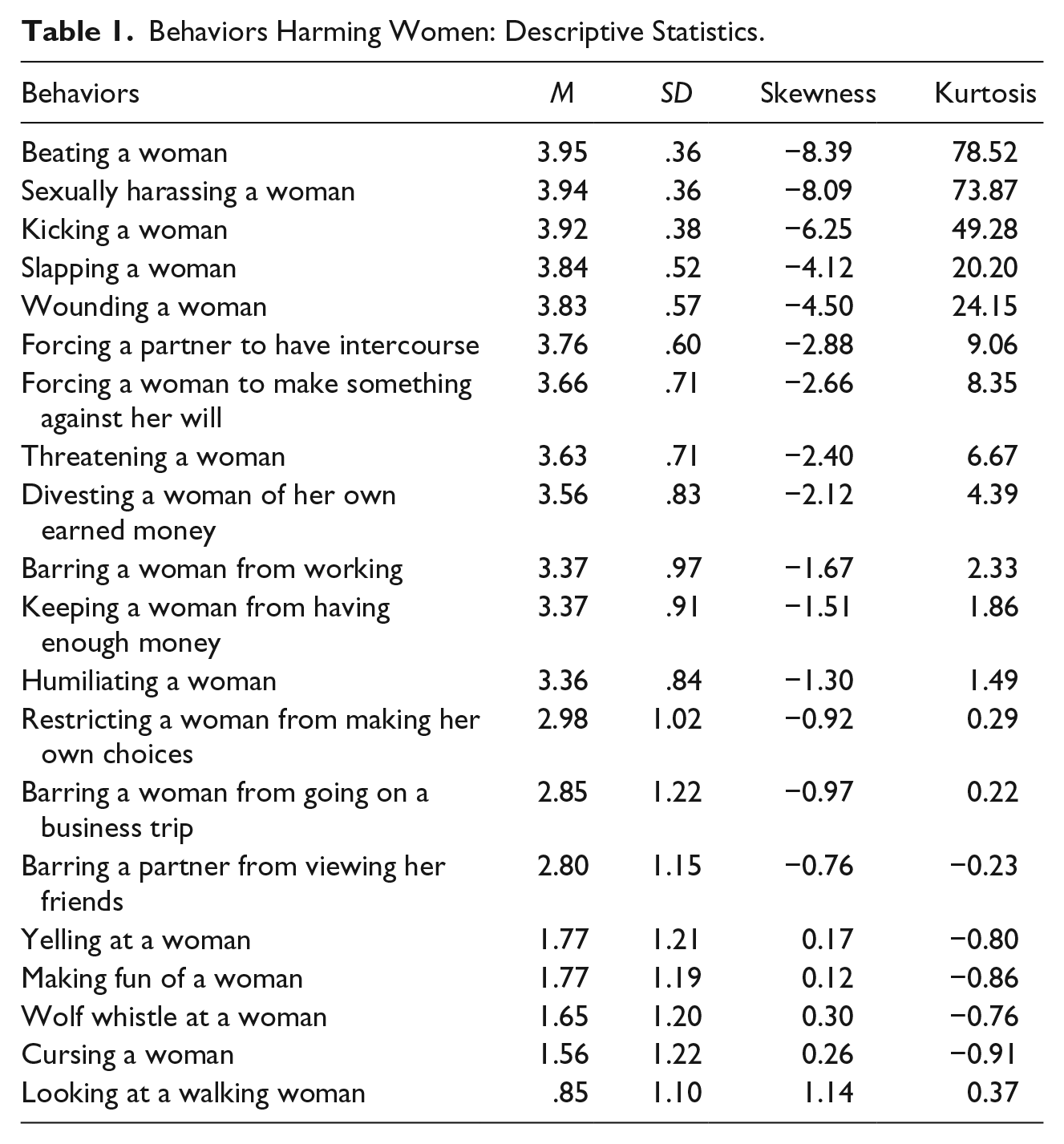
Table 1 reports the descriptive statistics concerning the evaluation in terms of violence of the list of behaviors against women. We ordered the behaviors from the higher means to the lower ones. At the top of the list there were the behaviors implying in most cases physical violence (e.g., beating a woman, kicking a woman). Participants unequivocally defined these behaviors as a form of violence, being the mean scores close to the maximum value of the scale (“it is certainly a violence”). This result was neither surprising nor interesting, as such behaviors were evidently brutal. Moreover, skewness and kurtosis values indicated that the distribution of the responses was far from being normal. For these theoretical and statistical reasons, we decided not to use the first eight behaviors reported in Table 1 in the following analyses.
Behaviors Harming Women: Descriptive Statistics.
Exploratory Factor Analysis
We performed an exploratory factor analysis (maximum likelihood extraction; oblimin rotation) using the remaining 12 items. We extracted two factors explaining the 62% of the total variance. Table 2 reports the factor loadings. On the grounds of the loadings and the content of the items, we called the first factor Limitation of freedom and the second Emotional abuse. The first one grouped all the behaviors limiting women’s possibility of action, the second grouped potentially aggressive but not physical behaviors against women.
Explorative Factor Analysis on the List of Behaviors Harming Women: Factor Loadings.
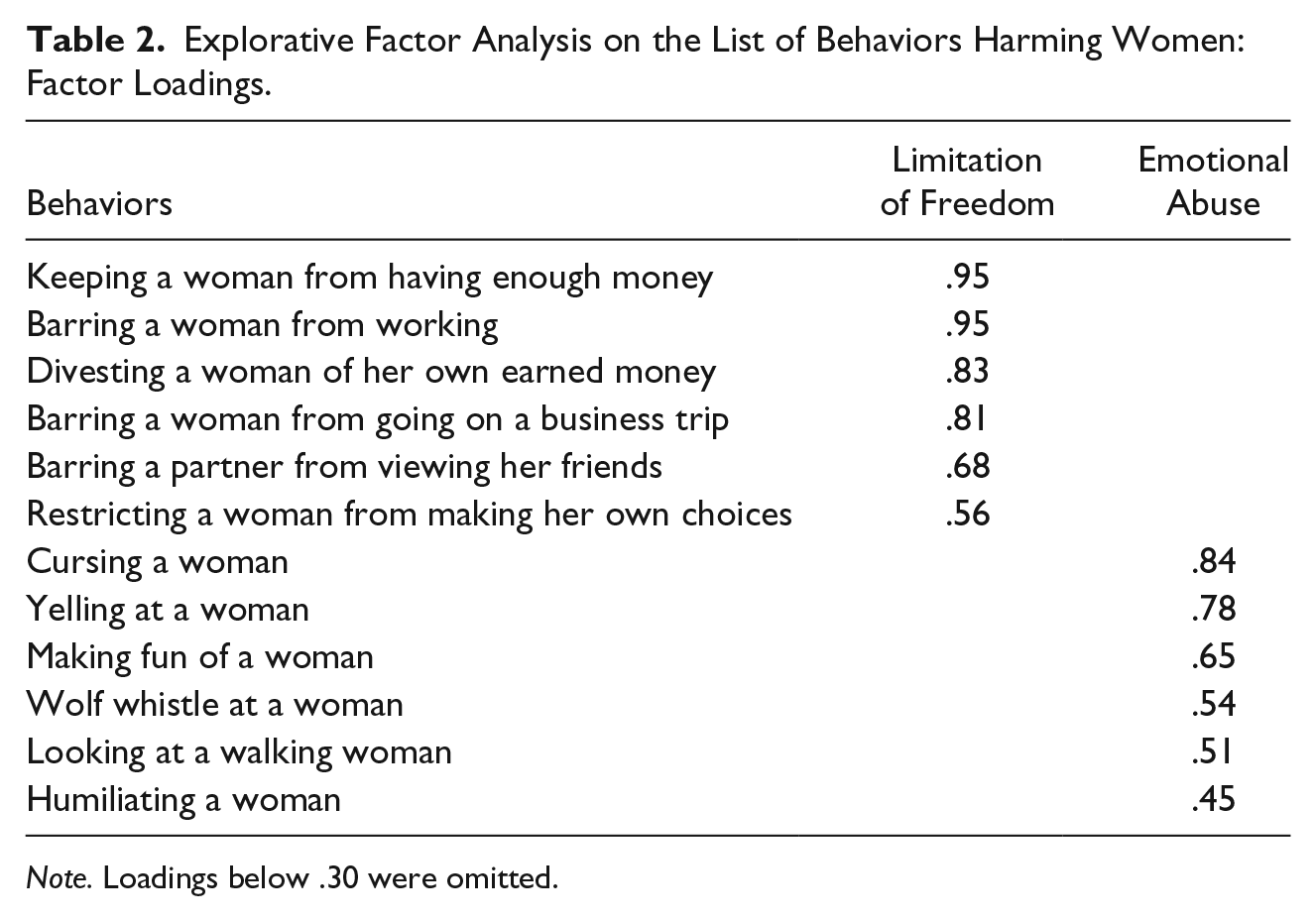
Note. Loadings below .30 were omitted.
After controlling for the internal consistency of the two factors (Limitation of freedom α = .91; Emotional abuse α = .80), we calculated the mean score of each dimension.
Bivariate Analyses
Using t test we compared men and women scores across all the variables (see Table 3). As hypothesized, men showed higher hostility toward women, BM, and SDO, whereas women scored higher on HM. Concerning the evaluations of the behaviors, females valued more violent both the Limitation of freedom and the Emotional abuse.
Differences Between Men (n = 119) and Women (n = 145): Mean Scores and t Values.

Note. SDO = social dominance orientation.
p < .05. **p < .01.
Table 4 shows the correlations between the scales. All sexist attitudes positively correlated with each other. SDO was associated with three out of four sexist attitudes. Limitation of freedom was negatively correlated with both sexist attitudes toward women, HM, and SDO. Emotional abuse correlated negatively with hostility toward women, BM, and SDO and correlated positively with HM.
Correlations Between Scales.

Note. SDO = social dominance orientation.
p < .05. **p < .01.
Hypotheses Verification
We tested a structural equations model assuming the influence of gender on SDO and sexist attitudes, the influence of SDO on sexist attitudes, and the influence of gender, SDO, and sexist attitudes on the factors, Limitation of freedom and Emotional abuse. Based on our preliminary analysis, we eliminated some paths (i.e., relations between variables) from the model, without considering the Physical violence factor. We used a partial disaggregating approach (Bagozzi, 1993; Bagozzi & Edwards, 1998), randomly aggregating the items of each scale in two indicators for every construct. The aggregating items reduce the number of variables in the model that may lead to a significant worsening of the fit, but still allows for an estimation of the measure error of the latent variables. The first model tested had good fit indexes: χ2(67) = 164.40 p < .01; χ2/gdl = 2.45; comparative fit index (CFI) = .95; Tucker–Lewis index (TLI) = .91; root mean square error of approximation (RMSEA) = .074. Nevertheless, because some paths were not significant, we modified the model removing such paths. Contrary to our assumptions, we eliminated the direct paths between gender and the factors, Limitation of freedom and Emotional abuse, because they were not significant. The second model was satisfactory and all of the parameters were statistically significant: χ2(72) = 166.76, p < .01; χ2/gdl = 2.32; CFI = .95; TLI = .92; RMSEA = .071. Figure 1 shows the model in graphic form.

The model tested: Standardized regression weights with standard errors.
Being male increased hostility toward women (β = .31), BM (β = .20), and SDO (β = .36) and decreased HM (β = –.19). SDO increased hostility toward women (β = .27), benevolence toward women (β = .13) and men (β = .19), and decreased the evaluation in terms of violence of Limitation of freedom (β = –.16). Hostility toward women decreased the evaluation in terms of violence of Emotional abuse (β = –.49). BM decreased the evaluation in terms of violence of Limitation of freedom (β = –.42). HM increased the evaluation in terms of violence of both Limitation of freedom (β = .26) and Emotional abuse (β = .36). All of the sexist attitudes were correlated (r ranging from .46 to .78). Limitation of freedom and Emotional abuse were correlated (r = .47) as well. 1
The bootstrap analyses (200 resamples used) allowed us to estimate the indirect effects. Being male had significant indirect effects on Limitation of freedom (β = –.22; 95% confidence interval (CI) = [–.30, –.16]; SE = .04; p < .01) and Emotional abuse (β = –.27; 95% CI = [–.35, –.19]; SE = .05; p < .01). SDO had indirect effects on Limitation of freedom (β = –.08; 95% CI = [–.16, –.03]; SE = .04; p < .01) and Emotional abuse (β = –.13; 95% CI = [–.22, –.06]; SE = .04; p < .01). The model explained 19% of the variance of Limitation of freedom and 23% of the variance of Emotional abuse.
Discussion
The present study aimed at exploring to what extent different behaviors potentially harming women are recognized as a form of violence. Moreover, we wanted to investigate the influence of gender, SDO, and sexist attitudes on the perception of violence inherent in such behaviors toward women.
As seen from the results of descriptive statistics, physical violence was unequivocally recognized as a severe form of violence. Yet, two other forms of violence emerged. The first one was defined as Limitation of freedom, and included all the behaviors restraining women’s action, independence, and autonomy. The second was called Emotional abuse and encompassed verbally and emotionally aggressive behaviors aimed at harming and humiliating women. Concerning the perception of these two forms, bivariate analyses showed relevant gender differences, as women valued more violent both the Limitation of freedom and the Emotional abuse. This result is in line with previous research (Chamberland et al., 2007; Vonderhaar & Carmody, 2015), arguing that the perception of violence seems to differ according to gender. However, when we tested the structural equations model assuming the influence of gender on Limitation of freedom and Emotional abuse, we did not find any direct effect of gender. Indeed, gender influence on the definition of violent behaviors was mediated by social attitudes, that is, SDO and sexism. Consistent with previous studies (Pratto et al., 2006; Rollero et al., 2014), we found that men were more hostile toward women, more benevolent and less hostile toward men, and they had higher levels of SDO. Some scholars (Flood & Pease, 2009) had already suggested that it is not sex per se, but gender-role attitudes that shape men’s and women’s understandings of violence against females. This result has important implications for prevention interventions, which should aim at changing attitudes toward gender roles. Thus, interventions should target not only males’ sexist attitudes, but also those of females who believe they must be submissive to men.
Regarding SDO, it directly influenced the evaluation of the Limitation of freedom but not that of the Emotional abuse. Participants with higher levels of SDO seem to be less likely to consider the limitation of freedom as a form of violence. The desire to maintain the superior position of their in-group motivates social dominance–orientated individuals to oppose equality-enhancing behaviors, such as allowing others to have their same freedom and rights. Contrary to our results, individuals with higher levels of SDO should denigrate and discriminate members of outgroup too, through emotionally and verbally aggressive behaviors (Berke & Zeichner, 2016; Whitley & Ægisdóttir, 2000). However, we found that SDO indirectly influenced the perception of Emotional abuse, through the mediation of HS. In line with previous research investigating the relationship between SDO and ambivalent sexism (Malatyalı et al., 2017), in our study SDO predicted HS, which in turn determined a lower recognition of emotionally and verbally aggressive behaviors as violent acts. Previous findings have indicated that individuals with higher levels of HS have a negative attitude toward women, perceived as seeking to take advantage of men (Glick & Fiske, 1996). It seems to be mainly this social attitude, rather than SDO, leading participants to legitimize behaviors that denigrate and emotionally harm women. We may argue that our participants high in SDO perceive the limitation of freedom of the outgroup as a “normal” behavior, but they do not have the need to denigrate members of such outgroup. Instead, when the members of the outgroup (i.e., women) are perceived as manipulative and seeking to take advantage of the ingroup members (i.e., men), emotional and verbal aggression toward the outgroup seems to be an appropriate reaction, as though if women deserved this treatment.
In line with previous research, SDO predicted BS, an ideology that justifies women’s subordinate status (Christopher & Wojda, 2008; Glick et al., 2015). Considering the influence of SDO on sexist attitudes toward men, we found that SDO did not have an influence on HM but was positively associated with BM. Probably, not only HS and BS, but also BM can be considered an attitude that legitimizes and justifies the inequality between gender groups. Individuals with higher levels of BM consider men as protectors and providers, and thus superior because of their more “essential” role. BM also partially mediated the relation between SDO and the evaluation of the behaviors encompassed in the limitation of freedom group. Individuals with higher levels of SDO tend to oppose equality-enhancing behaviors (Berke & Zeichner, 2016), and the endorsement of a benevolent attitude toward men could better explain why our participants oriented to social dominance consider the limitation of freedom as a usual conduct. Indeed, individuals with high levels of BM support an ideology that legitimize gender differentiation (Glick & Fiske, 2001), in which all freedom is granted to men as they have to economically provide for the family, whereas women have to take care of the house. The results of this study regarding the influence of SDO on sexist attitudes and the recognition of violent behaviors provided important suggestions, with implications for prevention. Prevention and educational programs should aim at eradicating ideologies that maintain group inequality and legitimize discrimination, because they reinforce sexist attitudes, leading to underestimate behaviors harming women.
Considering specifically the influence of sexist attitudes on the recognition of violence, we found that participants with higher levels of HS were less likely to define behaviors encompassed in the Emotional abuse group as violence. This result confirms the importance of hostility toward women in underestimating the psychological violence inherent in certain abusive behaviors (Rollero & Tartaglia, 2019; Sakall, 2001). However, HS did not have an influence on the perception of the Limitation of freedom. This datum is difficult to interpret, as HS fosters male dominance (Chen et al., 2009). Maybe, in our sample, dominance over women is implemented through humiliating and verbally aggressive behaviors, but not through the limitation of women’s action. Some scholars (Chen et al., 2009) have suggested that in Western culture the ideology prescribing gender roles is weaker and gender competition related to economic and power issues is less strong. These aspects could have influenced our results.
In line with a recent research on violence acceptance (Rollero & Tartaglia, 2019), we found that BS did not influence the recognition of violence, either intended as Limitation of freedom or as Emotional abuse. Contrary to previous research (Rollero & Tartaglia, 2019), we found that HM increased the evaluation in terms of violence of both Limitation of freedom and Emotional abuse. As HM represents the hostility toward the ways in which men exert control within intimate relationships (Glick & Fiske, 1996), endorsing this attitude may enhance the recognition of violence in all the behaviors potentially harming women. Finally, only partially in line with previous research (Rollero & Tartaglia, 2019), BM weakened the evaluation of the behaviors encompassed in the Limitation of freedom group, but not that of the behaviors encompassed in the Emotional abuse one. As seen above, a high endorsement of BM supports an ideology that legitimizes gender differentiation in all domains, including the allowed degree of freedom. However, individuals with high levels of BM respect women, seen as providers of domestic and maternal cares (Glick & Fiske, 1996). Probably for this reason, our participants with higher levels of BM may condemn emotionally and verbally aggressive behaviors toward women, perceiving them as a violence. Nevertheless, the same subjects seem to justify the limitation of freedom, suggesting that also this sexist attitude plays a key role in reinforcing the support of a certain kind of violence toward women.
The present study has some limitations. First, our sample comprised only young participants, attending university. Future research should be extended to other age cohorts, to investigate the replicability of these results with community people. Moreover, in our study there was not a measurement of the real implementation of violent behaviors. Even if the individual’s perspective, awareness, and attitudes about violence against women are strongly associated with actually committing violence (Ortabag et al., 2014), future studies should assess also the real perpetration of behaviors potentially harming women. Another important limitation is the particular context of the study (i.e., Italy), which does not allow to generalize the results to other areas of world, such as to some Eastern countries, where violence against women is more accepted by society (Ortabag et al., 2014), but also to United States and other European countries. Indeed, in Europe Italy represents one of the most masculine and gender-unequal country, with relevant gender stereotypes and sexist attitudes (Tartaglia & Rollero, 2015). As expectations concerning gender roles appear to play a key role, cross-cultural investigations should assess the replicability of these findings. Finally, the evaluation in terms of violence of specific behaviors might be affected by social desirability, even if confidentiality was assured.
To summarize, the influence of gender on the recognition of behaviors as violent was indirect, mediated by both gender-role attitudes and SDO: It was not gender per se, but gender-role attitudes that influenced the perception and recognition of violence against women. The present study may contribute to prevention and intervention efforts. Indeed, understanding whether specific behaviors are recognized as form of violence is necessary in the development of interventions to increase sensitivity to the potential harm of these behaviors (Rollero, 2019). As seen, violence against women is linked to a multitude of different dramatic outcomes. It represents a relevant public health issue that must be addressed. At the individual level, not recognizing that they are experiencing gender violence is the biggest barrier for women in both getting help and leaving an abusive relationship. Moreover, at a societal and community level, the ability to recognize violence can assist in responding effectively to gender abuse, in avoiding violent behaviors, and in stigmatizing violent behaviors.
Footnotes
Declaration of Conflicting Interests
The author(s) declared no potential conflicts of interest with respect to the research, authorship, and/or publication of this article.
Funding
The author(s) received no financial support for the research, authorship, and/or publication of this article.
