



Abstract
The objective of this study was to evaluate bullying at school and identify the factors associated with it among a sample of Lebanese school adolescents. A cross-sectional study was carried out between April 2014 and June 2014, using a convenient sampling of Lebanese students in private schools from Beirut and Mount Lebanon. The results showed that 712 (18.1%) adolescents had been bullied in the past 2 months (95% CI [0.169, 0.192]). A backward logistic regression, taking “being bullied in the last 2 months” as a dependent variable, showed significantly lower odds of being bullied in the last 2 months in those who find it easy (adjusted odds ratios [aOR] = 0.434) and very easy (aOR = 0.391) to talk to their father, and having some close male or female friends compared with none. Furthermore, significantly higher odds of being bullied were found among males compared with females (aOR = 0.664), having a best friend who smokes sometimes compared with never (aOR = 1.389), and a father who drinks everyday compared with never (aOR = 1.621). This study was able to shed light on a problem that sometimes goes silent in schools and has a negative impact on the mental health of teenagers. Indeed, the results of our study showed that peer victimization was closely linked to clinically relevant mental health issues. In addition, factors such as parental and peer support could protect against the negative effects of bullying.
Keywords
Introduction
Bullying or peer victimization is a quite common experience currently widespread among schoolchildren in many countries around the world (Due et al., 2008). It is defined as repeated aggressive behavior over time with the intention of harming the victim, and characterized by a disproportion of power between the bully and the bullied, the latter being the weaker of the two (Juvonen & Graham, 2014). Based on this definition, bullying consists of a triad that distinguishes it from other forms of school violence (Olweus, 2005), including repetition (the act is repeated several times), intentional harm (the action is intended to be harmful), and unequal power (the victim is inferior to the bully, either in status or power). Four different types of bullying have been identified (Faith et al., 2015): (a) physical bullying, characterized by observable behaviors, such as insulting, hitting, and pushing; (b) relational bullying, characterized by indirect behaviors, such as spreading false rumors, and social exclusion of the victim; (c) verbal bullying includes provocations, rumors, sarcasm, and threats; (d) cyberbullying involves attacking the victim through social media.
School bullying is a source of many problems, such as school absenteeism and dropping out for fear of going to school (Hawker & Boulton, 2000); it can also be detrimental to good peer relationships, and reduce students’ sense of security at school, with children/adolescents fearful of being the next victim (Cooper & Snell, 2003). In extreme cases, victims may experience depression, loneliness, anxiety, and suicidal thoughts (Olweus, 2005); some studies have predicted that this effect would persist into adulthood (Craig & Pepler, 2007).
The prevalence of bullying (all types taken together) varies by country, culture, economic status, gender, and age. It may range from 6.3% (for bullied girls in Sweden) to 41.4% (for bullied boys in Lithuania). In the Middle East, bullying among middle school students ranged between 20% in the United Arab Emirates and 44.2% in Jordan, with Lebanon reaching 33.6% (Fleming & Jacobsen, 2010). Recently, “Save the Children Association, n.d.” (a Non-Governmental Organization for the rights and protection of children) (Save the Children Association) commissioned a national study of bullying in the community among Lebanese, Syrian, and Palestinian children in Lebanon; results showed that 51% of the children between 9 and 18 years were bullied.
Of the many physical, social, and mental factors associated with bullying, gender and age play an important role. Indeed, boys are more likely than girls to be victims, bullies, or both (Glew et al., 2005), and results of previous studies (Acquah et al., 2016) suggest that peer victimization intensifies and culminates around mid-childhood to early adolescence. Hence, the prevalence of bullying and victimization most likely decreases with age (Newman et al., 2005).
Moreover, social support, defined as one’s perception of supportive behaviors from people in their social network (close friends, classmates, parents, teachers, etc.), might exert a protective effect by improving social functioning and protecting against external attacks (Malecki & Demaray, 2006). Previous studies have shown that students not involved in bullying (neither bullies nor bullied) reported increased peer and maternal support compared with bullies, bullied, or victimized (Holt & Espelage, 2007). Also, parents’ addiction to alcohol increases the risk of interpersonal and behavioral problems in children, such as peer victimization (Card & Hodges, 2008).
Another factor correlated with bullying is loneliness that consists of one’s perception of their connection to others and how others perceive them; the perception of loneliness includes the feeling of being disconnected, alienated, or unknown (Edery, 2016). Previous work on children and adolescents showed that subjects facing interpersonal problems, such as peer rejection (loneliness), are more likely to be victimized (Pellegrini & Long, 2002).
Chronic illness is also associated with bullying; it has been suggested that children and adolescents with chronic health conditions are at increased risk of being peer victimized (Faith et al., 2015). Symptoms of the illness, increased social dysfunction (Pinquart & Teubert, 2012), reduced academic performance (Pinquart & Teubert, 2012), and some treatment procedures may cause peers to perceive those with chronic illnesses as different, predisposing them to be an easy target for bullying (Dawkins, 1996).
Most bullying research has focused on the individual characteristics (such as sociodemographic features, chronic illness, and loneliness) of the bullies with little attention to the influence of parents and peers. Thus, many questions may arise, for example, how stable are the relationships between a victim of bullying and his parents? Do victims have strong peer relationships? Are they influenced by the behaviors of those around them? In this context, Figure 1 provides a conceptual framework. First, several risk factors pertaining to victimization can be related to individual characteristics or to the interpersonal and environmental contexts (Baldly & Farrington, 2005). Also, factors related to victimization can co-occur at multiple levels of the social-ecological domains. The social-ecological framework developed by Swearer and Espelage (2010) helps in understanding the concept of peer victimization. This framework considers the complex interaction between the individual’s behavior and social-environmental contexts, such as family, peers, school, and community.

A conceptual framework on the association between risk factors and bullying victimization.
Understanding the interpersonal relationships of adolescents and how they affect their role as peer victims is essential, given the ease with which adolescents can be influenced by others. Unlike developed countries, little is known about the prevalence of bullying and associated factors in Lebanon that has a heterogeneous sociocultural system and still suffers from the aftermath of civil war. In this context, bullying behaviors deserve careful consideration, as the sociocultural perspective theorizes that school bullying is a product of societal commitment to a culture of war rather than peace. For example, school-aged children are expected to emulate aggressive and violent behavior in their daily routine as they grow up in sociocultural climates replete with political turmoil, violence, and diversity-based discriminatory influences and in which conflicts are resolved through violence and discrimination against minority groups (Cappadocia et al., 2012; Meyer, 2011). In Lebanon, informal surveys of teachers in schools suggest that peer-on-peer bullying occurs on the basis of religious sects (e.g., Shiite vs. Sunni), physical appearance (particularly crooked teeth and being overweight), and perceived sexual orientation (Kazarian & Ammar, 2013).
Given the significant negative consequences of bullying, further research is warranted on the factors contributing to bullying at school in Lebanon. Thus, the objective of our research was to evaluate bullying at school and identify the correlated factors among a sample of Lebanese school-aged adolescents. Our findings would help raise public awareness at the national level and could serve as a guide for promoting a bully-free environment in communities and schools throughout Lebanon.
Method
Study Design
A cross-sectional study was carried out between April 2014 and June 2014, using a convenient sampling of Lebanese students in private schools from Beirut and Mount Lebanon. Using the STATCALC option of the Epi-info software, a sample size of at least 763 adolescents was calculated, based on a physical bullying frequency of 42% (as per the document by Save the Children Association), an error of 3.5%, with an alpha of 5% and beta of 20%. Doubling the number would allow to include cluster design (n = 1,526). Nevertheless, a total of 5,000 questionnaires were distributed to allow for adequate power so that bivariate (minimal OR = 1.3) and multivariate analyses can be carried out (20 variables to be included in the model), and to take refusals/incomplete answers into account (20%).
Data Collection
Out of 24 schools visited, nine accepted to participate (six in Mount Lebanon and three in Beirut). The total number of questionnaires completed and collected back was 4,000, distributed as follows: 452 in School 1, 563 in School 2, 437 in School 3, 460 in School 4, 572 in School 5, 482 in School 6, 453 in School 7, 256 in School 8, and 325 in School 9. Refusal rates of students varied between 16% and 24%. The questionnaires were distributed to all students during class. The objectives of the study were explained and the questionnaires handed out after obtaining oral consent. At the end of the process, completed questionnaires were placed in closed boxes and sent for data entry. Student anonymity was guaranteed during the data collection process.
Study Instrument
The standardized questionnaire used for data collection was taken from the Health Behavior in School-Aged Children (HBSC) study in different countries—France (Godeau et al., 2012), Belgium (Godin et al., 2010), and the United States (Iannotti, n.d.)—and adapted to the Lebanese population. It was self-administered, anonymous, and available in both French and English depending on the language of instruction at each school. The questions related to “substance abuse” and “sexual behavior” were removed following the recommendations of the school principals who agreed to participate. The questionnaire was pilot-tested on 20 school students to correct or clarify questions when necessary; the pilot sample was not included in the analysis. The questionnaire is presented in a Supplemental Appendix.
Independent Variables
The final questionnaire consisted of questions about sociodemographic and socioeconomic characteristics, including tobacco (cigarette and water pipe) and alcohol consumption, age of first consumption, entourage consumption (parents, siblings, and best friends), frequency of alcohol drinking (never, rarely, every month, every week, every day), high alcohol consumption and drunkenness, eating and drinking habits, weight status, general perceptions of personal health and life satisfaction, social activities, physical activity and sedentary behavior, school environment, and family and peers relationships.
Major Dependent Variable
The major dependent variable was defined by the question, “How often have you been bullied at school in the past couple of months,” with the following five possible answers: “I haven’t been bullied at school the past couple of months; it has only happened once or twice, it happened 2 or 3 times a month, it happened about once a week, and it happened several times a week.” The first two options were merged into “not bullied,” and the other three into “bullied,” thereby creating a dichotomous (yes/no) variable. An additional question with dichotomous answers was asked, “Has anyone circulated through mobile, e-mail or internet (Facebook …) pictures of you without your permission?”
Statistical Analysis
Data analysis was performed using SPSS, version 25.0. In descriptive analyses, means and standard deviations were presented for continuous variables, while percentages and 95% confidence interval were presented for categorical variables. As missing values were lower than 5% for the majority of variables, no replacement was needed. In bivariate analyses, Student’s test was used to compare means between two groups (quantitative variables), and the chi-square test to compare percentages (nominal, ordinal, and categorical variables). A p value less than .05 was considered significant.
To decrease confounding bias, a multiple logistic regression was carried out using a backward stepwise method, after ensuring sample adequacy. The dichotomous variable “had been bullied in the last 2 months” was taken as the dependent variable. All significant variables in the bivariate analysis were taken as independent variables in the final model. Adjusted odds ratios (aORs) were reported after ensuring noncollinearity and sampling adequacy by Hosmer-Lemeshow test.
Results
Sociodemographic and Other Characteristics
Of the 5,000 distributed questionnaires, a total of 4,000 students were recruited (refusal rate = 20%); the mean age of the participants was 15.31 ± 2.01 years, with 1,963 (49.1%) males. The results showed that 712 (18.1%) adolescents had been bullied in the past 2 months (95% CI [0.169–0.192]); 22% had their picture(s) circulated through mobile, email, or internet (Facebook) without their permission; 62.5% drank alcohol; 17.6% got drunk at least once in their lifetime; 20.5% smoked cigarette; 30.6% smoked water pipe; and the majority lived with their parents (97.1% with their mother and 91.8% with their father). Other characteristics, including ease of talking to parents and siblings, and parents’ smoking and drinking habits, are summarized in Table 1.
Sociodemographic and Other Characteristics of the Participants (N = 4,000).

Bivariate Analysis
A significantly higher percentage of those bullied in the past 2 months were males compared with females (21.1% vs. 15.2%), did not have a father (27.0%) or a mother (26.1%) or a friend of opposite sex (23.5%) to talk to, or close male friends (26.4%) or close female friends (29.4%), did not know their sibling’s smoking status (26.0%), and had father drinking everyday (28.6%) (Table 2).
Bivariate Analysis of Factors Associated With Being Bullied in the Last 2 Months.

Note. Numbers in bold indicate significant p-values.
Multivariable Analysis
The results of a backward logistic regression, taking “being bullied in the last 2 months” as the dependent variable, showed significantly lower odds of being bullied in the last 2 months in those who find it easy (aOR = 0.434) and very easy (aOR = 0.391) to talk to their father, and who have close male or female friends compared with none. Furthermore, significantly higher odds of being bullied were found in males compared with females (aOR = 0.664), in those who have a best friend who smokes sometimes compared with never (aOR = 1.389), and a father who drinks everyday compared with never (aOR = 1.621) (Table 3).
Multivariable Analysis: Logistic Regression Taking the Being Bullied Variable (Yes vs. No a ) as the Dependent Variable.
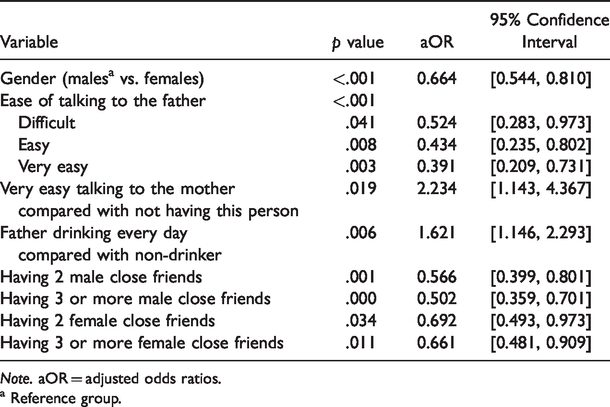
Note. aOR = adjusted odds ratios.
a Reference group.
Discussion
To our knowledge, this is the largest study analyzing personal, familial, and relational factors associated with bullying. Our results showed that the prevalence of bullying was 18%, comparable to findings of other research (Nansel et al., 2001). However, a recent study conducted among Norwegian adolescents showed that involvement in bullying was relatively infrequent, with only 1.7% of the adolescents reporting being victimized (Hysing et al., 2019).
Our study showed a negative relation between social support (from family and peers) and peer victimization. These results were expected and are consistent with previous research (Conners-Burrow et al., 2009). On another hand, increased social support can negatively affect adolescents, making them less able to tolerate bullying by reducing their level of independence and ability to solve problems (Perren & Hornung, 2005). Based on this theory, moderate social support would be ideal and could be a protective factor for adolescents exposed to harmful situations.
Regarding peer support, our results revealed lower odds of being bullied in the last 2 months among those who have close male or female friends compared with none. A study showed that a higher number of friends is a protective factor against traditional and relational bullying (J. Wang et al., 2009). In the same context, Furman and Buhrmester (1992) found that younger children rely on their parents and authority figures for social support, while older adolescents rely more on peer social support. Thus, perceived social support from peers can lead to positive effects such as increased self-esteem (Kleiman & Riskind, 2013), increased resilience (Richman & Fraser, 2001), and improved physical and mental health (Vandervoort, 1999), thereby reducing the risk of bullying. One explanation for this negative relationship between victimization and peer support is that those who are often bullied at school also have low self-esteem and reduced social skills, which may precede victimization and affect the subject’s ability to evade or tolerate intimidation (Cowie & Hutson, 2005). As a result, peer victimization may further reduce their self-esteem, perpetuating a cycle, and making them more vulnerable to the effects of bullying. Another explanation put forward by Rigby and Slee (1991) would be that many children despised their bullied peers because they perceived them as too “needy” and “demanding” (Rigby & Slee, 1991). This potential stigma can significantly increase the risk that peers will reject bullied children, thereby confirming that the peer group could serve as a protective factor against peer victimization (Pellegrini & Long, 2002).
At the family level, the results of our study showed lower odds of being bullied in the last 2 months in those who find it easy and very easy to talk to their father. A study in the United States showed that teenagers whose parents had met their friends, shared ideas, and talked to each other were less likely to be bullied (Shetgiri et al., 2012). These associations could reflect the parent–child communication and its involvement with the child. Other studies showed that children with greater parental involvement, more engagement with family units (Keelan et al., 2014), and increased maternal warmth were less likely to be bullied or victimized by peers (Bowes et al., 2009). Also, studies in the United States have suggested an association between bullying on one hand and low parental supervision and high family conflict on the other (Stevens et al., 2002). Another American study found that violent or almost no communication between parent and child was positively correlated with bullying (Spriggs et al., 2007). In fact, children who have no emotional parent, who have been abused, neglected by their parents, or with whom parents do not spend time communicating, often develop emotional regulation difficulties that can lead to poor relationships with their peers (Trickett et al., 2011). They may also become submissive, socially withdrawn, and isolated, making them more likely to be bullied, intimidated, or reluctantly assaulted (Juvonen & Graham, 2014). These results show on one hand that bullying behavior itself determines whether the parents communicate positively and regularly with their child and whether they are a source of support and capacity for that child, and on the other hand, the importance of key models of effective interventions (training and educating parents) to reduce bullying, highlighting the fact that parents’ characteristics and behaviors can influence bullying of children (Farrington & Ttofi, 2009).
Our results showed that having a father who drinks everyday was significantly associated with higher odds of being bullied, in line with results from other studies (Edwards et al., 2006). Children with alcoholic parents may be more vulnerable to victimization because of poor social skills and social isolation due to parental alcoholism (Card & Hodges, 2008). Another potential mediator of the association between parental alcohol problems and peer victimization is the quality of parent–child attachment. According to the attachment theory, early attachment models play a key role in the development of later relationships (Bowlby, 2008). Indeed, warm and supportive parents in parent–child interactions are more likely to have children with a secure attachment style (Ainsworth & Bell, 1970). This secure attachment provides a foundation for defending against stressful situations by providing adequate emotional regulation and problem-solving skills (Kuppens et al., 2008). Unsecured children may be more likely to be victimized by their peers because of a lower regulation of emotions or greater fear in the peer context (Kuppens et al., 2008). Thus, secure attachment can serve as a protective factor against peer bullying, especially in stressful situations or negative family experiences (Dallaire & Weinraub, 2007).
With regard to gender, the results of our study showed that boys reported being bullied more often than girls, consistent with the results of other studies (Pengpid & Peltzer, 2013; Zhang et al., 2019) showing that boys are more likely to be victimized by peers than girls, although victimization varies by type. Boys are more likely to experience physical victimization, and verbal victimization through threats and insults (Baldry, 2004), while girls are more likely to suffer from indirect bullying (Klomek et al., 2008), defined as threatening someone with social isolation, such as gossiping, spreading lies and rumors, name-calling, ignoring, refusing to engage or socialize, and so on. Our results also confirm those of a study conducted among Lebanese, Syrian, and Palestinian children in Lebanon (Save the Children Association) showing that boys (55%) are more likely to be bullied than girls (47%), with physical bullying (81%) being the most common form of bullying, followed by verbal (59%) and social bullying (44%). With 11%, cyberbullying was the least reported type.
Clinical Implications
This study showed that bullying is a serious problem among Lebanese adolescents, and highlighted the associated factors, thus warranting specific measures. The first would be the creation of a bullying prevention committee at school to raise awareness and train school staff to recognize possible signs of bullying and protect potential victims (H. Wang et al., 2012). The second measure would be to educate parents and adolescents about bullying, its causes, and consequences (Benavides Abanto et al., 2021), especially as victims tend to seek help from peers and parents. Individual interventions can also be used, such as directing bullies and bullied to the social worker or the school psychologist and encouraging them to talk about the problem (Abdulsalam et al., 2017).
Limitations
Despite the strengths of this study, particularly the large sample size, some limitations need to be considered. One of the limitations lies in the cross-sectional design of the survey, which prevents any implication of causality and direction of the influence of relational factors and the act of bullying; future research should consider reproducing this study using longitudinal data. This study may also be subject to recall bias, as it was based on self-reported measures, including bullying at school. Moreover, the difference in interpretation of bullying behavior among adolescents and the fact that the study was based exclusively on self-reported data could have influenced the results. As the sample was withdrawn from two out of five Lebanese governorates, and given the high refusal rate, our results might not be generalizable to the whole population. Nonetheless, we believe that our findings are noteworthy, as they are consistent with other recent studies.
Conclusion
Our results revealed that some factors, such as parental and peer support, could protect against the negative effects of bullying. It is essential to understand the in-depth issues of bullying, and therefore identify and develop effective interventions to help the bully and the victim. Further research on the relationship between aggressive, hostile, and abusive symptomatology in the abusive child, and the specific characteristics of the victim are warranted to implement and improve interventions. School staff should be trained to recognize possible signs of bullying and protect potential victims. Parents and peers should also be involved in the prevention and awareness, as victims tend to seek their help. Individual interventions can also be used, such as directing bullies and bullied to the social worker or the school psychologist and encouraging them to talk about the problem. Both the victim and the tyrant should have access to academic, family, and social support.
Supplemental Material
sj-pdf-1-jiv-10.1177_0886260520922376 - Supplemental material for School Bullying—The Silent Epidemic: A Cross-Sectional Study of Factors Associated With Peer Victimization Among Lebanese Adolescents
Supplemental material, sj-pdf-1-jiv-10.1177_0886260520922376 for School Bullying—The Silent Epidemic: A Cross-Sectional Study of Factors Associated With Peer Victimization Among Lebanese Adolescents by Sahar Obeïd, Hala Sacre, Souheil Hallit Pascale Salameh in Journal of Interpersonal Violence
Footnotes
Acknowledgments
The authors thank Rachel Abdo, Odette Lahoud, and Christine Azar for their help in the data collection and the students who agreed to participate in this study.
Declaration of Conflicting Interests
The author(s) declared no potential conflicts of interest with respect to the research, authorship, and/or publication of this article.
Funding
The author(s) received no financial support for the research, authorship, and/or publication of this article.

Supplemental Material
Supplemental material for this article is available online.
Author Biographies
References
Supplementary Material
Please find the following supplemental material available below.
For Open Access articles published under a Creative Commons License, all supplemental material carries the same license as the article it is associated with.
For non-Open Access articles published, all supplemental material carries a non-exclusive license, and permission requests for re-use of supplemental material or any part of supplemental material shall be sent directly to the copyright owner as specified in the copyright notice associated with the article.
