



Abstract
Alcohol use is known to correlate with intimate partner violence (IPV) perpetration, yet little research examines how alcohol influences how the violence unfolds. The current study used sequential analysis to examine descriptions of past violent incidents and explore the behaviors that preceded men’s perpetration of IPV. In accordance with the alcohol myopia model of alcohol use, it was hypothesized that intoxicated men would respond violently to a wide range of partner cues, whereas men who were sober would only react violently in response to the most threatening partner cues. Moreover, intoxicated men were expected to demonstrate less inhibition of violence to suppressor cues of the partners’ distress as compared to sober men. Participants were 80 couples reporting male-to-female IPV within the past year. Female partners’ descriptions of two past violent events were coded and entered into sequential analysis. Antecedents to the men’s first violent action were examined. While sober men were likely to react violently to their partner’s physical threat and perceived threat, intoxicate men did not. Sober men were less likely to become violent after their partners displayed distress cues, whereas there was no suppressor effect of women’s distress for intoxicated men. The precursors of the violence of intoxicated men appears to be indiscriminate and unpredictable. Clinical interventions that rely on behavioral strategies or communication skills training are unlikely to be effective for those who have an unmanaged alcohol use disorder.
Introduction
Intimate partner violence (IPV) is a troubling public health problem, with 20 people per minute, or 10 million people per year, being victims of physical violence perpetrated by a romantic partner (Center for Disease Control and Prevention, 2013). In the United States, the majority (55%) of these incidents involve alcohol (WHO, 2010). Women whose partners had been drinking were significantly more likely to be injured than were women whose partners had not been drinking (Thompson & Kingree, 2006). While laws surrounding such violence have become more stringent over the years (e.g., mandatory arrest laws), battering intervention and prevention programs have been found to be largely ineffective (Babcock et al., 2004). In order to develop more effective treatments, more work is needed to understand the underlying causes of IPV and motivations of those who perpetrate IPV.
Within the IPV literature, there has been consistent evidence for a positive association between IPV perpetration and alcohol use (Devries et al., 2014; Rodriguez & Derrick, 2017). More recently, a greater focus has been centered on the proximal relation between alcohol use and IPV. Laboratory paradigms approximating aggression have implicated alcohol as a contributing cause of violence (see Leonard & Quigley, 2017, for a review) but few have studied it carefully as it precipitates IPV. Daily diary studies support the notion that partner violence is more likely to occur on days when perpetrators have used alcohol (Moore et al., 2011; Testa & Derrick, 2014), but more information is needed about the conditions under which intoxication may facilitate physical violence. According to Leonard and Quigley (2017, p. 8), “We should be examining the processes by which alcohol facilitates the occurrence or severity of IPV.” The current study will explore whether immediate antecedents of physically violent acts differ whether alcohol is involved or not.
The Proximal Relationship Between Alcohol Use and IPV
Decades of research has supported a strong association between alcohol use and IPV perpetration (Flanagan et al., 2020; Okuda et al., 2015). Although there is a relative dearth of research on the proximal relationship between alcohol use and IPV, the existing evidence supports the notion that alcohol is a proximal, rather than simply a general, risk factor for increased relational conflict, verbal aggression, and IPV. These findings have been consistent across various methodologies, including semistructured interviews (Fenton & Rathus, 2010; Kaufmann et al., 2014; Testa et al., 2003), retrospective reports (Stuart et al., 2013), daily diary studies (Moore et al., 2011; Shorey et al., 2014; Testa & Derrick, 2014), and experimental administration of alcohol to partner violent subjects (Eckhardt, 2007; Leonard & Roberts, 1998). Longitudinal studies have additionally provided evidence for the temporal precedence of alcohol use to perpetration of partner violence (Derrick & Leonard, 2016). Qualitative studies have described a cycle of escalation of aggression based on the stages of their partner drinking and risk for violence at each stage (Wilson et al., 2017). However, no studies to date have examined differential stimuli (e.g., partners’ distress, threats, sarcasm, or violence) that precipitate violence against a partner when alcohol is involved or not.
Potential Mechanisms of Action—The Alcohol-Myopia Model
Although the association between alcohol use and partner abuse is clear, the mechanism by which alcohol directly impacts IPV perpetration is not fully understood. Due to the inability to conduct true experiments on violence, laboratory experiments administering alcohol to violent individuals study proxy measures of aggression. One experimental study has compared the effects of alcohol administered in the lab to IPV and nonviolent men on aggression and angry articulations (Eckhardt, 2007). State anger interacted with alcohol use to predict aggression. That is, IPV perpetrators who were randomly assigned to drink alcohol and who had the highest increases in state anger during the task responded the most aggressively (Eckhardt, 2007). While methodological and ethical limitations in this area of research preclude us from making definitive causal claims as to the effect of alcohol on actual IPV perpetration, the preponderance of the evidence taken from multiple methods of inquiry point to alcohol use as a contributing cause of aggression, including IPV (Leonard, 2005; Leonard & Quigley, 2017) for some people.
The alcohol myopia model (AMM; Giancola et al., 2010) is a theory that posits that alcohol intoxication causes perceptual and cognitive deficits that reduce one’s ability to effectively process situational cues. In some conditions, the distorted lens that alcohol causes can inhibit aggression. For example, in the absence of provocative cues, the alcohol myopia effect consumes all attentional resources on those less salient cues, leaving little working memory available to allocate should salient provocative cues arise (Giancola & Corman, 2007; Giancola et al., 2010). Early work by Steele and colleagues proposes that these deficits come about primarily due to alcohol’s impairment on effortful cognitive processing and its tendency to narrow perception to cues that are perceived as salient (Steele & Josephs, 1990; Steele et al., 1986). Disposition tendencies such as trait anger and hostile cognitive rumination also influence baseline attention to aggressogenic cues (Giancola et al., 2010). It is thought that due to this phenomenon, some individuals who are intoxicated may engage in IPV because they are magnifying innocuous, neutral, or low-level aggressive behaviors of their female partners as intensely threatening.
The AMM posits that an intoxicated individual is likely to react to the more salient cues present in a social interaction at the expense of less salient cues that may otherwise be considered important factors in determining behavior (Giancola et al., 2010). Alcohol intoxication restricts the number of cues one can attend to and it reduces our ability to process and extract meaning from the cues and information one does perceive (Steele & Josephs, 1988). Applied to IPV, intoxicated individuals’ perception and processing of the range of their partners’ cues may be narrowed and those that are perceived are magnified. Alcohol may increase the significance of cues that are perceived to be salient, such as a verbal affront by their partner. This focus co-occurs with diminished perception and processing of less salient cues, such as their partners’ distress, and the likely long-term social and legal consequences of violence against their partners (Eckhardt et al., 2015).
However, no study to date has examined the content of violent incidents to evaluate which cues are salient. Within the AMM framework, alcohol is thought to interact with personality traits to have a distorted, magnifying effect on perception, such that some individuals exhibit violent behavior in response to a variety of cues that are misinterpreted as salient (Steele & Josephs, 1988). Intoxicated individuals are also thought to have deficits in processing emotional cues that may prevent violence, including the victim’s distress and fear (Eastwood et al., 2020), as well as long-term consequences of their behavior. In short, alcohol is proposed to alter perception and magnify the significance of partner cues, many of which, although negative, are nonthreatening (e.g., verbal criticisms, sarcasm, rejection) and less sensitive to cues of partner’s distress, which would otherwise tend to inhibit violence.
Although this study is exploratory in nature given the relative novelty of the AMM’s application to the field of IPV, we posited that men who had reportedly used alcohol directly preceding or during a described incident of violence would react violently to a wider array of partner cues, including negative verbal behaviors, when compared with sober men. It was expected that codes indicating a high level of physical threat (e.g., women’s offensive violence) would be antecedents of the initial act of violence in both intoxicated and sober men. However, we predicted that intoxicated men would also react violently to a range of other partner behaviors that present lower level threats, such as yelling and rejection, which would not provoke violence in sober men. Moreover, we predicted that female partners’ distress cues would be less inhibitory of IPV among intoxicated men than among sober men.
Method
Sample
Couples were recruited as part of a larger, IRB-approved research study on personality disorders and psychophysiological responding of men who batter women (Babcock et al., 2011; Trahan & Babcock, 2019). Participants responded to ads in free, local newspapers and flyers soliciting “couples experiencing conflict.” Couples were required to be at least 18 years of age, married or living together as if married for at least six months, and able to speak and write English proficiently. Female volunteers were contacted by telephone by trained undergraduate interviewers who administered the violence subscale of the Conflicts Tactics Scale (CTS; Straus, 1979) to determine eligibility for the study. Couples were invited to participate in the study if the female partner reported at least two male-to-female acts of violence in the past year and did not anticipate increased aggression from her partner as a result of participation in the study. Couples were paid $10 apiece per hour for their participation, $10 extra for coming on time for their first scheduled appointment, for a total of $180-200.
Procedure
Male partners participated in two sessions, each lasting approximately three hours. During the first session, male partners were administered the Personality Assessment Inventory (PAI; Morey, 1991) and participated in experimental tasks. Both partners attended the second session, in which couples were separated to complete a series of questionnaires and were then interviewed independently regarding two instances of IPV in the history of the relationship by trained research assistants in the manner established by Jacobson et al. (1994). Participants were asked to describe in a step-by-step way what occurred during the most recent and worst incident of male-to-female IPV to have ever occurred in the relationship. They were told to recall the story as if it were a videotape of the events, as the order of events is important. Participants described the incident twice, first in a more freeform, narrative way, and then with probes and queries by the interviewer to establish a linear chain of events.
Safety check. The debriefing and follow-up procedures were designed by clinician Anne Ganley, PhD and first implemented successfully by Jacobson et al. (1994). Prior to the couple leaving the laboratory after the second assessment session, male partners were debriefed regarding the goals of the study and were asked to rate their current affect using an adjective checklist. If they reported any negative emotion, they were interviewed about their mood, anger, and plan to aggress in order to assess danger potential. Female partners were also debriefed and a safety plan was developed if indicated. All participants were provided with community referrals for counseling and resources for victims of IPV, including shelters. Each female partner was called one week following study participation to assess for adverse events resulting from participation. All participants denied adverse events.
Measures
Revised Conflict Tactics Scale. The Revised Conflict Tactics Scale (CTS2; Straus et al., 1996) assesses the frequency of domestically violence perpetration and victimization within the past year. The CTS2 is a 78-item self-report that assesses the number of physically, sexually, and psychologically abusive acts committed by intimate partners. Five scales measure negotiation, psychological aggression, physical assault, sexual coercion, and injury. Only the physical assault and psychological aggression scores were analyzed here. The Physical Assault subscale of the CTS2 is a 12-item scale assessing the frequency of physically abusive acts in the past year. Responses are indicated on a Likert scale ranging from 0 ‘This has never happened” to 6 (“More than 20 times in the past year”). Midpoints for the response category (e.g., 11-20 times in the past year = 15) were summed into a total score. Reliability of the Physical Assault scale of the CTS2 has ranged from α = .78 to .93 in female community and high-risk samples (Yun, 2011). The Psychological Aggression scale of the CTS2 is an 8-item scale assessing the frequency of psychologically abusive acts in the past year and responses follow the same format as the Physical Assault scale. Internal consistency of the Psychological Abuse scale was found to be α = .75 in a community sample (Yun, 2011). In the current study, internal consistency was α = .94 for men’s report and α = .93 for women’s report.
Personality assessment inventory. The PAI (Morey, 1991) is a 344-item measure designed to assess the severity of 11 mental health concerns, including general (i.e., not proximal) level of alcohol-related problems on the Alcohol Problems scale (ALC). Respondents indicate their responses on a 4-point Likert scale (false, somewhat true, mainly true, very true). Internal consistency of the PAI was α = .93 in a community sample (Gardner & Qualter, 2009), indicating strong internal consistency. Internal consistency of ALC was α = .93 in a clinical sample (Morey, 1991). In the current study, internal consistency for the ALC scale was α = .95. The PAI also contains 4 validity scales, Inconsistency (INC), Infrequency (INF), Negative Impression Management (NIM), and Positive Impression Management (PIM), which are designed to identify inconsistent or manipulated responding. The PIM scale is of particular interest in the current study, because elevated scores indicate that an individual is “faking good,” or trying to represent themselves in an overly positive light.
Semistructured clinical interview. Participants were individually administered a semistructured clinical interview to assess their relationship and violence history developed by Jacobson and colleagues (Babcock et al., 2000; Jacobson et al., 1994; Ross & Babcock, 2009). As part of this interview, participants were asked separately to describe the most recent and the worst violent incidents in which male-to-female physical aggression occurred in their current relationship. If a participant responded that there had been no incidents of physical aggression in their relationship, interviewers consulted the previously administered CTS2. Had the participant indicated any physical aggression on the questionnaire, the interviewer then asked specifically about the time in which that act had occurred and gently encouraged participants to discuss the incident. Interviewers were instructed to allow participants to describe the step-by-step progression of the incident and to interrupt as necessary in order to clarify the sequence of events or elicit more detail. Participants were asked to report on whether or not the male partner had been using alcohol directly prior to or during each of the violent incidents, α = .75 in the current study. They were also asked the quantity and type of alcohol consumed; however, this question proved unreliable, as most female partners reported that they did not know, in some instances stating simply that he was “drunk” or “had been drinking all day.” Therefore, a dichotomous measure (whether any alcohol at all was consumed vs. none at all) served as the measure of proximal alcohol intoxication.
Coding of violent incidents. The videotaped interviews of the two past violent events were transcribed by trained research assistants in a step-by-step format where each behavior was an act on a separate line of a spreadsheet. Research assistants trained to reliability on the coding scheme then coded each act. The comprehensive coding system utilized the following 30 codes to characterize each act: query, request, apology, problem-solve, ignore, leave/withdraw (physically leave, attempt to leave the room or threaten to leave or seek divorce), criticize, blame, complain, verbal threat (e.g., threats to take the children away, verbally threatens of physical harm) physical threat, sarcasm, offensive violence (moderate), offensive violence (potentially life-threatening), defensive violence (moderate), defensive violence (potentially life-threatening), retaliatory violence (moderate), retaliatory violence (potentially life-threatening), property damage, verbal defense, demand, pleading, distress, cry, scream/yell, positive, rejection, pursue, neutral, and substance use. The gender of actor of each behavior was also coded. In total, 25% of the transcriptions were double-coded for reliability purpose, kappa averaging 0.76, p < .001.
The 30 distinct codes were lumped together into larger categories based on theoretical similarity to address our specific hypotheses. The physical threat category includes: women’s physical threats and moderate and severe women’s perpetration of offensive violence. The perceived threat category includes: women’s verbal threat, yelling, rejection, ignoring, leave/withdraw, criticizing, blaming, complaining, and sarcasm. The distress category includes the following codes: distress, crying, pleading, and apology. A final “other” category was created by lumping together the remaining codes from the original 30 code system (i.e., query, request, problem-solve, property damage, verbal defense, demand, positive, pursue, neutral, and substance use).
While both men and women were interviewed regarding violent incidents in their relationship, only women’s interviews were used in the present analyses. Women’s interviews tended to be longer and more detailed (i.e., an average of 16 acts per incident) as compared to men’s (i.e., an average of 13 acts per incident). Longer descriptions are more conducive to sequential analysis. In addition, while men and women sometimes described the same incidents when asked to talk about the worst and most recent physical fights in their relationship, a majority of partners recounted different violent incidents.
Coded event sequences were entered into General Sequential Querier (GSEQ 5.1; Bakeman & Quera, 2011) and sequential analysis, which yields z-scores of which antecedent act is likely to precede the target act, was utilized. Women’s acts served as the antecedent, and men’s first act of violence were the consequent target behavior. Whether the man had been using alcohol or not directly prior to the violent incident was the categorical grouping variable. Events, not participants, were classified as intoxicated or sober in sequential analyses.
Results
A sociodemographic description of sample can be found in Table 1. Participants were 80 couples in which at least one partner reported some male-to-female IPV within the past year. Participants whose partners reported that they were not using alcohol directly prior to or during either the most recent or worst instance of IPV were included in the sober group. For preliminary analyses, participants who were reported to have used alcohol proximal to either the most recent or worst violent incident were included in the intoxicated group. The two groups were not significantly different on any demographic variables but did differ significantly in PAI ALC scores (F = 21.52, p < .001). Not surprisingly, men in the intoxicated group reported significantly higher scores on the ALC scale, (raw score M = 12.54, SD = 8.49; T score = 63, range 0-93T) indicating that they had more alcohol-related problems than did the men in the sober group (raw score M = 5.47, SD = 4.91, T score = 50, range 0-84T). In the intoxicated group, 48% were above the clinical cut off of 60T as compared to 24% in the sober group.
Sociodemographic Characteristics of the Sample.
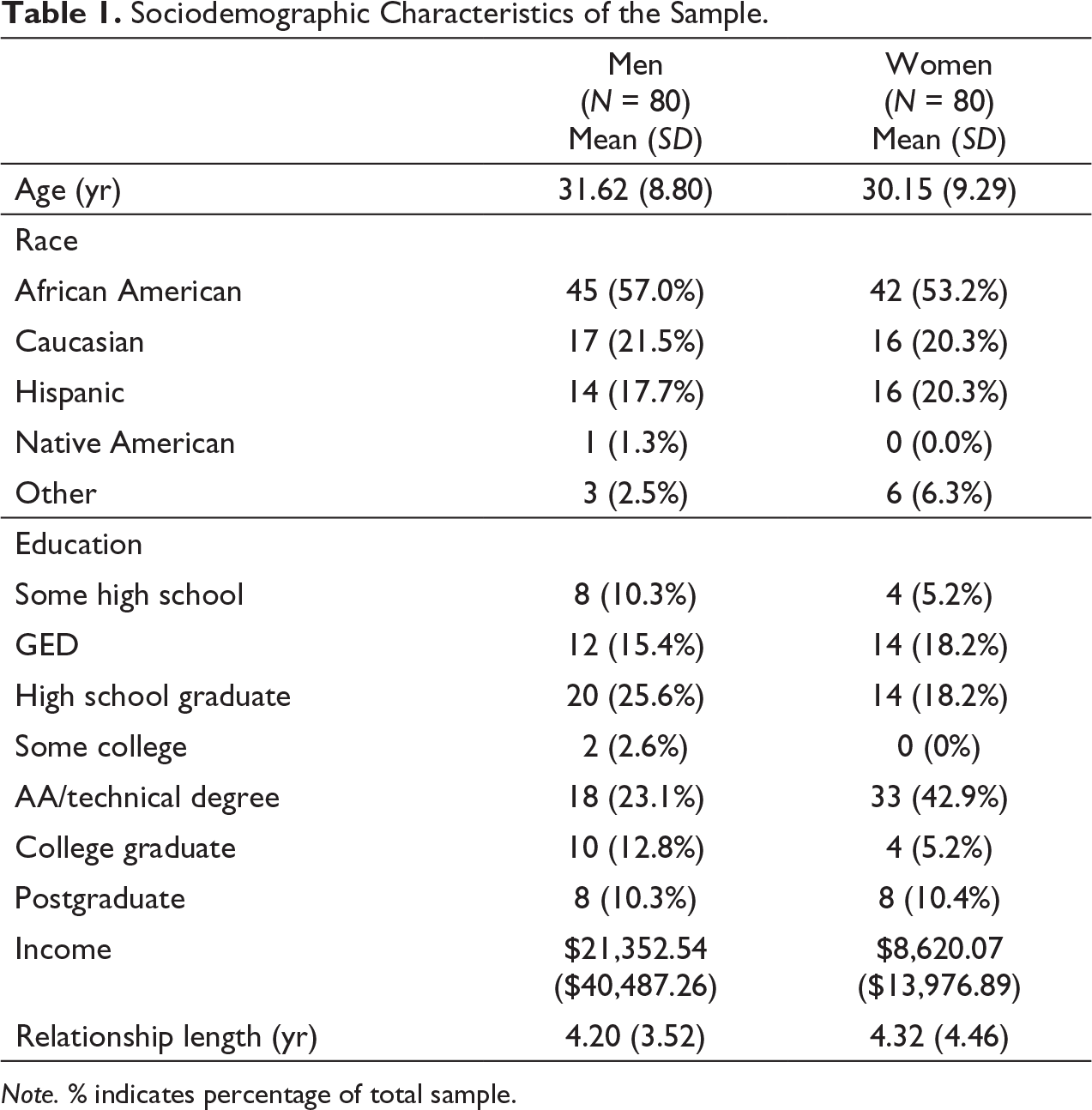
Note. % indicates percentage of total sample.
Relation Between Alcohol Problems and IPV
Men’s report of their own violence on the CTS2 ranged from between 0 and 177 acts in the past year (M = 14.875, SD = 27.61). Women’s reports of men’s violence ranged from 0 to 100 acts in the past year (M 18.030, SD = 23.62). The correlation between men’s and women’s reports of male-to-female violence was r = .40, p < .001. Men reported that their female partners were more frequently violent than they were (M = 19.317, SD = 29.69), although women denied this (M = 15.935, SD = 23.49). The correlation between men’s and women’s reports on female-to-male violence was r = .41, I < .001. To investigate whether general alcohol-related problems predicted frequency of IPV men’s ALC scores on the PAI were correlated with CTS2 violence variables (Table 2). Men’s PIM scores were found to significantly correlate with ALC scores (r = –.39, p < .001) and therefore were entered as a covariate in these correlation analyses. Only women’s report of men’s physical violence was significantly correlated with men’s ALC scores (r = .23, p = .041), further validating our decision to analyze women’s reports of violent incidents.
Partial Correlations Between General Alcohol Use and Men’s Frequency of Violence Perpetration on CTS2 Using PIM1 as a Covariate.
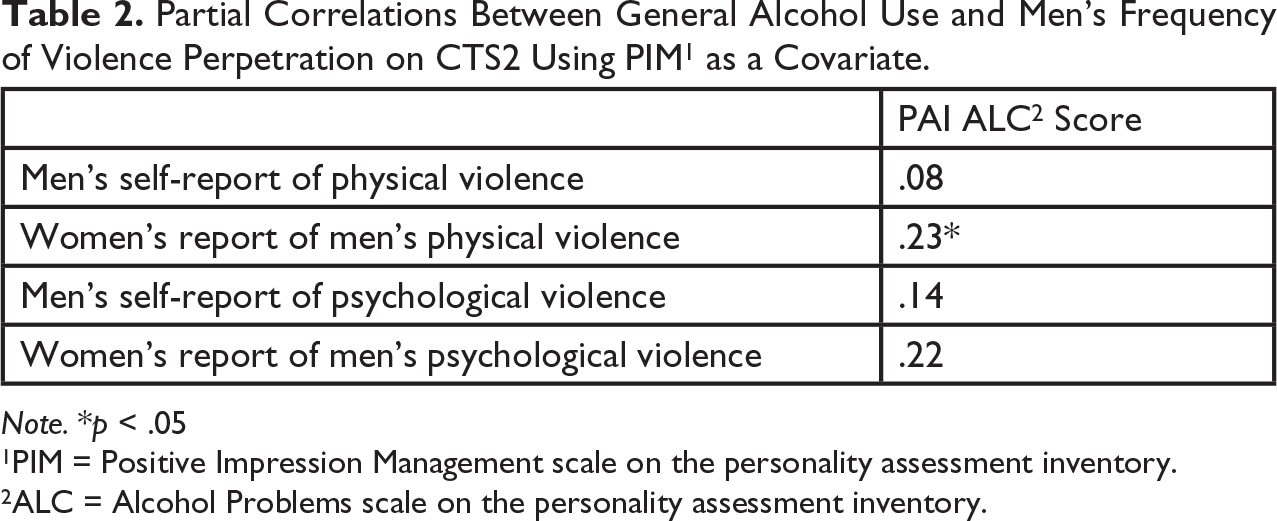
Note. *p < .05
1PIM = Positive Impression Management scale on the personality assessment inventory.
2ALC = Alcohol Problems scale on the personality assessment inventory.
Comparison of IPV During Incidents With and Without Alcohol Use
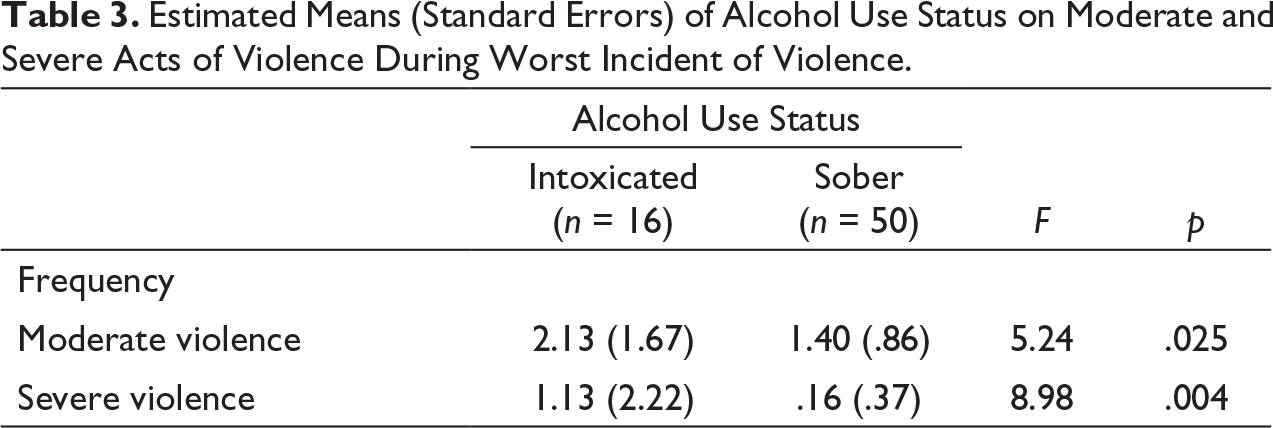
To investigate the perpetration of IPV by intoxicated men relative to sober men, two MANOVAs were conducted with alcohol status as the independent variable and frequency of moderate and severe acts of IPV coded during the most recent and worst incidents of violence as the dependent variables (see Table 3). For the most recent incident of violence, there was no statistically significant difference in violence perpetration based on men’s alcohol use status. When considering the worst incident of violence, there was a significant difference in the frequency of moderate and severe acts of violence based on men’s alcohol use status (Wilks’ lambda = .86, F(2, 63) = 5.29, p = .008). Box’s M test of equality of covariance matrices was not significant at the p < .001 level; thus, Wilks’ lambda was reported. Intoxicated men committed more acts of both moderate and severe violence during the worst incident relative to sober men.
Estimated Means (Standard Errors) of Alcohol Use Status on Moderate and Severe Acts of Violence During Worst Incident of Violence.
Women’s Antecedents to Men’s Initial Act of Violence: Sequential Analysis
Analyses were performed on coded retrospective interview data. Only women’s descriptions of past violent incidents were entered into sequential analysis, which was used to determine which female partner behavior preceded their male partner’s initial act of violence. Incidents were grouped based on presence of absence of men’s alcohol use. Positive z-scores indicate that men’s violence, following a particular female partner behavior of interest, is more likely to occur than one would anticipate based on chance alone. Conversely, negative z-scores indicate that men’s violence is less likely to follow the antecedent female partner behavior than would occur by chance.
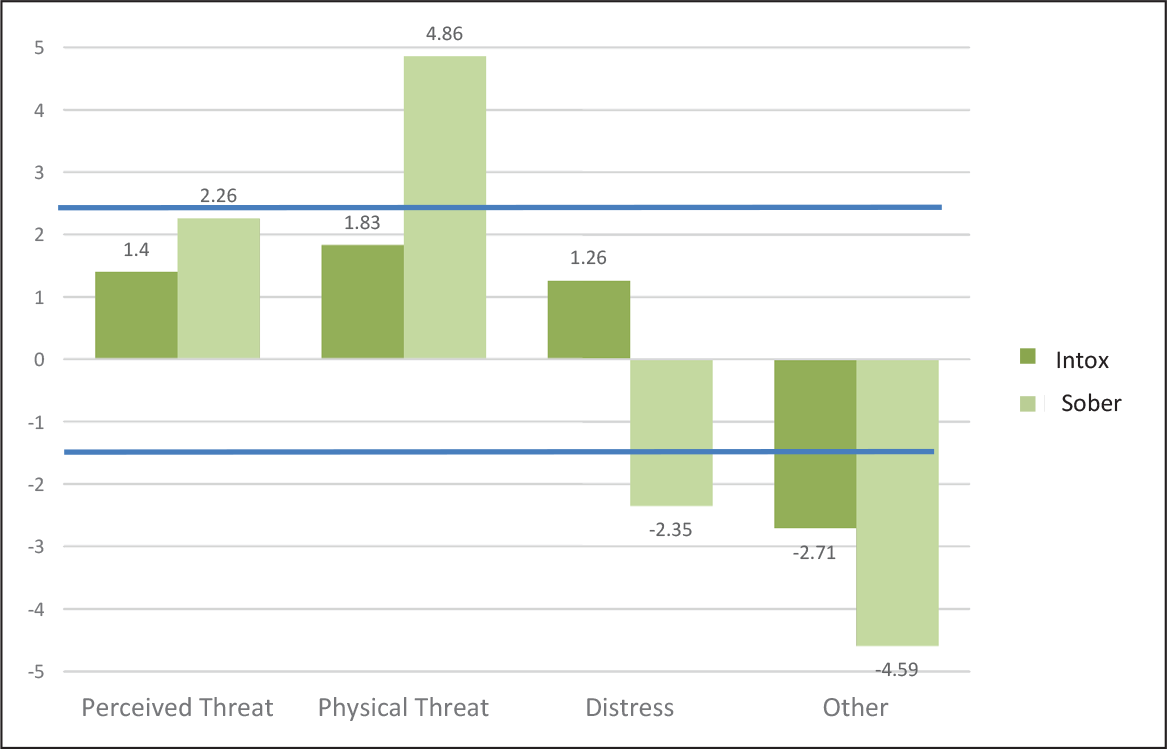
For sober men, their initial act of violence was more likely than expected based on chance alone to be preceded by both their intimate partner’s physical threat (z = 4.86, p < .001) and perceived threat behaviors (z = 2.26, p = .024). Sober men’s initial act of violence was unlikely to be preceded by their intimate partner’s engagement in codes categorized in the “other” group (z = –4.59, p < .001). For intoxicated men, the same pattern was not evidenced. Their initial act of violence was not related to their intimate partner’s perceived threatening or physically threatening behavior (z = 1.40, p = .162; z = 1.83, p = .067). However, their initial act of violence was similarly less likely than would be expected based on chance to be preceded by their intimate partner’s engagement in “other” behaviors (z = –2.71, p < .01). That is, prosocial and neutral behavior had a suppressive effect on men’s first act of violence for both sober and intoxicated men.
To investigate whether there were significant differences in the antecedents to men’s violence across the two groups in each violent incident scenario (intoxicated or sober), a difference of z-scores calculation was used: zdiff = z1 – z2/√2 (Babcock et al., 2000). The difference in z-scores between intoxicated and sober men was significant when considering women’s physical threat preceding men’s violence (zdiff = 3.03, p < .01).
To determine whether women’s distress cues led to an inhibitory effect on men’s violence, the same sequential analysis procedure was used to test the following partner antecedent codes that make up the distress category: distress, crying, pleading, and apology (See Figure 3 and Figure 1). Again, incidents were grouped by alcohol use status. Women’s distress cues were expected to have a suppression effect on men’s violence for sober men only. Sober men were less likely to become violent after their partners displayed distress cues (z = –2.35, p = .019), whereas women’s distress cues had no significant impact on intoxicated men’s perpetration of violence (z = 1.26, p = .208). The difference comparing z-scores between intoxicated and sober men in women’s distress preceding suppression of violence was significant (zdiff = 3.61, p < .001), with sober men being significantly less likely to react violently to female distress cues than intoxicated men.
Z-scores associated with women’s antecedents to men’s physical violence perpetration and suppression.
Discussion
While there is little dispute that there exists an association between IPV and alcohol use, the mechanism by which alcohol impacts violence is unclear. Diary studies support a temporal relation between the use of alcohol and the perpetration of IPV (Moore et al., 2011; Testa & Derrick, 2014), and some have called for the incorporation of alcohol use treatment strategies into existing partner-violence intervention programs (Devries et al., 2014; Stuart, 2005). However, this is one of few studies to examine how violent incidents unfold when alcohol is involved. Presumably, uncovering the antecedents of violent behavior when alcohol is proximally used may shed light on the cause of partner violence.
We expected that the initial act of violence among men who abuse women when intoxicated would arise in response to a variety of seemingly salient partner cues, whereas the initial act of violence in men who perpetrate IPV who were sober prior to the episode of violence would arise in response to relatively few partner behaviors, including female perpetration of violence and physical threat. While this exact hypothesis was not borne out, the results of this exploratory study did demonstrate interesting differences in antecedent-consequent relationships when alcohol was involved in violent incidents.
These results suggest that, proximally intoxicated men do react violently to partner cues in a pattern that is distinct from sober men. While sober men were likely to react violently to their partner’s physical threat and perceived threat behavior, these behaviors were not significantly predictive of violence for intoxicated men. This finding is partially in line with our prediction that sober men would be more likely to engage in violence only when presented with the most threatening cues by their partner. It is possible that behaviors we conceptualized as part of the perceived threat group (e.g., verbal threat, yelling, criticizing) were interpreted as overtly intimidating to sober men. The best predictor of sober men’s violent behavior is their female partners’ violent behavior. While this is also true of intoxicated men, women’s violent acts failed to meet significance as a precursor of men’s first violent act. Both groups were less likely to react violently to their partner’s “other” category behaviors, those that included nonthreatening and prosocial behaviors (query, request, problem-solve, or neutral).
These results contrast with our prediction that intoxicated men would react violently to both their partner’s physically threatening and perceived threatening behavior. That is not to say that intoxicated men were less violent than sober men. Recall that all couples included in the current study reported IPV in the past year and that all incidents described by women involved some form of male-to-female physical violence. These results simply indicate that there was no partner behavior that reliably predicted the perpetration of violence for intoxicated men. In other words, the initial act of violence committed by proximally intoxicated men appeared to arise following a variety partners’ behavior, in a seemingly random pattern. Presumably, there was such diversity in precursors of intoxicated men’s behavior that there was little signal to noise to detect meaningful patterns. Taken together, these findings suggest that, consistent with our prediction, intoxicated men do in fact react violently to partner cues in a way that is distinct from sober men.
These results are partially supported by the AMM (Giancola et al., 2010) and its implications with respect to alcohol’s facilitative effect on aggression. According to the AMM, alcohol confers specific physiological effects on the brain that impact executive functioning in such a way that restricts the attention of intoxicated individuals to the most salient environmental cues. In this way, it is thought that intoxicated individuals are prone to attending to provocative cues rather than inhibitory cues. In the current study, results support the hypothesis that the violence of intoxicated men is not suppressed by distress cues of their victims. However, intoxicated men were not more likely than would be expected based on chance to react violently to women’s overt physical threat or women’s verbally threatening behavior, both of which we had predicted would serve as salient environmental cues. This could be because intoxicated men were distracted by many nonprovocative cues viewed through a distorted, myopic lens, leading to decreased aggression (Giancola et al., 2010). Experimental studies find that when working memory is fully allocated to several innocuous cues, aggression may be less likely when an actual threat appears on the scene (Giancola & Corman, 2007). Alternatively, other dispositional characteristics, such as trait anger and hostile attributional bias, may be interacting with alcohol intoxication to influence violence likelihood.
Important differences between intoxicated and sober men were also evidenced when considering the inhibitory effect of partner distress cues on the perpetration of violence. In particular, women’s distress cues were shown to have a suppressive effect on violence for sober men, but not for intoxicated men. In the absence of the physiological effects of alcohol, it is presumed that sober men were better able to interpret the content of partner distress cues (e.g., crying, pleading), empathize with the underlying emotions of fear/sadness or understand the potential long-term consequences of violence, and modify their behavior accordingly (Eastwood et al., 2020). Intoxicated men, on the other hand, may have been myopically focused on prior instigating cues, which competed with subsequent inhibitory information, such as their partners’ distress cues (Giancola et al., 2010).
This multimethod study used both men’s self-report as well as collateral reports of physical and psychological aggression in analyses measuring the correlation between general level of alcohol use and IPV perpetration. The literature suggests a strong relation between alcohol use and IPV perpetration (Crane et al., 2014; Stuart et al., 2006; Testa et al., 2012). While men’s self-report of IPV was not significantly related to his alcohol use, women’s report of men’s physical violence was significantly correlated with men’s ALC score. This finding is not necessarily surprising, given that many studies have suggested that male perpetrators may minimize their own partner violence and alcohol use as these can be perceived as socially unacceptable behaviors (Dutton, 1986; Helfritz et al., 2006; Henning & Holdford, 2006). Because higher frequency of IPV is known to correlate positively with alcohol use disorder scores (Crane et al., 2014; Testa et al., 2012), it appears that women’s reports of men’s IPV and drinking are likely more accurate, particularly since violent men may underreport these behaviors.
Another aim of the current study was to examine the frequency of violence in violent incidents state alcohol use (i.e., during incidents in which men were drinking as compared to violent incidents where men were sober). As expected, there was a significant difference between sober and intoxicated men in frequency of violent acts. Specifically, intoxicated men committed significantly more acts of both moderate and severe violence relative to sober men, but this difference was apparent only in the descriptions of the worst violent incident. This result is consistent with the literature, which suggests the severity of IPV is higher for incidents in which one or both partners has been using alcohol (Cunradi et al., 2002; Graham et al., 2011). This finding is also consistent with the core tenet of the AMM, which posits that an intoxicated individual’s executive functioning is impaired, leading to decreased ability to perceive and process cues that may otherwise suppress IPV (e.g., their partner’s distress), and higher propensity for violence.
Limitations and Future Directions
As noted by Eckhardt et al. (2015), there is a scarcity of empirical research on the possible mechanisms underlying alcohol-facilitated IPV. While conducting true experiments on the impact of alcohol on IPV would yield the most valuable information, IPV cannot be ethically induced in a laboratory setting, thus greatly reducing our ability to make causal claims. Coding and sequentially analyzing past violent incidents can allow for direct testing of theories of alcohol-fueled IPV such as AMM and I3 Theory (Finkel & Eckhardt, 2013). Future studies could examine sequential patterns from the meta-theoretical I3 theory (Finkel & Eckhardt, 2013) perspective, examining partner threats as an instigator, intoxication as an inhibitor, and perpetrators’ traits, such as hostile cognitions, as impellors.
One limitation in the current study is that perpetrators’ traits were not tested as moderators or impellors of the sequential patterns predicting violence which cannot obfuscate findings. Previous sequential analyses of violence incidents have found that personality disorders (Ross & Babcock, 2009) and attachment style (Babcock et al., 2000) moderate precursors of violent events. Another limitation was the exclusive use of women’s retrospective reports of their male partner’s IPV. Women’s interviews tended to be longer and more detailed, which made them more conducive to sequential analysis procedures. However, these reports may be subject to bias given that they only take into account the perspective of one individual who was present during the incident. The issues of reporter bias and other threats to external validity have long been raised within the study of IPV (Follingstad & Rogers, 2013). We chose to use this methodology in light of concerns that perpetrators of IPV may be more likely to underreport their violence given the social stigma associated with domestic violence (Dutton, 1986; Follingstad & Edmundson, 2010; Helfritz et al., 2006; Henning & Holdford, 2006; Moffitt et al., 1997; O’Leary & Arias, 1988; Riggs et al., 1989). The patterns and precursors of violence may be different when men’s descriptions of their own past violent events are entered into sequential analysis.
In the current study, the sample was selected for male-to-female violence and female-to-male violence was free to vary. Given growing evidence that IPV is more gender symmetrical and bidirectional than previously thought (Bates, 2016), it is also important to consider couples in which the woman is the primary or only aggressor. In addition, the current study excluded same-sex couples. Further study is needed to determine whether these results generalize to same-sex couples. Given ethnically diverse sample, results may be generalizable to a broad range of community samples. However, findings may not generalize to perpetrators court-mandated to attend battering intervention programs or to international samples.
Surprisingly, relatively few incidents described involved alcohol (23%). While sequential analysis requires a high number of acts within events, the imbalance between sober and intoxicated events may have limited the ability to find precursors in the smaller group. The small number of violent episodes coded as “intoxicated” may be partly responsible for women’s violence and threats failing to reach significance as a precursor to men’s violence, due to limited power. A final limitation of the current study is that because these data were taken from a larger study whose main hypotheses were not related to alcohol use, the quantity and type of alcohol consumed by men prior to or during violent incidents could not be reliably coded. This limited information made it necessary to utilize a dichotomous and categorical conceptualization of alcohol use, rather than a dimensional one. Tracking the quantity and type of alcohol consumed would allow for the exploration of a dose-response relationship.
Similar to the methodology used in the current study, exploring the interactive individual and partner contributions to IPV will likely be the most useful path to elucidating the complex relation between alcohol and IPV (Rodriguez et al., 2014). For example, a recent study using the actor-partner interdependence model found that the highest level of IPV was observed in individuals with executive functioning deficits whose partners reported problematic alcohol use (Parrott et al., 2017). Further work in this domain is needed to explore how dyadic factors impact the relation between alcohol use and IPV.
Clinical Implications
Contextual precursors of men’s IPV were examined in the current study. Although women’s behaviors were examined as antecedents to men’s violence, we in no way intend to imply that women caused or are to blame for their partners’ violence. By the same token, we do believe that a better understanding of antecedent-consequent relationships leading up to violent behavior may help inform intervention efforts. Future studies can examine men’s behavioral antecedents to their own and their partners’ violence, men’s reports of violence incidents, and gender differences in violence antecedents one or more lags before violent acts.
New directions for battering interventions include multicouple group interventions (Bradley & Gottman, 2012) and an acceptance and commitment therapy group called Achieving Change through Value-Based Behavior (ACT-V; Zarling et al., 2015). Our results call into question the efficacy of couples’ interventions for male perpetrators with a drinking problem. While dyadic treatment of IPV is promising (Armenti & Babcock, 2016), it may only be useful and safe for sober couples. In this context, therapy can address the complex interactions and negative communication behaviors (e.g., blame, withdrawal), that may lead to IPV. It may also be useful to educate sober couples on the facilitative effect of certain partner behaviors (e.g., offensive violence, physical threats) as well as the inhibitory effect of distress cues on violence. Our findings suggest that the violence of intoxicated men is much more indiscriminate and unpredictable. Such perpetrators may benefit by first completing treatment to reduce problematic alcohol use before engaging in dyadic interventions for IPV (Murphy & Ting, 2010) or by participating in behavioral couples therapy for alcohol use (McCrady & Epstein, 2008; O’Farrell & Fals-Stewart, 2006), which has shown significant reductions in both problem alcohol use and IPV perpetration.
Finally, these results may inform clinical work with victims of domestic abuse. Women in violent relationships may be counseled to leave the home when their partner is drinking rather than try to reason with the perpetrator or predict his behavior. While the violence of sober men follows more predictable patterns, the violence of intoxicated men is erratic, illogical, and unpredictable. Victims of domestic abuse may blame themselves for not being able to predict or avoid partner violence (Whiting & Smith, 2016; Wilson et al., 2017). The current findings suggest that there may be little victims can do to reduce the risk of violence when their partners are intoxicated.
Footnotes
Authors’ Note
Collection of these data was funded by the National Institutes for Mental Health R03 MH066943-01A1. This manuscript was extracted from the dissertation of Susan Iyican as partial fulfillment for her PhD at the University of Houston. Preliminary findings were presented at Association for Behavioral and Cognitive Therapies Annual Convention, San Diego, CA, in November 2017.
Declaration of Conflicting Interests
Funding
The author(s) disclosed receipt of the following financial support for the research, authorship, and/or publication of this article: This project was funded by grant R03 MH066943-01A1 from the National Institutes of Health and by the University of Houston.
