



Abstract
Online consumers have the limitation of product experience and evaluation, due to the inability to directly experience the product, thereby increasing perceived risk of product performance. This study investigated the dimensions of product performance risk that relate to virtual product experience in online apparel shopping. Perceived risk theory was applied to explain consumers’ risk perceptions of product performance. Data were collected from 403 female college students at a Midwestern university using a web-based survey. Results indicate that online consumers perceived visual, tactile, and trial risks of product performance based on the evaluation of product attributes through virtual product experience. Visual, tactile, and trial risks may help online consumers determine more specific product performance characteristics related to product attributes. Attention to the three dimensions of product performance risk may allow online retailers to develop more differentiated virtual product experience strategies to reduce each dimensional risk of product performance in online apparel shopping.
Introduction
Online sales have continued to increase (Rueter, 2012). Forrester Research projects that online shoppers will spend close to $327 billion in 2016, up from $202 billion in 2011 (Rueter, 2012). Apparel is the fastest growing product category sold online, indicating potential growth of the online apparel market (Forrester Research, 2009). Apparel product sales accounted for $23.6 billion in 2008, ranked as the second best selling product category in the online retail market (Forrester Research, 2009).
The growth of online apparel shopping was spurred in part by the development of virtual product experience technology, which makes online apparel shopping more accessible and tangible to consumers (Verhoef, Neslin, & Vrooman, 2007). Apparel brands and retailers have integrated advanced image interactive technology (e.g., enlargement or zoom, 3-D rotation, mix and match, and personalized 3-D virtual models in virtual dressing rooms) into their online websites, allowing consumers to virtually examine and experience apparel products online and providing a more realistic experience similar to that of shopping in a physical store (Kim & Forsythe, 2008; Lee, Kim, & Fiore, 2010).
Despite online apparel retailers’ continual efforts to enhance the virtual product experience, consumers still face experiential limitations when shopping for apparel products online. The intangibility of shopping for apparel online hinders crucial product experiences and evaluations. Consumers may imagine the look and fit of garments on their bodies, based on product information available on model images or through image interactive technology, but the technological interface may limit accurate evaluation of product information, such as look, touch, texture, fit, and comfort (Kim & Forsythe, 2008; Park, Stoel, & Lennon, 2008; Rosa, Garbarino, & Malter, 2006). The lack of direct product experience in online apparel shopping environments may increase perceived risk of product performance, as well as negatively influence attitudinal and behavioral responses toward product, brand, or online retailer (Forsythe, Liu, Shannon, & Gardner, 2006; Forsythe & Shi, 2003; Lee et al., 2010; Park, Lennon, & Stoel, 2005).
Although there have been efforts to examine perceived risk in online shopping settings, most of the previous literature studied overall apparel shopping experiences (Choi & Lee, 2003; Forsythe et al., 2006; Park et al., 2005; Rosa et al., 2006). The studies each identified two to three dimensions of product performance risk in relation to virtual product experience: visual (Jiang & Benbasat, 2004–2005; Li, Daugherty, & Biocca, 2002), tactile (Forsythe et al., 2006; Peck & Childers, 2003), trial (Forsythe et al., 2006), functional (Jiang & Benbasat, 2004–2005), and/or behavioral (Li et al., 2002; Li, Daugherty, & Biocca, 2003) risks. Instead of studying these dimensions in a piecemeal fashion, it is important to study them simultaneously to further understanding of the online shopping experience and ultimately move to more effective reduction of perceived apparel product performance risk. Furthermore, the experiential nature of apparel products is an important component of multidimensional product performance risk. However, there are limited studies specifically and comprehensively examining the dimensions of perceived apparel product performance risk in the online shopping context.
The purpose of this study is to investigate the dimensions of product performance risk that relate to virtual product experiences in online apparel shopping. The present study applied perceived risk theory (Bauer, 1960; Cox, 1967) to explain consumers’ risk perceptions of product performance in online apparel shopping. Perceived risk can be a significant obstacle preventing consumers from selecting a product (Cox, 1967). Identification and better understanding of customer’s risk perceptions can benefit marketers in developing risk-reducing strategies that would assist in managing risk perceptions of consumers (Cox, 1967).
Theoretical Framework: Perceived Risk Theory
Perceived risk was conceptualized first by Bauer (1960) as undesirable consequences of uncertainty in the purchase decision process. Cox and Rich (1964) defined perceived risk as, “the nature and amount of risk perceived by a consumer in contemplating a particular purchase decision” (p. 33). In perceived risk theory, consumer behavior is regarded as risk taking in that “any action of a consumer will produce consequences which he cannot anticipate with anything approximating certainty” (Bauer, 1960, p. 24). Thus, Bauer proposed that consumers develop or adopt risk reduction strategies to obtain certainty when information is limited or inappropriate and when they do not anticipate favorable consequences in shopping situations. Based on Bauer’s article, Cox (1967) conceptualized that consumer decision making involves risk reduction activity. Cox suggested that consumers deal with risk through information handling as an important risk reduction strategy.
From the perspectives of risk handling in consumer behavior, Cox (1967) hypothesized that perceived risk is a multiplicative function of uncertainty and consequences. The amount of perceived risk is a function of two factors: “the individual’s subjective feeling or degree of certainty that the consequences will be unfavorable,” and “the amount that would be lost if the consequences of the act were not favorable” (Cox, 1967, p. 37). Cox hypothesized that when consumers perceive intolerable levels of risks, they tend to increase certainty through information handling rather than reduce the amount of risk or seriousness of the consequences. The most important hypothesis is that risk handling in consumer behavior is information handling to increase certainty through “receiving or seeking and evaluating new information or through referring to and evaluating already stored information (past experience)” (Cox, 1967, p. 81). This study utilizes the two dimensions of perceived risk—uncertainty and consequence—to assess dimensions of product performance risk. It is plausible to assume that online consumers perceive uncertainty and unfavorable consequence of product performance in the purchase process, due to the intangibility and inaccuracy of product information in online shopping environments. Online consumers seek and assess information regarding product performance through virtual product experience in order to reduce risk and increase certainty that the consequence of product performance will be favorable.
Perceived Risks in Online Shopping
Perceived risk is regarded as a multidimensional construct, involving financial, performance, social, psychological, and physical risks (Choi & Lee, 2003; Forsythe et al., 2006). Additional dimensions of perceived risks have also been identified in contexts of nonstore shopping environments—time loss, privacy, security, source, transaction, and convenience risks (Choi & Lee, 2003; Forsythe et al., 2006). Consumers tend to perceive higher risks in nonstore shopping environments, such as mail order, catalog, television, and the Internet (Denis & French, 2004; Verhoef et al., 2007).
In comparison to in-store shopping, online shopping engenders more perceived (a) product performance risk (Cases, 2002; Choi & Lee, 2003; Eggert, 2006; Forsythe et al., 2006; Rosa et al., 2006), (b) financial and/or transaction risk (Choi & Lee, 2003; Forsythe et al., 2006), (c) privacy and/or security risk (Choi & Lee, 2003; Forsythe et al., 2006), and (d) time and/or convenience risk (Cases, 2002; Eggert, 2006; Forsythe et al., 2006). These risks mainly result from the inability to engage in direct product evaluation and/or physical inspection, inability to interact with the seller, insecurity of online credit card usage and abuse of personal information, navigation difficulty and Internet slowness, delayed delivery, and inconvenient return and exchange policies (Choi & Lee, 2003; Forsythe et al., 2006).
Apparel has been regarded as a complex product category having multidimensional risks related to (a) performance risk, especially fit (Forsythe et al., 2006), (b) sociopsychological risk (Kwon, Paek, & Arzeni, 1991; Park & Stoel, 2005), (c) aesthetic or fashion risk (Winakor, Canton, & Wolins, 1980), (d) product care risk (Shimp & Bearden, 1982), (e) time risk (Kwon et al., 1991), and (f) financial risk (Kwon et al., 1991). In particular, online shopping engenders greater perception of product performance risk in comparison to many other products, due to the lack of direct product experience and the intangibility of apparel products online (Choi & Lee, 2003; Forsythe et al., 2006; Peck & Childers, 2003; Rosa et al., 2006).
Product Performance Risk in Online Shopping
Product performance risk is defined as, “the uncertainty and consequences of a product not functioning at some expected level” (Bruner, Hensel, & James, 2005, p. 474). Product performance risk relates to the risk that the product will not function as expected, often due to the lack of accurate product examination and evaluation prior to purchase (Cases, 2002; Tan, 1999).
In online shopping, virtual product experience—a computer-mediated indirect experience derived from product visualization technology—of visual and size or fit attributes, stimulates consumer learning and multisensory consumption experiences through image interactive function and virtual simulation (Kim & Forsythe, 2008). Online consumers formulate product knowledge and purchase decisions through virtual product experience, which actively involves evaluating product attributes (Li, Daugherty, & Biocca, 2001). Uncertainty about product attributes may lead online consumers to seek more information through virtual product experience to reduce product performance risk.
This study extends previous work to identify dimensions of product performance risk in relation to virtual product experience in online apparel shopping. Most studies explored multidimensional product attributes or virtual simulations—visual, tactile, trial, functional, or behavioral, which may relate to online shoppers’ risk perception of product performance (Forsythe et al., 2006; Jiang & Benbasat, 2004–2005; Li et al., 2002; Peck & Childers, 2003). However, these product attributes or virtual simulations have not been comprehensively examined as dimensions of perceived apparel product performance risk in relation to virtual product experience in online apparel shopping.
With regard to virtual product experience in online shopping, Jiang and Benbasat (2004–2005) proposed two dimensions of virtual product experience with sport watches—visual and functional control—to enhance product evaluation and reduce product performance risk. Visual control allows consumers to assess product attributes from various angles and distances and functional control helps them to manipulate and experience features and functions of product attributes.
Previous studies also suggested three dimensions—visual, tactile, and behavioral—in relation to virtual product experience with bedding material, a laptop computer, a ring, and a watch (Li et al., 2002, 2003). Visual simulation through 2-D graphics, zoom, and rotation from different angles allow consumers to visually inspect a product for color, pattern, design, shape, and texture. Tactile characteristics are difficult to simulate, although they are predicted usually through visual simulation, such as zoom or enlargement along with verbal description, which may help consumers imagine touch and feel. Behavioral simulation, such as a virtual model, virtual try-on, codesign customization, or spatial navigation in a virtual mall, may help consumers virtually experience a product through behavioral interactions with the product. According to previous studies of virtual product experience, 2-D and 3-D virtual product experiences provide visual, tactile, functional, and/or behavioral simulations of product attributes during product inspection and helped consumers perceive less product performance risk (Li et al., 2002; Park et al., 2005).
Product Performance Risk in Apparel Shopping
Apparel products consist of “two dimensions: (a) physical features, or what the garment is and (b) performance features, or what the garment does” (Brown, 1992, p. 2). The physical features include the garment’s design, materials, and construction; performance features include the garment’s aesthetic and functional performance. Brown proposed that the garment’s physical features—design, material, and construction—determine its aesthetic and functional (as assessed during garment trial) performances.
With regard to apparel shopping, aesthetic and trial (i.e., try on) attributes of apparel products provide important criteria during apparel purchase decision making (Eckman, Damhorst, & Kadolph, 1990). Aesthetic attributes of apparel include color, pattern, style, fabric, and match with other garments (Eckman et al., 1990), which may relate to visual risk in online apparel shopping. Trial attributes of apparel products allows assessment of fit or judgments of how a garment conforms to the shape of the body, comfort or how the garment and material feel to the consumer, and appearance or how the garment looks on the consumer (Eckman et al., 1990). Limited examination of trial attributes is likely to increase trial risk in online apparel shopping; performance trial is most difficult to experience online.
Peck and Childers (2003) emphasized haptic (or tactile) product attributes, such as texture, feel, and weight, as crucial factors which make consumers less confident about apparel product judgments during online shopping. Tactile attributes are difficult to simulate in virtual product experience; information processing of visual attributes may substitute for haptic exploration for fabric judgments (Klatzky, Lederman, & Matula, 1993). McCable and Nowlis (2003) compared the difference of consumer preferences between direct and indirect product experience environments of product haptic attributes. They found no difference in preference across the two environments when visual information was highly diagnostic. They also identified that verbal description of the haptic attributes of a material reduced the difference in preferences between the direct and indirect experience environments. Forsythe, Liu, Shannon, and Gardner (2006) identified tactile and trial product attributes in product performance risk resulting from the lack of direct experience of apparel products in online shopping. Tactile attributes include touch and feel, and attributes assessable during trial include physical evaluation, size, and try-on. Other possible dimensions of product performance risk (i.e., visual) were not examined in their study.
Conceptual Model of Product Performance Risk and Hypotheses
Based on the literature review, visual, aesthetic, tactile, trial, functional, and/or behavioral risks were identified as possible dimensions of product performance risk in relation to online apparel shopping behaviors. Visual and aesthetic risks relate to similar product attributes such as style, design, color, fabric, or pattern, so these risks were integrated as “visual risk” in this study. In addition, trial, functional, and behavioral risks were different terms used previously (Eckman et al., 1990; Forsythe et al., 2006; Jiang & Benbasat, 2004–2005; Li et al., 2002, 2003) that seem to indicate the same dimension. These three risks were integrated as “trial risk” in this study. “Tactile risk” was examined as another factor.
The inconsistent usage of the dimensions of product performance risk has been observed throughout the perceived risk literature, as is the limited examination of the dimensions in apparel product performance risk in online shopping. Thus, this study investigated possible dimensions of visual, tactile, and trial risks in product performance risk by testing whether consumers perceive uncertainty and unfavorable consequences in relation to visual, tactile, and trial attributes of apparel products online.
A conceptual model was developed to hypothesize visual, tactile, and trial risks of product performance in relation to virtual product experience in online apparel shopping. The conceptual model proposes that consumers perceive visual, tactile, and trial risks on the basis of evaluation of product attributes through virtual product experience in online apparel shopping. The model postulates (a) visual risk is perceived by a consumer in evaluating visual attributes of an apparel product, including style, fabric, color and print, details, and coordination with other items (or match with other items); (b) tactile risk is perceived by a consumer in evaluating tactile attributes of an apparel product, including touch and feel, weight of garment; and (c) trial risk is perceived by a consumer in evaluating trial attributes of an apparel product, including fit (or judgment of how a garment conforms to the shape of the body), comfort (or how the garment and material feel to the consumer), and appearance on the body (or how the garment looks on the consumer).
Accurate and sufficient apparel product attribute information may play an important role in reducing product performance risk in nonstore apparel shopping (Peck & Childers, 2003). An empirical test of the hypothesized dimensions in product performance risk examined whether these product attributes relate to risk perception of product performance in online apparel shopping. Three hypotheses were formulated:
Hypothesis 1: Perceived visual risk in online apparel shopping significantly relates to visual attributes of an apparel product, including style, fabric, color and print, detail, and coordination with other items.
Hypothesis 2: Perceived tactile risk in online apparel shopping significantly relates to tactile attributes of an apparel product, including touch and feel and weight of a garment.
Hypothesis 3: Perceived trial risk in online apparel shopping significantly relates to trial attributes of an apparel product, including fit, comfort, and appearance on the body.
Method
Sample
Female college students at a large Midwestern university were recruited for the web-based survey. A random sample of 7,000 female college students’ e-mail addresses was purchased from the Registrar’s Office of the university. As an incentive, all participants were given a chance to win one of five $20 gift certificates in a random drawing. This study targeted female college students, who are more likely to use the Internet for apparel shopping (Denis & Fenech, 2004), be technology-savvy and easily adopt new product visualization technology. Female college students are appropriate target consumers for the stimulus website of J. Crew, which primarily targets young, affluent, college-educated women and men between the ages of 20 and 30 (Reuters, 2008).
Stimulus
The J. Crew website was used to assess how participants perceive product performance risk while utilizing virtual product experiences, including 3-D rotation views, zoom, size chart, color choice, verbal product information, and fabric information. The J. Crew website was chosen because J. Crew provided highly advanced zoom technology, as well as 3-D rotation views for a virtual product experience. Furthermore, its website was regarded as a popular apparel brand website (Reuters, 2008) that represented current product visualization technology. J. Crew’s website had logged over 95 million visits in 2007, and its stores operate in upscale regional malls throughout the United States (Reuters, 2008).
Survey Instrument
To measure product performance risk, 3 items with a 7-point Likert-type scale that closely relates to uncertainty and consequence were adopted from Grewel, Gotlieb, and Marmorstein (1994) and Shimp and Bearden (1982): not sure at all (1)/very sure (7); very little risk (1)/a great deal of risk (7); not confident at all (1)/very confident (7). The reliability of the scale ranged from .73 to .90 in previous studies (Grewel et al., 1994; Shimp & Bearden, 1982). The 3 items measuring uncertainty and consequences included (a) How sure are you about the apparel product’s attributes to perform satisfactorily to your needs? (b) How much risk would you say would be involved with purchasing the product? and (c) How confident are you of the apparel product’s ability to perform as expected?
The 3 items were applied to assess 10 subdimensions (style, fabric, color and print, details, coordination with other items, touch and feel, weight of garment, fit, comfort, and appearance on the body) of three dimensions (visual, tactile, and trial) in the product performance risk construct. Five product attributes related to visual risk—style, fabric, color and print, detail, and coordination with other items—were developed from Eckman Damhorst, and Kadolph, (1990) and Li, Daugherty, and Biocca, (2001). Two product attributes for tactile risk—touch and feel and weight of garment—were developed from Li et al., (2001) and Peck and Childers (2003). Three product attributes related to trial risk—fit, comfort, and appearance on the body—were developed from Eckman et al. (1990) and Li et al. (2001). For example, regarding “style,” participants assessed (a) How sure are you about the apparel product’s attributes to perform satisfactorily to your needs? (b) How much risk would you say would be involved with purchasing the product? and (c) How confident are you of the apparel product’s ability to perform as expected?
To evaluate predictive validity of product performance risk in relation to attitudinal and behavioral responses, attitude toward product and purchase intention online were also measured. Attitude toward product was assessed using
Purchase intention online was measured by the Behavioral Intention (BI) scale, originated by Fishbein and Ajzen (1975). This scale has been widely used to assess BI, and the reliability of BI ranged from .84 to .98 (Stafford, 1996). Three items on a 7-point Likert-type scale were used to rate the probability that participants purchase any of the products they just browsed on the J. Crew website: very improbable (1)/very probable (7); very unlikely (1)/very likely (7); and very impossible (1)/very possible (7).
Data Collection Procedures
The administration of the survey followed a modified version of Dillman’s (2000) web survey design. After receiving approval from the Institutional Review Board (IRB), participants were e-mailed an invitation letter with a link to the web-based questionnaire site. A follow-up e-mail was sent after 1 week to encourage participation in the online survey.
Before assessing the J. Crew website, participants were given directions about exposure to the site, usage guidelines for imagery interactive functions, and the prohibited sites or behaviors on the website. When participants clicked to the J. Crew website and browsed the stimulus website, they were asked to browse various styles of one product category (e.g., denim) for 5 minutes utilizing all the features offered by the retailer to evaluate the product. Participants were instructed to try 3-D rotation views, zoom, size chart, and choice of another color and to read verbal product information as well as fabric information. In the survey, participants were asked to check off the browsing tools they used as a validity check that they had used all browsing tools requested. Exposure time to the stimulus may affect evaluations; therefore, connection time and exposure time to the stimulus were also assessed in self-recorded items. After browsing the stimulus website, participants were asked to rate their perceptions of product performance risk in the 10 product attributes, along with their attitude toward the denim products they browsed and their purchase intention online.
Pretest
A pretest was conducted with five female college students at the Midwestern university. They were asked to suggest problems or difficulties in completing the questionnaire and navigation of the stimulus website. Based on their comments and suggestions, the instructions and questionnaire were revised.
Data Analysis
To analyze the sample characteristics and test internal validity of research instruments, SPSS 18.0 was used. A confirmatory factor analysis (CFA) with a maximum-likelihood estimation procedure was conducted to test the hypothesized model using LISREL 8.72.
Results
Descriptive Sample Analysis
Of the 7,000 female college students randomly selected from a large Midwestern university in the United States, 403 female students responded, yielding a usable response rate of 6%. After cleaning the data, a total of 342 responses were deemed acceptable for further analysis using SPSS 18.0. The mean age of the respondents was 22.25 years (SD = 5.75). A majority of the respondents were White or European American (82%), followed by Asian or Asian American (11.9%), Latino or Hispanic American (3.2%), and Black or African American (2.7%).
Sheehan and McMillan (1999) reported that web survey response rates ranged from 6 to 75%, indicating response variations in web surveys. The low response rate of 6% may indicate a potential bias in the data. Therefore, this study assessed nonresponse bias by estimating response rates on key subgroups of the target population, such as age, ethnicity, major, and year in school. There was little evidence of nonresponse bias because the sample distribution was similar to the total student population distribution of 11,358 female students in terms of age, ethnicity, majors, and year in school.
In addition, exposure time to the stimulus website did not significantly influence respondents’ perceptions of visual risk (β = −.03, t = −.51, p > .05); tactile risk (β = −.01, t = −.26, p > .05); and trial risk (β = −.04, t = −.86, p > .05). Over 98% of participants browsed the J. Crew website and used 3-D rotation views, zoom in and out, size chart, and color choice; 84% of participants read verbal product information; and 85% of participants reviewed fabric information.
Preliminary Analysis
Item parceling divided the 30 items measuring respondents’ perceptions of product performance risk into 10 subscales for CFA. Item parceling was conducted to obtain fewer parameters, a more optimal variable to sample size ratio, more stable parameter estimates, and better model fit (Bagozzi & Edwards, 1998).
Descriptive statistics for the research variables are summarized in Table 1. Pearson correlation coefficients were calculated on summed scores of the hypothesized three dimensions in the proposed model. Significant correlations among the three dimensions were found. Visual risk was positively and more strongly associated with tactile risk (.73) than trial risk (.43), while tactile and trial risks were positively and moderately associated (.57).
Results of Confirmatory Factor Analysis of Product Performance Risk Scale
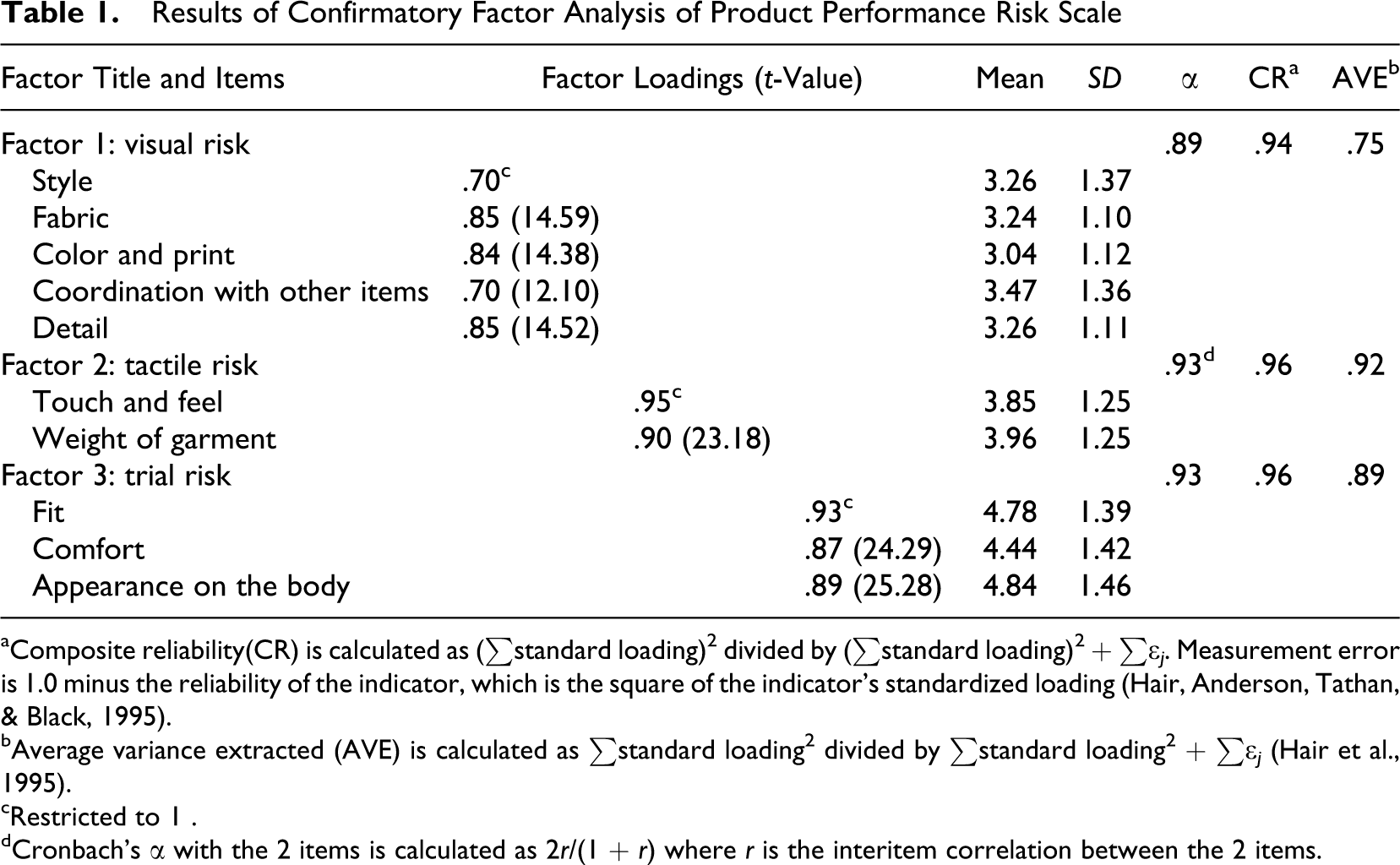
aComposite reliability(CR) is calculated as (∑standard loading)2 divided by (∑standard loading)2 + ∑∊ j . Measurement error is 1.0 minus the reliability of the indicator, which is the square of the indicator’s standardized loading (Hair, Anderson, Tathan, & Black, 1995).
bAverage variance extracted (AVE) is calculated as ∑standard loading2 divided by ∑standard loading2 + ∑∊ j (Hair et al., 1995).
cRestricted to 1
dCronbach’s α with the 2 items is calculated as 2r/(1 + r) where r is the interitem correlation between the 2 items.
Confirmatory Factor Analysis
A model composed of 10 observed variables and three latent variables was tested to evaluate the validity of visual, tactile, and trial risks (see Figure 1). The hypothesized three-factor model with 10 observed variables (or indicators) and three latent variables were tested by CFA. Hu and Bentler (1999) suggested that Standardized Root Mean Square Residual (SRMR) values of .08 or less and/or Comparative Fit Index (CFI), Incremental Fit Index (IFI), Normed Fit Index (NFI), or Nonnormed Fit Index (NNFI) values greater than .95 indicate a good fitting model in assessing the model’s fit. In particular, Hu and Bentler recommend SRMR of .08 or less and CFI with a stringent cutoff value greater than .95 as criteria of a good model fit.
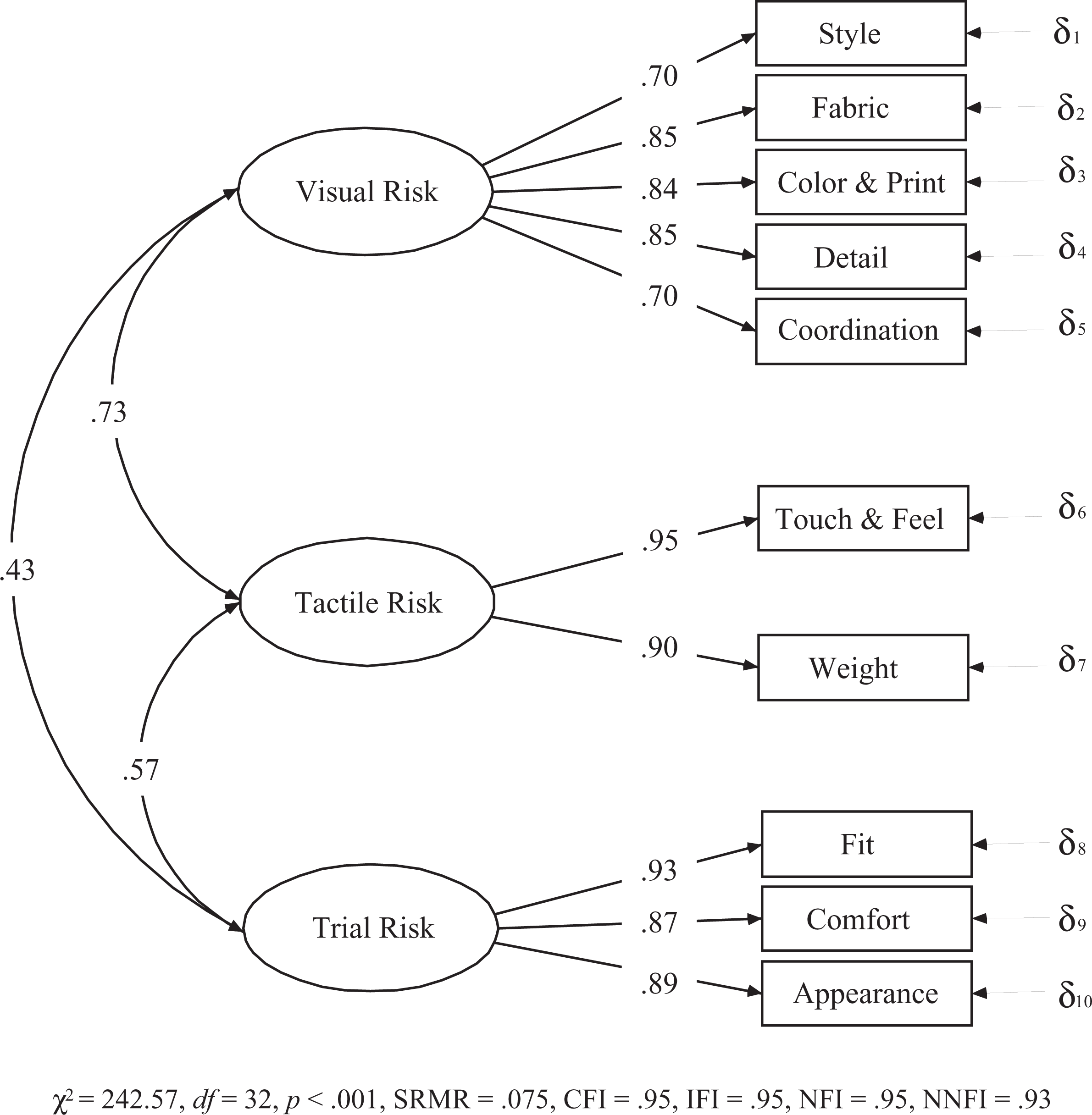
Three-factor model for the product performance risk in the online apparel shopping and virtual product experience context.
The test of the three-factor model yielded a χ 2 (32) value of 242.57 (n = 342, p < .001), thereby suggesting that the hypothesized three-factor model indicated a lack of satisfactory fit to the sample data. Chi-squared goodness-of-fit indices have limitations with large sample size (Hu & Bentler, 1999). Thus, other fit indices were carefully considered for model fit assessment. The other fit indices provide evidence of a fairly good-fitting model: SRMR = .075, CFI = .95, IFI = .95, NFI = .95, and NNFI = .93. The SRMR value of .075 and the CFI value of .95 from the model fit were well within the acceptable fit parameters (Hu & Bentler, 1999).
Results indicate that each latent construct was represented with multiple items in each observed construct, verifying multidimensionality—visual, tactile, and trial risks—of product performance risk. According to the parameter estimates in the model tested (see Figure 1), visual risk was significantly explained by visual attributes of apparel products, including style, fabric, color and print, detail, and coordination with other items; tactile risk was explained by tactile attributes of apparel products, including touch and feel and weight of garment; and trial risk was explained by trial attributes of apparel products, such as fit, comfort, and appearance on the body.
Evaluation of Reliability and Validities
As shown in Table 1, reliabilities for visual risk, tactile risk, and trial risk were adequate (Cronbach’s α > .89), representing the reliability of the multiple indicator measures of each dimension (Cronbach, 1951; Nunnally & Bernstein, 1994). Composite reliability values for all three product performance risk dimensions were also calculated, following Fornell and Larcker’s suggestion (1981). Cronbach’s α tends to underestimate the true reliability of the scale when the measure is multidimensional. Thus, composite reliability was calculated to assess the internal consistency for the multidimensional measures (Fornell & Larcker, 1981). Hair, Anderson, Tatham, and Black (1995) recommended considering the value of .70 or higher as an indicator of a reliable measure. The values for composite reliability for the three risks were higher than .94, which indicated that all constructs in the proposed model provide evidence of the good reliability of the measures in the model.
All factor loadings in the model ranged from .70 to .95 with statistically significant t-values ranging from 12.10 to 25.28. Therefore, good convergent validity among research constructs in the model was indicated (Fornell & Larcker, 1981). To assess convergent validity of constructs in the model, average variances extracted (AVE) were calculated (Fornell & Larcker, 1981). The values for the three constructs ranged from .75 to .92, as shown in Table 1. These values are greater than a threshold value of .50, indicating an acceptable measurement structure of the construct (Fornell & Larcker, 1981).
Discriminant validity was assessed by examining the correlations among research constructs. The specific criterion of correlation values less than .85 for discriminant validity was suggested by Kline (1998). The correlations of visual, tactile, and trial dimensions of performance risks ranged from .43 to .73. Thus, the research constructs in the model also met discriminant validity requirements.
Predictive validity was assessed to examine the effects of visual, tactile, and trail risk dimensions on attitudinal and behavioral responses. Cronbach’s α of attitude toward product and purchase intention online were .96 and .97, respectively. Previous studies indicated the negative effect of product performance risks on attitudes toward product, brand, or online shopping as well as purchase intentions (Forsythe et al., 2006; Forsythe & Shi, 2003; Lee & Huddleston, 2006; Park et al., 2005; Peck & Childers, 2003; Rosa et al., 2006). The significant relationships between research constructs and criterion variables are evidence of predictive validity (Nunnally & Bernstein, 1994). Simple regression tests showed that visual risk negatively and significantly influenced attitude toward product (β = −.31, t = −6.36, p < .001) and purchase intention (β = −.17, t = −3.34, p < .01); tactile risk negatively influenced attitude toward product (β = −.15, t = −2.98, p < .01) and purchase intention (β = −.12, t = −2.45, p < .05); and trial risk negatively influenced attitude toward product (β = −.20, t = −4.0, p < .01) and purchase intention (β = −.22, t = −4.38, p < .001).
Post hoc Comparisons of Alternative Models
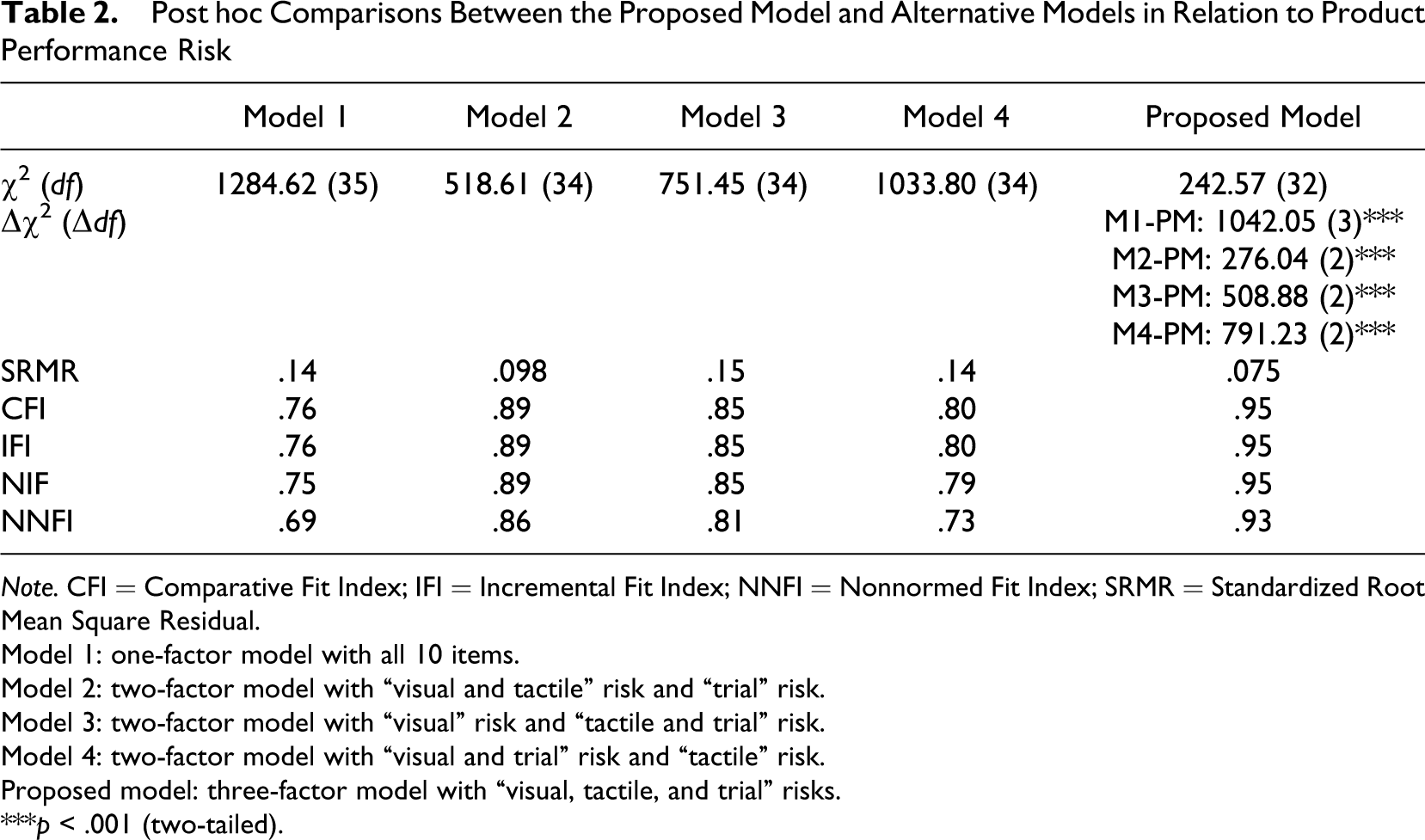
The proposed three-factor model of product performance risk in the context of virtual product experience was compared with four alternative models composed of the same 10 indicators, but developed with different factor structures (a) a one-factor model with all 10 items; (b) a two-factor model with visual and tactile risk and trial risk; (c) a two-factor model with visual risk and tactile and trial risk; and (d) a two-factor model with visual and trial risk and tactile risk. The post hoc comparison of the proposed model with the four alternative models examined whether or not the proposed three-factor model with the 10 items better represents multidimensions of product performance risk than the alternative one- or two-factor models with the same 10 items.
The proposed three-factor model yielded a χ2(32) value of 242.57 (n = 342, p < .001), but the alternative one- or two-factor models produced larger χ2 values, resulting in significant changes in chi-squares among the five models (See Table 2). The changes in chi-squared statistics validated the proposed three-factor model over the alternative one- or two-factor models. Additionally, the proposed three-factor model showed significant improvements of χ2 values ranging from Δχ2 = 276.04, Δdf = 2, p < .001 to Δχ2 = 1042.05, Δdf = 3, p < .001. Considering the other goodness-of-fit indices, the proposed three-factor model yielded a fairly good fit to the data with the SRMR value of .075 and the CFI value of .95, but the four alternative one- or two-factor models poorly fit the data with the SRMR values greater than .075 and the CFI values smaller than .95. That is, the comparison of the goodness-of-fit indices of all five models showed how well the proposed model specified three factors and selected appropriate indicators for each factor. Based on the post hoc comparison analysis, the three-factor model was considered the best model explaining visual, tactile, and trial dimensions of perceived product performance risk in the online apparel shopping context.
Post hoc Comparisons Between the Proposed Model and Alternative Models in Relation to Product Performance Risk
Note. CFI = Comparative Fit Index; IFI = Incremental Fit Index; NNFI = Nonnormed Fit Index; SRMR = Standardized Root Mean Square Residual.
Model 1: one-factor model with all 10 items.
Model 2: two-factor model with “visual and tactile” risk and “trial” risk.
Model 3: two-factor model with “visual” risk and “tactile and trial” risk.
Model 4: two-factor model with “visual and trial” risk and “tactile” risk.
Proposed model: three-factor model with “visual, tactile, and trial” risks.
***p < .001 (two-tailed).
Discussions and Implications
Despite online apparel retailers’ continuous efforts to enhance virtual product experience, consumers still face limitations when shopping for apparel products online. The present study empirically examined multiple dimensions of product performance risk of apparel in the online shopping context. The results indicate that online consumers perceived visual, tactile, and trial risks of product performance on the basis of evaluation of product attributes through virtual product experience. These three different risks may play an important role in helping online consumers determine more specific product performance risk in relation to apparel product attributes.
This study contributes to the body of knowledge concerning perceived risks of product performance, as most of the previous studies focused on general perceived risks (Choi & Lee, 2003; Forsythe et al, 2006; Forsythe & Shi, 2003). Previous research primarily identified multidimensional product attributes or virtual simulations related to perceived product performance risk in general (Eckman et al., 1990; Forsythe et al., 2006; Jiang & Benbasat, 2004–2005; Li et al., 2002, 2003; Peck & Childers, 2003). Thus, this study contributes to the exploration of the multiple dimensions of product performance risk—visual, tactile, and trial risks—which are applicable to explain product performance risk in the context of online apparel shopping and virtual apparel product experience.
The high association between visual and tactile risks in the present study was supported by previous studies (Klatzky et al., 1993; McCable & Nowlis, 2003) in that visual information of a product in virtual product experience initiates or provides tactile sensation projections for product evaluation. Previous studies suggested visual and verbal information related to touch, feel, fit, comfort, and look could provide information on the tactile and trial attributes of a product online; however, research did not empirically address the relationship between tactile attributes and trial risk (Klatzky et al., 1993; McCable & Nowlis, 2003). A positive association between tactile and trial risks was found in the present study, indicating the crucial role that tactile characteristics play in trial evaluations. This study extends an understanding of the importance of all three dimensions of product performance risk, which are interrelated.
The findings have managerial implications for online marketers and retailers to consider visual, tactile, and trial risks in the online apparel shopping process and develop appropriate strategies to minimize the three risks of product performance and maximize online consumption experiences. Visual, tactile, and trial risks of product performance can be reduced by supporting online consumers’ evaluation of product attributes through virtual product experiences. Online marketers and retailers may need to continually develop more informative virtual product experiences in relation to visual, tactile, and trial attributes of apparel products to reduce multidimensional product performance risk identified in the present study. For example, enhancing visual and verbal product information related to tactile and trial attributes, such as touch, feel, fit, comfort, and appearance, may help online consumers to assess the apparel product and reduce possible tactile and trial risks perceived in online context (Klatzky et al., 1993; McCable & Nowlis, 2003). Since consumers tend to rely on visual information to make a purchase decision online, providing more written information concerning tactile and trial attributes could support decisions made through the sense of vision (McCable & Nowlis, 2003). Additionally, developing websites to incorporate more visual, tactile, and trial experiences (e.g., use of models with various body types and body sizes or videos rather than static visuals) could help online consumers more accurately evaluate product attributes, which might reduce perceived visual, tactile, and trial risks.
The findings from this study also suggest that consumers perceived uncertainty and unfavorable consequences of product performance resulting from the limited product information about visual, tactile, and trial attributes in the context of online shopping. Online marketers or retailers need to enhance their online service performance by incorporating creative and effective risk reduction strategies using virtual product experience technologies or tools for their product presentations.
Limitations and Recommendations for Future Research
Several limitations of the present study inspire recommendations for future research. More diverse samples with a wider variety of age, gender, education, ethnicity, cultural difference, and region could expand explanation of visual, tactile, and trial risks in the context of online apparel shopping. The present study only identified the multiple dimensions of product performance risk. This study did not explore antecedents and consequences of the three dimensions. Thus, future research investigating antecedents and consequences of visual, tactile, and trial risks in virtual product experience and online apparel shopping may provide more in-depth explanations about the impact of product performance risk on online apparel shopping behaviors.
Future research should replicate the study to examine and evaluate the robustness and validity of the instruments used in this study and the empirical evidence of the visual, tactile, and trial risks as dimensions of perceived risk of product performance in online apparel shopping. To validate the measurement of apparel product performance risk, future research should replicate the reliability and validity of the measurement items using different samples. Additionally, the multiple dimensions of product performance risk should be validated across different product categories (e.g., highly intangible vs. highly tangible), apparel shopping technologies (e.g., virtual trial, video, customization, and body scanning), sales promotions (e.g., discount and free trial), and various nonstore shopping environments (e.g., mail order, catalog, television, the Internet, and mobile).
Virtual product experience and risk perception could be influenced by (a) prior experience with the J. Crew brand, such as brand familiarity or prior brand attitude (Chen & He, 2003; Eggert, 2006; Park & Stoel, 2005) and (b) satisfaction with prior online shopping experience (Park & Stoel, 2005). Previous studies revealed brand familiarity and satisfaction with prior online shopping experience were negatively related to perceived risk, and positively related to purchase intention (Park & Stoel, 2005). Online consumers, who have prior online shopping experiences with the brand, tend to have more information about visual, tactile, and trial attributes of the product, influencing their risk perception of product performance. Thus, future research may need to examine possible effects of prior brand experiences—such as brand familiarity, prior brand attitude, or brand loyalty—and prior online shopping experience on multidimensional product performance risk.
Trial information through interactive image technologies, such as 3-D rotation, virtual model, or virtual try-on, tends to result in greater product knowledge, less perceived risk, and more favorable attitudinal–behavioral responses than 2-D visual or tactile information (Jiang & Benbasat, 2004–2005; Lee et al., 2010; Li et al., 2002; Park et al., 2008). Offering more advanced features to enhance virtual product experiences, such as 3-D body-scanning or mass-customization for codesign, may be helpful to minimize perceived visual, tactile, and trial risks of product performance in online apparel shopping. Online consumers often rely on user-generated content available through the Internet during shopping, such as a chat room, user tips, online consumer reviews, and social interactions through pictures or e-mails (Sher & Lee, 2009). Online marketers may need to more actively manage and facilitate communications of more specific information on tactile and trial risks (Tan, 1999). Future research may need to examine how more advanced features of virtual product experiences, such as virtual trial using a 3-D virtual model, 3-D body-scanning, mass-customization, or social networks, influence consumers’ perceptions of product performance and how these features specifically reduce each dimension of product performance risks.
Footnotes
Declaration of Conflicting Interests
The authors declared no potential conflicts of interest with respect to the research, authorship, and/or publication of this article.
Funding
The authors received no financial support for the research, authorship, and/or publication of this article.