




Abstract
The purpose of this study was to identify important design factors for protective gardening gloves and consider possible design features for these gloves. A mixed methods procedure was used involving market research, an online survey, and a focus group. Ten design factors of protective gardening gloves were identified: skin cut and puncture protection, dirt and insect protection, UV ray protection, water resistance/waterproofness, dexterity, comfort of movement, breathability, ease of donning and doffing, durability, and ease of care. Potential consumers’ preferred design features for each design factor were investigated through the online survey and focus group. Designers can apply the identified preferred design features in this study as guidelines to satisfy each design factor so that designs can be more easily accepted by consumers. The results of this research can be beneficial for designers in the development process of protective gardening gloves and ultimately benefit gardeners.
More than 70% of U.S. households spend time and money on gardening (Euromonitor International, 2015), and gardening participation increased 2% in 2013 from 2012 (National Gardening Association, 2013). Gardening increases property values, and it also helps the owner fit into a local community (Robbins, Polderman, & Birkenholtz, 2001), build connections with neighbors (Glover, Parry, & Shinew, 2005; Nassauer, 1988), and demonstrate personal values (Nassauer, 1988). The practice of gardening teaches children patience, establishes a moral code, enhances a sense of responsibility, develops a love of nature, and improves social cohesion (Montessori, 1964). Gardening provides psychological and physical benefits such as entertainment, relaxation, mental stimulation, security and safety in local communities, improved access to food and better nutrition, and improved local ecology and sustainability that leads to better long-term health through involvement with the natural environment (Armstrong, 2000; Dickinson et al., 2003; Doyle & Krasny, 2003; Fusco, 2001; Hancock, 2001; Holland, 2004; Jamison, 1985; Kaplan, 1973; Kurtz, 2001; Patel, 1991; Relf & Predny, 2002; Schmelzkopf, 1995). Gardening plays a role in successful aging through benefits such as promoting a healthy lifestyle, and gardening is becoming a popular home-based activity for U.S. families (Clayton, 2007; Wright & Lund, 2000). According to the Garden Writers Association Foundation (2014), among gardening households, 58% of consumers who garden indicate that they would grow edible plants in 2015. Due to high interest in edible plants and organic foods, gardening is likely to increase not only among baby boomers but also in a new gardening population, the millennial generation (Kinzler, 2015; Weigel, 2014). Due to the growth of interest in gardening, the potential demand for gardening gloves may also increase. Retail sales of lawn and garden products have increased since 2012, and there are potential increased demands for gardening gloves (National Gardening Association, 2013). Although gardening brings many benefits to our life, gardening has risks as well. About 230,000 people receive emergency treatment every year due to being injured while doing lawn and garden work (Licher, 2016; U.S. Consumer Product Safety Commission, 1999). Gardeners face risks from insects, thorns, allergies, contaminated soils, bacteria from dirt, and even ultraviolet (UV) rays; thus, gardeners require protection for their skin (Avenel-Audran, 2009; Ogren, 2000). Although skin-protective gloves are not a brand new concept—the first literature can be dated back to World War II (Griffin, 1944)—and there are gardening gloves for skin protection on the market, there is no research on designing protective gardening gloves or what aspects are important to consider in the development process. Therefore, the purpose of this study was to identify the important design factors for protective gardening gloves and consider possible design features; the results of this study are expected to help designers develop protective gardening gloves and eventually provide gardeners with effective protection.
Literature Review
It is also important to consider what aspects are important when developing protective gardening gloves, but there is a lack of information to which designers can refer. Therefore, literature reviews were conducted to explore key design features for apparel designers when developing protective gardening gloves. After the literature review, the following potential key design factors for protective gardening gloves were identified: skin cut and puncture protection, dirt and insect protection, UV ray protection, water resistance/waterproofness, ample dexterity, comfort in movement, breathability, ease of donning and doffing, durability, and ease of care. In this study, design factors imply the specific performances that may be required for protective gardening gloves, such as comfort and durability; design features are aspects such as the appearance of the gloves, including characteristics such as color, length, and closures.
Design Factors for Protective Gardening Gloves
Skin cut and puncture protection
When gardening, people can get skin cuts and bruises from sharp objects such as thorns or broken branches that can penetrate gloves (Krikorian et al., 2007; Pereira, Machado, & Morais, 2013). These skin cuts and bruises can cause complications and contamination, especially for the elderly, children, and pregnant women (Bartlett & Tortorice, 2015; Danter, 2003; Vucicevic, 2015). As for protecting the skin from cuts and punctures of sharp objects, the American Society for Testing and Material (ASTM)’s standard test on evaluating cut resistance of glove materials (STP1237) showed that knitted materials such as Kevlar gloves or steel reinforced materials have higher cut resistance than other kinds of fabrics such as cotton or polyester (Johnson & Mansdorf, 1996).
Dirt and insect protection
Soil and soil contaminants, including bacteria, viruses, and insects in the soil, can also pose a threat to gardeners’ skin by causing various diseases. The soil can be contaminated with toxic materials such as lead, mercury, solvents, fertilizers, and pesticides as well as containing allergens (Meyer, Brown, & Falk, 2008). Protecting the skin from soil, animal excreta, or fertilizer when gardening can prevent various diseases and infections such as influenza H5N1 infection, varieties of pneumonia like Legionella, and toxoplasmosis (Baer, Turnberg, Yu, & Wohrle, 2010; Raloff, 2010). Furthermore, other soil contaminants such as pesticides can cause spontaneous abortions among female gardeners and malformations of the central nervous system among children of mothers exposed to these contaminants (Heidam, 1984). In addition, fertilizers are salts and thus pull moisture from the skin, making it very dry, and they can also cause allergies, which have increased in the United States over the last 30 years (Avenel-Audran, 2009; Relf & Predny, 2002). According to Ogren (2000), the number of people in the United States who suffer from allergies increased from 10% to 38% during this time period. These allergies can also cause fever, asthma, itching, and rash (Avenel-Audran, 2009; Ogren, 2000; Relf & Predny, 2002). Thus, protecting skin from dirt and insects while gardening is recommended to prevent dangers caused by these irritants.
UV ray protection
Gardeners usually work outside during the daytime when the light is strong, which can put them at risk for skin damage from sun exposure. Continuous and severe sunburns damage the surface epidermis and then deeper tissues and are the most common cause of skin cancer; enlarged broken veins weaken blood vessels, which also increases skin damage (Montague, Borland, & Sinclair, 2001). Thus, covering skin with gloves is important to prevent sun damage and skin cancer (Relf & Predny, 2002).
Water-resistant/waterproof
If gloves are not water-resistant or waterproof, they can absorb chemicals and may cause skin irritations or allergic reactions (Avenel-Audran, 2009). For wet work, it is recommended to use gloves made of thick leather or, even better, rubber or plastic (Avenel-Audran, 2009). Pesticides are chemicals intended to kill creatures such as insects, weeds, fungi, and rodents, but skin contact with pesticides can cause serious side effects like lung, liver, or kidney diseases; itching; erythema; and more (Yazicioglu & Idge, 2015). The best way to prevent these problems is to cover the skin with water-resistant or waterproof gloves to prevent exposure to these toxic liquid chemicals (Yazicioglu & Idge, 2015). ASTM’s standard test method, STP1133, measures the resistance of glove materials to permeation by agricultural pesticides (Schowope, Goydan, Ehntholt, Frank, & Nielsen, 1992). According to the test results, the best glove materials to protect against pesticides were nitrile rubber, butyl rubber, and plastic film laminates. However, natural rubber and polyvinyl chloride (PVC) were only weak barriers against pesticides (Schowope et al., 1992), and an inner cotton fabric layer showed no protective capability from liquid chemicals (Ort & Florus, 2007).
Dexterity
For superior manual performance, keeping or enhancing good manual dexterity is important when developing gloves (Bellingar & Slocum, 1993; Bensel, 1993). Since gardening requires delicate manual performance, it is important that gloves allow for dexterity while also giving a satisfactory level of protection. Many gardeners claim it is impossible to perform delicate tasks such as weeding with gloves on, because the gloves make it harder to feel soil and plants (Tilley, 2006). For evaluating wearer hand dexterity, ASTM has a standard testing method called F2010, which uses a modified pegboard test (ASTM, 2010) to evaluate delicate manual performances and shows that glove thickness affects the dexterity level; when users’ performance without gloves was compared to performance with thick gloves, such as Kevlar or latex gloves, error rates significantly increased when the gloves were thicker (Phillips, Birch, & Ribbans, 1997). Thus, a thin glove material compatible with protection of the hands is suggested for delicate manual performance (Bensel, 1993; Phillips et al., 1997; Tremblay-Lutter, Crown, & Rigakis, 1996). Also, dexterity can be affected by ease of grip. Gloves that impede grip power or sensitivity lead to discomfort, pain, and musculoskeletal disorders (Chantal, Alexandre, Simon, Patricia, & Jaime, 2012). ASTM’s standard testing method for grip adhesion of protective gloves is to slide a flat metal probe on a glove material and measure the static and dynamic coefficient of friction. The key variable that affects grip adhesion is surface roughness (Chantal et al., 2012).
Comfort in movement
There is a dilemma between comfort and protection, since higher protection and thickness can reduce the comfort level. The movement of clothing is affected by fabric types; fabric that is stretchy, flexible, lightweight, thin, and slippery will enhance movement. Aspects of clothing construction such as seam lines, sizes, and ease can affect the comfort level of movement (Watkins & Dunne, 2015). Since the hands are small but capable of various kinds of movement including abduction and adduction, designers of functional gloves must consider anatomical shapes and movements (Watkins & Dunne, 2015).
Breathability
Thermal comfort can be accessed by the permeability index, a relation between thermal conditions and evaporative resistance of the fabric and for still air (Johnson & Mansdorf, 1996). Excessive sweat can also build up maceration of the hands, but glove linings can be used to protect against this. Johnson and Mansdorf (1996) suggested using viscose/polyester/spandex for breathability. Thickness of gloves can also affect the breathability, so it is suggested to use thicker fabric on hands for protection and thinner fabrics for wrists (Ort & Florus, 2007).
Ease of donning and doffing
The ease of donning and doffing can be decreased by clumsy gloves or form-fitting gloves with adjustments made of nonstretchy fabrics. Glove length and location of openings and fasteners influence the ease of donning and doffing (Watkins & Dunne, 2015). Since dexterity is reduced by wearing gloves, small and complex mechanisms and difficult angles to reach fasteners might decrease the ease of donning and doffing. Designers need to consider suspension systems in the aspects of resistance, gravity, applied pressure, friction, and adhesion (Watkins & Dunne, 2015).
Durability
Durability is one of the major aspects of product performance that affect consumers’ evaluation of clothing (Eckman, Damhorst, & Kadolph, 1990). Durable products increase consumer satisfaction, enhance sustainability, and strengthen the partnership between producers and consumers (Kostecki, 2013; Juster, 1966). Since gardening involves using chemicals and heavy physical movements causing friction, gardening gloves can be worn out easily. Thus, it is suggested that designers use durable materials and construction for protective gloves so they can withstand the stress of the tasks (Korniewicz, Kirwin, & Larson, 1991).
Ease of care
Gardening gloves frequently get dirty after gardening. Ease of care will decrease the cost of using the gloves and impact sustainability (Laitala & Boks, 2012). The cost of laundering gloves can be evaluated by STP1237, ASTM’s test for estimated costs of home laundering pesticide-contaminated reusable clothing (Olson, 1996).
Research Questions
Based on the literature review, the following research questions were generated:
Method
To understand what design factors and features manufacturers applied to protective gardening gloves, an online product analysis was conducted by searching with the key words “garden” and “glove.” A total of 53 different types of gloves found in the local area, including those in big-box home stores, gardening centers, and feed and seed stores, were analyzed by checking professional reviews for each product to find any missing design factors from the companies’ descriptions. The frequency of each design feature for each of the 53 different gloves was calculated as a percentage, and a total of 10 design factors and 44 design features were identified (Table 1). The identified design factors and design features from the literature review and the online product analysis were used as guidelines to develop a survey questionnaire and interview questions for a focus group.
Design Features for Each Factor of Protective Gardening Gloves.
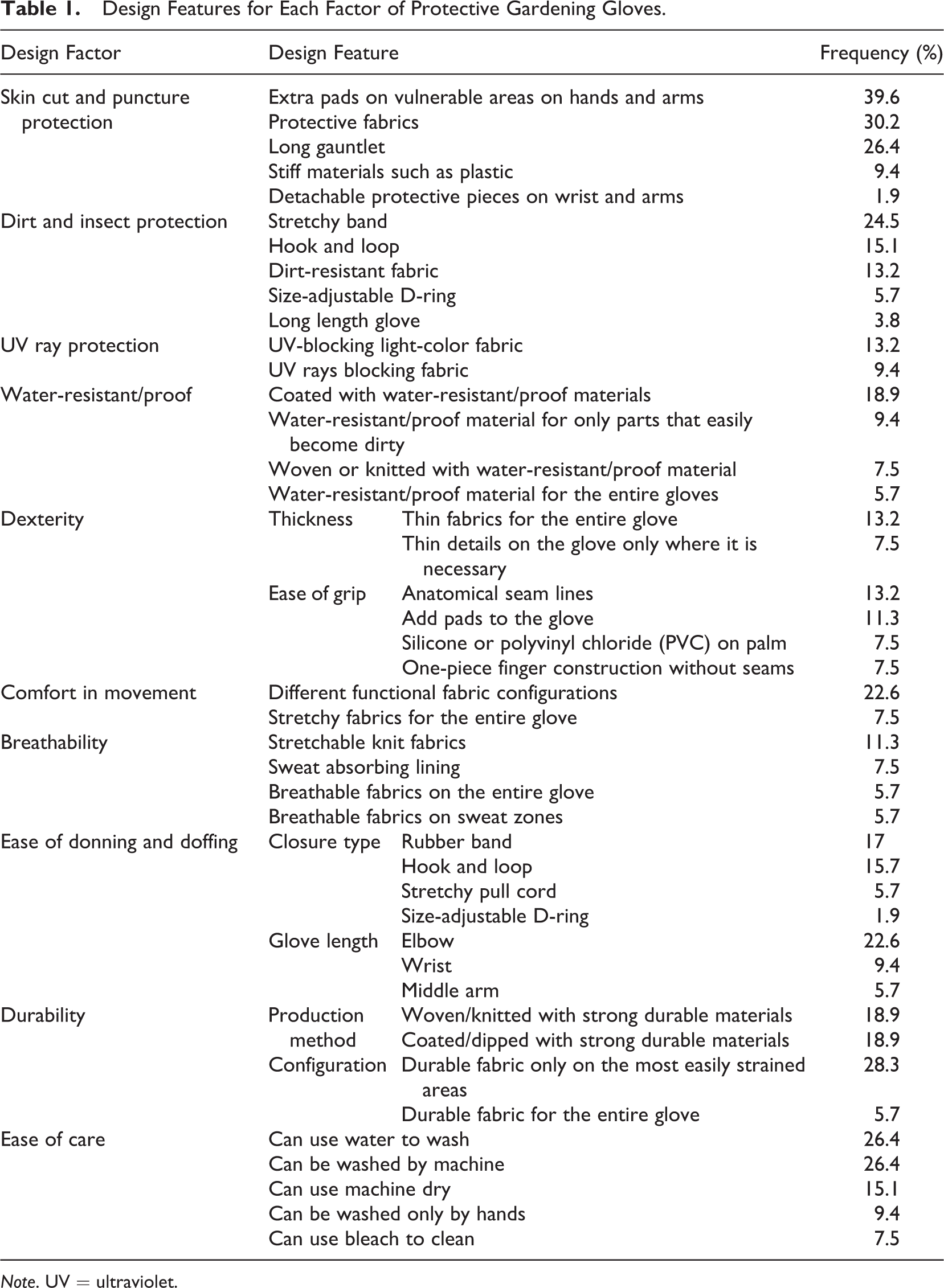
Note. UV = ultraviolet.
After receiving IRB approval, an online survey and a focus group were conducted. The online survey participants were recruited through the public lifelong learning center at a university in the southeastern United States. Participants were sent an invitation e-mail with a link that they could click to start the survey. The online questionnaire included closed- and open-ended questions: (a) closed-ended questions using a Likert-type chart (from 1 = least favorable to 5 = most favorable) asking about their preferences on design features for each design factor and (b) multiple-choice questions asking about necessary use context for these gloves, bruising experiences, possible situations for bruising, and price they were willing to pay, followed by open-ended questions for other options. Principal component analysis with varimax rotation was performed to determine underlying dimensions of the 10 design factors and assess the construct validity. The cumulative percentage of variance explained was 89.92% with factor loadings between .501 and .803, which are an acceptable level (above .50; George & Mallery, 2007). Descriptive statistical analyses were applied to find quantitative data such as mean, standard deviation, and percentages, and open coding for open-ended questions was employed to extract main themes. A series of independent sample t-tests, analysis of variance (ANOVA), and Tukey’s honestly significant difference tests were employed using SPSS (version 23.0) to answer the research questions (Horne & Weinman, 1999; Paterson, Brown, Gsödl, Johnson, & Karmiloff-Smith, 1999).
A focus group was conducted with women over 60. This group was selected because a large percentage of major gardeners are females (54%) over 55 years old (44%; Butterfield, 2009). Moreover, people over 60 have more fragile skin and need protective gloves more than other age categories. In addition, the online survey participants were all in their 50s or younger, so using a focus group allowed additional insight into the needs of older gardeners. Since people in the over 60 age-group may not be familiar with using online surveys or computers, a focus group was used to understand participants’ preferences on design factors and experiences with gardening gloves. Participants were recruited through e-mail invitations to a public lifelong learning center. The focus group was conducted with 13 volunteers and the interviews lasted for about an hour. The recommended number of participants for a focus group is 6–20 (Howard, Hubelbank, & Moore, 1989; Merton, Fiske, & Kendall, 1990). In addition to questions about demographic information, participants were asked the following seven questions: (a) What are the challenges when using gloves? (b) Have you ever gotten skin cuts or bruises and scratches from activities at home or in the garden? If yes, please tell us about your experiences; (c) What kind of activities can cause skin cuts or bruises and scratches in your home or garden? (d) In which situations do you think you need this kind of glove? (e) What are the important aspects that you consider when purchasing gardening gloves? (f) Please tell us anything you want to share about the design and functional aspects of gardening gloves; and (g) How much would you be willing to pay for protective gardening gloves? The interviews were video-recorded and transcribed. The transcribed data were cross-checked among researchers. Key words in each answer were highlighted and coded, and the words were categorized into major themes. The answers were peer reviewed by three researchers who independently coded and analyzed the data. The reliability was analyzed through an intraclass correlation coefficient, which is determined by the total number of dividing agreements through SPSS. A reliability of .959 (p = .000) was found, and a high degree of reliability was established (Koch, 1982; Mouter & Vonk Noordegraaf, 2012). Descriptive statistical analyses were conducted to find information such as mean, median, standard deviation, and percentages.
Results and Discussion
Online Survey Results and Discussion
Sample characteristics
A total of 148 participants responded to the online survey. After incomplete responses were excluded, there were 120 usable responses (81.1%). Participants were 63.3% male and 36.7% female in the age range of 18–57 (M age = 32, SD age = 9.08) and were mostly employed (84%). The differences on preferred design factors and features of protective gardening gloves between two genders were assessed. The questionnaire asked what design factors participants care about when purchasing or using protective gardening gloves. In the online survey, 70.8% of respondents indicated that they have experienced injuries when gardening such as while planting trees, cutting plants and branches, handling prickly plants, and plucking flowers. Other common types of injuries that participants had experienced at home included injuries from moving furniture (61.6%), fixing vehicles (54.5%), home repair (50%), bumping into corners (24.7%), and playing with pets (13.2%). Participants responded that they would also use protective gardening gloves when they are cleaning the house (16.1%), handling chemicals (8.0%), and cooking (5.4%).
The preferred design features for each design factor were identified for the first research question (Research Question 1). There were significant differences among preferences on design features for all design factors (p < .000; Table 2). Designers can apply the preferred design features to satisfy each design factor by (a) making the glove into a long gauntlet style or adding extra pads on vulnerable areas of the hands and arms to protect from cuts and punctures from sharp objects; (b) using hook and loop details or making the gloves with dirt-resistant fabrics to protect the hands and arms from dirt and insects; (c) making the gloves with UV-blocking light-color fabrics for UV ray protection; (d) applying water-resistant/waterproof materials to the entire gloves by coating them or making them with fabrics that are water-resistant/waterproof; (e) using thin details on the glove only where necessary and adding pads, silicone, or PVC on palms for dexterity; (f) using stretchy fabrics for the entire glove for the comfort of movement; (g) applying breathable fabrics on sweat zones or on the entire glove for breathability; (h) making the gloves elbow length or middle arm but adding hook-and-loop closures for ease of donning and doffing; (i) making the gloves out of strong, durable materials and applying these on the most easily strained areas of the gloves; and (j) making the gloves machine washable with water for ease of care. Based on these results, designers can consider detailed information about design features when making decisions in the development process.
Preferred Design Features for Each Factor of Protective Gardening Gloves.

Note. UV = ultraviolet.
*p < .05; **p < .01; ***p < .001.
The differences in preferred design features between male and female participants and among different age-groups were analyzed to answer the second research question (Research Question 2). There were not many differences between male and female groups or among different age-groups. However, males and females showed significant differences on preference for breathable fabrics. Interestingly, more males than females preferred to have the entire glove made of breathable fabrics (t = 2.114, p = .037), possibly because men may sweat and feel heat more than women (Giacomoni, Mammone, & Teri, 2009). Also, different age-groups (m = 3.71, SD = 1.37) showed significant differences in preferences for using one-piece construction without seams. The 50s–60s group preferred minimized seam design features more than other age-groups. This difference may exist because many or thick seam lines can cause bruises during the hard work of gardening, and aging skin is more vulnerable to infection or bruises and heals more slowly (Bartlett & Tortorice, 2015; Danter, 2003; Table 3).
Differences Among Ages and Genders for Preferred Design Factors.
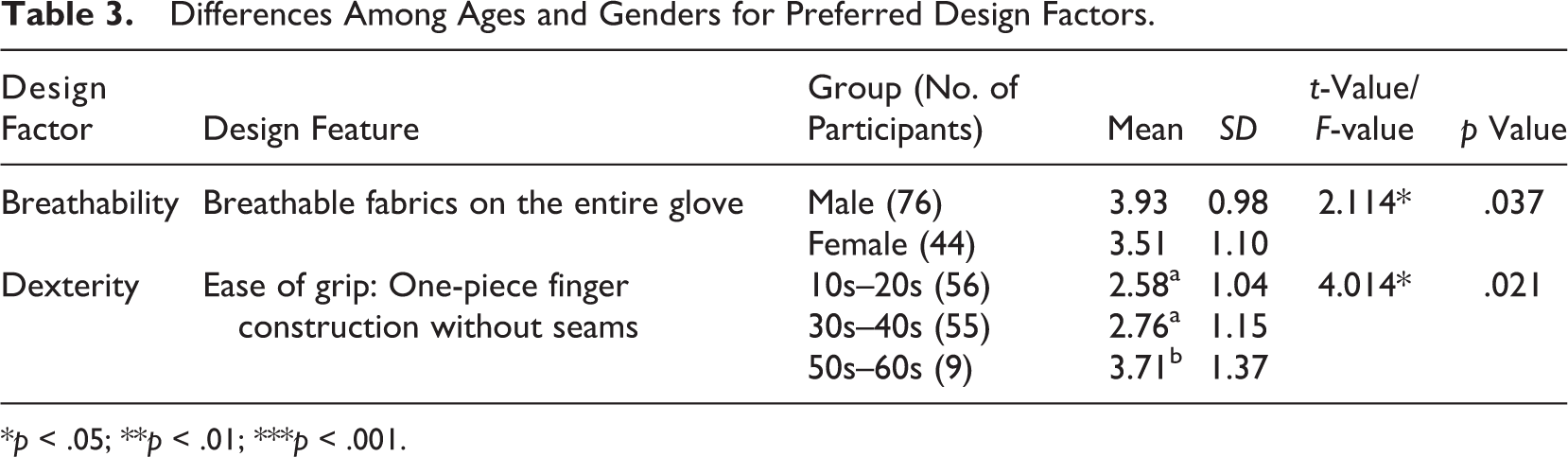
*p < .05; **p < .01; ***p < .001.
In addition, 56.3% of participants were willing to pay US$11–US$20, and 36.6% of participants were willing to pay US$10 for protective gardening gloves. This means that protective gardening gloves need to be reasonably priced.
Focus Group Interview Results and Discussion
Sample characteristics
Thirteen female volunteers (M age = 70, SD age = 6.46, range = 60–83) participated in the focus group. About 70% of them gardened at least once a week. Their glove sizes were small (54%), medium (39%), or both small and medium (8%). When gardening, they had problems with gloves that did not adequately protect their hands (77%). Participants had been bruised or scratched by handling thorny plants (31%); picking up or carrying plants such as sticks, limbs, or logs (15%); touching poisonous plants (8%); bumping into things when walking (8%); or being in contact with insects such as fire ants or wasps (15%). The names mentioned hereafter are not the actual names of the focus group members. Heather said about plant thorns that “we do need some protection here as you can see … thorns and everything all the time …” and Nancy said, “I use all kinds of things to try and do pruning and I always get scratched and also attacked.”
Durability of gloves was a major issue (23%). For example, one participant said that she always had left-handed gloves left over because the right-handed gloves wore out more easily. Another said that the fingers wear out very quickly on most gardening gloves. When asked for what other activities they would use protective gardening gloves, they suggested beekeeping (8%), heavy and deep cleaning (31%), protecting patients (23%), heavy work such as washing boats or using cleaning chemicals (23%), bathing animals (8%), general household maintenance (8%), and farming (8%). Since protective gardening gloves could be used in many different situations, designers should consider versatility in function. Daisy talked about protecting patients, saying that “half our patients either take aspirin, Plavix, or Coumadin … but love to get out in the yard” and Sophie said, about protecting patients, that “the home health and people who are taking the blood thinners” must be considered.
Purchase considerations of gloves
When they purchased gardening gloves, participants said that the most important aspects they considered were skin cut and puncture protection (85%), insect protection (69%), durability (54%), dexterity (38%), ease of care (31%), and water resistance/waterproofing (23%). All of these aspects were the design factors identified from the literature review and the survey. However, participants (15%) in the focus group mentioned an additional aspect of the gloves being lightweight. While gardening, heavy gloves can cause the wearer to feel more fatigue and increase potential for hand and wrist injuries. The weight of gloves can affect the psychological discrimination of object weights (Shih & Wang, 1996), affecting weight discrimination when doing things like lifting shovels, pots, and heavy plants. Also, heavy gloves may discourage users from frequent or long-term use because of the increased physical stress and decreased dexterity (Gavurin & Pockell, 1963). Existing gloves in the market use lightweight fabrics for the entire glove as well as lightweight fasteners and details. More than 30% of participants wanted to have protective pads on the hand side instead of the palm side. Color is one of the major design elements of clothing (Baldt, 1916; McJimsey, 1963; Rasband, 1996), and more than 50% of participants pointed out the importance of color for thermal comfort (15%) and ease of finding them when gardening (38%). Glove colors may affect the visibility of gloves in the grass or bushes since gloves are easy to lose in the garden (Tilley, 2006), so instead of brown or green, participants suggested fluorescent colors such as orange or hot pink. Dark colors are not only harder to find but will also absorb more UV rays and get hot more easily (Zhou, Reddy, & Yang, 2005). Catherine said about UV ray protection and thermal comfort, “Dark colors will get hot being in the sun … make it a lighter color” and Kristy talked about how some colors have poor visibility, so consider making gloves “light green, so when we drop it on the ground you can find it.”
Participants were asked to suggest any other design features for gardening gloves besides what had been discussed, and they suggested reinforced fingertips (62%), adjustable details on the top (38%), flexibility (38%), stretchy fabrics (23%), holes for breathability (15%), and a gusset on arm areas for ease of donning and doffing (8%). The most preferred price ranges for these gloves were US$20–US$30 (38%) and US$30–US$40 (15%); these price ranges were a bit higher than those suggested by participants in the online survey.
Conclusion
This research investigated preferences regarding design features for protective gardening gloves through mixed methods. This study provides the important design factors and design features that clothing designers and manufactures need to consider when developing protective gardening gloves, which may make the gardening lifestyle healthier by protecting gardeners from hazardous situations. Many gardeners experienced injuries while gardening, which is similar to the reports of Licher (2016) and the U.S. Consumer Product Safety Commission (1999), and were willing to purchase protective gardening gloves. In addition, since gardening is becoming a popular home-based activity, and there is potential for the market to increase, understanding people’s design preferences while satisfying required functions is the key to success in the market. There was no research on the development of protective gardening gloves. Thus, the results of this study can be used by apparel professionals when developing protective gardening gloves and considering key design factors and preferred design features.
The designer would need to consider how to design protective gardening gloves by satisfying the key design factors of skin cut and puncture protection, dirt and insect protection, UV ray protection, water resistance/waterproofness, dexterity, comfort of movement, breathability, ease of donning and doffing, durability, and ease of care. Among various design features, designers can apply the identified preferred design features in this study as guidelines to satisfy each design factor, so that designs can be more easily accepted by consumers. When targeting male gardeners, protective gloves made entirely of breathable fabrics will be more important than when developing gloves for female gardeners. The findings confirm Domina, An, and Kinnicutt’s (2015) research on the different sweating tendencies between genders while wearing clothing. Interestingly, when targeting consumers 50 years of age or older, making gloves with one-piece finger construction and without seams for better dexterity will be more important than it will be for younger consumers. This finding can be related to the results of Naveteur, Dupuy, Gabrielli, and Michael’s (2015) study, where participants in their 20s had more sensitive fingers than participants in their 50s or 60s. Designers need to be mindful of design features in order to improve dexterity for older consumers. Moreover, there are possibilities for gloves to be used to protect hands and arms in a variety of other situations—thus, fashion companies can think of extending to other markets. Also, since participants have shown willingness to pay reasonable prices, designers and manufacturers must consider how to make high-functioning gloves that are acceptably priced.
This study was conducted with only U.S. gardeners, and the focus group was conducted with only female gardeners. It will be meaningful to investigate gardeners in other countries and to compare the differences among different target consumers of both genders. The online product analysis can also be extended to user tests with real products. This will provide further insights for developing protective gardening gloves. The findings of this study are limited to gardening gloves. Thus, for the full protection of gardeners, it will be beneficial to study gardening clothes.
Footnotes
Acknowledgment
We thank Mr. T. J. Potts and Mrs. Jane Potts for their contributions for this project.
Declaration of Conflicting Interests
The author(s) declared no potential conflicts of interest with respect to the research, authorship, and/or publication of this article.
Funding
The author(s) disclosed receipt of the following financial support for the research, authorship, and/or publication of this article: This research was funded by PMT Publishing.