




Abstract
Prison officers have a demanding job and are at risk of burnout. The literature indicates that workplace variables are related to burnout, but there are gaps in the literature that need to be addressed, including the need for additional research on the association of organizational justice with officer burnout. Organizational justice theory holds that employees expect to be treated fairly by their organizations and that psychological strain occurs if they are not, and this strain increases the chances of job burnout. The current study examined how distributive and procedural justice views, which are dimensions of organizational justice, were related to the emotional exhaustion burnout of Nigerian prison officers. Data were collected from 120 officers stationed at medium-security prison in southeast Nigeria. Both procedural justice and distributive justice were significantly associated with lower emotional exhaustion burnout. The current findings support the postulation that workplace fairness is associated with lower levels of job burnout.
Officers are an essential resource for prisons across the globe; they perform numerous essential tasks for prisons to operate. Not only do officers affect the operation of prisons, but the prison work environment affects officers (Garland et al., 2014; Lambert et al., 2023). Working in a prison is a unique and demanding occupation, and officer burnout can be possibility (Choi et al., 2020; Lambert, Keena, et al., 2022). In fact, Keinan and Malach-Pines (2007) reported that prison officers have higher levels of burnout than the general population, and even higher than police officers. Job burnout, an undesirable outcome for both the officer and the prison, can result in increased physical and mental health problems (Belcastro et al., 1982), greater absenteeism (Lambert et al., 2015), decreased work performance (Maslach et al., 2001), higher turnover intent/turnover (Carlson & Thomas, 2006; Lambert et al., 2015), higher Post-Traumatic Stress Disorder (PTSD) (Boudoukha et al., 2013), and reduced life satisfaction (Lambert et al., 2015). Due to the negative outcomes indicated above, research is needed on the variables that are associated with the emotional exhaustion dimension of job burnout among correctional staff. The current study examined how two dimensions of organizational justice were associated with the emotional exhaustion dimension of job burnout among officers at a prison in southeast Nigeria.
Organizational justice refers to worker perceptions that the organization treats them in a fair and just manner (Colquitt et al., 2001; Greenberg, 1990). Different dimensions of organizational justice exist, but distributive justice (perceived fairness of organizational outcomes) and procedural justice (perceived fairness of processes/procedures to reach outcome) are its two main dimensions (Greenberg, 1990; Lambert, 2003). Job burnout refers to psychological strain that manifests itself in the burnout dimensions of emotional exhaustion, depersonalization, and a reduced sense of work accomplishment (Garland, 2004; Garland et al., 2014; Lambert et al., 2013; Maslach & Jackson, 1981). The current study focuses on the emotional exhaustion dimension of job burnout.
New research is needed. The study by Lambert, Hogan, Jiang, et al. (2010) was the only published research located that focused on how both procedural justice and distributive justice were related to emotional exhaustion burnout among prison staff, and this study involved staff at a U.S. prison. New research in different settings is needed. As noted by Lindsay and Ehrenberg (1993), replication research not only confirms (or contradicts) past findings, but it allows for a more thorough understanding of the conditions when relationships between variables vary across different settings. The study by Lambert, Hogan, Jiang, et al. (2010) involved staff at a U.S. correctional facility. Prisons are found all over the world, and the associations between justice variables and job burnout could vary across nations and cultures; conversely, the associations could be universal. The question of whether the associations are universal or contextual cannot be answered without studies involving staff working in correctional facilities in different nations. Jowell (1998) has argued that there is a need for research in different nations because it provides information about whether and how relationships vary in different settings. While the current study cannot conclusively answer that question, it does add to the literature about whether the effects of procedural and distributive justice are universal or contextual.
Nigeria was chosen because it is a populous, growing, and important African nation. Nigeria exerts a significant influence over other African nations due to its economic resources and population size (Bratton, 2004; Elechi et al., 2020). It has a population of approximately 231 million, making it the sixth most populous nation in the world. Almost one out of every five people living in Africa is a Nigerian citizen (Elechi et al., 2018, 2020; World Factbook, 2023).
Literature Review
Organizational Justice
The concept of organizational justice stems from organizational justice theory (Colquitt & Greenberg, 2005), which holds that workers expect to be treated fairly by their employing organization (Lambert, 2003). Being treated fairly tends to result in positive psychological feelings that are positively related to beneficial work outcomes, such as job satisfaction and organizational commitment (Barsky et al., 2011; Cohen-Charash & Spector, 2001). Low perceptions of fair treatment tend to result in psychological strain, and strain is associated with counterproductive outcomes, such as turnover and the emotional exhaustion dimension of job burnout (Cohen-Charash & Spector, 2001; Liljegren & Ekberg, 2009).
Organizational justice is a multidimensional construct, with distributive justice and procedural justice being its two main dimensions (Colquitt et al., 2001; Greenberg, 1990; Lambert et al., 2023). Distributive justice was the first dimension of organizational justice to be theorized in the literature (Greenberg, 1990). Distributive justice refers to perceptions of fairness in organizational outcomes, such as pay, benefits, promotions, assignments, evaluations, and discipline (Colquitt et al., 2001; Greenberg, 1990; Lambert et al., 2020). Later, procedural justice was proposed to be a dimension of organizational justice (Greenberg, 1990). Procedural justice refers to perceptions of fairness in the processes and procedures that the organization uses to determine outcomes (Colquitt et al., 2001; Greenberg, 1990; Lambert et al., 2023). Procedures and processes need to be fair (Greenberg, 1990; Lambert, 2003) and are at least as important as the outcomes. For example, Landy et al. (1980) found that the perceived fairness of employee evaluation procedures was important for employees, regardless of whether their performance appraisals were negative or positive. Lambert (2003) and Lambert et al. (2007) found that procedural justice was a stronger predictor of job satisfaction than distributive justice. In sum, distributive justice is concerned with the ends in terms of salient employee outcomes, while procedural justice is concerned with the means the organization uses to reach those ends (Greenberg, 1990; Lambert, 2003).
While procedural justice and distributive justice were first two proposed dimensions of organizational justice, other dimensions have also been theorized (Colquitt & Greenberg, 2005). Bies and Moag (1986) postulated the dimension of interactional justice, which deals with the organization informing and explaining decisions to workers and treating employees with dignity and respect. Colquitt et al. (2001) later contended that interactional justice should be separated into the dimensions of informational justice and interpersonal justice. Interpersonal justice refers to the perceptions that representatives of the organizations (e.g., supervisors, managers, and administrators) treat workers with respect and dignity (Colquitt et al., 2001; Colquitt & Greenberg, 2005). Informational justice focuses on the perceptions that the processes, procedures, decisions, and outcomes are explained to workers (Colquitt et al., 2001; Colquitt & Greenberg, 2005). 1 As a replication study of Lambert, Hogan, Jiang, et al. (2010) among U.S. correctional staff, the current study measured procedural and distributive justice, but not interactional, interpersonal, or informational justice, as these organizational justice dimensions were not measured in their study.
Job Burnout
In 1974, Freudenberger used the term job burnout to describe employees who were psychologically worn out and exhausted from their jobs. In 1978, Maslach postulated that job burnout occurs when, over time, a worker has a reduced level of caring for clients and coworkers, which results in reduced quality of work. Cherniss (1980) contended that burnout was emotional strain that resulted from an imbalance of work demands. In 1981, Maslach and Jackson further developed job burnout to include emotional exhaustion and cynicism of those providing services to other human beings. Maslach and Jackson (1981) theorized that job burnout has three dimensions: emotional exhaustion, depersonalization, and a reduced sense of being effective at work. Emotional exhaustion is defined as feeling emotionally drained and fatigued from the job (Maslach & Jackson, 1981). Depersonalization refers to treating clients and fellow employees in an impersonal manner (Maslach & Jackson, 1981). A reduced sense of work accomplishment focuses on feeling ineffective at work (Maslach & Jackson, 1981). Gerstein et al. (1987), Garland (2004), and Liu et al. (2022) contended that, of the three burnout dimensions, emotional exhaustion was the most important dimension of job burnout, and it was also the job burnout dimension measured by Lambert, Hogan, Jiang, et al. (2010), therefore, the current study measured the emotional exhaustion dimension of job burnout.
There is a growing body of research focusing on job burnout of correctional officers (Lambert, Hogan, Cheeseman Dial, et al., 2012). The role stressors of ambiguity (Choi et al., 2020; Lambert et al., 2009), role conflict (Drory & Shamir, 1988; Whitehead, 1989), and role overload (Choi et al., 2020; Lambert et al., 2009) have been associated with higher levels of correctional staff job burnout. Furthermore, the work stressors of job stress (Garner et al., 2007; Griffin et al., 2010), coworker harassment (Savicki et al., 2003), work–family conflict (Lambert & Hogan, 2010; Lambert, Hogan, & Altheimer, 2010; Lambert, Keena, et al., 2022; Lambert, Lanterman, et al., 2022), and the perceived dangerousness of the job (Garland, 2004; Lambert & Hogan, 2010) have also been linked with higher levels of job burnout among correctional staff. Conversely, the job characteristics of job autonomy (Griffin et al., 2012; Lambert, Hogan, Cheeseman Dial, et al., 2012), job feedback (Drory & Shamir, 1988; Lambert, Hogan, Cheeseman Dial, et al., 2012), job variety (Griffin et al., 2012), and supervision (Griffin et al., 2012) were related to lower levels of burnout for prison staff. The organizational structure variables of input into decision-making (Lambert, Hogan, & Jiang, 2010; Neveu, 2007) and instrumental communication (Lambert, Hogan, & Jiang, 2010) were also connected with lower correctional staff burnout. In addition, a sense of security (Isenhardt et al., 2019; Isenhardt & Hostettler, 2020), social support (Garland, 2004; Klinoff et al., 2018; Lambert, Altheimer, & Hogan, 2010; Neveu, 2007), trust in management (Lambert, Hogan, Barton-Bellessa, & Jiang, 2012), and trust in supervisors (Lambert, Hogan, Barton-Bellessa, & Jiang, 2012) have been observed to be associated with lower burnout among correctional staff.
Among U.S. correctional staff at a private prison, both distributive justice and procedural justice had significant negative associations with burnout, with procedural justice having twice the effect size of distributive justice (Lambert, Hogan, Jiang, et al., 2010). Among English correctional staff, distributive justice was associated with lower emotional exhaustion burnout; however, no measure of procedural justice was included in the analysis (Clements & Kinman, 2021).
While there is a growing body of research on the possible antecedents of correctional staff job burnout, additional studies are needed. Not all workplace variables have been fully examined. Only a few studies have examined the connection of organizational justice with the emotional exhaustion dimension of job burnout (Clements & Kinman, 2021; Lambert, Hogan, Jiang, et al., 2010). Lambert, Hogan, Jiang, et al. (2010) examined how both distributive justice and procedural justice were linked to emotional exhaustion among staff at a private U.S. prison. There is a need to study how distributive justice and procedural justice relate to the emotional exhaustion dimension of job burnout of correctional officers in other prisons, including in many nations, including African nations. This study of Nigerian correctional staff was, therefore, undertaken.
Nigerian Correctional Service
To place the current study and its findings into perspective, a brief overview of Nigerian prisons is provided. The prison system in Nigeria traces its roots to British colonization when prisons were used to control the indigenous population. Prior to colonization, the area known today as Nigeria used local control to deal with the harm caused by offenders and, for the vast majority of offenders, returned the offender back to society (Elechi et al., 2018). After Nigeria became independent from Great Britain, the use of prisons continued (Elechi et al., 2020). Today, Nigeria is a federal republic comprised of 36 states and Abuja, the federal capital territory (Elechi et al., 2018). The Nigerian Correctional Service, formerly known as Nigeria Prisons Service, is a federal agency overseen by the Nigerian Ministry of Interior. In November of 2023, there were approximately 80,000 persons held in 240 Nigerian correctional facilities (World Prison Brief, 2023). Unlike the United States and many other Western nations, prisons in Nigeria hold both pretrial detainees and convicted persons (Elechi et al., 2020; World Prison Brief, 2023). Approximately, 68% of those being held in Nigerian correctional facilities are pretrial detainees, and the Nigerian prison system is approximately 137% over capacity (World Prison Brief, 2023). The incarceration rate of 36 per 100,000 in 2020 is significantly below the U.S. rate of 531 per 100,000 (World Prison Brief, 2023).
Overall, many Nigerian prisons are in poor condition (Elechi et al., 2018). Overcrowding of Nigerian correctional facilities has led to low standard of living conditions and a shortage of supplies and services for inmates (Lambert, Otu, et al., 2022). As noted by Oyeyipo et al. (2021), overcrowding in prisons is a significant challenge for the Nigerian Correctional Service, and overcrowding has contributed to a lack of food, unclean living environments, and insufficient supplies for inmates. Even though prisons are required to hold pretrial detainees, Nigerian prisons do not receive direct funding for these detainees and are only funded for convicted persons (Saleh-Hanna, 2008). In addition, there are staffing shortages at many Nigerian prisons (Elechi et al., 2020). Reducing the emotional exhaustion dimension of job burnout of Nigerian prison officers is important. While overcrowding and lack of funding are often out of the direct control of Nigerian prison administrators, prison officer’s distributive and procedural views generally can be influenced by correctional administrators. As such, examining how distributive justice and procedural justice are associated with the emotional exhaustion dimension of job burnout of Nigerian prison officers is essential.
Methods
Focus of Current Study
Organizational justice goes to the heart of organizational legitimacy (Colquitt & Greenberg, 2005). Feeling that the employing organization is fair in terms of outcomes and procedures/processes for employees is likely to result in positive psychological feelings that can help buffer the more trying aspects of the job, which, in turn, can reduce the level of the emotional exhaustion dimension of job burnout from a demanding occupation (i.e., distributive and procedural justice can buffer job demands; Demerouti et al., 2001). Conversely, Nigerian correctional staff may feel greater psychological strain if they perceive distributive justice and/or procedural justice are low or missing (Lambert, Hogan, Jiang, et al., 2010). Skarlicki and Folger (1997) contended that “if organizational decisions and managerial actions are deemed unfair or unjust, the affected employees experience feelings of anger, outrage, and resentment” (p. 434). Feeling that organizational justice is low or missing is likely to result in greater levels of the emotional exhaustion dimension of job burnout.
Participants
The study had human subjects’ approval, met ethical standards, and had informed consent of the participants. Staff at a medium-security prison in southeast Nigeria were studied using a survey that was piloted tested among several Nigerian prison supervisors who did not suggest any changes. The prison held about 1,000 persons, including those awaiting trial and those convicted, and employed 246 full-time staff. Using employment numbers assigned to staff, a simple random sample of 145 officers was generated. To meet power analysis in terms of medium- to large-sized associations for linear regression (Statistics Kingdom, 2024), a total of 145 officers were surveyed to expect at least 100 completed surveys. In addition, a general rule of thumb is that it is preferable to have 20 cases per independent variable and no fewer than 10 cases. In the current study, there were six independent variables, suggesting between 60 and 120 cases would meet power analysis requirements. Also, Green’s (1991) rule of thumb with six independent variables suggests 98 cases for medium- to large-sized associations in multivariate regression to test the entire regression model and 120 cases to test the regression coefficients.
As English is the official language for Nigerian government agencies, the survey and accompanying materials were presented in English. The selected officers were informed of the purpose of the study and that participation was voluntary. Furthermore, officers were told that they could skip any survey item and that there was no reward or punishment for agreeing or declining to be part of the study. Finally, officers were informed that all responses would be anonymous, and the data would be kept confidential. The officers completed the survey on their own time and in their own chosen location. Of the 145 distributed packets, 131 completed or partially completed surveys were returned. Only completed surveys were used, which resulted in a total of 120 participants, which is a response rate of 83% (based on the 145 survey packets distributed).
The median age of the participants was 38 years and ranged from 23 to 60 years of age. Approximately, 68% of the participants indicated they were men. About 50% of the participants had a college degree. The median tenure in the current position was 6 years and ranged from 0 to 28 years. Based on information from the human resources office, the participants were similar to the overall staff complement in terms of age, gender, tenure, and educational level.
Dependent Variable
Based on the items from Griffin et al.’s (2010) study, the emotional exhaustion dimension of burnout was measured using the following four items: (a) I feel that I am emotionally drained from my job; (b) Working with others is an emotional strain for me; (c) I emotionally dread going to work; and (d) I am emotionally exhausted at the end of the day from my job. The items were answered using a 6-point Likert-type scale of 1 = strongly disagree, 2 = disagree, 3 = somewhat disagree, 4 = somewhat agree, 5 = agree, and 6 = strongly agree. The Cronbach’s alpha for the items was .92, and an index was created by summing the responses to these items.
Independent Variables
The procedural and distributive justice measures were adapted from Lambert et al.’s (2007) study and measured using the 5-point scale of 1 = very unfair, 2 = unfair, 3 = somewhat fair, 4 = fair, and 5 = very fair. The three procedural justice items were: (a) How fair is the promotion process here; (b) How fair of an opportunity do you have for input into organizational decision-making at this prison; and (c) How fair is the process of the evaluation of your job performance at this prison? The items had a Cronbach’s alpha of .87, and the item responses were added together to form a summed index measuring procedural justice views. The three items for distributive justice were: (a) How fair has the prison been in rewarding you when you consider the amount of effort that you have put forth; (b) How fair has the prison been in rewarding you when you consider the responsibilities that you have at work; and (c) How fair has the prison been in rewarding you when you consider the work you have done well? The responses were summed together, and the Cronbach’s alpha value for the index measuring distributive justice views was .90. Finally, the personal characteristics of age, gender, educational level, and tenure in the current position were included as control variables. See Table 1 for how these variables were coded.
Descriptive Statistics of Study Variables.
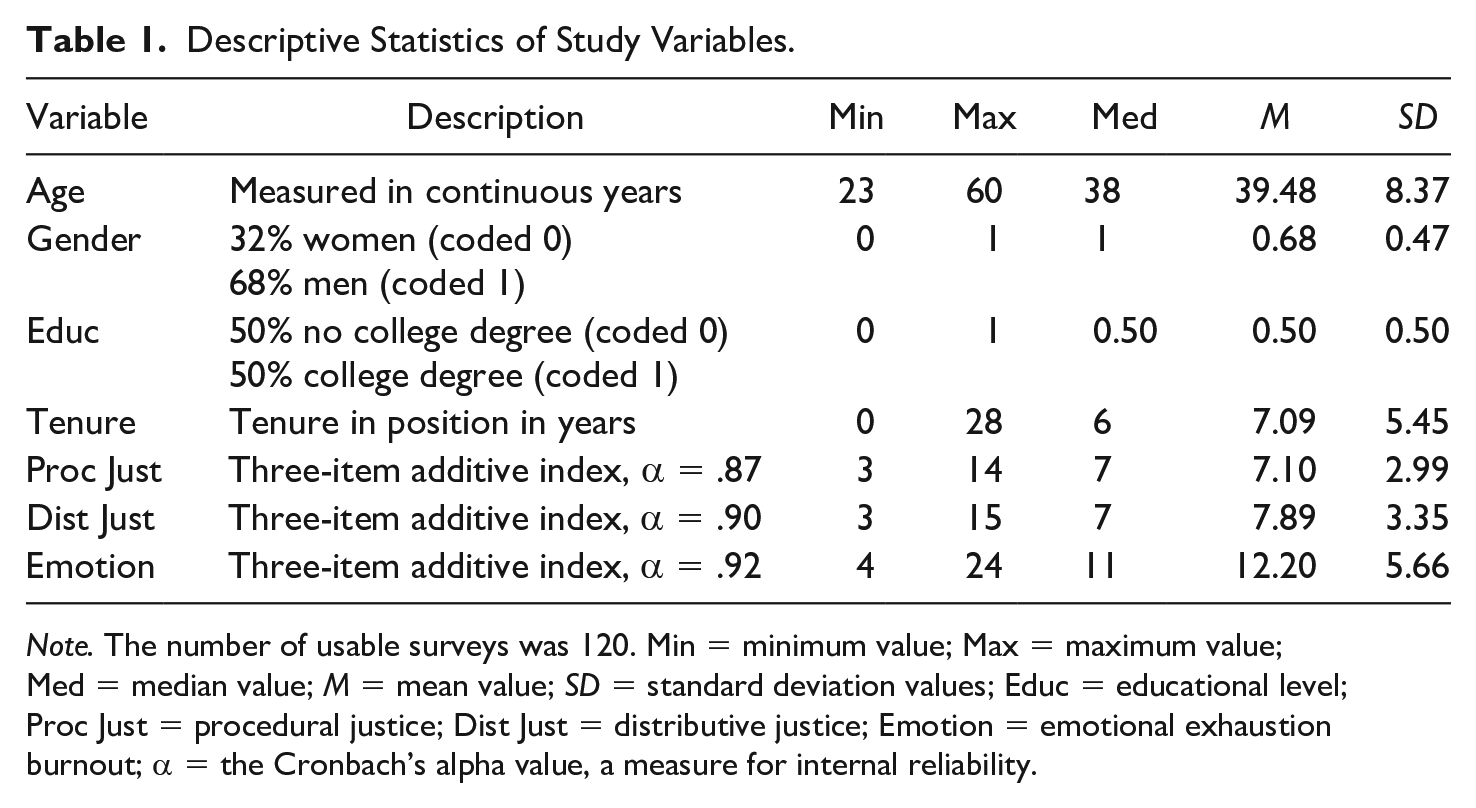
Note. The number of usable surveys was 120. Min = minimum value; Max = maximum value; Med = median value; M = mean value; SD = standard deviation values; Educ = educational level; Proc Just = procedural justice; Dist Just = distributive justice; Emotion = emotional exhaustion burnout; α = the Cronbach’s alpha value, a measure for internal reliability.
Results
The descriptive statistics are presented in Table 1. There was significant variation in the dependent and independent variables (i.e., none were constants). The variables conformed approximately to a normal distribution based on statistical tests of skewness and kurtosis. The median and mean values of the variables were similar to one another, also suggesting a normal distribution. All the variables measuring latent concepts (i.e., justice and burnout indexes) had Cronbach’s alpha value of .87 or higher, indicating good internal consistency (i.e., reliability; Cortina, 1993).
A correlation matrix is presented in Table 2 and shows the bivariate associations of the independent variables with the dependent variable. Age, gender, and educational level had nonsignificant correlations with emotional exhaustion burnout. Tenure had a negative statistically significant correlation, which meant the longer a person had been in the position, the less emotional exhaustion they reported. Both forms of justice also had negative correlations, which meant that increases in distributive justice views or procedural justice views were associated with lower levels of emotional exhaustion.
Study Variable Correlation Matrix.

Note. Educ Level = educational level; Proc Justice = procedural justice; Dist Justice = distributive justice; Emotion = emotional exhaustion burnout.
p ≤ .05. **p ≤ .01.
An ordinary least squares regression equation was estimated with emotional exhaustion dimension of job burnout as the dependent variable and the personal characteristics and the two organizational justice indexes as the independent variables. The results are reported in Table 3. Multicollinearity is seen as a problem when the variance inflation factor (VIF) scores exceed 5 (Tabachnick & Fidell, 2013). As indicated in Table 3, the highest VIF score was 1.64. Thus, multicollinearity was not deemed to be a problem. The issues of outliers, influential cases, normality, linearity and homoscedasticity of residuals, and independence of errors (all of which can affect the regression results) were also tested (Berry, 1993; Tabachnick & Fidell, 2013).
Regression Results for Dependent Variable Emotional Exhaustion Burnout.
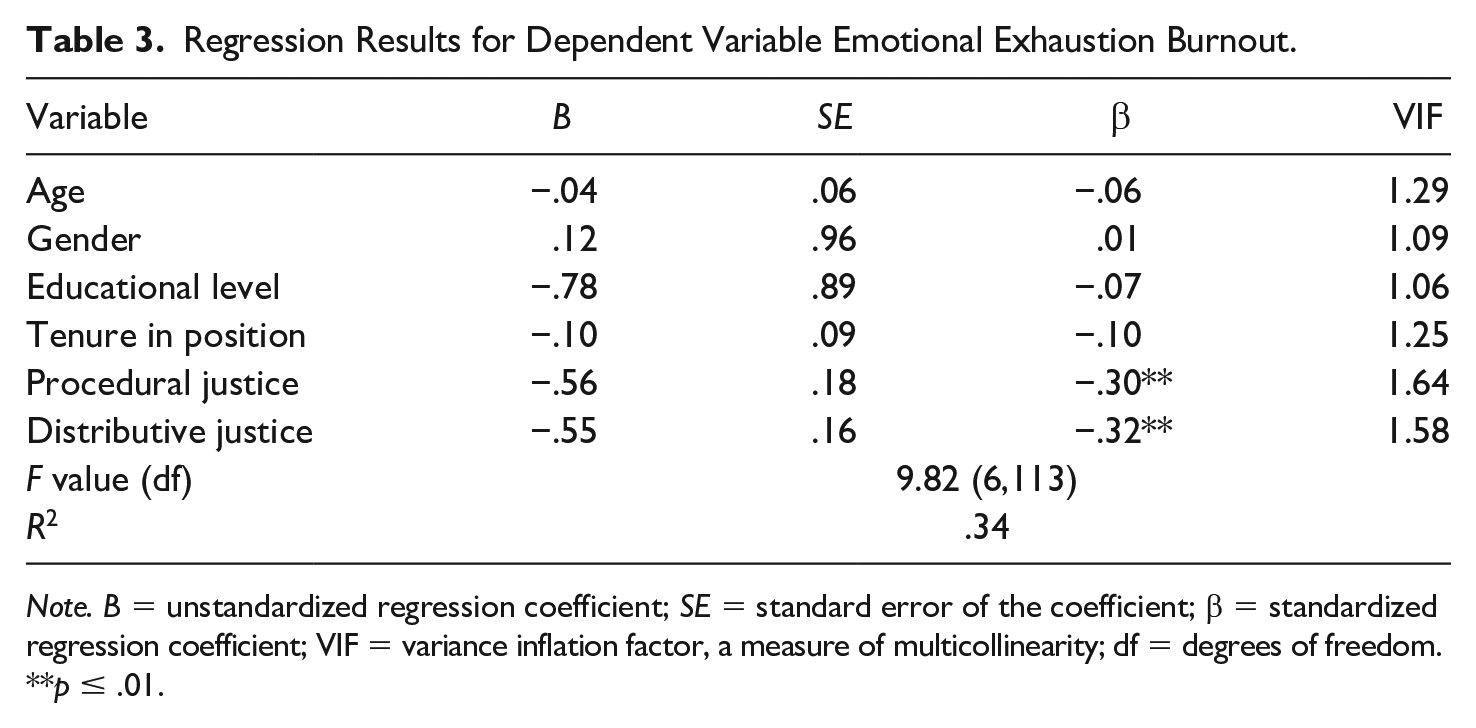
Note. B = unstandardized regression coefficient; SE = standard error of the coefficient; β = standardized regression coefficient; VIF = variance inflation factor, a measure of multicollinearity; df = degrees of freedom.
p ≤ .01.
The R2 value was .34, which meant that the independent variables explained about 34% of the observed variance in emotional exhaustion. None of the personal characteristics had significant associations with emotional exhaustion. Both procedural justice and distributive justice had significant negative relationships with emotional exhaustion, which meant that increases in either form of organizational justice were associated with lower emotional exhaustion.
Discussion
The current study supports organizational justice theory, which holds that views of organizational justice are negatively associated with counterproductive work outcomes (Colquitt & Greenberg, 2005). The results indicate that higher levels of organizational justice views among the studied Nigerian prison staff were associated with lower levels of the emotional exhaustion dimension of job burnout, a counterproductive work outcome. Not only were distributive justice and procedural justice significant negative predictors of the emotional dimension of job burnout, but both had similar-sized associations with burnout. This indicates procedural justice and distributive justice are likely important to the officers at the studied Nigerian prison. It is likely that feeling treated fairly in terms of both procedures and outcomes results in positive psychological feelings among Nigerian prison officers, which, in turn, probably buffers against the demands of working in a prison. Conversely, feeling being treated unfairly likely results in psychological strain, resulting in feelings of frustration and resentment, increasing the level of emotional exhaustion from the job among Nigerian prison officers. It is important to note that the psychological state of mind resulting from distributive and procedural justice was not directly tested in the current study and cannot be from the current data set. Future research should examine how and why justice views are linked to the emotional exhaustion dimension of job burnout.
The findings in the current study involving Nigerian prison officers are similar to that reported by Lambert, Hogan, Jiang, et al.’s (2010) study that also found a negative association with the emotional exhaustion dimension of job burnout among staff at a private U.S. prison. While not including a measure of procedural justice, Clements and Kinman (2021) reported that views of distributive justice were negatively related to the emotional exhaustion dimension of job burnout among English prison officers. The research by Clements and Kinman (2021) and Lambert, Hogan, Jiang, et al. (2010) indicates that organizational justice views are negatively related to the emotional exhaustion dimension of job burnout of correctional staff. Unsurprisingly, correctional staff across different correctional facilities likely desire fair procedures and outcomes. The limited research is not sufficient to make a definitive conclusion that distributive justice and procedural justice are universally negatively associated with the emotional exhaustion dimension of job burnout with correctional staff across different nations. More studies involving correctional staff in different nations are needed to provide sufficient evidence to determine whether the relationship of procedural and distributive justice with the emotional exhaustion dimension of job burnout is universal or is contextual, varying across correctional institutions in different nations.
Practical Implications
Assuming the findings of the current study are replicated in future research involving prison staff in other nations, correctional administrators should be aware of procedural and distributive justice and their probable negative relationship with the emotional exhaustion dimension of job burnout, and administrators may wish to prioritize enhancing justice views. One possible approach to enhancing perceptions of organizational justice may be to ask staff about their views of procedural and distributive justice as well as to inquire about changes they suggest (Lambert, 2003). Among U.S. prison staff, seeking input was associated with higher procedural and distributive justice views (Lambert et al., 2021, 2023). Supervisors and managers should be made aware of organizational justice and possibly given direction on how to engage in fair procedures and outcomes for staff (Lambert et al., 2023). Procedures and decisions should be explained to officers, as well as answering their questions, as instrumental communication was a significant positive predictor of both forms of organizational justice among U.S. correctional staff (Lambert et al., 2021). Transparent decisions and procedures have been linked to improved justice views (May et al., 2020). Favoritism should be avoided, as it has been reported to lower justice views (Lambert, 2003). Another possible recommendation is to evaluate and reward supervisors and managers for efforts to enhance justice views of prison staff. These are just recommendations based on the literature of how to raise distributive and procedural justice views. Additional research is needed to determine whether distributive and procedural justice views universally reduce the emotional exhaustion dimension of job burnout for prison officers or are contextual, found in some prisons and nations but not others.
Limitations and Recommended Future Research
As with many studies, the current study had shortcomings. This was a single study of staff at a single prison in southeast Nigeria. Additional research is needed to replicate the results and to determine whether the findings are universal or contextual, varying across different correctional facilities across nations. About 34% of the observed variance of the emotional exhaustion dimension of job burnout variable were explained in the multivariate analysis. This means about two-thirds of the variance was accounted for by other variables. Future studies need to explore what other variables are related to the emotional exhaustion dimension of job burnout. While the number of participants met the power analysis requirement for this study in terms of number of cases needed for multivariate regression analysis, it did not allow for subgroup analyses to determine whether organizational justice variables affected the emotional exhaustion dimension of job burnout differently for female and male staff. Future research should increase the number of participants so that subgroup analyses can be done. Another limitation was that only procedural justice and distributive justice were included in the current study. This was done because these were the dimensions of organizational justice measured by Lambert, Hogan, Jiang, et al.’s (2010) study. Future research should examine how interactional justice, interpersonal justice, and informational justice are related to the emotional exhaustion dimension of job burnout.
Another shortcoming of this study was that it used a cross-sectional design. While there is theoretical support for the ordering of the causal process, the data cannot be used to determine causality. To demonstrate causality empirically, a longitudinal study is needed. In the current study, the procedural and distributive justice items were answered using five response options, with two “unfair” options and three “fair” options. Future research should explore whether the results change if a balanced response option is used. Future studies should also examine how to best improve the procedural and distributive justice views of prison officers. In addition, new research should explore how the emotional exhaustion dimension of job burnout is linked to other outcomes, such as job performance, workplace deviance, absenteeism, turnover, organizational citizenship behaviors (going what is expected at work), and life satisfaction. As noted earlier, Maslach and Jackson (1981) contended that in addition to emotional exhaustion, the other dimensions of job burnout are depersonalization and a reduced sense of a reduced sense of being effective at work. New studies should explore how procedural and distributive justice views are related to depersonalization dimension of job burnout and the reduced sense of work effectiveness dimension of job burnout among prison officers. Finally, research is needed on the most effective and efficient interventions to help officers suffering from the emotional exhaustion dimension of job burnout. It is clear that more research is needed.
Conclusion
Emotional exhaustion burnout can be a possibility for prison officers who work in a unique and often demanding occupation. Organizational justice theory postulated that employees expect to be treated fairly by the organization, and if they are not, psychological strain can result, increasing the level of burnout. The current study examined how procedural and distributive views were associated with the emotional exhaustion dimension of job burnout among officers at a prison in Nigeria. The current findings were similar to those reported by Lambert, Hogan, Jiang, et al. (2010) who reported both dimensions of organizational justice were predictors of lower levels of burnout for U.S. prison staff. While far from conclusive, the findings by Lambert, Hogan, Jiang, et al. (2010) and the current study indicated that fairness in procedures and outcomes may have a universal association with the emotional exhaustion dimension of job burnout among correctional staff. Far more research is needed to reach a more definitive conclusion on the relationship between procedural and distributive justice and emotional exhaustion burnout among prison officers. New research is needed involving staff at correctional facilities across the world to answer the question whether the associations of the two organizational justice dimensions are universal or contextual. At the very least, it is hoped that this current study will spark continued interest in and research on organizational justice and job burnout among prison staff, a valuable resource for correctional organizations.
Footnotes
Acknowledgements
The authors thank the reviewers, the editor, and the editorial staff for reviewing the papers. The points raised in this review improved the paper. The authors thank Janet Lambert for proofreading the paper.
Declaration of Conflicting Interests
The author(s) declared no potential conflicts of interest with respect to the research, authorship, and/or publication of this article.
Funding
The author(s) received no financial support for the research, authorship, and/or publication of this article.

Data Availability Statement
Research data is available by contacting O. Oko Elechi.