



Abstract
There is a need to advance inclusive education for students with significant disabilities, and one way to support this effort is to ensure educators have expertise in, and are prepared to implement, inclusive practices. We surveyed and interviewed general and special education teachers to understand their experiences and preparation to demonstrate skills associated with inclusive education and collaboration and identify the factors that may contribute to their preparation. There was a relationship between educators’ preparedness for inclusive education and whether they have taken university courses or had special training on inclusive education. Analysis of interviews with a subset of participants supported this finding and provided a deeper understanding of the educators’ preparation and experiences in implementing inclusive practices for students with significant disabilities.
Inclusive education provides students with disabilities the opportunity to learn alongside typically developing peers in the general education classroom, with the needed supports from team members who collaborate to plan for the student (Downing & Peckham-Hardin, 2007). When students are included in the general education classroom, their learning is more aligned with grade level standards, and they are more engaged in their learning (Kurth & Mastergeorge, 2012; Matzen, Ryndak, & Nakao, 2010; Soukup, Wehmeyer, Bashinski, & Bovaird, 2007; Wehmeyer, Lattin, Lapp-Rincker, & Agran, 2003). Students with significant disabilities, however, defined as the 1% to 2% of students with extensive and pervasive support needs who complete their state’s alternate assessment, are continuing to experience separate educational placements that prohibit access to the general education classroom context (Kurth, Morningstar, & Kozleski, 2014). Given that all students, regardless of disability status, benefit from and should have access to grade level standards and opportunities in the general education classroom, there is a need to advance inclusive education (Courtade, Spooner, Browder, & Jimenez, 2012).
One way to support students with significant disabilities to have greater access to the general education setting and curriculum is to improve the capacity of personnel preparation programs and professional development activities to ensure educators have the expertise to implement effective practices for learners in inclusive settings (Ryndak, Jackson, & White, 2013). General and special educators have reported a lack of knowledge and a need to learn more about the characteristics, communication, and learning needs of students with significant disabilities including autism spectrum disorders (ASD; Finke, McNaughton, & Drager, 2009; McSheehan, Sonnenmeier, Jorgensen, & Turner, 2006). Furthermore, special education teachers may lack the understanding of how to adapt grade level content for students with significant disabilities, a gap in knowledge that may affect their ability to implement inclusive practices successfully (Ruppar, Dymond, & Gaffney, 2011).
Minimal Research on Teacher Preparation for Inclusive Education
Minimal research has explored the preparation of general and special educators to teach students with disabilities, and there exists a similar lack of research in the exploration of teachers’ readiness to include students with significant disabilities in general education classrooms (Conderman & Johnston-Rodriguez, 2009). Conderman and Johnston-Rodriguez (2009) investigated teachers’ perceptions of their preparedness to demonstrate skills related to inclusive education as well their views of the importance of such skills. Special education teachers felt more prepared than general education teachers to plan and pace instruction and adapt course content for students with disabilities (Conderman & Johnston-Rodriguez, 2009).
The limited research on teacher readiness to include students with significant disabilities has focused on the relatively low expectations teachers have of students with more obvious disabilities (i.e., multiple disabilities) in inclusive settings. For example, Cook (2001) and Cameron and Cook (2013) found teachers’ goals of inclusive education for students with significant disabilities focus on social development, stating academic performance was of little relevance to this group of students. Similarly, Agran, Alper, and Wehmeyer (2002) found that teachers viewed social skills and communication skills as most important for students with significant disabilities to learn (Agran et al., 2002). This line of research demonstrates the potential for educators to have lower expectations for students with significant disabilities and also highlights the need for teacher preparation in academic instruction and expectations aligned with the general education curriculum in inclusive settings.
Importance of Investigating Teacher Preparation
There is a need to investigate educators’ preparedness for inclusive education, including their skills and knowledge, rather than solely exploring their beliefs and dispositions because educators’ knowledge of inclusive education may differ from their beliefs (Pajares, 1992). Furthermore, educators’ knowledge of inclusive education and self-evaluations of their readiness to implement inclusive practices may influence their attitudes and beliefs toward the practice (Ajuwon et al., 2012; Lohrmann & Bambara, 2006). When exploring general education teachers’ views about including students with developmental disabilities who also have behavior support needs, Lohrmann and Bambara (2006) discovered more than half of the 14 teachers interviewed described having limited training and previous experience, and they reported hesitations about their preparedness to teach these students. The teachers’ nervousness about their lack of preparation for inclusive education led them to doubt the potential for the student to experience success in their classroom. In contrast, the four teachers who were dual certified in elementary and special education reported feeling confident and prepared to teach the students in their class (Lohrmann & Bambara, 2006).
Researchers have discovered similar results related to teachers’ views of their preparation for collaboration and their beliefs about inclusive education. In a recent analysis of teacher self-efficacy, beliefs, and concerns, Montgomery and Mirenda (2014) found that teacher self-efficacy for collaboration predicted more positive beliefs and sentiments for inclusion of students with developmental disabilities while simultaneously predicting fewer teacher concerns about including this population of students. Collaboration is essential for success in inclusive education, and examination of teachers’ preparedness to collaborate with each other is necessary because of its importance for instruction and student outcomes (Fisher, Frey, & Thousand, 2003).
In addition to learning more about educators’ preparation for inclusive education and collaboration, there is a need to specifically explore educators’ preparation to support students with significant disabilities in inclusive settings. Educators who support students with significant disabilities have complex roles as educators, given the need to collaborate with team members, support the students’ academic progress and communication skills development, and support any physical or health needs. Special educators need to continue to learn and practice new instructional and collaborative strategies throughout their careers to successfully support the complex learning characteristics of students with significant disabilities. In addition, due to the fact that it would be difficult to learn all of the necessary information for effective teaching during induction, it is important for educators to have ongoing opportunities for learning throughout their careers (Israel, Carnahan, Snyder, & Williamson, 2012; Knight, 2002). Therefore, it is important to continue to investigate educators’ preparedness, to not only ensure their continued growth in teaching students with significant disabilities but also to ensure the progress of inclusive education.
To advance inclusive education, it is critically important to continue to learn about teachers’ views of their preparation to support and collaborate for students with disabilities in inclusive contexts. Given that educators’ readiness or feelings of preparedness may influence their attitudes and beliefs about inclusive education (Lohrmann & Bambara, 2006), and that positive dispositions toward inclusive education do not necessarily correlate with necessary skills for teaching students with disabilities in general education settings (Segall & Campbell, 2012), there is a need to learn more about teacher experiences and preparation for including students with significant disabilities. Therefore, the purpose of this study was to gain an understanding of educators’ experiences and preparation to demonstrate skills associated with inclusive education and collaboration and identify the factors that may contribute to their preparedness. Specifically, the following research questions were addressed:
Method
To understand educators’ experiences and preparation to include students with significant disabilities, we used an embedded mixed-methods design consisting of a survey and interviews with a subset of participants. Specifically, we used the findings from the interviews to gain a deeper understanding of the survey results (Klingner & Boardman, 2011).
Participants
The first author contacted the principals of eight elementary schools and requested permission to attend a faculty meeting to explain the purpose of the study and recruit interested participants. Six principals responded to the email, and the first author attended one faculty meeting at each school to give a brief presentation to explain the purpose of the study. At that time, the teachers were invited to write their email addresses on a sign-up sheet to indicate their interest in participating in the study. In addition, the first author asked teachers to reply to the email if they were interested in participating in an interview on the same topic. The six schools were part of the same school district in the western United States, and the schools were selected for the initial contact in collaboration with the district special education administration. The schools represented a wide variety of service delivery models, ranging from fully inclusive and co-taught classrooms to primarily self-contained classrooms for students with significant disabilities. The total student enrollment at the six schools in 2014-2015 ranged from 285 students to 648 students, and the proportion of students receiving special education services ranged from 11% to 25.3% (M = 18.4%; median = 17%). During the 2015-2016 school year, between 40% and 95% of the student population was eligible for free and reduced lunch (M = 72.8%; median = 75.5%), and four of the six schools had Title I status.
Instruments
Survey
The survey included demographic items and a list of 15 skills associated with inclusive education (eight items) and collaboration (seven items). Table 1 includes a list of the 15 items that comprised the main portion of the survey. The demographic items included two questions about the teacher respondents, including where they teach and their role (i.e., special education teacher, general education teacher, or other educator). In addition, the survey included three yes/no questions about their pre- and in-service preparation, including completion of university courses on inclusive education for students with significant disabilities, completion of any special training focused on inclusive education, and whether or not they receive ongoing instructional support for inclusive education. For each of the 15 items related to inclusive education and collaboration, we asked participants to self-report their preparation to demonstrate skills associated with inclusive education (eight items) and collaboration (seven items). Participants rated each item on a Likert-type scale, one (not prepared) to four (very prepared; Conderman & Johnston-Rodriguez, 2009).
Survey Instrument: Teachers’ Preparation to Demonstrate Skills Associated With Inclusive Education and Collaboration.
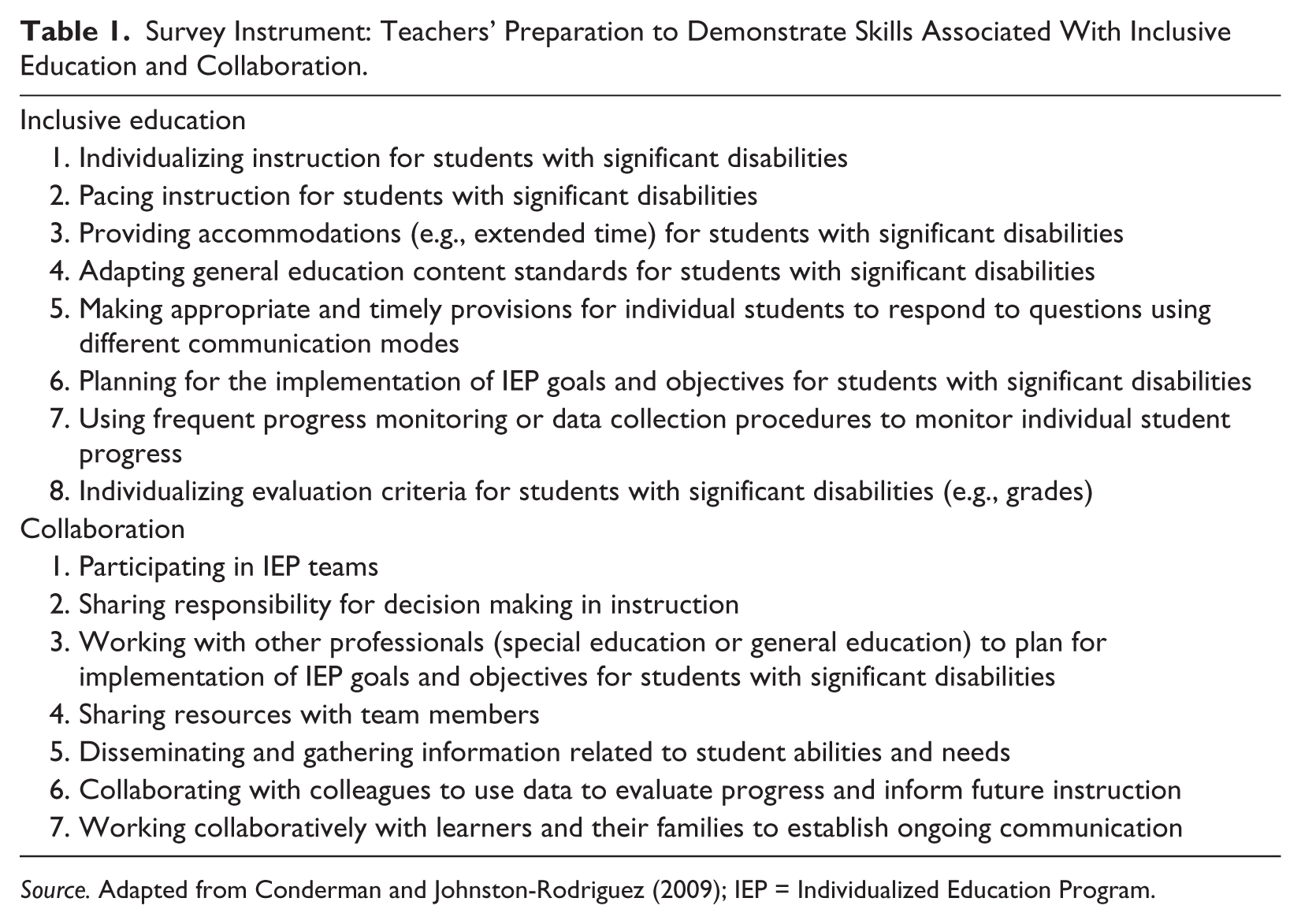
Source. Adapted from Conderman and Johnston-Rodriguez (2009); IEP = Individualized Education Program.
The 15 skills listed in the survey were associated with inclusive education and collaboration and were derived from prior work (Conderman & Johnston-Rodriguez, 2009), conceptual definitions of inclusion and collaboration, and the most current standards from the Council of Chief State School Officers (CCSSO), through its Interstate Teacher Assessment and Support Consortium (InTASC). In their study, Conderman and Johnston-Rodriguez used the InTASC standards to develop the survey items. We chose to reference the InTASC standards as well because we adapted our survey items in part from their survey. The CCSSO has indicated that the InTASC standards encompass effective teaching practices that lead to improved outcomes for students. There are 10 standards categories, and the items on the survey instrument were drawn in part from these standards. The 10 InTASC standards include learner development, learning differences, learning environments, content knowledge, application of content, assessment, planning for instruction, instructional strategies, professional learning and ethical practice, and leadership and collaboration (CCSSO, 2011). To develop the survey, we also drew upon existing literature to ensure the items reflected skills that educators for students with significant disabilities may need to demonstrate. The survey items were also developed to be reflective of conceptual definitions of inclusive education and collaboration from existing literature.
Conceptual definition of inclusive education
For purposes of this study, we defined inclusive education as special education service provision for students with disabilities in natural contexts (Ryndak, Jackson, & Billingsley, 1999-2000), in which a student is able to access the general education curriculum content by learning similar concepts and participating in the same activities as his or her typically developing peers (Jackson, Ryndak, & Wehmeyer, 2008-2009), with the needed supports and individualized, targeted teaching in order to participate meaningfully in that environment (Jackson et al., 2008-2009). Supports provided to the student with disabilities could include accommodations and adaptations; therefore, it is important for the teachers to individualize evaluation criteria for students with disabilities (Downing, 2010; Mortier, Hunt, Leroy, Van de Putte, & Van Hove, 2010). In addition, given the unique needs of students with significant disabilities who are included in general education classrooms, it is important that both special education and general education teachers plan instruction and use data-based decision making and progress monitoring (Etscheidt, 2006). Furthermore, for special education and general education teachers to plan for students with significant disabilities, they must have knowledge of strategies for collaboration.
Conceptual definition of collaboration
For purposes of this study, we defined collaboration as the shared responsibility for teaching and outcomes (Carter, Prater, Jackson, & Marchant, 2009; L. Cook & Friend, 2010; Hamilton-Jones & Vail, 2014). It is further characterized by use of carefully planned and implemented instruction that considers different team member’s perspectives (Downing, 2010). Furthermore, collaborative relationships among colleagues also involve regular communication with each other and the student’s parents regarding student progress and problem solving (Brinkmann & Twiford, 2012; Downing, 2010; Mortier et al., 2010), dissemination and gathering information (Jones, 2012), and sharing resources (Hamilton-Jones & Vail, 2014).
Interviews
We developed a semistructured interview protocol with the purpose of understanding special and general educators’ experiences and preparation in inclusive education. The interview protocol included 10 questions, five related to inclusive education, and five related to collaboration. The questions related to inclusive education included prompts for the participants to describe the following: (a) their preparation to include students with significant disabilities, (b) the skills associated with inclusive education that they feel more and less prepared to demonstrate, and (c) successes and challenges that they have experienced with inclusive education. The questions related to collaboration were very similar and only differed in that they referred to collaboration specifically.
Procedure
Survey
We created the survey using an online survey distribution program, Survey Monkey. The researchers sent an email with a link to complete the survey electronically to educators who signed their name and email during the faculty meeting presentations. Approximately 2 weeks after the initial email, the first author sent one follow-up email to the educators, thanking them for their participation and asking them to complete the survey if they had not yet completed it.
Interviews
After sending the initial email to educators interested in participating in the study, three educators replied to the email to express their interest in participating in an interview. The first author scheduled a time to meet with each educator separately. One general education teacher and two special education teachers participated in interviews. The interviews were audio recorded and transcribed for analysis.
Data Analyses
To answer our research questions, we completed both quantitative analysis of the survey data as well as qualitative analysis of the interview transcripts. In addition, we calculated Cronbach’s alpha for the survey items to determine the internal consistency of the survey.
Survey
To answer the first research question and determine whether relationships existed between educators’ self-reported preparedness to demonstrate skills involved in inclusive education and collaboration and various factors (i.e., type of teacher, previous coursework in inclusive education, special training in inclusive education, and ongoing support for implementing inclusive practices), we conducted Fisher’s exact tests using SPSS version 23. This is an appropriate alternative to the chi-square test when the assumptions of chi-square cannot be met, and in this study, the expected cell frequencies were less than five, which violated an assumption of the chi-square test (Howell, 2013).
To further understand the relationship between the educators’ self-reported preparation and whether they were a general or special educator, we conducted an additional analysis to support our findings. We created composite means for the teachers’ self-reported preparation for both inclusive education and collaboration. Then, we conducted independent samples t tests to compare the general education teachers’ self-reported ratings of preparedness with that of the special education teachers for inclusive education and collaboration.
Interviews
The first author transcribed audio recordings from the three interviews verbatim. A grounded theory approach was used in which repeated ideas and concepts across and within transcripts were extracted (Creswell, 2013), using the interview questions as guidelines. These repeated ideas were tagged with codes. The first author created a code book of descriptive codes and keywords and phrases that exemplified each code. Next, the first author used Dedoose Version 7.0.23 (2016) to apply the code book and code all three transcripts. Investigator triangulation was completed when the second author applied the code book to all three transcripts. The initial agreement between the two authors’ application of codes to transcripts was 69.23%. To complete investigator triangulation, the two authors then met to discuss code applications until 100% agreement was ultimately reached (Miles, Huberman, & Saldaña, 2014; Patton, 1999).
Results
Survey
After the follow-up email, complete survey responses were received from 33 general education teachers and 10 special education teachers across the six elementary schools (41.7% response rate). Two teachers for students who are English language learners (ELL) were among the respondents, and we coded them as general education teachers. Similarly, one adaptive physical education (PE) teacher and one speech language pathologist also completed the survey, and we coded their responses as special education teachers. We made the decision to code these educators in this manner as the adaptive PE teacher and SLP’s preparation focused on students with disabilities and was similar to that of the special education teachers, whereas the ELL teachers had similar preparation as general education teachers in the area of teaching students with disabilities.
Demographics
The special education teachers who completed the survey reported working across the continuum of placements including self-contained, resource/pull-out, and inclusion. In addition, the special education teachers’ years of prior teaching experience with students with significant disabilities ranged from zero (n = 1) to 10 years (n = 1; M = 4.37), with three teachers indicating they had 5 years prior teaching experience. The general education teachers’ prior experience teaching students significant disabilities varied from zero years (n = 11) to 17 years (n = 2; M = 5.41).
The special and general educators also varied in their prior training and background in inclusive education. Fifteen educators indicated that they have taken university courses on inclusive practices for students with significant disabilities, including three special educators. Seventeen educators indicated they have had special training on inclusive education and students with significant disabilities, including seven who were special educators. Three special educators and 12 general educators indicated that they have ongoing instructional support for their teaching regarding inclusive practices.
Reliability
The survey included items associated with inclusive education (eight items) and collaboration (seven items), and a Cronbach’s alpha analysis indicated the survey had a high level of internal consistency with an overall Cronbach’s alpha value equal to .949. In addition, when assessing the reliability of each separate construct (inclusive education and collaboration), the items associated with these constructs were internally consistent: α = .929 for inclusive education and α = .921 for collaboration items.
Research Question 1
To understand the relationship between educators’ self-reported preparation to demonstrate skills involved in inclusive education and collaboration, we completed Fisher’s exact tests of survey responses. The findings included the relationship between self-reported preparation for inclusion and (a) type of teacher (special education or general education) and (b) university coursework, in-service trainings, and support for inclusive practices. The means and standard deviations of special and general educators’ self-reported preparation are included in Table 2.
Means and Standard Deviations of Educators’ Self-Reported Preparation.
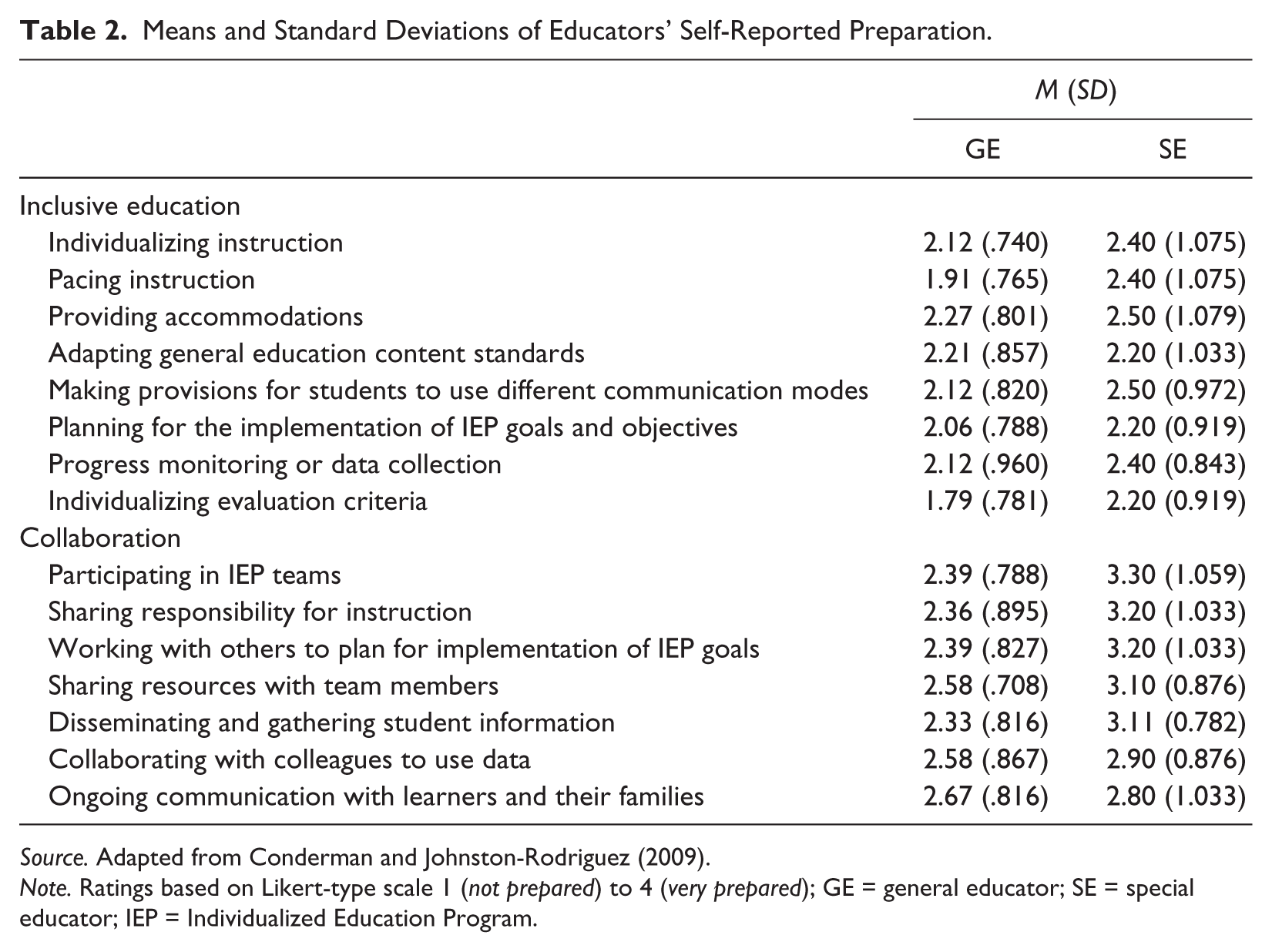
Source. Adapted from Conderman and Johnston-Rodriguez (2009).
Note. Ratings based on Likert-type scale 1 (not prepared) to 4 (very prepared); GE = general educator; SE = special educator; IEP = Individualized Education Program.
Relationship between type of teacher and preparedness
As indicated in Table 3, there was a significant relationship between the type of teacher (special or general educator) and their preparation to demonstrate the following skills associated with inclusive education: individualizing instruction (p = .048), pacing instruction (p = .028), and adapting content standards (p = .003). Analysis of this factor also revealed a significant relationship between whether the teacher was a special or general educator and three skills associated with collaboration: participating in Individualized Education Program (IEP) teams (p = .005), sharing responsibility for decision making in instruction (p = .039), and working with other professionals to plan for implementation of IEP goals and objectives (p = .026).
Fisher’s Exact Test Results: Relationship Between Self-Reported Preparation and Factors That May Influence Preparation.
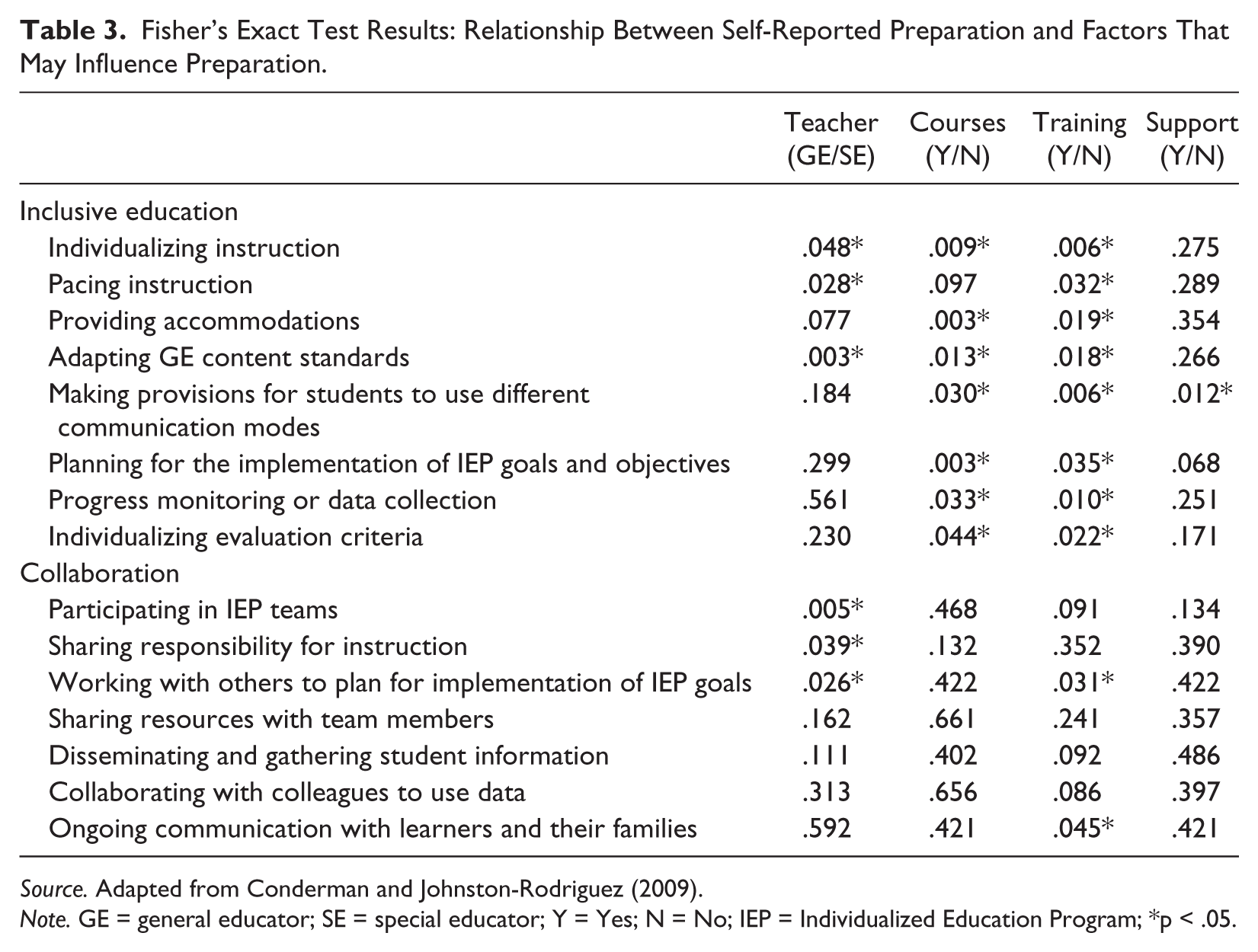
Source. Adapted from Conderman and Johnston-Rodriguez (2009).
Note. GE = general educator; SE = special educator; Y = Yes; N = No; IEP = Individualized Education Program; *p < .05.
The results of the independent samples t tests which compared general and special educators’ preparation suggested that special educators (M = 2.35, SD = .926) and general educators (M = 2.076, SD = .622) did not differ in their preparation for skills specific to inclusive education t(11.57) = −.879, p = .397, 95% confidence interval (CI) = [−.957, .409]. The results of the study, however, did indeed indicate that special (M = 3.086, SD = .754) and general educators (M = 2.472, SD = .674) differed in their overall preparedness for tasks and skills related to collaboration, t(13.7) = 2.46, p = .018, 95% CI = [−1.119, −1.09].
Relationship between preparedness and coursework, trainings, and support
The investigators also sought to understand whether there was a relationship between the teachers’ self-reported preparedness and whether they have taken university courses or had special training on inclusive education, and whether they have ongoing support for their instruction regarding inclusive practices. Overall, as evident in Table 3, there was a significant relationship between teachers who have taken university courses and their preparedness for inclusive education. Specifically, there was a significant relationship between teachers who have taken university courses on inclusive education and their preparedness to demonstrate seven out of the eight skills associated with inclusive education in the survey. This relationship, however, was not as evident for educators who had ongoing support for their instruction regarding inclusive practices.
There was also a significant relationship between teachers who have had special training on inclusive education and all of the skills associated with inclusive education included in this survey, as shown in Table 3. In addition, a significant relationship was evident between educators who have had special training on inclusive education and their preparedness to demonstrate two skills associated with collaboration: working with other professionals to plan for the implementation of IEP goals and objectives for students with significant disabilities (p = .031) and working collaboratively with learners and their families to establish ongoing communication (p = .045). In fact, the findings of this study did not reveal a significant relationship between teachers’ preparedness for collaboration and having taken university courses or receiving ongoing support for their instruction.
Interviews
Demographics
Two special education teachers and one general education teacher participated in semistructured interviews. At the time of the interview, one special educator was co-teaching with several general educators and including students with mild, moderate, and significant disabilities in general education classrooms. The second special educator who participated in an interview was a teacher in a self-contained class for students with significant disabilities, and has a master’s degree in special education for students with significant disabilities with an emphasis on inclusive practices. The third participant in the individual interviews was a general educator who taught third grade and had a unique perspective of being a former special education teacher and having a master’s degree in special education with an emphasis on inclusive education and students with significant disabilities.
Research Question 2
To understand how educators describe their experiences and preparation for inclusive education and collaboration, we interviewed three practicing teachers and completed a qualitative analysis of their responses using grounded theory techniques. Themes that emerged from these interviews include successes of inclusive education, challenges of inclusive education, and educator experience with coursework and trainings on inclusive education.
Successes in inclusive education
The special education teachers and general education teacher described similar areas in which they felt prepared and successful, including communicating with other teachers and parents and supporting the students with disabilities to become true members of their classroom community. When explaining her communication with the general education teachers, one of the special education teachers explained:
We’ve talked as much about other students and what we’re going to do about that child who’s having that behavior issue or these children who don’t understand the math concept. We don’t even talk about whether they have an IEP or not because we’re both working to get all students where they need to be so there’s not that differentiation of who is special ed[ucation] and who is not.
Another area of success for these respondents was related to student outcomes. As one of the educators explained, when students are included, “they’re so much happier, they’re so much more accepted, and they don’t feel like strangers in their own class when they come back and don’t know what’s going on.” Another educator described the successes when students with significant disabilities “get to be a part of the community” when they go to their home school.
Both of the special education teachers described successes with developing a relationship with the general education teachers at their school. The special educator who was in a co-teaching role explained, “I think they feel like they [general education teachers] have the tools they need more now.” In addition, the special educators described feeling prepared to advance inclusive education. The special educator who has a self-contained class described advancing inclusion now that she has a smaller class size but knows she’ll need to “start off small” and “think outside the box” because some educators at the school don’t have knowledge of inclusive education. This teacher in particular described feeling most prepared to share knowledge about inclusive education and explained that it is her responsibility to inform others about it by possibly providing a professional development session. Furthermore, the special educator in a co-teaching role explained that she has been able to serve as a resource for other special educators from around the district to learn about co-teaching. She explained that she is able to be most helpful with the beginning stages of implementing inclusive education that include scheduling, which is important for co-teaching because scheduling “makes it or breaks it.”
Challenges in inclusive education
While all three educators have had coursework or training in special education and inclusive education, they all described challenges in meeting individual student needs. These challenges involved students with health needs as well as finding the “balance” between supporting the student to be a part of the class activity and modifying the way the activity was taught or completed so that the student was able to complete it independently. Regarding the difficulty in finding the “balance” between remediation and involvement in the class activity, one special educator explained, “you have to pick and choose when it’s the right time to work on something totally different and when it’s the right time to just have them do whatever everyone else is doing.” Another special educator described challenges associated with inclusive education when students have complex health needs: “some students . . . have seizures that can happen at any time.”
All three educators described feeling less prepared for collaborating with colleagues who have different philosophies, including teachers who do not want to collaborate, and managing situations in which the focus is more toward students who have high incidence disabilities, rather than focusing on all of the students in the class. For example, one educator explained, “I’m hopeful that somewhere down the line that [general education teachers] were willing to actually collaborate more than just share their lesson plans with someone and say this is what we’re doing. That’s not collaboration.” The special educators also described experiences with colleagues who they felt were against inclusive education, resulting in the special educators feeling “separated.” One special educator expressed nervousness about collaborating with her general education colleagues because of their differing philosophies: “I don’t feel comfortable doing that because again I feel like people aren’t on the same page here.” She recognized, however, that in her role as the special educator, she can share information, and maybe even do a professional development for her school on inclusive education. The other special educator described a similar sentiment, “dealing with people who are very much against [inclusion].” This educator also explained the need to do “public relations” in inclusive education because “sometimes I feel like not just parents, [but] teachers within the building don’t understand it [inclusive education] and don’t buy into it.”
Both special educators described additional challenges in inclusive education including not having enough personnel and having large caseloads. One special educator explained that she doesn’t have enough para-educator support to advance inclusive practices in her school. The other special educator described having high caseloads, and having so many students “in different classrooms with totally different individual needs is really really really hard to stay on top of.”
Coursework and training in inclusive education
Two of the educators, including one special educator and one general educator have a master’s degree in special education for students with significant disabilities from the same university. This particular master’s program has an emphasis on inclusive education, and when the participants described their preparation for inclusive education, they explained their coursework and the master’s program. They explained their experiences with hands-on, applied projects in the program, explaining that it was a “combination of textbook and practical experience.” One educator described the professor’s emphasis on meaningful experiences in the schools across the range of ages. They described the importance of support from their peers in the program as well as the professors who were “easy to talk to.” One educator explained an important component of his preparation was in advancing inclusive education: “Another part of our training was that you don’t just roll over and accept things because they’re difficult.” The educators who have taken university courses on inclusive education both described challenges with meeting individual student’s needs.
Although the special education teacher in the role of a co-teacher has not taken special courses related to inclusive education, she has attended workshops and conferences. This educator began teaching as a general educator for more than 15 years before returning to school to obtain a special education teaching credential. She also emphasized her preparation to share responsibility for instruction, explaining that she is not just meeting with her co-teacher, but she is also meeting with the entire grade level team.
Discussion
Limitations
Prior to discussing our findings, there are limitations of this study that must be considered. First, we recognize that the size and diversity of the sample was limited; however, we felt it was still an appropriate response rate, given that we conducted this study for more than three months and recruited participants from six schools in one district. Second, this study focused on practicing teachers in one school district in the Western United States. While their responses may not be representative of teachers across the United States, studies such as this extend previous work on teacher skills and dispositions to describe the experiences and preparation of practicing teachers who work with students with significant disabilities. Finally, three teachers volunteered to participate in interviews. Given that these three teachers had university coursework or special training in inclusive education, they may not have been representative of the sample of teachers who completed the survey.
Implications for Teacher Preparation and Research
Analysis of the survey and interview results suggest several important implications for research and teacher preparation programs including (a) the importance and need for additional research on teacher preparation programs and university coursework pertaining to inclusive education for students with significant disabilities, (b) the need for future research to explore strategies for meeting the needs of individual students with significant disabilities, (c) the need for future research to investigate special and general educators’ experiences collaborating including the types of special training that educators have attended, and (d) the need for future research to investigate teachers’ preparation to advance inclusive education.
University coursework
The results of the survey revealed a relationship between educators who have completed university coursework on inclusive education and their preparation to demonstrate the following skills associated with inclusive practices: individualizing instruction, providing accommodations, and adapting content standards. Two of the educators who were interviewed have completed coursework in inclusive education and have their master’s degrees in special education for students with significant disabilities. During their interviews, both of these educators mentioned their coursework as part of their preparation, and expanded on this through their description of “hands on” learning and “practical preparation” in their courses. Examples of this type of applied preparation may include assignments that involve the completion of ecological assessments (Downing, 2010) or planning and implementing individualized adaptations for students at their practicum or fieldwork placements (Janney & Snell, 2013). The survey and interview results suggest the value of teacher preparation programs and university coursework for teachers’ readiness to include students with significant disabilities in general education classrooms, and future research on this topic is necessary.
There is also a need for future research to explore teacher preparation programs and to understand the characteristics of effective preparation programs, including the content that is most essential to ensuring teachers feel prepared. Furthermore, it would be important to explore the different methods for delivering the content, such as online or in-person courses. It would also be important to learn whether there are certain projects that are most beneficial for pre-service teachers, and whether there are certain types of feedback and support from university faculty that are more or less effective.
Meeting individual student’s needs
The educators who were interviewed described challenges they have faced involving meeting the needs of individual students and finding the “balance” between supporting the student to participate in the class activity and meeting his individual academic needs. This finding was also evident in the survey results in that, on average, educators felt only somewhat prepared to individualize and pace instruction and provide accommodations for students with significant disabilities in inclusive settings, and the special educators were only somewhat prepared to individualize instruction and adapt content standards for students with significant disabilities. Future research is needed that explores educators’ experiences with supporting students to participate in class activities and modifying class activities. This research would be particularly important because the results could be included in the design of university coursework and professional development on inclusive education. Researchers have noted this need to better understand how to meet individual students’ needs in inclusive classrooms (Dymond, Renzaglia, Gilson, & Slagor, 2007; Morningstar, Shogren, Lee, & Born, 2015; Ryndak et al., 2013); therefore, future research should address the strategies educators use to individualize instruction and adapt learning standards for students with significant disabilities.
In addition to a need for future research to focus on modifications and accommodations, there is also a need to explore the impact of large caseload numbers on educators’ views of their preparation to meet individual student’s needs. The special educators who were interviewed expressed difficulty in meeting students’ individual needs; however, they also described having high caseloads and the need for more support from para-educators. Future research should explore the factors that may influence educators’ feelings of readiness, such as the amount of students across different grade levels and classrooms they serve. It would also be important for future research to investigate the number of students the special educators support and the relationship between large caseloads and teachers’ views of their preparedness. In addition, future iterations of this survey should include questions about the amount of support the educators have from para-educators and administration and any potential role they have in predicting their views of their preparation for inclusive education.
Collaboration
The survey results revealed a significant relationship between whether the teacher was a special or general educator and three skills associated with collaboration: participating in IEP teams, sharing responsibility for decision making, and working with other professionals to plan for the implementation of IEP goals and objectives. The results of the independent samples t tests provided further insight into this finding, indicating that special educators felt more prepared to collaborate with their colleagues, as compared with general education teachers. Given the differences between general and special educators in their preparation for skills related to collaboration, teacher preparation programs should work to ensure that general education teachers have the opportunity to learn and practice skills for participating in IEP teams. Pre-service general education teachers must also have the opportunity to learn and practice strategies and systems for sharing responsibility for instruction and for the implementation of IEP goals. It may be particularly useful for this practice to occur during fieldwork or practicum placements so that the students may be able to reflect upon their experience and obtain feedback from university mentors.
The findings of the survey related to collaboration revealed several directions for future research including a need to understand the reasons for special educators reporting to be more prepared than general educators, and a need to collect additional information through the surveys. Future research should investigate reasons for the difference in feelings of preparation for collaboration between general and special educators. Perhaps special educators have more opportunities to practice the skills involved in participating in IEP teams and working with other professionals to make decisions and implement IEP goals and objectives; however, future research should explore this result. For example, future research could include investigations of the experiences of general and special educators in collaborating through in-depth interviews.
An interesting finding of this survey was that there was not a significant relationship between educators who have completed university coursework on inclusive education and their views of their preparation for collaboration; however, there was a relationship between teachers who have had special training and their preparedness for two skills involved in collaboration: working with others to plan for the implementation of IEP goals and ongoing communication with learners and their families. Future iterations of this survey should include questions about the types of training the teachers have attended. For example, have teachers attended professional development sessions at their own school site that involved collaboration with their colleagues? Alternatively, did the teachers attend district-wide in-services in which they learned useful information related to these topics?
All three educators who were interviewed described feeling less prepared to collaborate with colleagues who have different philosophies about collaborating and supporting students with significant disabilities. Future research should explore this result further, and it would be useful to document strategies that educators find successful to use in these situations. Given the need to advance inclusive education, and given the role of collaboration involved in supporting students with significant disabilities in inclusive settings, this should result should be explored in future research.
Advancing inclusive education
The findings of the interviews also revealed both special educators felt prepared and motivated to advance inclusive education at their sites. They viewed this as a potential challenge, but also recognized that doing “public relations” regarding inclusive education is part of their role as a special educator. This topic was not listed in the survey; therefore, future uses of this survey should explore educators’ preparation or readiness to advance inclusive education and support the shift in understanding and beliefs at their school.
This finding from the interviews also suggests an important implication for teacher preparation and courses on inclusive education: Pre-service teachers should have the opportunity to learn and practice the skills involved in advancing inclusive practices in practicum and student teaching placements. The pre-service teachers will need support from their mentor teachers and university supervisors as they reflect on their successes and challenges in advancing inclusive practices at their site. As schools work to shift to more inclusive placements for students with significant disabilities, it is important for educators to feel prepared to engage in conversations and have meaningful discussions about the benefits, strategies, and best practices involved in inclusive education.
Footnotes
Declaration of Conflicting Interests
The author(s) declared no potential conflicts of interest with respect to the research, authorship, and/or publication of this article.
Funding
The author(s) received no financial support for the research, authorship, and/or publication of this article.