



Abstract
In the past 20 years, Latinas have begun to outperform Latinos in high school completion and college enrollment, tracking the overall “gender reversal” in college attainment that favors women. Few studies have examined what factors contribute to Latinas’ increasing educational success. This article focuses on gender differences in college-going behavior among a cohort of 50 Latino/a college aspirants in the San Francisco East Bay Area. Through 136 longitudinal interviews, I examine trends in Latinos/as’ postsecondary pathways and life course decisions over a two-year period. Findings suggest evidence for gendered familism, in which gender and racial/ethnic beliefs intersect to differentially shape Latinos/as’ attitudes, behaviors, and college choices. Gendered familism encouraged Latinas to seek a four-year degree as a means of earning independence, while Latinos expressed a sense of automatic autonomy that was not as strongly tied to educational outcomes.
College enrollment patterns have shifted since 1960, resulting in women achieving majority status in college enrollments in 1988 (U.S. Department of Education 2008). Notably, men’s enrollment rates have not decreased; they continue to rise, albeit more slowly. This “gender reversal” in college enrollment represents a profound shift in the educational sphere that has provoked considerable debate (DiPrete and Buchmann 2013).
Latino/a 1 college attainment rates follow this gender reversal trend (Saenz and Ponjuan 2009). In 2009, Hispanic women earned 61 percent of bachelor’s degrees awarded to Hispanics 2 (U.S. Department of Education 2010). However, few studies explore the phenomenon of Latinas’ increasing educational success; instead, many continue to focus on the ways Latinas are disadvantaged (Gowan and Treviño 1998; Williams, Alvarez, and Hauck 2002). A rich body of literature examines Latino/a educational experiences, with particular focus on Latino/a familism, in which family and collective needs are privileged above individual ambitions (c.f. Desmond and Turley 2009; Sabogal et al. 1987). Still, little in-depth research considers how or why Latino/a postsecondary pathways vary by gender (but see Barajas and Pierce 2001).
This article represents a portion of an ongoing project using longitudinal in-depth interviews to follow a largely working class 3 sample of 50 Latino/a college aspirants who attended one of three high schools in the San Francisco East Bay Area 4 (“East Bay”). Here I focus on an approximately two-year period in these young people’s lives, beginning with their senior year of high school in 2007. With this large and qualitatively rich data set, composed of 136 interviews with 23 Latinos and 27 Latinas, I am able to dig deeper into the processes and mechanisms that underlie the trends we observe. In particular, I investigate the finding that a greater percentage of four-year eligible Latinas than Latinos in this sample enrolled in four-year universities. My approach contributes to existing literature on familism and higher education, showing how Latino/a respondents’ attitudes, behaviors, and college pathways were shaped by the intersectional influences of gender, race/ethnicity, and culture.
Gender Theory and Differential College Pathways
Most current education research focuses on economic pressures (e.g., the decline of highly paid low-skill jobs) and changing family structure, combined with greater acceptance of careers for women, as a likely explanation for women’s college gains (Buchmann and DiPrete 2006; DiPrete and Buchmann 2006; Goldin, Katz, and Kuziemko 2006; Jacob 2002). This framework views the college choice process as shaped primarily by individual rational choices based on calculated attempts to maximize economic potential, rather than as a potential site for the (re)production and revision of gender and cultural beliefs about education and the life course. Analyzing how gender as both process and social structure informs the meanings Latino/a college aspirants assign to educational choices may provide new insight on the gender reversal for both men and women.
Gendered Latino/a Transitions to College
Research has documented that Latino/a college aspirants remain underprepared academically (Hurtado et al. 1997) and psychologically (Barajas and Pierce 2001; Ceja 2004) for the transition to college. These challenges are not gender-neutral (Saenz and Ponjuan 2009). Latino/a college aspirants’ subjective experiences, including gendered socialization processes engaged by teachers and family members, can exert a powerful influence on college pathways.
School-based social networks may respond more favorably to Latinas and other female minority group members, who are perceived as more tractable and scholastically inclined 5 than minority males (Ferguson 2001; Lopez 2002; Smith 2002). A gendered school culture that encourages a focus on “masculinity projects” for boys, such as sports, may lead Latinos to identify with a dominant culture that emphasizes competition and individual effort (Barajas and Pierce 2001; Lopez 2002). Being academically successful does not call Latinas’ femininity into question in the same way that focusing on school raises questions about Latinos’ masculinity. Therefore, Latinas face less scrutiny for choosing school success and identifying with Latino/a culture (Barajas and Pierce 2001; Bettie 2002; Lopez 2002).
Research has consistently found that family support is very important for Latinos/as’ college decision making. Though the influence of “traditional” patriarchal family structures in Latino/a culture is waning, particularly among immigrant families where women regularly work for pay, gender ideologies that define Latinos as breadwinners and Latinas as caretakers remain salient (Baca Zinn 1980; Hondagneu-Sotelo 1992; Peña 1991).
Familism, defined as a social pattern that privileges family interests above those of the individual, has been associated with Latino/a groups. Desmond and Turley (2009, 314) describe three interrelated dimensions of familism: attitudinal, including “values and beliefs that prioritize the welfare of the family”; behavioral, including decisions conditioned by “attachment to family ties”; and structural, including the propensity to “live in larger and denser kinship networks than whites.” Previous studies find that familism is stronger among families of Latino/a origin relative to other groups, that its effects continue across generations, and that it may help or hinder educational outcomes (Desmond and Turley 2009; Roschelle 1999; Sabogal et al. 1987; Trusty, Plata, and Salazar 2003). For example, Latino/a college aspirants frequently cite the importance of family support (Cammarota 2004; Ceja 2004), but some of the Latino/a–white college attendance gap may be explained by the desire to stay close to family (Desmond and Turley 2009; Hurtado et al. 1997).
Research on gendered socialization processes among Latinos/as consistently finds gender differences in subjective experiences of family, as well as attitudes and behavior towards family (Cammarota 2004; Raffaelli and Ontai 2004; Sy and Romero 2008), two of the dimensions of familism highlighted by Desmond and Turley (2009). However, little extant research explores how familism itself is gendered. Most previous research on Latinos/as’ college pathways considers the salience of gender (Cammarota 2004) or familism (cf. Pérez and McDonough 2008; Sabogal et al. 1987; Trusty, Plata and Salazar 2003), or discusses each concept separately (Barajas and Pierce 2001; Lopez 2002). Many studies simply exclude men (Ceja 2004; Espinoza 2010; Gloria and Castellanos 2012; Sy and Romero 2008). In sum, while previous research considers familism an important concept for understanding the Latino/a college choice process, its gendered dimension has yet to be explicitly examined.
Gendered Familism: Intersectional Complexity
The recent turn in gender theory toward intersectional approaches seeks to integrate the study of race/ethnicity, gender, and class as social structures, acknowledging that norms and standards of behavior for women and men are not viewed or performed in the same way across groups (Collins 2009; Glenn 1999; McCall 2005). Focusing on individuals at the intersection of two or more structures reveals the linkages between interlocking systems of oppression (Glenn 1999), or what Collins calls the “matrix of domination” (Collins 2009, 26). Examining Latino/a college transitions qualitatively provides an opportunity to consider whether and how educational trends illuminate the (re)production of intersecting gender and racial/ethnic beliefs, attitudes, and behaviors—what I call gendered familism. I focus on familism as a social pattern the majority of my respondents recognized as representing important values connected to their racial/ethnic heritage. Gendered familism represents a set of strategies employed, in part, as a response to Latinos/as’ ongoing struggle for socioeconomic mobility and acceptance in U.S. society.
Research that combines Sewell’s (1992) theory of structure with an intersectional approach allows us to consider how structures that “share resources as well as cultural schemas (or ‘rules’)” themselves intersect (Beisel and Kay 2004, 503; Hamilton and Armstrong 2009). Following this reasoning, gender and race/ethnicity intersect in the realm of college choice; each communicates beliefs about the college choices individuals should make. That is, the value of college (as a resource) varies within racial/ethnic groups because of gender beliefs applied to its use. Much previous research in the sociology of education identifies the ascendency of women in the college realm as an unexpected outcome attributable in part to increasing gender equality; however, this gender reversal does not automatically revise gender rules because, as Ridgeway and Correll point out, “social relational contexts carry preexisting gender beliefs into new activities” and thereby “conserve gender hierarchy” (Ridgeway and Correll 2004, 523).
In the present case, education is a resource that both East Bay Area Latinos and Latinas are motivated to access, but gendered familism influences divergent interpretations of the value and meaning of college, leading to gendered college pathways. Especially given the context of 2008’s Great Recession, both Latinos and Latinas feel pressured to succeed in the job market, both connect a college degree with achieving middle-class status, yet only Latinas identify a college education as essential for independence. That is, though Latino respondents expressed a sense of automatic autonomy, Latinas saw a college degree as necessary for earned independence. These gendered cultural schemas intersect with Latinos/as’ racialized status as a “high-risk” minority, achieving special urgency given the disruption of traditional family support structures through group members’ recent histories of incorporation and immigration (Glenn 1999; Roschelle 1999). My analysis connects the intersectional influence of gender and race/ethnicity—or gendered familism—to the divergent college pathways of Latino/a college aspirants in the East Bay Area.
Methods
I conducted in-depth interviews with fifty Latino/a high school seniors, including 27 Latinas and 23 Latinos, at three East Bay Area public high schools. 6 Interviews were conducted in three waves, from the fall of 2007 through the spring of 2009. Seven respondents were undocumented immigrants. 7 The first interviews were conducted during the fall and winter of respondents’ senior year in high school, second interviews were completed either just before or following high school graduation, and third interviews took place about six months after high school graduation. Interviews explored respondents’ life histories, school experiences, family support systems, economic resources, romantic relationships, and other factors influential for postsecondary pathways. At Wave 1, all respondents reported plans to enroll in college. The longitudinal nature of this unique data set allowed me to follow respondents’ decision making over time, and to detail the resulting pathways (see online appendix at http://gas.sagepub.com/supplemental).
Twenty students in the sample were drawn from two urban public high schools in a middle-class community (“Valley High” 8 and “Plain High”), and thirty from an urban school in a working-class community (“Inland High”). In 2007, the student population at Valley High and Plain High was 11 percent Hispanic, with the majority of students being Asian and white. 9 Inland High was about 43 percent Hispanic, with no other group providing more than 20 percent. Forty respondents, including all thirty who attended Inland High, came from working-class households. Class status has been shown to be influential for postsecondary outcomes, such as propensity to take on loans. However, as this was overwhelmingly a working-class sample, a thorough examination of these factors is outside the scope of this article.
I identified respondents using a variety of methods. Principals at each school put me in contact with counselors, who referred me to interested teachers. I recruited students through classroom presentations, counselor-sponsored “study recruitment events,” hallway signs, and word of mouth. I also recruited students through Inland High’s “La Raza” club. I offered a modest donation to the club for each member who participated. I was able to form close relationships with many of my respondents, some of whom continue to update me on their educational progress and major life events.
In all, 136 interviews, ranging in length from 30 minutes to two hours, were recorded and transcribed. Forty respondents completed all three interviews at the target time points. Four respondents completed two interviews each. The remaining six respondents completed just the first interview; however, for four of these respondents I was able to complete a follow-up phone call, e-mail, or Facebook message. Through these various means, I was able to obtain complete postsecondary information for the specified timeline for 48 out of 50 respondents.
Using an extended case method approach to data analysis (Burawoy et al. 1991), I use in-depth interviews to inform and develop theories and concepts related to gender differences in educational aspirations and attainment. I created broad, thematic codes, which I refined through an iterative process of categorization and reflection on the data, allowing categories of analysis to emerge from the data. I created memos to document this process and forge connections between the themes that emerged.
While I cannot directly analyze the desires and demands of respondents’ families, the messages these young Latinos/as report receiving from their families are suggestive of group trends. My analysis focuses on how respondents’ discourse revealed the intersectional influence of Latino/a and gender beliefs—or gendered familism—on life course decisions and college pathways. I select comments and responses from both men and women to demonstrate how gendered familism differentially affected respondents’ behaviors and choices. A note following each respondent’s first appearance in the text indicates the type of college they attended. For example, Melinda (two-year) attended a two-year college. Where applicable, I also include the number or percentage of other respondents who reported similar opinions or experiences. Respondents’ career interests appear in the online appendix. My intent is not to generalize to the national population of Latino/a college aspirants but to exemplify the processes and mechanisms through which gendered familism affects life course decisions.
Overview of Gendered College Pathways
More Latinas than Latinos in my sample attended four-year bachelor’s degree granting institutions (Table 1), which have better records of success than two-year colleges in keeping students on track to completing postsecondary degrees (Dowd 2003). As Table 1 shows, slightly more than one-half of women in the sample attended a B.A. granting institution by their final interview date, while just over a third of men did the same. In contrast, slightly more than one-half of men in the sample attended or planned to attend a two-year college. 10
Interview Sample College Enrollment Numbers and Percentages by Gender at Wave 3 (Fall 2008)
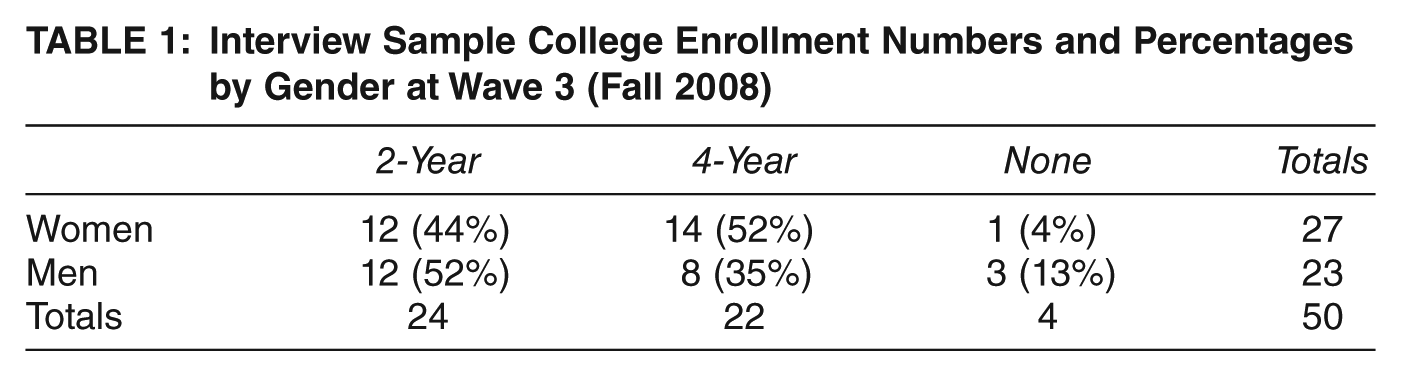
Moreover, a larger percentage of eligible Latinas enrolled in four-year universities. Four-year universities typically impose minimum requirements for high school grade point averages (GPA) and standardized test scores. Selective universities add requirements such as essays and personal interviews. For example, prospective enrollees with a 3.0 (B average) GPA are automatically eligible for California State University (CSU) East Bay, a lower-tier four-year university near Inland City. 11 GPAs between 2.0 and 3.0 are acceptable if applicants’ ACT or SAT scores meet certain thresholds. 12 Taking eligibility into account lessens concerns that my findings simply reflect that Latina respondents had superior grades and test scores.
Based on self-reported GPAs and college application behaviors, I ascertained that 41 respondents (17 Latinos and 24 Latinas) were eligible to enroll in a CSU (see online appendix). This is a conservative calculation, including only respondents with GPAs of at least 3.0, or who reported having been accepted to a CSU. Of these, just 8 out of 17 eligible Latinos (47%) enrolled in four-year universities, as compared with 14 out of 24 eligible Latinas (58%). In short, accounting for eligibility, Latina respondents more often chose four-year universities.
Changes in postsecondary schooling plans nearly always resulted in “downgrading” college level or prestige. In addition, dropouts, stopouts, and irregular attendance more often complicated Latinos’ pathways. Of the 12 respondents who changed plans, 11 (four women and seven men) downgraded or lost momentum toward their original aspiration. Of these seven Latinos, three abandoned college altogether. Of these four Latinas, just one left college.
Though college graduation and career outcomes are outside the scope of this article, it is worth noting that the gender gaps in my respondents’ enrollment behaviors are similar to the 2009 gender gap in national Latino/a college completion rates, when 61 percent of all bachelor’s degrees earned by Hispanic students were awarded to Hispanic women (U.S. Department of Education 2010). Also, it is useful to know that nearly all respondents initially aspired to careers that required four-year degrees. This desire crossed gender lines during the first wave of interviews, but was less frequently articulated by Latinos as time went on.
Analysis: Gendered Familism
Familism has been heretofore associated with culture; that is, familism is an orientation considered unique to Latinos/as that applies more or less uniformly to all group members (Sabogal et al. 1987). 13 This focus ignores or leaves underdeveloped the ways familism itself is gendered. Familism is typically used to explain whether Latinos/as go to college or not. In the present case, all my respondents wanted to go to college, but the decision to go to a four-year college is informed by gendered interpretations of familistic beliefs (or attitudes) and different familistic behaviors for men and women. Familism, as a set of norms, attitudes, and behaviors, is “transposed” (Sewell 1992) to a new resource—college education—but its application does not result in uniform results because it is simultaneously structured by gender. In the analysis that follows, I show how nearly identical familistic beliefs, refracted through a gendered lens, resulted in very different family-oriented behaviors, including caretaking, spending habits, dating and relationships, and achieving independence. In the final section, I connect respondents’ divergent behaviors to the production of gendered college pathways.
Gendered Familism: Taking Care of Family
The attitudinal dimension of familism suggests that Latinos/as will express “values and beliefs that prioritize the welfare of the family” (Desmond and Turley 2009). Latino and Latina respondents agreed that supporting family was important and that attaining a college degree would further this goal. Javier’s (two-year) mother “always tells me, ‘Well, how are you gonna support your family if you’re living off a measly little paycheck?’” Javier explicitly connected his future ability to “provide” to finishing college. Raoul (four-year) was attending college “so I can do what I want, get what I want, have a family that I wanted.” Others, like Melinda (two-year), noted that college would enable them to “provide my family with things I didn’t get.” Heather (two-year), like virtually every respondent, highlighted the necessity of having not just a job but a career; without college “you can’t get a good job . . . I’ve noticed a lot of parents are managers of Payless [shoe store] or whatnot. I’m, like, that’s not a good-paying job.”
Latinos/as referenced their parents’ struggles in supporting families without the benefit of a college education. In all, 41 respondents agreed with Aurelio (two-year) that their parents “are an example to me to see what would happen if you don’t make it. If you don’t study, you will live a hard life.” Others went further, connecting a higher education with being “proud of your life” (Marina, four-year), “growing into a responsible citizen” (Devin, two-year), and the feeling that “my life would [not] be properly lived if I didn’t go to college” (Hayden, four-year). Respondents’ sense of living “properly” included offering both direct and indirect family support. “I like big families,” Javier remarked, but “I can’t just have hella [lots of] kids with no money.” More than simple economic support, Oscar (four-year) noted, attending college would reflect well on his family by proving he was more than “just another Mexican.” Aurelio’s father encouraged college in order to “make our name last for [a] long [time] and be the best . . . to be better than he was,” indicating that going to college would raise the status of the family name. Oscar also drily noted the inverse; should he fail, his family would share in that, too: “Like, ‘Oh, another construction worker in the family, woo hoo.’”
Familism shaped respondents’ recognition that college was a new resource their generation could access to lift family fortunes. However, Latinos and Latinas differed markedly on exactly whose family they would support, and the behaviors these attitudes indicated. Traditionally, Latino/a families expected women to care for siblings and aging parents, while men were expected to take on a breadwinner role. In a twist on this traditional conception, Latinas mentioned feeling pressure from parents to succeed both educationally and financially at a much higher rate than Latinos. While similar numbers of Latinos and Latinas mentioned parental pressure to succeed at least once across three waves of interviews, fully 70 percent of all reports of parental pressure came from women. In other words, Latinas reported such pressures repeatedly, and parental pressure entered into more aspects of their lives. For example, Consuelo’s (four-year) parents said they were “sacrificing” to send her to UC-Santa Cruz “so that I can be a model for my siblings. . . . They’re, like, ‘Try your best. Your sister and your brother look up to you. We look up to you.’ They always call me an investment.” Alicia (four-year) was highly influenced by her mother’s stories of life as an immigrant single mother victimized by serial domestic abuse: “She would tell me the way she suffered. . . . She says I need to get more, to do something with my life.” Alicia’s sister had tried a two-year college, “but then she didn’t have a green card. She couldn’t go no more . . . so my mom told me that I should go.” Cassie (four-year) was responsible for most of the household chores: “My dad would yell at me, saying, ‘What are you doing throughout the day? You’re not cleaning!’” Cassie was also expected to carry the weight for the family educationally and financially because her parents did not have high hopes for her twin older brothers, who liked to “party all the time.” Cassie said, “They keep on telling me I’m the one who’s gonna have to support my brothers, help my brothers out in the future . . . that’s why they want me to get a good job.” At the end of her senior year, Cassie reported that this pressure had grown and was causing her stress: “It’s kind of a burden.”
These examples show how gendered familism led to much higher-stakes collegegoing experiences for Latinas, who more often reported fulfilling caretaker and breadwinner roles while attending college full time. Eight Latinas contributed financially to their families of origin, and five more reported seeking jobs in order to do so. Lupe (four-year) worked 30 hours a week at her uncle’s taquería. Her entire paycheck went toward rent, food, and clothing for herself and her siblings. Marina and Juana (four-year) also worked 30 hours a week and contributed earnings toward household expenses. Blanca (two-year) helped raise her younger siblings and worked “under the table” for two years, starting in the ninth grade: “[The money] went straight towards rent or food or clothing for the kids if they needed it.”
Latinos, in turn, related the necessity of higher earnings through college completion almost exclusively to the need to provide for their future families. For Latinos, gendered familism contributed to a sense of automatic autonomy that was not infringed upon by their families of origin. Comments from Javier and Raoul, noted previously, illustrate this. Devin, who felt that college would help him become a “responsible citizen,” opined that completing college would also help support one’s family, “if you have one.” Miguel (four-year) and Ricardo (two-year) related attaining a college degree to the ability to “have” or “form a family,” respectively.
This shift in focus—from present to future family—also had consequences for Latinos’ spending habits. Latinas who passed earnings to their families, or sought jobs in order to do so, more often expressed a collective earnings approach. Latinos completed household chores, but despite reporting similar familistic attitudes as Latinas, only two Latino respondents provided direct financial contributions to their families. For example, I asked Raoul what he did with earnings from his after-school job: “Spend it.” Interviewer: “On just whatever?” “On anything I want. Well, at first, like, I never understood why my friends bought two-hundred-dollar jeans and two-hundred-dollar shoes and stuff like that, but I understand now, you know? I worked for it, so why not?” Oscar had a lucrative position as assistant manager of a car wash: “I waste my money on whatever the hell I see. . . . I bought a thousand dollars worth of clothes, six hundred dollars worth of shoes, and I don’t know what I did with the rest” [laughs]. Though Oscar’s example is perhaps extreme, it illustrates the typical spending habits of Latino respondents. Some men did save, but usually these savings were for future spending on themselves. For example, Armando (four-year) told me, “I have saved it up for if I want to buy something nice for myself, like . . . a $480 Xbox 360.”
Latinos who did provide direct family support typically did so at the expense of their educations. Ésteban (two-year) reduced his university studies to one class at a time in order to run the family business after all of his immediate relatives were deported. Rafael’s (two-year) father “pulled the plug” after his father lost his job during Rafael’s first semester at CSU-East Bay. Rafael reverse-transferred to a community college. Rafael’s older sister attended CSU-East Bay, and his younger sister planned to attend the following fall. Rafael viewed this as “unfair,” but said that his father “expects more of me; he expects me to help the family.” Making an educational sacrifice was perceived as a proper response for Ésteban and Rafael, but not for Rafael’s sisters, nor for any women sample members.
Both Latinos and Latinas expressed familistic values. However, their supportive behaviors varied by gender, indicating the influence of gendered familism. Similar to the second-generation Caribbean women in Lopez’s (2002) study, East Bay Latinas “were expected to be serious and responsible,” though Latinos were not (p. 139). Latinas expressed a greater sense of financial obligation to their families of origin, and more often did so while attending college at the same time. Men did not report high-stakes parental pressure to succeed educationally and financially to the same extent. In fact, young men’s discourse celebrated and supported their individualistic spending habits, assuming that the fruits of their educational labor were reserved for their future families.
Gendered Familism: Dating, Relationships, and Independence
Dating was framed as threatening to women’s educational and career objectives. Some Latina respondents explicitly eschewed dating and boyfriends, a strategy they reported that their parents encouraged. 14 Rachel (four-year) replied “getting married,” when I asked if she had any concerns or fears about completing college. “I am afraid of a guy coming into my life and changing it all around,” she elaborated. “I think that [a serious relationship] would keep me away from [finishing college] unless the guy is really encouraging you, which is not most of the time.” Alicia concurred, “All my girlfriends say, ‘My boyfriend did this and blah, blah, blah’ . . . That’s why I want to be single.” Elisa (two-year) agreed that women in relationships “can’t really balance the two things of schoolwork and keeping a relationship.” In all, nine young women in the sample expressed these sentiments. Concerns with “balance” and boyfriends privilege the male prerogative in relationships, and assume that women have little power to change this dynamic. Most Latinas assumed that this was just the nature of relationships, and the only strategy to employ was avoidance.
In contrast, several men, including Patrick (two-year), said their relationships had positive effects: “That was another person that pushed me,” Patrick said, relating how he would skip classes. “My girlfriend, she got mad. . . . She was, like, ‘You see me going every single day, even when I don’t feel good.’ And then I’m, like, ‘Damn . . . I guess I do gotta go. . . . No more messing around, I guess.’” Lorenzo (four-year) said his first serious girlfriend “changed me, made me work harder in school.” Only Javier expressed reservations about romantic entanglements: “Some [relationships], you can build [each other] up . . . but some, you just spend too much time, you ignore what really matters.” But he added, “That’s not the reason why I don’t got a girl right now.” On the whole, Latino respondents felt little need to justify their dating or relationship choices. Latinas, however, viewed relationships as a potential minefield of temptations, risks, and responsibilities that might keep them from their goals.
Latinos/as’ contrasting dating and relationship behaviors share characteristics with what Hamilton and Armstrong (2009) call the “relational double bind” for college women—the clash of the “relationship imperative” with a classed “self-development imperative.” In this case, it is the intersection of gender and Latino/a familism that drove Latinas to avoid romantic relationships. Gendered familism pushed Latinas to utilize higher education as a new resource for lifting family fortunes but did not vacate gender and cultural beliefs that mark romantic behavior as risky for women’s ambitions, but rewarding or neutral for men’s.
Avoiding relationships gained special significance for many Latinas given stories of hardships due to recent immigration and disruption of family structures. Gendered familism encouraged women to equate completing a college degree with achieving independence and avoiding traditional, patriarchal power structures they saw their mothers and aunts struggle with. Beatriz (four-year) told me what her mother’s advice had been since her divorce: [She would say], “You want to be stupid, you want to have my life, you want to be cleaning houses and stuff for a living? . . . Or you just wanna sit at a desk with air conditioning, or being able to get money easier than [I do], then study. Education. But if you wanna be, like, begging your husband for money, or [worry that] if you don’t do [what he wants] they’re gonna cancel your access to the bank, and stuff like kicking you out of the house every time he feels like it. . . . Support yourself” [emphasis Beatriz’]. She always used to tell me, like, “Be independent.”
Beatriz’s mother had married her father at the age of 14 and had no education herself. Her story of an immigrant family controlled by a domineering patriarch, echoed by several women in the sample, rests at the intersection of gender, ethnicity, and culture. Beatriz feared being “stuck” with her mother’s life—powerless and controlled by men—if she did not complete college.
In all, 14 Latinas (compared with six Latinos) made this connection. Unique to Latinas, however, was the specific link between college and avoiding the effects of bad marriages. Juana’s parents encouraged college “so I can be independent. . . . Like, if I get married and the guy is mean or something and doesn’t support me.” Blanca reported that her father emphasized independence “money-wise, make sure I can be financially capable of doing things on my own.” Most respondents reported that their mothers had less remunerative jobs than their fathers, and Latinas saw—and were told—that the kinds of jobs their mothers had would not secure an independent life. Yolanda’s (two-year) mother told her, “I don’t want you to need a guy to support you. If you guys get divorced or whatever, you have your education to go on and not depend on someone to have a living.” She also used a family example: “My auntie . . . has a lot of kids and she’s divorced. . . . [My mom’s] like, ‘I don’t want you to end up like that.’ She doesn’t have an education. She never finished high school or anything, so right now she’s really struggling.”
Latino respondents like Ramón (two-year) reported that parents wanted better for them, too: “They don’t want me to be like them, working [for] low pay or anything like that.” As Emilio (two-year) put it, “My uncle . . . tells me to stay in school or the shovel and other tools that are required to do construction will be waiting for me.” Many Latinos (but no Latinas) contrasted college favorably with readily available but physically punishing construction work. Lorenzo wanted to avoid working construction like his father, because “all the time he’s hurt and his hands are rough.” Aurelio agreed that construction was one of “the hard jobs. . . . I don’t want to [end up] working like that.” However, Latinos’ motivation to attend college was never linked to a fear that life without college would not be “properly lived,” or that without college they might become “dependent.” In fact, several young men remarked that manual labor was well paid; many fathers, like Javier’s, financed houses and supported stay-at-home spouses while working construction. The pay is “pretty good,” Javier said, and he might consider it “if I for some reason screw up or something, which I won’t.” No Latino sample members considered construction work a desirable option, but it did represent a well-paid “fallback” job of the kind that was simply not available to Latinas.
Gendered familism presented Latinos and Latinas with different pathways to independence. Despite Latinas receiving strong encouragement to achieve independence through college attainment, women still lacked independence in relationships. Latinas felt obliged to curtail their dating behavior if they wanted to achieve educational and financial success. Latinos’ access to well-paid manual labor as a fallback position encouraged their sense of autonomy and lowered any risk associated with romantic entanglements.
Gendered Familism: Choosing a Pathway
Thus far, I have shown how gendered familism influenced attitudes and behaviors that affected college-going. The decision to attend a four-year college, as with caretaking and dating behaviors, varied by gender despite the distribution of grades and the universal acceptance that four-year colleges were “better.” Gendered, cultural, and familistic beliefs pushed women to focus more explicitly on planning their career and educational pathways. Latinas’ preoccupation with achieving independence led to more women in the sample choosing four-year colleges. Latinos’ assumed automatic autonomy decreased the pressure associated with college choice, and led men, who were often less career focused, to adopt two-year colleges as a least resistance “meanwhile plan.”
I asked all respondents why they chose their college pathways. Many who chose four-year colleges specifically contrasted the four-year and two-year experiences in terms of programs and prestige. Six women and one man inspected college programs, looking for a good “fit.” Megan (four-year) “wanted schools that had good broadcast programs.” Kim (four-year) was interested in UC-Santa Cruz: “I’ve looked into the psychology program and I really like it.” Beatriz said she “searched, [on] who had the psychology of social work, [their] percentages . . . I wasn’t going to apply to some school that didn’t have my major.” Lorenzo considered CSU-San Francisco “because they had the electronic music studio and that’s what I want to work on,” but instead chose CSU-East Bay because “it’s close to home . . . don’t want to go too far.”
These six women reported thinking carefully about how their college program and support structures would help them achieve their careers. Lupe told me, “I think that it’s better for you at four-year college. . . . You get better opportunities and two-year college is simple.” Natasha (four-year) elaborated, “Two-year colleges are for people who maybe aren’t really sure what they’re going to do. . . . And I feel like I know what to do. I am more focused and I’ve prepared myself.” Dahlia (four-year) seemed surprised by my question, responding, “[Four-year college] is the only way to become a music teacher, so . . .” Marina initially thought she would go to a two-year college, but changed her mind: People just decide to go to Chabot [two-year college], but I feel like you don’t get the same experience out of it. Chabot, anybody can go, like anybody [emphasis Marina’s]. I’m guessing four-year colleges, you get to meet people that help you out more. . . . I guess they don’t let you give up. That’s what I need in my life, somebody that doesn’t let you give up.
Latinas felt pressure to complete a college degree in order to achieve independence and recognized that four-year colleges were better at producing results. In contrast, prestige was the most common response to that question for men who attended four-year colleges. Armando compared four-year college to taking Advanced Placement classes: “I am an above average guy . . . in my head, four-year college is AP college.” Miguel concurred, “I’m trying to raise high, like why go to Chabot or a [CSU] when I can go to a UC?” Connecting attendance at a four-year university with prestige highlights how gendered familism led men to think more individualistically, assuming that their independence was automatic. Most Latinos did not represent “investments” for their current families, like Consuelo, nor did their college decision-making process rest on concerns about achieving independence, like Beatriz.
Among these 50 college aspirants, the college-for-all mentality was well known. Dorota (four-year) explained, “Chabot doesn’t even count as college for us” because Chabot is everyone’s “meanwhile plan.” Because California’s two-year colleges are so cheap, “It’s just, like, why not?” Choosing a “meanwhile” two-year path, even among respondents who did not have a strong desire to attend college, helped satisfy college-for-all demands and save face. A few respondents were in truly dire financial straits and chose two-year colleges out of necessity. Elisa was accepted to two CSUs, but she and her single mother could not afford the tuition even with California’s CalGrants program. For students who did have a choice, however, going the “two-year route” indicated, as Natasha suggested, that they were not sure what they wanted.
Gendered familism, including the influence of immigrant experiences, made Latinas feel more driven to achieve at a college that “counts.” Latinos expressed less urgency. “Guys,” Dorota contended, “they’re just kind of, like, ‘Eh, whatever.’ They kind of have a more nonchalant kind of attitude, ’cause their parents don’t ride them about it . . . they’re more independent.” Respondents of both genders perceived lesser confidence in Latinos’ ability to achieve in college, referencing the “nonchalant attitude” Dorota articulated. Respondent after respondent reported that women are “more focused” and decide on a career path earlier. Men “are interested in other things” and “cut class more.” Ramón concurred, saying he would not attend a four-year college: “Because I didn’t want to take math. I guess I just went the lazy way and I’m going to Chabot now.” “Girls know more than the boys,” Javier agreed. “A lot of boys, they be, like, ‘I don’t even know what the hell I’m doing,’” while women have “a more clear plan.” Attending a two-year college, then, was a means of maintaining “meanwhile” college ideals with little trouble or financial risk.
These findings corroborate previous research that men’s greater independence leads to lower aspirations and attainment (Lopez 2002; Portes and Rumbaut 2001; Smith 2002). The analysis presented here suggests the salience of gendered familism for Latino/a youths’ college enrollment patterns. While certainly a “burden” for women in the short term, the ways gendered familism pushed Latinas to focus on family caretaking, avoid romantic entanglements, and take a more deliberate approach to college and career in order to ensure an independent life are likely to result in more favorable educational and occupational outcomes for East Bay Area Latina respondents in the long run.
Conclusion
My research contributes important insights into the intersectional influence of gender, culture, and race/ethnicity—what I call gendered familism—on the college pathways of East Bay Latino/a college aspirants. In contrast to previous studies that focus on very small samples or Latinas alone, this qualitative study provides in-depth longitudinal interviews with a sample of 50 Latino/a respondents. Much previous research has focused on parsing out the effects of familism, but has ignored its gendered aspect, which has significant implications for the differential behaviors and college pathways I document among East Bay Area Latinos/as. Though both Latinos and Latinas agree with familistic attitudes highlighting the importance of supporting the family, Latinas’ behaviors more often demonstrated the provision of material and financial support for families of origin, while Latinos’ discourse and behaviors celebrated individualistic spending with the expectation that the benefits of their educational labors would be reserved for their future families.
This finding extends our understanding of differential returns to college beyond individual gain (Buchmann and DiPrete 2006; DiPrete and Buchmann 2006; Jacob 2002), in order to consider the possible family advantage of Latinas acting as standard-bearers. In effect, for some Latinas, it is not the coupling of higher achievement with more equalized expectations that propels them to greater educational success, as Goldin, Katz, and Kuziemko (2006) argue, but the intersection of gender and “traditional” racial/ethnic cultural schemas. In this case, then, the gender reversal in college enrollment does not challenge traditional Latino/a gendered familism or result in significant revisions to gender “rules” (Ridgeway and Correll 2004). There is little evidence in my qualitative data to suggest that access to higher education was accompanied by any serious questioning of men’s prerogative to take the upper hand in relationships, or attempts to flee the demands of family caretaking. Latinas sought to avoid or postpone the negative effects of the existing gender hierarchy but did not challenge its “rules” directly.
Final in-depth interviews took place six months after high school graduation, so the present study cannot say whether women’s college attainment will fulfill the promise of their higher expectations. Checking in with 14 of the original respondents in 2012, I found that none were eligible for on-time graduation in their fourth post-high school year, and no two-year students in this subset had managed to transfer by February 2012. Graciela and Mateo were in the midst of their fourth year at their two-year institutions (both did apply to transfer; see online appendix). However, the subset of these 14 who chose four-year pathways (Juana, Dahlia, and Oscar) had earned more credits and were closer to their goals. One happy ending emerged: Dahlia graduated with a degree in music from CSU-East Bay in 2012. The follow-ups were sobering, but respondents continued to be upbeat about their chances. Future research using intersectional approaches should examine long-term results, such as college completion rates and job market outcomes, as well as evaluate the potential—though not realized in the present study—for women’s advancement in higher education to challenge existing gender hierarchies. As well, it will be important to continue to critically examine the negative effects of gendered familism for Latinos’ college pathways. It will also be important to investigate whether the assumption of automatic autonomy among Latinos has suffered any disruption given the ongoing effects of the economic downturn.
An intersectional approach illuminates the ways gendered familistic attitudes and behaviors were produced and reproduced in Latinos/as’ attempts to access education as a new resource expected to provide both acceptance and social mobility. Both Latino and Latina respondents aspired to complete college, compete in the job market, and increase their socioeconomic standing, but only Latinas connected failure to complete college with a life of dependence on others, and Latinas more often reported the “burden” of intense pressure to perform both educationally and financially. The intersection of gendered cultural schemas and familistic beliefs led to gendered college pathways—including a greater number of eligible Latinas choosing four-year colleges—because of these conflicting interpretations of the value and meaning of a college education.
Gendered familism encouraged Latinas to achieve independence through education. Immigrant stories told of dependent, uneducated women whose pathways in life were bounded by patriarchal restrictions. These stories suggest the ongoing salience of patriarchal power structures as a referent and touchstone in the lives of Latinas (Baca Zinn 1980; Hondagneu-Sotelo 1992; Peña 1991). Gendered familism, then, suggested that Latinas had a much narrower path to walk. This narrow path helped Latinas to make a more explicit connection between “going directly” to a four-year college and achieving freedom from the threat of dependence on unsatisfying marriages and low-paying jobs. For Latinos, college completion was not viewed as necessary for independence, and young men experienced a wider array of available postsecondary pathways, including the possibility of high-paid manual labor, that could lead to independence and respect.
Contrary to expectations about the dampening effect of traditional gendered power structures on Latinas’ scholastic ambitions (Gowan and Treviño 1998; Olsen 1997), my findings suggest that gendered familism, while placing extra burdens on Latinas, may encourage greater long-term educational attainment. In reporting this finding, I do not suggest that stalled progress toward a more egalitarian family model is “good” for schooling outcomes. Instead, such findings indicate the necessity of studying the ways in which the factors that influence the gender gap in educational pathways may vary by ethnic/racial group, and underscore the importance of investigating the processes and mechanisms of between-group differences in order to ameliorate gaps in college enrollment and attainment.
Footnotes
Acknowledgements
The author wishes to thank Dina Okamoto, Vicki Smith, Eric Grodsky, Claude Fischer, and two anonymous reviewers for their insightful comments on earlier versions of this article. Thanks also to Demetra Kalogrides, Melanie Jones Gast, David Orzechowicz, Kim Ebert, Minjeong Kim, Petra Rivera-Rideau, Christine Labuski, Rachelle Brunn, Manisha Sharma, and Eric Sindelar for their helpful feedback and support.
Sarah M. Ovink is an assistant professor of sociology at Virginia Tech. Her research areas include education, gender, and race/ethnicity, using mixed methods of inquiry. She completed her Ph.D. in sociology at the University of California, Davis, in 2011. This article is based on a portion of her dissertation research.
Notes
References
Supplementary Material
Please find the following supplemental material available below.
For Open Access articles published under a Creative Commons License, all supplemental material carries the same license as the article it is associated with.
For non-Open Access articles published, all supplemental material carries a non-exclusive license, and permission requests for re-use of supplemental material or any part of supplemental material shall be sent directly to the copyright owner as specified in the copyright notice associated with the article.
