




Abstract
University ombuds serve as a resource for students who want to resolve conflicts with professors. However, little research examines the relationship between individual conflict style preferences, perceptions of procedural justice, and intentions to use ombuds processes. Professor–student conflict is a unique area of study because the relationship is temporary and also the first time that individuals deal with conflict as adults. This study examined the relationship between students’ preferred conflict style, their perceptions of procedural justice, and their intentions to use the ombuds system if involved in a conflict. Individuals with solution-oriented styles had positive perceptions of procedural justice, whereas control and nonconfrontation styles were associated with negative perceptions. In addition, individuals with solution-oriented styles were more likely to indicate intent to use ombuds systems. The findings provide further support for the original literature on conflict styles.
Power differences in organizations can be problematic for organizational fairness; when subordinates are in conflict with a superior, seeking outside help can be an equalizing opportunity. In traditional corporations, troubleshooters help organizational members resolve conflicts with their superiors (Ziegenfuss, 1988). In academic settings, students can use the ombuds process to resolve grievances with professors (Harrison, 2003, 2007). While much is known about how disputants experience and evaluate these processes, little is known about the relationship between individual conflict style and use of organizational grievance processes, including the reasons for or circumstances under which an individual would pursue a grievance. This research extends theoretical contributions of conflict style related to procedural justice and using third parties.
University Ombuds Systems
Many types of third party grievance systems exist, including mediation, arbitration, and ombuds. Ombuds, like other third parties, are neutral and work with the conflicting parties to find a solution to the problem. Historically, ombuds were appointed government officials; today, ombuds offices are found in many types of organizations, from corporations (Wagner, 2000) and universities (Harrison, 2004, 2007) to prisons (Verkuil, 1975) and long-term care facilities (Netting, Paton, & Huber, 1992). An organizational ombud is usually appointed to his or her position because of a long tenure and a favorable reputation in the organization (Rowe, 1987). The responsibilities of an ombud include listening, informally investigating organizational issues, keeping confidences, providing information, counseling, reframing difficult situations, providing options, and referring individuals to other offices and organizations if necessary (Harrison, 2004; Rowe, 1995). Other tasks that an ombud may fulfill are mediation, shuttle diplomacy (meeting with the disputants on separate occasions to work out an agreement), and suggesting systems change (Rowe, 1995; Wagner, 2000).
An ombud is expected to be fair and confidential. Although the ombud reports directly to the head of the organization, he or she has no power to enforce any rules—he or she can only recommend what actions should be taken. Moreover, the ombud typically does not keep any official paperwork that would contain identifying information to maintain confidentiality of the office (Rowe, 1987, 1995). Rowe (1987) found that, when they are educated about the differences, employees prefer an ombud to a traditional human resources office because ombuds offices do not keep records of visitations. All visits to the office are kept confidential, and the ombud is perceived as neutral and unbiased. In short, the office can provide options for parties who believe that they have none. Ombuds offices are desirable for disputants because they do not require involvement of the other party—in the case of student–professor conflict, the student may speak confidentially to the ombud without the professor’s knowledge.
For the above reasons, ombuds systems are popular in universities. They provide an anonymous means for students to discuss conflicts they have with instructors. Universities are often among the first organizations that adults belong to, making college the first experience they may have with conflicts “at work.” Universities are considered information-based organizations (Drucker, 1988) and share attributes such as power differences and formal rules with other organizations. Thus, university years offer a formative influence on young adults and may affect their use of alternative dispute resolution systems after college. Not all university campuses offer ombuds offices, and not all students utilize the ombuds offices that do exist. Of the students who have utilized ombuds services, the majority have been highly satisfied with the outcome of the experience (e.g., Harrison, 2004).
Organizational Justice
Organizational justice refers to the fairness, or lack thereof, in processes related to conflict resolution in organizations. Organizational justice keeps organizational members in balance—it prevents supervisors from exerting too much power over subordinates and prevents subordinates from undermining the organization (Colquitt, Greenberg, & Zapata-Phelan, 2005). Organizational justice can yield many positive benefits, especially successful resolution of conflict. However, Vermunt (2002) cautioned that the appearance of fairness will only yield short-term benefits for all the parties involved—the fairness must be genuine and perceived to be so for its effects to be permanent.
There are three categories of organizational justice: distributive, interactional, and procedural. Distributive justice refers to perceived equity in compensation of individuals by the organization (Folger & Konovsky, 1989). Interactional justice refers to the perceived fairness of the treatment that organizational members receive when speaking with colleagues or leaders (Lee, 2001; Mikula, Petri, & Tanzer, 1990; Skarlicki & Folger, 1997). Procedural justice is defined as fairness of procedures in decision making (Korsgaard & Sapienza, 2002).
This article focuses on procedural justice because the researchers were interested in how individuals perceive organizational processes, as opposed to how individuals perceive relationships with supervisors and how individuals perceive allocations of rewards and punishments (Colquitt et al., 2005). Organizations and their processes are perceived as fair when individuals have control over the situation and their story of what happened (Thibaut & Walker, 1975). Organizational members involved in a conflict believe that they are the ones who have suffered an injustice. Injustice is a threat to identity and self, and therefore individuals may assign blame or rationalize the situation (Bies & Tripp, 2002). For individuals to perceive that procedural justice has been returned, they must be allowed to share their stories with more powerful organizational members. In this way, their status in the organization is confirmed because their superior heard their voice (Shapiro & Brett, 2005). This “voice effect” is also present when an ombud hears the story because they are perceived as being powerful in organizations (Harrison & Doerfel, 2006).
When individuals perceive that decision-making processes are fair, and that they are treated fairly, they tend to be satisfied with the results, no matter in whose favor the outcome turns out (Shapiro & Brett, 2005). The ombud system is designed to create and support justice, but members must perceive this to be true. Third party systems may also be empowering for individual members because they encourage them to take action (Bies & Tripp, 2002). Individual differences may affect perceptions of procedural justice of the ombuds system. Because the ombuds system is a university’s way of responding to conflict, perceptions of fairness may be linked to how individuals approach conflict.
Conflict Styles
During conflict, individuals exhibit patterns of behavior based on a series of principles that guide their actions and reactions. The combination of principles, actions, and reactions are known as “conflict styles.” Kuhn and Poole (2000) define conflict style more specifically as a “behavioral orientation and general expectation about one’s approach to conflict” (p. 559). Circumstances that can affect style include access to resources, power differences, and past instances of conflict. The Organizational Communication Conflict Instrument (OCCI, Putnam & Wilson, 1982) is one of numerous typologies of conflict styles and, like other conflict inventories, stems from Blake and Mouton’s (1964) managerial grid. Individuals, when faced with conflict, engage in different behaviors, either by avoiding the situation entirely, giving in to the other party, compromising with the other party, confronting the situation directly to find the optimal solution, or forcing the other party to accept their position (Blake & Mouton, 1964). A conflict style represents one’s orientation toward the conflict itself, not toward the other party. In addition, any references to confrontation refer to confronting the conflict, not confronting the other party.
Conflict styles have been interpreted and studied in numerous ways, so here we clarify our definition and approach for the construct. We consider an individual’s conflict style to remain relatively consistent for two reasons. First, conflict styles have been linked to personality (Moberg, 2001) which does not change much over the course of an adult’s life. College students’ personalities do change over the 4 years of their education, but the changes are small (Robins, Fraley, Roberts, & Trzesniewski, 2001). Conflict style has been shown to be strongly related with personality variables, especially nonconfrontation and solution-oriented styles (Antonioni, 1998).
Second, although conflict styles have been shown to change depending on the situation (e.g., organizational or interpersonal; Knapp, Putnam, & Davis, 1988; Munduate, Ganaza, Peiró, & Euwema, 1999), when individuals are in an unfamiliar situation, personality factors will have more of an influence on choice of conflict style than on circumstance (Moberg, 2001). This finding indicates that while individuals rely on conflict style, organizational circumstances can also provide cues to help an individual decide how to best manage conflict. Organizations tend to remain stable over a period of time, therefore individual responses to organizational situations also remain stable (De Dreu, Evers, Beersma, Kluwer, & Nauta, 2001). For many students, conflict with a professor is an unfamiliar experience. We take the approach that individuals have a conflict style preference that varies little given consistent parameters (i.e., conflict with a professor) and that preference may influence perceptions of procedural justice, as well as the intent to utilize conflict resolution programs.
Reasons to Use Various Conflict Styles
According to Putnam and Wilson’s (1982) typology, there are three distinct conflict styles. First, they group the styles of “avoiding the situation entirely” and “giving into the other party” under the umbrella term of “nonconfrontation.” Nonconfrontation styles are defined by withdrawal from the conflict, refusal to acknowledge that a conflict exists, or giving in to the opposing party to end the conflict. Nonconfrontation-oriented individuals are less likely to voice their concerns during a conflict, compared with the other styles (Friedman, Tidd, Currall, & Tsai, 2000).
Scholars have theorized on the reasons why individuals would fall into this category. The idea of standing up for themselves even through seeking help would be acknowledging the problem and indicate that they would have to go through a formal channel to voice their concern. Nonconfrontation-oriented individuals may also consider conflict in short-term relationships an unimportant problem, the potential negative consequences, the impropriety of complaining, or the damage to self-image as reasons for not initiating or responding to conflict (Roloff & Wright, 2009). Wang, Fink, and Cai (2012) noted that avoiding includes indirect ways of resolving conflict, such as gathering information or venting. By engaging in those types of activities, the disputant may address the conflict indirectly. Nonconfrontation was found to be significantly and positively linked to agreeableness (Moberg, 2001) and neuroticism (Antonioni, 1998), but negatively related to extraversion, openness (Antonioni, 1998), and conscientiousness (Moberg, 2001). This presumes that nonconfrontation-oriented individuals may also be averse to discussing ideas or have their own way of dealing with conflict indirectly and would not prefer to pursue grievances further.
Next in their typology, Putnam and Wilson (1982) grouped compromise and confrontation into a “solution-oriented” style, because both aim to achieve a resolution that benefits both the parties. Compromising refers to reaching a middle ground between the parties albeit not necessarily an optimal solution. Confrontation addresses the conflict directly—the parties work together to decide what is the best solution for them by engaging in direct communication (Blake & Mouton, 1964). Confrontation (also known as integration) has been linked significantly and positively to extraversion, openness, and conscientiousness among students (Antonioni, 1998). Solution-orientation is negatively related to stress at work, presumably because those individuals stand up for what they want (Friedman et al., 2000). Individuals who confront conflict and work toward a mutually beneficial resolution have been found to have more agreeable personalities (Graziano, Jensen-Campbell, & Hair, 1996), as have individuals who use compromising strategies (Moberg, 2001). Confrontation has been correlated positively to extraversion, openness, and conscientiousness (Moberg, 2001). Presumably, the solution-oriented student would be concerned about his or her grade and be willing to listen to the professor’s point of view to improve for the future. Therefore, the student might want to try to see things the professor’s way and meet him or her halfway by adjusting their work.
Much of procedural justice, as noted above, includes perceived fairness of organizational processes. For instance, when individuals perceive that the system is just, they are more likely to accept the outcome, even if not in their favor. Based on the personality factors associated with solution-orientation, such as openness, this style would probably be receptive to organizational grievance processes. For instance, because the style can mean cooperation or looking for the best solution, an individual wanting to use this style in conflict management would be more likely to listen to someone else and understand the inner-workings of the university. Therefore, the following hypothesis is proposed:
A control style is characterized by those who force the other party to accept their position in conflict (Putnam & Wilson, 1982). Individuals who have a control approach in a conflict have concern for their goals only, not for others or for maintaining relationships (Blake & Mouton, 1964). These individuals will go to great lengths to ensure that they obtain the solution that they want and maintain their power. For instance, supervisors are more likely than subordinates to take a control approach (Morrill, Zald, & Rao, 2005). These styles have been positively associated with extraversion (Antonioni, 1998) and negatively related to agreeableness (Antonioni, 1998; Graziano et al., 1996; Moberg, 2001). Graziano et al. (1996) noted that those who were lower in agreeableness believed power assertion to be the most effective way of handling conflict. Individuals who exhibit control strategies force the other side to accept their position, so asserting power would appeal to them as a more effective technique. In student–professor relationships, students may realize that they do not have much power over the professor to force their opinion, but knowing that there is a system that can enforce student rights would be appealing. The ombuds office can be seen as an empowering assistance for students seeking help by closing the power gap between students and professors (Rowe, 1987). A higher office, therefore, appeals to the control-oriented student because the ombud can direct the student as to handle the conflict effectively and give them the necessary empowerment to take control of the situation. For control-oriented students, an office that handles the conflict effectively and helps them achieve their goals is likely to be perceived as just and fair. Therefore, a hypothesis about control styles is proposed:
Using the Ombuds System
In order for the ombuds office to be utilized, students must be aware that it exists, know how to get in touch with the ombud, and understand the process of utilizing the system. Ombuds offices do not exist at every university, and the ones that do exist are not utilized by many students, mostly because students are not aware of their existence. In fact, the number of students who actually use the office, in relation to the number of students who report having conflicts with professors, is very low (Harrison, 2007). The reasons students give for not pursuing grievances reflect issues related to procedural justice, including beliefs in a lack of fairness of the process or that there was little chance of a favorable decision. Understanding how the ombuds office is viewed and who is more or less inclined to use it as a way of resolving conflict would help universities make the process more visible and accessible to all students who need it. The action could presumably increase office utilization rates and prepare students to use alternative dispute resolution systems when they enter the workforce.
The final purpose of this study is to address students’ intent to actually use the ombuds system when they have conflicts with professors. Research has shown that when the grievance system is perceived as fair, organizational members are more likely to use it (Harrison, Hopeck, Desrayaud, & Imboden, 2013). Individuals vary in how they perceive the ombuds system, and they also vary in their conflict style preferences. Harrison (2003) argued that different types of disputants exist with very different goals in utilizing ombuds processes: Their desired outcomes range from re-establishing a positive relationship to punishing and hurting the other party. Individual differences seem to play a role in whether or not students use the ombuds process as well as how they use it. Harrison (2004) also demonstrated that disputants have very different evaluations of the strategies the ombud employs, implying that students are likely to vary in their conflict management style preference. These individual differences in conflict management style preference may affect the intent to use ombuds processes. Therefore, a research question is proposed:
Method
Participants
Participants (n = 806) for this study were undergraduates from a large Midwestern university. These students from more than 100 different majors received extra credit for their communication courses in return for participation in the research. Of those who responded to the demographic questions, 50.6% were female, and 86% were between the ages of 18 and 21, although respondents reported a range of ages from 18 to 31. The majority of participants were freshmen (40.3%), followed by seniors (18%), sophomores (17.7%), and juniors (16.5%). Finally, most participants (84.1%) self-reported as White, 10.2% as Asian, 3.3% as African American, 0.3% as Native American, 0.3% as Pacific Islander, and 1.8% as Other.
Procedures
Creating a realistic role-play scenario would be almost impossible, and finding a sufficient number of students experiencing these kinds of conflicts and willing to participate in a study would be difficult. To be successful, we would need a relatively controlled experiment and years for that many students to go through ombuds process. Therefore, using a scenario-based survey instrument was the most ethical and practical design to understand the student responses to serious conflicts with professors.
Participants completed the study by using an online research participation system. Stimulus materials were assigned using a computerized randomization algorithm. Participants first read one of the nine scenarios followed by one of three ombuds system descriptions. Next, participants completed a series of inventories, as described below. Three questions made up the manipulation checks for seriousness, level of comfort, and realism. Next, five items assessed the intent to use the ombuds system. Participants were then asked to imagine that they would indeed use the ombuds system described earlier and then answered the 8-item procedural justice subscale.
Participants were then asked to consider their own experiences with their professors and no longer focus on the scenario they had read. Based on their experiences with their real professors, students completed the OCCI. In this way, we were able to measure students’ conflict styles, given realistic but specific parameters of conflict with their professors. Finally, demographics were collected at the end, including age, school year, major, sex, race, and income.
Instruments
Conflict management
The OCCI was developed to highlight the communicative aspects of conflict management behaviors. The 30-item inventory has high content validity and internal reliability (Putnam & Wilson, 1982). Items are 7-point Likert-type items with a label for each option ranging from “always” to “never,” in relation to communicative conflict management behaviors. The initial scale’s wording is intended for measuring conflict style preferences with supervisors. For this research, the wording was altered to reflect conflict with professors, not supervisors. This still reflects the original intent of conflict as someone with power, but tailored to individuals who would be in the situation. The inventory measures participants’ likelihood of using each of the three conflict management styles: nonconfrontation, solution-orientation, and control. Factor analyses of the measure have shown that a three-factor model best represents the results (Putnam & Wilson, 1982). Twelve items measured nonconfrontation, with a Cronbach’s α = .89. Ten items measured solution-orientation with a Cronbach’s α = .82. Finally, 7 items measured control with a Cronbach’s α = .82.
Procedural justice
Procedural justice was measured using the eight-item scale developed through the factor analysis of items drawn from Moorman’s (1991) measures of formal procedures and interactive justice items, Folger and Konovsky’s (1989) feedback items, and Jones, Scarpello, and Bergman’s (1999) accuracy and support items (Harrison et al., 2013). As participants did not actually use the ombuds process, the questions were phrased as anticipatory procedural justice. Each item was worded as “I would anticipate that the ombud . . .” and was rated on a 7-point Likert-type scale ranging from “strongly disagree” to “strongly agree” such that the higher scores represented more favorable perceptions of justice. The procedural justice subscale was highly reliable (α = .89).
Intent to use ombuds process
Five items measured how likely participants were to use the ombuds system. Four questions were phrased in first person about intentions; for example, “In this situation, I would plan on setting up an appointment to see the ombudsperson.” These items were measured with a 7-point Likert-type scale ranging from “strongly agree” to “strongly disagree.” The last item, “How likely would you be to use the ombuds process?” was measured on a 7-point scale from “likely” to “unlikely,” with high scores representing a higher likelihood of use. The five-item scale had a Cronbach’s α = .93.
Stimulus Materials
This study was part of a larger project about the different types of ombuds systems and the effects of those systems. Because multiple systems do not exist in one single organization, a design with scenarios offered more control and variability over all the variables of interest. The scenarios varied across three factors: three types of ombuds systems, three sources of conflict, and three levels of severity, for a total of 27 scenarios, explained in more depth below. Appendix A also includes an example of one of the scenarios that participants read.
Based on prior research, actual student conflicts, and our experiences in academe as both students and faculty members, nine different conflict scenarios were developed to present a variety of problematic situations. Most important, this variety ensures that any results are due to the broader variables being manipulated rather than the specific characteristics of any single scenario. The situations were based on three sources of conflict and three levels of severity. The sources of conflict were unfair grading, racial discrimination, and sexual harassment. Each issue was addressed in three scenarios that varied in severity or intensity of the situation. For example, the sexual harassment scenarios included issues of ambiguous touching on the back, unequal grading due to sex differences, and changing a student’s grade in exchange for a date. Each of the scenarios was written in second person to place the individual at the heart of the situation (i.e., “you have a problem”).
Professors with whom the conflict occurred in each scenario remained gender-neutral. After the description of the conflict event, the script described a meeting between the student and the department chair, who ignored the complaint. Following this meeting, the ombuds system is defined and described as a possible option for managing conflict with the professor. This section included information about the ombuds program (such as what an ombuds office does, how to set up an appointment, where it is located, how the ombud is chosen for that position) but varied the type of ombud (single ombud, dual ombuds, ombuds network) based on the work of Mankin (1996). Because there were three different conditions for the type of ombud that participants read about, a one-way ANOVA was initially run to test for significance between type of ombuds system and perceptions of procedural justice. However, the results were non-significant, F(2, 680) = 1, p = .22, indicating that participants perceived no difference between the type of ombuds system in terms of justice. In addition, a one-way ANOVA was also run to test for significance between type of ombuds system and the intent to use the ombuds system. Results were also non-significant, F(2, 686) = 0.94, p = .39, indicating that participants perceived no difference between type of ombuds system in terms of the intent to use the system. Therefore, these three categories were collapsed across conditions for this study.
A manipulation check for severity ranged from extremely serious (1) to not at all serious (7) on a 7-point scale. The results ranged from 1 to 7, with an average of 2.43 for all scenarios (SD = 1.13), indicating that on average the participants perceived these conflicts to be relatively serious. A manipulation check for level of discomfort ranged from very uncomfortable (1) to very comfortable (7) on a 7-point scale. The results covered the entire range, with an average of 2.09 (SD = 1.11), indicating that, on average, participants would feel uncomfortable given these scenarios. Realism of the conflict indicated that the participants viewed the conflicts as realistic on a 7-point scale (1 = very realistic, 7 = not at all realistic), M = 2.59 (SD = 1.20). For the analyses, severity was calculated by reverse coding and averaging seriousness and level of discomfort such that high scores on severity meant that the conflict was serious and made participants feel uncomfortable. Severity (M = 5.74, SD = 0.94) ranged from 1.5 to 7.
The type of conflict scenario, that is, whether it was unfair grading, sexual harassment, or racial discrimination, did not create any significant differences in perceptions of procedural justice, F(2, 680) = 0.17, p = .84. The type of conflict scenario also had no effect on any of the conflict styles; nonconfrontation, M = 4.04, SD = .80, F(2, 608) = 0.95, p = .39; control, M = 3.38, SD = .89, F(2, 640) = 1.62, p = .20; solution-orientation, M = 4.51, SD = .62, F(2, 624) = .63, p = .53. The nine conflict scenarios did vary statistically significantly in terms of severity, F(2, 687) = 14.25, p < .001. An earlier article from the same dataset focused explicitly on the nuances of severity in conflict situations, including which situations are perceived as more severe and how those ideas relate to procedural justice (Harrison et al., 2013). The research presented in this article focused explicitly on linking a general conflict style with perceptions of procedural justice. Controlling for the severity of the situation allowed the researchers to see the association between procedural justice and conflict style in general, without the different severity issues confounding the data.
Results
Hypothesis 1 predicted that solution-oriented styles would have the most favorable perceptions of procedural justice of the ombuds office than those with control or solution-oriented styles. Hypothesis 2 predicted that individuals with control styles would also have favorable perceptions of procedural justice toward the ombuds office. A stepwise linear regression was run with perceptions of procedural justice (M = 5.20, SD = 0.62) as the dependent variable, demographics (sex, year in school, race) in the first block, type of scenario and perceived severity in the second block, and conflict styles in the third block.
Results for the first block (R2 = .01) found no statistically significant results. Results for the second block (R2 = .04) found no statistically significant effects for type of scenario, but perceived severity had a statistically significant, positive relationship with anticipatory procedural justice (β = .18, p < .001). Severity still had a significant effect in the third block (β = .17, p < .001), as did solution-orientation (β = .17, p < .001). The effect size for the third block is R2 = .07 with ΔR2 = .03, F(13, 521) = 3.00, p < .001, suggesting that conflict style is a useful variable for predicting perceptions of procedural justice. Thus, Hypothesis 1 was supported. Hypothesis 2 was not supported, in that there were no significant relationships between control styles and procedural justice (β = −.07, p = .184). Table B1 in Appendix B presents the full regression model.
In Research Question 1, we asked how conflict management style is associated with the intent to use the ombuds office. To address this question, a similar stepwise linear regression was run with the intent to use the ombuds system (M = 5.20, SD = 1.32) as the dependent variable, demographics (sex, year in school, race) in the first block, type of scenario and perceived severity in the second block, and conflict styles in the third block.
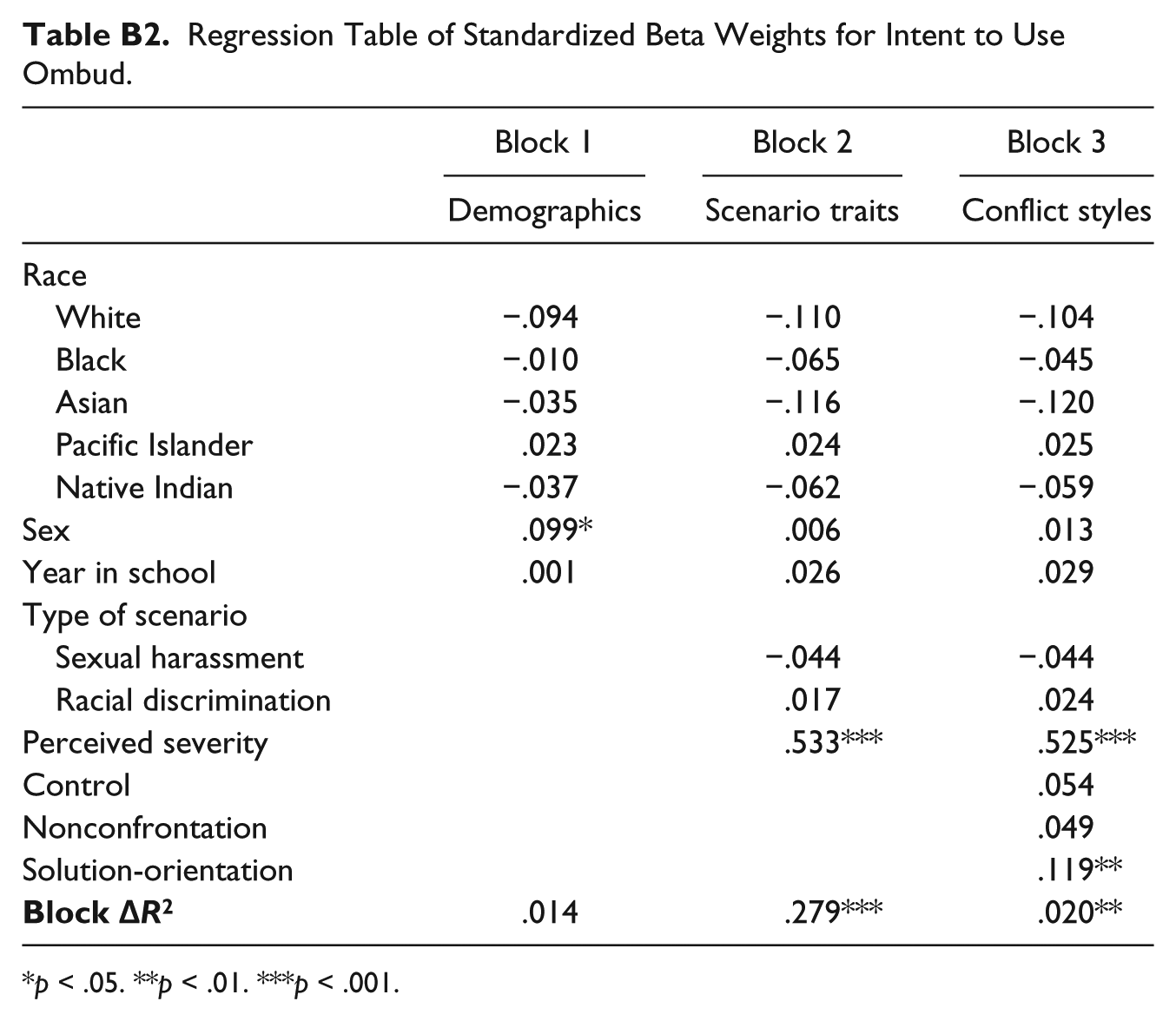
Results for the first demographic block (R2 = .01) found a statistically significant relationship between sex and the intent to use the ombuds system (β = .10, p = .026) such that women are more likely than men to intend to use the ombuds system. This effect disappears in the second block, when conflict scenario type and severity are included in the equation. Results for this second block (R2 = .29) found no statistically significant effects for type of scenario, but perceived severity had a statistically significant positive relationship with the intent to use the ombud system (β = .53, p < .001). Severity still had a significant effect in the third block (β = .53, p < .001) as did solution-orientation (β = .12, p = .002). The effect size for the third block is R2 = .31 with ΔR2 = .02, F(3, 521) = 5.00, p = .002, suggesting that conflict style is also useful for predicting the intent to use ombud systems. Table B2 in Appendix B has the full regressions of conflict style and the intent to use ombuds processes.
Individuals with solution-oriented conflict styles are more likely to intend to use the ombuds system than individuals with either of the other two conflict styles. Thus, even when controlling for perceived severity of the situation, individuals are more likely to seek out the ombud when they are solution-oriented in their conflict style.
Discussion
Other studies have linked perceptions of organizational justice subscales to stable personality traits (e.g., Scott, Colquitt, & Zapata-Phelan, 2007). The findings in this research reinforce the existing literature on conflict styles, provide insight into perceived fairness of university conflict processes, and link conflict style to perceptions of procedural justice. The discussion is organized based on conflict style preferences, followed by a summary of practical implications for ombuds offices and theoretical implications.
Solution-orientation was the only conflict style statistically significant related to procedural justice and the intent to use the ombuds office in cases of conflict. The relationship between this individual difference variable and perceptions of procedural justice is roughly the same as the size of the relationship between severity and perceptions of procedural justice. This suggests that both individual differences and situational variables play a role in conflict, highlighting our original argument that conflict management style is an individual preference. This finding adds to our understanding of how different conflict styles as measured by the OCCI may influence actual conflict practices. It also validates the measure as appropriate for students and professors. In addition, as Harrison (2007) noted, individuals who utilized the ombuds program were more likely to use the process again. This would indicate that, had the individuals perceived conflict and sought an outside conflict specialist, they may have perceived this situation as being successful and would therefore use it again if a similar problem arose. Similarly, if the individual had a positive experience with managing conflict with a boss or high school teacher, the use of conflict management style could produce the confidence that it would work in a similar situation.
Even without prior experiences of conflict, Moberg (2001) noted that solution-oriented styles, particularly confrontation, are linked with openness and conscientiousness. The implication is that solution-oriented students are more likely to be conscientious and therefore may be concerned with resolving the conflict for the sake of their grade. Because these individuals are more likely to be open, they may also be more predisposed to hearing another side’s ideas and thoughts to understand why such a conflict was occurring. These traits, combined with values of finding mutually beneficial solutions, may explain solution-oriented students’ motivation to seek out help from an ombud as well as their perceptions that third parties are just.
Individuals who are more inclined to utilize control styles in conflicts likely want a more forceful tool against their professors. Although it is plausible to expect they might seek out someone perceived as a professor’s “superior,” if the ombud cannot punish the professor, the individual would seek someone who would. Therefore, because the ombud is perceived as “neutral,” this would not appeal to an individual who wants to punish the professor. Another possible explanation could be that participants felt confident enough in their management styles that they presumed that they would not need an ombud if the situation occurred. As noted above, however, control styles had the smallest correlation with perceived severity, indicating that control (at least in this study) may not see a need to utilize the ombud because the conflict is not serious enough.
The results also add to the theoretical literature concerning conflict styles and procedural justice. Prior research has focused on personality traits (Graziano et al., 1996; Moberg, 2001) or situational variables (Marin, Sherblom, & Shipps, 1994; Ohbuchi & Suzuki, 2003). The research here examines how individuals would handle conflict in an unfamiliar situation. The study also assesses how the individual perceives the procedural justice system at their university and their likelihood of using the system.
The study also reinforces knowledge of communication design (Aakhus, 2007; Harrison & Morrill, 2004; Jackson, 1998), indicating that conflict resolution systems designs should be tailored to target users. Those who are not confrontational significantly downplay conflict, although there are many possibilities why individuals would not pursue a conflict in this case. Given the circumstances, the individual may perceive that using the system would not be worth it, either because this method of resolution is inappropriate for the situation or because the relationship is short term, thereby not meriting the time and effort to repair the relationship. However, this may mean their rights are more likely to be violated without recourse.
Universities that have implemented ombuds processes or that are planning to implement processes should consider making it very clear to students what the process is, that the process is available for them to use, and how to utilize it. For instance, being able to tell an individual’s side of the story and get answers about how they were treated has been noted in the literature as a positive outcome of using the ombuds office (Kulik & Holbrook, 2002). Appealing to this side of the process for individuals would be a way for students who are new to college to get acclimated to the college environment.
Individuals who have a solution-oriented style may be predisposed toward meeting a professor halfway about turning in a late assignment, but the professor may have a rigid policy about turning in assignments late, and practices such as going 50–50, giving in a little, or meeting a professor halfway might not work. In this case, working through toward a solution would not be helpful to a student, but an ombuds office would allow the student to tell his or her side of the story and explain how some classroom policies work, giving the student voice for his or her grievance and providing another perspective about university policy from an outside source. For issues that require legal involvement (racial discrimination and sexual harassment), by their job description, the ombud should recommend legal action and explain the rights of the students. Individuals who are solution-oriented would want to understand why such discrimination was occurring and want to work with the professor, so an ombud office would be appealing. Individuals who had control styles most likely would prefer legal action because it is more powerful than a fact-finding ombud. Nonconfrontation individuals may perceive, again, that the situation is not worth following through on or simply want to wait out the semester because this is only a temporary relationship. Or they may choose to leave the university on their own without dealing with it all. Ideally, individuals who take advantage of this process as undergraduates would then look for similar types of offices once they are in the workforce if a problem arises.
As noted above, nonconfrontation preferences may indicate lack of a reason to use an ombud due to the nature of the relationship or that using an ombud just is not worth it. However, sometimes these problems with professors should be reported to help facilitate better communication or address a problem that a faculty member may be oblivious to. Therefore, the role of the ombud should be expanded from beyond simply “conflict resolution” but also include a place for students to ask questions or report problems without getting involved themselves. For instance, if an individual who favors nonconfrontation styles in a particular situation complains to a friend about his or her problems with the professor, the friend may feel more secure about contacting an ombud to alert them of a problem to investigate. Or if the student feels more comfortable talking to another professor outside of the department, that professor may utilize the ombud office to alert them to problems. As noted above, expanding the description of functions of the ombuds office could have positive effects for individual departments, who can be alerted to problems with their faculty. A student may be ignored to protect the faculty member (as was implied in the scenario provided); however, the faculty might be more inclined to listen to another professor if informed that their behavior could have consequences to the individual professor (not receiving promotion) or the entire university (being sued for sexual harassment or racial discrimination).
Although university ombuds offices cater specifically to issues between students and faculty, the general function of the office remains the same for corporations and organizations. Moreover, visiting the ombuds office as an undergraduate may facilitate understanding about power differences in the workforce and clarify what should be done about different types of conflict. For instance, unfair grading may translate to understanding that unfair promotion is a conflict as well and prompt individuals who are so inclined to pursue an outside conflict specialist. This may also minimize employee retaliation in the workplace if they know that these programs are available to them (Bies & Tripp, 2002; Colquitt et al., 2005; Kassing, 2009; Shapiro & Brett, 2005).
Limitations
The study has several limitations. First, participants initially were asked to read a description of a conflict, which may have affected their point of view about conflict and subsequently influenced their responses to the OCCI—even though explicit directions were provided to focus on conflicts in general for this portion of the survey. Second, the OCCI is a self-report measure, which could have social desirability bias, as noted by Wilson and Waltman (1988). In the OCCI, the measure may make certain conflict behaviors more appropriate or cause participants to answer in ways that would make them appear more likely to utilize solution-oriented styles. Overall, solution-oriented styles were reportedly used more frequently than control or nonconfrontation styles, but the difference was not significant. Moreover, the reported styles were consistent with findings that have previously been found in the literature. Third, it is difficult to determine whether perceived power differences between professors and students would affect how they perceive conflict. Fourth, many of the participants were in their first year of college, so many of them may not have been involved in a disagreement with a professor, making these results more optimal than actual. This particular limitation was considered in advance, which is why the authors wrote the scenarios to be as vivid as possible.
It should also be noted that the university where data were collected has no formal ombuds office to handle all of the issues discussed for undergraduates. Instead of one office, there are separate offices and resources that handle grading disputes, sexual harassment, and racial discrimination. Some majors have an ombuds office for their students, and the Office of the Dean offers ombuds services. While it is possible that this lack of a unified ombuds system at the university might influence student responses, prior research shows that most students are unaware of the existence of an ombuds office until they have decided to pursue a conflict and have been directed toward the office. Thus, we think the lack of a unified system likely had minimal effect on student responses.
Finally, although it likely did not account for severity findings, sexual harassment and racial discrimination are highly different from grading issues. In each of the scenarios, participants were informed in each one that they approach the chair of the department, who in some way dismisses their complaint. We intended this to set it up as though the student was unsure about where he or she would go after having the confrontation with the professor and the chair. Ideally, ombud offices would re-direct students with legal cases to a lawyer. However, we also acknowledge that the ombud may want to conduct an investigation first before making a recommendation.
Conclusion
The research presented here provides insight into conflict styles in student–faculty relationships, contributes to conceptualizations of conflict styles, and offers new directions for studying conflicts between students and faculty members. Future directions for the research would be to determine whether there is significance between involvement in a conflict with a faculty member and reported types of conflict management style with a faculty member. In addition, individuals who have gone through the process of reporting a conflict with a professor may have differing views on procedural justice. Further research would also include targeting these individuals and comparing with other students who have not been involved in a conflict with a professor.
Footnotes
Appendix A
Appendix B
Regression Table of Standardized Beta Weights for Intent to Use Ombud.
| Block 1 |
Block 2 |
Block 3 |
|
|---|---|---|---|
| Demographics | Scenario traits | Conflict styles | |
| Race | |||
| White | −.094 | −.110 | −.104 |
| Black | −.010 | −.065 | −.045 |
| Asian | −.035 | −.116 | −.120 |
| Pacific Islander | .023 | .024 | .025 |
| Native Indian | −.037 | −.062 | −.059 |
| Sex | .099* | .006 | .013 |
| Year in school | .001 | .026 | .029 |
| Type of scenario | |||
| Sexual harassment | −.044 | −.044 | |
| Racial discrimination | .017 | .024 | |
| Perceived severity | .533*** | .525*** | |
| Control | .054 | ||
| Nonconfrontation | .049 | ||
| Solution-orientation | .119** | ||
|
|
.014 | .279*** | .020** |
p < .05. **p < .01. ***p < .001.
Acknowledgements
The authors thank the three anonymous reviewers for their suggestions that have improved the quality of the manuscript.
Declaration of Conflicting Interests
The author(s) declared no potential conflicts of interest with respect to the research, authorship, and/or publication of this article.
Funding
The author(s) received no financial support for the research, authorship, and/or publication of this article.