




Abstract
Employee burnout is a critical organizational concern that can be prevalent among customer support workers whose day-to-day tasks inherently include emotional labor. This study examines emotional labor and burnout among call center workers in customer service industries, specifically focusing on the influences of injustices from customers and supervisors. The findings demonstrate that: (a) customer injustice was associated with an increase in emotional labor, which in turn exacerbated customer support workers’ disengagement and exhaustion; (b) interpersonal justice perceived in the interactions with supervisors was negatively associated with disengagement; and (c) procedural justice perceived in supervisors’ decision-making processes was also negatively associated with disengagement. The findings indicate the mitigating role of interpersonal and procedural justice in reducing burnout among customer support workers.
Employee burnout is a critical organizational concern that can be prevalent in customer support industries. People who work in service industries are often required to be sympathetic, understanding, and selfless; however, the pressures related to such job demands may increase the likelihood of burnout (Miller et al., 1988). In fact, early studies of burnout focused on examining the experiences of service workers, conceiving burnout as an outcome of “cost of caring” or “job-related interpersonal stress” (Maslach, 1982, p. 14). Working along the frontline, customer support workers are positioned to face a range of stressors that stem from their communication with customers and supervisors. As opposed to, for example, knowledge workers whose job involves extensive peer-to-peer collaboration, customer service workers (e.g., call center workers) interact primarily with customers and supervisors, often through one-on-one conversations. The quality of relationships with customers and supervisors could therefore substantially shape customer support workers’ well-being.
Highlighting this concern, this study investigates potential antecedents of burnout by attending to call center workers’ perceptions of justice enacted by their customers and supervisors. Specifically, we draw on the multifoci model of organizational justice to interrogate the perceived quality of such interactions and its effects on burnout. Employees’ justice perceptions are particularly salient in the context of customer support industries in which emotional labor is widely prevalent and ingrained in daily work practice (Hochschild, 1979). Because of the nature of service work, customer support organizations regularly expose their workers to potential injustices from customers (Rupp & Spencer, 2006). Unfair treatment and expectations from customers can prompt organizational members to feel anger and guilt (Spencer & Rupp, 2009) and even thoughts of revenge or sabotage (Skarlicki et al., 2008). Additionally, supervisors can be also a significant source of interpersonal job demands and emotional exhaustion (Wilk & Moynihan, 2005). If customer service workers continue to fulfill their job expectations while enduring emotional labor and unjust treatment, they are more likely to become vulnerable to burnout.
Our study seeks to disentangle the potential precursors of burnout among customer support workers by investigating the extent of justice manifested in their interactions with customers and supervisors. First, we examine customer injustice and its influence on emotional labor performed by customer support workers, which may subsequently increase burnout. Second, we investigate interpersonal and procedural justice dimensions that are particularly relevant to perceived fairness in supervisor-subordinate relationships in service work (Simons & Roberson, 2003). Third, we delve into how justice perceptions are associated with burnout and may ameliorate the adverse effects of emotional labor.
To pursue these goals, we conducted our study among call center workers in the customer support sector in South Korea, whose day-to-day tasks are customer-oriented and emotion-laden by design. Customer injustice experienced by call center workers has recently emerged as a crucial social concern in South Korea. A large corporation even started a nationwide campaign to urge civility and kindness, explicitly invoking the emotional labor among call center workers. The campaign proposed some creative ideas about initial voice instructions provided before being transferred to a customer service representative. Their voice instructions included: “My mum, who I love the most in the world, will help you soon” or “My loving, dear wife will help you in a moment” (Mumbrella, 2017, para. 5). This approach had been adopted by more than twenty organizations in South Korea that later reported that verbal abuse targeting call center workers noticeably decreased. Considering this urgent social and organizational problem, we look into the role of organizational justice in mitigating burnout among customer support workers who are expected to cope with substantial emotional challenges every day.
The Multifoci Model of Organizational Justice and Burnout
To ensure a holistic investigation of organizational justice as a potential antecedent of burnout, this study is situated within and builds upon the multifoci model of organizational justice (Rupp & Cropanzano, 2002). Contrary to a conventional approach concentrating on supervisors’ fair treatment, the multifoci model of organizational justice acknowledges that workers construct their justice perceptions based on evaluations of multiple targets such as organizations, supervisors, and coworkers. Organizational justice researchers later included customers as a source of justice perceptions to further extend the model, particularly with respect to service work (Rupp & Spencer, 2006). As such, the multifoci model demands accountability from multiple entities in an examination of the consequences of their behaviors that may improve or impede justice in the workplace (Rupp, 2011).
The multifoci model of organizational justice is a useful theoretical framework in the study of customer support organizations. Unlike other occupations where interactions mainly take place within teams or among peers, customer support work is strongly focused on customer interactions, which are directly linked to employees’ performance and emotional labor (Rupp & Spencer, 2006). Rather than excluding external entities, the multifoci model of organizational justice orients scholars to consider customers a potential source of (in)justice. Additionally, the present study regards supervisors as another primary source of justice perceptions among customer service workers. Contrary to team-based occupations that center around peer-to-peer collaboration or knowledge sharing, customer support workers such as call center employees have less chance to communicate with other workers (e.g., strictly-controlled lunches or break times). However, call center workers must contact their supervisor multiple times a day primarily through one-on-one channels to relay customer complaints or comments, solicit clarifications regarding customer inquiries, and report their performance. Given our research context, we examine the effects of (in)justices from customer support workers’ two primary communication counterparts—customers and supervisors—on burnout.
Since the scholarship of burnout formally emerged (Maslach, 1982), scholars have generally agreed that burnout is a multidimensional construct that encompasses various symptoms, despite different conceptualizations and measurements. Along this line, Demerouti et al. (2003) proposed that burnout includes two core dimensions: disengagement and exhaustion. Disengagement is viewed as distanciation from one’s work, tasks, or job, which reflects employees’ overall job attitudes and identification. Exhaustion refers to a consequence of intensive physical, affective, and cognitive strain, which indicates a long-term effect of prolonged exposure to certain job demands. Each dimension can be viewed as a continuum: disengagement-engagement and exhaustion-vigor (Demerouti et al., 2010).
Given the negative ramifications of employee burnout, a number of studies have strived to identify its potential antecedents. Prior scholarship has demonstrated that exhaustion and disengagement are related but independent constructs, sometimes correlating with disparate antecedents and outcomes. For example, high or unfavorable job demands were primarily linked to exhaustion whereas limited job resources were often associated with disengagement (Demerouti et al., 2001). A meta-analysis study reported that employees with low levels of control and professional identification showed more intense emotional exhaustion (Lee et al., 2011). A recent study of healthcare professionals showed that job characteristics, such as hours of patient contact via different media and hours of overtime, had different relationships with emotional exhaustion and disengagement, depending on professional occupations (Westwood et al., 2017).
We contribute to the burnout scholarship by adopting a justice angle to investigate the antecedents of burnout and emotional labor. Employees’ justice perceptions with respect to both targets have not been studied in tandem in the context of emotional labor and burnout. Skarlicki et al. (2016) reported that both customer justice and supervisor justice can affect frontline service workers’ customer-directed sabotage, which was also replicated in a sample of South Korean employees. Expanding this scholarship, the current study examines both supervisors and customers as key parties that dynamically shape employees’ perceptions of organizational justice, which in turn affect the extent of burnout. Specifically focusing on customer support workers, our study elucidates how fair treatment at work may mitigate burnout, especially under the condition of constant demands of emotional labor and customer injustices.
The Effects of Customer Injustice and Emotional Labor on Burnout
Emotional labor involves the suppression or change of emotional displays to meet the needs of a customer, situation, and/or organization (Hochschild, 1983). Customer service organizations expect their employees to adhere to strict interaction rules (e.g., always appear courteous and approachable) (Grandey, 2003). Such expectations make service workers subject to surface acting, a core dimension of emotional labor. Surface acting occurs when “we are capable of disguising what we feel, of pretending to feel what we do not” (Hochschild, 1983, p. 33). The ability to self-regulate and “fake” emotions is arguably a cornerstone in service organizations, where emotional display rules are normative (Waldron, 2012). Organizational expectations for surface acting remain intact even in cases of customer injustice, such as unfounded complaints, verbal aggression, and displaced blame toward customer service workers (Bougie et al., 2003; Spencer & Rupp, 2009). Customer injustices are also likely to engender negatively-valenced emotions in employees. Among the wide gamut of emotional experiences, workers are most likely to focus their emotion management efforts on hiding feelings of agitation (Erickson & Ritter, 2001). To fully comply with normative rules while facing customer injustices, customer support workers must hide negative emotions and wear a positive emotion instead—a feat only possible through surface acting. Therefore, our first hypothesis is:
H1: Customer injustice is associated with an increase in surface acting.
Surface acting may beget burnout, which is essentially the consequence of chronic mental and emotional stress (Maslach & Jackson, 1981). In particular, disengagement, a key dimension of burnout, may transpire when workers feel emotionally distant from their work in relation to their specific job roles or customers (Demerouti et al., 2010). Customer support workers may find it difficult to identify with their work when they are constantly experiencing emotional and cognitive dissonance through surface acting. In fact, surface acting is inversely associated with job satisfaction (Pugh et al., 2011). Employees may even purposefully begin to distance themselves from work as a way of lowering the costs of emotional labor (Tracy, 2005). Customer support workers are also known for adopting attitudes of “detached concern” and cynicism as a method of coping with emotional stress (Maslach et al., 2001, p. 400). Thus, we propose the following:
H2: Surface acting is associated with an increase in disengagement.
Given that surface acting involves the presentation of inauthentic emotions (Miller et al., 2007), it is unsurprising that surface acting is positively linked to emotional exhaustion over time (Miller & Koesten, 2008; Pugh et al., 2011). Emotional labor through surface acting is a primary job demand among customer support workers. An extensive amount of customer interactions in a typical workday is also viewed as another job demand (Maslach et al., 2001). It has been reported that job demands increase the risk of burnout; further, the risk is doubled when job demands are perceived as unfavorable (Demerouti et al., 2001) or as hindrances that do not contribute to personal growth (Crawford et al., 2010). As the combination of emotion work and other organizational and social stressors significantly augments levels of emotional exhaustion (Zapf et al., 2001), surface acting may also contribute to exhaustion. In fact, a study of service workers in South Korea revealed that customer-related stressors exacerbate negative affectivity and exhaustion (Lee et al., 2012). Surface acting also significantly contributed to emotional exhaustion and turnover intention among flight attendants in South Korea (Hur et al., 2016). When customers act in uncivil manners, customer support workers’ exhaustion increases and their ability to remain civil in interactions suffers (van Jaarsveld et al., 2010). Hence, increased emotional labor may exacerbate the degree of exhaustion:
H3: Surface acting is associated with an increase in exhaustion.
The Effects of Organizational Justice on Burnout
Organizational justice, defined as “the perceived adherence to rules that reflect appropriateness in decision contexts” (Colquitt & Zipay, 2015, p. 76), is vital for the survival and thriving of any workplace. By functioning as a relational glue, organizational justice influences a variety of positive workplace outcomes such as increased organizational commitment, organizational citizenship behaviors, and decreased conflict levels (Cropanzano et al., 2007). Employees who experience injustice at work are more likely to exhibit psychological withdrawal and exhaustion over time (Whiteside & Barclay, 2013), resulting in concerning levels of exhaustion and cynicism that can negatively affect mental and physical well-being (Maslach & Leiter, 2008). In contrast, workers in fair environments display patterns of increased engagement and decreased burnout. As such, scholars have increasingly studied the role of organizational justice in promoting employee health (Fujishiro & Heaney, 2009).
Interpersonal and procedural justice dimensions are particularly salient in examining the perceptions of fairness in customer support workers’ interactions with their supervisors (Simons & Roberson, 2003). Interpersonal justice refers to communicative criteria of fairness, or the perceived fairness of interpersonal treatment during the decision-making enactments, specifically in terms of respect and propriety of interactions (Bies & Moag, 1986). Workers are more likely to view their managers as interpersonally fair when managers demonstrate empathic concern (Patient & Skarlicki, 2010) and phrase their feedback in positive ways (Westerman & Westerman, 2013). Namely, the qualities of communication (i.e., respect, dignity, and politeness) represent the heart of interpersonal justice (Colquitt, 2001).
Prior research has demonstrated that interpersonal justice may decrease burnout. Maslach et al. (2001) proposed that burnout occurs when there is a mismatch between an individual and the fairness domain of job environments, centering on the ideas of mutual respect and enhancement of each other’s self-worth through communication. Violations of interpersonal justice are thus likely to result in symptoms of burnout at work. Conversely, organizations that match an individual’s expectations for interpersonal justice are more likely to foster engagement and well-being at work. Indeed, higher perceptions of organizational justice increased workers’ trust and commitment to the organization (Cropanzano et al., 2007). In a study of hotel service employees in China, interpersonal justice from supervisors reduced negative emotion (Lam & Chen, 2012). As such, we suggest the following:
H4: Interpersonal justice is associated with a decrease in disengagement.
H5: Interpersonal justice is associated with a decrease in exhaustion.
Procedural justice, or the perceived fairness of decision-making processes (Thibaut & Walker, 1975), can also have a profound impact on individuals’ organizational experiences. Procedural justice is positively associated with organizational commitment (McMillan & Albrecht, 2010) as well as perceived supervisor support (Campbell et al., 2013). Perceptions of organizational and supervisor support in procedural matters are inversely associated with various consequences of burnout, including emotional exhaustion, depersonalization, and a diminished sense of personal accomplishment (Campbell et al., 2013). In a study of Korean flight attendants, perceived procedural justice was also positively related to positive psychological capital, which may be effective in combating the consequences of burnout (Hur et al., 2016). Taken together, these findings indicate that procedural justice facilitates positive regard for employees, which may serve as a powerful buffer against burnout. Building on this logic, we hypothesize:
H6: Procedural justice is associated with a decrease in disengagement.
H7: Procedural justice is associated with a decrease in exhaustion.
Finally, our last hypothesis concerns the relationship between the two outcome variables (disengagement and exhaustion) explored in this study. As these two dimensions of burnout are independent yet interrelated in some cases (Demerouti et al., 2010), we propose that disengagement and exhaustion are positively linked to each other. Although both are likely to manifest under unjust conditions, exhaustion is framed as a long-term effect of prolonged exposure to certain job demands such as emotional labor (Demerouti et al., 2003). Based on prior scholarship, we suggest that disengagement is positively related to exhaustion (Figure 1).

Hypothesized model.
H8: Disengagement is positively associated with exhaustion.
Method
Research Context
In South Korea, the intensity of emotional labor performed by call center workers has been known to be quite severe mainly because of frequent episodes of verbal aggressions. To conduct this study, the first author obtained permission from an online community of South Korean call center workers. Civic activists and social workers who managed the community verified members’ identity using personal information such as their legal name, official work email, and mobile phone number. As all members’ personal information was validated by community managers, this online community was viewed as a safe haven in which members could share their experiences without risks of information leaks or retributions. Not surprisingly, it was difficult to secure access to the community and obtain permission to circulate our online survey. The first author had been in touch with community managers for months to build rapport before distributing the survey. In contrast to other open access online venues, this community was an ideal research site that eliminated concerns about unverified identities or inauthentic responses that might stem from distrust or a fear of potential detrimental outcomes of study participation.
Data Collection
Upon the approval by the institutional review board at the authors’ institution, the online survey hosted on Qualtrics was distributed within the community in June 2019. The informed consent indicated that the survey was anonymous; participation was voluntary; and only aggregated results at the group level would be reported. The informed consent and survey questions were translated into Korean by the first author. Both documents were back-translated and certified by a researcher who was a native speaker of Korean. Participants were entered into a raffle to win 1 of 30 Starbucks e-gift certificates as a participation incentive. In total, 212 participants completed the survey.
Measures
Customer injustice
The customer interpersonal injustice scale (Skarlicki et al., 2008) was adapted to assess the levels of injustice customer support workers perceived during their communicative interactions with customers. This eight-item Likert-type scale (1 = never, 5 = frequently) consisted of statements such as “refused to listen to you,” “interrupted you,” “yelled at you,” “used condescending language,” and “spoke aggressively to you” (M = 3.04, SD = .86, α = .88).
Surface acting
To investigate customer support workers’ emotional labor, the surface acting scale was employed (Diefendorff et al., 2005). The scale included seven items that described emotion workers’ various surface acting strategies while dealing with customers, such as “I fake a good mood when interacting with customers” and “I put on a ‘mask’ in order to display the emotions I need for the job.” Participants rated the statements based on a five-point Likert-type scale ranging from 1 = strongly disagree to 5 = strongly agree (M = 3.99, SD = .91, α = .92).
Organizational justice
The interpersonal justice scale and the procedural justice scale developed by Colquitt (2001) were employed. Participants were prompted with instructions that primed them to think of their supervisors who were job-related decision-making authorities (e.g., for promotions, incentives, penalties). Both scales were based on a five-point Likert-type instrument, ranging from 1 = to a small extent to 5 = to a large extent. The interpersonal justice scale included four items about fair communicative treatment by supervisors such as “have they treated you with dignity?” and “have they refrained from improper remarks or comments?” (M = 2.87, SD = .92, α = .90). The procedural justice scale presented seven questions regarding the fairness of procedural enactments related to job-related decision-making outcomes such as “have those procedures been applied consistently?” and “have those procedures been free of bias?” (M = 2.39, SD = .84, α = .91).
Burnout
The Oldenberg Burnout Inventory (OLBI: Demerouti et al., 2010) was used in our study. OLBI has been one of the most widely used measurements of burnout across disciplines. OLBI was originally written in German and has been extensively tested and examined in non-Western contexts including Asian and African countries (Demerouti et al., 2010). The OLBI consisted of eight items for disengagement and exhaustion, respectively. This 16-item instrument was assessed drawing on a Likert-type scale (1 = strongly disagree, 5 = strongly agree). Sample items for disengagement included: “It happens more and more often that I talk about my work in a negative way” and “sometimes I feel sickened by my work tasks” (M = 3.43, SD = .77, α = .82). Sample items for exhaustion included: “During my work, I often feel emotionally drained” and “after my work, I usually feel worn out and weary” (M = 3.87, SD = .72, α = .81).
Participant Demographics
We collected minimal demographic information to respect and protect the members of the online support community. Reflecting the common characteristics of the customer service industries, 147 respondents identified themselves as a woman (69%). The rest of respondents identified themselves as a man. No one indicated their gender as non-binary. Also, respondents were relatively young, in comparison to other industries. No respondents were sixty years or older. Eleven respondents were in their fifties (5%); 29 were in their forties (14%); 106 were in their thirties (50%); and 66 were between 19 and 29 (31%). Finally, regarding employment status, 178 participants were in a permanent position (84%) whereas 34 participants were in a temporary position.
Data Analysis
As preliminary analyses, bivariate correlations among all study variables were performed (see Table 1). For primary analyses, we performed maximum likelihood structural equation modeling (SEM) in AMOS 25 to investigate whether the hypothesized model fits the observed data. Before testing the measurement and hypothetical models, we imputed occasional missing data of nine cases based on maximum likelihood estimation (Allison, 2003). Therefore, the final data set did not have any missing values (N = 212). Additionally, for the latent variables that consisted of six or more indicators, we created three parcels per each latent factor by adopting random assignment as all factors were unidimensional and items contained roughly equal common factor variance (Little et al., 2002, 2013). Consistent with the two-step modeling procedures outlined by Kline (2011), a confirmatory factor analysis (CFA) was conducted using a measurement model that included all study variables. In turn, the final empirical model was tested to ascertain whether the proposed model fits observations. Finally, as our hypothesized model suggested that emotional labor mediated the relationship between customer injustice and the two dimensions of burnout, we performed bootstrapping to corroborate indirect effects. Based on 10,000 bootstrap resamples, we computed indirect effects, whose significance is determined by examining bias-corrected and accelerated 95% confidence intervals (CI) (Hayes, 2018).
Bivariate Correlations Among Study Variables.

p < .05. **p < .01. ***p < .001.
Results
A CFA of six-factor measurement model demonstrated an excellent fit: x2 (174, N = 212) = 262.67, CFI = .97, SRMR = .05, RMSEA = .05 (90% CI: LO = .037, HI = .062), p < .001. For all latent variables, manifest indicator loadings ranged from .68 to.91. Subsequently, the hypothesized model was tested using SEM with maximum likelihood estimation procedures. The results also indicated an excellent model fit: x2 (178, N = 212) = 271.43, CFI = .97, SRMR = .06, RMSEA = .05 (90% CI: LO = .038, HI = .063), p < .001. All but two path coefficients included in the final model were significant. As proposed, customer injustice was associated with an increase in surface acting (H1). In turn, surface acting was positively related to disengagement (H2) and exhaustion (H3). Both interpersonal justice (H4) and procedural justice (H6) had negative relationships with disengagement. Also, disengagement was positively associated with exhaustion (H8). However, neither interpersonal justice (H5) nor procedural justice (H7) significantly reduced exhaustion. For all estimates and accounted variances (see Figure 2). Next, bootstrapping procedures revealed significant indirect effects for mediation paths implied by the model. For indirect effects (see Table 2).
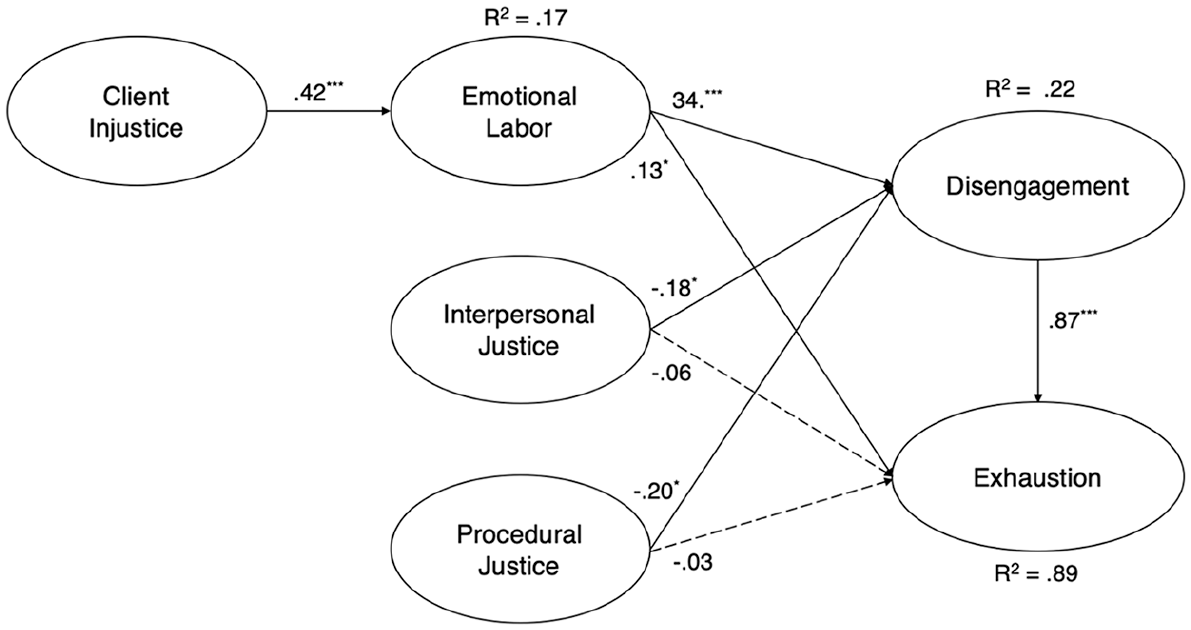
Final empirical model.
Indirect Effects on Burnout.

p < .001.
Discussion
We investigated the influence of customer injustice and supervisory justice on burnout among South Korean customer support workers whose job inherently demands substantial emotional labor. Our findings revealed that customer injustice increased emotional labor, which was positively associated with the two core symptoms of burnout: disengagement and exhaustion. Interpersonal and procedural justice in relationships with supervisors were linked to a decrease in disengagement but not in exhaustion. These findings may imply that perceived fair interactions with supervisors were not necessarily efficacious for ameliorating exhaustion, a long-term consequence of emotional labor. Finally, disengagement was positively related to exhaustion.
Theoretical Contributions
Our study makes significant contributions to the scholarship of burnout and emotional labor by examining the positive impacts of justice that can be achieved through communicative relationships and interactions at work. Interpersonal justice has been conceived as a communicative dimension of organizational justice (Bies, 2015), while procedural justice can be promoted and constructed by managers’ communicative tactics, feedback, and rapport management (Garner & Dougherty, 2017). Although contemporary workers increasingly demand fair practices (Rupp, 2011), scholars have yet to scrutinize the different types of justice enacted by multiple parties to capture a holistic understanding of workers’ experiences of justice and the influence of justice on burnout. Further, although organizational justice has been studied in Asian contexts such as China and South Korea (Lam et al., 2002; Skarlicki et al., 2016; Zhou et al., 2017), multiple types of justice have not been investigated in conjunction with one another and with respect to employee well-being. As moral evaluations and justice judgment are critically important in shaping life experiences across cultures (Bisel, 2017), more studies of justice are needed in diverse cultural contexts.
With respect to burnout, it is relatively unknown how fair treatment and just interactions (or lack thereof) at work may ameliorate or mitigate burnout. Our study demonstrates the positive influences of interpersonal and procedural justice on employee engagement, which calls for further research on the characteristics, enactments, and effects of organizational justice. Given their high level of communication, customer service workers tend to face a range of job demands that could be irregular or fluctuating depending on their daily tasks or unusual customer demands, which may subsequently increase emotional labor and burnout. However, if their interactions with customers and supervisors are just, those interactions can make their work experiences more positive, rewarding, and self-validating (Colquitt, 2001; Colquitt et al., 2013). Especially when employees suffer from overwhelming job demands or depleted job resources, interpersonal and procedural justice provided by supervisors can function as social support in times of need (Campbell et al., 2013). Interpersonal justice encompasses various communicative criteria of justice such as respectfulness, politeness, and empathetic communication (Bies, 2001). Such communicative enactments performed by supervisors could be powerful enough to help employees perceive their work to be more meaningful and valuable. Also, when supervisors’ decision-making procedures are enacted and completed in a just way, workers can reduce uncertainty and experience enhanced feelings of safety, trust, and morality (Colquitt & Zipay, 2015), which can promote job engagement.
Our study also contributes to the emotional labor scholarship by examining communicative sources of emotional labor from a justice perspective. Our study showed that unjust practices from customers, which consisted of a diverse set of communicative enactments that we assessed (e.g., refusing to listen, interrupting, yelling, using condescending language, and speaking aggressively), were directly linked to an increase in emotional labor. Such profound influence of justice in everyday communication should be further explored to reveal its relationships with emotional behavior, employee health, and other organizational outcomes. Although our study focused only on the impact of customer injustice on emotional labor, communicative injustice from other organizational stakeholders (e.g., higher executives, peers) may also affect employees’ emotion work and management. Specifically, communication scholars can make substantial contributions to organizational justice research by looking into actual communicative interactions, enactments, discourses, or even non-verbal behaviors. We call for further research on justice in communicative enactments that may be a critical antecedent of organizational behaviors and outcomes (Bies, 2015).
Practical Implications
Due to customer injustices and high expectations for surface acting, customer support workers are at risk of suffering from burnout. Potential consequences like disengagement and exhaustion should motivate managers to cultivate organizational justice, especially in manager-employee interactions (interpersonal justice) and communication about decision-making processes (procedural justice). It is critical to communicatively enact justice through everyday interactions and procedural enactments. In particular, customer support workers are typically in low-status positions with limited discretion and autonomy as well as strict pre-defined duties and demands, which could in turn decrease participation (Kim, 2018). Indeed, a recent study has found that interpersonal justice from supervisors can mitigate the negative impact of status disparities (Kim & Kiura, 2020). Managers should be respectful and polite in their communication (Colquitt, 2001), particularly when interacting with low-status employees or workers burdened with emotional labor and stress. Supervisors can promote interpersonal justice by being mindful of language choices and avoiding messages that threaten employee autonomy (Campbell et al., 2007). Strategic communication choices can also enhance procedural justice. Supervisors’ demands and threats tend to lower procedural justice, whereas affirming messages of praise and sympathy may increase procedural justice (Garner & Dougherty, 2017). These communicative adjustments can cultivate a fair and inclusive organizational climate that can mitigate burnout.
In addition, organizations should overhaul the resources that are available to employees suffering from burnout. Managers may be tempted to simply offer training in emotion management and coping mechanisms. Although such efforts can be helpful to some extent, emotion management training alone sends a message that emotional labor is an inevitable responsibility to be shouldered alone (i.e., a matter of individual capability). Instead, emotion management training should be a supplement behind formal efforts and organizational policies that provide various structural support. Specifically, perceived organizational support can buffer the negative effects of heavy workloads on employee well-being (Nahum-Shani & Bamberger, 2011). Given the positive association between procedural justice and perceived organizational support (McMillan & Albrecht, 2010), managers should highlight available resources and procedures for employees experiencing burnout.
Limitations and Future Directions
This study is not without limitations. First, as a cross-sectional study, our findings have limited generalizability. A longitudinal design may produce more robust findings illustrating how the continued experiences of organizational justice can substantively promote employee well-being over time. For example, future studies could interrogate how exhaustion, a longitudinal effect of job demands, can be mitigated by continued practices of interpersonal and procedural justice. Second, this study did not look into actual communicative interactions among customer service workers, supervisors, and customers. Qualitative forms of inquiry can bring rich descriptions regarding specific mechanisms through which organizational justice can improve various aspects of employee work-life. As workers form their perceptions of justice primarily through everyday communication, future studies could investigate how justice is discursively enacted in various relationships, situations, and dialogues.
Footnotes
Acknowledgements
The authors are indebted to Dr. Rebecca Meisenbach, Dr. Ryan Bisel, and the two anonymous reviewers for their helpful feedback.
Declaration of Conflicting Interests
The author(s) declared no potential conflicts of interest with respect to the research, authorship, and/or publication of this article.
Funding
The author(s) disclosed receipt of the following financial support for the research, authorship, and/or publication of this article: This work was supported by the Ministry of Education of the Republic of Korea and the National Research Foundation of Korea (NRF-2018S1A3A2075237).
