



Abstract
The authors define family–business embeddedness as confluence of values and objectives stemming from the overlapping institutional contexts—family, business, and symbolic—in the family firm. Hence, the family–business embeddedness perspective investigates the effect of integrating divergent institutional values and objectives, economic and noneconomic, on family firm’s performance. The authors contend that family–business embeddedness and work centrality will magnify family employees’ job satisfaction, whereas superior job alternatives will produce an opposite effect. In turn, job satisfaction will be negatively related to family employees’ turnover intentions. A survey of 111 family employees from 70 family firms in the United States supported the hypotheses.
Keywords
In the family business literature, family and business are often contrasted as two opposite and yet overlapping value systems or institutions whose interface customarily produces negative consequences (Lansberg, 1983). This approach is known as the theory of institutional overlap in family studies (Lansberg, 1983). Along similar lines, scholars have recently argued that business embeddedness (family executives’ embeddedness in the family business) and family embeddedness (family executives’ embeddedness in their family) have contrary effects on family executives’ commitment and governance (Le Breton-Miller & Miller, 2009). According to this approach, business embeddedness helps overcome agency conflicts and motivates stewardship behavior, whereas family embeddedness incites agency conflicts and discourages stewardship behavior (Le Breton-Miller & Miller, 2009). The theory of institutional overlap (Lansberg, 1983) suggests that productive synthesis of business values and family values is only possible at early stages of venture development. Similarly, family embeddedness and business embeddedness described as conflicting orientations would be difficult to integrate (Le Breton-Miller & Miller, 2009). Conversely, other scholars argue that family embeddedness facilitates generation of socioeconomic wealth, or realization of noneconomic objectives expressing family firms’ identity (Cruz, Justo, & Castro, 2012).
At times, family values and business values and, likewise, family embeddedness and business embeddedness may certainly diverge and create conflict (Steier, Chua, & Chrisman, 2009). However, we contend in this article that the interface of family embeddedness and business embeddedness could be synergistic. If so, a productive synthesis of business embeddedness and family embeddedness could be imperative for the family firm’s survival, prosperity, cross-generational sustainability, and longevity (Chua, Chrisman, & Sharma, 1999; Le Breton-Miller & Miller, 2006). To describe such productive synthesis of family embeddedness and business embeddedness, we introduce a new notion of family–business embeddedness defined as confluence of values stemming from divergent institutional contexts—family, business, and symbolic—within the family firm. The key argument in this article is that family–business embeddedness enhances family employees’ job satisfaction and thus helps reduce turnover intentions. This is because family–business embeddedness is likely to reduce frustration and hostility because of conflict between various institutional dimensions of the family firm, conflict that often arises and may have negative consequences for the family firm’s cohesion and employee satisfaction (Boyar, Maertz, Pearson, & Keough, 2003; Ensley & Pearson, 2005; Ensley, Pearson, & Sardeshmukh, 2007; Kellermanns & Eddleston, 2004).
Prior research has shown that value congruence is related to family firms’ ethical focus (O’Boyle, Rutherford, & Pollack, 2010). Correspondingly, we propose that value congruence between and among various institutional contexts in which the family firm is immersed measures family–business embeddedness. Since family–business embeddedness is likely to decrease cognitive dissonance (Festinger, 1957) arising when values collide, it could also increase job satisfaction. Family employees that view their work tasks and responsibilities as congruent with their family and symbolic values encapsulated in the family firm’s vision and founder’s dream are prone to be satisfied with their job and view it as meaningful, important, and exciting. In addition, we contend that work centrality defined as “the beliefs that individuals have regarding the degree of importance that work plays in their lives” (Paullay, Alliger, & Stone-Romero, 1994, p. 225) represents a pertinent dispositional variable to measure family employees’ job satisfaction.
The notion of work centrality, as we argue in this article, is highly relevant to family firms since some family employees may choose the family business as a safe haven after failing to establish themselves in other lines of work they could view as more germane to fulfilling their aspirations. Moreover, some family employees might simply be more engaged in pursuit of other interests, unrelated to work, and take a job in the family firm complying with the family’s expectations. Naturally, such family employees’ job satisfaction could be quite low. Therefore, a number of family employees may stay with the family firm because of “imperative commitment” (Sharma & Irving, 2005), that is, a type of continuance commitment growing out of necessity or lack of other employment opportunities rather than stemming from affective or normative commitment (Allen & Meyer, 1990; Meyer & Allen, 1991).
In contrast, the most talented firm employees that could easily find employment elsewhere may stay with the family firm because their equity stake and prospects make it a better investment for them compared with alternative job opportunities. Such employees may develop “calculative commitment” (Sharma & Irving, 2005) rather than affective or normative commitment (Meyer & Herscovitch, 2001). However, if the long-term benefits of staying with the family firm pale in comparison with the benefits of other available jobs, calculative commitment could favor leaving over staying with the family firm. To measure this effect, we introduce the notion of superior job alternatives. Prior studies used the concept of “alternative employment opportunities” to probe the respondent’s confidence that he or she could obtain an equally good or even better job (Griffeth, Hom, & Gaertner, 2000). In contrast, superior job alternatives may assess family employees’ perception that they are being underpaid and could be better off elsewhere.
Overall, the key contribution of this article is that it clarifies the role of factors specific to the family firm in affecting family employees’ job satisfaction and turnover intentions. These include a contextual variable related to the family firm’s internal environment—family–business embeddedness—that explains why it is especially important for the family firm to build value congruence between its overlapping but divergent institutional contexts. These factors also include a contextual variable related both to the family firm’s external environment and internal environment: superior job alternatives. It sheds light on the ability and willingness of the family firm to provide sufficient compensation to its employees in comparison to the competition. Finally, the third variable is dispositional: work centrality. It helps explain why family employees that do not view work as central to their lives may not be satisfied with their jobs, whereas others could be satisfied with their jobs even in the presence of superior job alternatives. This article is based on a survey of more than 100 family employees from 70 firms located in the western part of the United States. Most businesses in the sample are profitable and successful. Consequently, our sample is more representative of the upper segment of the family firms’ population.
Job Satisfaction in the Family Firm: The Role of Family–Business Embeddedness
Based on literally thousands of studies, the theory of turnover intentions asserts that “job satisfaction directly and negatively relates to employees’ intentions to quit their jobs (i.e., turnover intentions), which in turn positively relate to actual turnover” (Chen, Ployhart, Thomas, Andersen, & Bliese, 2011, p. 159). Turnover intentions represent one of the most researched topics in the organizational behavior literature. Still, a number of questions remain and even some key predictors appear problematic (T. H. Lee, Gerhart, Weller, & Trevor, 2008). Thus, scholars continue to scrutinize if extant theories have sufficiently explained “why, how, and when changes in job satisfaction exert unique influences on turnover decisions” (Chen et al., 2011, p. 159).
Overall, studies of turnover intentions have shown the importance of both “proximal precursors” in the withdrawal process including “job satisfaction, organizational commitment, job search, comparison of alternatives, withdrawal cognitions, and quit intentions” and—to a lesser extent—the influence of distal precursors encompassing the characteristics of work environment as well as a number of some additional “factors external to the firm, such as alternative job opportunities” (Griffeth, Hom, & Gaertner, 2000, p. 483). More recently, job embeddedness theory has examined the psychological reasons why people may choose to stay with an organization (Felps et al., 2009; T. R. Mitchell, Holtom, Lee, Sablynski, & Erez, 2001). The construct of job embeddedness represents a composite measure that encompasses (a) “links” (formal and informal connections with other people and the organization as a whole) that triggers the normative pressures to stay with the company, (b) “fit” (employee’s perceived compatibility with an organization), and (c) “sacrifice” (the perceived loss of tangible and intangible benefits because of leaving; T. R. Mitchell et al., 2001).
Curiously, few studies have examined turnover intentions in family firms (Boles, 1996; J. Lee, 2006; Memili & Barnett, 2008). The findings were largely the same as those established in broader research on nonfamily firms. Although some scholars conjectured that factors unique to family firms, such as family cohesion, would affect job satisfaction, the hypotheses were not supported (J. Lee, 2006). We believe that the difficulties prior research has experienced in trying to capture the effect of family firm–specific factors on job satisfaction and turnover intentions can be explained by that the frameworks and concepts they employed (e.g., family cohesion) were not quite suitable for such examination. To resolve this problem, we study family employees’ job satisfaction and turnover intentions from a new perspective of family–business embeddedness as a more appropriate tool for capturing family firms’ uniqueness and heterogeneity.
We propose that both family embeddedness (the embeddedness of entrepreneurs or family executives in their family; Aldrich & Cliff, 2003; Le Breton-Miller & Miller, 2009; Steier et al., 2009) and business embeddedness (the embeddedness of entrepreneurs or family executives in their business; Le Breton-Miller & Miller, 2009) as well as their apt interface and integration are critical to the family firm’s employees’ experience of job satisfaction. As emphasized in prior family business research (Chua, Chrisman, & Steier, 2003; Lansberg, 1983; Sharma, 2004; Steier, 2001a, 2001b, 2003), “family firms are embedded in social structures that differ substantially from those of nonfamily firms.” It is important that “while these social structures can be sources of strength, they can also lead to dysfunctional consequences” (Steier, Chua, & Chrisman, 2009, p. 1157).
Theory of institutional overlap (Lansberg, 1983) first brought attention to the hybrid nature of the family firm combining two opposite and often conflicting value systems—business and family. The key contentions of the theory of institutional overlap can be summarized as follows: (a) family firms exist on the boundary of the family and the business as two distinct social institutions each replete with unique values, norms, principles, and rules of conduct; (b) the differences between these two institutions stem from their divergent social functions: “to assure care and nurturance of its members” (family) and to generate “goods and services through organized task behavior (business); (c) the primary functions of family and business as diverse institutions are reflected in their relationship structure: relationships within families are structured to satisfy their members’ development needs, whereas relationships within businesses are structured to facilitate the productive process; (d) productive synthesis of family and business is only possible in the family business’ formative years when the informal family relations are carried over into the business contributing to organizational members’ growing commitment and identification with the founder’s dream; (e) as family firms grow, mature, and develop more complex organizational forms, productive synthesis of family and business is increasingly hampered by the growing conflicts or normative contradictions, since what is expected of employees as family members “often violates what is expected of them according to business principles” (Lansberg, 1983, p. 40); (f) the conflicts between family and business as institutions arise in the areas of (i) succession (should more competent business manager be chosen over less competent heir?), (ii) selection: hiring incompetent family members that cannot get or keep a job elsewhere, (iii) compensation and fairness: underpaying family members employed in the family business, (iv) performance appraisal: failing to assess family members’ competence, and (v) training and development: overinvestment in family members’ ventures and educational opportunities (Lansberg, 1983). To resolve conflicts between family and family business, the theory of institutional overlap suggested employing two main “copying mechanisms”: (a) recognizing the nature of the existing contradictions and openly discussing them with family members and (b) separating the ownership perspective following family relations as its guiding principle from management perspective following business guidelines regardless of family relations (Lansberg, 1983).
Twenty-five years later, similar institutional problems arising because of a conflict between family and business values and objectives have been approached from the perspective of social embeddedness (Le Breton-Miller & Miller, 2009; Steier et al., 2009; Villanueva & Sapienza, 2009). The notion of “embeddedness” was explained by Granovetter (1985, 2005) as mixing of economic and noneconomic activities in which economic activities are affected by noneconomic activities even though the mechanisms of such influence are often difficult to detect. Theory of social embeddedness appears to be pertinent for examining family firms. The latter combines economic and noneconomic activities and objectives. Furthermore, such merger of economic and noneconomic activities and objectives differentiates family form nonfamily firms (Chrisman, Chua, Pearson, & Barnett, 2010; Gomez-Mejia, Haynes, Nuñez-Nickel, Jacobson, & Moyano-Fuentes, 2007). Specifically, family firms may be guided not merely by the goals of achieving profitability but the intention to create and multiply social capital (Pearson, Carr, & Shaw, 2008), generate and maintain socioemotional wealth (Cruz et al., 2012; Gomez-Mejia et al., 2007), and other family-centered noneconomic objectives (Chrisman et al., 2010).
Some studies have applied the theory of social embeddedness to the family firm in the spirit of the theory of institutional overlap (Lansberg, 1983), specifically, by contrasting family embeddedness and business embeddedness as two opposite and largely incompatible value orientations (Le Breton-Miller & Miller, 2009). Respectively, scholars have argued that “family business owners and executives who are more embedded in the family than the business will tend to reflect more parochial, and perhaps self-serving family concerns, whereas owners more embedded in the business will reflect those business interests” (Le Breton-Miller & Miller, 2009, p. 1187). Importantly, Le Breton-Miller and Miller (2009, p. 1186) acknowledged that “family influences on the business can also be positive. The stability, trust, cohesiveness, and powerful traditions that exist within some business families enable them to preserve and strengthen a functional business model and maintain its integrity across long intervals.” However, although the authors recognized that stable, trust-based, cohesive families may affect business positively, they approached family embeddedness as antithetical to stewardship behavior and leading to agency conflicts (Le Breton-Miller & Miller, 2009). In contrast, some recent studies have proposed that family embeddedness may help overcome the conflict between noneconomic and economic objectives (Cruz et al., 2012). Furthermore, scholars have commented on the importance of identifying business and family values and objectives and finding links between such values and objectives (Aronoff & Ward, 2001; Parada, Nordqvist, & Gimeno, 2010).
Hence, we propose that family embeddedness and business embeddedness do not necessarily represent two opposite, incompatible and conflicting value systems and objectives (Lansberg, 1983; Le Breton-Miller & Miller, 2009). Instead, we contend that family embeddedness and business embeddedness could mesh well, positively influence one another, and create synergistic effects. On these grounds, we put forth the notion of family–business embeddedness as a combination of these two underlying types of embeddedness. We define family–business embeddedness as confluence and productive synthesis of values and objectives stemming from divergent institutional contexts in which the family firm operates and emphasize that business values, family values, and symbolic values could be mutually enriching. Following the essence approach toward defining the family firm through its conduct based on founder’s vision and the intention to secure cross-generational sustainability (Chrisman, Chua, & Sharma, 2005; Chua, Chrisman, & Sharma, 1999), we draw attention to the role of the symbolic, identity forming constituents of the family–business embeddedness. As such, the notion of family–business embeddedness could measure the degree to which a family firm has succeeded in overcoming various value discrepancies between its diverse institutional underpinnings and values (Cruz et al., 2012).
Importantly, Steier’s (2001a, 2001b, 2003) case studies portray different combinations of family and business embeddedness defined as the mixing of familial, “altruistic,” and business “market” rationalities (Steier, 2003). Some of these mixed activities or rationalities illustrate the divergence of family embeddedness and business embeddedness. For instance, in one vignette (Steier, 2003), a father, the owner of the family firm, acts as a venture capitalist and provides his son, a budding entrepreneur, with a loan to launch his new venture. However, unlike a professional venture capitalist, the father never properly performs the screening of the venture and does not exercise due diligence to monitor its performance. His attitude is based on trust, love, and nurturing, that is, family values. When the venture fails and the father dies, the family is dismayed to learn that part of its wealth has been wasted on a still-born venture that should not have been supported (Steier, 2003).
However, along with such failed interface of family and business (market) rationalities, Steier (2003) provided compelling examples of what we would describe as confluence and productive synthesis of family embeddedness and business embeddedness. In another vignette, the uncles bought a business and turned it over to a nephew with fitting business experience. Although the nephew received a sizeable equity stake in the venture, the uncles continued to exercise adequate control thus fusing family and business embeddedness. There was also an expectation that the nephew will fulfill his family obligations and pass on his business acumen to the uncles’ children once they mature. In this win-win situation, family embeddedness and business embeddedness did not conflict but rather reinforced one another producing a synergistic combination.
Other studies have provided a plethora of examples demonstrating that family, business, and symbolic values can be combined synergistically in family firms in a way expressing their meta-identity (Shepherd & Haynie, 2009). Thus, in one family firm, “the founder’s guiding values shaped the relationship between the family and the business. It meant nondifferentiation between management and ownership, with all family members sharing the CEO position and with no dividends” (Parada et al., 2010, p. 362). The importance of the founder’s legacy reveals the role of symbolic identity-building mechanisms in the family business. Symbolic contexts may be articulated in war stories (Wry et al., 2011) to help build the meta-identity of the family firm (Shepherd & Haynie, 2009) and gradually integrate business embeddedness and family embeddedness.
Furthermore, the ability of a family firm to synthesize family embeddedness and business embeddedness depends on its efforts to establish a network of supportive relationships (Steier, 2001b). Forging numerous links between the family and the family business could facilitate integrating these two entities (business organization and family organization) almost seamlessly. Once such integration is achieved family employees working in the family firm are less likely to experience the cognitive dissonance (Festinger, 1957) that could arise because of conflicting family and business demands, values, and objectives. When family and business values converge and exhibit congruence, family members are more likely to experience job satisfaction since they can freely express their views in the family and business contexts alike and have a better opportunity to act as institutional entrepreneurs (Garud, Hardy, & Maguire, 2007) by negotiating change with other family members and gradually loosening the existing institutional constraints (Parada et al., 2010).
Family–business embeddedness, in our view, represents a multidimensional construct. It encompasses the congruence of entity–entity values (family business’ values and family’s values), individual–individual values (family employee’s values and family founder’s or leader’s values or the shared symbolic values of the family and the family business), and entity–individual values (family employees’ values and family business’ values). As a result, family–business embeddedness could provide a distinct source of job satisfaction compared to the key types of organizational commitment (Allen & Meyer, 1990; Meyer & Allen, 1991; Sharma & Irving, 2005) and/or job embeddedness (Felps et al., 2009; T. R. Mitchell et al., 2001) whose impact on job satisfaction has been thoroughly examined in prior research. The theory of job embeddedness (T. R. Mitchell et al., 2001) focuses on the combined role of such factors as “links” to peers, the perception of emotional sunk costs or “sacrifice” as a result of leaving an organization as well as the role of person–organization “fit” in increasing job satisfaction and reducing turnover intentions.
Hence, the theory of job embeddedness has mostly examined individual–individual connections (links) and individual–organization connections (fit) as well as individual’s own emotions with regard to forgoing prior emotional investment (sacrifice). However, the theory of job embeddedness does not consider the role of symbolic contexts related to the founder’s dream and the intention to keep the business in the family’s hands that underlie the follower–leader relationship in the family firm. Such follower–leader relationship, however, as shown in the theory of transformational leadership, plays an important role in forging both individual–individual and individual–organization value congruence (Hoffman, Bynum, Piccolo, & Sutton, 2011). Nor does the theory of job embeddedness consider the entity–entity links integrating the family and the family business.
Respectively, the theory of organizational commitment (Allen & Meyer, 1990; Meyer & Allen, 1991) examines the role of person–organization connections, affective and normative, and individual comparisons of the present organization with perceived alternative job opportunities: continuance commitment. This theory, however, does not consider specific types of commitment manifest in the family firm such as imperative commitment arising when family members commit to the family firm because of their low self-efficacy (Sharma & Irving, 2005). Nor does it consider the role of calculative commitment occurring when family members commit to the family firm because they believe to be better off staying with the family firm because of the additional awards available to them through their ownership stake and inheritance prospects (Sharma & Irving, 2005). Hence, the theory of organizational commitment in its classical form (Meyer & Herscovitch, 2001) does not capture the role of factors specific to the family firm. In contrast, the family–business embeddedness perspective explains that a family employee’s job satisfaction may be affected by the ability of a family firm to integrate values and objectives stemming from its divergent institutional contexts. This perspective allows capturing the interconnectedness of business, family, and symbolic values in the family firm and the family firm’s ability to overcome conflict between its economic objectives and noneconomic (family-centered noneconomic) objectives (Chrisman et al., 2010) related to the creation of socioeconomic wealth (Cruz et al., 2012). Therefore, we hypothesize the following:
Hypothesis 1: Family–business embeddedness will be positively related to family employees’ job satisfaction.
The Impact of Work Centrality on Job Satisfaction in the Family Firm
Work centrality or recognition of work as the dominant value in an individual’s value system rather than thinking of work as merely a way to make a living is “shaped by the socialization of the individual” (Paullay, Alliger, & Stone-Romero, 1994, p. 225). It can also be affected by various institutions: “People learn to value work from their families, friends, religion, or culture” (Paullay et al., 1994, p. 225). As such, work centrality is highly applicable to the family firm. Importantly, work centrality can be affected not only by dispositional variables characterizing a particular individual’s values but also by situational variables such as family culture (Manheim & Schifrin, 1984).
In the previous section, we have argued that family–business embeddedness affects family employee’s job satisfaction. Family embeddedness can be characterized as a contextual variable assessing the quality of the internal environment of the family firm. It is determined, in our view, by value congruence between and among various institutional contexts in which the family firm operates. However, family–business embeddedness does not capture various dispositional factors that could affect family employee’s job satisfaction. Such dispositional variables may include person–job (PJ) fit (Kristof-Brown, Zimmerman, & Johnson, 2005) as well as job involvement and job centrality, that is, those variables that measure either an individual’s fit with a certain job (PJ fit), the extent of a person’s involvement with the present job (job involvement), or the importance of work in an individual’s value system. Many studies have not differentiated between job involvement (interest in a particular job) and job centrality (the value of work for an individual; Kanungo, 1982; Lodahl & Kejner, 1965). However, later research recommended differentiating between involvement with the current job and interest in work in general (work centrality; Parboteeah, Cullen, & Lim, 2004; Paullay et al., 1994).
We propose that work centrality is especially appropriate for measuring family employees’ job satisfaction because a number of family employees may be hired despite their lack of competence and even interest in the area in which the family firm operates (Lansberg, 1983; Sharma & Irving, 2005). On the other hand, since work centrality can also be affected by family culture, it may increase job satisfaction of family employees even when they are underpaid or when a better job may be available elsewhere (the subject we will examine in the next section). It is important that work centrality does not merely refer to an employee’s interest in a particular function or tasks carried out in his or her position but connotes the value placed on work (even the kind of work that may not be one’s first choice). To summarize, work centrality could affect family firms in two different ways. On one hand, family firms may have family employees not interested in work at all or interested in other types of work that have chosen to get a job in the family firm for purely pragmatic reasons. On the other, family firms may have family employees that value work so much that they could be satisfied even when their current job function is not very engaging or if they are underpaid. Based on these two arguments regarding the effect of work centrality on job satisfaction, we hypothesize the following:
Hypothesis 2: Work centrality will be positively related to family employees’ job satisfaction.
Superior Job Alternatives and Family Employees’ Job Satisfaction
Research has established that there are three main mechanisms of turnover: (a) job attitudes (job satisfaction, organizational commitment), (b) turnover intentions, and (c) job search (Steel & Lounsbury, 2009). Job search models often measure either the objective availability of employment opportunities in the marketplace related to the state of the economy (Gerhart, 1990; March & Simon, 1958) or subjective job availability because of one’s perceived employability (Steel & Griffeth, 1989). The predictive validity of subjective measures was found to be generally higher than that of objective measures (Griffeth et al., 2000). Although the correlation between perceived employment opportunities and actual turnover is somewhat low (Griffeth et al., 2000; Steel & Lounsbury, 2009), these concepts are important as they help assess the perceived “ease of move” (March & Simon, 1958). However, these concepts may need improvement.
In our view, even subjective measures of perceived job opportunities may be relatively weak because they are defined exceedingly broadly. For instance, a popular item measuring these constructs asks the respondents if they believe that they could find a job as good as the one they presently have or superior to their current job (Peters, Jackofsky, & Salter, 1981; Steel & Griffeth, 1989). Such questions are not sufficiently specific because they do not define in what respects the new job is supposed to be superior to the existing job. To capture this information, we propose using the concept of superior job alternatives that would measure the assumed attractiveness of the perceived job opportunity on dimensions such as compensation (greater salary or faster salary increase), benefits, as well as whether the location of the perceived opportunity—within the same or different industry. Such enhanced measures of superior job alternatives could be more appropriate than the existing ones because a realization that one is being underpaid a certain amount (e.g., he or she may believe that his or her salary would be 20% higher in another company) would undermine one’s job satisfaction and incite turnover intentions.
Importantly, the proposed construct of superior job alternatives is especially germane, in our view, for family business studies. Prior research has established that, contrary to typically held opinion that family firms are nepotistic, the latter usually tend to underpay rather than overpay their employees, especially family employees (Harris et al., 2004; Reid, Morrow, Kelly, & McCartan, 2002). Knowing that they are being underpaid could certainly undermine family employees’ job satisfaction. Such family employees may decide to stay with the family firm because of their equity stake and the intention to seize a greater portion of family wealth in the future once their relatives retire. Still, a simple comparison of one’s compensation with much higher salary available for doing the same job elsewhere could be quite frustrating. Such lower compensation could be viewed as a breach of psychological contract (Rousseau, 1995). Therefore, we hypothesize the following:
Hypothesis 3: Superior job alternatives will be negatively related to family employees’ job satisfaction.
Job Satisfaction and Turnover Intentions in the Family Firm
Numerous studies have established a strong association between job satisfaction and turnover intentions (Chen, Ployhart, Thomas, Andersen, & Bliese, 2011; Griffeth et al., 2000; T. H. Lee et al., 2008). Should this relationship be any different in family firms? Are there any factors specific to the family firm that may potentially change the familiar relation? We believe that such factors exist, indeed. First, one has to take into account that even those family employees whose job satisfaction is relatively low may not develop turnover intentions. That could happen if family members are practically unemployable in any other company and realize that the family business is their principal source of income. Such family employees may not be very competent, intelligent, and/or motivated. Furthermore, their interests may not even be related to work but other pursuits such as various hobbies. Yet these family employees may stoically stick to their jobs in the family firm and exhibit imperative commitment (Sharma & Irving, 2005) because of being painfully aware of their ineptitude. If so, one may not observe a correlation between job satisfaction and turnover intentions.
Despite these complications that may affect the relation between job satisfaction and turnover intentions in family firms, it is hard to imagine that lower job satisfaction would not produce turnover intentions in the family firm just as it would in any other kind of firm. People universally desire to have important, meaningful, and exciting jobs that would allow making a difference. This is especially characteristic of family firms that pursue not only economic but also family-centered noneconomic objectives (Chrisman et al., 2010). Lower levels of family–business embeddedness and work centrality and the increasing differential between family jobs and superior job alternatives may reduce job satisfaction and, therefore, prompt turnover intentions. Based on the argument that job satisfaction is unlikely to lose its universally observed association with turnover intentions in the family firm despite some existing idiosyncrasies, we hypothesize the following:
Hypothesis 4: Family employees’ job satisfaction will be negatively related to turnover intentions.
Method
Sample
Data were collected via a survey of family businesses associated with the Family Council of a large University. All the members of the Council charging substantial fees for membership represent quite profitable and successful businesses. Practically all the members have responded positively to our request. The survey targeted multiple members of each business family to obtain richer data about the principal subject: job satisfaction and turnover intentions in the family firm. We sent survey packages to family businesses that responded positively. Each package contained 4 surveys along with 4 prepaid envelops. To track businesses and family members, each survey contained a unique identifier. All the family members employed by the business were asked to complete the survey anonymously. A total of 111 completed surveys were returned. The resulting sample included 73 males and 38 females from 70 family businesses. The most common level of respondent education was a bachelor’s degree (43%), followed by some college (26%). Twenty-eight percent of the respondents had a master’s degree, and only 13% did not pursue education beyond high school. The average age was 42 years. The respondents spent 13.3 years on average working in the family business, and average ownership was 39% (ranging from 0% to 100%). The businesses in the sample typically employed 4 family members that owned collectively 82% of the business. The owners were mostly male (64%). The businesses in the sample had on average 52 employees (the range was between 1 and 700 employees). The average revenue was more than $11 million, with an average 3-year growth of 22%. The surveyed businesses had average profit margins of 33%, and an average 3-year profit increase of 16%.
Constructs and Measures
Before launching this study, we put together a focus group of 10 family business owners and asked them to discuss the reasons why family employees may or may not be satisfied with their jobs and, ultimately, develop turnover intentions. Based on the focal group’s feedback and a careful examination of the literature on the subject including previously used constructs and measures, we developed our survey instrument. Subsequently, we conducted a second pilot study. We asked the same business owners to read the survey and comment on the questions and/or propose how to better formulate the questions or propose to include new questions. The purpose of the second pilot study was not to measure psychometric characteristics but rather to improve comprehension of the statements used in the survey expressing the ideas coming from the first pilot study as well as the related literatures on the subject. The respondents were asked to assess their agreement with the statements in the survey on the Likert-type scale ranging from 1 (completely agree) to 7 (completely disagree). In what follows, we will clarify all the constructs and measures used and provide a justification for their content, construct and criterion validity.
Family–business embeddedness
Family–business embeddedness is a new concept introduced in this article. Thus, it is especially important to establish its content validity that “addresses whether or not the measure comes from a theoretical domain and is appropriately defined” (Pearson & Lumpkin, 2011, p. 288). “Embeddedness” represents “mixing of activities” (Granovetter, 1985, 2005). This concept is usually used to elucidate the influence of noneconomic activities on economic activities (Granovetter, 1985, 2005). Although criticized for its conceptual vagueness (Krippner & Alvarez, 2007), embeddedness is widely used to assess interorganizational connections (Moran, 2006; Rowley, Behrens, & Krackhardt, 2000). Recently, scholars have introduced the notion of dyadic embeddedness arising when two organizations mutually influence one another (Hagedoorn, 2006). In family business studies, family embeddedness and business embeddedness have been contrasted as two opposite types of embeddedness that affect family executives’ behavior in different ways (Le Breton-Miller & Miller, 2009). In contrast, other scholars defined family embeddedness as a way to overcome the conflict between economic and noneconomic objectives (Cruz et al., 2012).
Following the second approach (Cruz et al., 2012) and understanding of embeddedness as interorganizational connectedness (Hagedoorn, 2006), we defined family–business embeddedness as confluence of values and objectives stemming from various institutional contexts—family, business, and symbolic—within the family firm. Overall, we believe that the new notion of family–business embeddedness has content validity since it stems from the existing literature (Cruz et al., 2012; Hagedoorn, 2006) and its definition is appropriately constructed.
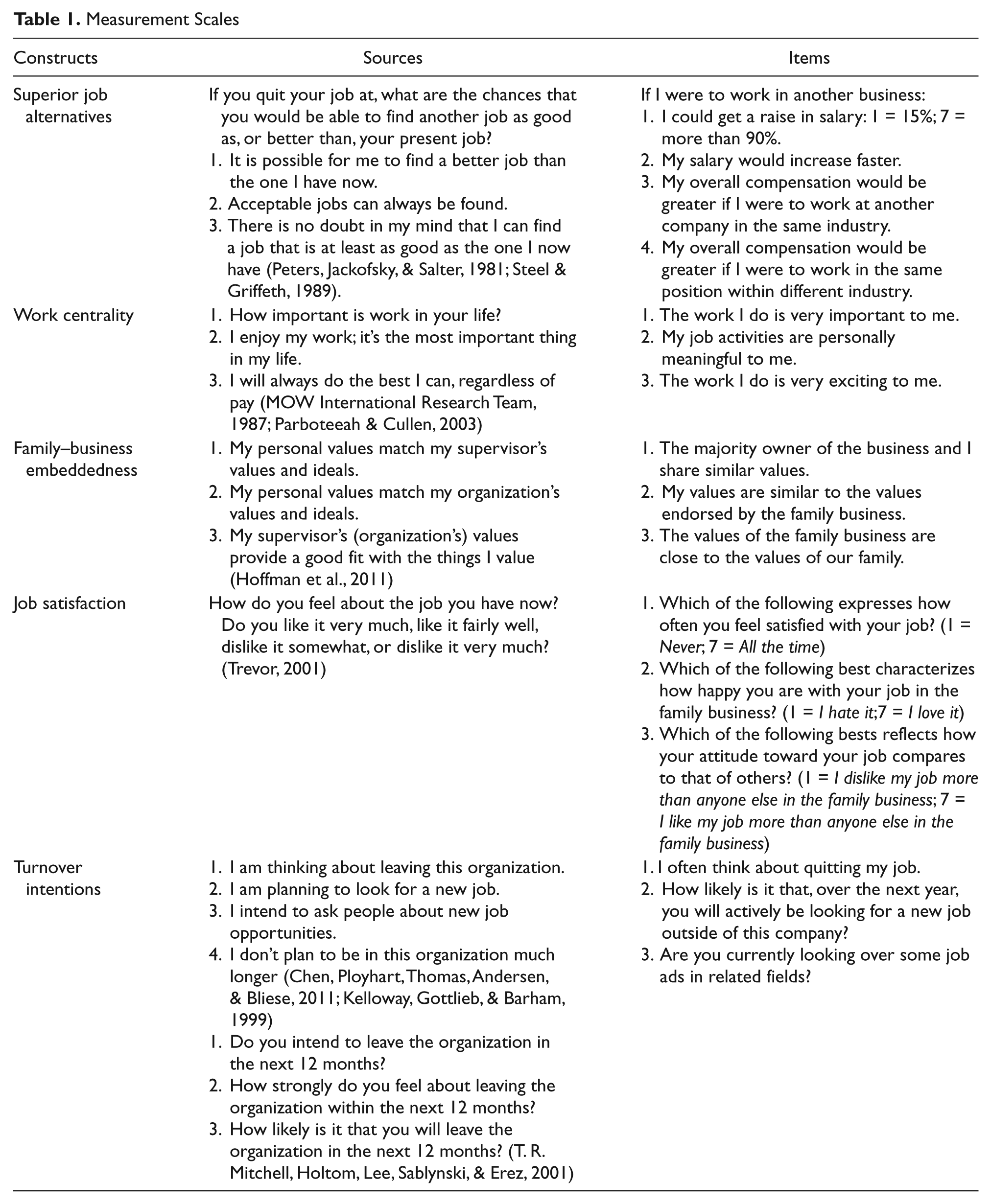
It is also critical to assess the construct validity of family–business embeddedness. This “involves assessing the structural form of the measure and whether or not the scale items actually represent what was intended to be measured” (Pearson & Lumpkin, 2011, p. 288). Prior research has approached value congruence as the best method for measuring the interplay of individual and organizational value systems (O’Boyle et al., 2010). Many authors have argued that “the value-congruence model focuses upon similarities between the values of the organization or the work group and those of its individual members” (Watson, Papamarcos, & Teague, 2004, p. 337). This is precisely our objective. Furthermore, recent studies that measured person–organization value congruence recommend using multiple measures including, for instance, person–organization value congruence combined with person–supervisor value congruence (Hoffman et al., 2011). Following these recommendations, we used three single-item measures of entity–entity value congruence (family business–family), individual–individual value congruence (family employee–family leader), and entity–individual value congruence (family employee–family business). The criterion validity of family–business embeddedness will be covered below in the analysis section. Table 1 reports all the measures we have used in this study as well as their sources in prior research.
Measurement Scales
Work centrality
This measure was originally employed in combination with job involvement (Kanungo, 1982; Lodahl & Kejner, 1965). In contrast, work centrality was defined “as the degree of general importance that working has in one’s life at any given time” both in Meaning of Work studies and the consequent tradition (Hirschfield & Field, 2000). Job involvement (with the current job) and work centrality (importance of work in general) were contrasted in Paullay et al.’s (1994) study. Although work centrality is often interpreted as a purely cognitive notion, it is currently defined as including affective components, that is, work is not only important and meaningful but also exciting (Hirschfield & Field, 2000). We used a three-item measure of work centrality from a recent article on social institutions (Parboteeah & Cullen, 2003) as most suitable for a study of family–business embeddedness and only slightly modified it.
Superior job alternatives
Numerous measures of alternative employment opportunities were used in prior research with subjective measures showing higher predictive validity compared with objective measures (Griffeth et al., 2000; Steel & Griffeth, 1989). Since the existing measures were reported as rather weak predictors of actual turnover, we sought to make the measure stronger by focusing on several important indicators of the perceived superiority of a job alternative: from greater amount of compensation to faster salary increase. Thus, we used measures consistent with prior research but attempted to quantify the perceived advantages of an alternative.
Job satisfaction
Prior research has emphasized that a single measure of job satisfaction is usually sufficient (Griffeth et al., 2000). Nevertheless, we decided to employ a multidimensional measure that allows capturing (a) the frequency of the experience of job satisfaction, (b) the emotional range of one’s attitude toward his or her job (from love to hate), and (c) the perceived intensity of job satisfaction experience compared with coworkers (greater or lesser job satisfaction).
Turnover intentions
Our measure of turnover intentions is consistent with the measures used by prior researchers (Chen et al., 2011; Kelloway, Gottlieb, & Barham, 1999). It encompasses both planning to do a job search in the near future (within a year) and actual involvement in job search.
Analysis and Results
Following the best practices and recommendations for establishing the validity and reliability of constructs used (Hinkin, 1995, 1998; Pearson & Lumpkin, 2011), we initially assessed construct validity utilizing techniques that incorporate measurement errors. First, an exploratory factor analysis was performed to ensure that the proposed measurement items loaded on their designated factors and did not highly cross-load on other factors. Principal component analysis was performed in SPSS 18, with Promax rotation with the default Kappa parameter of 4. Rotation was allowed because the emerging components were expected to correlate. Five factors emerged that captured together 71% of the variation in the data set. The loading pattern was as expected on the five components. All loadings on designated factors were mostly more than .7. Only two items (Job satisfaction 3, and turnover intentions 1) had acceptable but not too-high loadings of more than .51. Cross-loadings were substantially lower: typically, less than .2, and the highest was .35. This analysis provided preliminary support for the convergent and discriminant validities of the proposed measures.
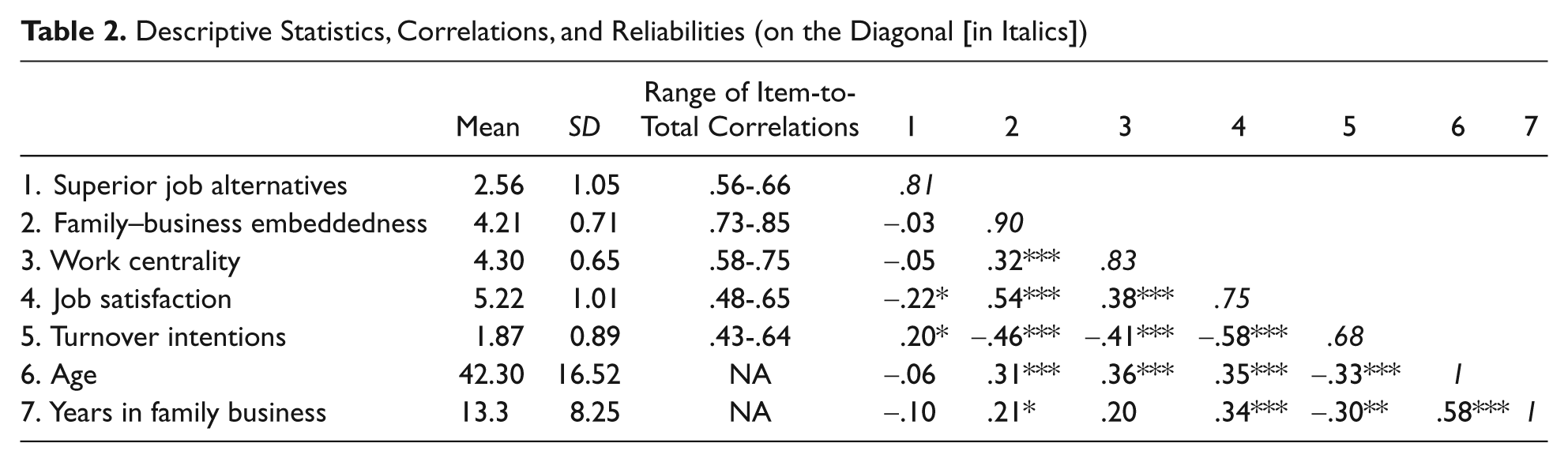
Second, correlations and reliability measures (Cronbach’s alpha) for the model constructs were calculated (see Table 2). As can be seen, the measures were reliable, and the correlations were in the expected directions. Only one measure had a Cronbach alpha value marginally less than the recommended .7 threshold, but all its items were retained because of sufficient item-to-total correlation values in excess of .35 (Fornell & Larcker, 1981). Together, these two analyses established sufficient validity, and hence, we proceeded with further assessments.
Descriptive Statistics, Correlations, and Reliabilities (on the Diagonal [in Italics])
Assessment of Common Method Bias
The potential existence of a major common method variance (CMV) component was assessed because it may be meaningful in single-source survey-based research (P. M. Podsakoff, MacKenzie, Lee, & Podsakoff, 2003). Two approaches were employed to increase the validity of the assessment. First, Harman’s single-factor test was employed. The results of unrotated principal component analysis applied to the model’s constructs indicated more than one principal component. The first one explained only 33% of the variation, and the second one explained another 15%. Thus, no single dominant (i.e., method) factor exists (Harman, 1967). Second, an examination of correlation matrices as specified by Pavlou et al. (2007) was conducted. The correlations ranged from−.03 (not significant) to −.58, and all were less than the .9 threshold. The fact that there are several very low correlations (close to zero) among some of the constructs further indicates that there is no dominant CMV factor. Overall, these analyses show that CMV is unlikely to have a major influence on the data. Nevertheless, these techniques are imperfect (Richardson et al., 2009), and more research using multiple methods would be needed to increase confidence in this conclusion.
Model Estimation
The structural model was estimated following a two-step approach (Anderson & Gerbing, 1988). First, a confirmatory factor analysis model in which the model’s constructs were allowed to freely correlate was specified and estimated with the structural equation modeling facilities of AMOS 18. The data presented good fit to the model, χ2(94) = 118.4 (p < .04); CFI (comparative fit index) = .97, IFI (incremental fit index) = .97, RMSEA (root mean square error of approximation) = .049 with p close = .51, and SRMR (standardized root mean square residual) = 0.065, and also satisfied condition-9 tests (i.e., all loadings were significant; Kelloway, 1998). This further demonstrated that the proposed factors structure has adequate measurement properties and, specifically, convergent and discriminant validities.
Because the confirmatory factor analysis model was adequate, a structural model was specified and estimated. Initially, the model included two control variables, namely, age and tenure at the organization (years in the family business). Although the data fit the model well, χ2(119) = 146.3 (p < .05); CFI = .97, IFI = .97, RMSEA = .045 with p close = .61, and SRMR = .065, the control variables did not significantly influence the endogenous latent variables and were therefore removed from further analyses. Subsequently, the model as depicted in Figure 1 was specified and estimated. The data fit this model quite well, χ2(97) = 123.11 (p < .04); CFI = .97, IFI = .97, RMSEA = .049 with p close = .50, and SRMR = .067. The fit indices also meet the good-fit criteria specified by Hu and Bentler (1999). The implied standardized path coefficients, their levels of significance, and the latent variables’ squared multiple correlations (SMC = the variation in a variable that is explained by its predictors) are depicted in Figure 1. All the hypotheses were supported. In combination, family employee’s family–business embeddedness, work centrality, and perceived superior job alternatives explained almost 60% of the variation in job satisfaction. In turn, job satisfaction explained almost 67% in the variation of family employees’ turnover intentions.
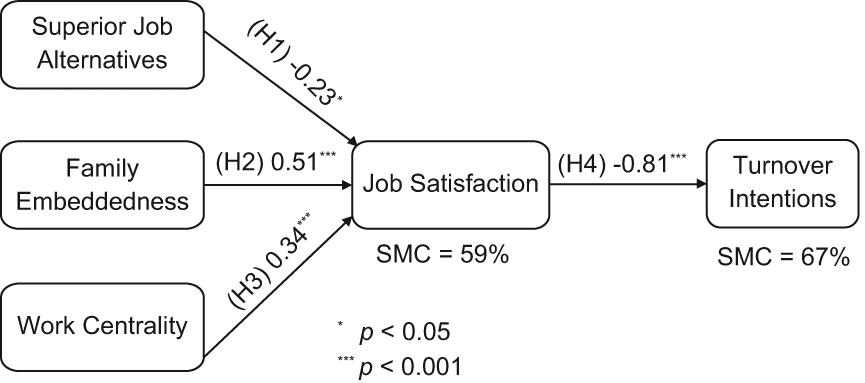
The family–business embeddedness perspective on job satisfaction and turnover intentions in family firmsa
Post hoc Mediation Analysis
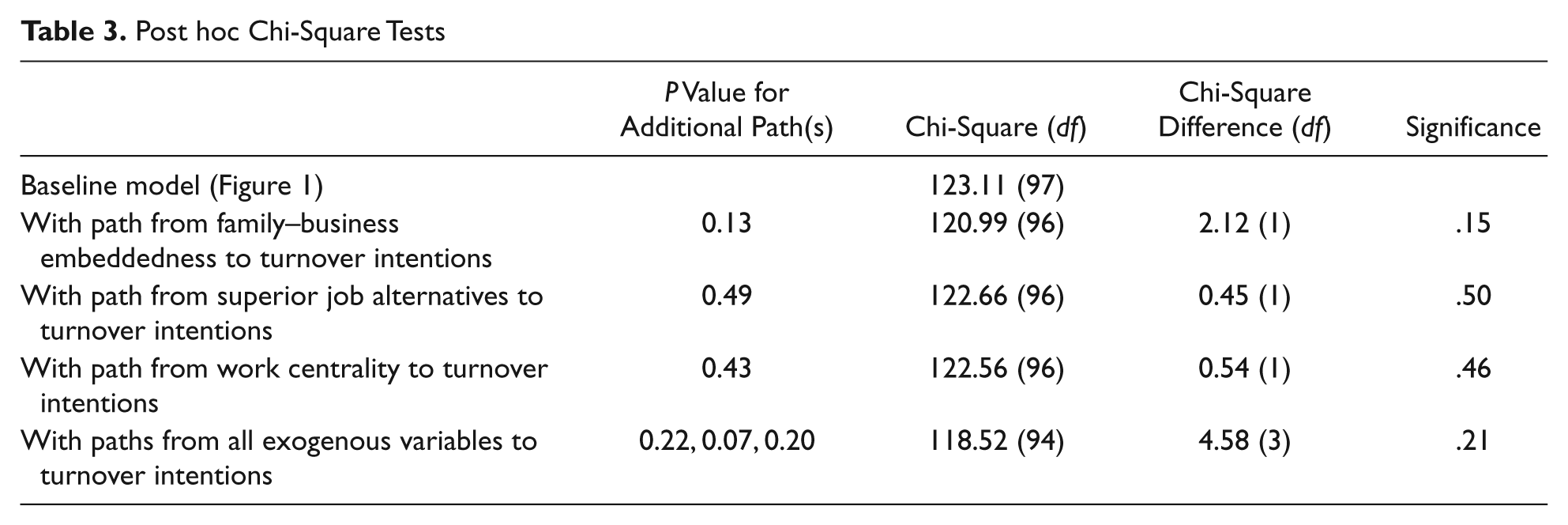
The hypotheses imply that the effects of superior job alternatives, family–business embeddedness, and work centrality on turnover intentions are fully mediated by job satisfaction. This is supported by the data (see Figure 1). To provide an additional check of the model’s validity, we attempted to verify whether or not job satisfaction could partially mediate the observed effects. It is possible that the exogenous variables could influence turnover intentions directly, on top of the hypothesized mediated effects. If so, job satisfaction could conceivably be conceptualized as a partial mediator. To test for this possibility, four additional structural models were constructed and estimated. The first three added a direct effect from each exogenous construct to turnover intentions, one at a time. The fourth model added three direct effects, from all exogenous constructs to turnover intentions. First, the emerging path coefficients were analyzed. All hypothesized paths retained significance in all four additional models, and as can be seen in Table 3, the additional direct effect paths were not significant. Second, the models were compared with the baseline model (Figure 1) using chi-square tests. The results are reported in Table 3. As can be seen, all chi-square difference tests were not significant, implying that estimating the additional parameter(s) is not worthwhile and that for parsimony reasons the baseline model is superior. Thus, it was concluded that the full mediation model best fits the data.
Post hoc Chi-Square Tests
Discussion
In this study, we attempted to identify a range of factors specific to family firms that could affect family employees’ job satisfaction and, consequently, influence their turnover intentions. Prior research has shown that family firms are simultaneously exposed to diverging institutional influences that may create normative discrepancies, for instance, when firm owners agree to hire and promote their insufficiently competent and motivated offspring (Lansberg, 1983) or finance children’s new ventures without providing effective monitoring, oversight, and control (Steier, 2003). In such instances, family norms based on trust, love, and nurturing contradict business norms based on cost–benefits analyses, risk avoidance, and profit seeking. We agree with prior researchers that family and business values may diverge and cause conflicts in the family firm (Lansberg, 1983) and that respectively business embeddedness (family executives’ embeddedness in business) and family embeddedness (family executives’ embeddedness in family) may diverge with family embeddedness influencing the family firm negatively (Le Breton-Miller & Miller, 2009).
However, we proposed that many successful families have the ability to integrate and productively synthesize family and business embeddedness. Respectively, we introduced a new notion of family–business embeddedness defined as confluence and productive synthesis of values and objectives stemming from different institutional contexts in which the family firm operates. In justifying content validity of the concept of family–business embeddedness, we built on Granovetter’s (1985, 2005) definition of embeddedness as mixing of economic and noneconomic activities in which noneconomic activities can influence economic activities and current research showing the importance of family-centered noneconomic objectives for family firms (Chrisman et al., 2010). In addition, we used the understanding of embeddedness as a dyadic relationship of codependence in which two companies influence one another (Hagedoorn, 2006). Our approach is also close to understanding of family embeddedness as a measure of family firm heterogeneity, an attribute that helps a family firm overcome the conflict between its economic goals and noneconomic goals related to the creation of socioeconomic wealth (Cruz et al., 2012).
Subsequently, we have shown that family–business embeddedness along with work centrality enhance family employees’ job satisfaction although for different reasons. Family–business embeddedness appears to enhance job satisfaction by reducing cognitive dissonance (Festinger, 1957) because of value conflict among different institutional contexts within the family firm (Le Breton-Miller & Miller, 2009). Thus, family–business embeddedness represents an organizational-level variable that differentiates the level of integration of values and objectives originating in various intuitional contexts—business, family, and symbolic. As such, it allows examining the heterogeneity of family firms that differ with regard to family embeddedness (Cruz et al., 2012) or family–business embeddedness and respective effects on performance. In contrast, we applied the notion of work centrality as a dispositional variable establishing the value, meaningfulness, and excitement that an individual family employee may derive from his or her work. Given the fact that some family employees may choose to work for the family firm for the reasons of imperative rather than normative or affective commitment (Sharma & Irving, 2005), but also because family employees may put up with lower paying jobs because of work centrality, it is critical to measure the impact of work centrality on family employees’ job satisfaction.
Finally, we were able to establish that family employees are well aware of the pay difference between their compensation and compensation that could be available to them elsewhere and that such presence of superior job alternatives affects family employees’ job satisfaction. Although prior research has established that alternative employment opportunities are a weak predictor of voluntary turnover (Griffeth et al., 2000), they may play an important role in affecting job satisfaction (Steel & Lounsbury, 2009). Furthermore, employing this construct is especially important in studies of family business since family firms are known for chronically underpaying their employees and underutilizing professional HR management practices (Harris et al., 2004; Lansberg, 1983; Reid et al., 2002).
Contributions
The key contributions of this study are as follows: First, we introduced a new concept that shows an interesting and previously overlooked aspect of family firms: their ability to successfully navigate divergent institutional contexts and productively synthesize values and objectives stemming from such diverse environments. This is why the family–business embeddedness perspective could help in explaining greater resilience of family firms (Chrisman et al., 2011) and their impressive longevity (Le Breton-Miller & Miller, 2006). Second, our study uncovers that the coping mechanisms for overcoming value conflicts in family firms may include not only separation of ownership and management perspectives (Lansberg, 1983). Additional copying mechanism may be defined as (a) inculcation of business and symbolic values into the family, (b) incorporation of family values into business, and (c) creative adjustment of the family firm’s symbolic values over time to bring them in line with the evolving family and business values (Parada et al., 2010). Third, our study shows that family firms need to be put on greater alert as to their employees’ level of job satisfaction and possible emergence of turnover intentions. Like any business, family firms are interested in retaining their key talent while minimizing the negative impact of their least dedicated and least talented employees. Assessing family employees from the perspective of work centrality and their perception of superior job alternatives could help family businesses to see what is going on within their boundaries more realistically.
Limitations
Our article has some limitations that need to be noted. First, this study has introduced a number of new or modified measures including family–business embeddedness and superior job alternatives. It is quite possible that our measures of these new concepts are still imperfect and will require a lot of additional work, clarification, and further validation and verification. Second, our sample is rather small and our conclusions could and should be tested on a much larger population of family firms. Third, our sample mostly consists of rather profitable and successful family firms. That certainly affects the conclusions we reached. It is possible, for instance, that family employees from poorer and less successful family firms would not assess their superior job alternatives as optimistically. Finally, our sample comes from the United States and our conclusions may not be fully generalizable to family firms operating in different institutional environments.
Research Implications
We believe that the family–business embeddedness perspective could be employed in the future in various areas of family business studies. It is based on the essence approach toward defining the family firm through its conduct (Chua et al., 1999; Chrisman, Chua, Sharma, 2005) and could be used to investigate the differences in family firms’ behavior such as their varying ability to reconcile economic and noneconomic objectives or socioemotional wealth (Cruz et al., 2012), deal with conflict within the TMT (Ensley et al., 2007; Ensley & Pearson, 2005), or apply stakeholder management strategies (R. K. Mitchell, Agle, Chrisman, & Spence, 2011).
Practical Implications
This article has several important practical implications. First and foremost, it casts into doubt advice previously given to family executives as to how they should deal with value conflict within the family business. Prior studies suggested that coping mechanisms for overcoming value conflict could include separately applying ownership perspective dovetailed to family relations and management perspectives customized to business relations (Lansberg, 1983). In addition to this previous recommendation, we suggest building bridges between family and business embeddedness to find a way of productively synthesizing values and objectives coming from family, business, and symbolic contexts within the family firm. Family executives need to attain versatility and even ambidexterity (Raisch, Birkinshaw, Probst, & Tushman, 2000) in their ability to navigate distinct institutional environments and build value congruence among these diverse environments. This could allow family firms increase employees’ job satisfaction and reduce turnover.
Footnotes
Declaration of Conflicting Interests
The author(s) declared no potential conflicts of interest with respect to the research, authorship, and/or publication of this article.
Funding
The author(s) received no financial support for the research, authorship, and/or publication of this article.
Bios
References
Supplementary Material
Please find the following supplemental material available below.
For Open Access articles published under a Creative Commons License, all supplemental material carries the same license as the article it is associated with.
For non-Open Access articles published, all supplemental material carries a non-exclusive license, and permission requests for re-use of supplemental material or any part of supplemental material shall be sent directly to the copyright owner as specified in the copyright notice associated with the article.
