



Abstract
We explored the relationships between the experience of work–family conflict and levels of distress in the family and at work among a sample of 227 Israeli working mothers. We also examined how role set density (RSD, the number of roles they perform) and personal and environmental resources are related to the women's experience of distress. Work–family conflict resulting from interference of work with family roles (WIF) and from interference of family with work roles (FIW) correlated positively with distress in the family and at work. RSD correlated negatively with distress at work but did not correlate with distress in the family. Perceived social support and personal resources correlated negatively with the women's experience of distress. WIF mediated the relationship between social support and women's experience of distress as well as the relationship between RSD and distress.
In Israel, as in other Western countries, there have been far-reaching changes in gender roles in recent decades as well as a considerable increase in the proportion of dual-earner families (Stier, 2010). Nonetheless, the traditional view that the woman bears the main responsibility for the family has not changed appreciably in Israel (Nordenmark, 2002). Therefore, most women today perform two demanding roles simultaneously: the role of mother and the role of worker. There are two competing theoretical approaches that deal with the impact of multiple roles on women's well-being: “role scarcity theory” (Goode, 1960), and “role expansion theory” (Marks, 1977). The role scarcity approach is based on two premises. One premise is that individuals have a limited amount of energy; and the other is that social organizations (e.g., family and the workplace) are greedy and demand all of the individual's allegiance. According to this approach, the efforts that women invest in the attempt to meet the simultaneous demands of work and the family may generate two types of work–family conflict (Greenhaus & Powell, 2006). The demands of the workplace can interfere with the demands of the family (WIF); and the demands of the family can interfere with the demands of the workplace (FIW; Frone & Rice, 1987). Whether the sense of work–family conflict among working mothers derives from WIF or FIW, it yields one inevitable outcome: the woman feels a sense of distress, which is often manifested in physical health (Baltes & Heydens-Gahir, 2003) as well as in emotional symptoms (Lapierre & Allen, 2006). In contrast, role expansion theory (Marks, 1977) emphasizes the privileges rather than the obligations that accrue to incumbents of multiple roles. According to that perspective, multiple roles can increase the woman's supply of resources, including monetary resources (obtained from work), and personal resources such as the development of a professional identity and self-esteem.
Over the years, researchers have examined these two approaches—role scarcity theory and role expansion theory. However, the results of these studies are inconsistent: For example, the findings of a recent meta-analysis support the scarcity theory (Amstad, Meier, Fasel, Elfering, & Semmer, 2011), whereas other recent findings support enrichment theory (Carlson, Kacmar, Wayne, & Grzywacz, 2006). Because there is evidence supporting both approaches, recent studies have examined the conditions that support role scarcity theory, and the conditions that support expansion theory (e.g., Carlson, Grzywacz, & Kacmar, 2010). Against that background, we examined the contribution of two factors to explaining the relationship between work–family conflict and distress among working mothers. One factor was role set density (RSD, the number of roles a woman performs) and the other was the women's personal and environmental resources.
RSD of Women Today
In recent decades, the role set of women has constantly expanded (Adelman, 1994). Although paid work has been an economic necessity for many women, prior to World War II married women in Western countries were typically expected to perform two main roles—wife and mother. In most cases, the wife was responsible for household tasks and the husband was the main provider. However, the entry of women into the labor force over the past six decades has dramatically increased their RSD. Hence, in Israel, as in other Western countries, many women have expanded their role set to three main areas. That is, besides the roles of wife and mother, most women also work for pay outside of the home (Stier, 2010). However, in light of the demographic, social, and technological developments in the contemporary era, the role set of women has continued to expand beyond these three domains. One example relates to the care of elderly family members, which has traditionally been considered a feminine role (Zauszniewski, Bekhet, & Suresky, 2009). With the increase in life expectancy and the growing population of elderly persons who require nursing care today, the burden of care for elderly parents has become more intense, and it persists for a longer period of time than in the past (Remennick, 1999). In addition, because medical technology has enabled women to remain fertile for longer, many women in midlife are grandmothers and also have young children of their own (Kulik, 2007a). As such, they are often expected to help out with their grandchildren besides caring for elderly parents and for their own children (Neal & Hammer, 2007). Beyond these roles, which relate to the family, the role set of women in Western societies also includes community activities such as volunteer assistance to individuals and groups that aim to promote community issues (Driham & York, 2002). In Israel, statistical data indicate that 12% of all married women volunteer and that the share of volunteers among employed women is 14% (Ministry of Industry, Trade and Labor, 2006). Moreover, working mothers can also engage in additional roles such as studying (at a university or other post-secondary institution), which enables them to improve their vocational skills, broaden their horizons, and fulfill themselves (Home, 1998). In Israel, 41.2% of all women continue postsecondary studies 8 years after completing 12th grade, and most of those women are married (Israel Central Bureau of Statistics, 2006). Another role that can be characterized as self-investment is leisure activity. In contrast to paid employment and continuing education, the main purpose of leisure activity is relaxation and entertainment (Pearson, 2008). Although most of the leisure activities reflect the individual's free choice (Kelly, 1996), they often require an investment of time and energy at the expense of the family or work. Therefore, even leisure roles are a potential burden that can generate distress for working women.
Even though not all of the roles described above are part of every working mother's role set, today women show a greater tendency than in the past to perform many of these roles simultaneously (Kulik, 2007a). However, researchers have focused mostly on examining how the dual role of mother and employee affects distress among women, and there is a dearth of research evidence regarding the impact of multiple roles on women's sense of work–family conflict and distress. Against that background, we examined whether women's RSD is directly related to their experience of distress. Moreover, we examined whether RSD is also indirectly related to distress among working mothers. Based on research findings that reveal a relationship between RSD and the experience of work–family conflict (e.g., Malhotra & Sachdeva, 2005) as well as a relationship between work–family conflict and distress (Amstad et al., 2011), we examined whether two types of role conflict (WIF and FIW) mediate the relationship between RSD and the experience of distress.
Theories on patterns of coping with distress situations relate to coping resources as a key concept. These approaches have examined the direct as well as the indirect impact of coping resources on the individual's well-being (Lazarus & Folkman, 1984; Pearlin & Schooler, 1978).
Coping Resources and Distress
Coping resources have been defined as the characteristics of a person, group, or environment that help individuals adapt to stress (Lazarus & Folkman, 1984). Among researchers in the field, it is accepted to distinguish between personal and environmental resources (e.g., Pearlin & Schooler, 1978). Consistent with that approach, the personal resources examined in the present study were self-assessed health (henceforth state of health), self-assessed level of income (henceforth economic situation), and education; the environmental resources were two types of perceived social support—emotional support (social networks outside of work) and support in the workplace.
Personal Resources
State of health
The potential inherent in health resources derives from the very fact that good health enables individuals to function physically and socially, so that they will be able to accumulate additional resources and improve their quality of life (Danziger et al., 2000). For example, good health increases a woman's chances of entering the labor market and engaging in social activities which, in turn, contribute to enhancing her well-being (Olson & Pavetti, 1996).
Economic situation
Research has revealed a direct negative relationship between the level of income and the experience of distress (Gyamfi, Brooks-Gunn, & Jackson, 2001). Moreover, high income enables individuals to obtain services such as medical, emotional, or psychological assistance. Thus, it increases their sense of security and also contributes indirectly to reducing the levels of distress (Danziger et al., 2000).
Education
The direct impact of higher education on well-being is manifested in its contribution to the development of various skills that are essential for effective coping with stress situations. Women with higher education have better chances of being hired for high-level jobs than do those with lower levels of education (Hilton & Kopera-Frye, 2004).
Environmental Resources
Emotional support
Emotional support contributes to well-being, in that it gives people a sense of structure and order in their lives (Church & Looner, 1998), facilitates day-to-day coping (Heller, Swindle, & Dusenbury, 1986), and provides an accepting atmosphere that promotes adjustment (Dubow, Tisak, Cavsey, Hryskho, & Reid, 1992).
Social support in the workplace
This type of support (henceforth support in the workplace) is mainly manifested in flexible work hours and appropriate professional guidance (Kulik, 2007b). Moreover, studies have found that when workers feel that the workplace adopts a holistic approach to workers and takes their family role into account, they feel a stronger sense of equity which, in turn, reduces the experience of distress (Grandey, 2001).
As described above, many of the studies have revealed a direct relationship between resources and distress. However, others have revealed an indirect relationship between these variables, which is mediated by the sense of role conflict. Thus, for example, Home (1998) found that education and high income reduce women's experience of role conflict when family demands interfere with the demands of work and that role conflict is related to distress (Baltes & Heydens-Gahir, 2003). Moreover, researchers have found that work–family conflict mediates between social support and distress (Thomas & Ganster, 1995).
Research Goals
The study presented in this article proposes an expanded model for understanding the impact of work–family conflict on mothers' experience of distress. Based on the theoretical background presented above, the study aimed to examine the direct as well as the indirect impact of two factors on the experience of distress among working mothers: RSD and resources. The indirect effects of these two factors on the experience of distress were examined through the mediation of work–family conflict (FIW and WIF). According to the scarcity approach, higher RSD should be associated with higher distress, whereas according to the enrichment approach, higher RSD should be associated with lower distress. In light of the facts that the most recent evidence supports the scarcity approach (Amstad et al., 2011) and that we examined a negative outcome (distress), we framed our hypotheses in terms of the scarcity approach (Figure 1).
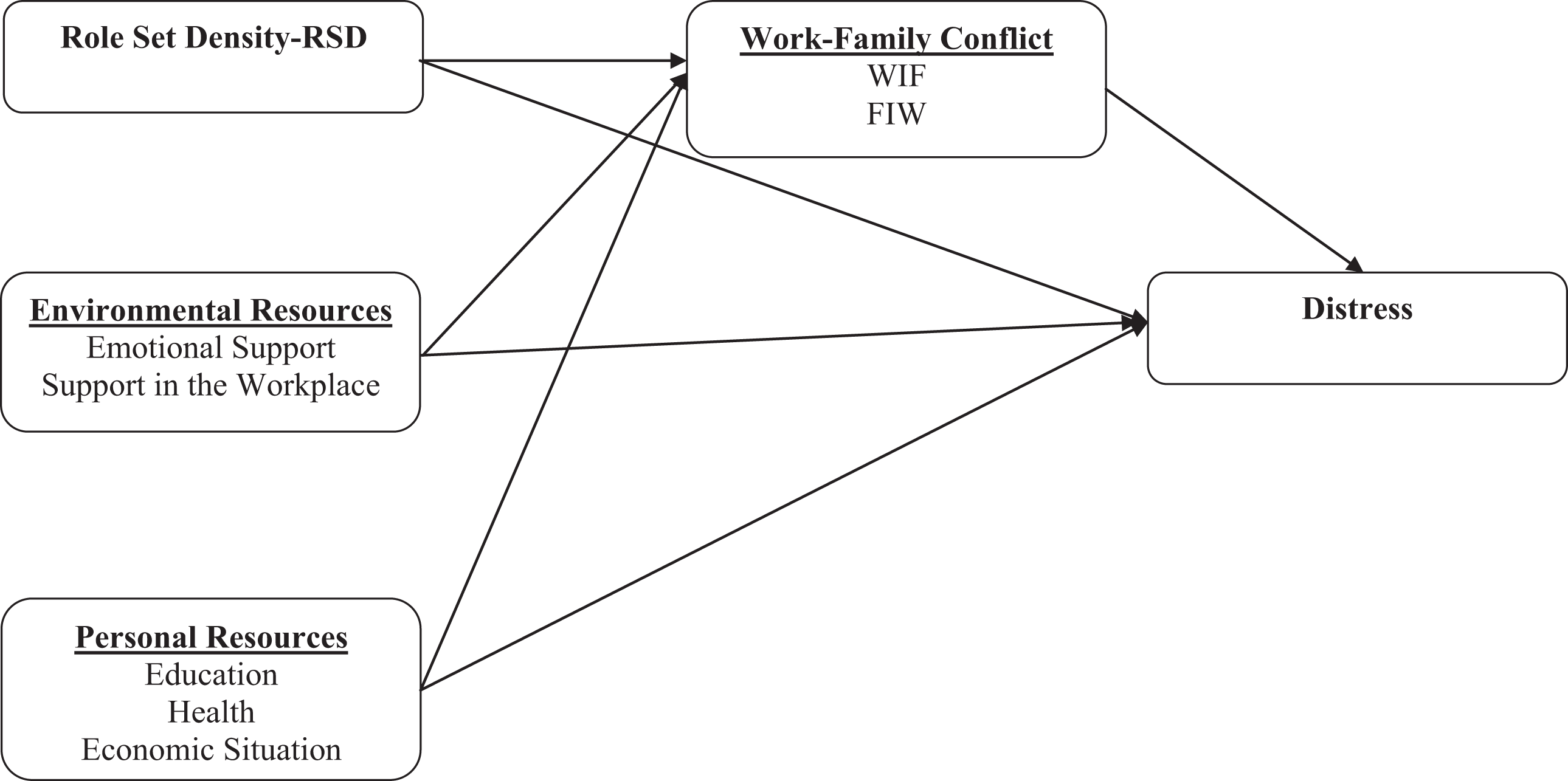
Research model.
Research Hypotheses
Method
Sample
The sample of participants comprised 227 working mothers with children up to age 17 living at home: 162 of the women were married and 65 were single mothers. Of the single mothers, 25 were never married, 34 were divorced, and 6 were widowed. The mean age of the participants was 32.85 (SD = 7.2). Regarding ethnic origin, 32.3% of the women were Mizrahi (Asian African), 54.8% were Ashkenazi (European American), and 12.9% were mixed. As for the level of education, 15% of the participants had up to 12 years of schooling, 55% had 12–15 years of schooling, and about one third reported that they had between 16 and 18 years of schooling. As for religiosity (based on self-assessment), 54.6% of the participants were secular, 31.5% were traditional, and 13.9% were religious. The mean number of children per woman was 2.8 (SD = 1.7), and the mean number of children living at home was 2.4 (SD = 1.64). As for the women's role set, 14% had grandchildren and 11% were caregivers for elderly parents; 35.7% of the women engaged in some kind of community volunteer activity, and 32.2% were enrolled in some kind of postsecondary education program; 53.7% of the participants engaged in some kind of leisure activity.
Instruments
Because the research was conducted in Israel, all of the questionnaires were adapted and translated into Hebrew. The research instrument consisted of several subquestionnaires:
Distress questionnaire. The original questionnaire was developed by Pearlin and Schooler (1978) and was used to examine distress resulting from multiple roles among working mothers. The instrument was translated into Hebrew by Shaked (2004) and included 16 items that measured distress. Eight items related to distress in the family domain (e.g., “When you think of your family, to what extent do you feel worried or dejected?”—henceforth distress in the family), and 8 items related to distress in the work domain (e.g., “When you think of your work, to what extent do you feel worried or dejected?”—henceforth distress at work). Responses were based on a 5-point scale ranging from 1 (not at all) to 5 (to a great extent). One score was derived for each factor of distress, by calculating the mean of the responses to the items relating to the specific factor: the higher the score, the higher the participant's level of distress in the family or at work. The Cronbach's α reliability values of the items measuring each factor were .88 for distress in the family and .91 for distress at work. Work–family conflict questionnaire. The original questionnaire, which examined role conflict in the family and in the workplace, was developed by Frone and Rice (1987) and consisted of 12 items. The questionnaire was translated into Hebrew by Somech and Drach (2007). Six items measured role conflict due to family demands that interfere with functioning in the workplace (FIW, e.g. “The time I spend with my family often prevents me from investing in activities that can promote my professional career”); and 6 items measured role conflict due to work demands that interfere with family life (WIF, e.g. “My work prevents me from engaging in family activities as much as I would like”). Responses were based on a 5-point scale ranging from 1 (not true at all) to 5 (very true). One score was derived for each type of work–family conflict by calculating the mean of the responses: the higher the score, the more the participant experienced each type of conflict. The Cronbach's α reliability values of the items measuring each type of conflict were .83 for FIW and .77 for WIF. RSD. The questionnaire examined the number of roles that the woman performs. Participants were presented with a list of eight roles relating to the domains of the family, work, the community, and personal development: wife, employee, mother, grandmother, caregiver for an elderly family member, volunteer, student, and participant in leisure activity. Responses were based on a dichotomous scale, in which participants indicated whether or not they perform that role (1 = yes, 2 = no). One score was derived for each participant by calculating the overall score of “yes” answers on the list of items. Because the participants were working mothers (married and single), the minimum potential number of roles was two (paid employee and mother), and the maximum number of roles was eight. The higher the score on the measure, the higher the women's RSD. Personal resources. These resources were measured as part of the background questionnaire and included questions regarding the women's level of education, self-assessed state of health, and self-assessed economic situation. The scale of responses for state of health and economic situation ranged from 1 (very low) to 5 (very high). Level of education was measured on the basis of years of schooling (see Methods section, sample description). Perceived emotional support. The original questionnaire for assessment of perceived emotional support was developed by Zimet, Dahlem, Zimet, and Farley (1988) and translated into Hebrew by Drori (1983). The questionnaire used in this study consisted of 12 items that examine perceived emotional support from three sources: family, friends, and significant others (e.g., “There is a special person with whom I can share my joys and sorrows”). Responses were based on a 7-point scale ranging from 1 (doesn't describe my feelings at all) to 7 (describes my feelings to a great extent). One score was derived for the questionnaire by calculating the mean on all of the items: the higher the score, the greater the participant's perceived social support. The Cronbach's α reliability of the questionnaire used in this study was .94. Social support in the workplace. The questionnaire was developed by Kulik (2007b), originally in Hebrew, and examined the perceptions of various aspects of support in the workplace such as flexible work hours, the option of working from home, consideration for workers, and provision of professional training. The questionnaire consisted of 12 items (e.g., “I have the option of changing the hours that I start and finish work,” or “When I need to take a day off for personal reasons, my boss gives me permission”). One score was derived by calculating the mean of the items on the questionnaire: the higher the score, the higher the participant's level of support in the workplace. The Cronbach's α reliability of the questionnaire used in this study was .86.
Data Collection
Data were collected from women in various settings all over the country, including workplaces as well as community centers that organize social activities for working mothers with children. The sample of single mothers was reached by distributing questionnaires to women attending support groups for single mothers at community centers as well as through the snowball method. All of the women attending the groups were approached to participate in the study. The time required to complete the questionnaires was about 20 min, and the response rate was about 80%. Participants were assured of anonymity and were asked to sign informed consent forms.
Results
Correlations Between FIW/WIF and Distress (Hypothesis 1)
A moderately significant positive correlation was found between the two types of work–family conflict and the two measures of distress: higher levels of FIW were associated with higher levels of distress at work and distress in the family (r = .46, p < .001 and r = .24, p < .001, respectively); and higher levels of WIF were associated with higher levels of distress at work and distress in the family (r = .40, p < .001 and r = .40, p < .001, respectively, Table 1).
Correlations Between the Main Research Variables and Measures of Distress.

Note. M = mean; SD = standard deviation; WIF = work-family conflict; FIW= family-work conflict.
*p <.05. **p <.01. ***p <.001.
Correlations Between RSD and Distress (Hypothesis 2)
A significant negative correlation was found between the women's RSD and distress at work (r = −.20, p < .01): the more roles the women performed, the lower their distress at work was. However, RSD did not correlate significantly with distress in the family (r = −.11, p > .05).
Correlations Between Women's Resources, Work–Family Conflict (FIW/WIF), and Distress at Work and in the Family (Hypotheses 3–4)
Higher levels of emotional support and workplace support were associated with lower levels of distress in the family (r = −.39, p < .001; and r = −.27 and p < .001, respectively), and distress at work (r = −.21, p < .001 and r = −.41, p < .001, respectively). Additionally, negative correlations are found between personal resources and distress: the better the women's self-assessed state of health and economic situation, the lower their levels of distress at work were (r = −.26, p < .001 and r = −.25, p < .001, respectively). This pattern of association was also found between state of health and distress in family but not between economic situation and distress in the family (r = −.35, p < .001 and r = −.11, p > .05 respectively; Table 1).
As for the third personal resource, level of education, one-way analysis of variances (ANOVAs) revealed significant differences only with regard to distress in the family, F(3, 216) = 2.97, p < .05, η2 = .04. The means and standard deviations for family distress by level of education were as follows: up to matriculation and vocational education, M = 2.13, SD = 0.86; postsecondary, M = 1.82, SD = 0.52; BA degree, M = 1.87, SD = 0.62; and MA degree, M = 1.74, SD = 0.67. Scheffe tests were performed in order to determine possible differences between educational levels among women. The results revealed that women who did not have a matriculation certificate experienced higher levels of distress in the family than did those with an MA degree.
Hierarchical Regressions to Explain Levels of Distress (Hypothesis 5)
We conducted stepwise hierarchical regressions to examine the overall contribution of the independent variables to explaining the women's levels of distress in the family and at work as well as the mediating effect of work-family conflict (WIF, FIW) and RSD on the relationships between personal and environmental resources and distress. The regressions were carried out separately for distress in the family and distress at work. The variables were entered in the same order in both regression equations. Because the bivariate analyses of the background variables examined in the study (number of children living at home, age of the youngest child, and religiosity) revealed no significant correlations with distress in the family or at work, none of these variables were entered into the regression. The only exception was marital status, which was found to distinguish significantly between the experience of distress at work among married and single women, F(1, 216) = 8.36, p < .01, η2 = .04 (for married women, M = 2.25, SD = 0.73; for single women, M = 2.59, SD = 0.95). Thus, the mothers' marital status (married = 1, single = 2) was entered in the first step of the regression in order to partial out its effect from the effect of variables entered in subsequent steps of the regression. Personal resources (education, state of health, and economic situation) were entered in the second step, and environmental resources (emotional support and support in the workplace) were entered in the third step. Finally, WIF, FIW, and RSD were entered in the fourth step. We chose to enter the variables in this order as a basis for examining whether the effect of environmental, personal resources, and RSD on levels of distress among the participants was both direct and indirect. Moreover, we used the PROCESS procedure to test Hypothesis 5, which related to the mediating effects of the variables. PROCESS is a special SPSS macro procedure developed by Hayes (2012), which can be used to test hypotheses relating to direct and indirect effects of variables in complex statistical analyses (e.g., multiple moderations, multiple mediations, control variables, moderated mediation, and mediated moderation). When a significant direct effect is found together with a significant indirect effect, it is considered partial mediation. This procedure is also supported by bootstrapping, which tests the stability and consistency of the effect among multiple subsamples.
Distress at work
All of the research variables explained 40% of the variance in distress at work (Table 2). In the first step, marital status explained 4% of the variance in distress at work, and its contribution was significant (see Table 2). The β coefficients indicate that among the married women, levels of distress at work were lower than among the single mothers. The personal resources (education, state of health, and economic situation), which were entered in the second step, contributed an additional 8% to explaining the variance in distress at work. However, only two of those variables contributed significantly to explaining the variance in the women's assessments of distress at work. The β coefficients indicate that the better the women's self-assessed state of health and economic situation, the lower their levels of distress at work. However, education did not contribute significantly to explaining the variance in distress at work after partialing out the effects of the other two personal resource variables (economic situation and state of health). The perceived social support variables (emotional support and support in the workplace) explained 11% of the variance in distress at work, over and above the variance explained by the variables entered in the previous steps of the regression. However, as can be seen in Table 2, only support in the workplace contributed significantly to explaining the variance in distress at work. The β coefficients indicate that the more support the women received in the workplace, the lower their levels of distress at work.
Hierarchical Regression to Explain Distress at Work.
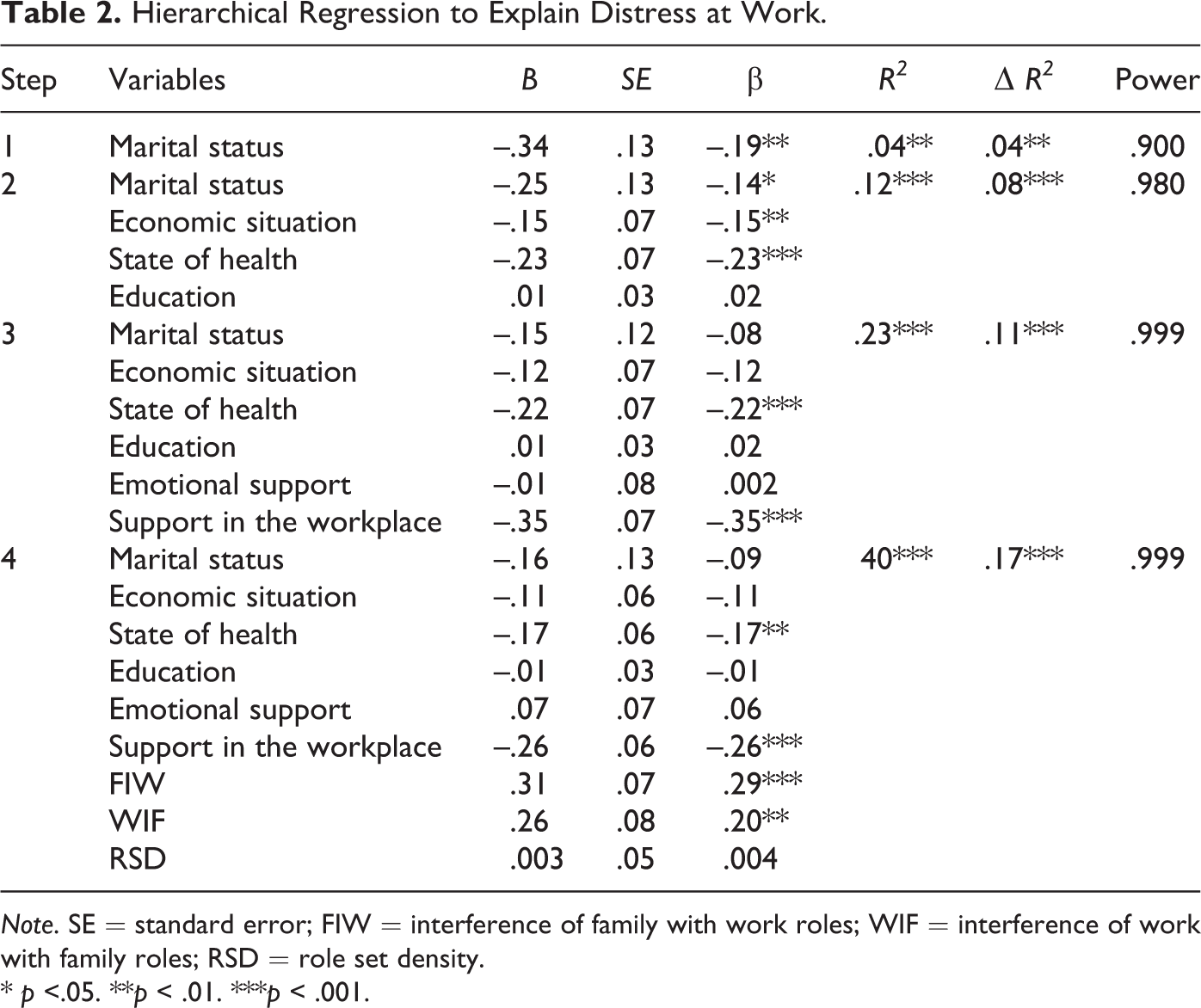
Note. SE = standard error; FIW = interference of family with work roles; WIF = interference of work with family roles; RSD = role set density.
* p <.05. **p < .01. ***p < .001.
The two measures of work–family conflict (WIF and FIW) and the measure RSD explained 17% of the variance in distress at work, and their contribution was significant. Notably, after entering the work–family conflict variables (WIF and FIW) and RSD in the fourth step of the regression equation, the direct contribution of resources remained significant.
Distress in the family
All of the research variables explained 33% of the variance in distress in the family (see Table 3). In the first step of the regression, marital status did not contribute significantly to explaining the participants' distress in the family. All of the personal resources that were entered in the second step explained 11% of the variance in distress in the family. However, of those variables only the contribution of state of health and education were significant. The negative direction of the β coefficients indicates that the better the women's assessments of their state of health, the lower their sense of distress in the family. In the third step, the social support variables (emotional support and support in the workplace) contributed an additional 12% to explaining the variance in family distress. The β coefficients revealed that the higher the levels of emotional support and support in the workplace, the lower the women's sense of distress in the family. The work–family conflict variables (WIF and FIW) and RSD, which were entered at the fourth step, explained 10% of the variance in family distress. However, as can be seen in Table 3, only the contribution of WIF was found to be significant. That is, the more the women felt that their work responsibilities interfered with the family domain, the higher their levels of family distress were.
Hierarchical Regression to Explain Distress in the Family.
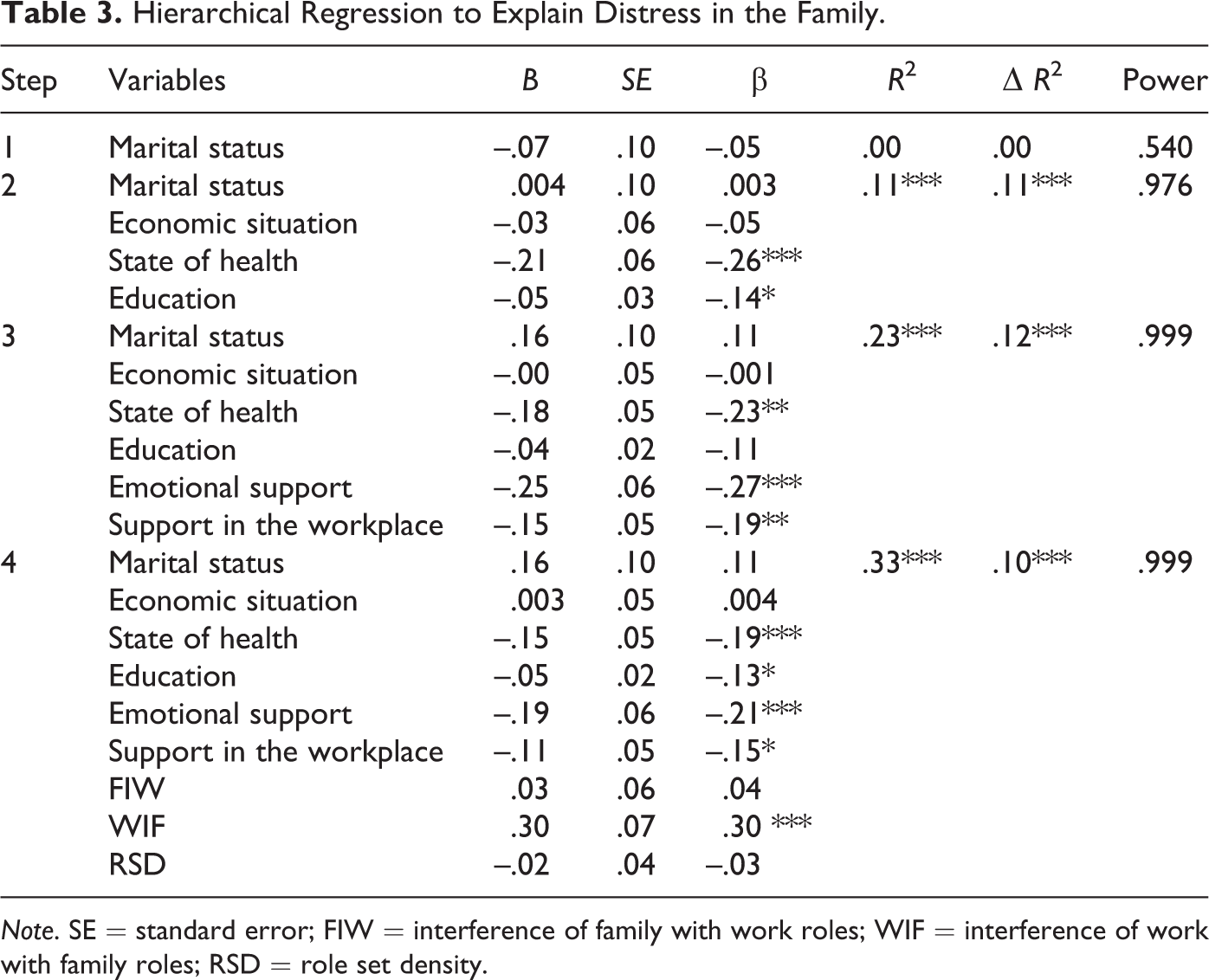
Note. SE = standard error; FIW = interference of family with work roles; WIF = interference of work with family roles; RSD = role set density.
To complete our analysis, we tested several mediating effects with respect to Hypothesis 5. We hypothesized that FIW and WIF would mediate the effects of RSD and resources on distress. As shown in Table 4, four significant mediating effects were found. First, WIF mediated the relationship between support in the workplace and distress at work. That is, higher levels of support in the workplace were directly associated with lower levels of WIF which, in turn, decreased distress at work. There was also a direct negative association between support in the workplace and levels of distress at work: higher support in the workplace was associated with lower levels of distress at work. Thus, the mediating effect was only partial when a significant direct effect existed (Preacher, Rucker, & Hayes, 2007). Second, we found a similar relationship between emotional support and distress in the family. That is, higher levels of emotional support were directly associated with lower levels of distress in the family. This relationship was also partially mediated by FIW. When levels of FIW were lower, the indirect effect of emotional support on distress in the family was stronger. That is, higher levels of emotional support were found to reduce distress in the family. Third, we found that emotional support was indirectly associated with distress at work, which was mediated by FIW. That is, when FIW was lower, higher levels of emotional support were associated with lower distress at work. The direct effect of emotional support on distress at work is found to be insignificant. Lastly, WIF mediated the relationship between RSD and distress at work. Specifically, RSD correlated negatively with distress at work through WIF, and this effect was found to be significant (p < .05). That is, higher levels of RSD decreased distress at work by reducing levels of WIF.
Indirect effects – Coefficients (b) and standard error (in parenthesis).

Note. SE = standard error; FIW �terference of family with work roles; WIF = interference of work with family roles; RSD = role set density.
p<.05 **p<.01 ***p<.001
Discussion
Consistent with the research hypotheses, the findings revealed that the women's sense of work–family conflict correlated with distress in the family as well as with distress at work (supporting Hypothesis 1). Moreover, among the mothers who experienced work–family conflict, the demands of one domain spilled over to the other. As such, when work–family conflict resulted from the interference of work demands with family responsibilities (WIF), the women felt distress not only in the family domain but also at work. Conversely, when family demands interfered with work (FIW), the women felt distress in the family as well as at work. These findings are consistent with the conclusions of another study which revealed that the experience of distress spills over from the domain of work to the domain of the family and vice versa (Westman, 2005).
Contrary to the predictions of role scarcity theory, RSD, as reflected in the number of roles the women performed, did not correlate positively with their sense of work–family conflict or with the experience of distress in the family and at work. On the contrary, RSD correlated negatively with the experience of distress at work: the more roles the women performed, the less distress they experienced at work (failing to support Hypothesis 2). This unexpected finding, which is consistent with role enrichment theory, is consistent with the results of a recent study conducted in Israel (Brafman, 2011), which indicated that women with a high RSD, including those who engage in volunteer activity, are less likely to develop stress symptoms than are women with a lower RSD.
How can multiple roles produce beneficial outcomes? Greenhaus and Powell (2006) have identified three relevant psychological mechanisms that can account for the positive outcomes associated with participation in multiple roles. First, to the extent that each role increases well-being, performing multiple roles can have additive effects on well-being. Second, the positive experience of participation in one role can buffer distress in another role. Third, satisfaction from one role can enhance experiences in others. The third mechanism refers to the concepts of work–family facilitation, enhancement, positive spillover, and enrichment (Greenhaus & Powell, 2006). The findings of the current study are consistent with this third explanation. That is, greater RSD reduces the experience of role conflict aroused by the demands of the family and the workplace which, in turn, reduces distress.
As expected, and consistent with the findings of other researchers (Ayman & Antani, 2008), the women's levels of perceived support (emotional and workplace) correlated negatively with their levels of work–family conflict (WIF and FIW) as well as with levels of distress (supporting Hypothesis 3). Regarding personal resources (state of health, economic situation, and education), the differential correlation patterns found between each of those variables and levels of distress are noteworthy. The better the women's state of health, the lower their levels of distress were in the family and at work. Level of education correlated negatively with distress in the family, whereas economic situation correlate negatively with distress at work (partially supporting Hypothesis 4). Apparently, women in a good economic situation may utilize those resources to acquire services that can ease the burden of household responsibilities (e.g., day care and domestic services). Thus, it is possible that by delegating some of their family roles to other people, the family domain does not interfere with their work responsibilities and they experience less distress at work. However, because the potential sources of distress in the family are diverse, a good economic situation is not necessarily related to the experience of distress that women experience in this domain.
Besides the direct effect of work–family conflict on distress at work and in the family, FIW and WIF also mediated the relationship between social support and distress in certain cases. The results indicate that personal resources only had a direct impact on distress among working mothers. In contrast, the impact of social support on reducing distress was direct, and in some cases it was also indirect. Specifically, it was found that FIW mediated the relationship between emotional support on one hand and manifestations of distress in the family and at work on the other. This finding suggests that greater emotional support leads to less FIW conflict, which in turn leads to less distress. In addition, WIF mediated in the relationship between support in the workplace and distress at work. Thus, a supportive work environment also contributed to reducing the experience of WIF among working mothers. Lower levels of role conflict, in turn, reduce the experience of distress at work. Moreover, WIF mediated the relationship between RSD and distress at work. That is, higher levels of RSD reduced distress by decreasing levels of WIF (partially supporting Hypothesis 5).
Limitations and Recommendations for Future Research
One limitation of the study relates to the cross-sectional research design. Because the data were collected at one point in time, there is no way of determining the causal relationship between the explanatory variables. To determine causal relationships, there is a need to conduct longitudinal research, which will examine the explanatory variables (RSD, WIF, and FIW) at one point in time and follow up on the outcome variables (distress in the family and at work) at subsequent points in time. Another limitation relates to the nature of the sample, which consisted mainly of educated middle-class women. In future studies, it would be worthwhile to focus on examining the experience of distress among mothers with low levels of income and education who cope with the simultaneous demands of the workplace, family life, and other roles.
Practical Recommendations
The findings of the present study elicit several recommendations for counselors working with women in situations of distress. Regarding identification of employed women who are at risk for distress, it appears that single mothers with low levels of education, poor health, and economic difficulties have a relatively high potential for experiencing distress, particularly in the workplace. Regarding recommendations for intervention, in light of the direct and indirect contribution of WIF to explaining the experience of distress among working mothers, it would be worthwhile for vocational counselors to invest efforts in developing training workshops at workplaces in an attempt to help working mothers internalize efficient methods for reducing this conflict. Toward this end, women should be encouraged to adopt behavioral strategies such as efficient time management and setting priorities. In addition, interventions can focus on cognitive strategies such as changing the women's negative perceptions of work–family conflict and helping them learn to view this conflict as a challenge and as an opportunity that can lead to empowerment and growth.
Footnotes
Declaration of Conflicting Interests
The author(s) declared no potential conflicts of interest with respect to the research, authorship, and/or publication of this article.
Funding
The author(s) received no financial support for the research, authorship, and/or publication of this article.