




Abstract
This qualitative study examined themes in the career development of 1.5-generation Hmong American women. Twenty participants, residing in two Midwestern states, who came to the United States when they were young and who obtained a bachelor’s degree or higher were interviewed. Participants’ responses were analyzed using principles of inductive analysis and modified consensual qualitative research (CQR). Six domains were identified in participants’ narratives that addressed career conceptualization; self and career actualization; family, cultural, and gender expectations; systems of support; barriers; and resilience. Thirty-one themes under the domains are described and discussed, including implications for continued areas of examination. Participants’ narratives provided valuable insight toward community, educational, and career interventions.
Keywords
As the number of Hmong Americans entering higher education and professional careers increases, there is an increased need to understand this population’s career development. While aggregated data suggest that Asian Americans have obtained educational and economic success at a level comparable to or exceeding that of the general population, disaggregated data show that Hmong Americans have had far less educational and economic success (Asian American Center for Advancing Justice, 2011). Hmong women lag even further behind in educational and economic attainment. In the population aged 25 years and over, 59.4% of Hmong women have earned a high school diploma or higher and 14.7% have earned a bachelor’s degree or higher as compared to 69.6% and 16.6% of Hmong males and 85.9% and 28.5% of the general population. In mean earnings for full-time, year-round workers, Hmong women earned $33,096 as compared to $46,465 for the female total population; Hmong men earned $36,096 as compared to $63,912 of the total male population. Hmong women were more likely to be employed in less prestigious jobs. In the population aged 16 years and over, 22.3% of Hmong women were employed in production, transportation, and material moving occupations compared to only 5.7% for the female total population and 12.1% of the total population (2011 American Community Survey 1-Year Estimates, the U.S. Census Bureau, 2010). Given these disparities for Hmong women, it is important to develop a deeper understanding of their educational, work, and career experiences.
An important step in narrowing educational, occupational, and economic disparities for Hmong Americans is to better comprehend how this group perceives, understands, and experiences work and career, and to identify factors influencing their career development. Moreover, it is important to understand the different subgroups within this population. As reflected in the statistics, Hmong women lag behind Hmong men in educational and economic attainment. Traditional Hmong culture and social organization support strict gender roles that may have a profound effect on women’s development and experiences. In addition to gender, generational differences may influence the career development of Hmong Americans. Researchers have found that different generations of Hmong qualitatively differ in their educational experiences (e.g., Lee, 2005). Taking these factors into consideration, the purpose of the current study is to examine themes in the career development of one subgroup of Hmong Americans—1.5-generation Hmong American women—and to gain an understanding of how personal, cultural, and contextual variables influence their career development. The 1.5-generation Hmong are those who came to the United States when they were young, have gone through most of the K–12 education system, and have largely grown up in the United States.
An Ecological Perspective on Career Development
Any framework used to conceptualize the career development of racial and ethnic minority women must consider the multiple influences shaping their experiences. In his ecological model of human development, Bronfenbrenner (1977) theorized that human behavior and the meanings that humans attribute to their experiences are the result of interactions between the person and his or her environment and are made within a context. In addition to the individual and his or her personal characteristics (e.g., age, abilities), Bronfenbrenner identified four major subsystems influencing human behavior: (a) microsystems include the interpersonal interactions within a given environment, such as the home, school, or work; (b) mesosystems include interactions between two or more microsystems; (c) exosystems consist of linkages between subsystems that indirectly influence the individual; and (d) macrosystems are the ideologies of a given society, including norms and values.
The career development of all women occurs in a specific cultural context in which values, customs, and social norms send implicit messages about appropriate and inappropriate paths based on the cultural and gendered context which women are a part of (Cook, Heppner, & O’Brien, 2005). For Hmong American women, their career development occurs in multiple cultural contexts, the most prominent of which are Hmong culture and mainstream American culture. Individuals at the microsystem level may internalize ideologies from these two macrosystems. These ideologies influence how others treat Hmong women because of their gender and/or ethnicity. Mesosystems, or the interactions between two microsystems, such as a young Hmong girl’s parents and her teachers, play a significant role in defining and strengthening certain choices and paths. Although they have an indirect impact, exosystems are linkages between subsystems that provide women with information about appropriate and inappropriate behaviors. For example, media images and messages can socialize Hmong girls and women into mainstream American values and gender-specific behaviors. This dynamic model is relevant to understanding the educational and career needs and behavior of Hmong American women because it takes into consideration contextual, environmental, and cultural factors while valuing the role of the individual in making meaningful educational and career choices.
Insights From Hmong American Women’s Educational Experiences
Although there is no published research about the career development of Hmong American women, research on education (e.g., Fendya, 1995; Garrity, 2003; Lee, 1997, 2005) has identified several relevant barriers and supports that influence their career development. Like most women, Hmong American women experience the expectation of responsibilities for home and children while working and/or pursuing education. The larger culture working as a macrosystem perpetuates these values and norms within American society. Like other racial/ethnic minority women, Hmong American women must also contend with their double marginalized status as both women and women of color (Cook et al., 2005). Research about Hmong American women’s education has identified several key barriers to their education. These include early marriage and childbearing, limited personal freedom, and extensive family responsibilities (Garrity, 2003; Lee, 1997; Ngo, 2002).
Garrity (2003), in her study of first-generation Hmong women pursuing higher education, noted that Hmong societal demands for participation in traditional ceremonial events, as well as the existence of extended families, place more domestic duties and obligations on Hmong women than on White American women. Other scholars have noted that Hmong women who pursue education may experience reverse discrimination by others within the culture because these women are considered too Americanized (Nguyen & Brown, 2010; Vue, 2007). Additionally, young Hmong girls may face the skepticism of Hmong adults who question whether they have the ability or disposition to persist in school (Lee, 1997). Other barriers that Hmong women may face in their educational pursuits include racism and social and structural limitations. Several scholars have noted that the use of cultural explanation and a cultural deficit model to explain low academic achievement and high drop-out rates of Hmong girls and women can mask the impact of racism and social and structural limitation on their opportunities and experiences (Lee, 1997; Ngo, 2002). Furthermore, aspects of Hmong culture and society can serve as supports for education but may be overlooked with the emphasis on cultural deficit models.
Support for Hmong women’s education includes tangible family support, such as the provision of child care, and intangible family support, such as verbal encouragement toward higher education. Hmong women’s persistence in higher education is also motivated by their family’s hardships as refugees, economic forces, and family roles and responsibilities (Garrity, 2003; Lee, 1997; Vue, 2007). Research suggests that in addition to the link between education and economic mobility, Hmong women have made a connection between education and freedom from male dominance, and espouse the idea that education leads to independence, self-empowerment, and greater gender equality than their mothers and grandmothers had (Lee, 1997).
The Hmong
Hmong origins can be traced to northern China, but this group is better known for their residence in the highlands of Southeast Asia (i.e., North Vietnam, Laos, and Thailand) (Donnelly, 1994). During the Vietnam War, the Hmong people were recruited by the U.S. Central Intelligence Agency to fight against the Communist regime in Southeast Asia. When the United States withdrew, the Hmong experienced retaliation. In fear of retribution, the Hmong were forced to flee to refugee camps in Thailand. From these refugee camps, many Hmong were eventually granted asylum in other countries. There are an estimated 260,073 Hmong in the United States with the largest populations residing in California, Minnesota, and Wisconsin (Asian American Center for Advancing Justice, 2011). The greatest catalyst for change in Hmong women’s lives was immigration (Donnelly, 1994), which brought access to education, work, and career. However, choosing to access educational and career opportunities forces a negotiation of gender roles that can create conflict between family, peer group, educational, and workplace microsystems.
Traditionally, Hmong social organization and culture is clanal, built on the patrilineal family, and is patriarchal. The value placed by the Hmong on family and community is the most important dynamic within the culture (Donnelly, 1994). Traditionally, the dominant cultural norm for Hmong women is as part of a married couple with children. Each woman works under the command of the men of her household: under her husband if married, under her father and brothers if unmarried, and under her son if aged. Within this male-based system exists another female-based system of authority: Mother-in-laws have authority over their daughter-in-laws; mothers have authority over their daughters; elder co-wives have authority over younger co-wives; and elder sisters have authority over their younger sisters. Across both these systems of authority cuts the hierarchy of age, with old men at the top followed by old women, and young women at the bottom below young men (Donnelly, 1994). Women’s positional weakness is thus embedded in Hmong social structure. In the current context of the United States, variations in practices of these traditional and dominant cultural norms for Hmong women continue to exist.
Aim of the Study
Researchers have documented the educational achievements and experiences of Hmong women (Garrity, 2003; Lee, 1997, 2005; Vue, 2007), but not their career development. Therefore, the current study aims to provide a preliminary understanding of the ways in which one subgroup of Hmong Americans, 1.5-generation Hmong American women, 1 construct meaning in their career development and to highlight how personal, cultural, and contextual variables influence their career development.
Method
This study used a qualitative approach to research the career development of 1.5-generation Hmong American women. Qualitative methodology was appropriate because there was no a priori hypothesis or theory to confirm or disconfirm. Rather, the overarching goal was to describe and understand these women’s experiences. Qualitative research is not only appropriate but necessary in order to deepen our understanding of psychological constructs and phenomena in different cultural groups (Sue, 1999). Qualitative methodology is also more likely to provide insights into complex social phenomena (Patton, 2002).
Participants
The sample consisted of twenty 1.5-generation Hmong American women (Mdn age = 31 years, range: 23–42 years). The inclusion criteria were that participants be 1.5-generation Hmong women who came to the United States during their elementary school years and who had completed a postsecondary degree. We chose to study 1.5-generation women because these women are often the
Participants immigrated to the United States between 1975 and 1995. At the time of immigration, participants’ ages ranged from 2 months to 12 years. Eleven participants were married and nine were single. All 20 participants resided in the upper Midwest. Participants had either entered a professional position and/or were currently pursuing a graduate or professional degree. Seven participants had earned master’s degrees; and one of these seven had also earned a professional degree. Four were currently pursuing graduate degrees (two master’s and two PhD degrees). Another participant was currently pursuing a professional degree.
Interview Protocol
A semistructured interview protocol was developed. Due to the nonexistent literature on Hmong American women’s career development, the interview protocol was based on insights from the education literature and research team discussion (see Appendix for questions). The questions were open-ended. Follow-up questions were designed to help participants more fully explore the interview question.
Procedure
Participants were initially recruited by the principal investigator through Hmong women affiliated professional organizations in the states of Minnesota and Wisconsin. Snowball sampling was also used where the organizations, study participants, and acquaintances of the principal researcher were asked to forward the recruitment e-mail to others who might fit the inclusion criteria. The study sample size of 20 exceeded Guest, Bunce, and Johnson’s (2006) finding that data saturation typically occurs by the time twelve interviews are analyzed. Additionally, there was considerable homogeneity in the findings, suggesting that data saturation was achieved. Participants received via e-mail a brief overview of the study including the topic, inclusion criteria, that they would be audiorecorded, and its confidential nature. When women who met the inclusion criteria contacted the principal investigator, a face-to-face interview was scheduled and written consent was obtained. The interviews lasted approximately 90–120 min and were recorded. The principal investigator conducted all 20 interviews. A professional transcriptionist transcribed the audiotaped interviews verbatim.
Data Analysis
Analysis of the data was based on inductive analysis (Patton, 2002) and modified consensual qualitative research (CQR as described in McCarthy Veach, Bartels, & LeRoy, 2001). Inductive analysis began with specific observations and developed toward general patterns. Data analysis consisted of organizing the smallest units of data (concepts) into meaningful and progressively broader themes and domains. The analyses also adhered to the principles of CQR (Hill, Thompson, & Williams, 1997). The philosophical underpinnings of the CQR approach are primarily constructivist and were appropriate, given the focus on the participants’ construction of meaning in their own career development. CQR describes naturally occurring phenomenon from the perspective of the participants using their own words (Ponterotto, 2005) rather than interpretations by researchers. Because many qualitative methodologies have been criticized for their apparent lack of methodological rigor (Hill et al., 2005), CQR was developed to integrate the depth of exploration of qualitative approaches with the systematic data analysis commonly associated with quantitative methodologies (Ponterotto, 2005). CQR has been used successfully to study career development and the experiences of people of color (e.g., Fouad et al., 2008). In relation to the goals of this study, CQR provided a means of assessing both the frequency and the meaning of participants’ responses to open-ended questions.
The research team comprised the principal researcher, a 1.5-generation Hmong American woman, and a second researcher, a first generation Chinese American male. Adhering to the principles of CQR, the investigators used a consensual process in determining how data were coded and interpreted, and checks and balances were conducted throughout analysis to ensure participants’ experiences and responses were accurately represented. This entailed working both separately and consensually in order to come to agreement about basic concepts, themes, and domains. First, the principle researcher independently analyzed the transcripts through paragraph-to-paragraph analysis in search of basic concepts. In the next stage of analysis, basic concepts in participants’ narratives were identified and organized into themes and then domains. The second researcher reviewed the basic concepts and themes at two stages of formation to ensure that they captured participants’ narratives, and he reviewed domains at two stages to ensure that the domains captured the essence of the themes. To resolve any discrepancies, the researchers engaged in dialogue until consensus was achieved. This resulted in 31 themes being identified under six domains. The frequency of each theme was assessed using the guidelines detailed by Hill and colleagues (1997). Themes that applied to all participants were classified as general, themes that applied to half or more of the participants as typical (
Results
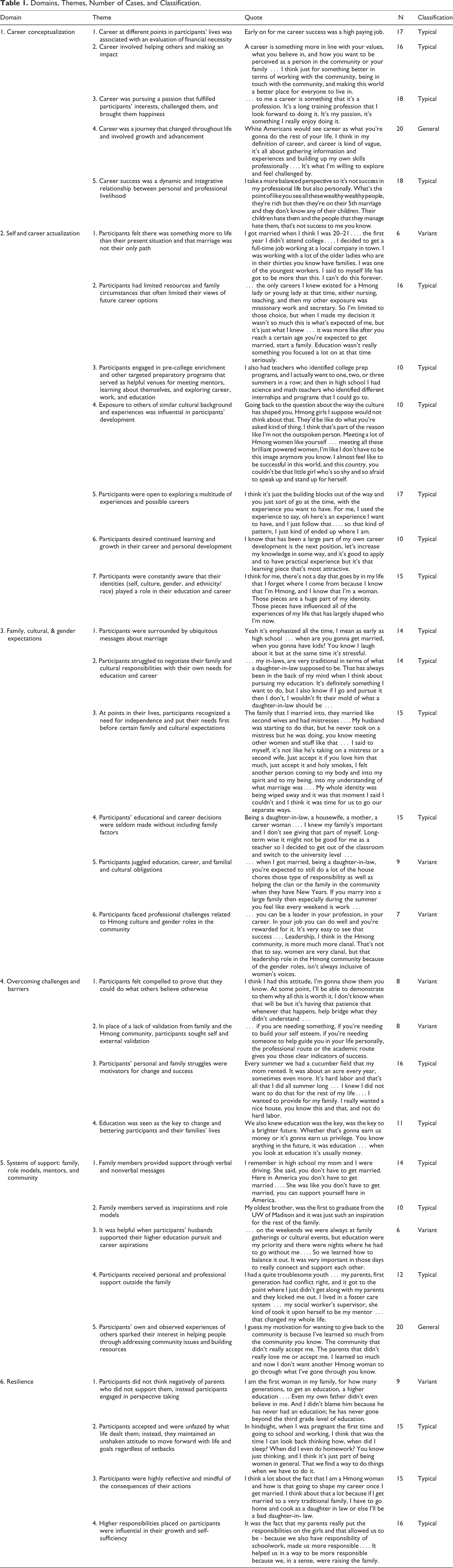
Six domains were identified in participants’ narratives that addressed career conceptualization; self and career actualization; family, cultural, and gender expectations; overcoming challenges and barriers; systems of support: family, role models, mentors, and community; and resilience. Within these domains, several themes were found. Table 1 summarizes these domains and themes. Domains are broadly labeled to reflect their themes; however, instead of using a reductionist approach, each theme was kept in descriptive language to best capture the spirit of participants’ narratives. Selected quotes are included to illustrate each theme. The themes are also labeled with frequency numbers and as general, typical, or variant. The themes under each of the six domains presented here are summarized in Table 1.
Domains, Themes, Number of Cases, and Classification.
Domain 1: Career Conceptualization
The domain of career conceptualization refers to participants’ perspective on what career and career success means to them.
Domain 2: Self and Career Actualization
The domain of self and career actualization refers to participants’ sense of agency in shaping their lives and careers. Participants discussed experiences and factors that helped and hindered their self and career actualization.
Domain 3: Family, Cultural, and Gender Expectations
The domain of family, cultural, and gender expectations refers to participants’ career experiences in the context of her family, Hmong culture, and gender.
Domain 4: Overcoming Challenges and Barriers
The domain of overcoming challenges and barriers refers to obstacles and experiences in participants’ lives that have influenced their life pursuits, including education and career.
Domain 5: Systems of Support: Family, Role Models, Mentors, and Community
The domain of systems of support: family, role models, mentors, and community refers to the supports in participant’s life pursuits, including education and career.
Domain 6: Resilience
The domain of resilience refers to participants’ attitudinal characteristics that have helped them be resilient to challenges as well as experiences that have helped them develop skills to overcome these challenges.
Discussion
The narratives of these Hmong American women convey a dynamic and multifaceted process of career development that is influenced by personal, cultural, and contextual variables. Although I recognize all four systems of Bronfenbrenner’s (1977) ecological model of development, the micro- and macrosystems in which these Hmong American women are situated have been particularly influential in their development and are used here to conceptualize their career development. At the microsystems level, the interpersonal interactions between their families, communities, and individuals from the broader society have been instrumental factors in these Hmong women’s education and career development. At the macrosystems level, ideologies, both within Hmong culture and the American mainstream, have also played a fundamental role in their experiences. In some ways, the barriers and supports these Hmong women identified parallel the experiences of other racial/ethnic minority women who must contend with their double marginalized status as women and as women of color (Cook et al., 2005). In other ways, these barriers and supports are unique to Hmong American women, especially 1.5-generation Hmong American women. In this section, I discuss participants’ conceptualization of what constitutes a career and further elucidate those contextual and environmental factors at the microsystem and macrosystem levels that interact with personal factors to shape their educational and career experiences.
Participants’ narratives paint a nuanced picture of inner struggles with gender expectations and their identity as Hmong American women (e.g., see Table 1; theme 3.3). Prior to immigration, identity as a Hmong woman was largely defined by marriage (Donnelly, 1994). Thus, the path of a successful Hmong woman was to marry into a good family and bear children; and the dominant state of a Hmong woman was as part of a married couple with children (Donnelly, 1994). In the context of the United States, these prevailing beliefs generate a complicated picture for Hmong women that reflects the tension between dueling macrosystems. Scholars have noted that because Hmong are a collectivistic society, a Hmong woman’s identity and her ideas of what comprises a successful life reflect the tension between, and her attempts to negotiate, American values of independence, individualism and self-determination, and Hmong values of interdependence and kinship (Fendya, 1995; Garrity, 2003). Additionally, Hmong American women’s traditional roles as daughters, wives, and mothers often interfere with their education (Garrity, 2003; Vue, 2007). The women’s narratives in this study reflected these tensions.
Although participants’ conceptualization of what constitutes a career parallel the ideologies of the mainstream macrosystem (e.g., careers provide financial security; also see Table 1; theme 1.1), they differed in important ways from those of White as well as other Asian American women. One key difference is that few identified having specific “career dreams” while growing up. This is particularly interesting, given that research has consistently noted that other Asian Americans are often pushed into careers, such as the sciences, business, or engineering, that are viewed by their parents as promising economic stability and having high social status (Dundes, Cho, & Kwak, 2009). Inconsistent with this literature, participants in this study made no mention of pressure from their family or community to aspire to this view of the career market.
Instead of identifying “career dreams,” these Hmong American women talked about the limitations of growing up not knowing what was beyond high school, instead only knowing that the next path for a Hmong girl is marriage. Participants cited a lack of vocational role models and a lack of expectations and support for exploring careers from within their family microsystem and the larger Hmong community. For example, one participant described what she called the “cultural glass ceiling” of “not having anybody else to look at to see what happens after the age of eighteen” (see Table 1; theme 2.2). Participants also talked about being surrounded by ubiquitous messages to marry from a young age (see Table 1; theme 3.1). This suggests that expectations in Hmong culture may not have included education and career development for these participants as young Hmong girls.
Although participants may have had limitations stemming from their family microsystem, they also identified their families as sources of support, motivation, and inspiration in their education and career persistence (see Table 1; themes 5.1, 5.2, and 5.3). This suggests that a lack of familial expectations and support for education and careers for women may not be a simple outcome of culture or of gender roles and expectations. In many cases, participants were the first in their family to pursue higher education. The discrepancy between the educational levels of parents and children may explain why parents were not equipped to actively assist them in their educational pursuits and career exploration (see also Thao, 2009).
When these women did later develop a conceptualization of what constitutes a career, all valued careers that involve helping others and making an impact within their communities (see Table 1; theme 1.2). Two explanations that stem from macrosystem ideologies for why these women may value these careers are women’s relational orientation (Donnelly, 1994) and the collectivistic orientation within Hmong society. However, this study further indicates that these Hmong American women developed this value from their family’s and community’s struggle with poverty and a lack of resources. This suggests that the desire to strive for education for the sake of their family, community, and Hmong society may be particularly strong among recent Hmong American immigrants such as the first and 1.5 generations (see also Thao, 2009).
Personal factors also drove these women’s career development. Participants identified critical moments in their lives in which they broke away from family and cultural expectations, putting themselves and their needs first. This reflects the notion that adherence to cultural practices is not an either-or situation. Participants may value Hmong beliefs and traditions but are also constantly negotiating culture with a sense of agency in shaping their own lives. As highlighted in Bronfenbrenner’s model, the individual plays a key role in making meaningful life choices, such as educational and career choices. Similar to Ngo’s (2002) work with Hmong women, these women are not “passive absorbers and victims” (p. 181) of culture and their environment, instead they are active agents in change through reaction and negotiation. Themes under domain 2: self and career actualization (see Table 1) further reflect participants’ sense of agency in shaping their lives and careers; and elucidate the experiences and factors that helped and hindered their self and career actualization.
For the Hmong American women in this study, career and education became arenas in which they could explore self-actualization. Participants saw education as the key to bettering their positions and that of their families (see Table 1; theme 4.4). Because participants’ families valued education for their children, although less so for women than men, pursuing education provided these women with some leverage in gaining a degree of freedom and independence. Previous work has found that for a Hmong woman in the United States, education is considered the key to a successful life that includes economic self-sufficiency, increased personal autonomy, the progression of their families and the Hmong community, and a greater sense of gender equality (Fendya, 1995; Lee, 1997; Thao, 2009; Vue, 2007). For participants in this study, educational and career environments serve as a transitional space between two prominent macrosystems, Hmong culture and mainstream American culture, and provide these women opportunities for exploring their potential and identity. If and how these environments successfully help Hmong American women to integrate and consolidate their identities (as suggested in Fendya, 1995) remains a question. What is clear is that support for Hmong women’s educational and career aspirations both outside and within the Hmong community is important because it provides affirmation of her developing identity that will help her cope with the stresses of being bicultural (Cook et al., 2005; Fendya, 1995).
Despite many apparent limitations, these participants successfully pursued and obtained postsecondary degrees and professional work. This success, in spite of challenges, demonstrates that they possess skills necessary to overcome barriers. These Hmong American women’s openness to a multitude of experiences may have served to rectify initial limitations in knowledge about career options (see Table 1; theme 2.5). Precollege enrichment and targeted exploration programs also helped to compensate those participants whose families may not have had the knowledge to support them in their education and career exploration (see Table 1; theme 2.3). Participants felt that meeting and being exposed to other Hmong, especially Hmong women contributed to the development of their identity as Hmong and as Hmong women, in both the professional and personal realm (see Table 1; theme 2.4). It also contributed to a greater sense of self-efficacy for these participants in their continuous negotiation of education and careers in gendered and cultural terms. Participants also identified individuals within their microsystems, such as teachers, mentors, and role models who were instrumental in their life, educational, and career experiences (see Table 1; theme 5.4). Other research shows that mentoring and role models at the microsystems level play a critical role in the career development of girls and women (Betz, 1994; Rhodes, Lowe, Litchfield, & Walsh-Samp, 2008). For these Hmong women, mentors and role models were especially powerful when they could see their gender and ethnicity positively reflected.
For many participants, having seen their parents struggle with poverty and adjust to mainstream culture motivates them to lead a different life with education and career as the catalyst (see Table 1; theme 4.3). This lends support to the work of Thao (2009) who found that family’s past hardships, current struggles, poverty, and oppression influence Hmongs’ perspectives on education and careers. The nuanced insight afforded by narratives shows that participants in this study felt that, in bettering themselves, they put themselves in better positions to help their family and community. Interestingly, the risks taken by participants for freedom from familial and cultural holds had the projected outcome of benefiting not only themselves but also their family and community. They simultaneously considered familial and cultural obligations in diverging from appropriate and accepted gender roles and expectations, potentially setting up an inherent contradiction that may serve to preserve gender ideologies in that macrosystem.
Gender roles in the Hmong American community appear to have changed with more Hmong women pursuing higher education and occupying high profile careers. However, similar to Zhou and Bankston’s (2001) research with Vietnamese-American women, we must further explore whether the Hmong community has made strides in including the voices of women and validating their achievements, or whether women are pursuing education and work outside the home only to accommodate the socioeconomic realities of the United States The accounts from this study suggest that the educational and career achievements of Hmong women are minimally acknowledged and the status quo maintained within Hmong communities (e.g., see Table 1; theme 3.6). The continuation of value placed on traditional women’s roles, and the incongruence between the validation of Hmong women’s career success in society at large and the lack of validation within the community (e.g., see Table 1; theme 4.2), work to sustain gender-specific roles within the Hmong community.
When faced with situations that may otherwise have been blockades in their lives, participants in this study persevered. In addition to systems of support, participants possessed or developed resilience necessary to overcome challenges. Resilience (see Table 1; themes 6.1, 6.2, and 6.3) is reflected in participants’ forward moving mind-set, their ability to take other’s perspectives, and to reframe. Consistent with Bronfenbrenner’s (1977) ecological model of development, personal factors interacting with cultural and contextual variables serve to influence these women’s education and career experiences. For example, many participants have reframed their parents’ lack of support for their education and career development as a lack of understanding of U.S. schools, colleges, and careers rather than adopting the view that their parents do not care. Participants in this study did not deny that life had at times dealt them a hard hand; however, they perceived this as a part of life that they had to deal with and move beyond.
How did participants learn to manage these hardships? Higher expectations and responsibilities placed upon them at the family microsystem level helped them to become self-sufficient. From a young age, participants had to learn skills like planning, self-management, multitasking, and problem solving. Many participants had to juggle heavy responsibilities in their families, such as cooking, cleaning, and interpreting for their parents while maintaining their schoolwork (see Table 1; theme 6.4). While their parents relied more heavily on them at home, they allowed boys to freely pursue whatever they wanted. Interestingly, through this process, Hmong girls have had to seek knowledge and skills outside the home and to learn to be independent, something not typically encouraged in a traditional Hmong family. Hmong communities are similar to the Vietnamese communities studied by Zhou and Banskton (2001) in that when girls come home from school they are expected first to help with housework and then do their studying. Also like Vietnamese women, Hmong women outperform their male counterparts in education (Lee, 2005). Self--sufficiency, among other factors, likely aids in academic performance and may account for this difference.
Finally, the women in this study engage in continuous reflection about their education and careers (see Table 1; theme 6.3). These internal dialogues may serve as a substitute for the external dialogue on gender roles within the Hmong community that Hmong women may be reluctant to engage in. Previous research has found that Hmong women’s concern with dialogue on issues like gender roles within the Hmong community reflects the juxtaposition of her growing sense of personal autonomy and differentiation from others with her desire to establish and maintain supportive relationships (Fendya, 1995).
Strengths and Limitations
Issues of generalizability and researcher bias are important to address. The 1.5-generation Hmong American women in this study represent a small subset of Hmong Americans. In addition to their status as 1.5-generation Hmong Americans, these women are highly educated and are from a small geographical region. The ability to generalize findings to the wider Hmong American population is thus limited. An advantage of a qualitative study such as this one is that it can help to deepen our understanding of cultural groups and provide insights into complex social phenomena.
The principal researcher is a 1.5-generation Hmong American woman. Her identification with this population and topic may have prevented her from recognizing blind spots in both the interview and the analysis processes. It is also possible that her interpretation of the data was inadvertently influenced by her own life experiences. However, several procedures, such as the use of a second reviewer, were employed to minimize the potential risk of researcher bias. It can also be argued that the principal researcher’s proximity to this topic was an advantage. The common background and experiences of the principal researcher and participants helped accelerate rapport because the participants were able to talk about their experiences without having to provide a frame or to explain every detail of their cultural backgrounds. Many of the participants preceded disclosures with references about how the researcher “might understand” because of her similar background and seemed more willing to share their private experiences.
Conclusion and Implications
Participants’ narratives highlight the fluid and dynamic nature of their career and personal development as well as the ways in which traditional practices and cultural practices are not fixed, but are instead continuously being negotiated and changed by these women. The microsystems and macrosystems in which these women are situated have been particularly influential in their development. This means that change must be enacted in the different systems in which they engage. Contextual influences like culture, family, and society strongly shape these women’s experiences. However, these women are far from victims of their environment, instead they are active agents in shaping their own lives and in turn changing their environments.
Results from this study indicate a need for closer examination of the role of gender in various aspects of career development, such as career expectations and support for the social mobility of women within the Hmong American community. The incongruence between the validation and acceptance of Hmong American women’s career and leadership in the larger society and limited validation in the Hmong community seems to sustain gender specific roles within the Hmong community (see Table 1; themes 3.6 and 4.2) and reflects the work that still needs to be done in the Hmong community in affirming Hmong women’s achievements. This work will need to engage the Hmong community in dialogue about topics related to gender roles, education, career, and what constitutes community pride.
Results from this study also suggest that career exploration and preparatory programs and exposure to others of similar cultural background are instrumental in Hmong American women’s career, work, and educational development (see Table 1; themes 2.3 and 2.4). It would, therefore, be beneficial for programs, such as mentorship programs, to recruit Hmong women and men already working in professional capacities. It could greatly contribute to younger Hmong Americans’ self-perception and self-efficacy to have mentors and role models who have successfully finished college, entered the workforce, and who juggle family life and career. In the workplace, the diversification of personnel in various settings and industries to include recruitment and retention of Hmong Americans will also be crucial in providing role models for younger Hmong American women and men.
Appendix
Interview Protocol
1. What does the term “career” mean to you? How did you get to this point in your occupation?
We are interested in knowing more about your work history. As far back as you can remember, please talk about your work history. What worked well for you? Are there things you would change?
What were your work or career dreams growing up? How did you learn about or become inspired to have these work or career dreams?
Were there certain persons in your life that have contributed to or have influenced your career decisions?
How has your cultural background influenced your career development?
What are the gender expectations that you face with your family and community and how have they influenced your career choices? How did you reconcile these expectations?
Were there certain situations in your life that has contributed to or have influenced your career decisions?
What obstacles did you have to face and how were you able to overcome these obstacles to get to where you are in your career today?
What does the term “career success” mean to you? What does it look like to be successful in one’s career?
How has your perspective on “career” changed over time?
Of all the things that you have talked about today regarding your career process, does any one thing stand out as the most important you would like to emphasize?
Is there anything else you would like to add?
Footnotes
Author’s Note
Research was conducted at Department of Educational Psychology, Counseling and Student Personal Psychology, University of Minnesota. Ava Yang is now at Asian American Studies, University of Wisconsin–Madison.
Declaration of Conflicting Interests
The author(s) declared no potential conflicts of interest with respect to the research, authorship, and/or publication of this article.
Funding
The author(s) received no financial support for the research, authorship, and/or publication of this article.