




Abstract
Despite the emerging interest in the job crafting construct, researchers know little about its dimensions and their potential benefits for organizations. In a quantitative investigation, using a self-report questionnaire among a group of 189 Portuguese nurses and nursing assistants, we analyze how job crafting can be strongly related to workers’ sense of calling and turnover intention. The results indicate that sense of calling totally mediated the negative relation between the increase in challenging job demands and turnover intention. Although traditional assumption is that a sense of calling leads workers to craft their jobs, we theorize about the potential reverse path, given that our results support the possibility that sense of calling may be triggered when workers increase their own challenging job demands. We recommend further research to provide additional insight into job crafting formation mechanism.
The adaptation made by workers to their jobs and job tasks is gaining importance, as crafting advantages are highlighted by social investigators (P. Lyons, 2008; Tims, Bakker, & Derks, 2014; Wrzesniewski & Dutton, 2001). Tims and Bakker’s (2010) approach to job crafting advances a step forward in this process. These authors framed this construct’s definition in terms of the Job Demands–Resources model developed by Demerouti, Bakker, Nachreiner, and Schaufeli (2001), which defines job crafting as a self-initiated behavior of employees aimed at changing their job demands or job resources. According to Job Demands–Resources theory, workers implement changes in their workplaces to help balance the surrounding demands and resources with their needs and personal characteristics. Workers are assumed capable of changing their jobs by increasing the level of available resources, by decreasing the amount of job demands, or by increasing the amount of job resources (Bakker & Demerouti, 2007). Job crafting concept’s scrutiny facilitates direct investigation to the impact of its dimensions on core organizational concepts such as turnover intention and sense of calling. This line of research may then impact employees’ satisfaction, by approaching them to more meaningful and satisfying work experiences and by helping to better understand the best direction to focus their career development.
Although the notion of calling and its considerable potential for individuals have been known for centuries (Hardy, 1990), it has only recently become a subject of academic interest (Wrzesniewski, McCauley, Rozin, & Schwartz, 1997). The calling concept has a strong religious background, as it was traditionally perceived and interpreted as a higher purpose to carry out certain type of task or mission (Hardy, 1990). In the last years, the connection to the religious perspective is losing importance, focusing instead on individual’s internal motivation in seeking a professional sense of realization and purpose (Wrzesniewski et al., 1997). Although some individuals might start working in something for religious motives, the religious component is neither enough nor necessary to perceive the job as a calling (Hansen, 1996). In the context of work, calling is understood as a meaningful and continuous experience that drives individuals to passionately perform their jobs without expecting a material reward in exchange (Wrzesniewski et al., 1997). As such, the goal of the present study is to analyze the relation between calling and job crafting, in order to understand if this relation can provide us indications about the formation process of workers’ sense of calling.
In addition, we aim to understand whether the sense of calling mediates the relation between job crafting and workers’ turnover intention. Although turnover intention has long been recognized as a problem for organizations (T. Lyons, 1971) and for workers’ career development (Scandura & Viator, 1994), factors that trigger it and methods to prevent it are yet to be completely understood (Steel & Lounsbury, 2009). The lack or excess of challenges at work is often the reason for workers to leave (Takase, Yamashita, & Oba, 2008); also, the sense of calling possibly suppresses turnover intention (Cardador, Dane, & Pratt, 2011). We want to analyze whether the sense of calling may function as a mediator between job crafting and the intention to leave.
Theory and Hypotheses
Job Crafting
As defined by Wrzesniewski and Dutton (2001), job crafting refers to adaptations that individuals make to labor tasks and to the relational boundaries of the job to approach it from their physical and cognitive ideals, thus transforming work into a meaningful and positive experience. This implies that workers adjust their interpersonal relations and tasks in ways that are most convenient for them (Berg, Dutton, & Wrzesniewski, 2008), when faced with situations in which the functions being performed do not correspond to their needs and/or labor characteristics (Wrzesniewski & Dutton, 2001). Job crafting can increase motivation, job satisfaction, productivity (P. Lyons, 2008; Wrzesniewski & Dutton, 2001), work engagement, and job performance (Tims et al., 2014), thus forming a potential source of innovation in organizations (Wrzesniewski & Dutton, 2001).
Tims and Bakker (2010) made advancements in this subject using the Job Demands–Resources model (Demerouti, Bakker, Nachreiner, & Schaufeli, 2001) to elaborate job crafting contextualization. These authors limited job crafting analysis to the active behavioral changes made by employees to craft their jobs, making this construct easier to analyze from a quantitative viewpoint. Job crafting was proposed to occur, as workers initiate action within four dimensions: (a) increasing social job resources, (b) increasing structural job resources, (c) decreasing hindering job demands, and (d) increasing challenging job demands (Tims, Bakker, & Derks, 2012). The actions in the first two dimensions consist of efforts to increase the amount of resources available, while the efforts in the latter two dimensions are focused on customizing job according to labor demands.
From the resource side, the increase in social job resources dimension is relative to the increase in social support, such as the search for feedback and guidance from the leader and/or coworkers. The increase in structural job resources primarily represents a self-development desire, reflecting the will to learn new things and to professionally seek new capabilities. From the demands side, the decrease in hindering job demands dimension refers to the proactive lowering of job demands ruled as harmful, such as mentally/emotionally intense tasks, or activities that require difficult decisions. The increase in challenging job demands dimension particularly refers to the efforts initiated to seek challenges at work. Examples include the proactive participation in new tasks or projects, or the unconcerned analysis of the daily tasks to look for ways to make it more challenging. This division of job crafting into dimensions contributes detail to analyses on the origin of various crafting characteristics, thus allowing an approach to the practical intervention.
The sense of calling is a particularly individualistic variable, strongly related to inner feelings and with the development and pursuit of self-directed behaviors (Hall & Chandler, 2005). Due to these characteristics, a relation between the increase in social job resources and the sense of calling is not expected. We believe that the possibly existing bond between the increase in job resources and calling happens primarily due to workers’ proactive self-development desire, which leads them to experience new realities and reinforces their self-awareness. From the job demands viewpoint, we will not investigate the adaptation made to hindering job demands because previous research seems to discard its potential relation with the sense of calling (Creed, Rogers, Praskova, & Searle, 2014). Also, it is intended to provide in this study a positive approach toward job crafting. However, we will examine the angle of labor demands associated with the increase in challenges with interest, as the work challenges were previously found to be related to the sense of calling (Steger, Pickering, Shin, & Dik, 2010).
While interpreting demands as the psychological and/or physiological cost of labor, studies applying the Job Demands–Resources model have traditionally considered the resources side as highly positive to the worker (Bakker & Demerouti, 2007). Results from a study by Van den Broeck, De Cuyper, De Witte, and Vansteenkiste (2010) have investigated enough to change this perspective. By analyzing job demands in further detail, the authors conclude that, as expected, hindering demands are associated with increases in worker exhaustion and decreases in vigor. However, unexpectedly, the results also indicate that challenging demands are not associated with worker exhaustion, although they are associated with increases in vigor. Despite requiring employees to expend energy to overcome labor challenges, this type of demands apparently serve as a stimulus for workers, thus suppressing their sense of exhaustion (Van den Broeck, De Cuyper, De Witte, & Vansteenkiste, 2010). These evidences support a deeper analysis to increase the challenging job demands as a potentially positive construct and not only the job resources side of job crafting.
Because the outcomes associated with job crafting appear to be complex—ranging from greater satisfaction and well-being (P. Lyons, 2008; Wrzesniewski & Dutton, 2001) to frustration (Wrzesniewski & Dutton, 2001) that may lead to work withdrawal—we sought to understand more about potential correlates of this construct by examining its associations with workers’ sense of calling and their turnover intentions.
Calling
Although academic study on calling is quite recent, its materialization can offer tangible benefits to workers as well as to the organizations that they represent. Workers acting on a sense of calling exhibit lower levels of absenteeism, higher job satisfaction (Duffy, Dik, & Steger, 2011; Peterson, Park, Hall, & Seligman, 2009; Wrzesniewski et al., 1997), greater career commitment, higher levels of organizational commitment (Duffy, Dik, et al., 2011) have a tendency to progress faster (Wrzesniewski et al., 1997), perceive a greater sense of organizational duty, attribute greater meaning to their work (Bunderson & Thompson, 2009), and have a higher level of life satisfaction and perceived employability (Praskova, Creed, & Hood, 2015).
The perception of an unanswered calling has been believed to relate to the development of job crafting, which seems to be driven by an inherent necessity to fulfill the calling feeling. This theoretical approach advocates that this drive leads workers to develop crafting strategies; these strategies help workers to approach their jobs from an ideal workplace perspective (Berg, Grant, & Johnson, 2010). This makes the ones who experience a sense of calling to demonstrate a greater propensity to adapt jobs to their own personal characteristics and desires, even if it means a higher labor demand.
While traditionally was assumed that the sense of calling was a spontaneous and inapt characteristic (Hardy, 1990), recent studies open gates for a different perspective. Without disregarding its role as a predictor, recent literature has been focused on the notion of calling as an outcome variable. The sense of calling has been found to be predicted by life meaning, vocational development (Duffy, Manuel, Borges, & Bott, 2011), personal growth (Bott & Duffy, 2015), search for life meaning, and vocational self-clarity (Duffy, Douglass, Autin, & Allan, 2014). This perspective led us to believe that job crafting may expose workers to an interesting task or area, thus allowing them to discover a calling in their work. Researchers know that the process of searching for a calling can take a long time, and this calling may even be discovered by accident. In many cases, experiencing this feeling seems necessary to understand its importance (Duffy & Sedlacek, 2007). A focus on a specific task possibly invokes a sense of calling, even if the worker is not initially aware that this has taken place. French and Domene (2010) interviewed some young university students who felt a sense of calling. In one of the analyzed cases, it was concluded that the student had become aware of the calling when a teacher pointed out to her that she had an unusually high level of performance in a specific activity, suggesting that she should pursue it professionally.
In this case, the sense of calling clearly did not exist before. It was the exposure to a task, without any particular previous significance, that led the student to find a calling. Hall and Chandler (2005) presented a real career case to illustrate their perspective about calling. While a sense of challenge was present in the analyzed individual’s career, a sense of calling seemed to arise. Later, when the boredom was installed, this was associated with a necessity to change and to look for challenges. This apathy in the career may help to justify the decrease in the sense of calling when individuals are socially more comfortable (Dobrow, 2013). Dobrow (2013) also indicated the sense of calling as something dynamic, which can be shaped by antecedents, rather than a static construct. The author defends that calling should also be seen as a consequence and not only as a cause.
Despite these perspectives, the assumption that the relation between calling and job crafting is unidirectional and controlled by calling is prevalent (Berg et al., 2008; Wrzesniewski & Dutton, 2001), and the possible inverse path of this liaison is yet to be explored. Considering the above descriptions, we believe that the increase in challenging job demands should be related to an increase in the sense of calling.
Similar to what happens when the challenging job demands are increased, we also believe that the proactive development of skills and aptitudes can help workers to find their sense of calling. According to French and Domene (2010), the ones who found their calling shared some common personal attributes: resiliency, sense of identity, proactivity, and tenacity. The participants in that study revealed a proactive pursuit and involvement in activities related to their personal preferences, even if they had to fight with obstacles and adversities along the way. As the increase in structural job resources is closely related to workers’ proactive self-development, we believe that the increase in structural job resources dimension of job crafting may also be related to the sense of calling.
Turnover Intention
If workers perceive a calling that they are unable to pursue, they will eventually develop an intention to leave the organization (i.e., “turnover intention”; Cardador et al., 2011). Turnover intention, defined as the propensity of individual employees to leave organizations in which they are exercising functions (T. Lyons, 1971), is considered as the best predictor of effective turnover (Takase, 2010). Turnover has a significant impact on organizations, resulting in an increase in recruitment costs and in losses of human capital in the form of highly differentiated workers. It also leads to productivity losses, to costs associated with integrating new employees (Jones & Gates, 2007), and it is harmful to workers’ career development (Scandura & Viator, 1994).
The same intention to leave can arise if workers perceive a lack of challenge in their jobs (Takase et al., 2008). Both excess and lack of challenges are believed to contribute to increase turnover (Takase et al., 2008). Excess challenge does this by increasing workload and stress (Fochsen, Sjogren, Josephson, & Lagerstrom, 2005). In contrast, the lack of challenges tends to decrease motivation (Tzeng, 2002), which in turn also leads to turnover intention (Yildiz, Ayhan, & Erdoğmuş, 2009). Although some literature claims that if the job is too challenging, it will force workers to reduce this demanding stimuli (Petrou, Demerouti, Peeters, Schaufeli, & Hetland, 2012), we also found examples of how workers are willing to deal with adversities to maintain proximity with their source of motivation. The zookeeper’s analysis made by Bunderson and Thompson (2009) is an excellent illustration of this perspective; they depict the possibility to continue to deal with an exhausting environment over time with personal and professional sacrifice by workers. Some interviewees with a clear sense of calling declared that they would not quit their jobs for anything, even if they weren’t paid anymore. The relation between worker’s challenging job demands and vigor increase, without a surge on exhaustion (Van den Broeck et al., 2010), brings the possibility that something may help workers to deal with the adversities in a demanding environment. Considering the relation between the challenging job demands and the possible result in terms of intention to leave and considering that workers experiencing a calling may better resist to sacrifices and to exhaustion (Bunderson & Thompson, 2009), the existence or the discovery of a sense of calling may mediate the relation between the increase in challenging job demands and turnover intention.
Method
Participants and Procedure
This cross-sectional study was developed among health-care professionals. Study participants were 189 nurses and nursing assistants from a midsized regional hospital center in Portugal. Similar to most Portuguese State departments, this hospital was also one of the institutions affected by budget cuts and reduction in hiring, as a consequence of the financial adjustment conducted in the country. These financial adversities may have contributed to work overload and lack of motivation, conditions in which job crafting, calling, and turnover intention would be especially highlighted.
To gain research access, we contacted the hospital center board and submitted a formal request to develop a study. We received authorization to coordinate the survey distribution with the hospital investigation department. A questionnaire was distributed to all nurses and nursing assistants working in the institution (n = 609). We ultimately received 189 completed questionnaires, which translates into a response rate of 31% (n = 189). All the surveys were anonymous, and they were distributed in opaque envelopes. The consent form informed participants that their responses would be kept private and that data would be reported in aggregate, excluding any information that could be used to identify specific respondents. Respondents received instructions to seal the unidentified questionnaire in the opaque envelope after completing it and to send it by internal mail to the investigation department without sender information. Of all participants, 141 (74.6%) were registered nurses and 48 (25.4%) were nursing assistants. A mean age of 39.8 years was reported (SD = 9.61), mostly self-identified as women (86.8%). The average job experience was 15.5 years (SD = 8.56), with an average tenure of 13.4 years (SD = 8.03).
Instruments
As the scales weren’t in respondents’ native language, they were previously submitted to a process of translation–retroversion to convert them from English to Portuguese. All items on this survey were assessed along a 5-point Likert-type scale, ranging from strongly disagree to strongly agree.
Before adjusting instruments, we treated data for missing values. All responses with more than three missing values were excluded (four responses were eliminated for this reason). Preserving the remaining surveys with missing values was decided because, even considering that the missing values only represented less than 1% of the total responses, the sample size (n = 185) wasn’t sufficient to drop all the surveys with missing values. The percentage of missing values among items varied between 0% and 2.2%. After Missing Completely at Random (MCAR) confirmation, we proceeded with the multiple imputation technique (Hair, Black, Anderson, & Babin, 2014) using one imputation, as suggested by Schafer (1999) for databases with less than 5% of missing data.
Calling
The calling construct was assessed using a scale based on the one developed by Wrzesniewski, McCauley, Rozin, and Schwartz (1997). This measure has been widely used, with evidence of reliability and discriminant validity in several studies (e.g., Cardador et al., 2011; Leana, Appelbaum, & Shevchuk, 2009; Park, 2010; Peterson et al., 2009), positively correlating with similar constructs such as life satisfaction (r = .32, p < .001), job satisfaction (r = .54, p < .001; Peterson et al., 2009), organizational identification (r = .42, p < .05), or instrumentality (r = .51, p < .05; Cardador et al., 2011). As stated by Cardador, Dane, and Pratt (2011), the moderate correlations with similar constructs support the convergent and discriminant validity of the measure. This scale was originally based on Wrzesniewski et al.’s (1997) study, aiming to understand whether workers perceived their professional activities as a job or as a calling. An individual would perceive the work as a job if his or her main professional goal would be to make money in order to subsist. An example item for job is “My primary reason for working is financial—to support my family and lifestyle.” On the other hand, an individual could perceive the work as a calling. In that case, as previously stated, the main motivation would be the personal fulfilling and the contribution to a major purpose. A good item example for calling scale would be “My work is one of the most important things in my life.” The job and calling items presented a strong negative correlation in the original study, and factor analysis revealed that both loaded on the same factor, as opposite poles of the same construct. Therefore, we decided to use all the items used by Wrzesniewski et al. (1997) to evaluate calling and job, thus allowing statistical refinement after data collection. As there was an item pointing for the satisfaction brought by weekends’ anticipation, we decided to add an extra item pointing for a day off anticipation. Since the majority of our participants were working in shifts, the weekend itself would not bring great satisfaction for the ones who had to stay at work on Saturdays and Sundays. As expected, the item referring weekends later failed in the factor analysis, while the one referring day offs loaded together with other calling items (reverse). Although the Cronbach’s α score for this scale is not presented in the original study, Cardador et al. (2011) reported a Cronbach’s α score of .72 for calling dimension.
Turnover intention
Turnover intention was measured by 3 items conceptually developed by Mobley, Griffeth, Hand, and Meglino (1979). This measure has been widely used, with evidence of reliability and validity (α > .80; e.g., Carmeli & Gefen, 2005; Cohen & Golan, 2007), negatively correlating with similar constructs such as job involvement (r = −.29, p < .001) and career commitment (r = −.47, p < .001; Carmeli & Gefen, 2005). Although this scale usually refers to the organizational context, as we were dealing with health-care professionals, we decided to change the word “organization” to “hospital.” An example item is “I often think about leaving this hospital.”
Job crafting
We measured the job crafting dimensions using the scale created by Tims, Bakker, and Derks (2012). In the original study, the Cronbach’s α score for the increase in challenging job demands was .75 and for the increase in structural job resources was .82. An example item for the increase in challenging job demands dimension is “If there are new developments, I am one of the first to learn about them and try them out.” An example item for the increase in structural job resources dimension is “I try to learn new things at work.” The increase in challenging job demands measure was found to positively correlate with similar constructs such as proactive personality (r = .55, p < .01), and the increase in structural job resources measure was found to positively correlate with similar constructs such as personal initiative (r = −.51, p < .01; Tims et al., 2012).
Results
Due to the modifications made to our measures, a principal component analysis (PCA) with promax rotation was performed to assess that items were loading on their respective factors. Minor adjustments were performed to guarantee that all items from calling, turnover intention, increase in challenging job demands, and increase in structural job resources had loadings greater than .40, and cross loadings with a difference smaller than .2 between factors. Regarding job crafting dimensions, 3 items were deleted for having a loading inferior to .40 in the expected factor. About turnover intention scale, all items were maintained after PCA. Five items from calling scale were selected after PCA: “I find my work rewarding,” “If I was financially secure, I would continue with my current line of work, even if I was no longer paid,” “My work is one of the most important things in my life,” “I am eager to retire (Rev.),” “I would not encourage young people to pursue my kind of work (Rev.),” and “I am very conscious of what day of the work week it is and I greatly anticipate my day offs. I say, Thank God it’s my day off! (Rev.).” Considering that calling scale has undergone significant amendments, it is important to reinforce that the selected items are closely related to the explanatory text originally created by Wrzesniewski et al. (1997), on which the quantitative measure was based.
Descriptive Statistics
The means, standard deviations, Cronbach’s αs (in parentheses), and Pearson correlations of the model variables were calculated (see Table 1). Table 1 shows that internal consistencies were, in general, quite acceptable.
Means, Standard Deviations, Cronbach’s α (in Parentheses), and Pearson Correlations of the Model Variables.

*Correlation is significant at the .05 level. **Correlation is significant at the .01 level.
Correlational analysis results show that relationships point in the expected direction. As anticipated, and consistent with Hypothesis 1, there is a positive correlation between sense of calling and the increase in challenging job demands. Also consistent with Hypothesis 2, there is a positive relation between the increase in structural job resources and sense of calling.
After the preliminary steps, Amos, Version 20 (Arbuckle, 2011) was used to confirm the fitness of the model previously obtained. In order to do so, we analyzed χ2, degrees of freedom (df), comparative fit index (CFI), Tucker–Lewis index (TLI), and root mean square error of approximation (RMSEA), as recommended by Hair, Black, Anderson, and Babin (2014) and Hu and Bentler (1999). After small error correlations within items suggested by the modification indices, a good model fit was obtained (χ2 = 118.59, df = 97, CFI = .98, TLI = .97, and RMSEA = .035).
To test the positive relation between the increase in challenging job demands and sense of calling (Hypothesis 1) and the positive relation between the increase in structural job resources and sense of calling (Hypothesis 2), we performed structural equation modelling within AMOS, Version 20, software package (Arbuckle, 2011), including all the hypothesized variables (Figure 1). The model had a good fit (χ2 = 119.09, df = 99, CFI = .98, TLI = .97, and RMSEA = .033), thus allowing the inference that the increase of challenging job demands had a strong positive relation with calling (β = .70, p < .001). This result supports Hypothesis 1. Although we found a positive correlation between the increase in structural job resources and calling (Table 1), this path was not supported in the Structural Equation model (SEM) (β = −.09, p = .40). For this reason, we must reject Hypothesis 2. To confirm the directionality of the relation between the increase in challenging job demands and the sense of calling, a test to verify the potential reciprocal relation between both variables using structural equation modelling was performed. To do so, a model with a double path between calling and the increase of challenging job demands was designed, as suggested in Marcoulides (1998). The model had a good fit (χ2 = 32.00, df = 25, CFI = .98, TLI = .97, RMSEA = .039), and the significance of the increase in challenging job demands > calling path (β = .71, p < .001), contrary to the lack of significance of the calling > increase in challenging job demands path (β = −.08, p = .37), provides additional support to Hypothesis 1.
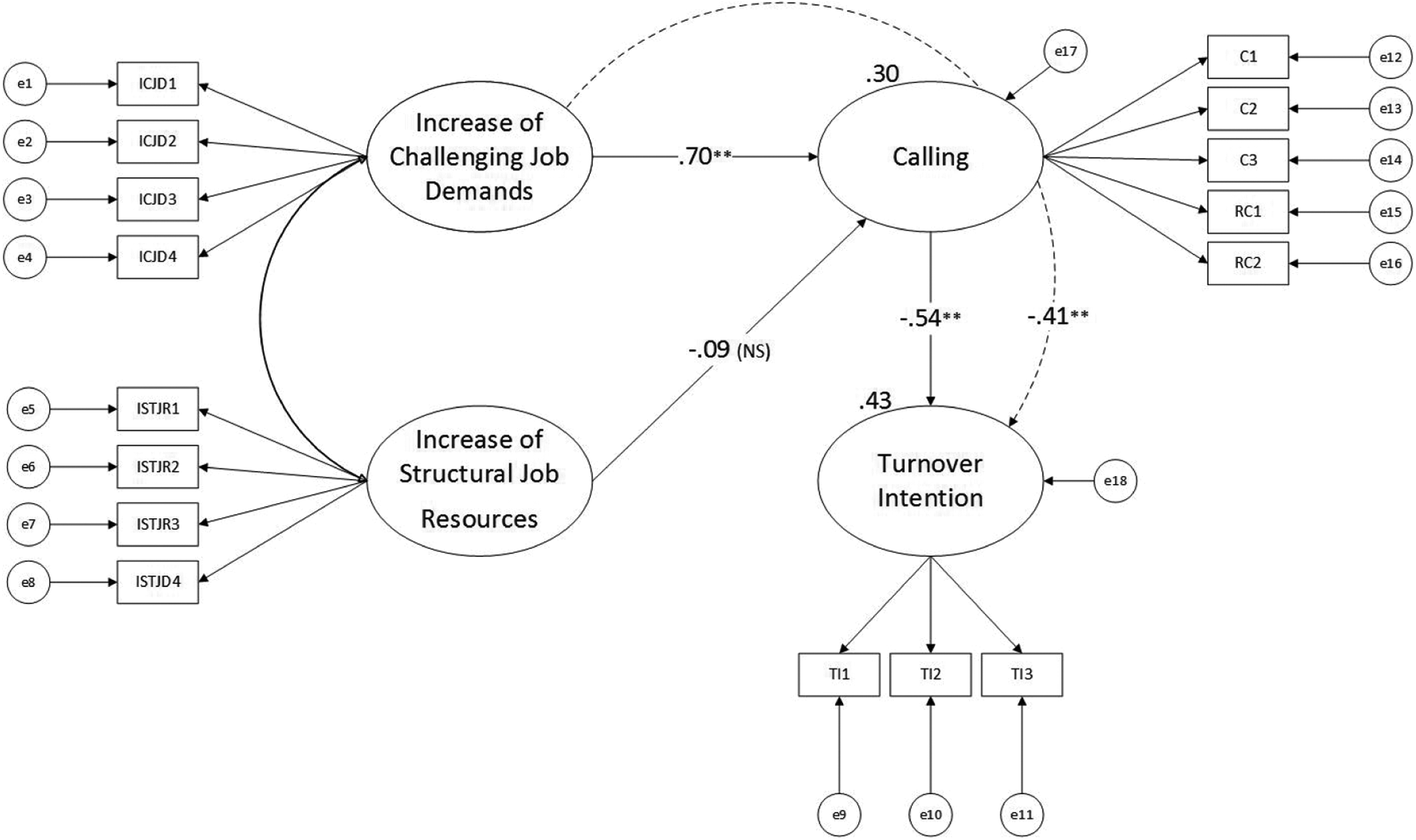
Final model representation. Numbers in the arrows indicate the standardized regression weights. Numbers above the items indicate R2. The dashed path represents the relation between increase in challenging job demands and turnover intention, mediated by calling.
To test Hypothesis 3 and the potential mediator effect of calling in the relation between the increase of challenging job demands and turnover intention, we used SEM with bootstrapping. The model (χ2 = 25.49, df = 13, CFI = .97, TLI = .95, RMSEA = .072) for the direct relation without the mediator confirmed the significant negative relation between the increase in challenging job demands and turnover intention (β = −.31, p < .001). The model (χ2 = 74.22, df = 50, CFI = .96, TLI = .95, and RMSEA = .051) for the relation between the increase of challenging job demands and turnover intention mediated by calling revealed that the relation between the increase in challenging job demands and turnover intention loses its direct significance (β = .10, p = .52). The bootstrap analysis (2,000 samples) confirmed the pathways between the increase in challenging job demands and turnover intention through calling (bootstrap estimate = −.41, standard error = .15, confidence interval = [−.69, −.24], p < .01), thus confirming that the sense of calling is a full mediator of the relation between the increase in challenging job demands and turnover intention. These results support Hypothesis 3. In the final model (Figure 1), 43% of the calling variance and 30% of the turnover intention variance are explained.
Discussion
Our purpose with this study was to deepen the understanding of job crafting positive relation with workers’ sense of calling and turnover intention. Although researchers have traditionally assumed that individuals who feel that they have a calling are likely to adapt their jobs to create the conditions necessary to fulfil this feeling (Berg et al., 2010; Wrzesniewski & Dutton, 2001), our results are closer to those who argue that the sense of calling should be considered as an outcome and not only as a predictor. Our results suggest that the increase in challenging job demands help to explain a significant portion of variance in the sense of calling. As stated by Bott and Duffy (2015), calling has been assumed to predict several variables, but in most studies, the directionality of the relation between variables was not even tested. In a study in which participants were asked to indicate the origin of their callings, more than half attributed it to a perfect fit with their jobs (Duffy, Allan, Bott, & Dik, 2013). It isn’t, however, clarified whether the respondents had sought this perfect fit or it had been occasionally found. Nevertheless, it seems plausible that this fit could be arranged by the individuals through the increase in their challenging job demands, ultimately resulting in the discovery of a calling. This fitting process could be similar to the adaptation made by the university students investigated by French and Domene (2010), which led them to find their callings, although this discovery was completely unexpected in some cases. Dobrow’s (2013) study supports the conception that calling can change over time, decreasing in individuals who were more behaviorally involved and more socially comfortable. This decrease in the sense of calling can be related to the lack of perceived challenges, as it increases their adaptability to the tasks performed. This relation between challenging crafting and the sense of calling could help to explain the decrease in calling in the musicians studied by Dobrow (2013). In the same line, the finding of vocational development as a predictor of the sense of calling (Duffy, Manuel, et al., 2011) reinforces the potential relation between the increase in challenging job demands and calling, due to the association between vocational development and a challenging environment (Zimmer-Gembeck & Mortimer, 2006).
As we weren’t looking for unanswered callings, this might have conditioned the relation path found between calling and the increase of challenging job demands. Our calling scale is based on the work of Wrzesniewski et al. (1997), which seeks for a calling in the performed job. When Berg, Grant, and Johnson (2010) investigated the adaptive process made by workers to answer their callings, the calling had thus already been discovered. The participants might have discovered a sense of calling while performing another activity or job, possibly due to a prior increase in challenging demands associated with an occupation, whether professional or nonprofessional. Our results suggest that the process of discovering a calling is triggered in part by adaptations made by the individual to realize a challenging occupation. Even the zookeepers studied by Bunderson and Thompson (2009) were previously in touch with their area of interest. Most of them related that they already dealt with animals during childhood. This meaningful experience could be the triggering factor to the professional sense of calling later pursued.
The rejection of the second hypothesis, which had posited a connection between workers’ increase in structural job resources and their sense of calling, was unexpected. Although we found a significant correlation among the two constructs, the corresponding path in structural equation model was nonsignificant. We supported the relation between the increase in structural job resources and sense of calling in the assumption that the proactive development of skills and aptitudes could help workers to find their calling. The reason for this failure may be in these characteristics’ nature. While individuals studied by Hall and Chandler (2005) perceived a calling associated with labor-related challenges, the characteristics associated with proactivity and tenacity from French and Domene’s (2010) study were exclusively personal attributes. Although we assumed that a proactive and tenacious person would also proactively develop professional skills, this relation may not exist. The significant relation between both job crafting dimensions is also expected to influence the increase in structural job resources’ relation with calling. As calling variability accounted for the relation with increase in social resources is partly shared with the increase in challenging job demands variable, the already weak relation between increase in structural job resources and calling may be voided of significance when all variables are in the same model.
Our results also suggest that the sense of calling totally mediates the negative relation between the increase in challenging job demands and turnover intention. Although Podsakoff, LePine, and LePine’s (2007) study indicates that, while job hindrances have a positive relation with turnover intention, job challenges seem to be negatively related to this variable (Podsakoff, LePine, & LePine, 2007), some other studies’ results seem to support that the linearity of this relation might be dependent on the intensity and duration of job challenges (Fochsen et al., 2005; Petrou et al., 2012; Takase et al., 2008). Takase, Yamashita, and Oba (2008) even note that, when their study participants perceived either a shortage or an excess of challenges, their intention to leave increased. The zookeepers’ resilience in a highly demanding environment (Bunderson & Thompson, 2009) led us to believe that the existence or the discovery of a sense of calling might be the balance factor between the intensity and duration of challenging stimuli and turnover intention. Our results seem to support that the sense of calling works as a coping mechanism to help employees to deal with their own increase in challenging job demands, or even with a challenging environment, thus preventing the appearance of an intention to leave the organization. When considering the work withdrawal, the employee may realize that in another organization, the adaptation that led to the discovery of a calling might not be possible, therefore suppressing the turnover intention. Although we found a negative relation between the increase in challenging job demands and turnover intention, our model seems to indicate that this relation might not be relevant if a calling does not arise, giving no purpose to the increase in challenging demands.
Limitations and Future Directions
Like most research, this study has several limitations. In first place, the use of cross-sectional data does not allow us to prove cause-and-effect inferences (Bollen & Pearl, 2013). Although we defend the existence of a path from the increase in challenging job demands to calling, and the SEM seems to support it, a longitudinal study would be important to verify causality. A longitudinal analysis would also help to better understand the direct relation between the increase in challenging job demands and turnover intention. We can theorize that the increase in challenging job demands may temporarily work as a suppressor of the intention to leave, going to long-term suppression if a purpose for that challenging increase is found, but we cannot verify this possibility within a cross-sectional analysis.
This study was conducted among health-care professionals, an occupational group that has traditionally been associated with calling (Cardador et al., 2011). Future studies should involve similar investigations in different professional groups, preferably heterogeneous, thus allowing to extrapolate the results. Given the high significance of the explained variance in turnover intention, it would be relevant to create a more comprehensive model with its other known predictors, to identify possible interactions with calling.
We also encourage researchers to elaborate the personal characteristics associated with each job crafting dimension. It would be important to understand if personal characteristics, as resiliency, sense of identity, proactivity and tenacity, could increase the propensity to craft a job. In addition to personal characteristics, it would be important to understand whether other factors, such as leadership, may contribute to the job crafting mechanism. Future studies should also investigate whether these results are also valid for workers with unanswered callings. As suggested by Berg et al. (2010), when workers have unanswered callings, they try to craft their jobs to approach them from the calling perspective that they perceive to be missing. This process could lead them to increase their challenging job demands, or, as previously suggested, these unanswered callings might already have been triggered by a previous increase in challenging tasks. Although we have chosen not to go down that route, it is important that future analysis also verify the negative effects of job crafting for the organizational context and individuals’ career development.
Theoretical Contributions
Our study contributes to literature in two different ways. First, we provide evidence that the relation between the sense of calling and at least one dimension of job crafting, the increase in challenging job demands, should henceforth be viewed in a different angle. Although several scholars have studied this relation treating the sense of calling as a predecessor of job crafting (Berg et al., 2010; Wrzesniewski & Dutton, 2001), our results suggest the existence of a path in which the craft made to a job might be a possible trigger for discovering a calling. The finding concerning the relation between the increase of challenging job demands and calling can contribute insight into the discussion about the origin of the sense of calling. This topic has been explored by Duffy and Dik (2013), who identified issues regarding to it, and pointed it out as being among the most controversial subjects in the literature on calling. According to our results, a sense of calling’s origin is not necessarily predestinated, and individuals might be able to discover it in response to their own actions.
Second, the strong negative relation between the increase of challenging job demands and turnover intention, mediated by the sense of calling, constitutes a significant contribution to the understanding of turnover intention. Analyses of the most prominent turnover models created in recent years, and to the 26 constructs that have been identified as related to this variable, reveal no reference to calling or job crafting (Steel & Lounsbury, 2009). The only reference relating calling and turnover intention was found on Cardador et al.’s (2011) study. Our results revive the discussion about what can be done to minimize organizational problems associated with turnover, while enhancing the potential of employees by stimulating their sense of calling.
Practical Implications
Our study has implications for organizational leaders who aim to retain workers and stimulate their sense of calling and for counselling programs aimed at fostering a sense of meaning in individuals’ life. The findings highlighting the increase in challenging job demands as a potential antecedent of the sense of calling, and the confirmation of this construct as a suppressor of turnover intention, suggest that measures should be taken to allow and stimulate individuals to increase their challenging job demands. These contributions may involve the cooperation to facilitate, stimulate, and monitor measures designed to increase the challenges in the professional context, to expose and potentially approach each individual of tasks that might be considered enjoyable.
Our results should also be considered by school counsellors, as they may play an important role in individuals’ career development (Knight, 2015). Our findings’ contribution to clarify calling mechanism may have implications in the choices that students have to do. School counsellors may help students to experience and be involved in practical tasks or activities, instead of directing their attention to a vocational analysis based on previous preferences. The active search of stimulating tasks could potentially trigger particular interests, paving the way to the discovery of a calling for a given field or profession.
Footnotes
Declaration of Conflicting Interests
The author(s) declared no potential conflicts of interest with respect to the research, authorship, and/or publication of this article.
Funding
The author(s) received no financial support for the research, authorship, and/or publication of this article.